
Planning a design and make project
边玩边学
回答这些题目来赚取能量,然后钓鱼探索。无需账号。
给教育者: 面向 Planning a design and make project(Design and Technology,Non-Exam Assessment)的即用型课程幻灯片, 复习笔记——用在你的课堂上,或将该知识点作为学习者可实时游玩的互动课堂活动来运行。
课程笔记
The project
- A design-and-make project connects investigation, design development, prototypes and evaluation through relevant evidence. The NEA uses the current board and assessment-year requirements; this general lesson does not set the annual context or provide a personal submission.
- For example, AQA GCSE D&T 8552 specifies 30–35 hours unless relevant access requirements apply and recommends a concise folder up to 20 A3 pages or equivalent. These are AQA-specific directions, not a universal GCSE hour or page rule. Check the current specification and teacher instructions for the course being taken.
Project requirements have different sources
Stages
- Investigate a problem, users and context, then develop a brief and justified, testable requirements. A client commissions or sets requirements and may be different from users. Use evidence to develop ideas through sketches, CAD and suitable models.
- A prototype is a representation chosen to investigate a design question: it may test shape, interaction, mechanism or an integrated function. Return to investigation, modelling or evaluation when needed rather than following a rigid one-way sequence. Record actual decisions and outcomes.
Planning
- Break work into manageable tasks with estimated duration, dependencies and checkpoints. A Gantt chart places task bars against a time axis; a flowchart explains process sequence and decision routes. Neither alone guarantees feasibility.
- Include ordering lead times, equipment availability, skills, curing or waiting periods where relevant, and contingency for revision. The illustrative four-week table is a planning example, not an NEA allowance or board timetable. It shows that later tasks depend on earlier evidence and approved readiness.
- A cutting list identifies material, part quantities and dimensions with units and relevant allowances or tolerances. A materials list supports ordering; a cost plan includes stock yield, consumables, processes and other relevant resources. Implement suitable risk controls and plan quality checks before making.
Illustrative four-week project plan
The portfolio
- Communicate selected relevant evidence using clear annotations and organised records. Research, sketches, models, photographs, test results and evaluation should explain decisions, not merely decorate pages. Follow the current permitted format and assessment rules.
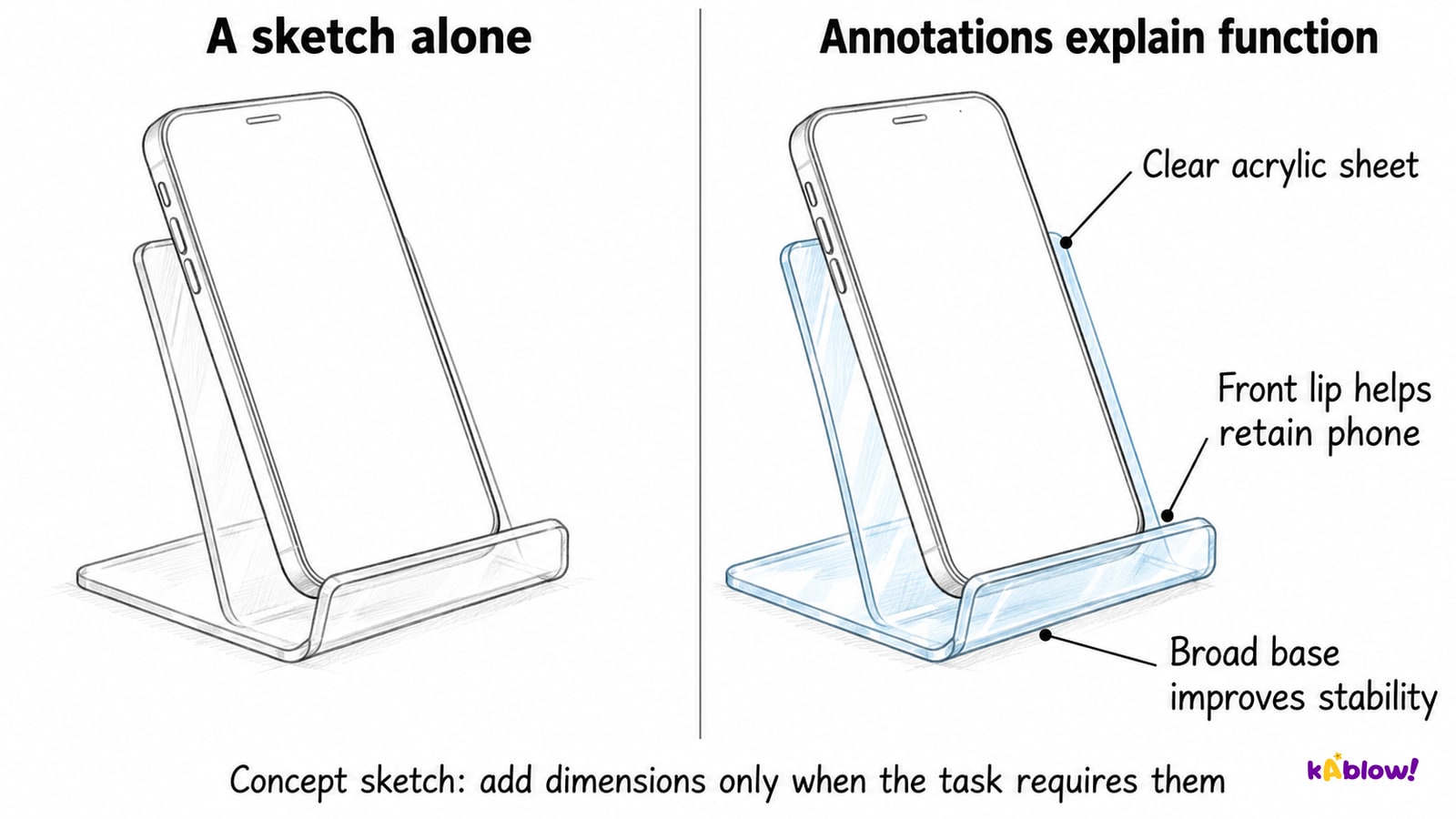
- The reused original phone-stand sketch shows how notes identify a proposed material and functional features. It supplies no tested dimensions or verified performance. A portfolio must distinguish what is proposed from what the actual evidence establishes.
Annotations communicate a proposal
Making the prototype
- Select material grades, tools and processes that can meet the requirements with available resources and safe authorised methods. Plan checks against tolerances and other criteria at suitable stages, and record departures from the plan with reasons.
- After an unsuccessful result, stop any unsafe activity and review the requirement, test conditions, measurement and controls before revising. Diagnose a supported cause, make an appropriate change and retest. A change may reveal a trade-off or fail to help, so record the outcome honestly.
Review a failed result
Evaluating
- Evaluate throughout development and at completion against justified requirements. Use relevant user feedback alongside objective evidence. A small or biased sample does not represent all users; a preference does not prove strength, safety or durability.
- State met, unmet and untested requirements with reasons, prioritise supported improvements and explain limitations. Consider how a stated commercial production scale would change tooling, material use, assembly, quality, cost or recovery; a one-off prototype process does not automatically transfer unchanged.
Make the evaluation traceable
幻灯片
练习题
免费预览——31 题中的 8 题。注册即可查看全部。
1.What is a portfolio?
Easy- Aa record of design development and evidence
- Ba tool
- Ca finish
- Da joint
2.What is a prototype?
Easy- Aonly a fully finished saleable product
- Bonly a protective coating
- Conly the final production batch
- Da representation used to investigate or test an aspect of a design
3.What is a Gantt chart?
Easy- Aa map
- Ba flow chart
- Ca bar chart showing planned tasks over time
- Da pie chart
4.What is a flow chart in making?
Easy- Aa list
- Ba diagram of the sequence of making steps
- Ca time plan
- Da drawing
5.What is a cutting list?
Easy- Aa list of specified parts, quantities and dimensions to cut
- Ba tool list
- Ca time plan
- Da drawing
6.Why write a risk assessment?
Easy- Ato increase cost
- Bto avoid tools
- Cto avoid work
- Dto identify hazards and control them
7.Why identify a client or user?
Easy- Ato avoid testing
- Bto increase cost
- Cto investigate relevant needs and turn them into testable requirements
- Dto avoid research
8.What is quality control in making?
Easy- Aavoiding checks
- Bchecking work against tolerances and the specification
- Cignoring errors
- Dhiding faults
历年真题
该知识点的历年真题练习即将推出。
即将推出