
Speaking and writing in German
边玩边学
回答这些题目来赚取能量,然后钓鱼探索。无需账号。
给教育者: 面向 Speaking and writing in German(German,Exam Skills)的即用型课程幻灯片, 复习笔记——用在你的课堂上,或将该知识点作为学习者可实时游玩的互动课堂活动来运行。
课程笔记
Speaking tasks
- Role-play, image discussion and conversation have different purposes. Current AQA 8662 also includes reading aloud from a supplied text; prepare for the actual board, tier and task rather than an outdated universal speaking format.
- Original read-aloud practice: nach der Schule gehe ich in den Park. Dort lese ich ein Buch. Morgen möchte ich mit dem Zug fahren. Practise the words and sound–spelling links with feedback; this written text is not an audio model or a pronunciation score.
Match response to the task
Developing answers
- Develop an answer using relevant detail, an opinion, a reason or an example when the question calls for them. Meiner Meinung nach explicitly introduces an opinion; zum Beispiel an example and außerdem an addition.
- Use time frames for the requested meaning: gestern habe ich gelesen, heute lese ich, morgen werde ich lesen. Ich würde gern reisen and ich möchte reisen express hypothetical/wish meanings rather than the same indicative future. Variety or extra length alone does not guarantee a stronger answer.
Choose the connector pattern
Describing a photo
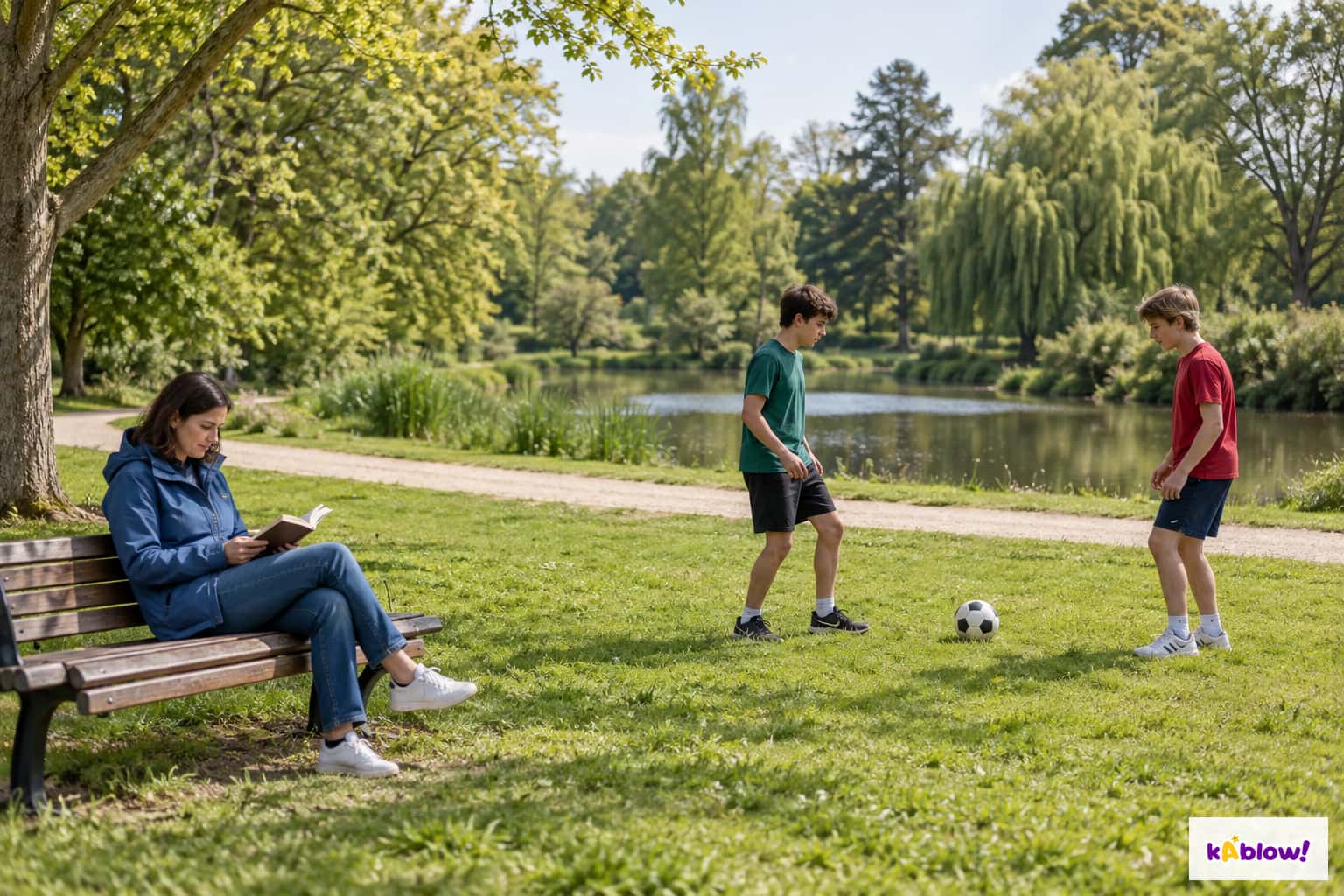
- The original shared illustration shows three people. Auf dem Bild sieht man drei Personen; links sitzt eine Person und liest ein Buch; zwei andere Personen stehen bei einem Ball. Im Hintergrund sieht man Bäume und Wasser.
- The ball rests on the ground; the image does not capture a kick. No visible detail establishes family relationships, identity, nationality or feelings. Describe evidence before clearly marked speculation; this generated illustration is practice material rather than a documentary photograph.
Describe visible image evidence
Handling unexpected questions
- Wie bitte?, können Sie das wiederholen? and können Sie bitte langsamer sprechen? request repetition or slower speech in suitable contexts. Ich verstehe nicht states non-understanding and lassen Sie mich überlegen means let me think.
- Actual tasks control what can be repeated or rephrased. Na ja, also and eigentlich have different conversational functions; a brief natural hesitation may help, but repeated fillers are not a replacement for a relevant response or an automatic scoring advantage.
Repair communication appropriately
Writing tasks
- Read the writing prompt’s target language, compulsory content and approximate length. Current AQA has several writing tasks with different guidance; 90–150 words is not a universal requirement for every task, level or board.
- Plan a coherent response covering the required points, then check it against the prompt. A dialogue should have distinct speakers and a role-play may ask for a specific short question; no task is improved merely by adding unrelated memorised material.
Plan the response the prompt needs
Translation into German
- Preserve meaning while checking the relevant construction. Heute spiele ich has finite spiele after one opening constituent; weil es regnet closes the written reason clause with regnet; denn es regnet retains declarative order in the reason.
- A participle does not always end every clause: weil ich gespielt habe has habe final. Ich lese, um Deutsch zu lernen has the same understood subject; ich helfe dir, damit du Deutsch lernst explicitly assigns learning to du. Use the actual subject and purpose rather than inserting um…zu automatically.
Check the complete construction
Checking
- Ordinary nouns such as Park, Schule and Buch take initial capitals. Sentence starts and formal Sie also have capitalisation rules. Check umlauts ä/ö/ü and ß according to the target variety and word, without treating every German-speaking country’s spelling as identical.
- Check verb endings, case, gender, number, punctuation and pronoun referents. Ich würde reisen differs from ich wurde müde; small spelling differences can change mood or meaning. Correction should preserve the intended message and the task’s content.
Complex structures
- Use complex structures when they serve the task: wenn es regnet, bleibe ich zu Hause; obwohl es regnet, gehe ich aus; ich lese, um Deutsch zu lernen. The written subordinate patterns close with the finite verb in these models.
- Original town response: ich wohne in einer kleinen Stadt. Es gibt einen Park und ein Kino. Ich mag die Stadt, weil sie ruhig ist. A relevant past extension is optional unless the prompt requests it; no real address or private travel history is required.
Develop the original town response
幻灯片
练习题
免费预览——37 题中的 8 题。注册即可查看全部。
1.In an image description, what does links mean?
Easy- Aon the left
- Bon the right
- Cin the front
- Din the back
2.In an image description, what does rechts mean?
Easy- Aon the left
- Bin the front
- Cin the back
- Don the right
3.What does "im Hintergrund" mean?
Easy- Aon the left
- Bat the end
- Cin the background
- Din the foreground
4.What does "im Vordergrund" mean?
Easy- Aat the top
- Bin the foreground
- Cin the background
- Don the right
5.What does "ich verstehe nicht" mean?
Easy- AI do not understand
- BI do not know you
- CI do not agree
- DI do not like
6.What does "wie bitte" mean?
Easy- Ahow much is it?
- Bhow much?
- Cwhy not?
- Dpardon?
7.What does "lassen Sie mich überlegen" mean?
Easy- Alet me over there
- Blet me lay
- Clet me think
- Dleave me alone
8.In Na ja… ich finde den Film interessant, how can na ja function?
Easy- Asays no
- Bas a hesitation or qualified response before continuing
- Cends the conversation
- Dasks a question
历年真题
该知识点的历年真题练习即将推出。
即将推出