
Levers, planes and axes
边玩边学
回答这些题目来赚取能量,然后钓鱼探索。无需账号。
给教育者: 面向 Levers, planes and axes(Physical Education,Movement Analysis)的即用型课程幻灯片, 复习笔记——用在你的课堂上,或将该知识点作为学习者可实时游玩的互动课堂活动来运行。
课程笔记
Levers
- A lever model uses a relatively rigid bar, a fulcrum/pivot, effort force and load/resistance. Bone commonly serves as the bar and muscle force transmitted through tendons supplies effort. A joint axis often provides the pivot in a body-segment model, while the selected system may instead use an external contact point.
- The load can include body-segment weight and an external object. Define the system and forces first: a standard standing calf raise pivots about forefoot contact with body-weight resistance through the ankle region and Achilles effort at the heel. It should not be assumed that the fulcrum is always the ankle joint.
Define the lever roles
Lever classes
- The middle role identifies each class: first class effort–fulcrum–load, second class fulcrum–load–effort, third class fulcrum–effort–load. Mirroring the layout does not change class. The table gives symbolic linear order; a simple sketch uses a straight bar with pivot and force roles placed in that order, not invented anatomical proportions.
- Standard models include head-weight extension as first class, a standing calf raise about forefoot contact as second and an elbow-flexion curl as third. Third-class arrangements are common and can favour distal displacement/speed relative to effort displacement, at the cost of force advantage. Different support or force systems require their own analysis.
Symbolic linear lever order
Mechanical advantage
- For an ideal balanced lever, force mechanical advantage equals the perpendicular effort moment arm divided by the perpendicular load moment arm. The physical force ratio is load force divided by effort force under those assumptions. A value above one favours force, while below one requires a larger effort force for the stated resistance.
- Second class has an ideal advantage in the standard parallel-force arrangement. First class can have an advantage above, equal to or below one depending on arms; third class has force disadvantage but can favour movement/speed. This trade-off does not create energy and the ratio is not an efficiency percentage or a complete measure of strength.
Ideal force advantage by arrangement
Planes of movement
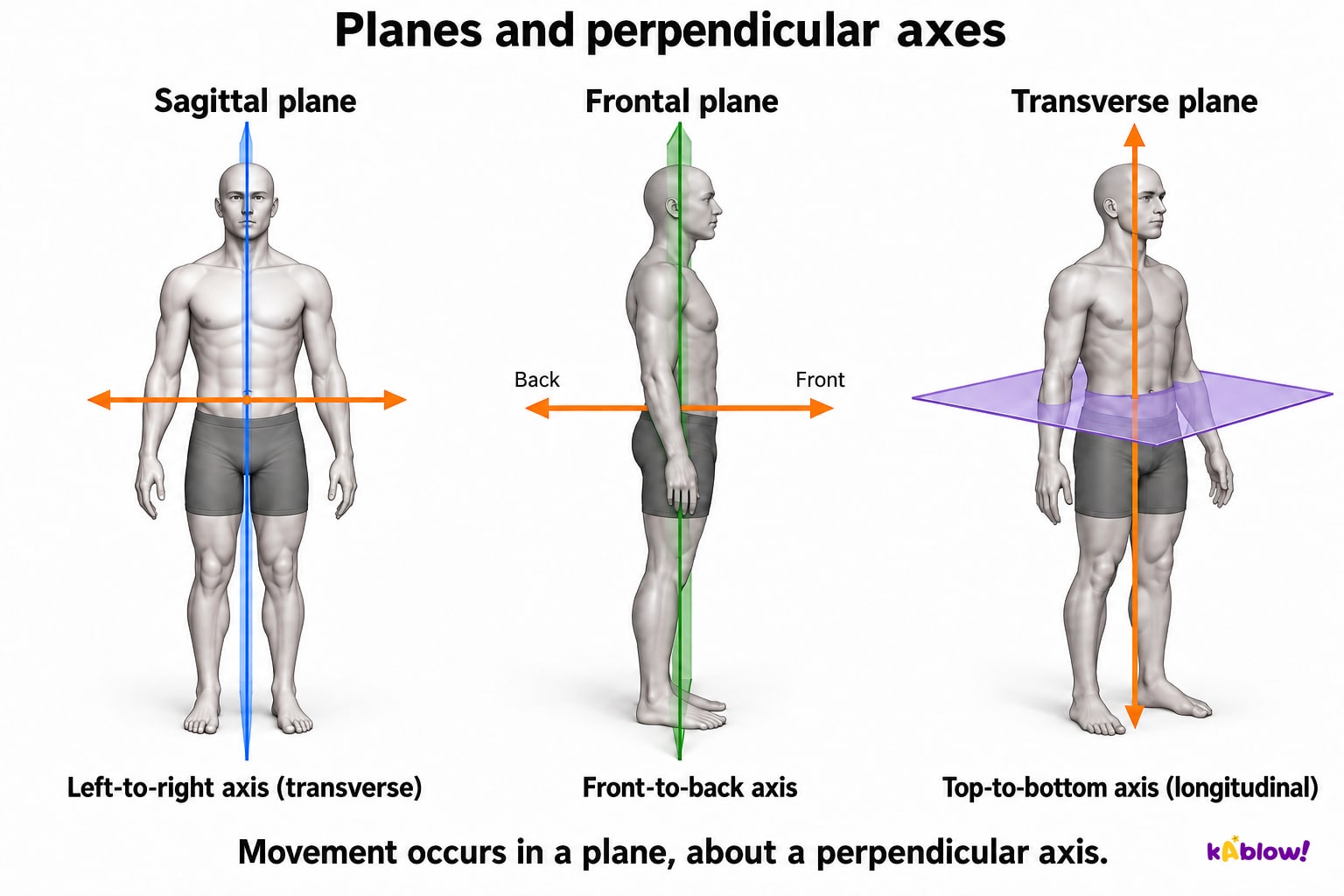
- Sagittal planes divide left/right portions, frontal or coronal planes divide front/back, and transverse or horizontal planes divide upper/lower. Only the midsagittal plane divides equal left/right halves. The anatomical reference shows these three spatial orientations rather than measured action trajectories.
- A simple rotation occurs in a plane about an axis perpendicular to it. Real sporting skills can combine rotations in different planes, so name the joint, phase and reference orientation before labelling a complete movement. Whole running or throwing actions are not restricted to one plane throughout.
Planes and perpendicular axes
Axes of rotation
- Sagittal-plane rotation pairs with a left-to-right transverse axis. Frontal-plane rotation pairs with a front-to-back axis, often called sagittal or anteroposterior and sometimes frontal in PE resources. Transverse-plane rotation pairs with a top-to-bottom longitudinal axis. Give direction to avoid naming ambiguity.
- A standard cartwheel illustrates frontal-plane rotation about a front-to-back axis; a forward somersault without twist illustrates sagittal-plane rotation about a left-to-right axis; an upright pirouette illustrates transverse-plane rotation about the longitudinal axis. Added tilt or twist can combine rotations, so specify the action.
Pair each plane with its perpendicular axis
Applying
- For a simple elbow-flexion curl, elbow is pivot, biceps effort is applied at its forearm attachment between pivot and hand load, and the arrangement is third class. The effort arm is short relative to the load arm in the standard model, so a substantial muscle force may be required.
- For planes and axes, describe a stated action such as knee flexion in forward running or the trunk-rotation phase of a throw. Do not infer every muscle contraction from joint direction or assign an entire multijoint activity to one plane. The named acrobatic actions are analysis examples, not an instruction to attempt them.
Specify the action and phase
Moment arms and balancing moments
- Moment arm means shortest perpendicular distance from the pivot to a force’s line of action. A full bone length or distance along a sloping bar is not automatically that distance. Geometry and force direction can change moment arms during real movement.
- At ideal static balance, effort force times effort arm equals load force times load arm. Use consistent units and distinguish that model from dynamic motion, changing muscle geometry and additional forces. A longer perpendicular effort arm reduces required effort for the same load moment under the stated assumptions.
Use perpendicular moment arms
Worked fictional ideal lever
- Perpendicular effort arm 20 cm and load arm 10 cm give ideal force mechanical advantage 2. The distance units cancel; there is no unit and it is not 200% efficiency. These are original teaching values, not anatomical measurements.
- For a balanced 100 N load under those assumptions, effort force is 50 N because 50 times 20 equals 100 times 10 in N cm. Real muscle forces require a fuller model and cannot be read directly from this example. Verify the force lines and assumptions before using an arm-length ratio.
Fictional ideal-lever arithmetic
幻灯片
练习题
免费预览——36 题中的 8 题。注册即可查看全部。
1.What is a fulcrum?
Easy- Athe pivot point of a lever
- Bthe force applied
- Cthe load
- Da muscle
2.What is the load in a lever?
Easy- Athe pivot
- Bthe effort
- Ca bone
- Dthe resistance acted against
3.What is the effort in a lever?
Easy- Athe load
- Ba tendon
- Cthe force applied
- Dthe pivot
4.In a simple elbow body-segment lever model, what provides the pivot?
Easy- Afat
- Bjoint axis
- Cmuscle
- Dskin
5.In the body, which structure acts as the lever?
Easy- Abone
- Bskin
- Cfat
- Dblood
6.In the body, which structure provides the effort?
Easy- Abone
- Bjoint
- Cskin
- Dmuscle
7.In a first class lever, where is the fulcrum?
Easy- Aat the effort
- Bat the end
- Cbetween effort and load
- Dat the load
8.In a second class lever, where is the load?
Easy- Aat the effort
- Bbetween fulcrum and effort
- Cat the fulcrum
- Dbeyond the effort
历年真题
该知识点的历年真题练习即将推出。
即将推出