
Atomic Structure
邊玩邊學
回答這些題目賺取能量,接著就能釣魚、探索。不需要帳號。
給教育者: 為 Atomic Structure(Chemistry、AQA)準備好可直接使用的課程投影片, 複習筆記——用於你的課程,或把這個主題當成互動班級活動,讓學習者以即時遊戲的方式進行。
課程筆記
Particles, nuclei and changing models
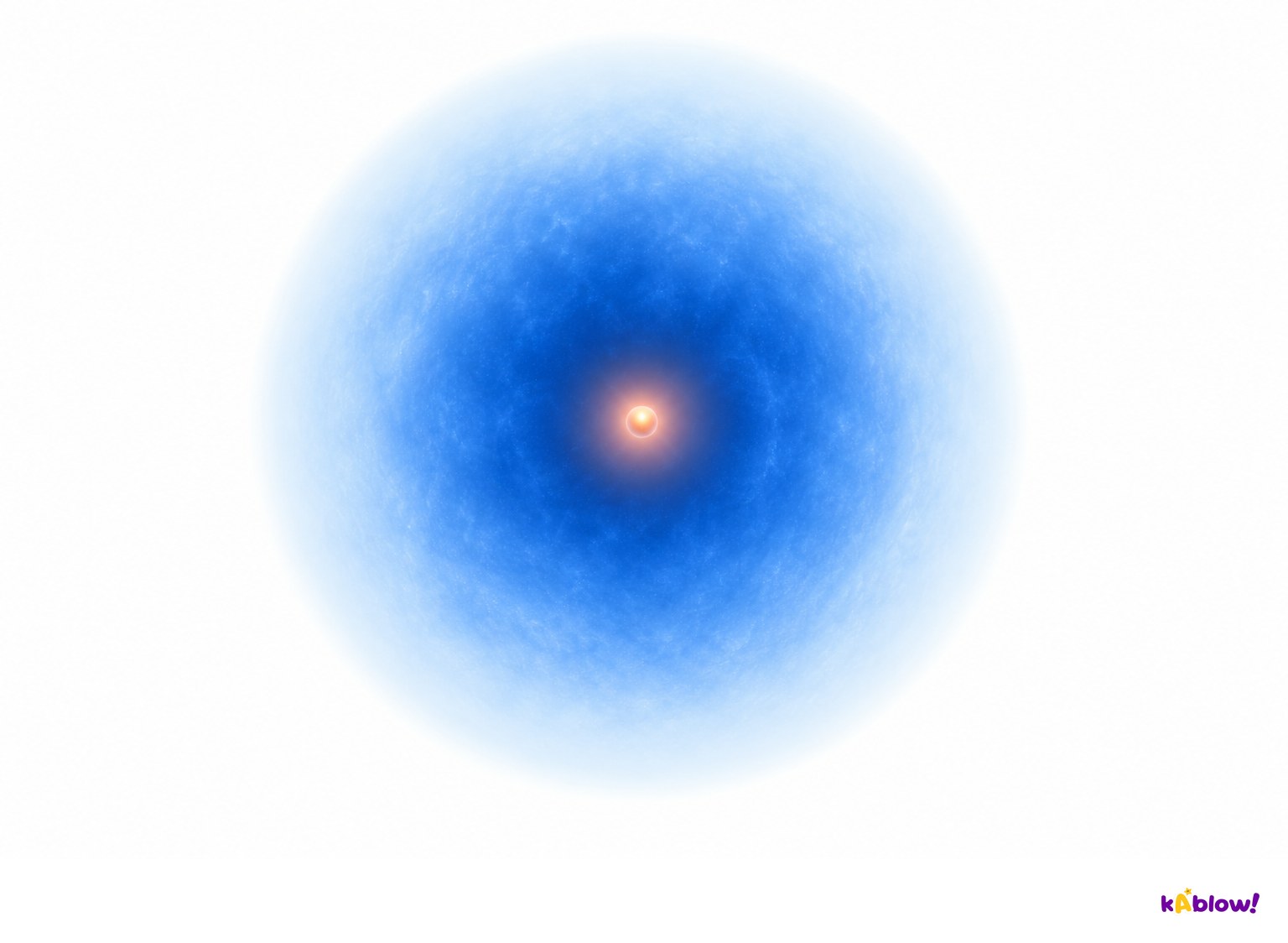
- A nuclear atom contains a compact positive nucleus and surrounding electrons. Most of its volume is outside the nucleus, while almost all its mass is in protons and neutrons.
- A proton has relative charge +1 and relative mass approximately 1; a neutron has charge 0 and mass approximately 1; an electron has charge −1 and mass approximately 1/1836.
- Models change when evidence demands it. α-particle scattering challenged a diffuse positive-charge model because a small proportion of particles were deflected through large angles. The nuclear model accounts for a small, concentrated positive region.
- An orbital is associated with a probability distribution for an electron. A shell drawing is a simplified representation of electron occupancy, not a photograph or a set of planetary paths.
A nucleus and surrounding electron cloud
Counting particles in atoms and ions
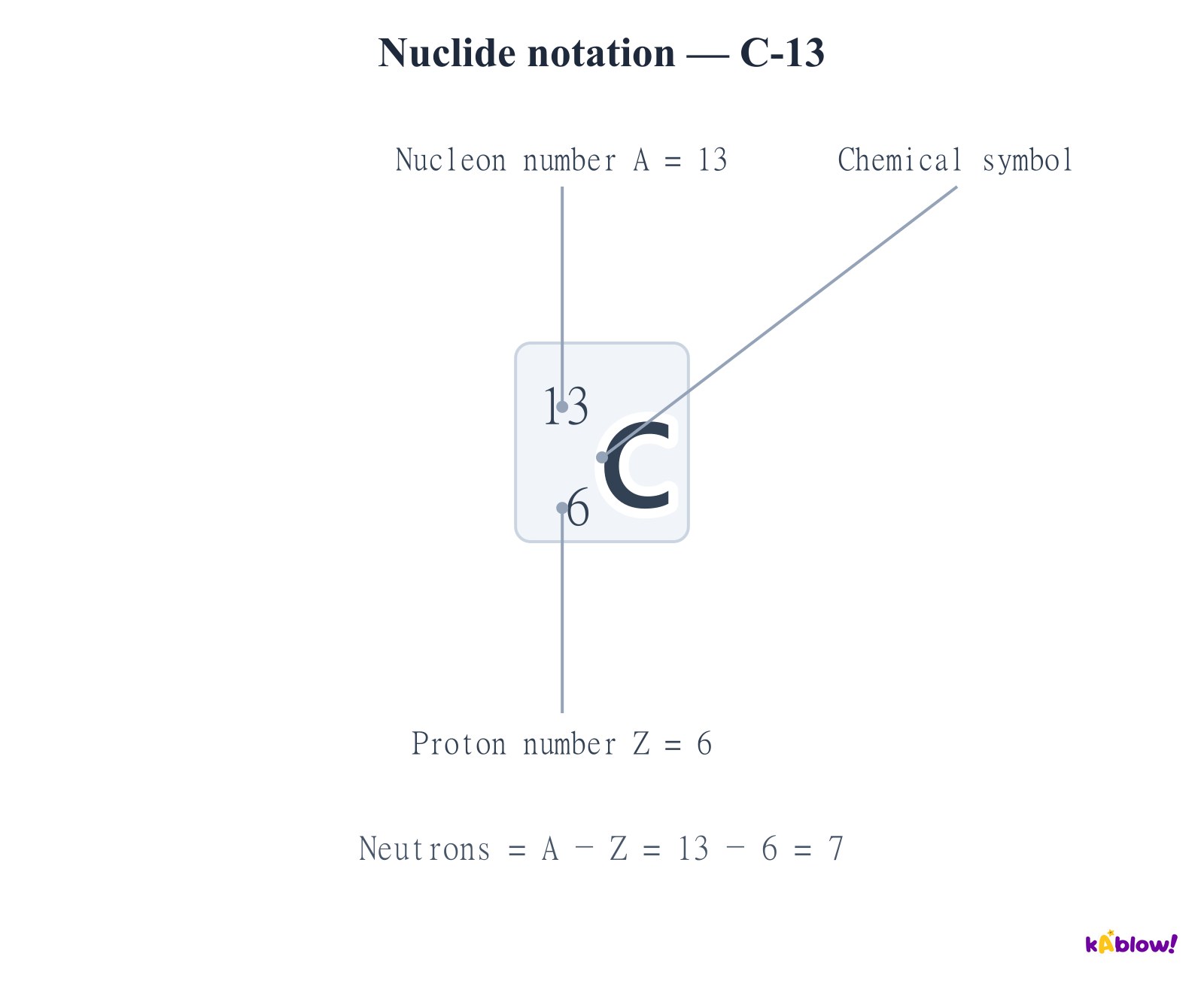
- Atomic number Z counts protons and identifies the element. Mass number A counts protons plus neutrons in one nucleus. Neutron number is A − Z.
- For a neutral atom, electron number equals Z. For an ion with signed charge q in elementary-charge units, electron number is Z − q: positive ions have lost electrons and negative ions have gained them.
- For magnesium-26 with Z = 12, the 2+ ion contains 12 protons, 14 neutrons and 10 electrons. Ion formation changes electrons, not the nucleus.
- Isotopes have equal proton numbers and different neutron numbers. Neutral isotopes have the same electron configuration, so their chemical behaviour is usually very similar, although small isotope effects can occur.
Nuclide notation for carbon-13
Isotope abundances and relative atomic mass
- Relative atomic mass compares the average mass of atoms in a sample with one twelfth of the mass of a carbon-12 atom. It is dimensionless and need not be an integer.
- Calculate a weighted mean: sum each isotopic mass multiplied by its relative abundance, then divide by the sum of the relative abundances. Divide by 100 only when percentage abundances total 100.
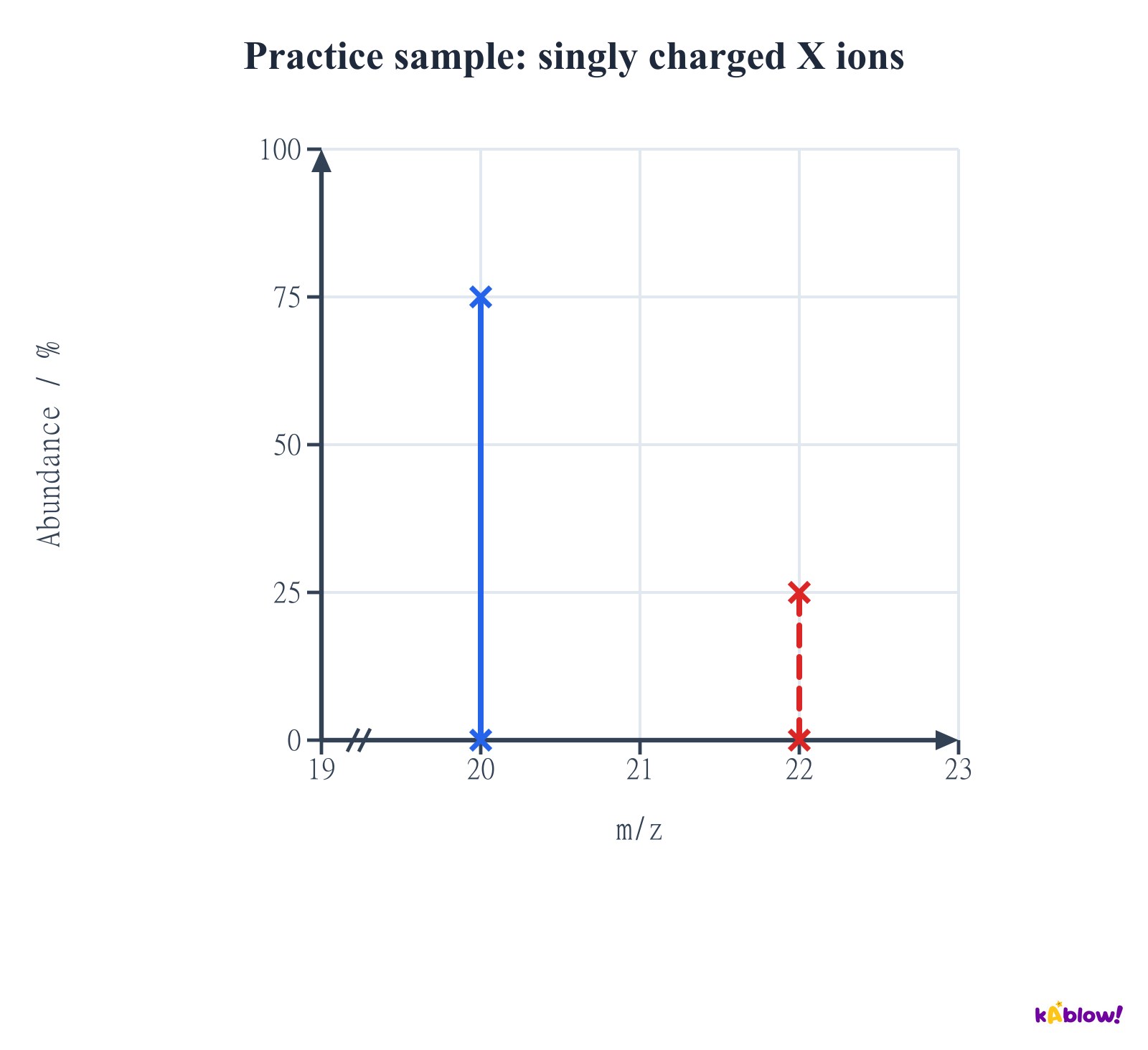
- For practice masses 20 and 22 with abundances 3:1, the weighted mean is (20 × 3 + 22 × 1) / 4 = 20.5. Mass numbers approximate isotopic masses when exact values are not supplied.
- A mass spectrum plots detected ion signal against m/z. For a singly charged ion, m/z approximately matches its mass in atomic mass units; a 2+ ion appears at about half that mass value. Use comparable calibrated signals before inferring abundance.
A practice isotope spectrum
Time-of-flight mass spectrometry
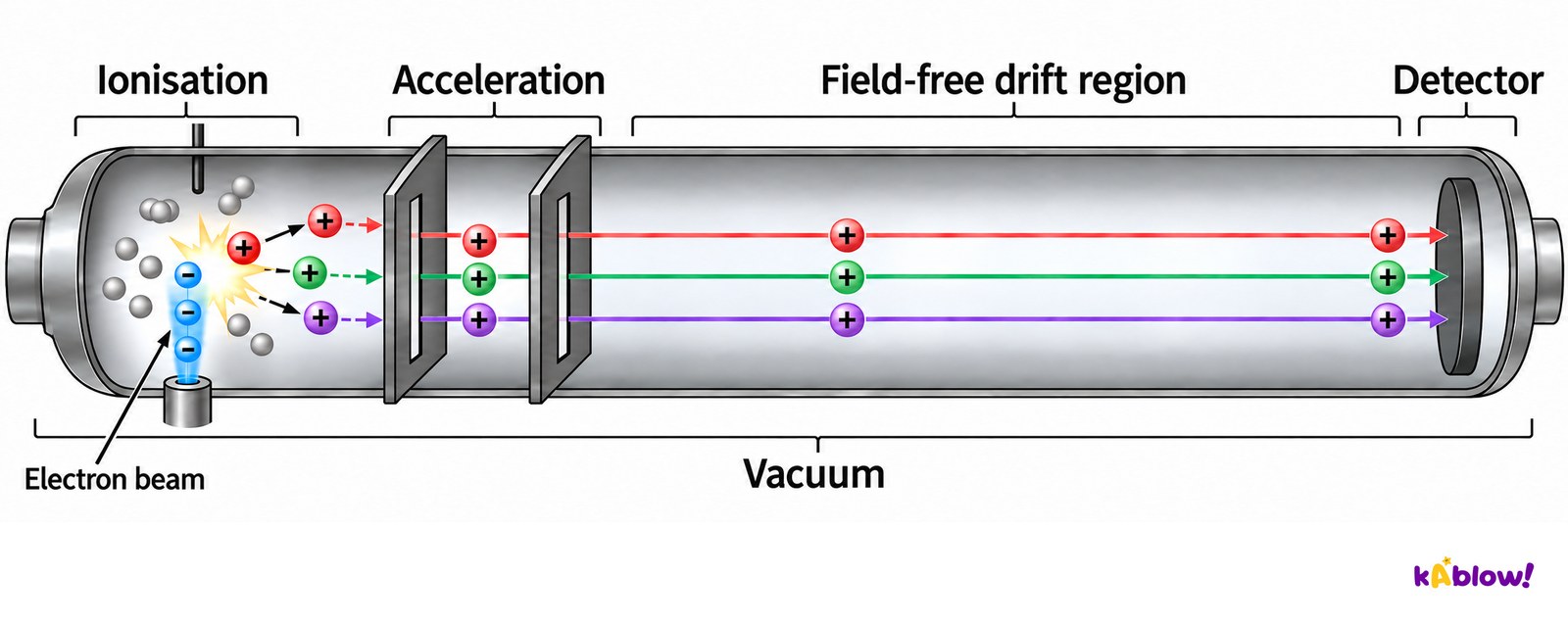
- A simplified time-of-flight instrument ionises the sample, accelerates the ions, lets them drift through a field-free tube and detects their arrivals. A vacuum limits disruptive collisions with gas particles.
- Electron impact removes an electron to produce a positive ion and can cause fragmentation. Electrospray is softer: a common singly protonated ion is [M+H]+, whose approximate m/z is Mr + 1. Specify the ion type and charge before making that calculation.
- An ion accelerated through potential difference V gains kinetic energy qV when its initial kinetic energy is negligible. Equal charge and acceleration voltage therefore give equal kinetic energy, not equal speeds.
- Use E = ½mv² and v = d/t. For fixed charge, acceleration and drift distance, t is proportional to √m. More generally, under the same voltage t is proportional to √(m/z).
- Convert mass to kilograms before using SI equations. The detector signal records arrivals; travel time is calibrated to m/z and signal size can indicate relative ion abundance.
Simplified linear TOF apparatus
Shells, subshells and orbitals
- A principal shell is labelled by n. A subshell contains orbitals: s has one orbital, p has three and d has five. Each orbital can contain at most two electrons with opposite spins.
- The capacities of s, p and d subshells are 2, 6 and 10 electrons. A principal shell can hold up to 2n² electrons, so n = 3 can hold 18 when 3s, 3p and 3d are filled.
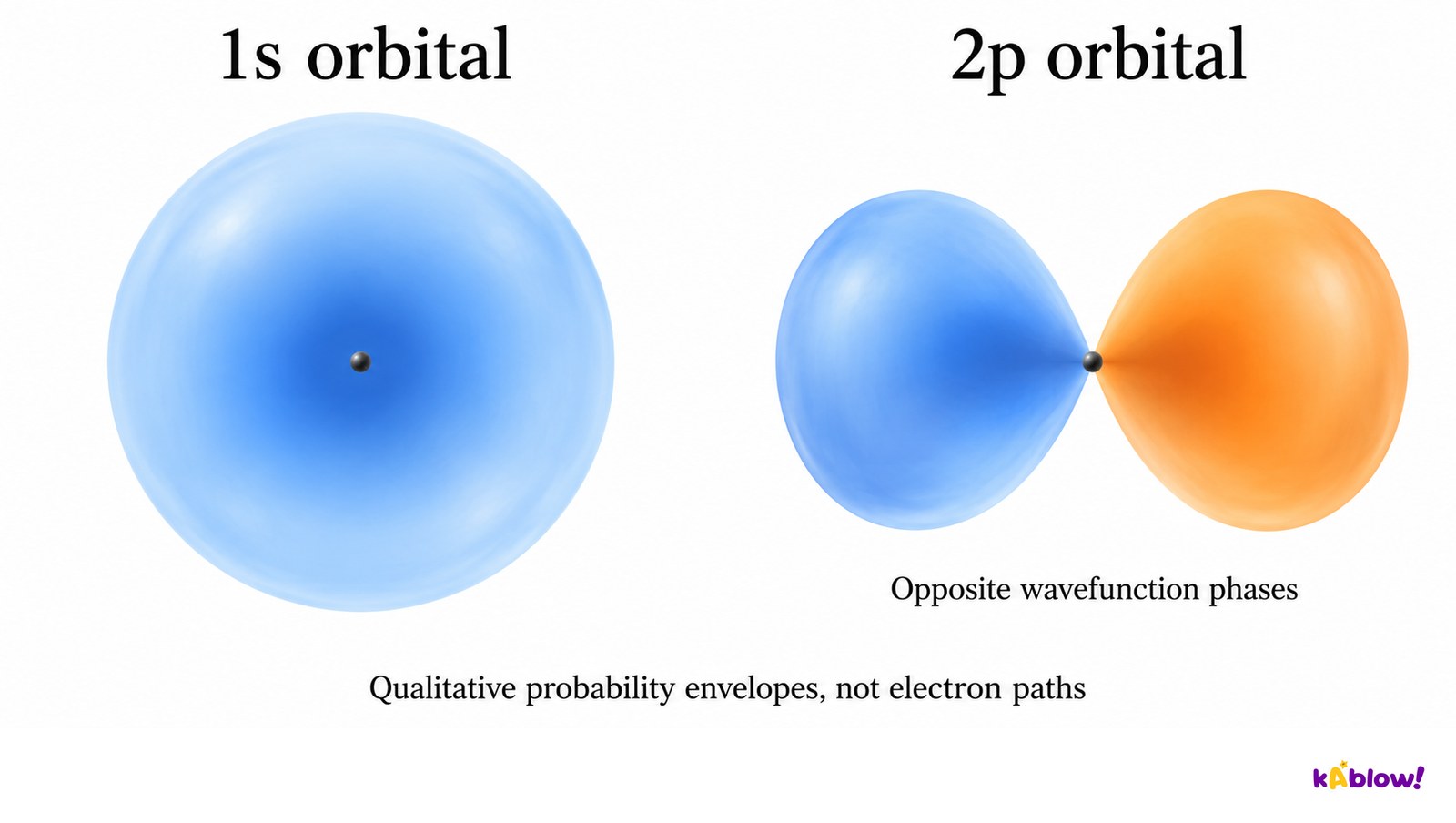
- An s orbital has a spherical probability envelope. A p orbital has two lobes with opposite wavefunction phases; their colours do not represent electrical charges. The three p orbitals in a subshell have different orientations.
- Fill orbitals in the appropriate ground-state energy order. Within degenerate orbitals, electrons occupy separate orbitals with parallel spins before pairing. For 2p⁴ there is one pair and two unpaired electrons.
Qualitative s and p orbital shapes
Configurations of atoms and ions
- For the early elements the familiar filling sequence is 1s, 2s, 2p, 3s, 3p, 4s and then 3d. Orbital energies depend on occupancy; this sequence is not a universal fixed ordering for every atom and ion.
- Calcium is 1s² 2s² 2p⁶ 3s² 3p⁶ 4s², written [Ar] 4s² in shorthand. The symbol in brackets represents the electron configuration of the preceding noble gas.
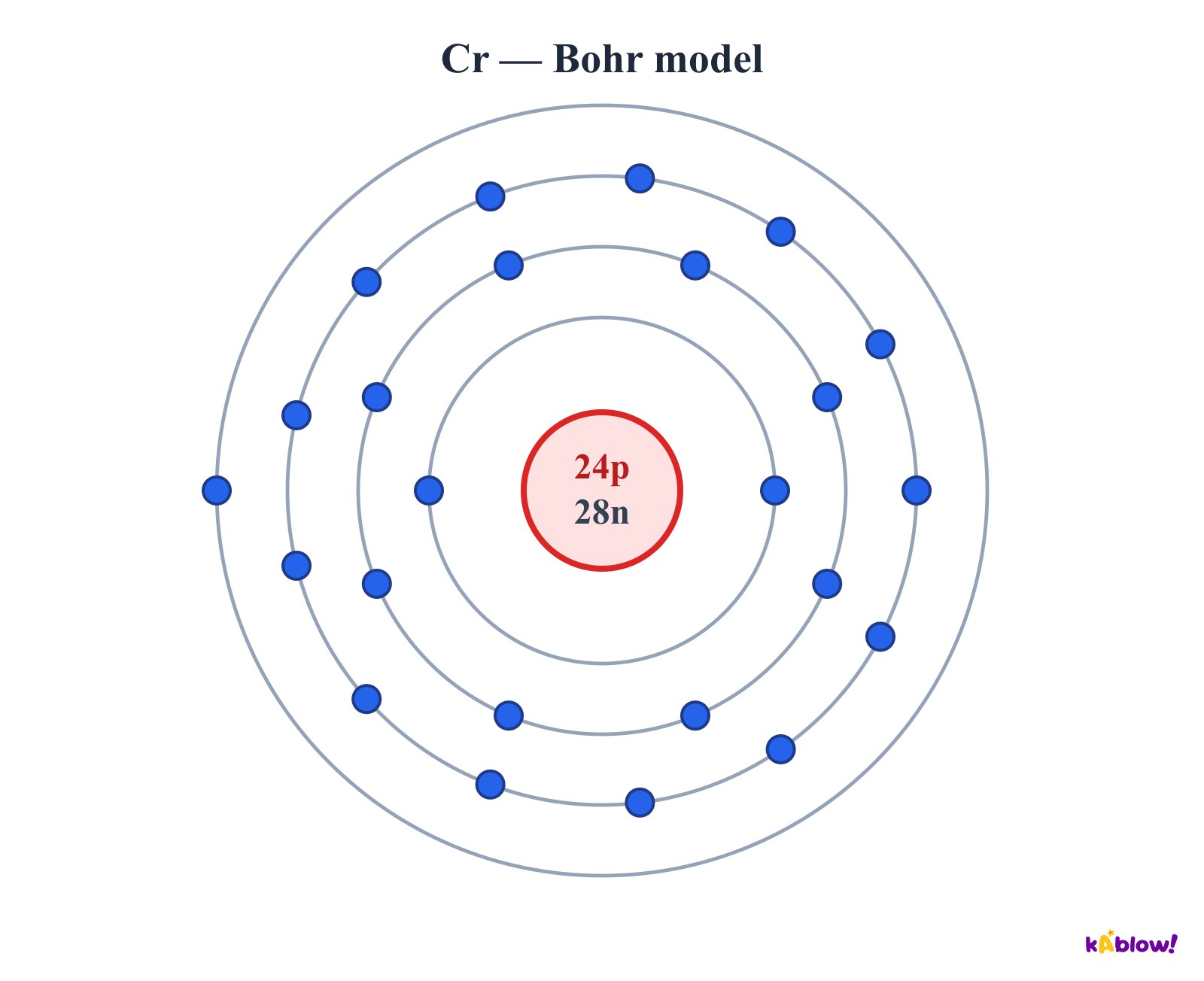
- Chromium and copper are important exceptions to the simplest prediction: Cr is [Ar] 3d⁵ 4s¹ and Cu is [Ar] 3d¹⁰ 4s¹. Check the total electron count.
- When these transition metals form positive ions, remove 4s electrons before 3d electrons. Iron is [Ar] 3d⁶ 4s², Fe2+ is [Ar] 3d⁶ and Fe3+ is [Ar] 3d⁵.
Chromium principal-shell occupancy
Ionisation energies and their evidence
- First ionisation energy is the energy required to remove one electron from each atom in one mole of gaseous atoms, forming one mole of gaseous +1 ions. For example, Mg(g) → Mg+(g) + e−. Values are normally quoted in kJ mol−1.
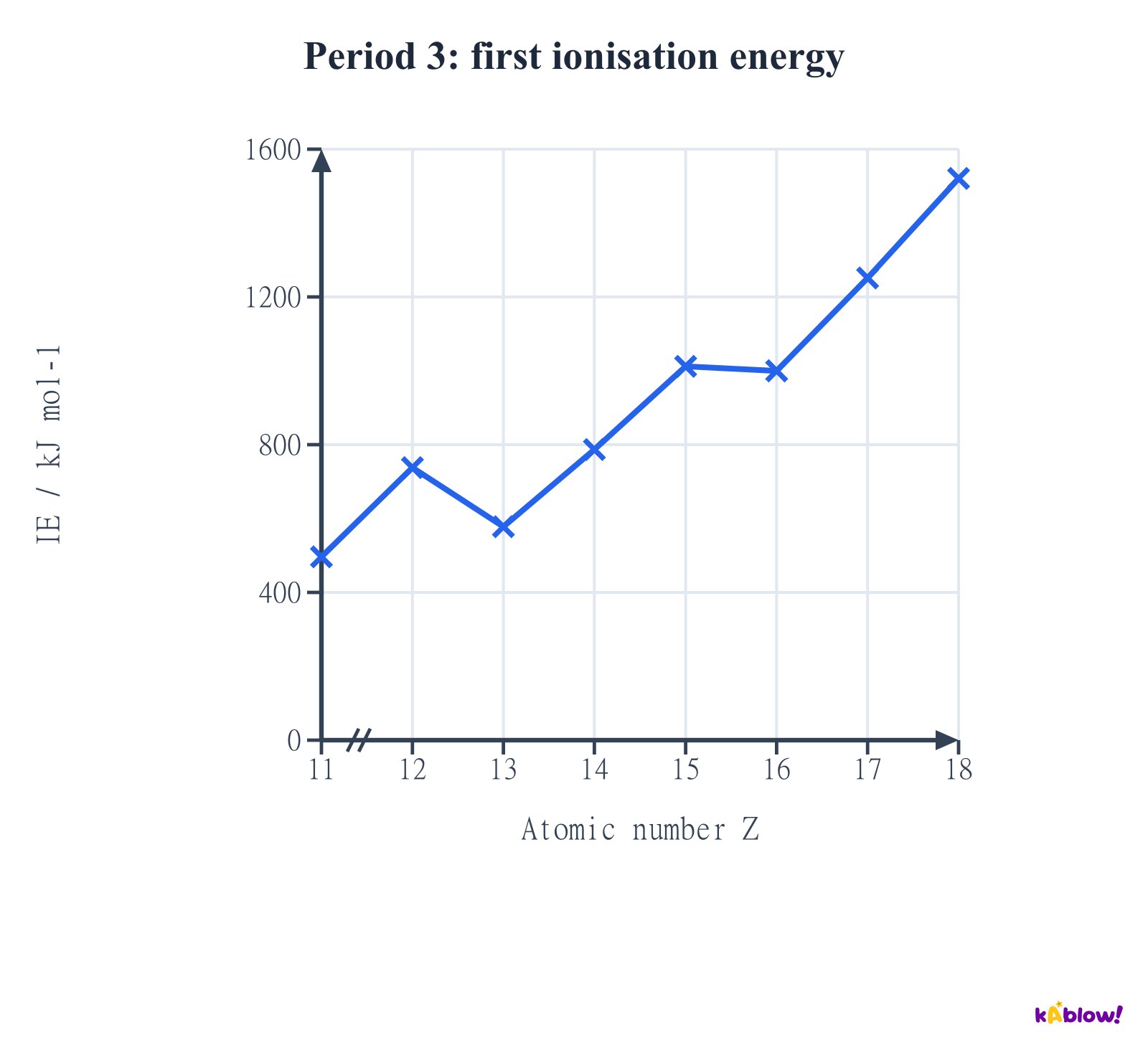
- First ionisation energy generally increases across a period as nuclear charge rises while added electrons enter the same principal shell. It generally decreases down a group because greater distance and shielding outweigh increased nuclear charge.
- Subshell and pairing effects explain important dips. Aluminium loses a 3p electron more easily than magnesium loses a 3s electron; sulfur has a paired 3p electron whose repulsion makes removal easier than in phosphorus.
- Successive ionisation removes electrons from increasingly positive ions. A large increase marks removal beginning from a more tightly bound inner shell. For a main-group atom, a large jump after three removals supports three outer-shell electrons and Group 13.
- Distinguish the first-ionisation trend across different elements from successive ionisation of one element. Use gaseous state symbols and identify the subshell before giving an explanation.
Measured Period 3 ionisation energies
投影片
練習題
免費預覽——40 題中的 8 題。註冊即可查看全部。
1.Which pair gives the relative charge and approximate relative mass of a proton?
Easy- A+1 and 1
- B0 and 1
- C−1 and 1/1836
- D+1 and 1/1836
2.Which subatomic particle has no electrical charge and a relative mass close to 1?
Easy- APositron
- BNeutron
- CElectron
- DProton
3.Where is almost all the mass of an atom concentrated?
Easy- AIn its outermost occupied orbital
- BOnly in its electrons
- CIn the nucleus
- DUniformly throughout its volume
4.A sodium-23 ion has atomic number 11 and charge +1. How many electrons does it contain?
Easy- A11
- B12
- C23
- D10
5.A chlorine-35 ion has atomic number 17 and charge −1. Which counts are correct?
Medium- A17 protons, 18 neutrons, 18 electrons
- B17 protons, 18 neutrons, 16 electrons
- C18 protons, 17 neutrons, 18 electrons
- D17 protons, 35 neutrons, 18 electrons
6.Which change produces a different isotope of the same element?
Easy- ARemoving all electrons from the atom
- BChanging neutron number while keeping proton number fixed
- CChanging proton number while keeping neutron number fixed
- DAdding an electron to form an anion
7.Which statement defines mass number?
Easy- AThe number of protons plus electrons
- BThe mass of one mole of atoms in grams
- CThe total number of protons and neutrons in a nucleus
- DThe abundance-weighted mean mass of atoms in a sample
8.A sample contains 20% isotope X-10 and 80% isotope X-11. Using the mass numbers as isotopic masses, what is its approximate relative atomic mass?
Medium- A10.2
- B10.5
- C21.0
- D10.8
歷屆試題
這個主題的歷屆試題練習即將推出。
即將推出