
Group 2, The Alkaline Earth Metals
邊玩邊學
回答這些題目賺取能量,接著就能釣魚、探索。不需要帳號。
給教育者: 為 Group 2, The Alkaline Earth Metals(Chemistry、AQA)準備好可直接使用的課程投影片, 複習筆記, 圖表——用於你的課程,或把這個主題當成互動班級活動,讓學習者以即時遊戲的方式進行。
課程筆記
Connect Group 2 to two-electron loss
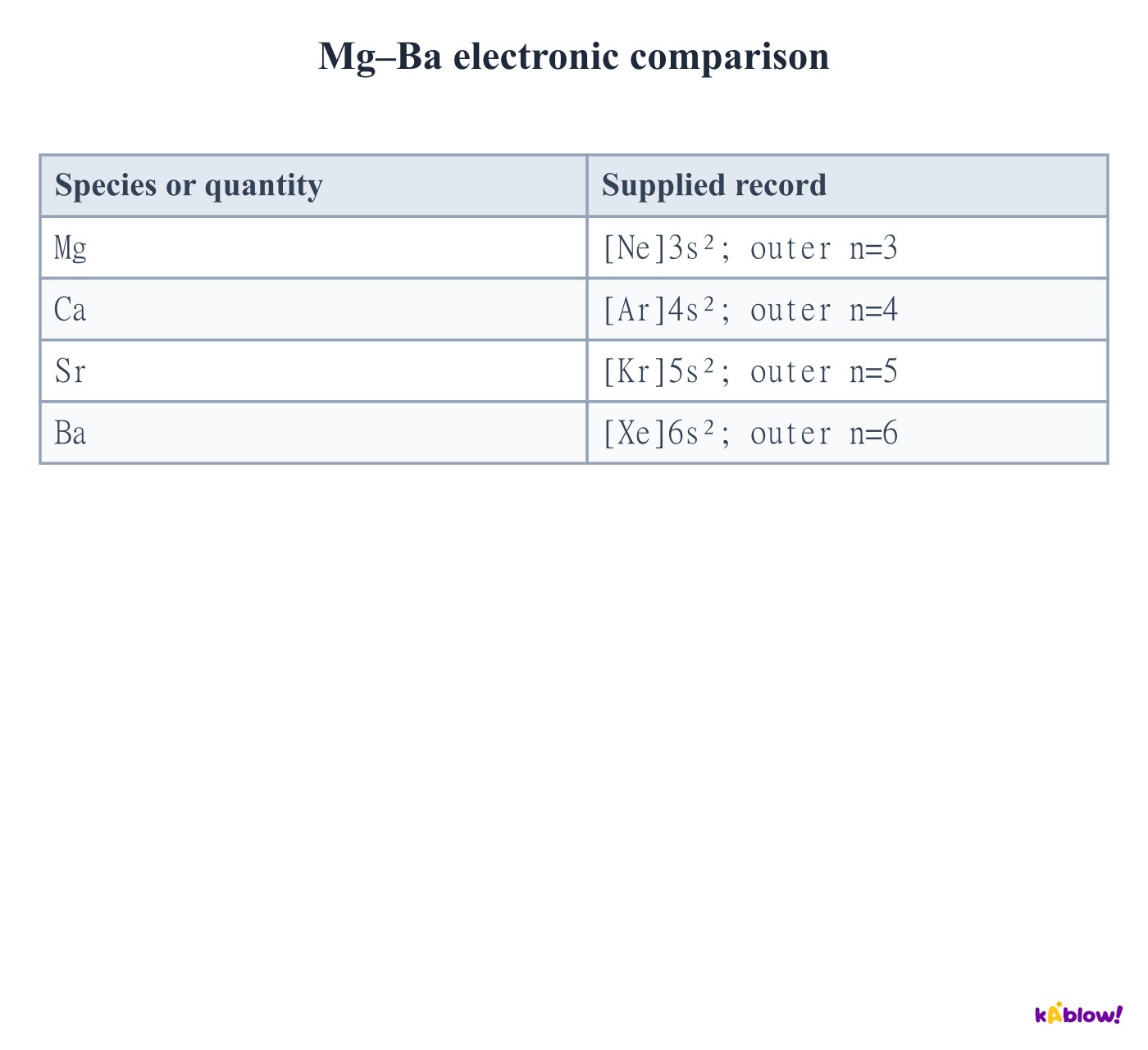
- The Mg–Ba metals have two outer s electrons: Mg[Ne]3s², Ca[Ar]4s², Sr[Kr]5s² and Ba[Xe]6s². Their common ions are M²⁺.
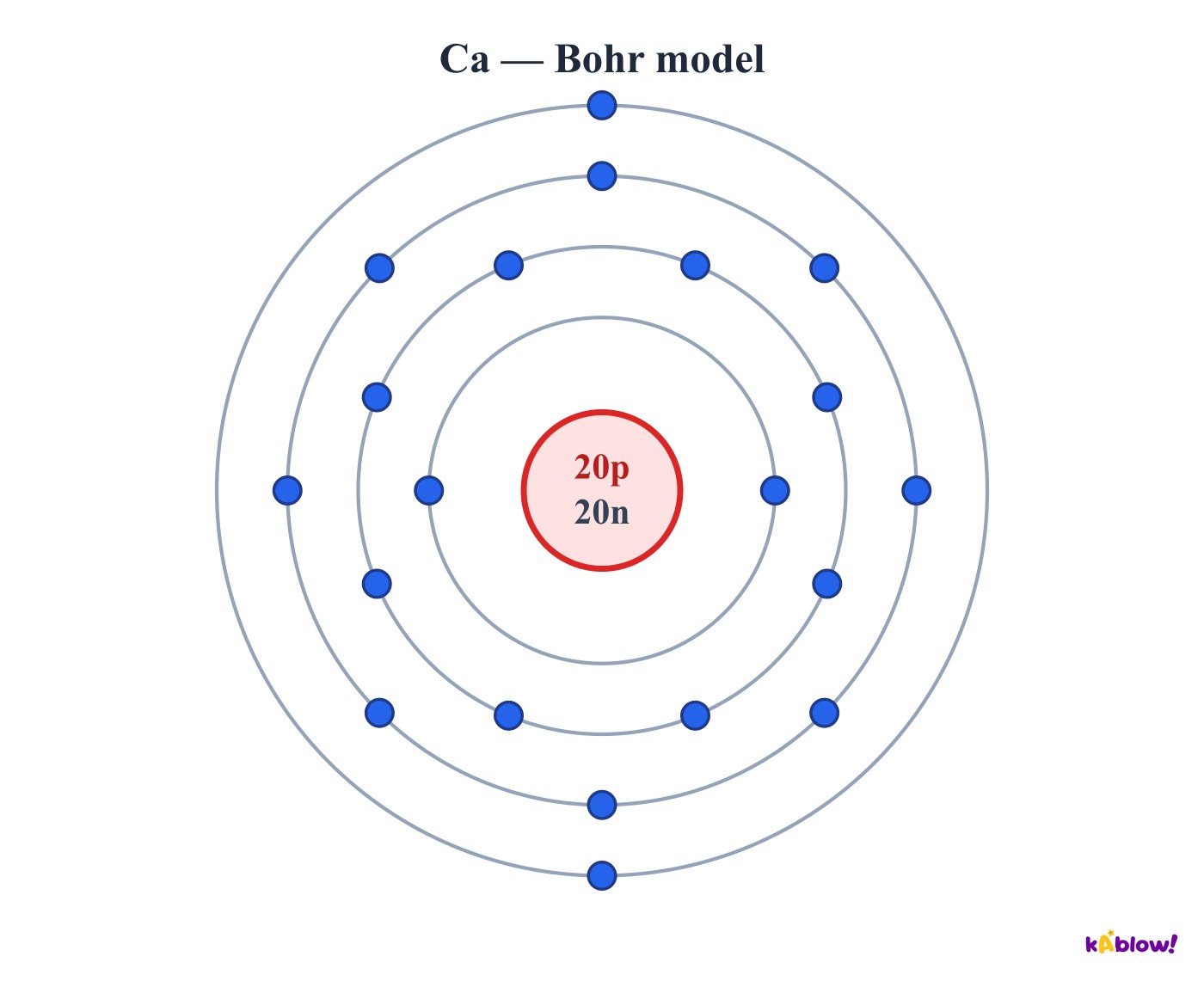
- The supplied calcium schematic has 20 electrons arranged 2, 8, 8, 2. Losing the two outer electrons gives Ca²⁺ with 18 electrons and the same nucleus.
- M→M²⁺+2e⁻ is oxidation. The metal supplies electrons to another species and therefore acts as a reducing agent.
Calcium schematic electron shells
Explain increasing radius down Mg to Ba
- Moving down Mg–Ba adds occupied principal shells. The outer electrons are further from the nucleus and experience increased shielding.
- These effects outweigh the increased proton number for the outer electron’s attraction. Comparable atomic radii increase down the group.
- A larger nuclear charge alone does not predict a smaller atom when occupied shells and shielding also change. State all three factors.
Mg–Ba electronic comparison
Distinguish first and second ionisation
- First ionisation is M(g)→M⁺(g)+e⁻. Second ionisation is M⁺(g)→M²⁺(g)+e⁻; both use gaseous species and positive energy input.
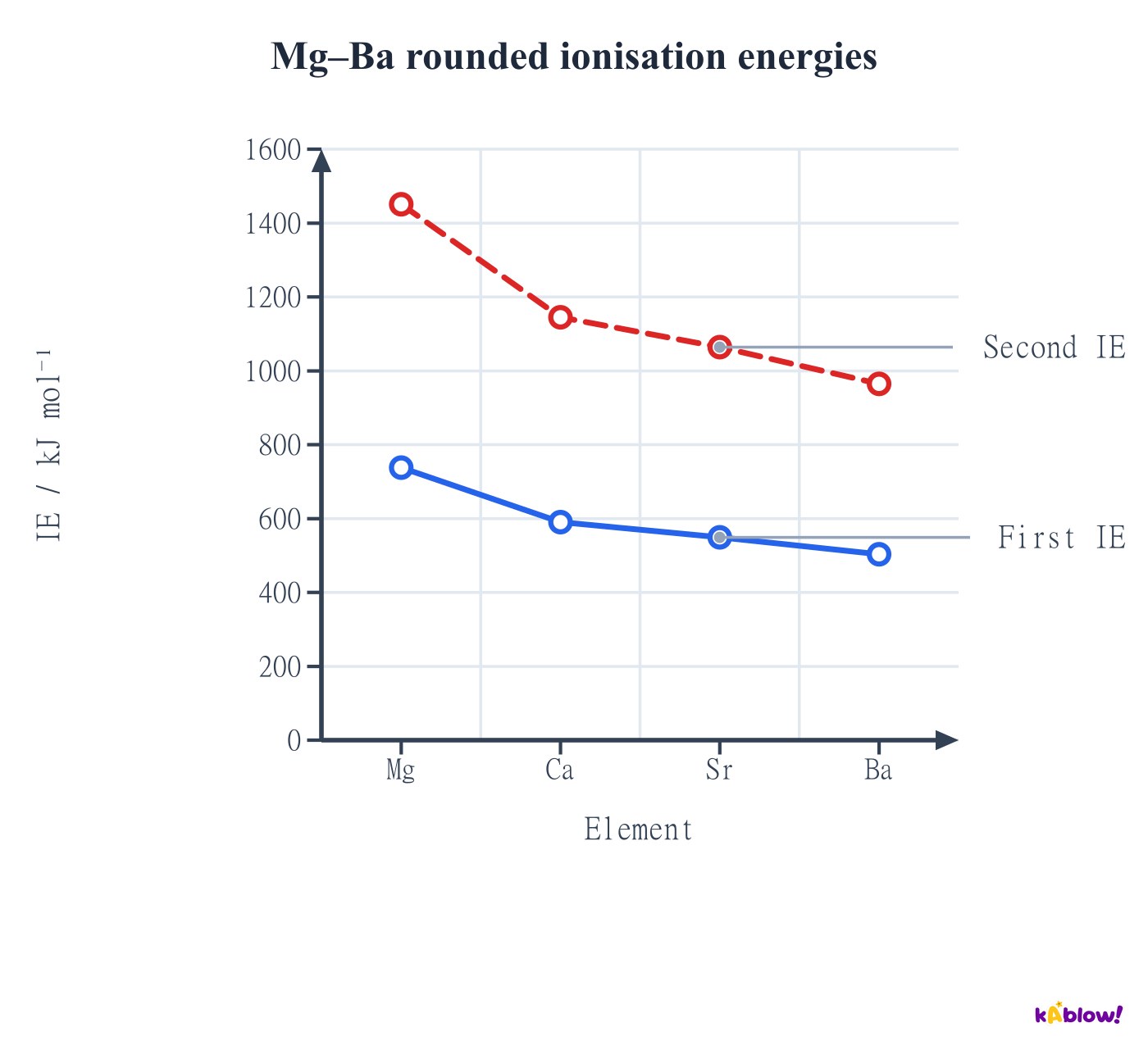
- For each Mg–Ba element, the second energy exceeds the first because an electron is removed from an already positive ion. Both values decline overall from Mg to Ba.
- Their sum describes removing both outer electrons from gaseous atoms. It is not the full enthalpy or rate of a metal’s aqueous reaction, which includes other processes.
Mg–Ba rounded ionisation energies
Link easier electron loss to increasing reactivity
- Reactivity generally increases down Mg–Ba under comparable conditions. Greater outer-electron distance and shielding make loss of the two outer electrons easier.
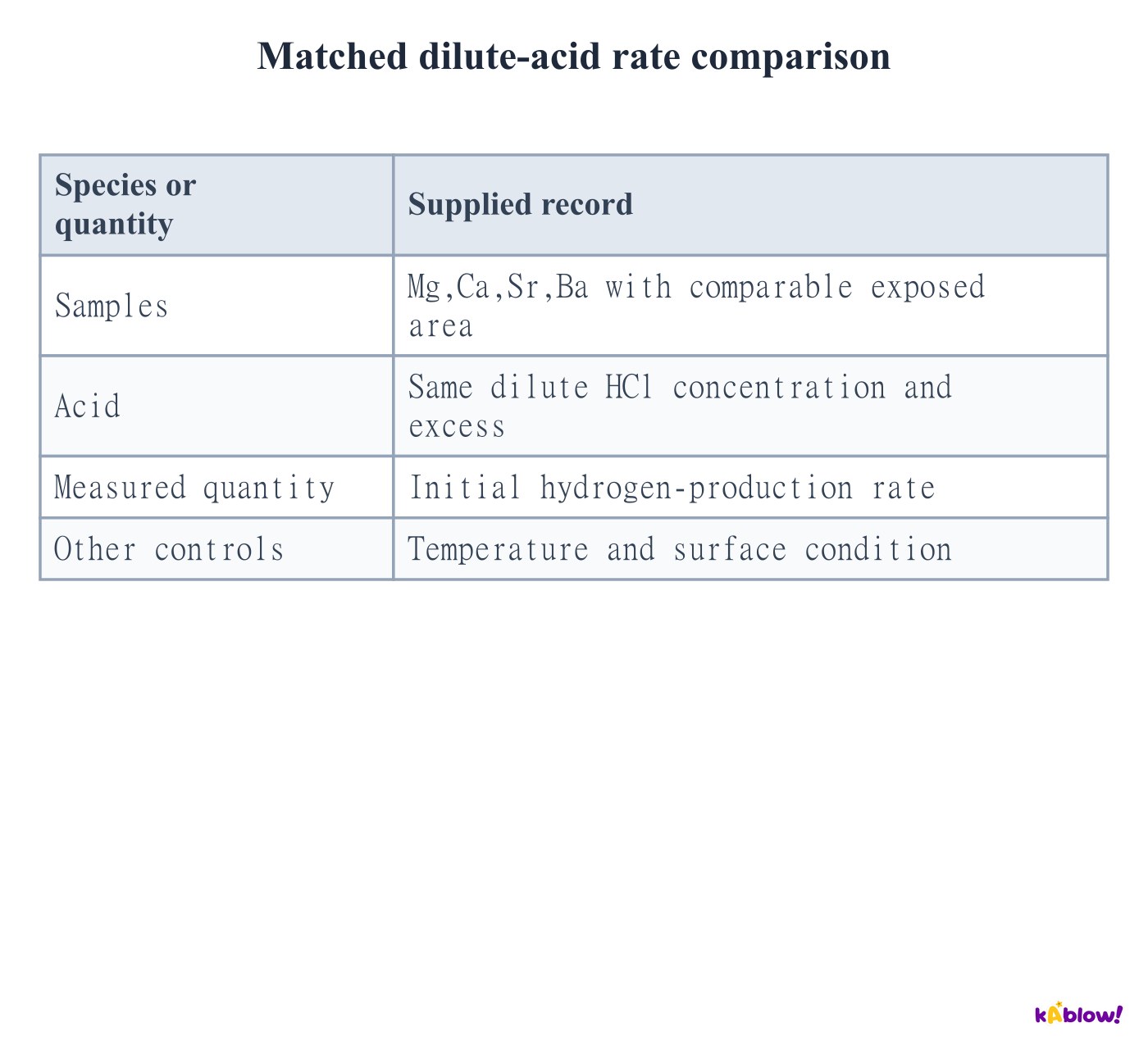
- In a matched reaction with dilute hydrochloric acid, the metals form M²⁺ and hydrogen. Compare rates only when exposed area, temperature and reagent conditions are controlled.
- Oxide or sulfate coatings can alter observed rates. An obstructed surface does not by itself reverse the underlying electron-loss trend.
Matched dilute-acid rate comparison
Use physical data rather than forcing a smooth trend
- These metals have metallic bonding. Increasing core size can weaken attraction to delocalised electrons, but packing and crystal structure also affect melting.
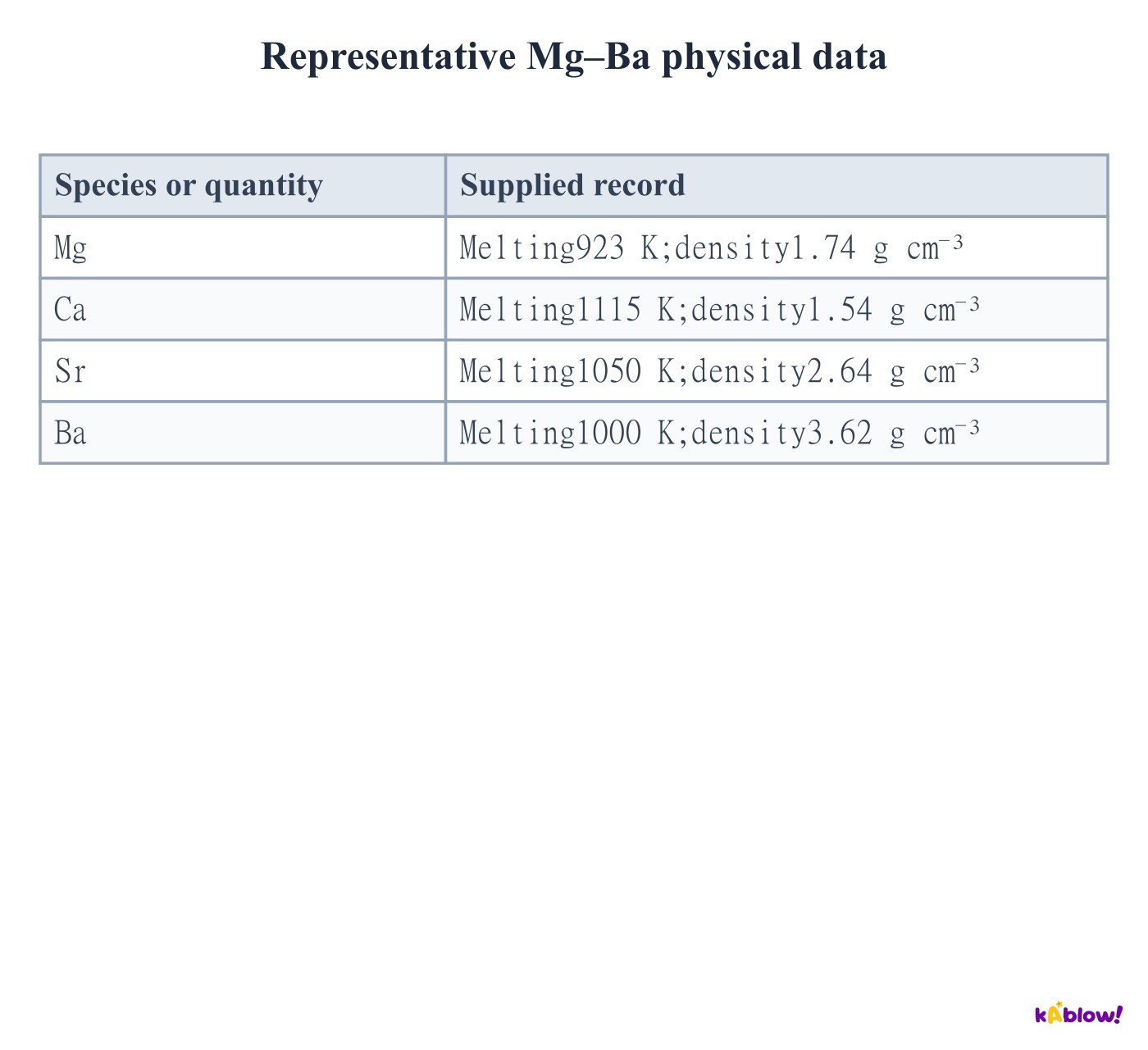
- The supplied melting temperatures rise from Mg 923 K to Ca 1115 K, then fall toward Ba 1000 K. A claim of a decrease at every step is false.
- Density also varies non-uniformly:Ca is less dense than Mg, but Sr and Ba are denser. Both mass and occupied volume, including packing, matter.
Representative Mg–Ba physical data
Write dissolution with correct species and states
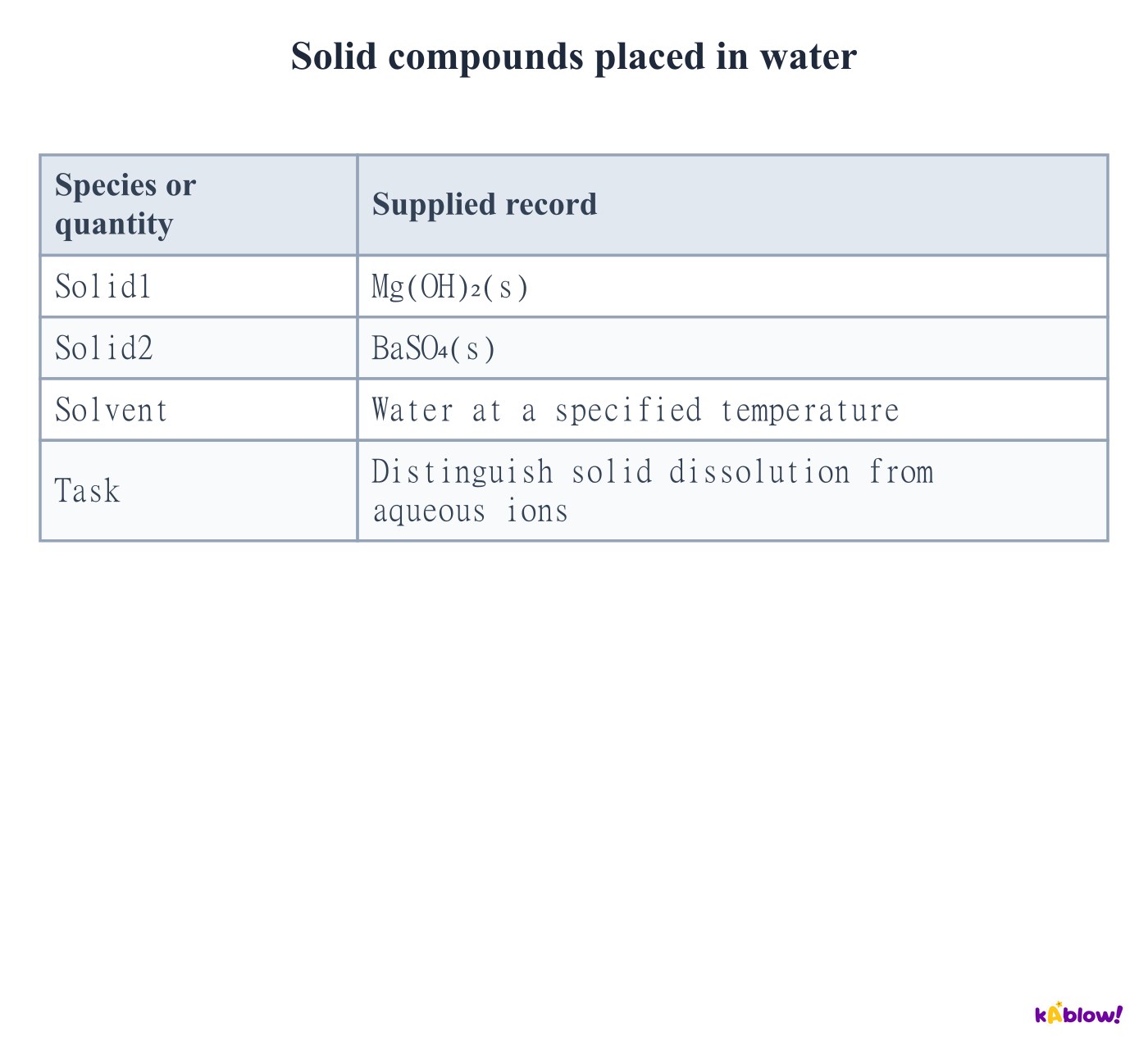
- A hydroxide dissolution equilibrium is M(OH)₂(s)⇌M²⁺(aq)+2OH⁻(aq). A sulfate dissolution equilibrium is MSO₄(s)⇌M²⁺(aq)+SO₄²⁻(aq).
- A very small equilibrium amount can dissolve even when a compound is described as insoluble in ordinary laboratory language. The solid and dissolved ions are different species.
- Free O²⁻ is not a persistent aqueous solute:it reacts strongly with water. Write the actual oxide/water reaction instead of treating a bottle of aqueous oxide ions as an ordinary solution.
Solid compounds placed in water
State the Mg–Ba hydroxide-solubility trend
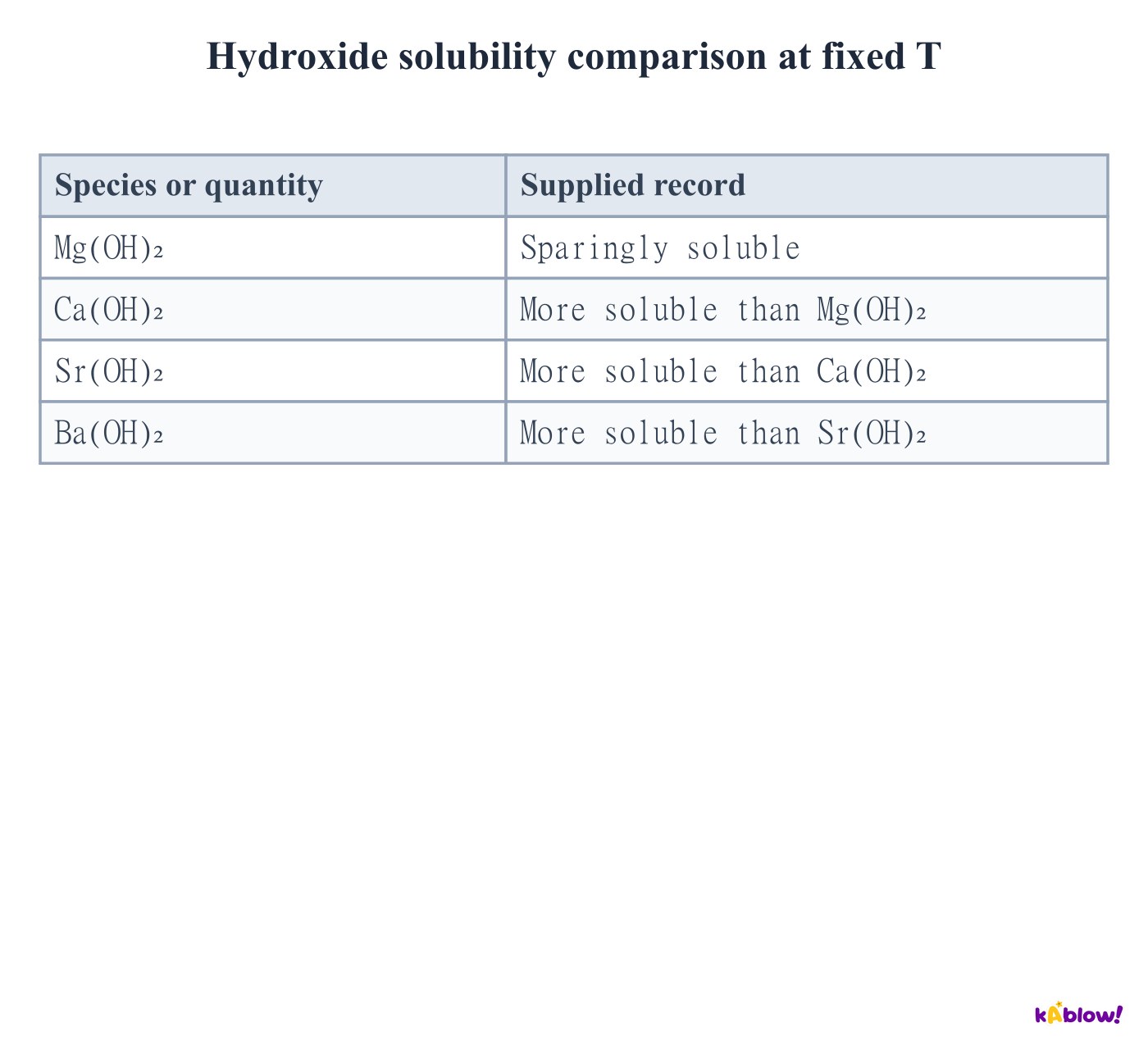
- The hydroxides become more soluble down Mg–Ba under comparable conditions. Mg(OH)₂ is sparingly soluble; Ba(OH)₂ is much more soluble.
- The dissolved portion supplies metal ions and hydroxide. Low solubility is different from a weak acid/base ionising only partly after it is dissolved.
- Solubility is an equilibrium property at a stated temperature. The rate at which a lump reacts or dissolves is a separate observation.
Hydroxide solubility comparison at fixed T
Keep sulfate and hydroxide trends separate
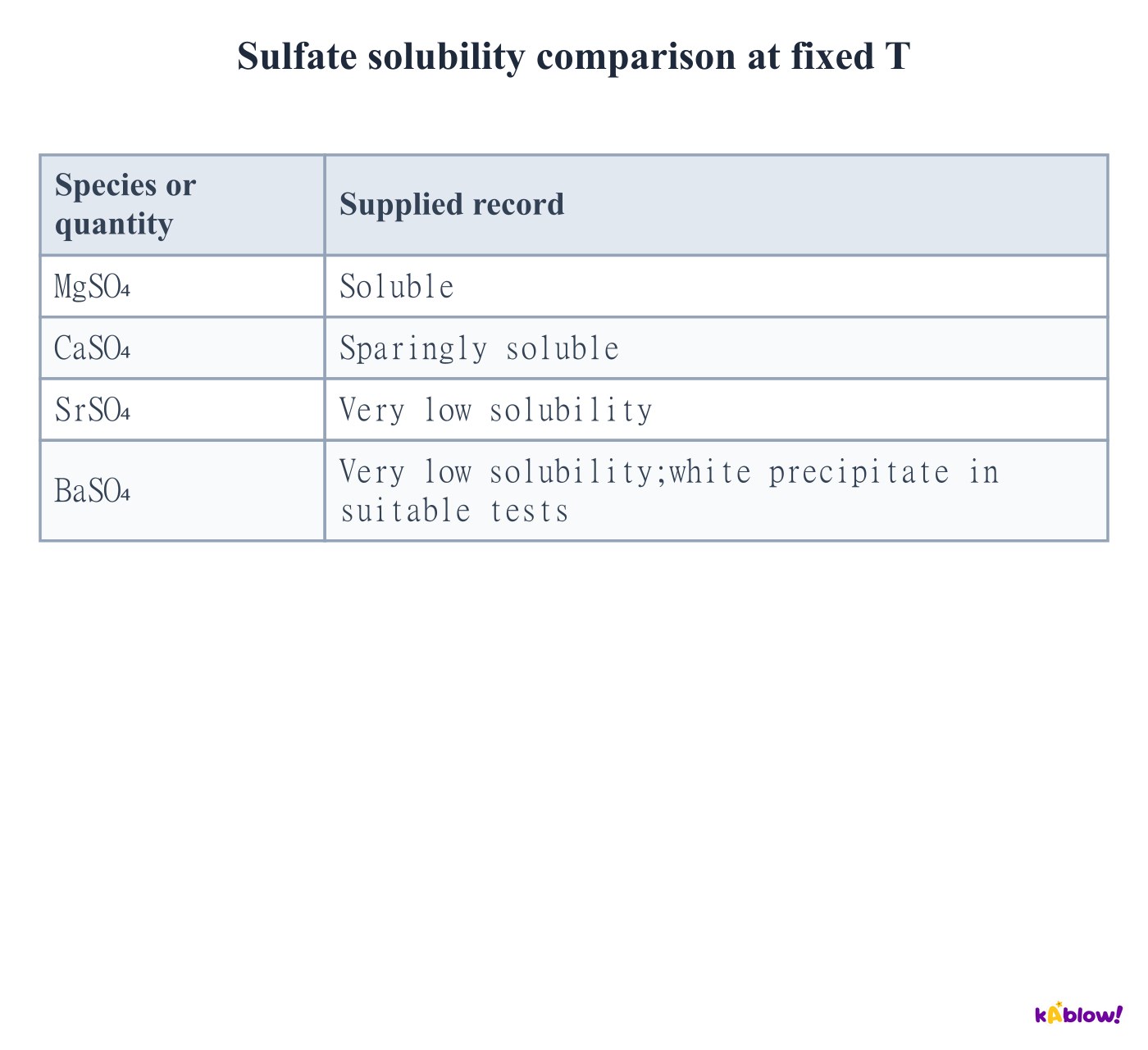
- Group 2 sulfate solubility decreases down Mg–Ba, the opposite of the hydroxide trend. MgSO₄ is soluble, CaSO₄ sparingly soluble, and BaSO₄ has very low solubility.
- Formation of a solid depends on ion concentrations as well as low solubility. Mixing very dilute ions does not guarantee an observable precipitate.
- A sulfate layer can form on a reacting solid when local concentrations exceed the precipitation threshold. Use the appropriate solid state when precipitation actually occurs.
Sulfate solubility comparison at fixed T
Qualify an alkalinity comparison
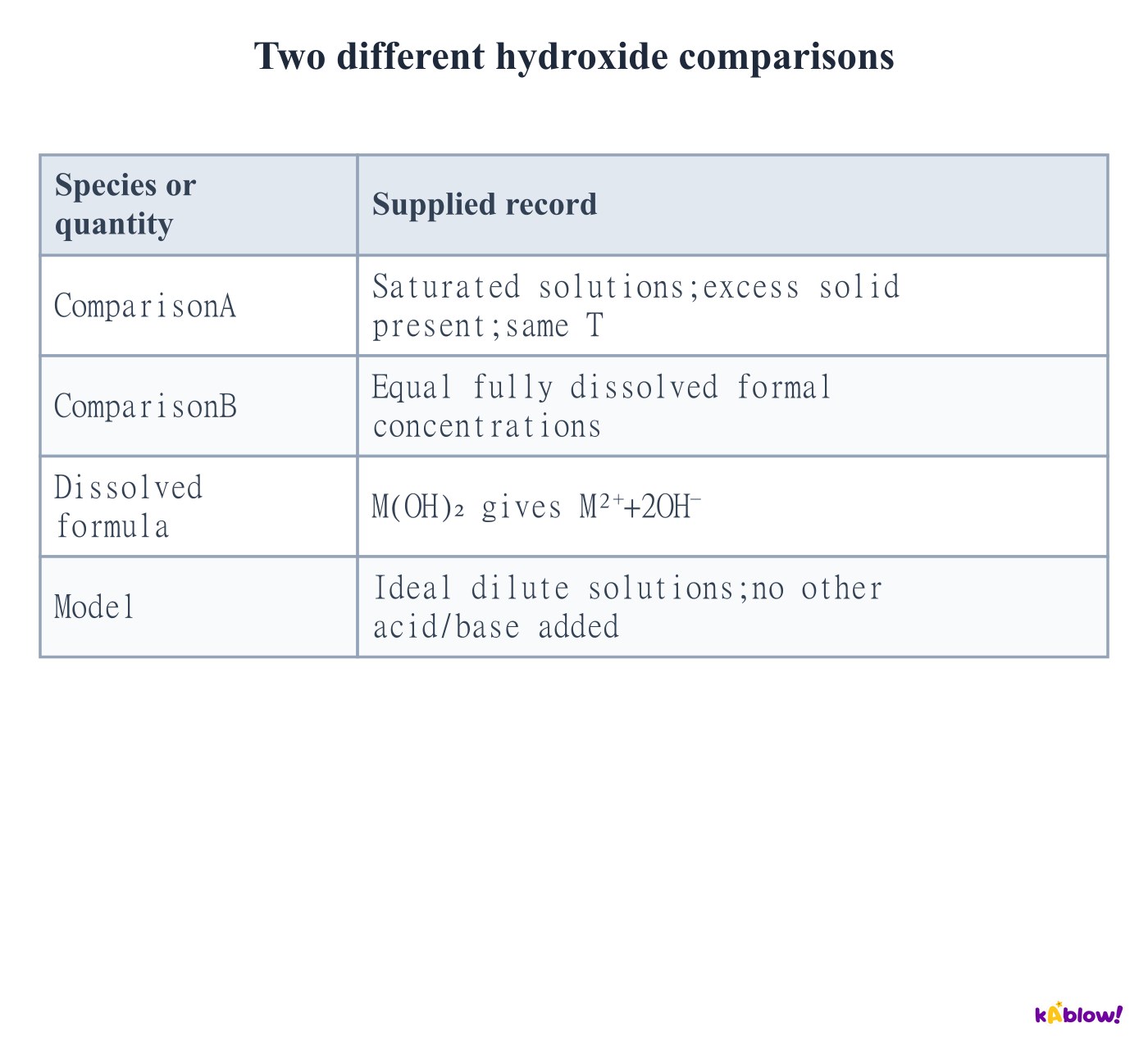
- For comparable saturated solutions, the more soluble hydroxide supplies a higher equilibrium hydroxide concentration and generally a higher pH at the same temperature.
- For equal fully dissolved concentrations of M(OH)₂, the ideal hydroxide concentrations are equal:each supplies two OH⁻. Position in the group alone does not make one such solution more alkaline.
- Distinguish the amount introduced, the amount dissolved and whether excess solid remains. A fixed universal pH for each hydroxide is inappropriate.
Two different hydroxide comparisons
Calculate hydroxide concentration before pH
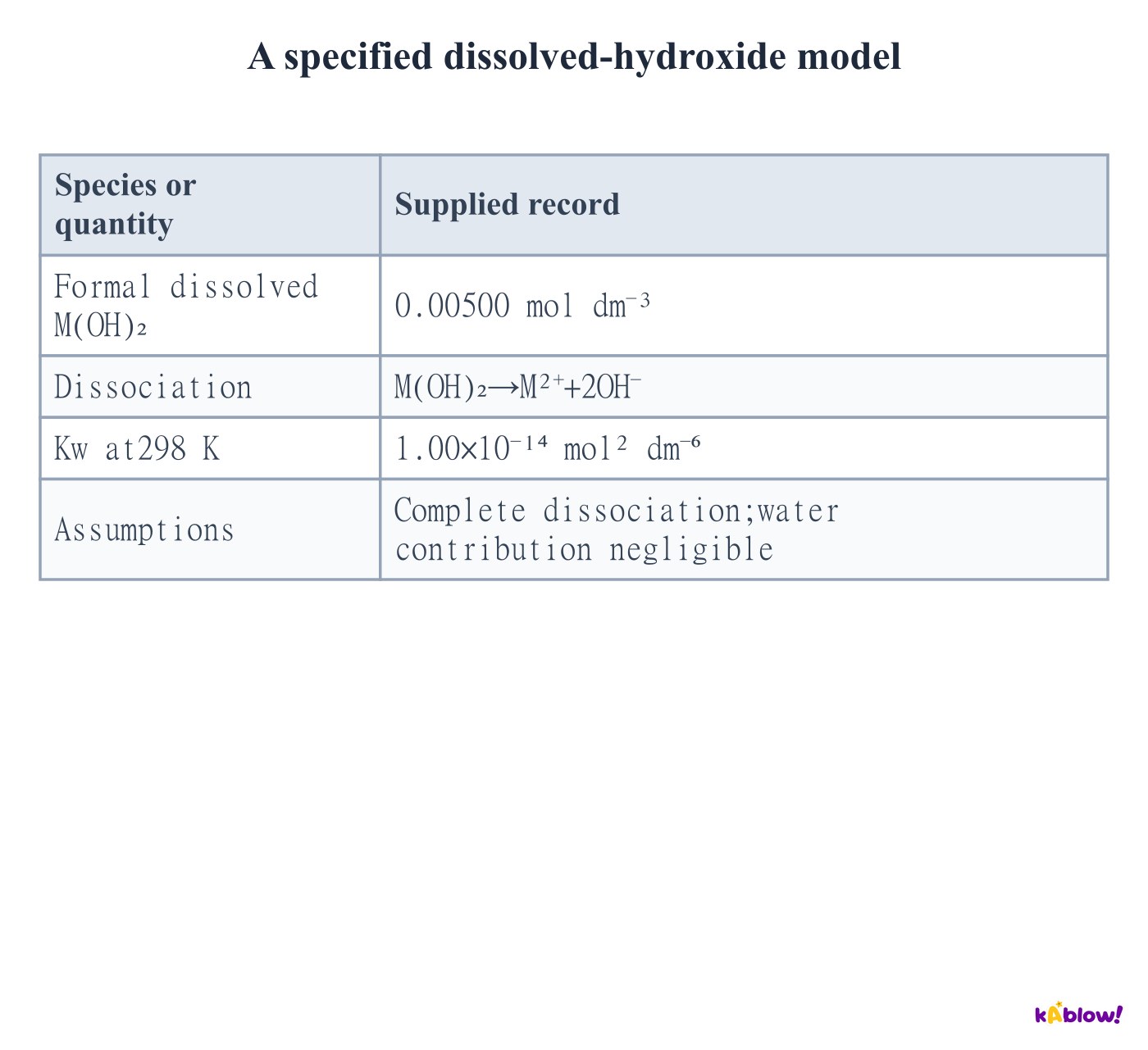
- For the stated fully dissolved model, [OH⁻]=2×0.00500=0.0100 mol dm⁻³. The factor of two comes from the formula, not from an acid/base strength ranking.
- Then[H⁺]=Kw/[OH⁻]=1.00×10⁻¹² mol dm⁻³, so pH=12.00 at the specified temperature.
- Do not apply this concentration to an undissolved mass unless its solubility permits it. Use actual dissolved amount and total solution volume.
A specified dissolved-hydroxide model
Compare Mg–Ba cold-water reactions
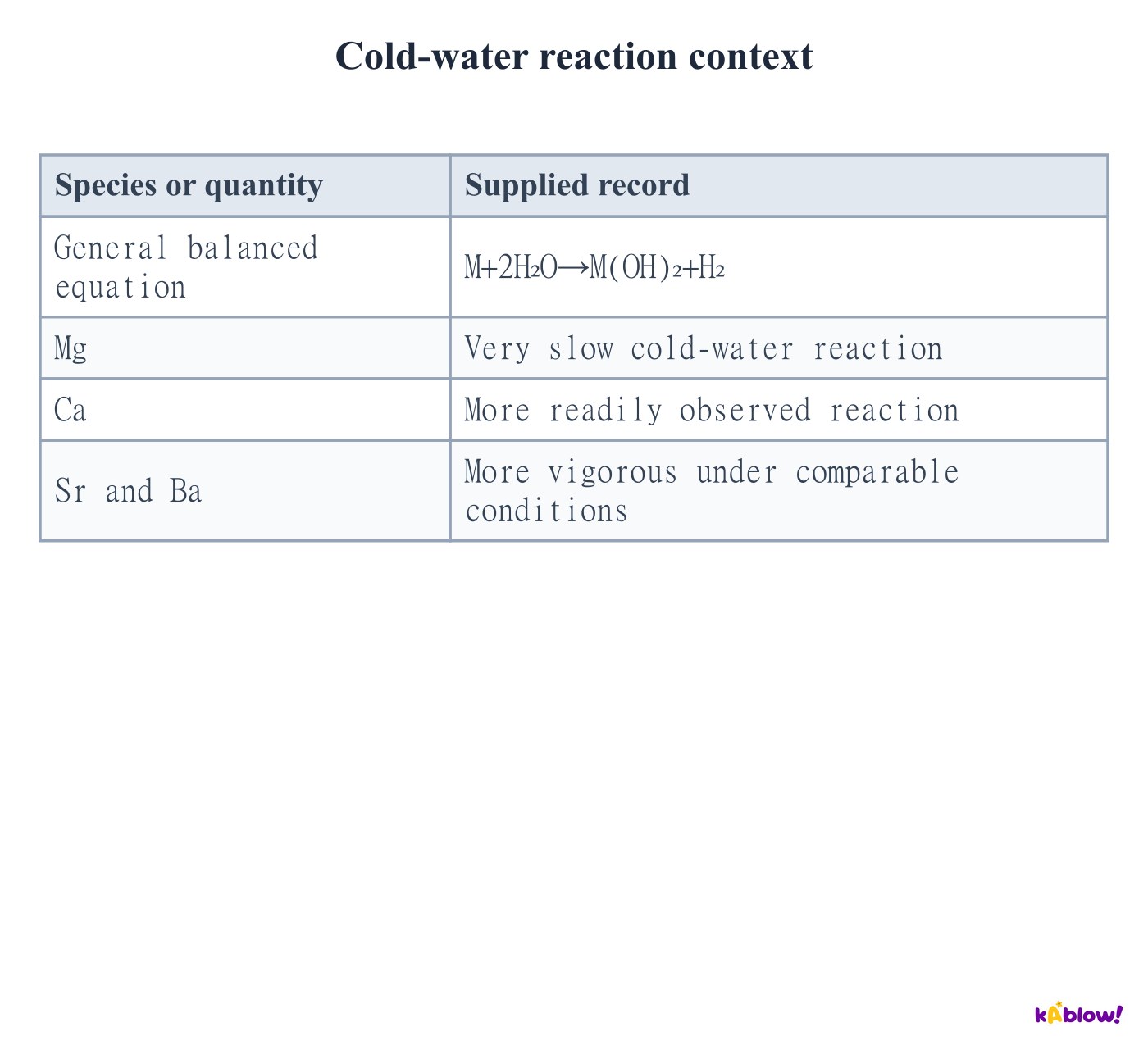
- For these metal/water reactions, M+2H₂O→M(OH)₂+H₂ balances both atoms and electrons. Metal is oxidised from 0 to+2.
- Mg reacts very slowly with cold water; Ca reacts more readily, and Sr/Ba more vigorously under comparable conditions. Dissolved hydroxide makes the solution alkaline.
- State information depends on solubility and amount:Ca can produce a cloudy suspension when Ca(OH)₂ exceeds its dissolved limit. A gas bubble is not a precipitate.
Cold-water reaction context
Distinguish steam from the cold-water reaction
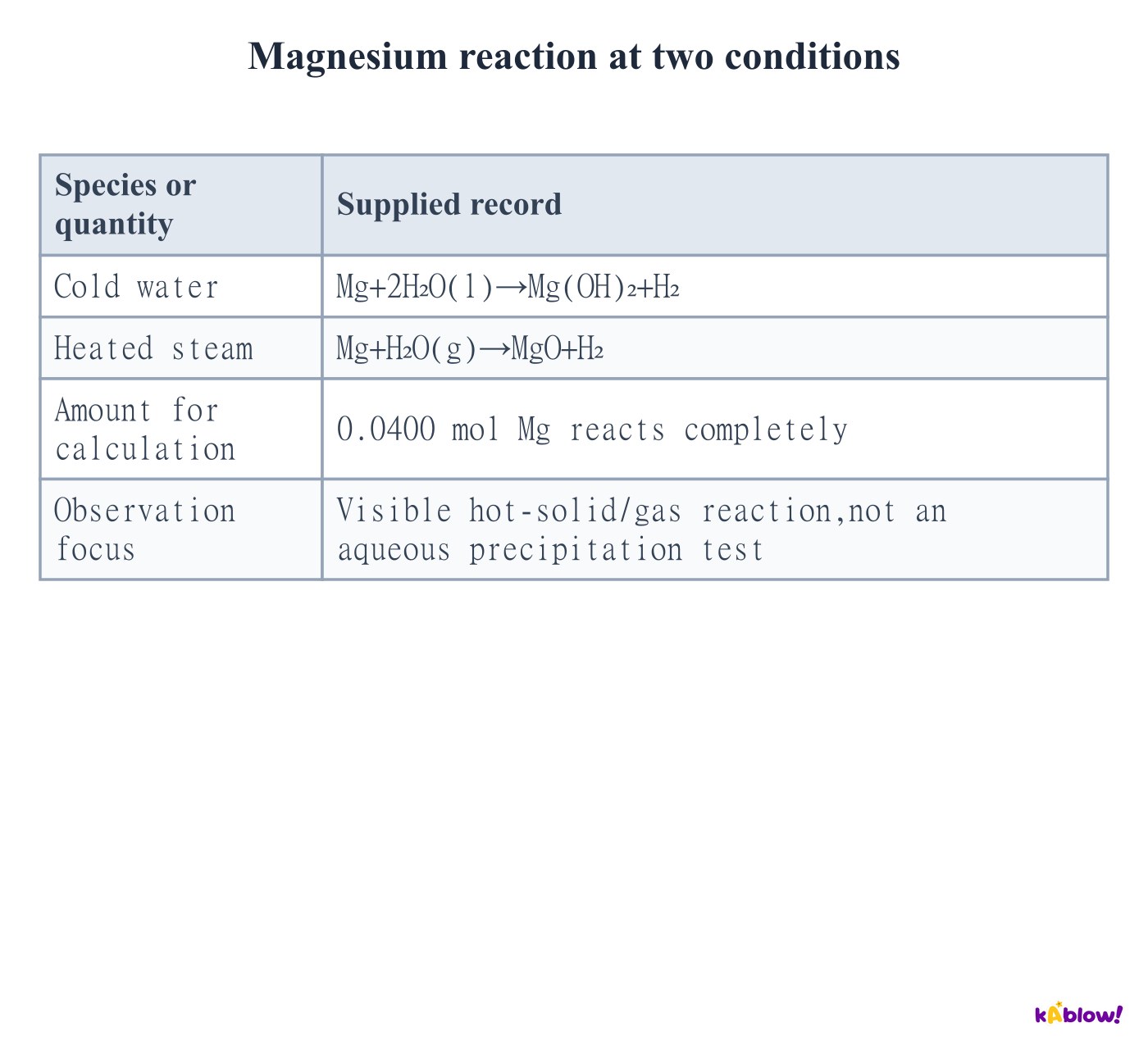
- Heated magnesium reacts with steam to form MgO and hydrogen. The hot reaction can show bright white light or glow and a white solid oxide residue.
- Hydrogen formation follows the equation, but hydrogen itself is colourless. The main visible evidence in this setup is not a white precipitate forming in an aqueous solution.
- The steam equation gives one mole of H₂ per mole Mg. Reaction conditions change the oxygen-containing product compared with cold water.
Magnesium reaction at two conditions
Distinguish an oxide from a peroxide
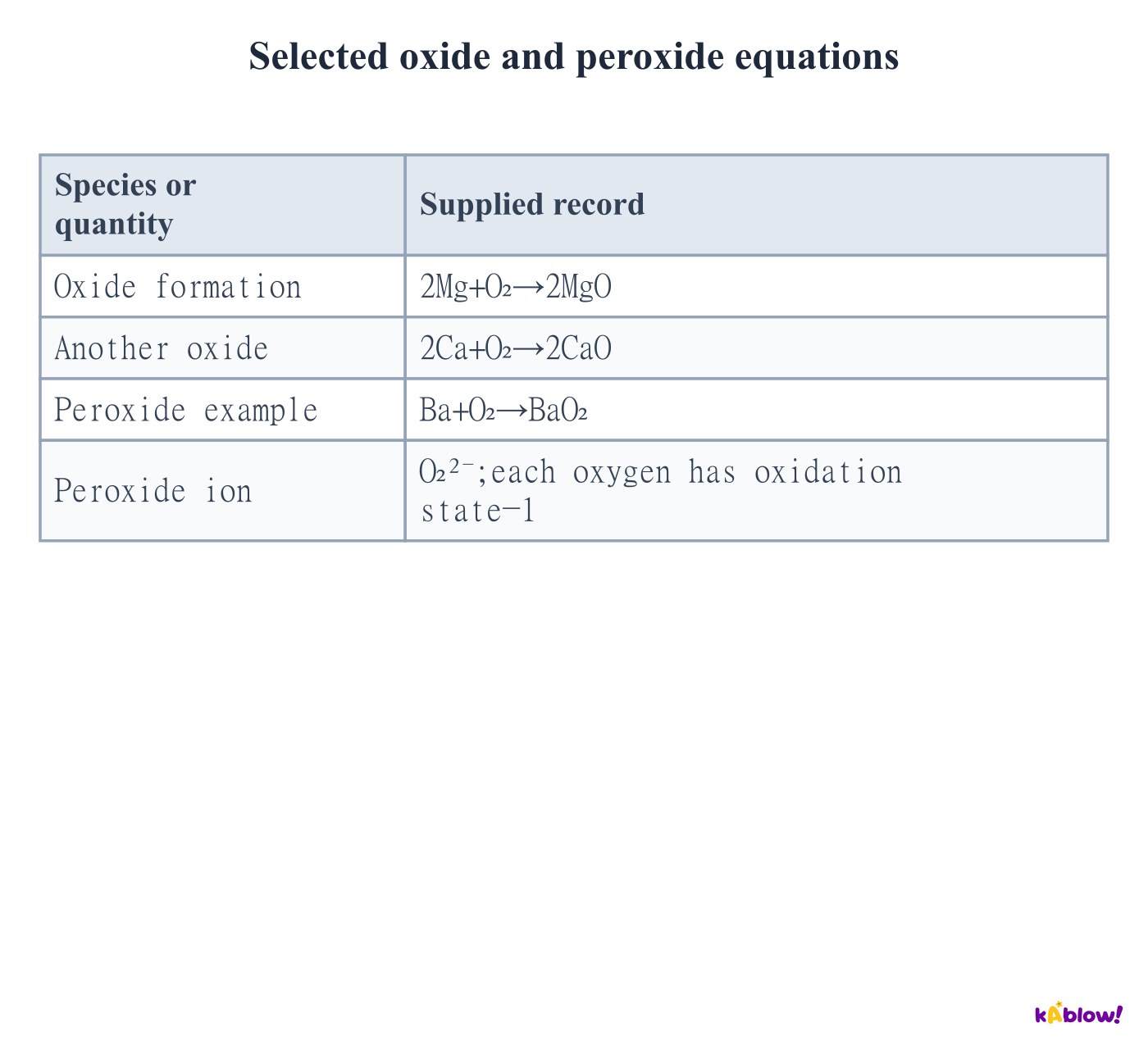
- For formation of a simple Group 2 oxide, 2M+O₂→2MO. The oxide ion is O²⁻ and the metal is+2.
- Sr and Ba can also form peroxides under suitable oxygen conditions. In BaO₂, the anion is O₂²⁻, so Ba still has oxidation state+2.
- The subscript2 in a peroxide does not make the metal+4. Product conditions matter; one general MO equation is not every possible oxygen reaction.
Selected oxide and peroxide equations
Use the hydrochloric-acid reaction ratio
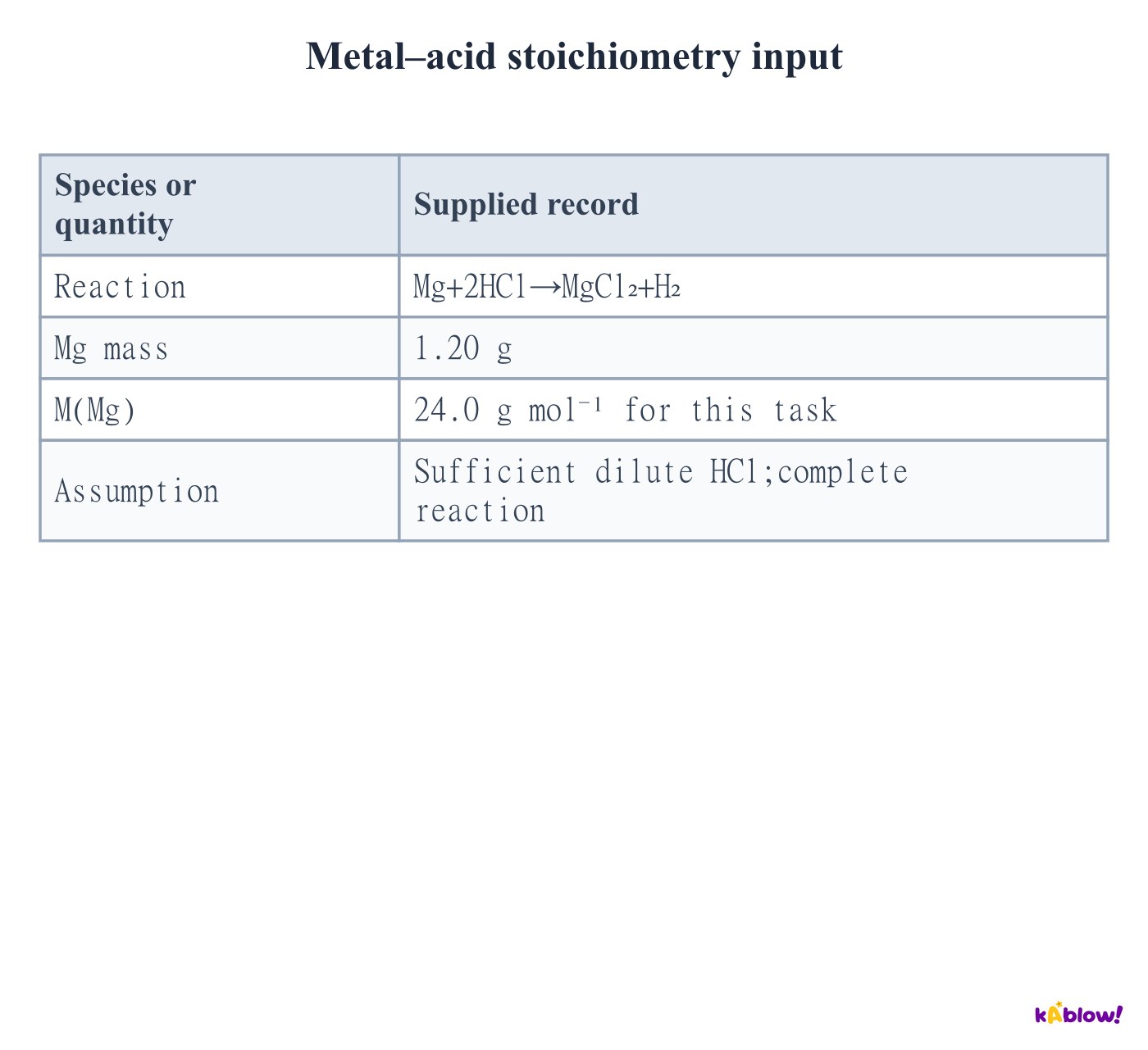
- The general reaction is M+2HCl→MCl₂+H₂ for Mg–Ba metals under the stated dilute-acid conditions. The chloride salts are soluble.
- For 1.20 g Mg using 24.0 g mol⁻¹, n(Mg)=0.0500 mol. Complete reaction consumes 0.100 mol HCl and forms 0.0500 mol H₂.
- Compare rates only with controlled conditions. Stoichiometric gas yield depends on the amount that reacts, not simply which metal appears more vigorous.
Metal–acid stoichiometry input
Explain inhibition by a sulfate layer
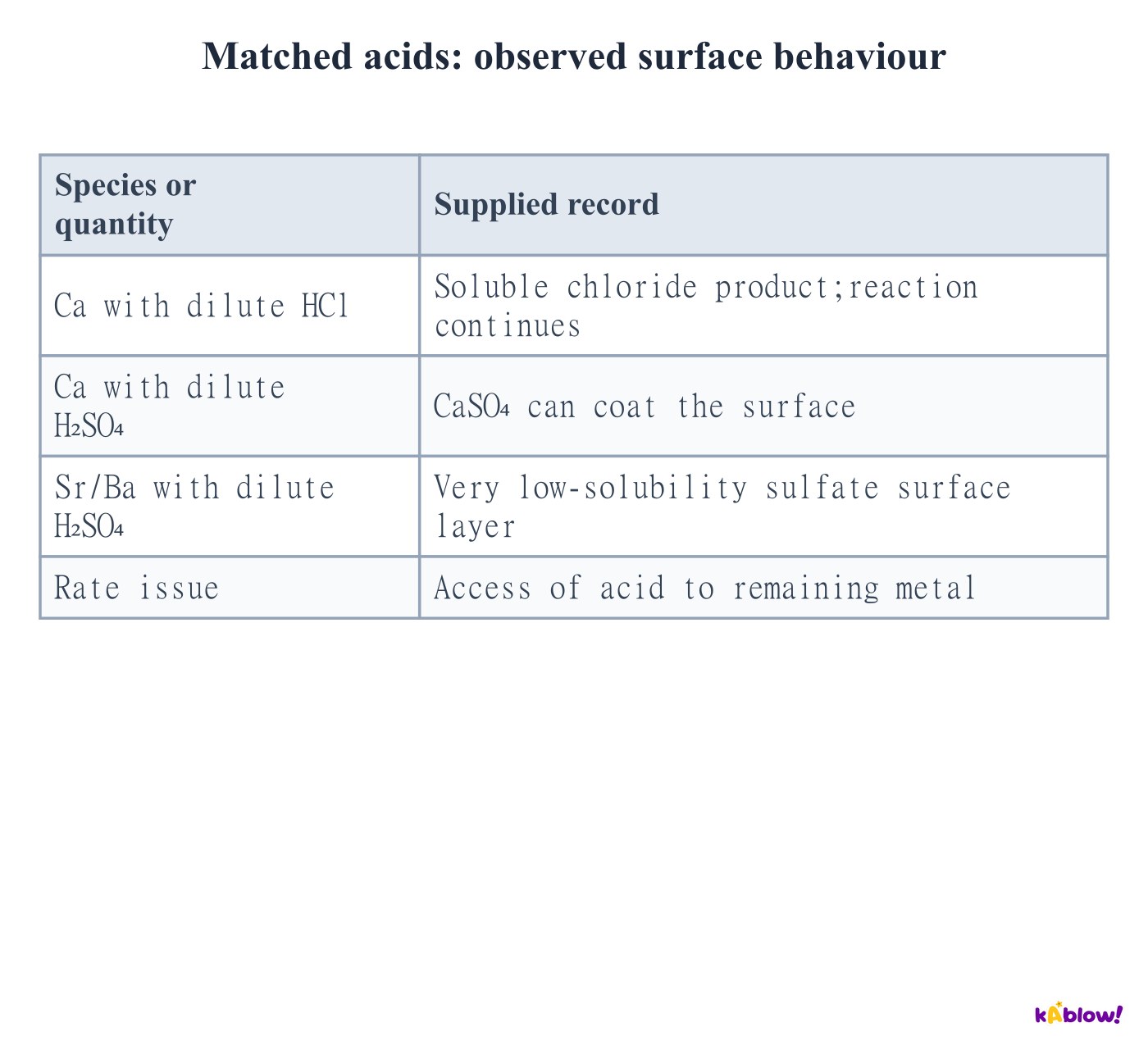
- Sulfuric acid can produce a sparingly soluble CaSO₄ layer or very low-solubility SrSO₄/BaSO₄ layer on the reacting metal.
- The coating reduces acid contact with unreacted metal, slowing or stopping the visible reaction. It is more than a claim that bubbles are physically trapped.
- A slower observed reaction with sulfuric acid can coexist with greater underlying electron-loss reactivity. Surface chemistry must be considered.
Matched acids: observed surface behaviour
Distinguish hydration from simple dissolution
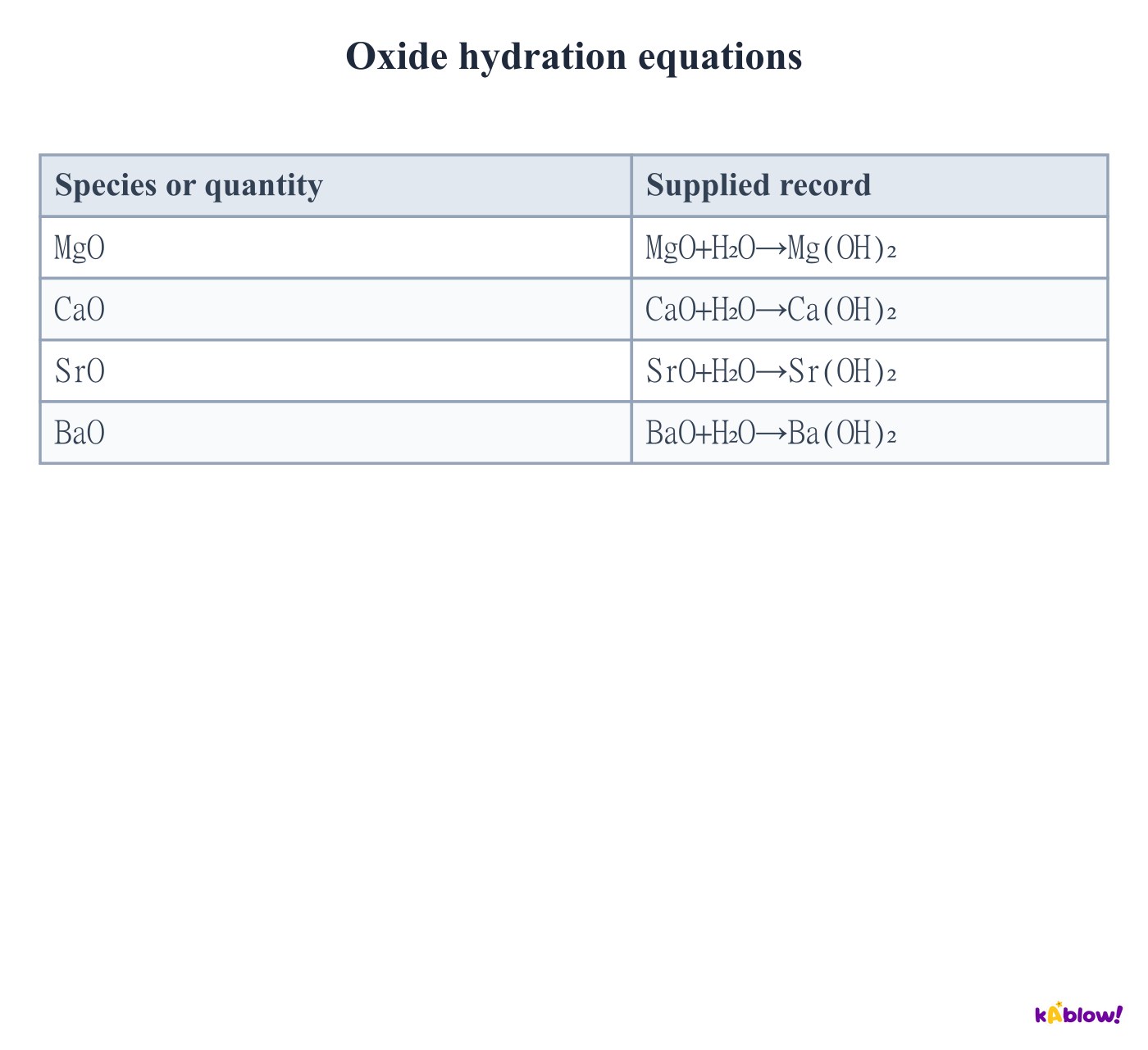
- The Mg–Ba oxides can form the corresponding hydroxides with water. Calcium oxide hydration is strongly exothermic and forms slaked lime.
- Hydration changes the compound; subsequent solubility determines how much hydroxide enters solution. MgO does not simply produce a freely soluble strongly alkaline solution at any concentration.
- BeO is outside the Mg–Ba focus:it is amphoteric and does not follow a blanket claim that every Group 2 oxide readily reacts with water.
Oxide hydration equations
Balance acid reactions of oxides and hydroxides
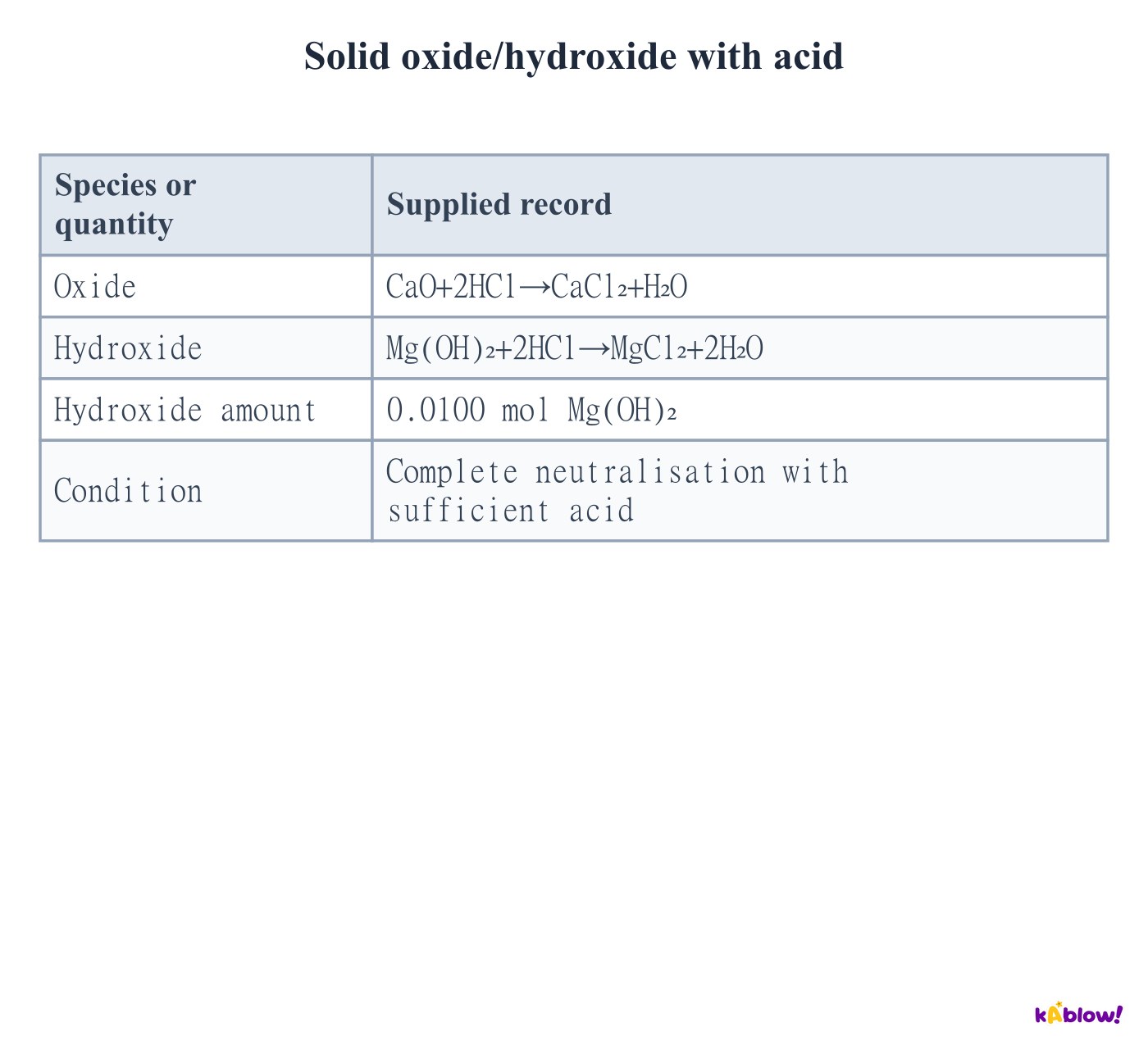
- Basic oxides and hydroxides neutralise acid. CaO consumes two H⁺ per formula unit; M(OH)₂ also consumes two H⁺ per formula unit.
- For 0.0100 mol Mg(OH)₂, complete neutralisation consumes 0.0200 mol HCl and forms 0.0200 mol water. This is not a metal reaction generating H₂.
- For sulfuric acid, write the sulfate state according to whether precipitation occurs. An insoluble sulfate coating can limit reaction with a solid.
Solid oxide/hydroxide with acid
Recognise carbonate neutralisation and gas formation
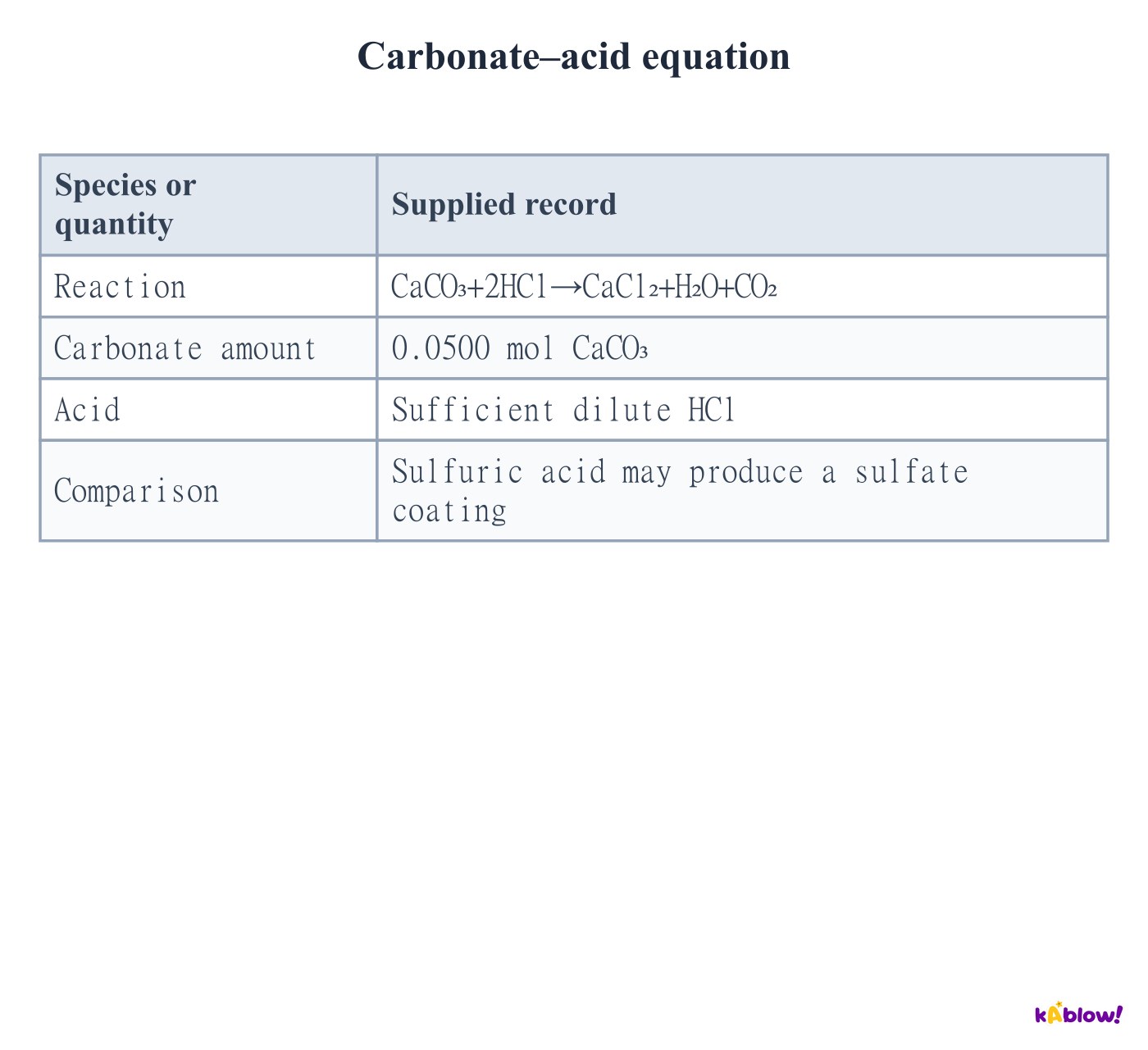
- The Mg–Ba carbonates have low water solubility but can react with dilute acid. Carbonate protonation gives CO₂ and water as the metal salt forms.
- For CaCO₃+2HCl→CaCl₂+H₂O+CO₂, one mole carbonate gives one mole CO₂ and consumes two moles HCl.
- Sulfuric acid can form a sparingly soluble sulfate coating on CaCO₃ and very low-solubility coatings for Sr/Ba carbonates, restricting further reaction.
Carbonate–acid equation
Choose reagents for a controlled sulfate test
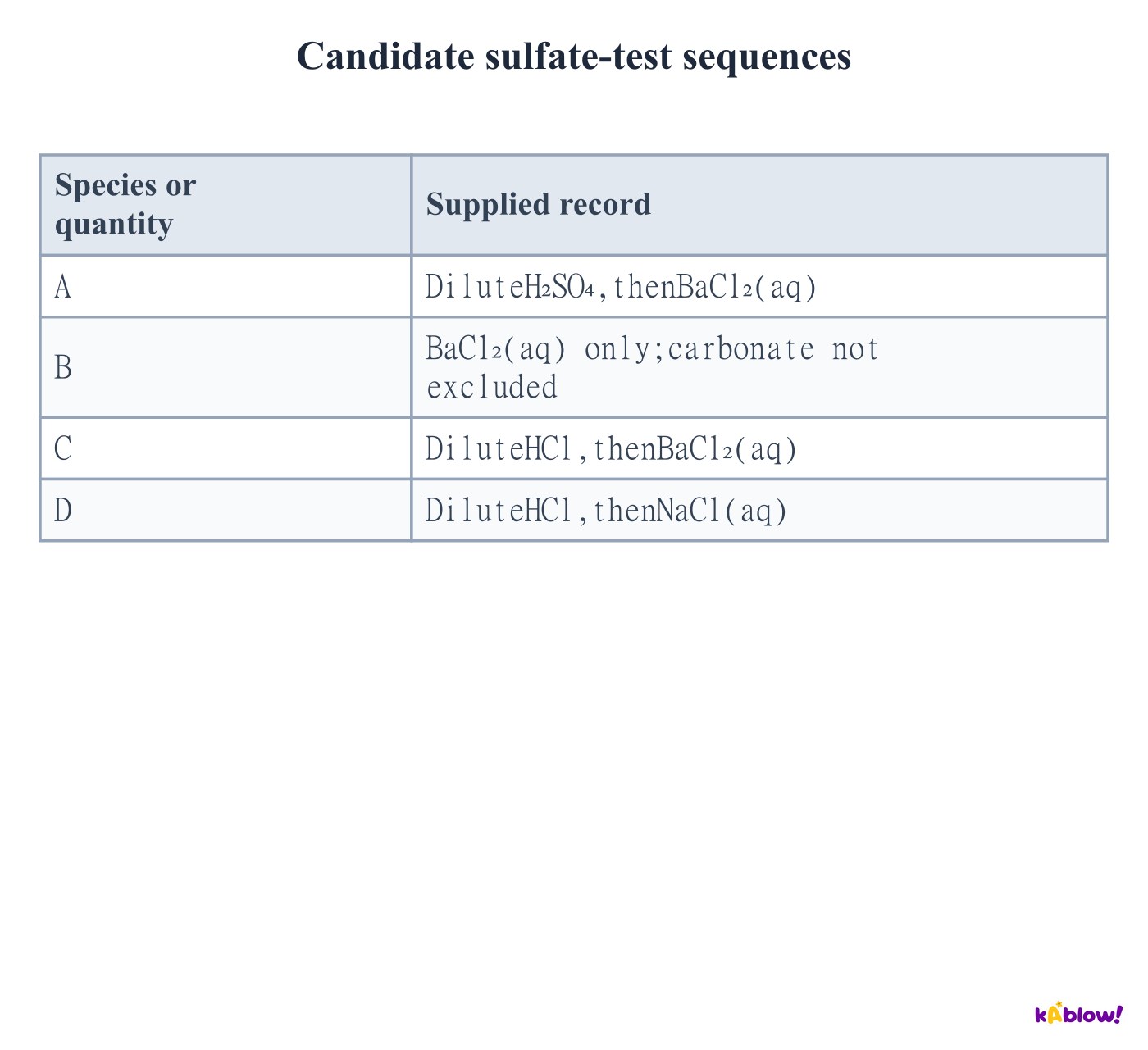
- Acidify the aqueous sample with dilute HCl, then add BaCl₂ solution. A white BaSO₄ precipitate is evidence for sulfate in the controlled test.
- Acid removes carbonate interference by forming CO₂ and water. Dilute HNO₃ followed by Ba(NO₃)₂ is an alternative appropriate reagent combination.
- Do not acidify with sulfuric acid:it introduces the sulfate being tested for. Acidification does not guarantee removal of every possible interferent in an arbitrary mixture.
Candidate sulfate-test sequences
Use a net ionic equation and limiting ion
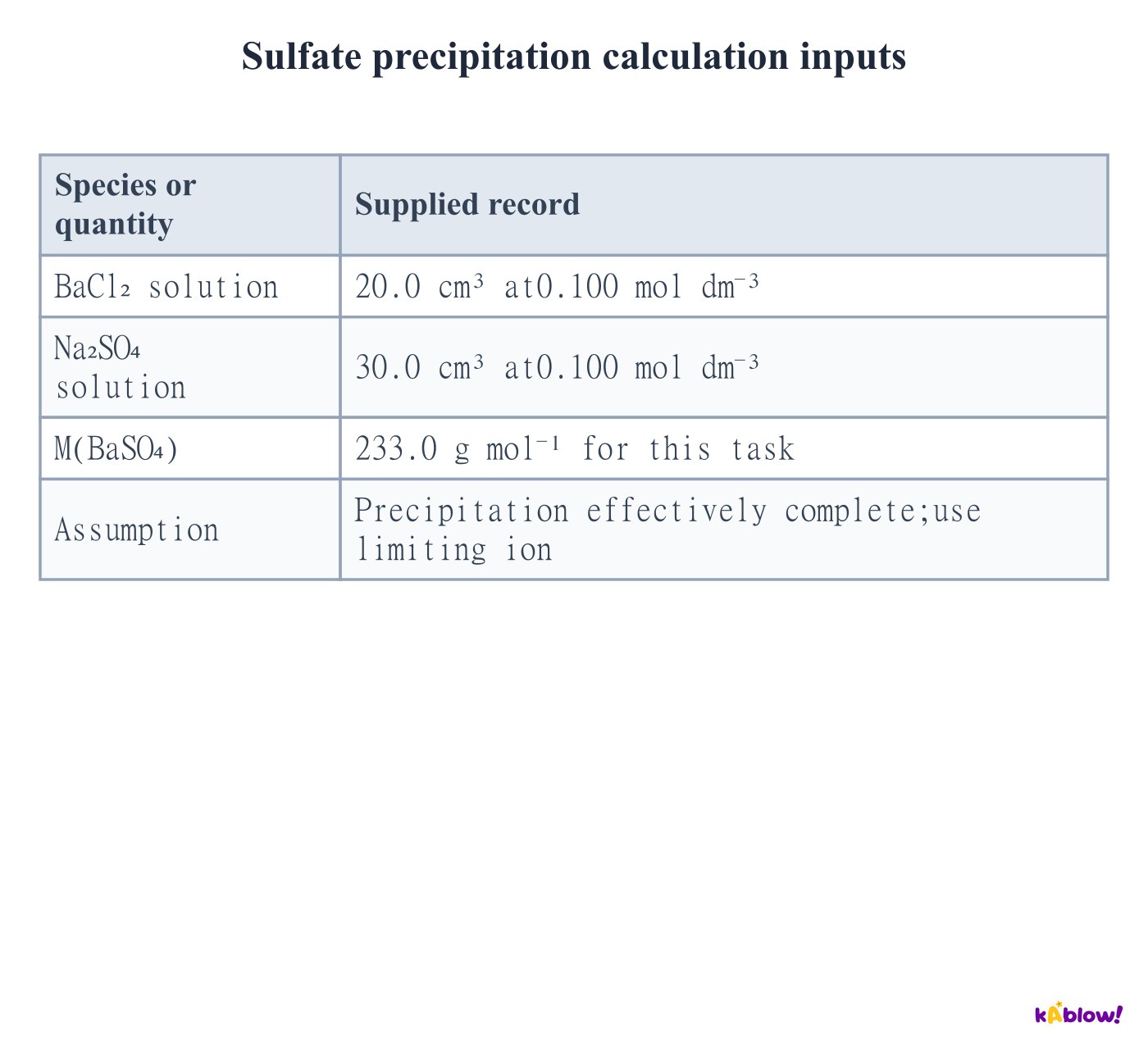
- The net ionic precipitation equation is Ba²⁺(aq)+SO₄²⁻(aq)→BaSO₄(s). The ion ratio is1:1.
- The supplied mixture has2.00 mmol Ba²⁺ and3.00 mmol sulfate. Ba²⁺ limits the effectively complete precipitation to 2.00 mmol BaSO₄.
- Using233.0 g mol⁻¹ gives 0.466 g solid. The spectator Na⁺ and Cl⁻ ions do not belong in the net ionic equation.
Sulfate precipitation calculation inputs
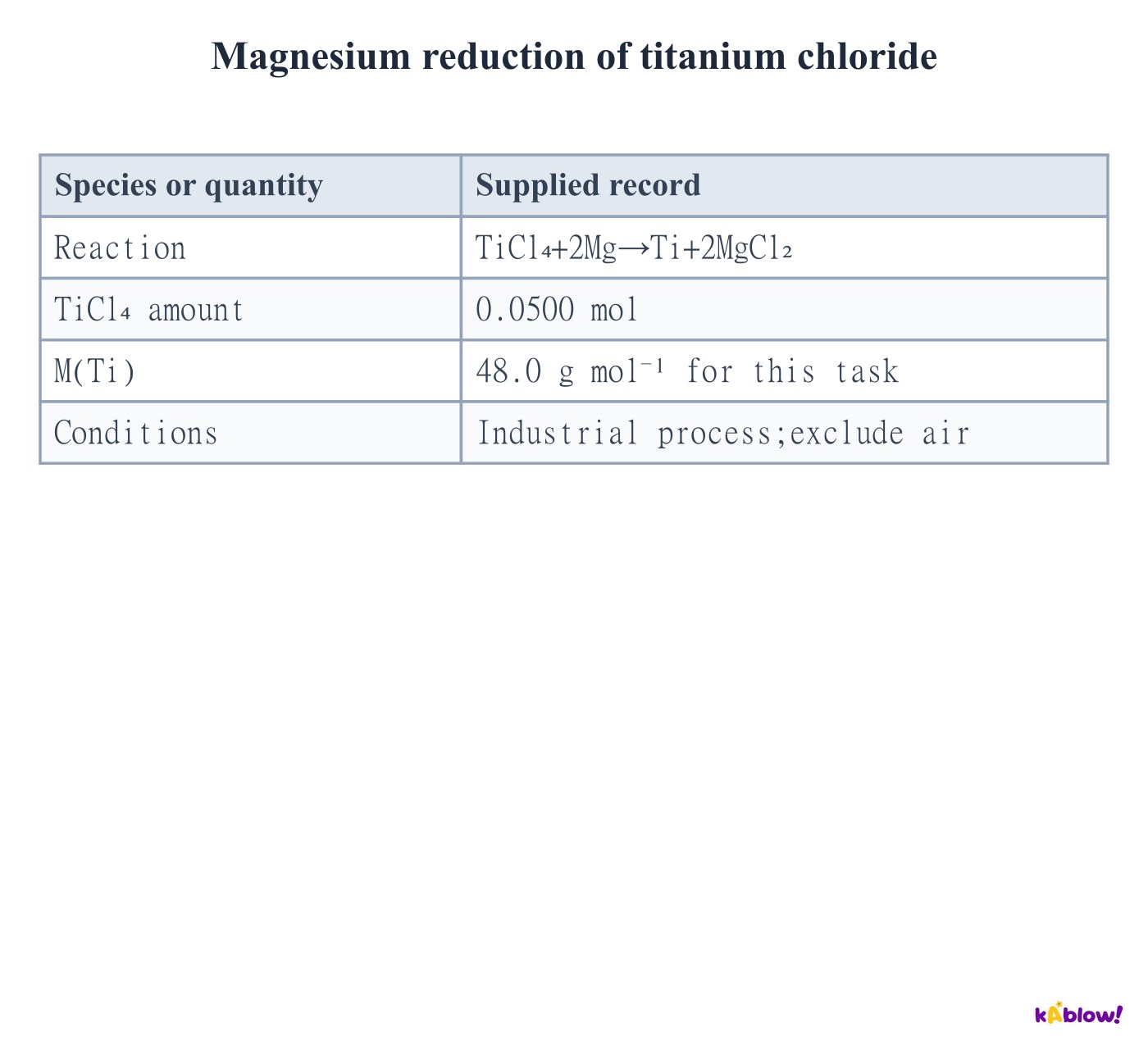
Explain magnesium’s role in titanium extraction
- Magnesium reduces titanium(IV) chloride:TiCl₄+2Mg→Ti+2MgCl₂. Titanium changes from +4 to 0, and magnesium from 0 to+2.
- Two Mg atoms supply four electrons per Ti atom formed. Magnesium is the reducing agent because it is oxidised.
- The high-temperature process excludes air to limit oxidation and unwanted reactions. This equation describes reduction of TiCl₄, not a claim that magnesium directly replaces every ore-processing step.
Magnesium reduction of titanium chloride
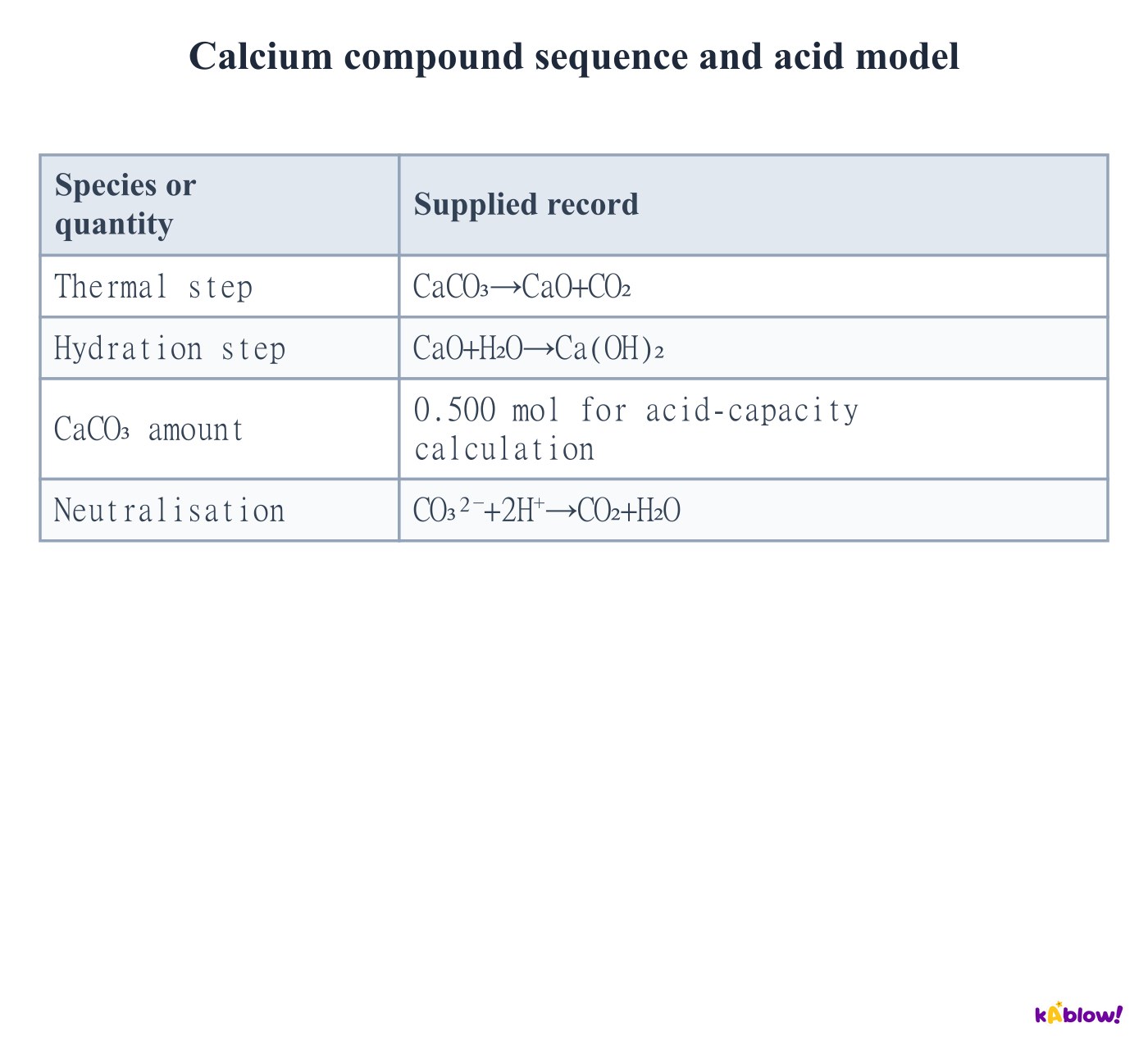
Connect lime chemistry with agriculture
- Limestone contains CaCO₃; quicklime is CaO; slaked lime is Ca(OH)₂. Heating and hydration connect these different compounds.
- Calcium carbonate, oxide and hydroxide can neutralise soil acidity. The required pH depends on the crop and soil; there is no universal optimum for every plant.
- Calcium carbonate is commonly used as agricultural lime because of cost and handling properties, though low solubility can make its action slower. Limewater is the clear dissolved Ca(OH)₂ fraction, not a slurry of excess solid.
Calcium compound sequence and acid model
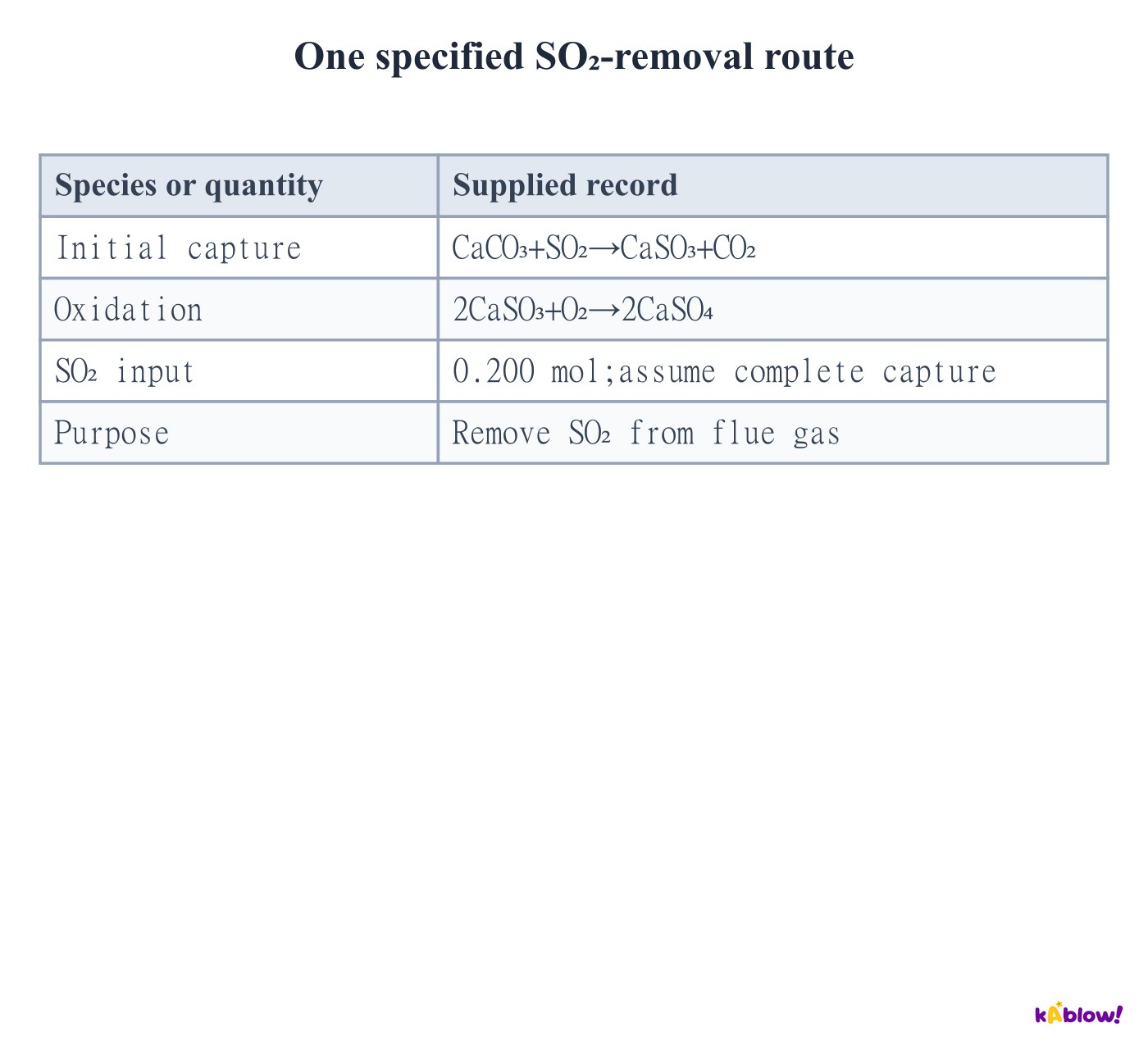
Balance sulfur scrubbing with the oxygen step
- Calcium carbonate or oxide can remove acidic SO₂ from flue gases. A specified carbonate route forms calcium sulfite and releases CO₂.
- Oxidation can convert sulfite to sulfate. Include oxygen when writing an overall sulfate-forming equation; do not create an extra oxygen atom without a source.
- For the supplied capture equation, one mole CaCO₃ consumes one mole SO₂. Gas cleaning reduces SO₂ emissions but does not make all combustion products disappear.
One specified SO₂-removal route
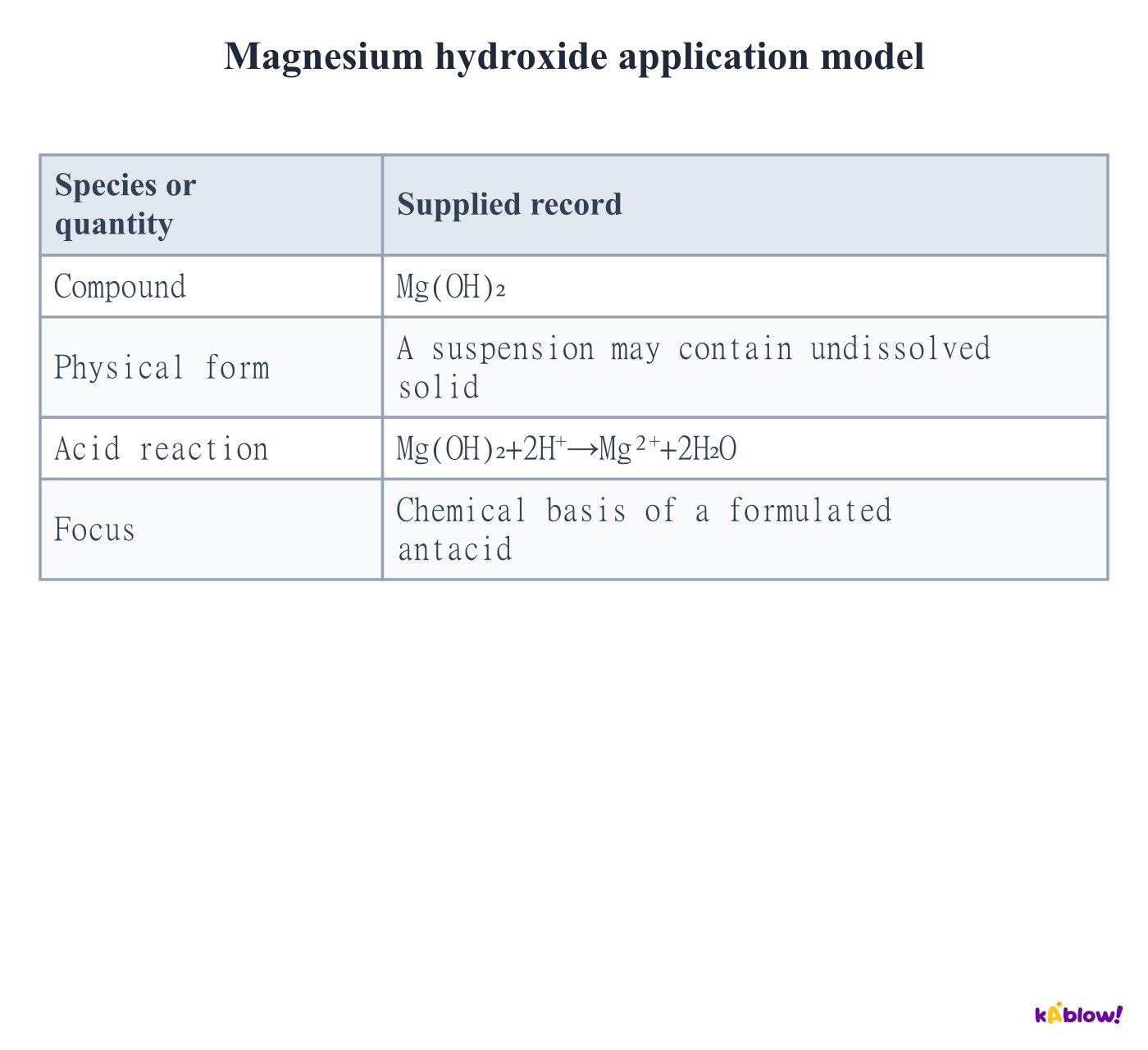
Explain magnesium hydroxide’s antacid chemistry
- Magnesium hydroxide is used in formulated antacids. The chemical basis is neutralisation:Mg(OH)₂+2H⁺→Mg²⁺+2H₂O.
- Its low solubility means a suspension can contain solid and a dissolved fraction. As acid reacts, more solid may dissolve and contribute neutralising capacity.
- Low solubility does not establish safety at any dose or in every medical situation. This application illustrates chemistry rather than a treatment instruction.
Magnesium hydroxide application model
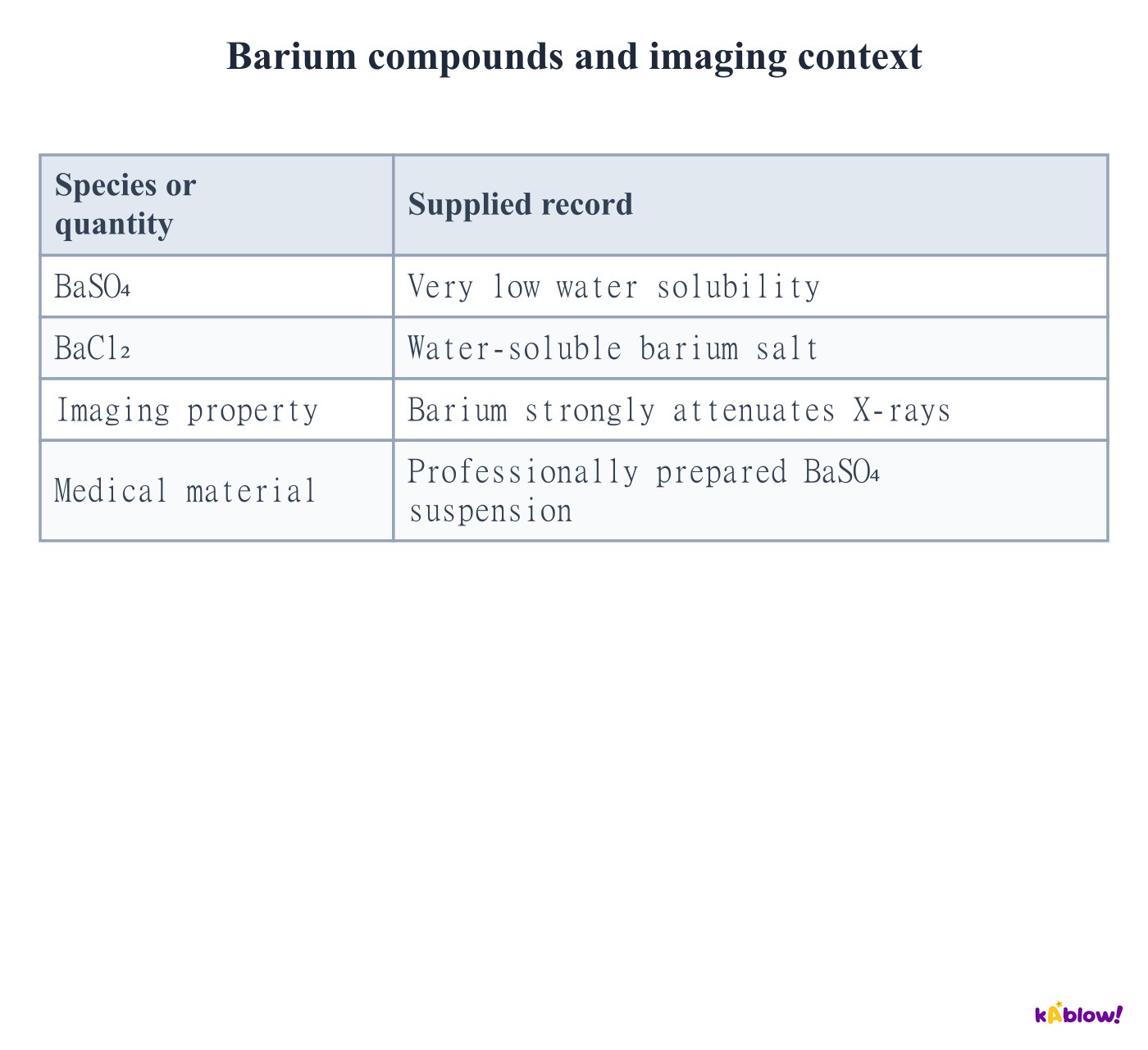
Connect barium sulfate properties to contrast imaging
- A professionally prepared BaSO₄ suspension can make parts of the digestive tract more visible on X-ray images because barium strongly attenuates X-rays.
- The very low solubility of BaSO₄ limits release of dissolved Ba²⁺; a soluble salt such as BaCl₂ is not an interchangeable substitute.
- This is a controlled medical application, not a claim that all barium compounds or all amounts are harmless. Low solubility alone does not make every procedure risk-free.
Barium compounds and imaging context
Use predictions with explicit limits
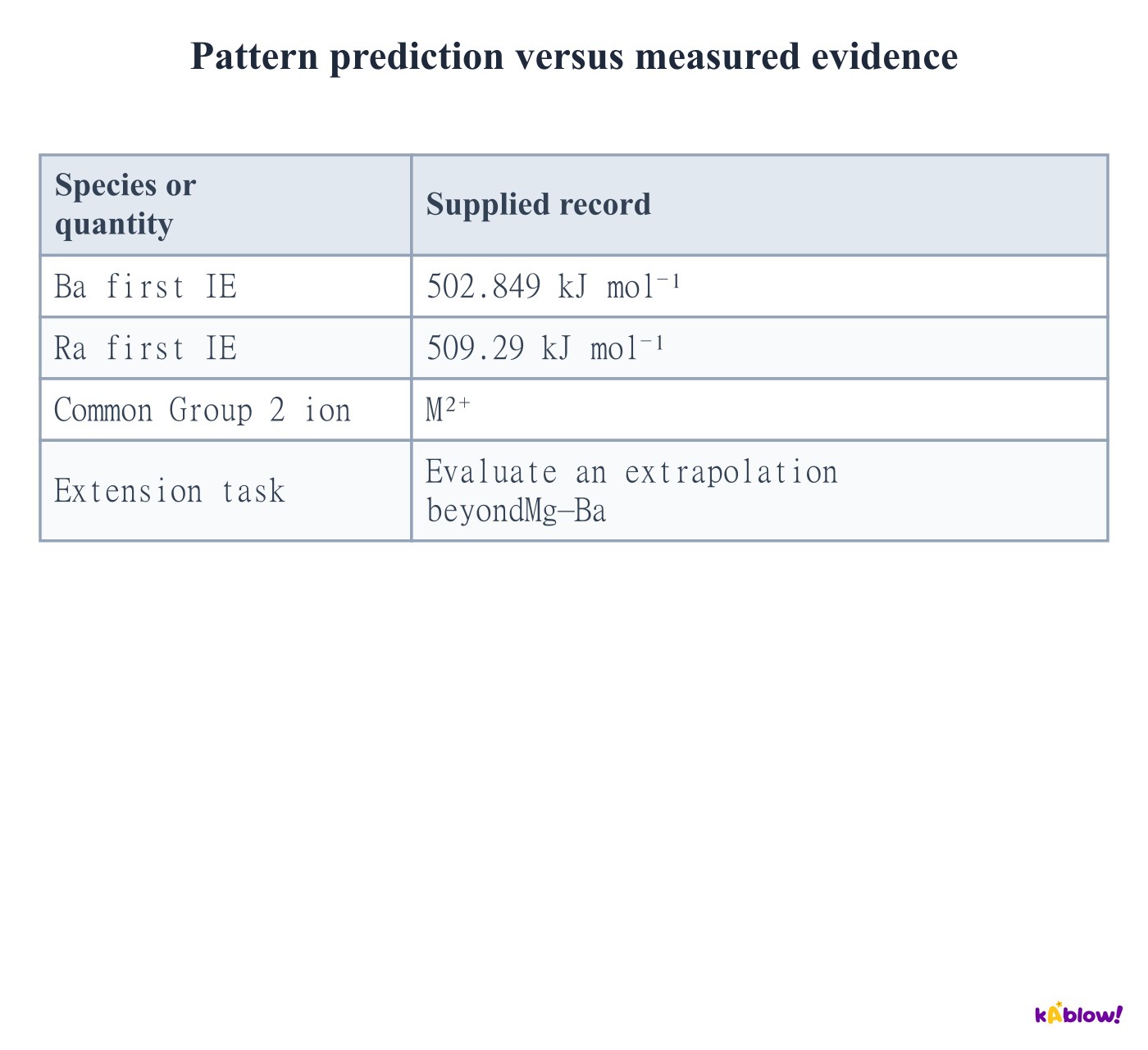
- The Mg–Ba trend supports useful qualitative predictions, but it does not guarantee every physical quantity changes monotonically beyond that range.
- The supplied primary values show Ra first IE slightly above Ba, so a prediction that it must be below Ba is contradicted by evidence. This is enrichment beyond the Mg–Ba core.
- Common Group 2+2 chemistry still suggests formulas such as RaO and Ra(OH)₂. Predicting a formula is different from knowing an exact energy, rate or solubility; radium is not a routine school practical material.
Pattern prediction versus measured evidence
投影片
練習題
免費預覽——60 題中的 8 題。註冊即可查看全部。
1.After the supplied neutral calcium atom loses its two outer electrons, how many electrons remain?
Medium- A18
- B20
- C22
- D2
2.Which combination explains the larger radius lower down Mg–Ba?
Medium- AFewer protons and no inner electrons
- BAdditional shells and increased shielding
- CRemoval of a shell at each step
- DIdentical distance and identical shielding
3.Which statement fits the supplied Mg–Ba data?
Medium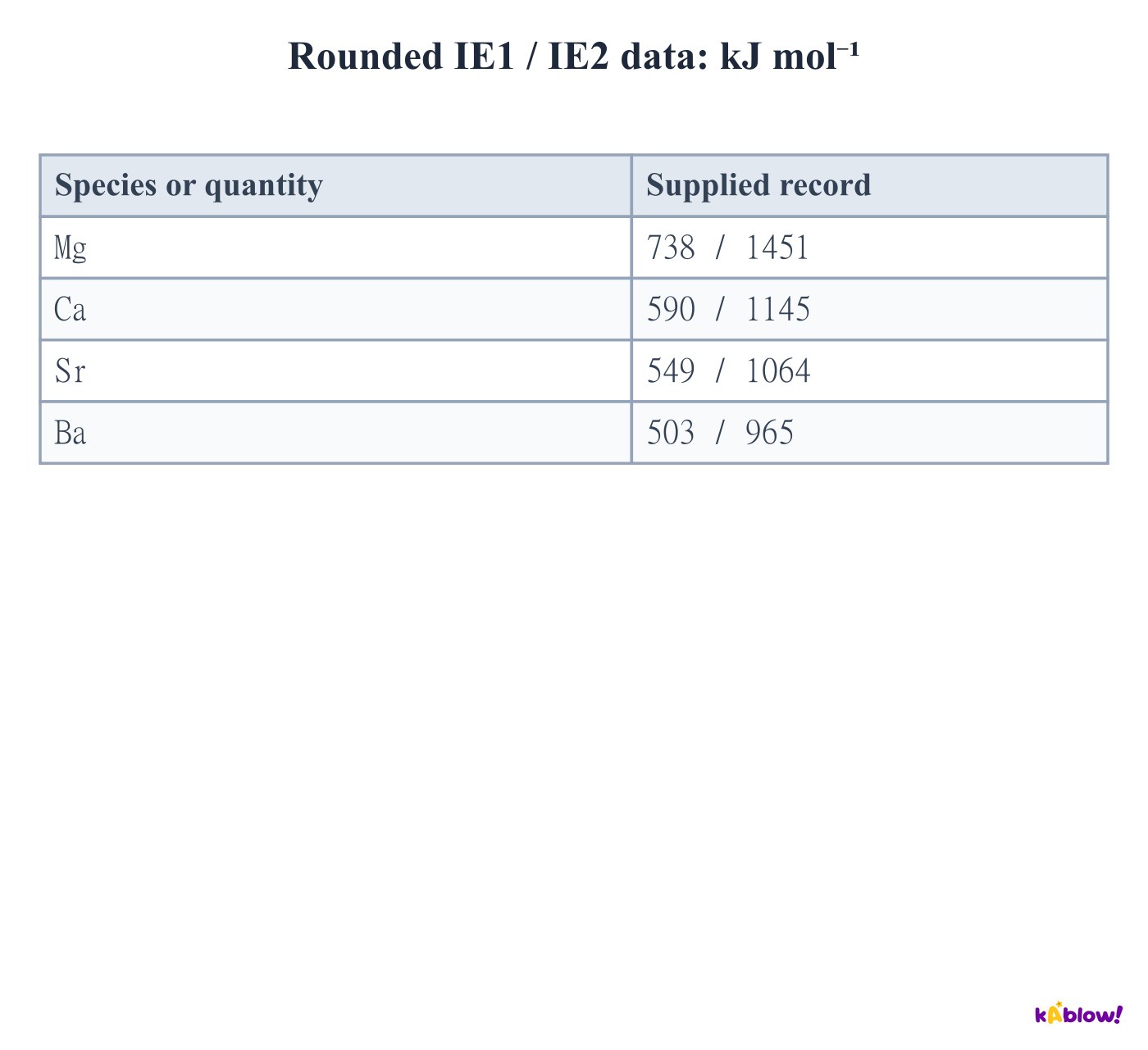
- ASecond IE is below first IE for every metal
- BBoth energies increase down Mg–Ba
- CSecond IE exceeds first IE for each element, while both decrease down Mg–Ba
- DAll entries describe removal from neutral atoms
4.Why must exposed metal area be controlled in the supplied rate comparison?
Medium- AIt fixes the number of protons in each atom
- BIt changes every metal into the same element
- CIt makes hydrogen soluble
- DDifferent areas change reagent contact and can confound the rate comparison
5.Which statement is supported by the supplied data?
Medium- AMelting rises from Mg to Ca before decreasing through Sr to Ba
- BMelting decreases at every step
- CDensity depends only on proton number
- DCa has the greatest density
6.Which equation correctly represents dissolution of solid magnesium hydroxide into its aqueous ions?
Medium- AMg(OH)₂(s)→Mg⁺+OH⁻
- BMg(OH)₂(s)⇌Mg²⁺+2OH⁻
- CMg(OH)₂(s)→Mg²⁺+OH²⁻
- DMg(OH)₂(s)→Mg²⁻+2OH⁺
7.Which distinction is scientifically correct?
Medium- ASparingly soluble means no ions ever exist
- BA slow reaction proves the product is a weak acid
- CSolubility and rate of dissolution describe different properties
- DAll dissolved hydroxides supply only one OH⁻ per formula unit
8.Which claim correctly describes precipitation?
Medium- AEvery mixture containing trace Ba²⁺ and sulfate must be visibly cloudy
- BSulfate solubility increases down Mg–Ba
- CCaSO₄ is always freely soluble
- DA precipitate requires suitable ion concentrations as well as a low-solubility salt
歷屆試題
這個主題的歷屆試題練習即將推出。
即將推出