A theme, object, visit, artwork, concept or chance mark can start an enquiry. Its usefulness depends on how it informs observation, making and decisions rather than whether the starting page looks polished.
Primary or secondary status depends on the research question. Direct observation can be first-hand evidence for a subject; books and websites can hold primary records, reproductions or secondary interpretation. Record authorship and the actual source role.
Ask what a source supplies
Compare a purposeful variation
A crop can change emphasis between an object’s context, identity and detail; scale, material, colour and arrangement can raise other questions. Select changes relevant to an intention and compare the results.
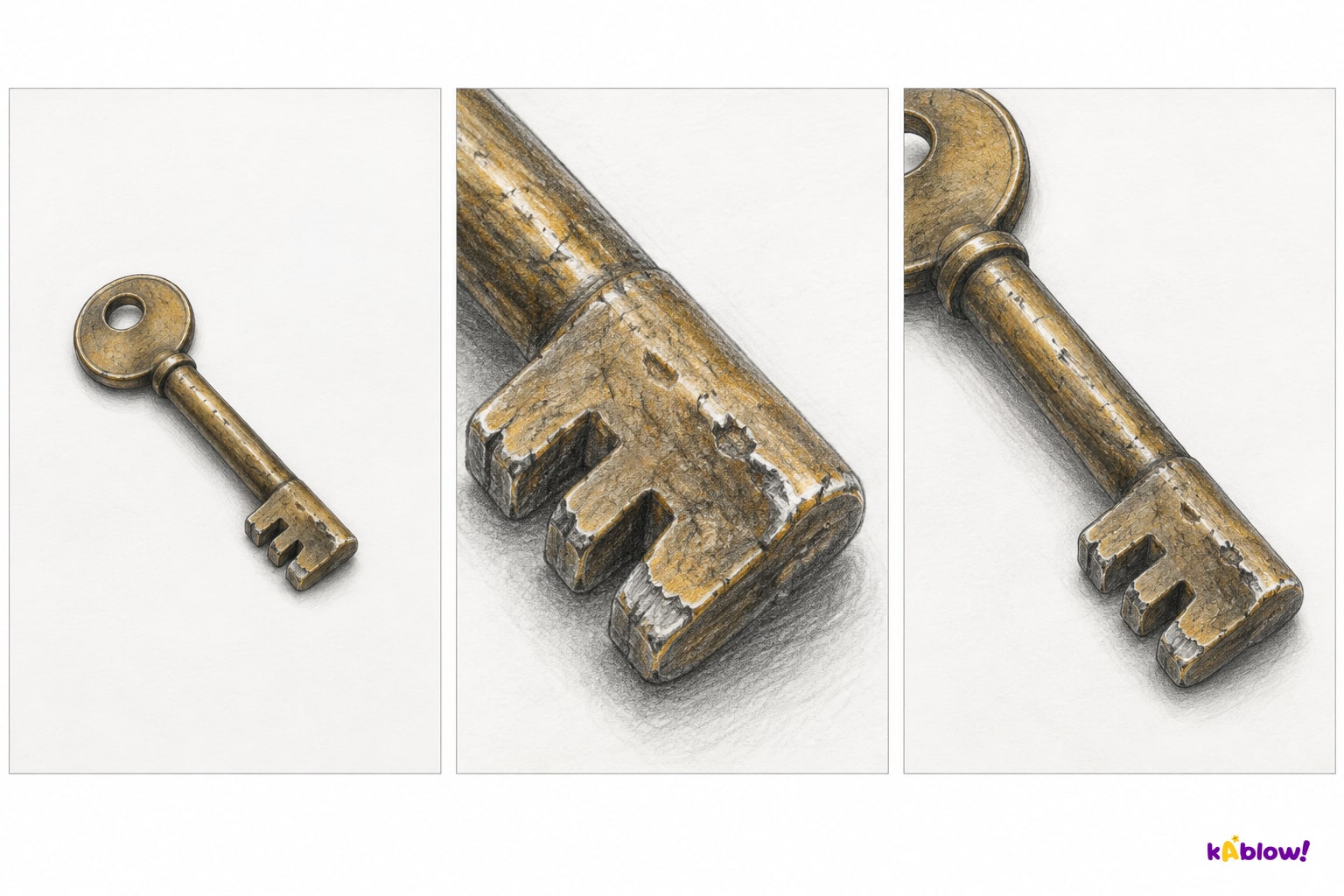
The original key studies show a broad view, close worn detail and intermediate view. They are teaching illustrations, not a student’s first-hand recording. No image is universally strongest and a crop cannot recover an unseen side of the object.
Compare emphasis in three key studies
Plan with a testable question
Thumbnails, samples, mock-ups and maquettes offer different forms of testing. State the feature being tested and what the result can or cannot reveal about the full-size outcome.
For an enquiry into surface wear, a close detail might be useful; an enquiry into access may need the whole key. This is an invented comparison of intentions, not a compulsory answer or evidence of a real student’s decision.
Choose a test for a question
Connect a source with personal development
Choose a feature in a named work and explain its relevance. A credited copy or partial study can investigate a process; a further trial develops it through your own subject, intention or decisions.
Changing colour or medium alone does not make borrowed imagery wholly original. Show the influence accurately, check appropriate use and explain what you learnt, retained or changed.
Develop a selected source feature
Originality and a flexible process
Originality involves independent, purposeful decisions rather than a demand to invent an unprecedented technique. A personal response need not disclose private identity or avoid every shared visual convention.
Research, experimentation, selection and reflection can inform each other throughout. Chance marks and earlier options can become useful; more techniques do not automatically make the enquiry stronger.
Explain a decision and a limitation
Record the tested option, observed result and reason for the next choice. In the invented key example, retaining the whole form serves one intention while a detail crop serves another.
A trial may answer a local question while leaving scale, material durability or display unresolved. Identify a useful next test rather than label an option best without a criterion.
Make the decision explicit
Achievable sources and next steps
Choose a subject you can observe appropriately and use the taught material process. Ordinary objects and familiar settings can support meaningful work; a special journey or personal disclosure is not required.
An outcome can be a drawing or another appropriate form. Select a next action from the evidence and intention, whether a new observation, material comparison, composition change or display test.
Select an achievable next action
投影片
Sign up free to view the lesson slides
Step through every slide for this topic — plus flashcards and revision notes — with a free account.