
Experimenting with materials and techniques
邊玩邊學
回答這些題目賺取能量,接著就能釣魚、探索。不需要帳號。
給教育者: 為 Experimenting with materials and techniques(Art and Design、Developing Ideas)準備好可直接使用的課程投影片, 複習筆記——用於你的課程,或把這個主題當成互動班級活動,讓學習者以即時遊戲的方式進行。
課程筆記
Experiments answer different questions
- Begin with an intention or an open possibility and inspect what happens. A sample may investigate a mark, edge, material property, arrangement or scale; its purpose matters more than the number of techniques used.
- Creative risk concerns an uncertain artistic result within the taught process. An unexpected result may be useful when observed and evaluated, while dangerous tool use is not an assessment requirement.
Connect the test with an enquiry
Technique relationships and compatibility
- Wax resist can preserve underlying areas against a compatible water-based wash. A painting glaze lets earlier colour show through; scumbling uses a broken relatively opaque layer; sgraffito scratches through one layer to reveal another. Ceramic glazing is a different process.
- Transfers, collagraphs, clay, wire and mixed-media combinations need their specified material system and taught method. Do not infer a universal heat, solvent, firing or inking recipe from a technique name.
Compare original application studies
- The illustrative sampler contrasts diffused wet-on-wet colour, a more defined wet-on-dry edge, dry-brush deposits with gaps and raised impasto. Discuss the visible differences against a chosen intention.
- These are original teaching images, not measured experimental evidence. They do not establish exact paint composition, dilution, drying time or the result of every product on every support.
Compare application effects
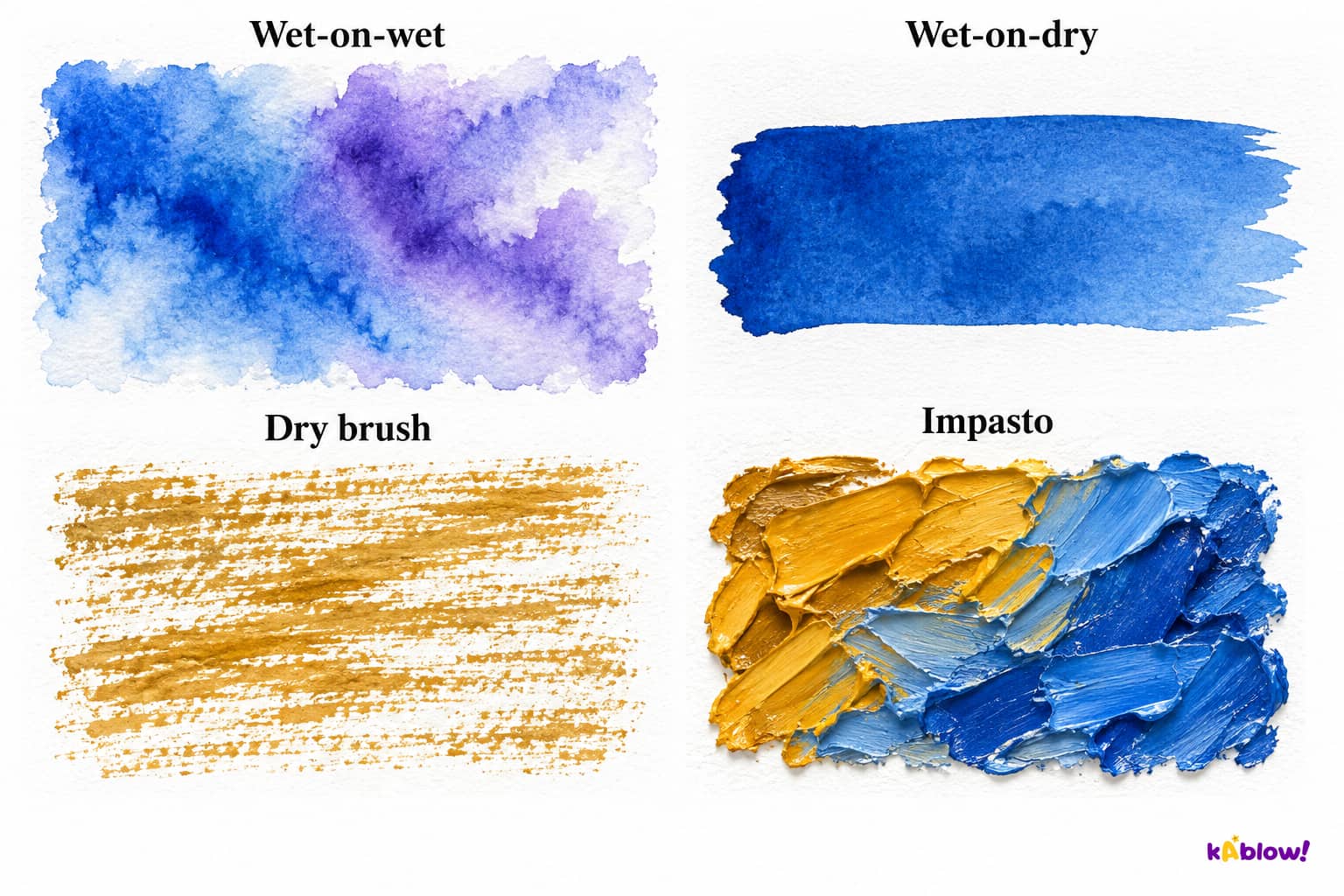
Focused comparisons and their limits
- Changing one selected factor while keeping relevant conditions comparable can help investigate its effect. Open-ended trials may change more than one factor, but cannot as readily attribute a result to one cause.
- A single comparison does not guarantee proof: handling, material variation, drying conditions and interactions may still matter. Record relevant influences and choose whether a repeat or further comparison would clarify the result.
An invented focused comparison
Record and evaluate honestly
- Identify the sample, materials, method, intention and relevant conditions, then describe the actual result. Photographs or separately stored samples may support the record where bulky or fragile materials do not belong in a book.
- Explain what the observation suggests, what remains uncertain and what to test next. A disliked result can still be informative; fabricated observations or retrospective claims about an unperformed process misrepresent the evidence.
Make the record useful
Source connections and personal trials
- Investigate a specific feature of a named work using a reliable source. Distinguish a visible effect from an exact historical recipe that the available evidence does not establish.
- A credited study can support a later personal adaptation. Explain what your trial changed and how the effect serves the intention rather than assume unfamiliar tools or more media automatically improve the work.
Avoid an invented historical recipe
Use the approved material and tool system
- Follow the specified material instructions, supervision, process controls and cleanup. Protection or ventilation must suit the actual task; an open window or generic mask is not a complete plan for every spray, solvent or dust.
- Keep creative uncertainty separate from physical hazards. For unfamiliar tools, adhesives, mixed materials or heat processes, seek the taught method rather than improvise a procedure from a short definition.
Creative uncertainty and physical safety
Choose a next decision
- Compare the observation with the intention, then decide whether to repeat, change a condition, explore an alternative or revise the aim. Refinement may simplify the work rather than add layers or detail.
- A small sample has limits at final scale. Record a remaining question about marks, support, assembly or display so the next action follows evidence rather than the cost or novelty of the materials.
投影片
練習題
免費預覽——33 題中的 8 題。註冊即可查看全部。
1.What is a sample?
Easy- Aa test piece used to investigate a material, process or effect
- Ba final work
- Ca tool
- Da frame
2.What does creative risk mean in a supervised art enquiry?
Easy- Aignoring the tool instructions
- Bmixing unknown chemicals without guidance
- Cusing dangerous equipment without supervision
- Dtrying an uncertain artistic possibility within the approved process
3.What is wax resist in a suitable watercolour study?
Easy- Aa type of brush
- Ba type of clay
- Cwax marks resisting the water-based wash so underlying areas remain visible
- Da type of paper
4.What is scumbling?
Easy- Aa print
- Ba broken, relatively opaque paint layer through which underlying colour remains visible
- Cthick paint
- Da drawing
5.What is scratching through an upper paint layer to reveal underlying colour commonly called?
Easy- Asgraffito
- Bcollage
- Cglazing
- Dstippling
6.What is a transfer?
Easy- Adrawing
- Bpainting
- Ccarving
- Dtransferring an image or marks between surfaces using a suitable process
7.What is layering?
Easy- Aerasing
- Bframing
- Cplacing successive materials or marks over one another
- Dusing one layer
8.What is a mixed-media experiment?
Easy- Aerasing
- Bcombining materials in one test
- Cusing one material
- Dcopying
歷屆試題
這個主題的歷屆試題練習即將推出。
即將推出