Check the current specification and assessment arrangements for your chosen board: paper names, timing and programming requirements vary.
This generic lesson practises computer-systems knowledge, algorithms, tracing and programming responses; its illustrative papers do not represent official exam documents.
Preparing systems and programming skills
Command words
State/Give/Name: short fact. Describe: say what something is or does. Explain: give a reason ("because"). Compare: similarities and differences. Evaluate/Discuss: weigh up advantages and disadvantages and reach a judgement. Write/Complete: produce code or fill in a table.
Answering a storage question
Reading and writing algorithms
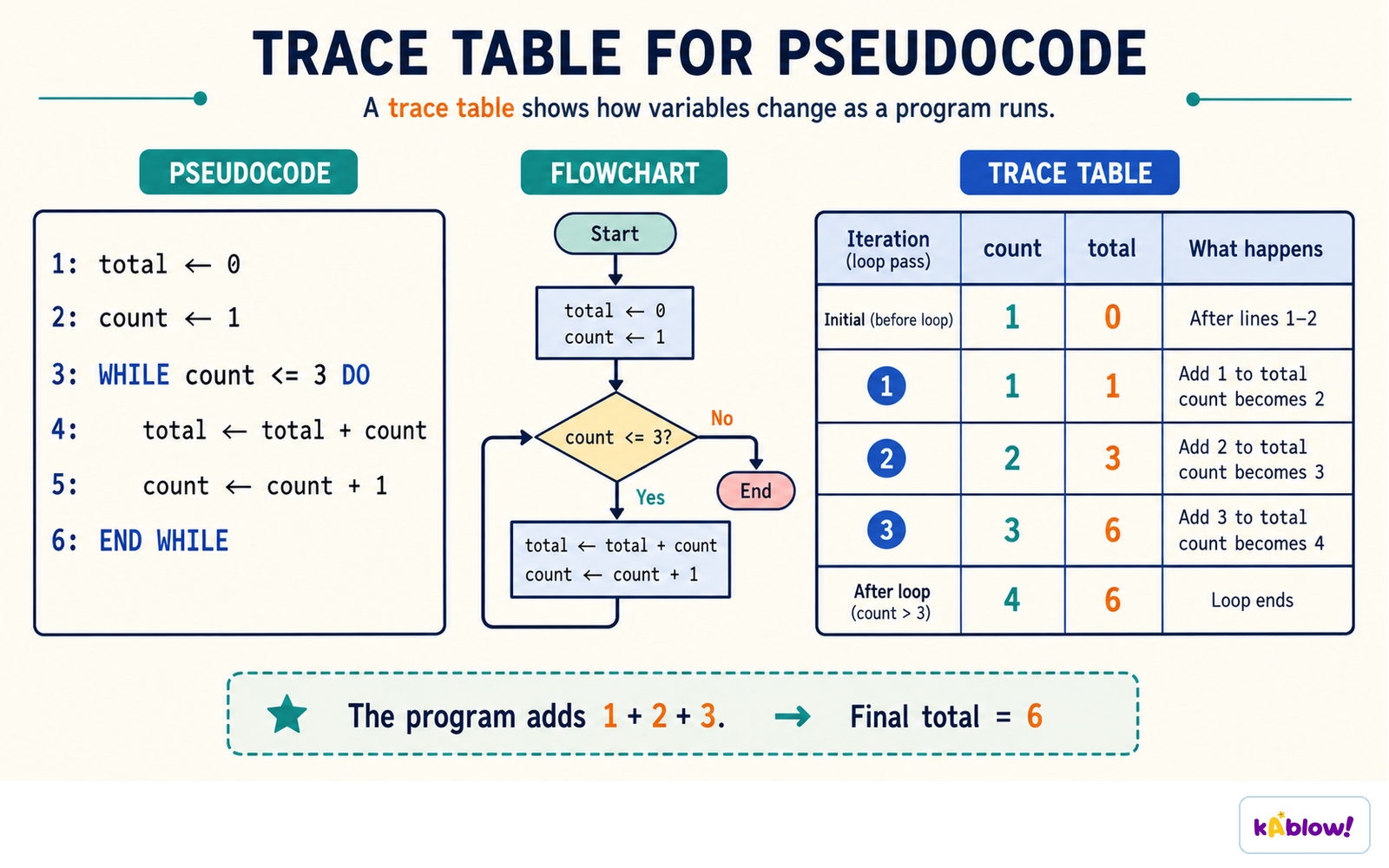
Read pseudocode carefully; trace with a table; write code using the language or pseudocode listed. Use meaningful names, indentation and comments. Check boundaries and loop conditions (off-by-one errors).
Check an algorithm with a trace
Extended-response questions
Use chains of reasoning: point, because, therefore. Apply knowledge to the scenario; use technical terms accurately; include both sides for evaluation.
Calculations
Convert between binary, denary and hexadecimal; file-size calculations; show working.
Time management
Use the paper’s actual duration and total marks to plan an approximate time budget, leaving time to check. Do not assume a universal one-mark-per-minute rule.
Attempt relevant steps in difficult questions; partial-credit rules depend on the mark scheme.
Revision
Practise past papers; flash cards for key terms; write code; use trace tables; review mistakes.
投影片
Sign up free to view the lesson slides
Step through every slide for this topic — plus flashcards and revision notes — with a free account.