
Speaking and writing in French
邊玩邊學
回答這些題目賺取能量,接著就能釣魚、探索。不需要帳號。
給教育者: 為 Speaking and writing in French(French、Exam Skills)準備好可直接使用的課程投影片, 複習筆記——用於你的課程,或把這個主題當成互動班級活動,讓學習者以即時遊戲的方式進行。
課程筆記
Speaking tasks
- Speaking tasks differ by board and tier. Role plays simulate a communicative situation, visual tasks use supplied pictures and conversations develop responses to questions. AQA 8652 includes reading aloud with follow-up interaction; check your current specification rather than assuming one universal format.
- Answer the exact prompt with appropriate length and register. A role play may require a specific question as well as an answer. An accurate relevant sentence is more useful than an unrelated memorised speech; more words do not automatically earn credit.
Match language to the task
Developing answers
- Develop an opinion with a reason and relevant detail: J’aime ma ville parce qu’il y a un parc. Le week-end, j’y retrouve mes amis. Parce que and car give reasons, cependant contrast, de plus addition and par exemple an example.
- Use time frames that the question requires. J’ai visité is perfect, je vais visiter a future plan and je voudrais visiter a conditional wish. J’ai alone can be present possession; je vais alone can be present movement. Accuracy and relevance matter as well as variety.
Develop the answer coherently
Describing a photo
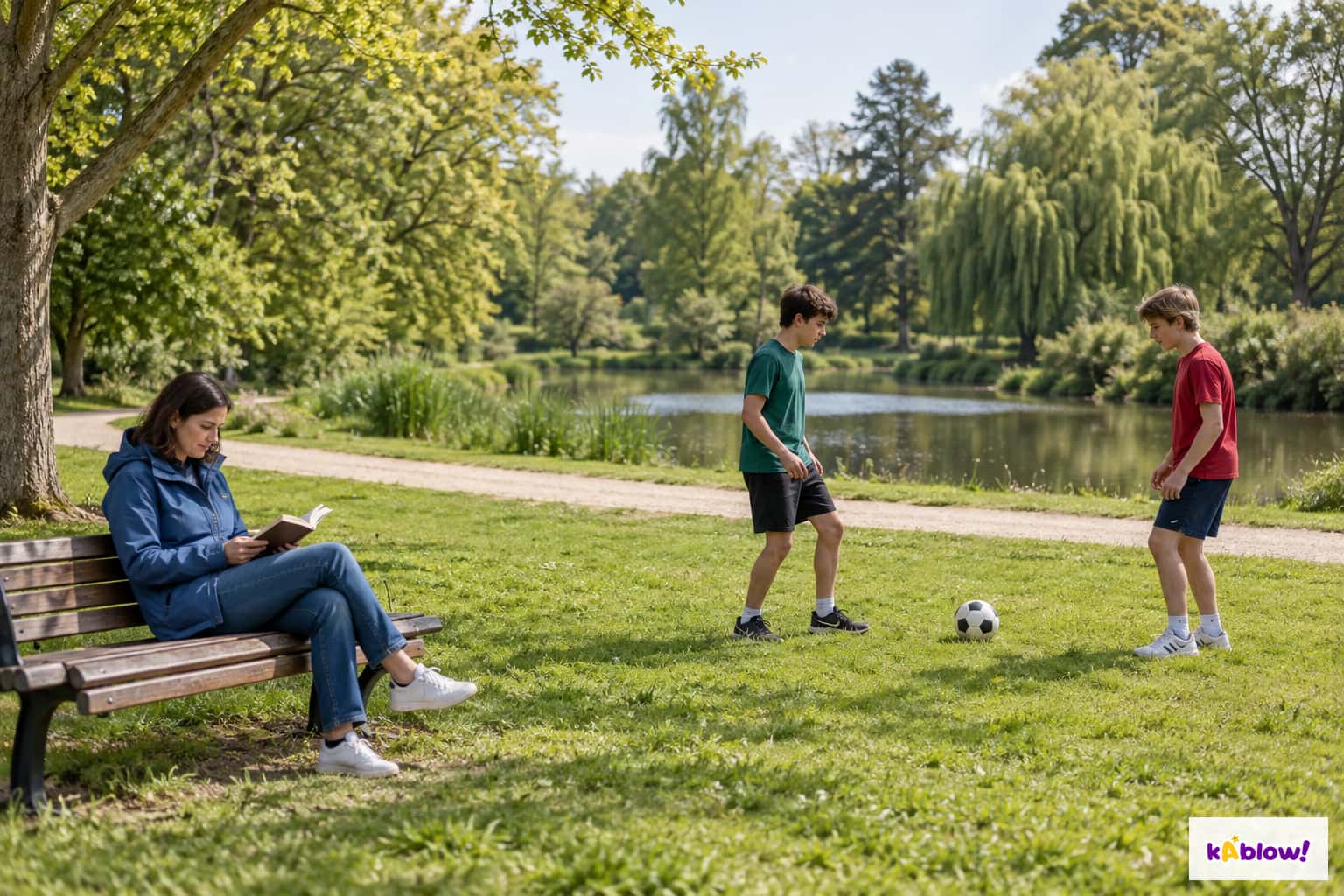
- Use the original generated park scene for practice: Sur l’image, il y a trois personnes. À gauche, une personne en veste bleue lit sur un banc. À droite, deux personnes sont près d’un ballon. À l’arrière-plan, on voit des arbres et de l’eau.
- Left/right normally follow the viewer’s perspective; au premier plan is foreground and à l’arrière-plan background. Visible people do not prove family relationships, names, nationality or feelings. Distinguish observation from a tentative inference, and do not claim the still ball is visibly being kicked.
Original park scene for picture description
Handling unexpected questions
- Je ne comprends pas means I do not understand; pouvez-vous répéter, s’il vous plaît ? asks for repetition and pouvez-vous parler plus lentement ? asks for slower speech. These are useful in ordinary conversation, but assessment rules control what an examiner may repeat or rephrase.
- A brief pause or eh bien can help organise a response. En fait introduces a clarification and is not empty padding. Rephrase with known language when possible; a string of fillers cannot replace the information requested.
Choose a repair phrase
Writing tasks
- Plan from the actual bullet points, response type and stated word count. Word counts differ by board, tier and task, so 90–150 words is not a universal requirement. Cover each requested point clearly; a coherent order can differ from the printed order unless instructions specify otherwise.
- Draft connected relevant sentences, then check content and meaning before fine details. Use appropriate reasons and time frames rather than adding grammar solely to make the answer longer. The lesson’s models are fictional practice examples, not compulsory scripts.
Plan and check the actual writing task
Translation into French
- Translate the meaning with the intended speaker, time and references. Example: Mes amis sont contents parce qu’ils vont visiter un musée. The plural possessive, verb and adjective agree; aller plus infinitive describes the plan.
- For a feminine plural group, Mes amies sont contentes parce qu’elles vont visiter un musée is valid. Check articles, possessives, negatives and word order rather than transferring English literally. Do not infer someone’s grammatical self-reference from a name or appearance.
Translate the intended reference
Checking
- Check first whether the response answers the task and preserves who, when, meaning, negation and quantity. Then check verb forms, noun/adjective agreement, articles, pronouns and word order.
- Check accents and spelling, including a/à and ou/où, plus punctuation and capitals. These can affect meaning or pronunciation. Assessment consequences depend on the criteria; do not assume every accent error has the same fixed penalty or that accents never matter.
Proofread meaning before fine details
Complex structures
- Après avoir mangé, j’ai fait mes devoirs uses a past infinitive followed by a completed main action. The implied eater and main subject are the same in this model. Select avoir or être as required by the infinitive; not every past infinitive uses avoir.
- S’il pleut, je resterai à la maison uses si plus present and future for a real future condition. Quand je serai adulte, je voyagerai uses future for the stated future-time meaning. Use these patterns accurately when relevant; they are not automatic rules for every use of si or quand.
Use a structure for its stated meaning
投影片
練習題
免費預覽——37 題中的 8 題。註冊即可查看全部。
1.What does "à gauche" mean?
Easy- Aon the left
- Bon the right
- Cat the front
- Dat the back
2.What does "à droite" mean?
Easy- Aon the left
- Bat the front
- Cat the back
- Don the right
3.What does "au fond" mean?
Easy- Aon the left
- Bat the end of the year
- Cin the background
- Din the foreground
4.What does "au premier plan" mean?
Easy- Aat the top
- Bin the foreground
- Cin the background
- Don the right
5.What does "ils sont en train de jouer" mean?
Easy- Athey are playing
- Bthey were playing
- Cthey will play
- Dthey played
6.What does "je ne comprends pas" mean?
Easy- AI do not know you
- BI do not agree
- CI do not like
- DI do not understand
7.What does "pouvez-vous parler plus lentement" mean?
Easy- Acan you write more
- Bcan you speak faster
- Ccan you speak more slowly
- Dcan you speak louder
8.In a conversation, what can « eh bien » help a speaker do?
Easy- Asays no
- Bintroduce a response and allow a brief thinking pause
- Cends the conversation
- Dasks a question
歷屆試題
這個主題的歷屆試題練習即將推出。
即將推出