
Energetics
Apprends en jouant
Réponds à ces questions pour gagner de l'énergie, puis pêche et explore. Sans compte.
Notes de leçon
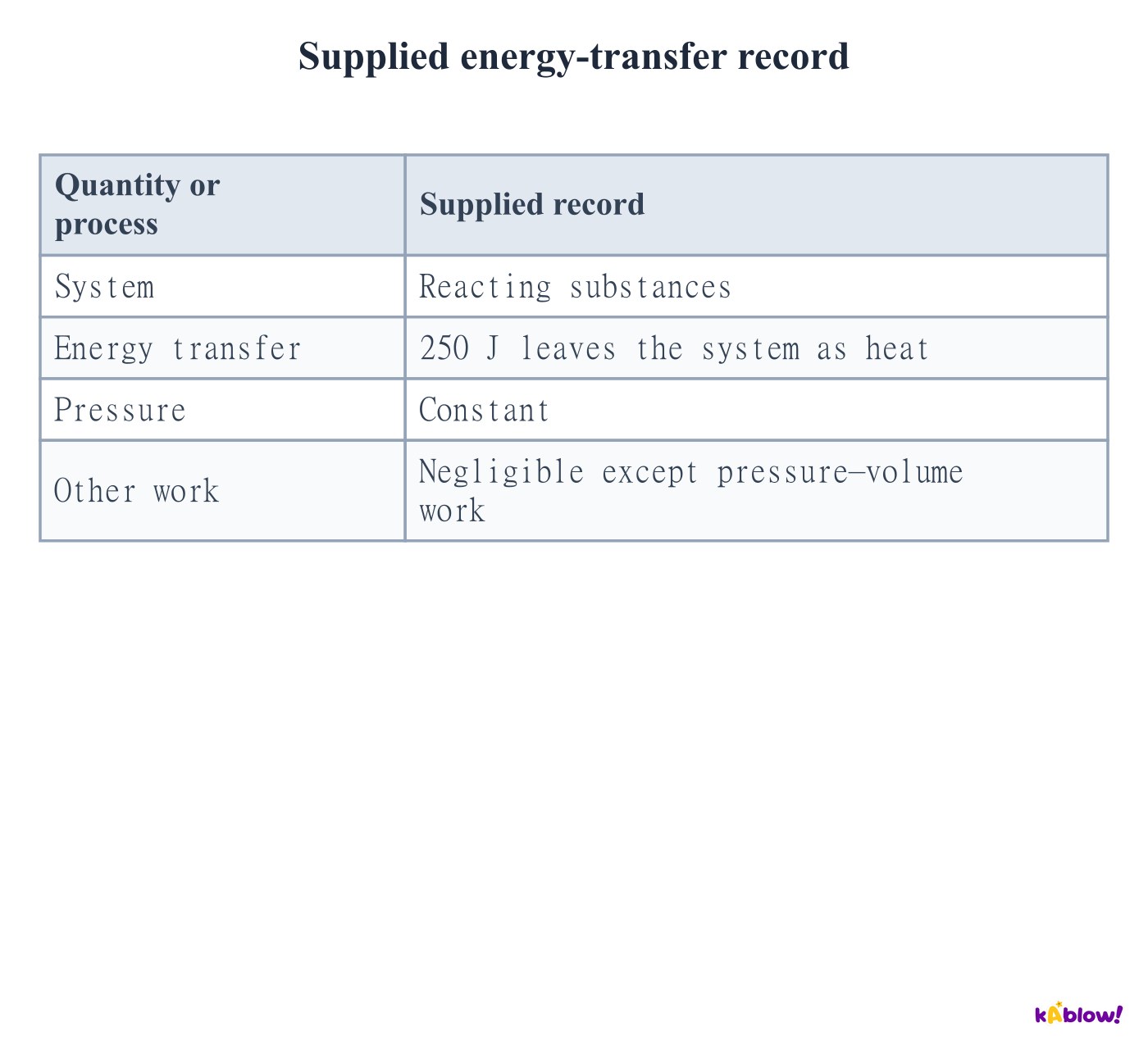
Identify the system and the sign of heat transfer
- The reacting substances form the system; the solution, calorimeter and wider environment can form parts of the surroundings. Always name the boundary before assigning a heat sign.
- At constant pressure, with only pressure–volume work under the usual calorimetry assumptions, the heat transferred to the system equals its enthalpy change. Exothermic changes have negative ΔH; endothermic changes have positive ΔH.
- A temperature rise in an initially equilibrated surrounding solution can indicate an exothermic reaction. A controlled-temperature bath can absorb heat without warming, so warming is not the definition of exothermicity.
Supplied energy-transfer record
Account for bond breaking and bond formation
- Breaking a specified covalent bond requires energy; forming that bond from the separated gaseous atoms releases energy. Reaction enthalpy reflects the balance of all relevant changes.
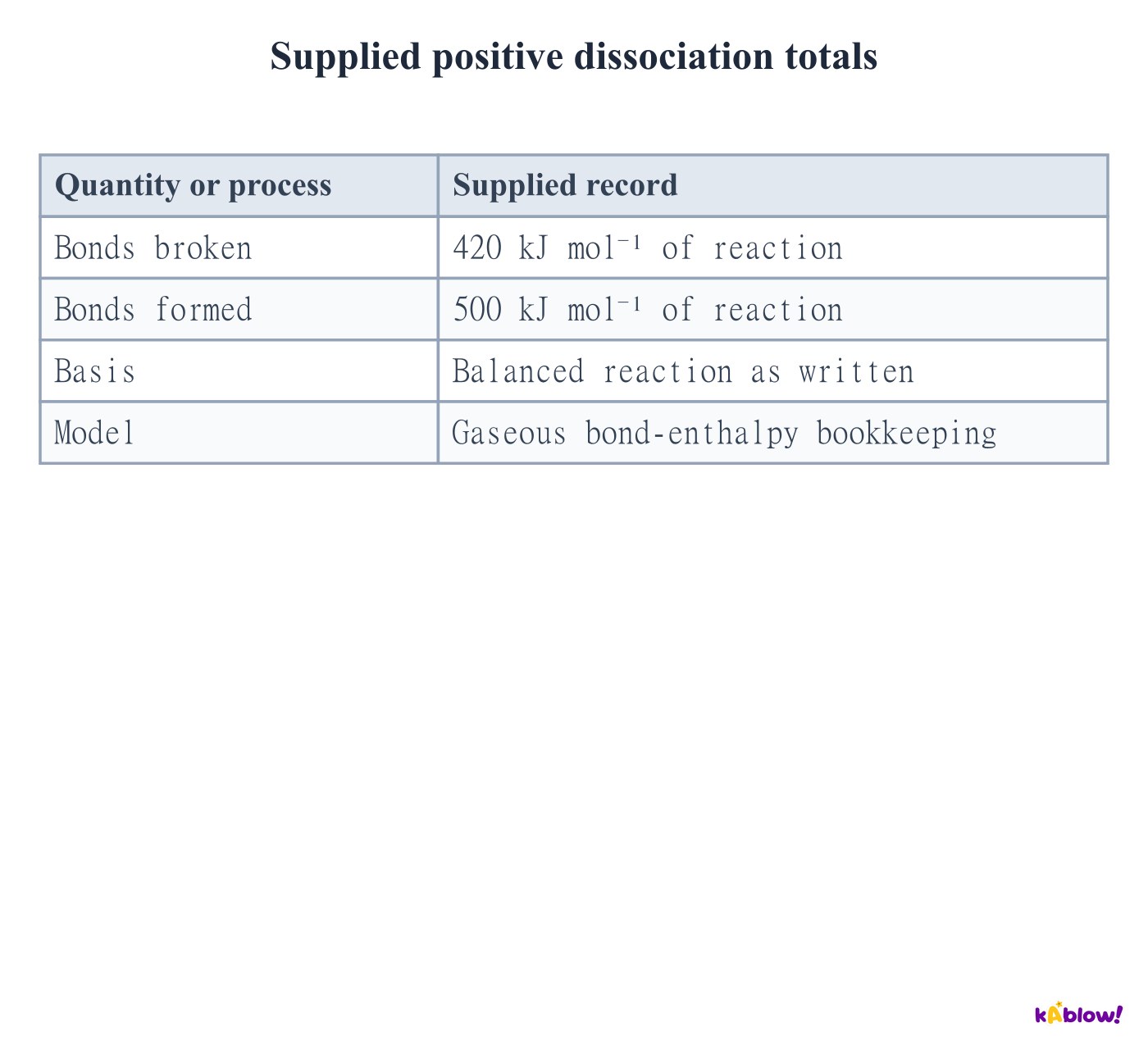
- Using positive bond-dissociation magnitudes, estimate ΔH as the total for bonds broken minus the total for bonds formed. A larger release on formation gives a negative overall result.
- The imagined route through gaseous atoms is a bookkeeping route. It does not claim that every real reaction proceeds by first breaking all reactant bonds into isolated atoms.
Supplied positive dissociation totals
Read enthalpy changes from a reaction profile
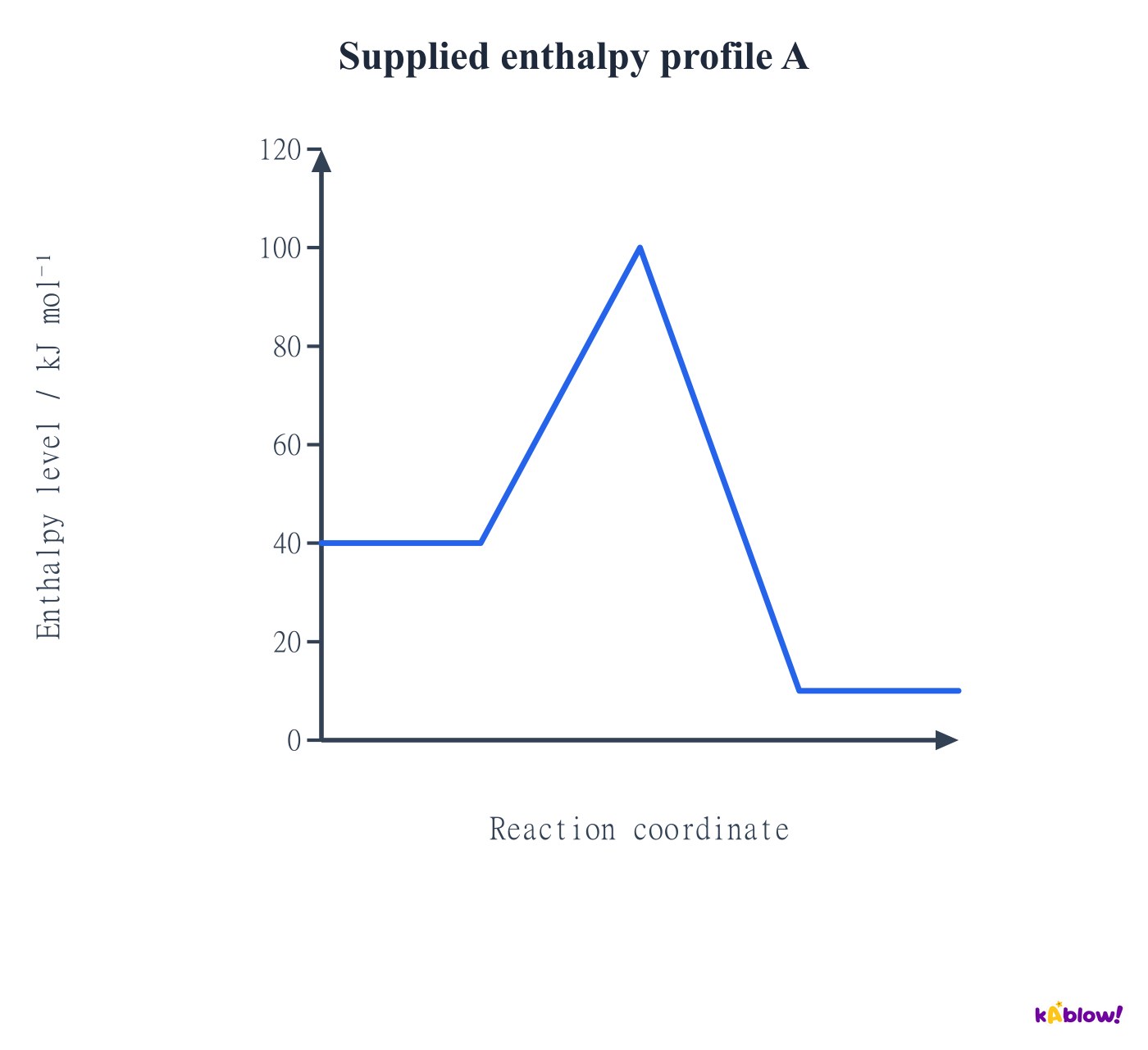
- A reaction profile compares reactant, transition-state and product levels along a reaction coordinate. The horizontal coordinate is not elapsed time.
- The vertical difference products minus reactants gives ΔH. The forward activation barrier is measured from reactants to the transition-state maximum.
- The supplied piecewise-linear profile is an idealised reading model, not a measured molecular trajectory. Read the endpoint levels and maximum separately; the zero on the axis is a reference level.
Supplied enthalpy profile A
Separate activation barriers from reaction enthalpy
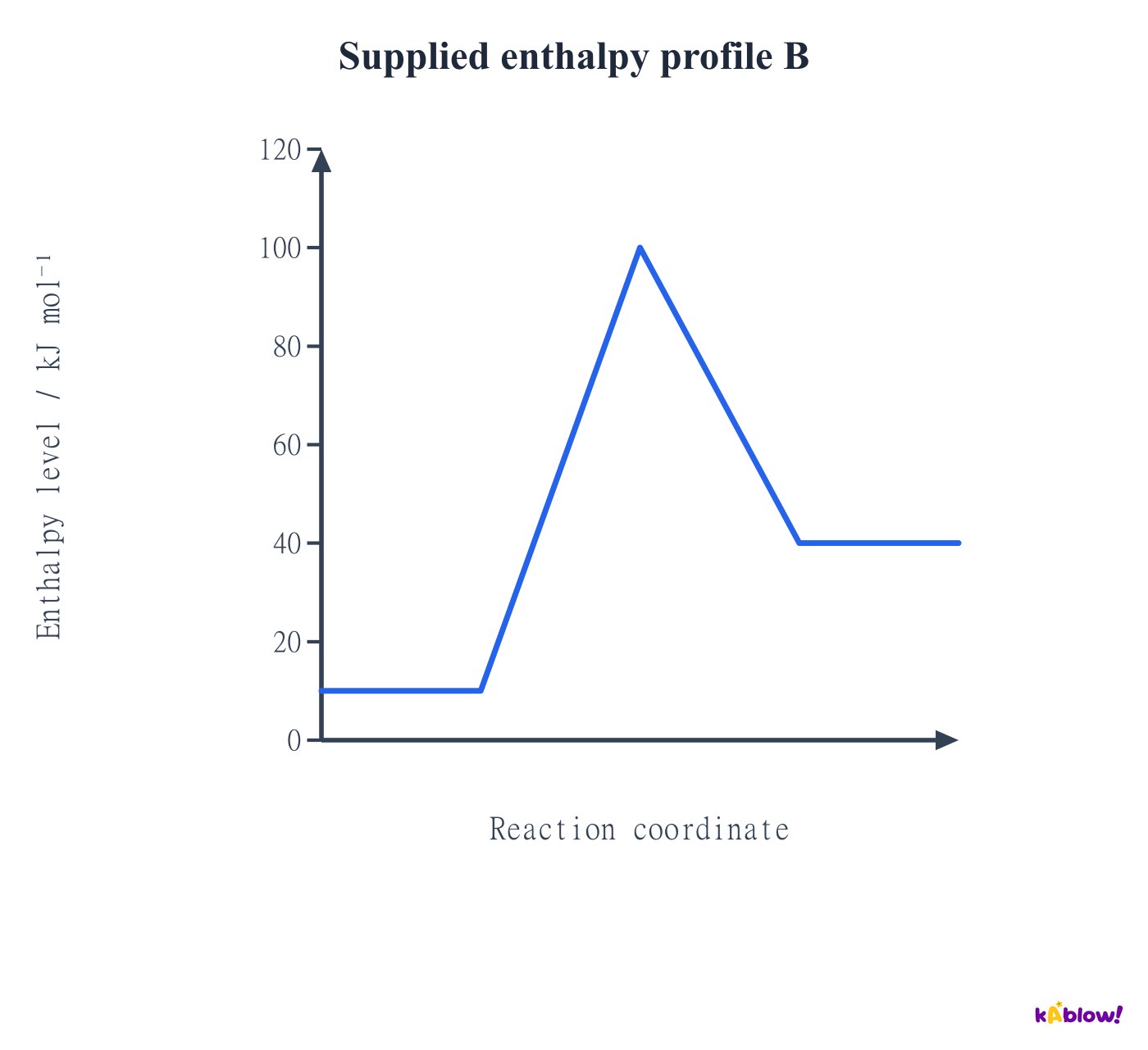
- For the same single-step profile, forward and reverse barriers reach the same maximum. The forward barrier minus the reverse barrier therefore equals ΔH in this simple energy-level model.
- An exothermic reaction can still have a large activation barrier and proceed slowly. The sign of ΔH alone does not determine a rate or establish thermodynamic spontaneity.
- A catalyst offers a different route with a lower barrier while leaving reactant and product enthalpies unchanged. Transition states are not isolable reaction intermediates.
Supplied enthalpy profile B
Specify standard conditions and physical states
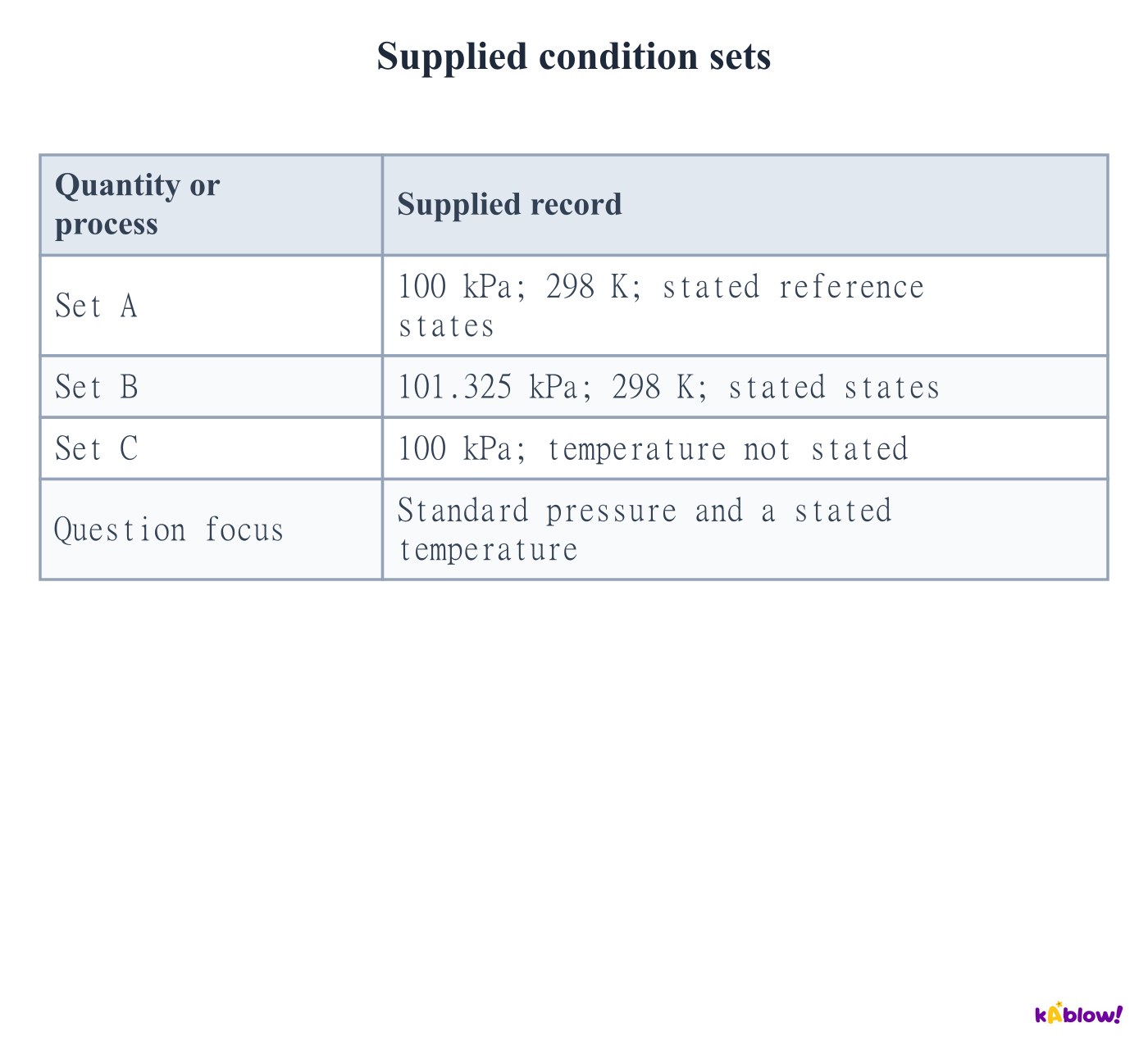
- A standard enthalpy change refers to standard pressure, 100 kPa, and a stated temperature, often 298 K. The standard-state symbol does not force every measurement to be at 298 K.
- Use the appropriate reference state at that temperature and pressure. State symbols matter: forming H₂O(l) and H₂O(g) gives different enthalpy changes.
- For solution problems, state the concentration or standard-solution convention when relevant. One bar is 100 kPa; one atmosphere is 101.325 kPa, a distinct pressure.
Supplied condition sets
Define standard enthalpy of formation
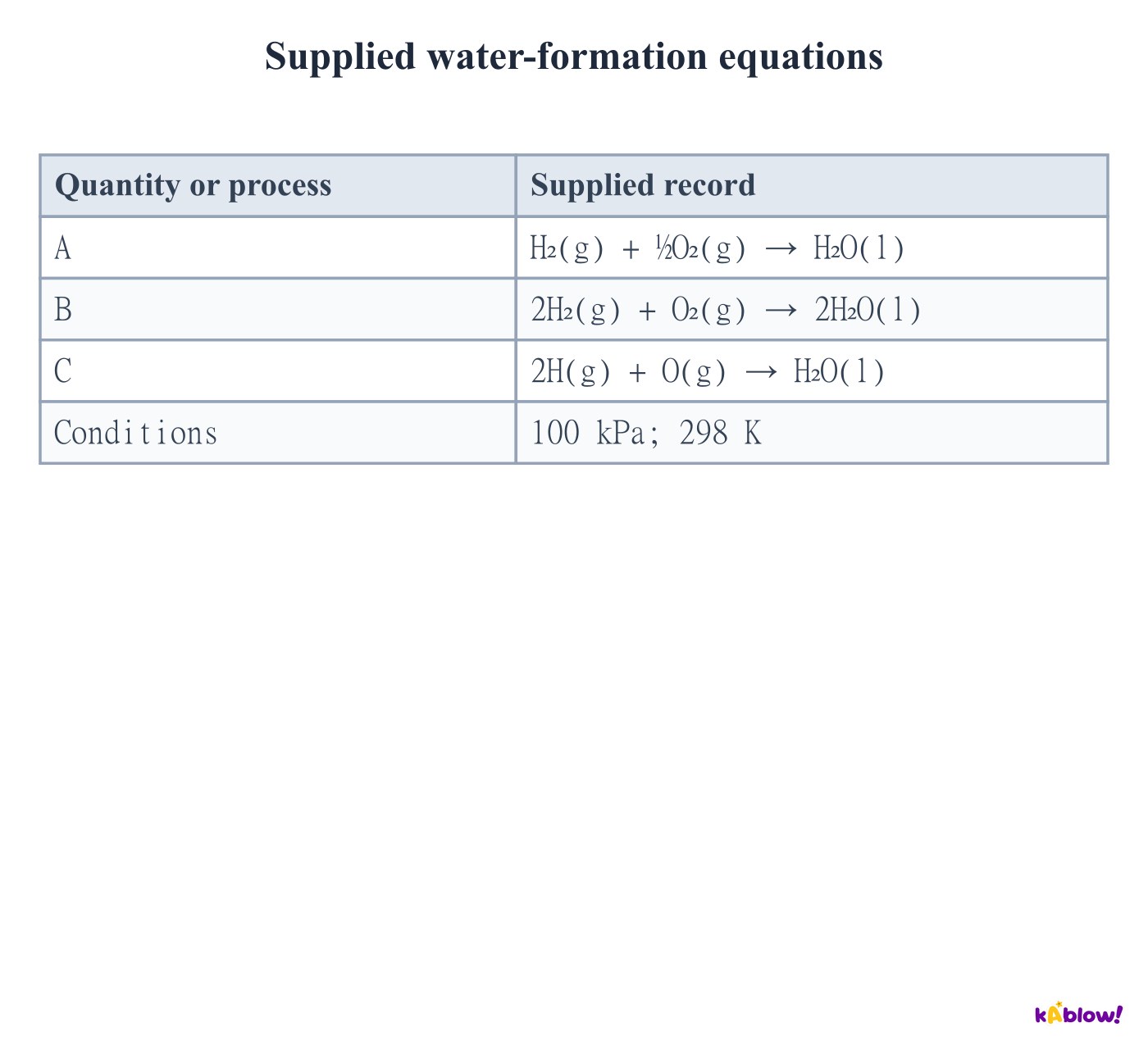
- The standard enthalpy of formation is the enthalpy change when one mole of a substance forms from its constituent elements in their reference states at standard pressure and the stated temperature.
- Fractional coefficients can be necessary to form exactly one mole. For H₂O(l), H₂(g) + ½O₂(g) → H₂O(l) is a formation equation at the stated conditions.
- An element in its reference state has zero standard formation enthalpy by convention. This does not assign zero to every allotrope or to isolated gaseous atoms of that element.
Supplied water-formation equations
Define standard enthalpy of combustion
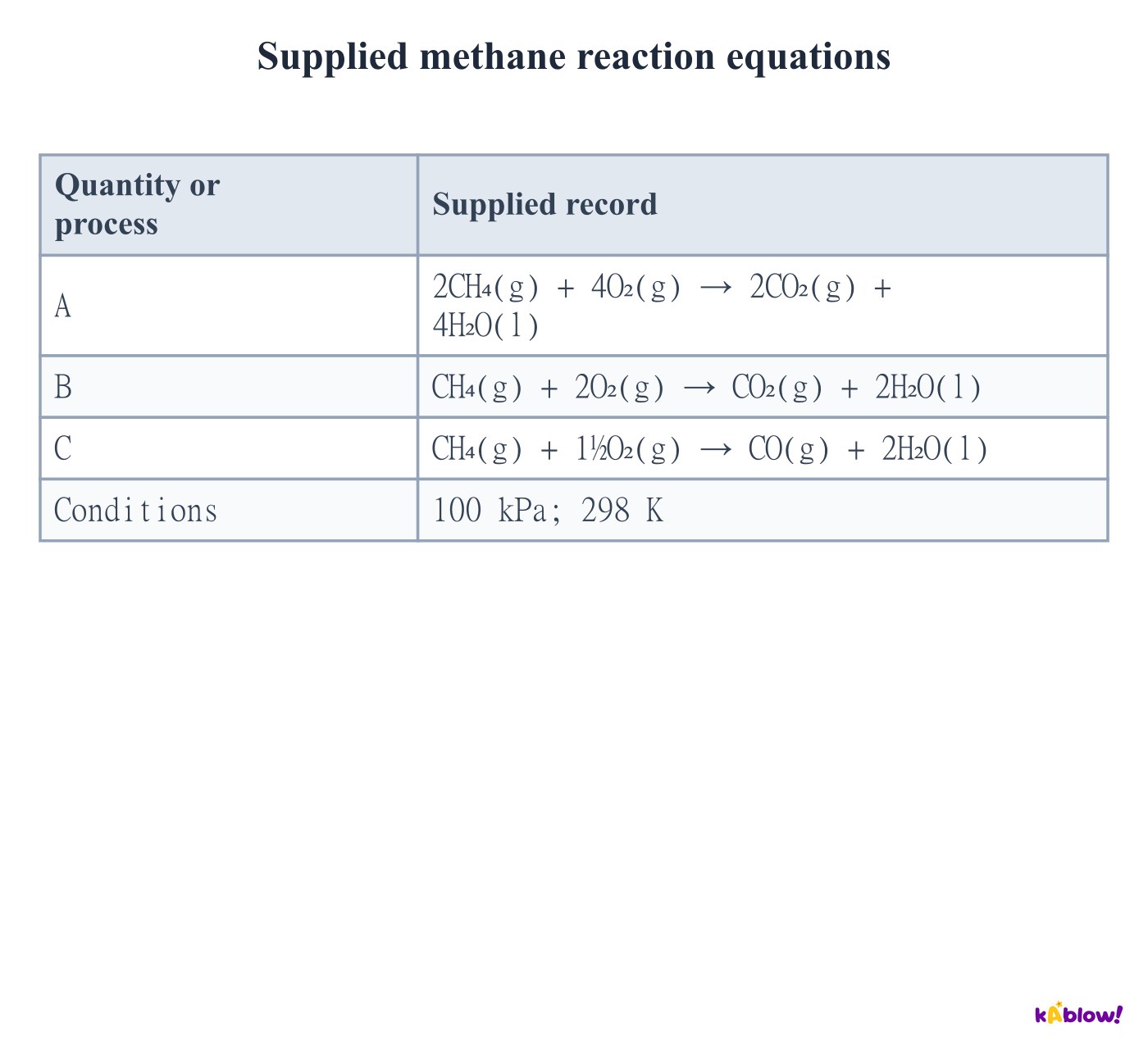
- The standard enthalpy of combustion refers to complete burning of one mole of a substance in oxygen, with reactants and products in their specified standard states at the stated temperature.
- Normalise the equation to one mole of fuel and include product states. Carbon dioxide and liquid water are the usual specified products for standard hydrocarbon combustion near 298 K.
- A formation equation can also be a combustion equation, as when one mole of carbon in its reference form burns to one mole of CO₂(g). These labels need not be mutually exclusive.
Supplied methane reaction equations
Reverse and scale thermochemical equations
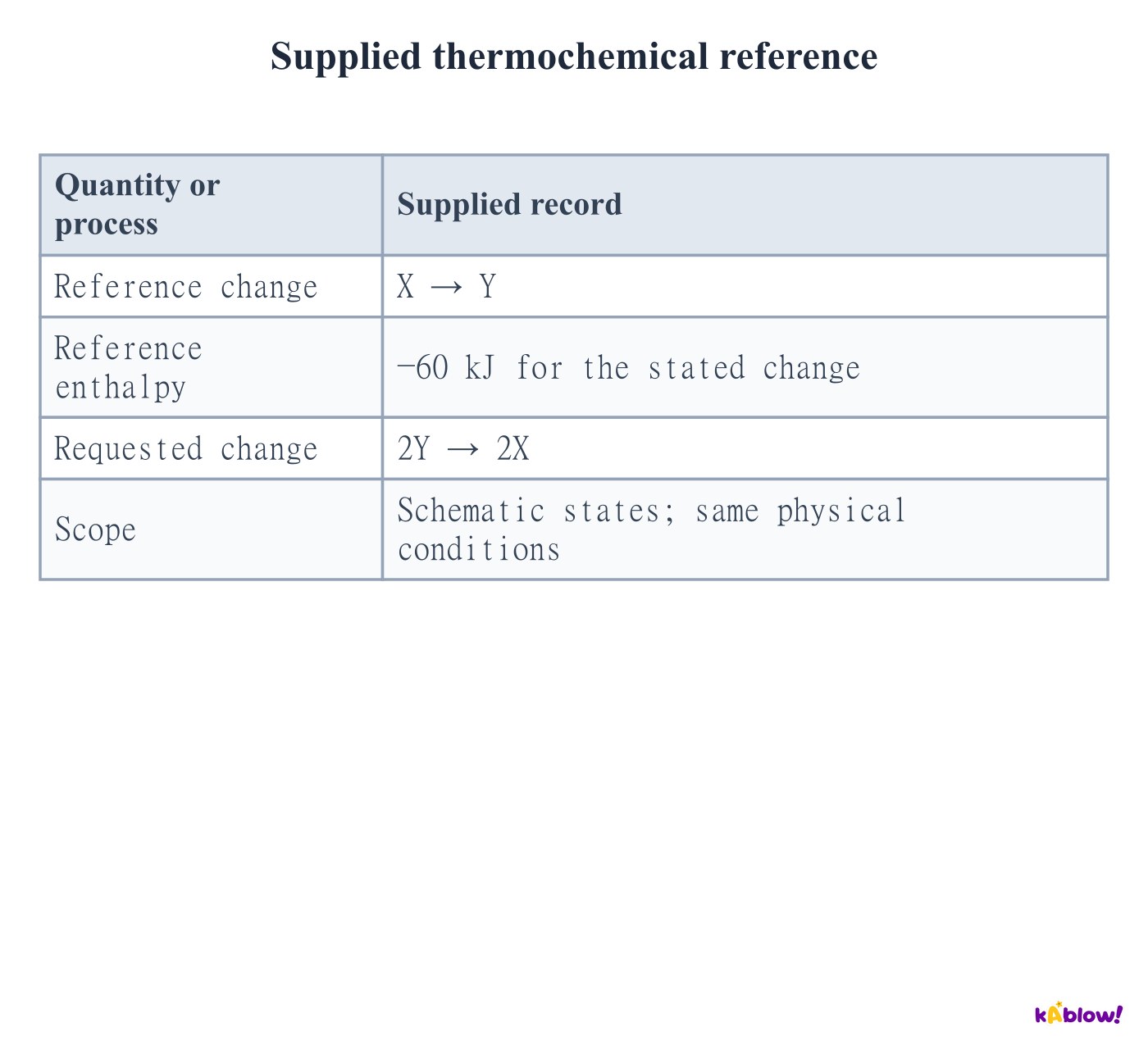
- Reversing a thermochemical equation reverses the sign of its enthalpy change. Multiplying every coefficient by a factor multiplies the enthalpy change for that equation by the same factor.
- State whether an energy refers to a particular reacting amount or to one mole of reaction as written. Scaling an equation is different from silently changing the molar basis.
- Keep state symbols unchanged while scaling. If a state changes, an additional phase-change enthalpy may be required.
Supplied thermochemical reference
Use a solution calorimeter correctly
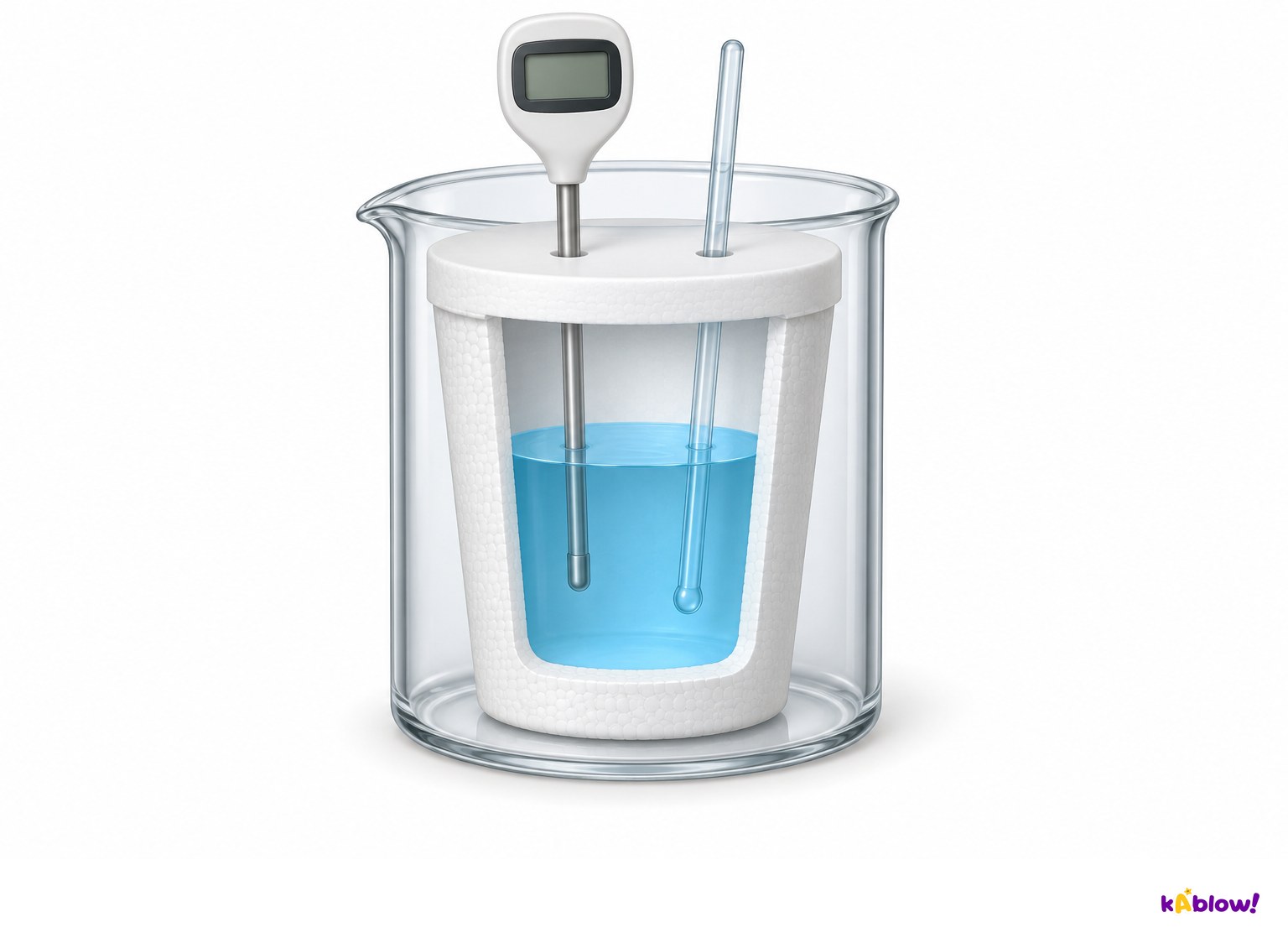
- The cutaway shows an insulated cup with a lid, support beaker, immersed temperature probe and stirrer. In use the cup is opaque; the cutaway reveals the contents for explanation.
- Mix measured quantities, stir, and record temperature against time. Keep the probe clear of the base and sides so that it samples the solution rather than the vessel.
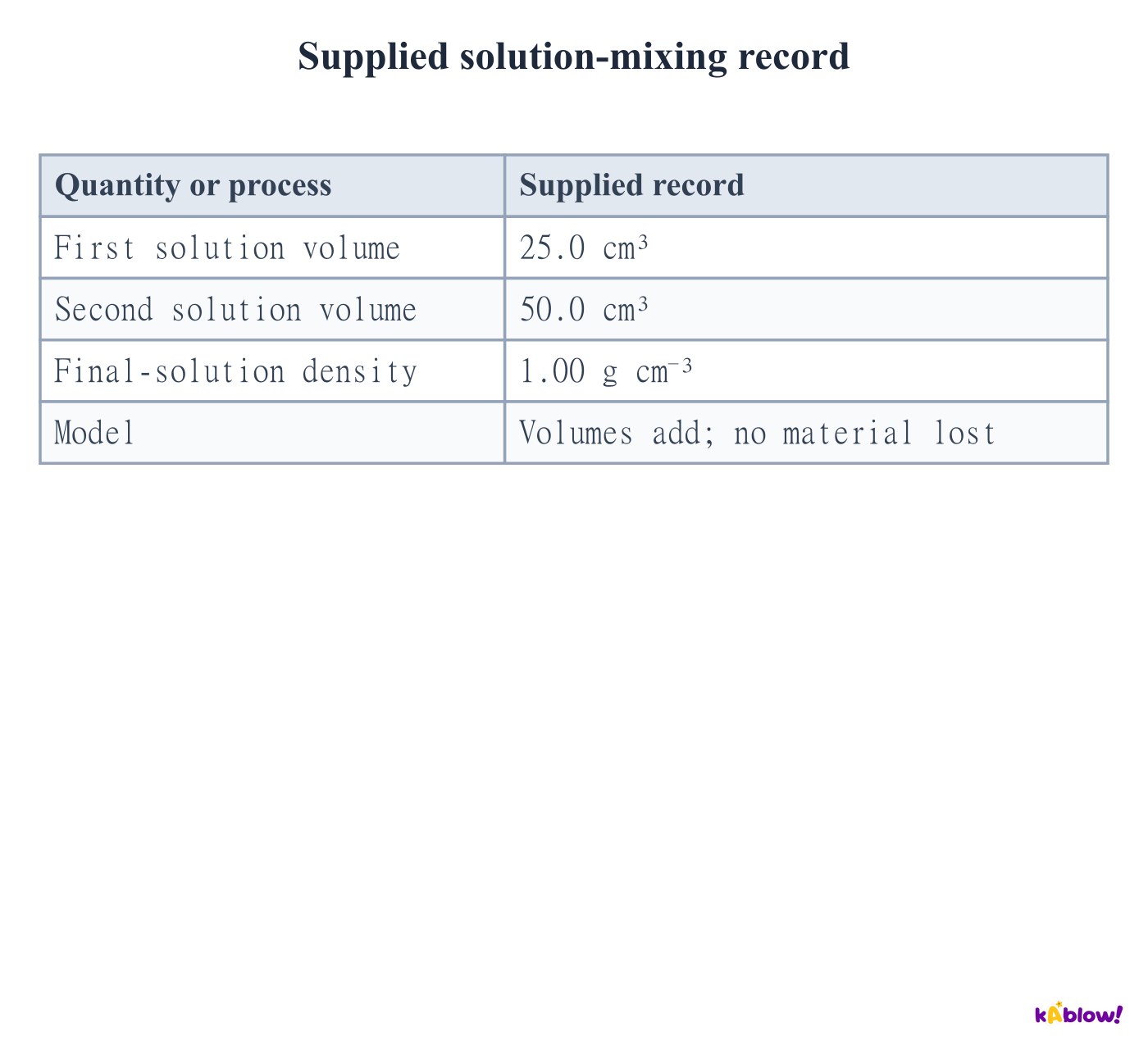
- Insulation and a lid reduce heat exchange; they do not remove all heat loss or calorimeter heat capacity. Use the total heated solution mass when the calculation assumes both liquids form one solution.
Measure a solution’s temperature change
Calculate heat from mass and temperature change
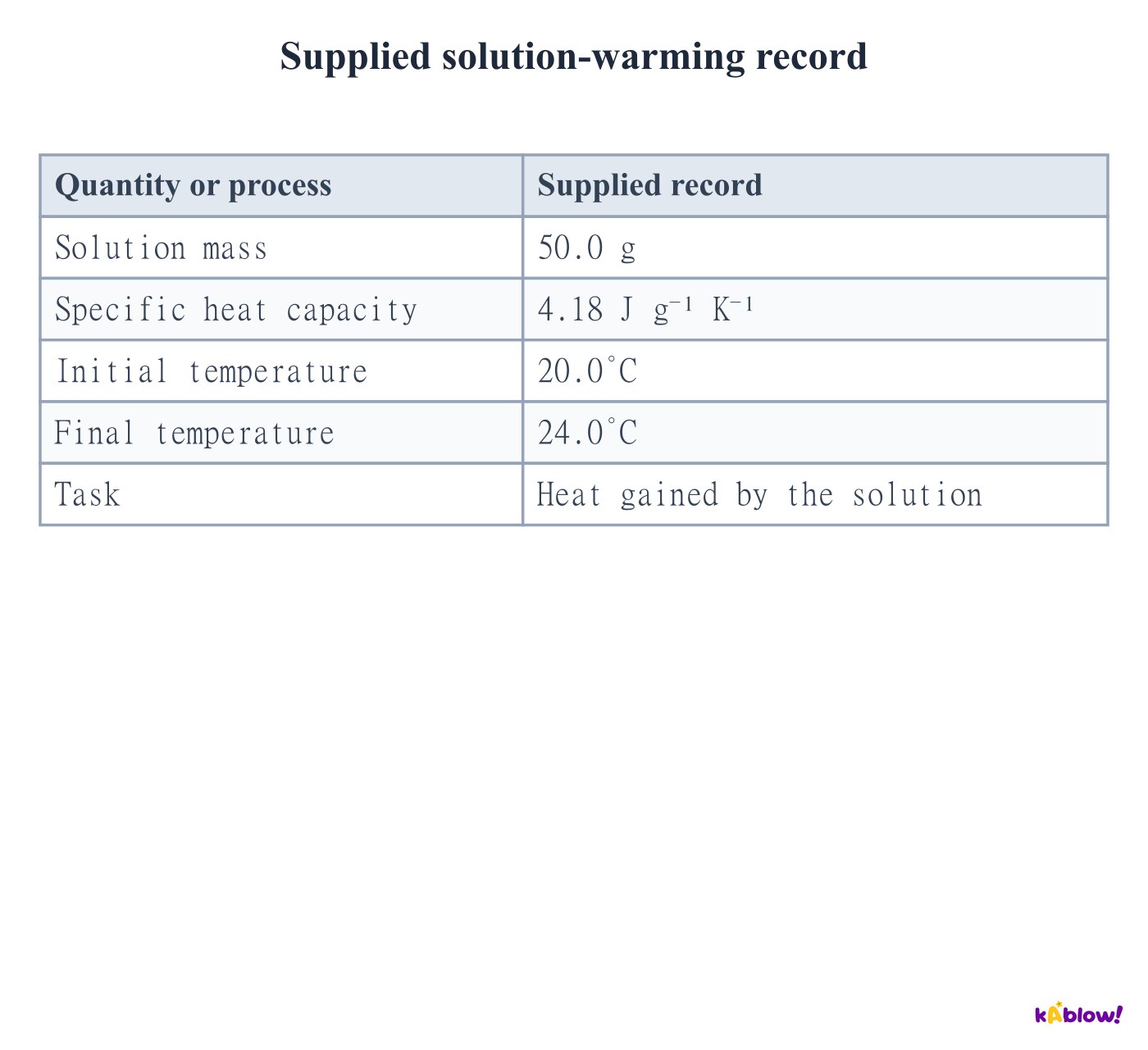
- For a material with approximately constant specific heat capacity, q = mcΔT. Use units consistently: grams with J g⁻¹ K⁻¹ give q in joules.
- A temperature difference has the same numerical value in kelvin and degrees Celsius. ΔT is final temperature minus initial temperature, not the final temperature alone.
- The calculated q belongs to the body whose mass and temperature are used. Convert joules to kilojoules before reporting a molar result in kJ mol⁻¹.
Supplied solution-warming record
Obtain a molar neutralisation enthalpy
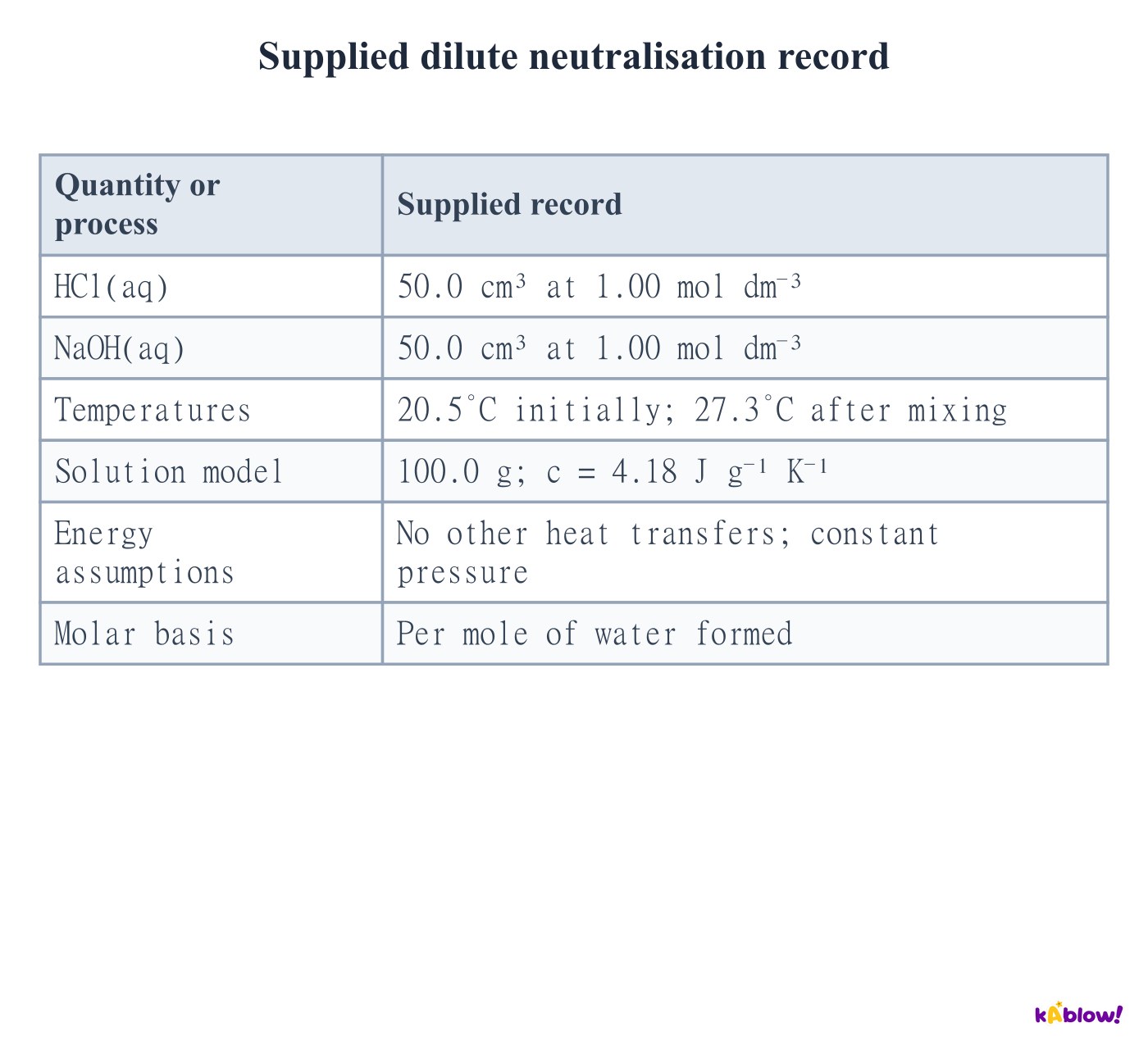
- For dilute strong acid–strong base neutralisation, H⁺(aq) + OH⁻(aq) → H₂O(l) forms one mole of water per mole of reaction. The measured value is usually close to −57 kJ mol⁻¹ under familiar conditions.
- In the supplied experiment, 100.0 g of solution warms by 6.8 K and 0.0500 mol of water forms. Ignoring other transfers, qsolution = 2842.4 J and ΔH = −2.8424/0.0500 = −56.848 kJ mol⁻¹.
- Weak-acid or weak-base ionisation can contribute to the measured enthalpy, so do not define every possible neutralisation as having an identical value or sign. Report sensible precision from the measurements.
Supplied dilute neutralisation record
Choose the correct reacting amount and molar basis
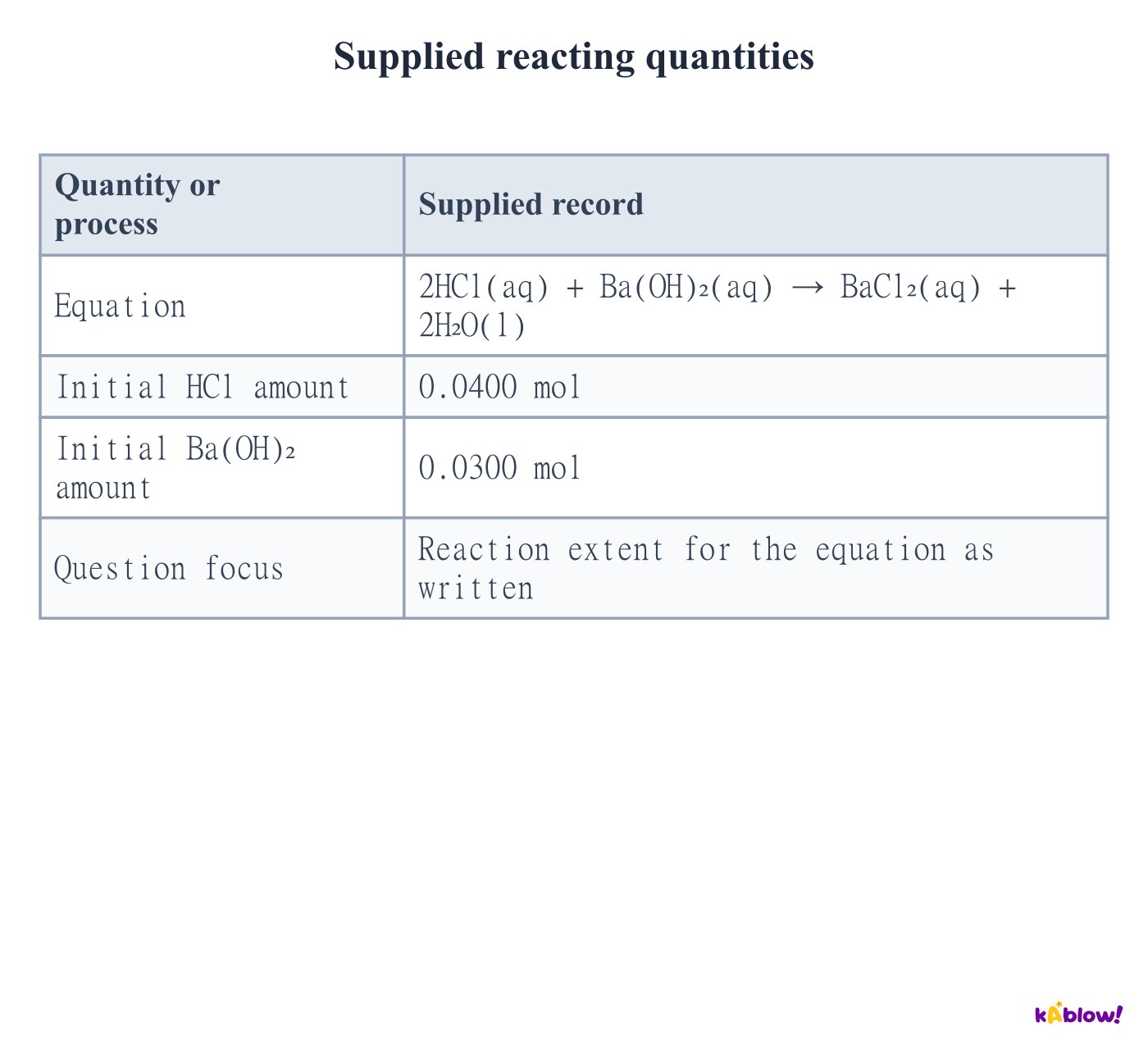
- Use concentration and volume to calculate amounts, then compare them with the balanced equation. Excess reagent is not all consumed.
- For reaction enthalpy per mole of reaction as written, divide the reaction heat by the reaction extent: amount consumed divided by its stoichiometric coefficient.
- For a neutralisation value per mole of water, use moles of water formed instead. These molar bases differ if the written equation produces more than one mole of water.
Supplied reacting quantities
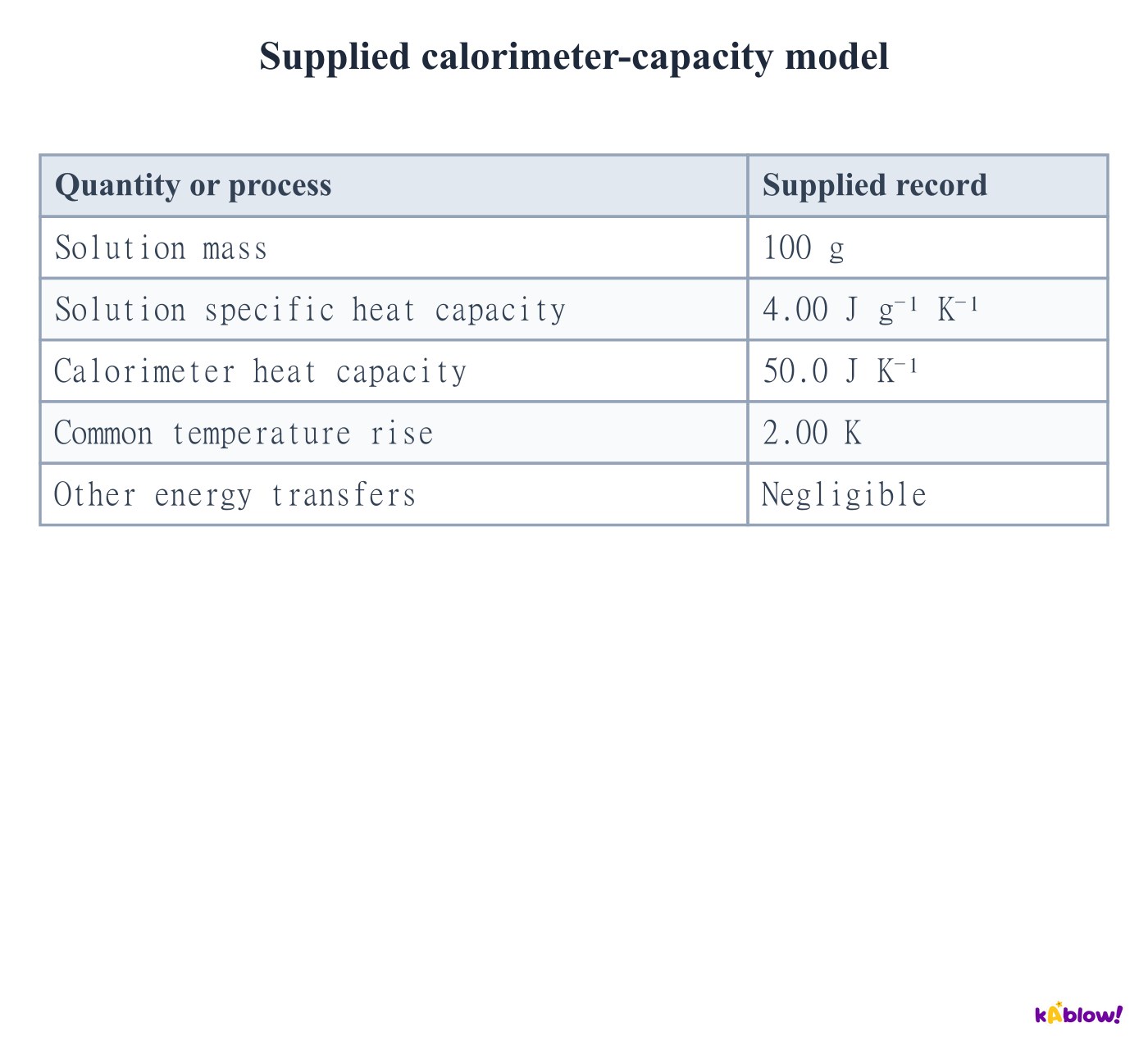
Include calorimeter heat capacity when supplied
- A calorimeter can absorb heat as well as the solution. If its heat capacity is Ccal in J K⁻¹, its heat gain is CcalΔT.
- When the solution and calorimeter undergo the same rise and other transfers are negligible, the reaction heat is −(mc + Ccal)ΔT.
- Omitting a positive calorimeter heat gain from an exothermic calculation makes the estimated reaction enthalpy less negative, provided the other quantities and assumptions are unchanged.
Supplied calorimeter-capacity model
Calculate an experimental combustion enthalpy
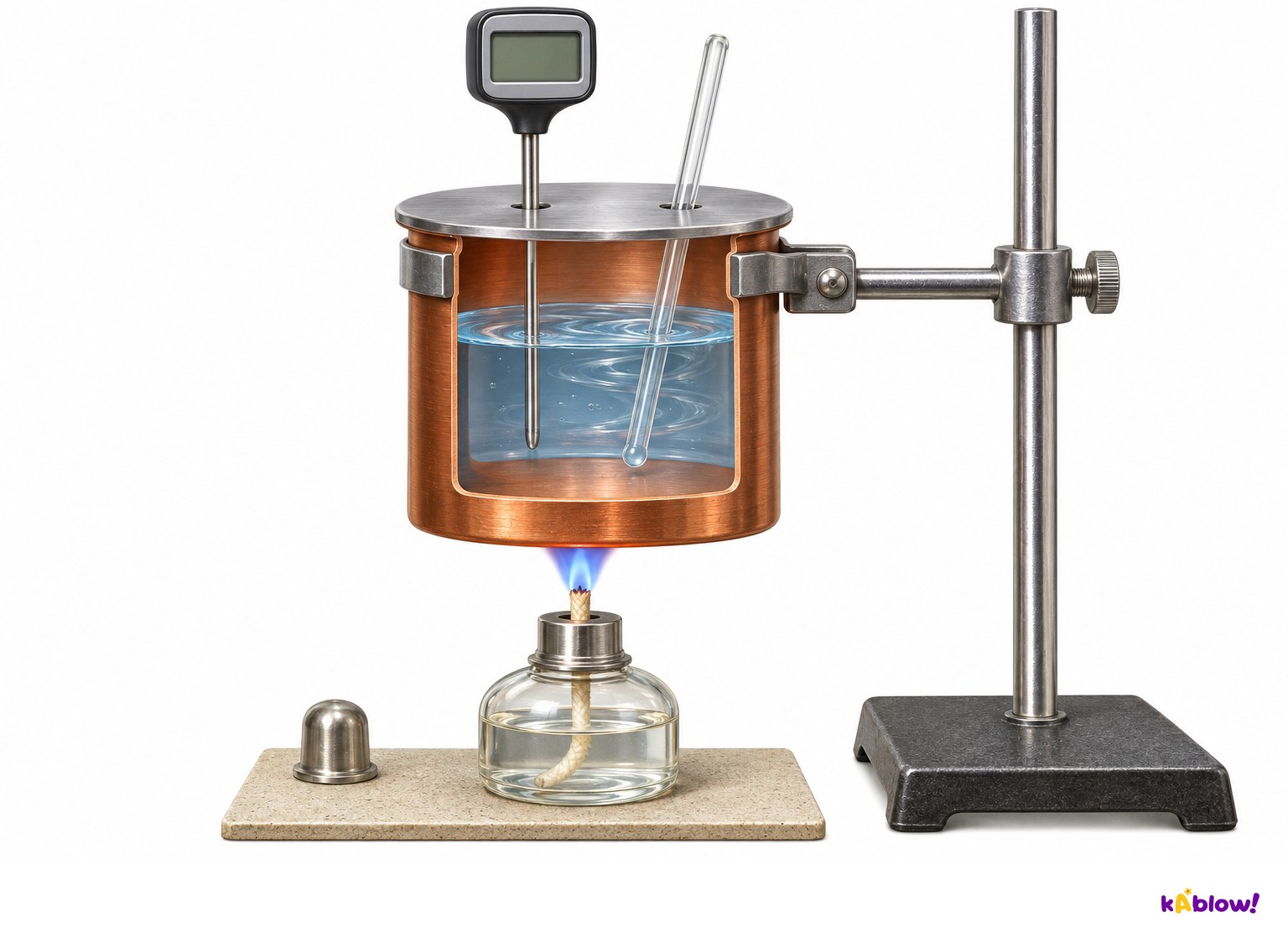
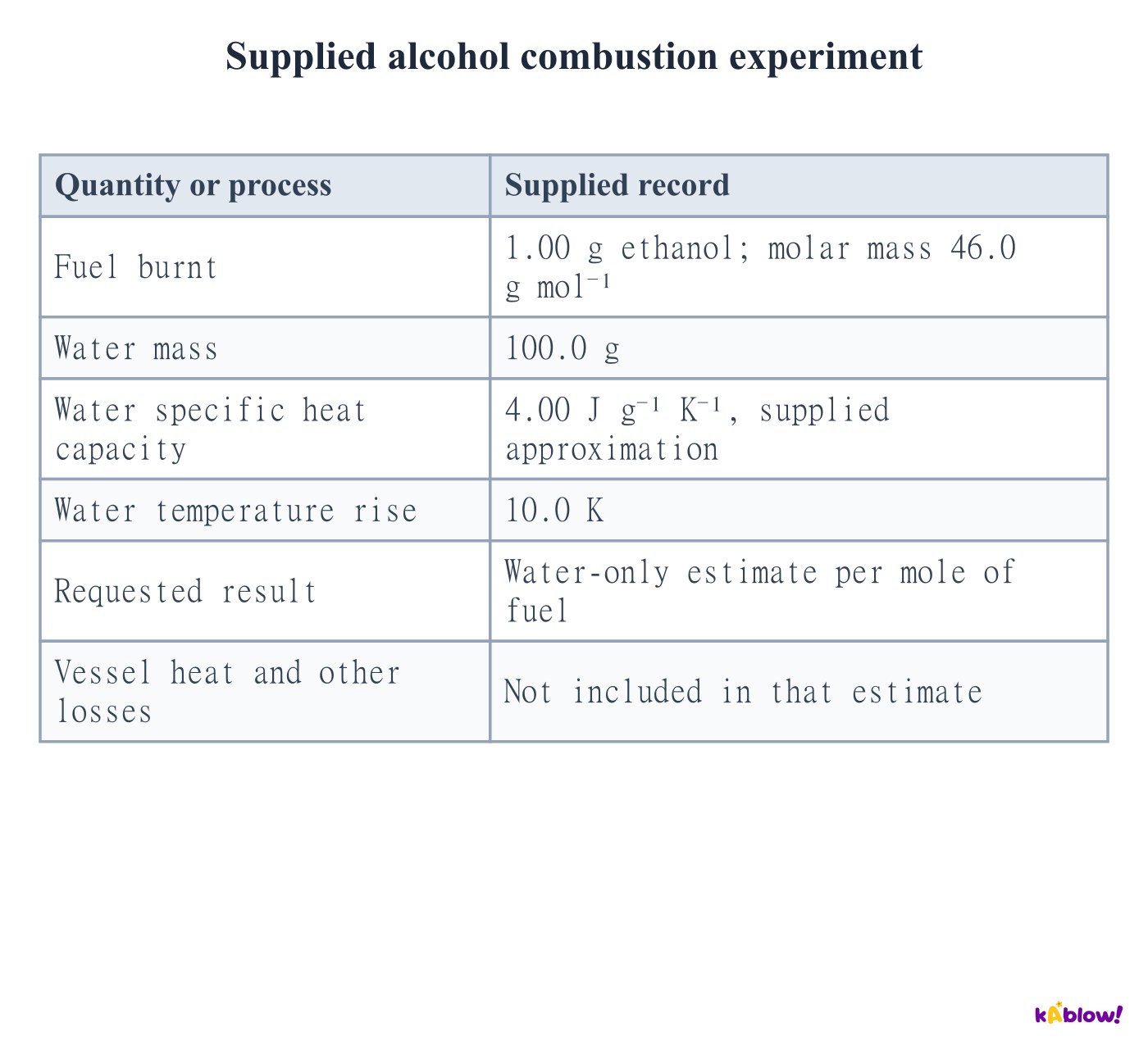
- In simple combustion calorimetry, a spirit burner heats water in a metal can. Weigh the burner before and after burning to estimate fuel consumption, and measure the water temperature rise.
- The illustrated copper can has a solid base between flame and water; a metal probe and stirrer are immersed above it. Heat lost to the air, the vessel and other surroundings limits the simple water-only estimate.
- Use moles of fuel, not water, for a combustion value per mole of fuel. The result can be less negative than a reference value because the water captures only part of the released heat.
Measure heat captured from an alcohol flame
Evaluate systematic errors in calorimetry
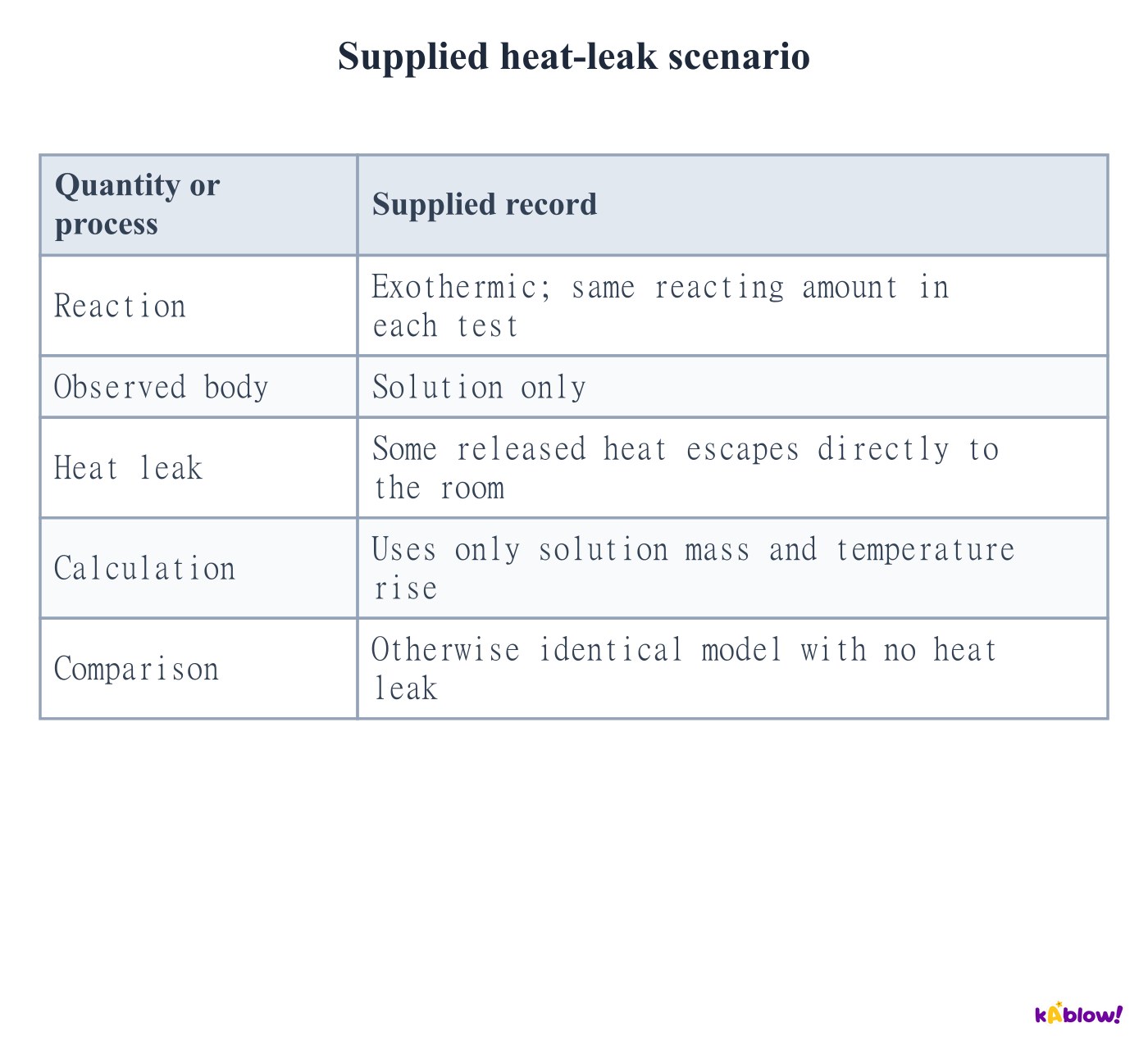
- Heat escaping an exothermic reaction’s measured solution generally reduces its observed temperature rise. A water-only calculation then underestimates the magnitude of the released heat.
- Incomplete combustion reduces energy released per measured mass of fuel. Evaporation from a burner can exaggerate the mass apparently burnt; both can make the calculated combustion value less negative.
- Repeated measurements improve the estimate of random variation but do not automatically remove a systematic loss. Choose a practical improvement that targets the stated limitation.
Supplied heat-leak scenario
Estimate a temperature at the mixing time
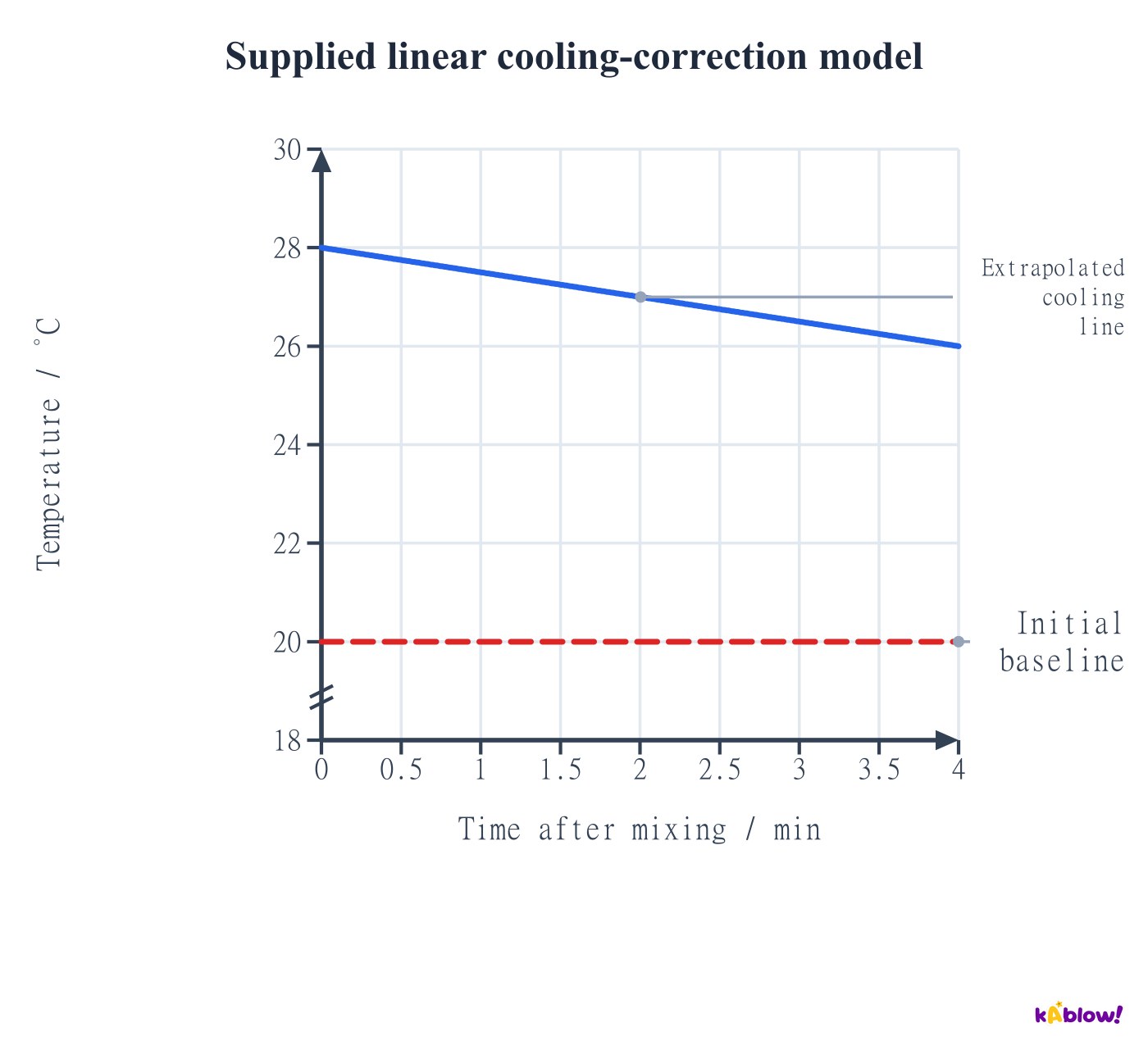
- A temperature–time trace can be extrapolated to estimate the temperature at a defined mixing time before later cooling has reduced the reading.
- Apply the chosen model only over the region it describes. A linear cooling correction is an approximation, not proof that the entire experiment cools linearly.
- Subtract the appropriate initial baseline from the estimated mixing-time value. Keep the temperature correction separate from the energy and molar calculations.
Supplied linear cooling-correction model
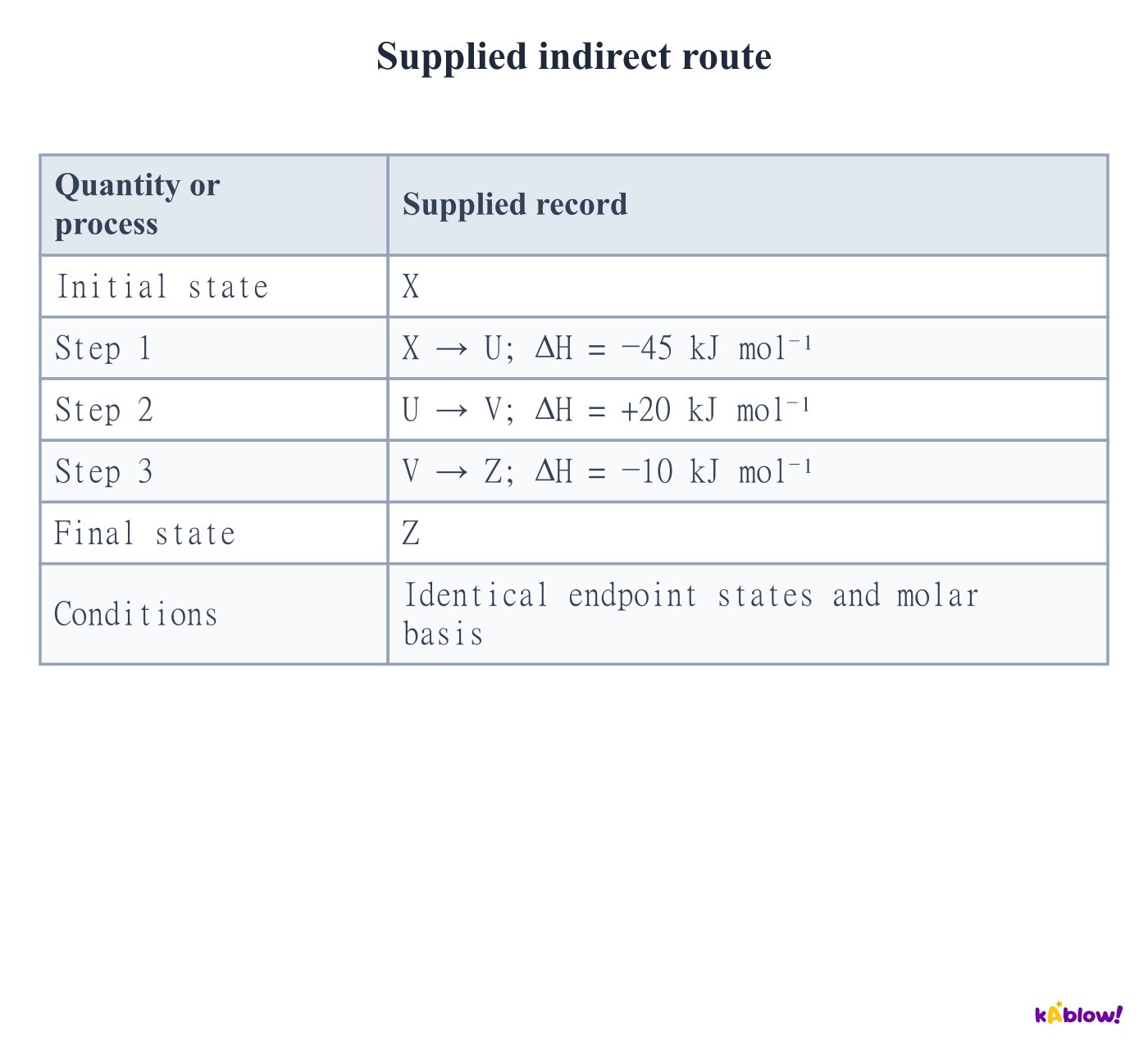
Apply Hess’s law to identical endpoints
- Enthalpy is a state function. The overall change between specified initial and final states is independent of the route taken.
- Add equations and their signed enthalpy changes, reversing or scaling them as required. Intermediate species cancel only when both their formulae and physical states match.
- A cycle’s layout is a drawing choice. Follow the defined equations and arrow directions rather than assuming that every formation arrow must point upward on the page.
Supplied indirect route
Calculate reaction enthalpy from formation data
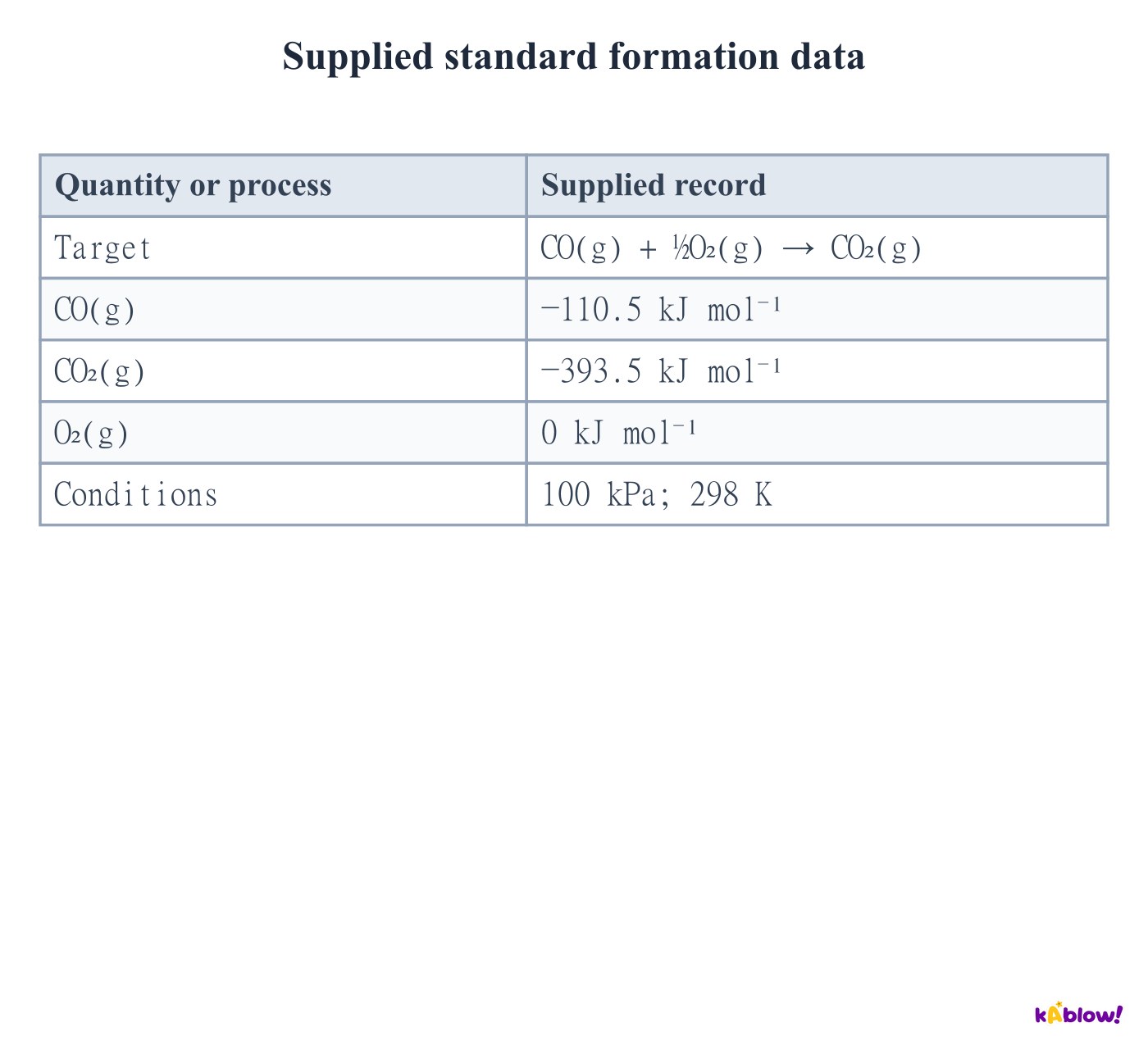
- Multiply each standard formation enthalpy by its coefficient in the balanced equation. Add the product contributions and subtract the reactant contributions.
- For CO(g) + ½O₂(g) → CO₂(g), supplied formation values −393.5 and −110.5 kJ mol⁻¹ give −393.5 − (−110.5) = −283.0 kJ mol⁻¹.
- O₂(g) contributes zero only because it is the reference form at the stated conditions. Preserve the states and the reaction’s molar basis.
Supplied standard formation data
Use combustion data with common final products
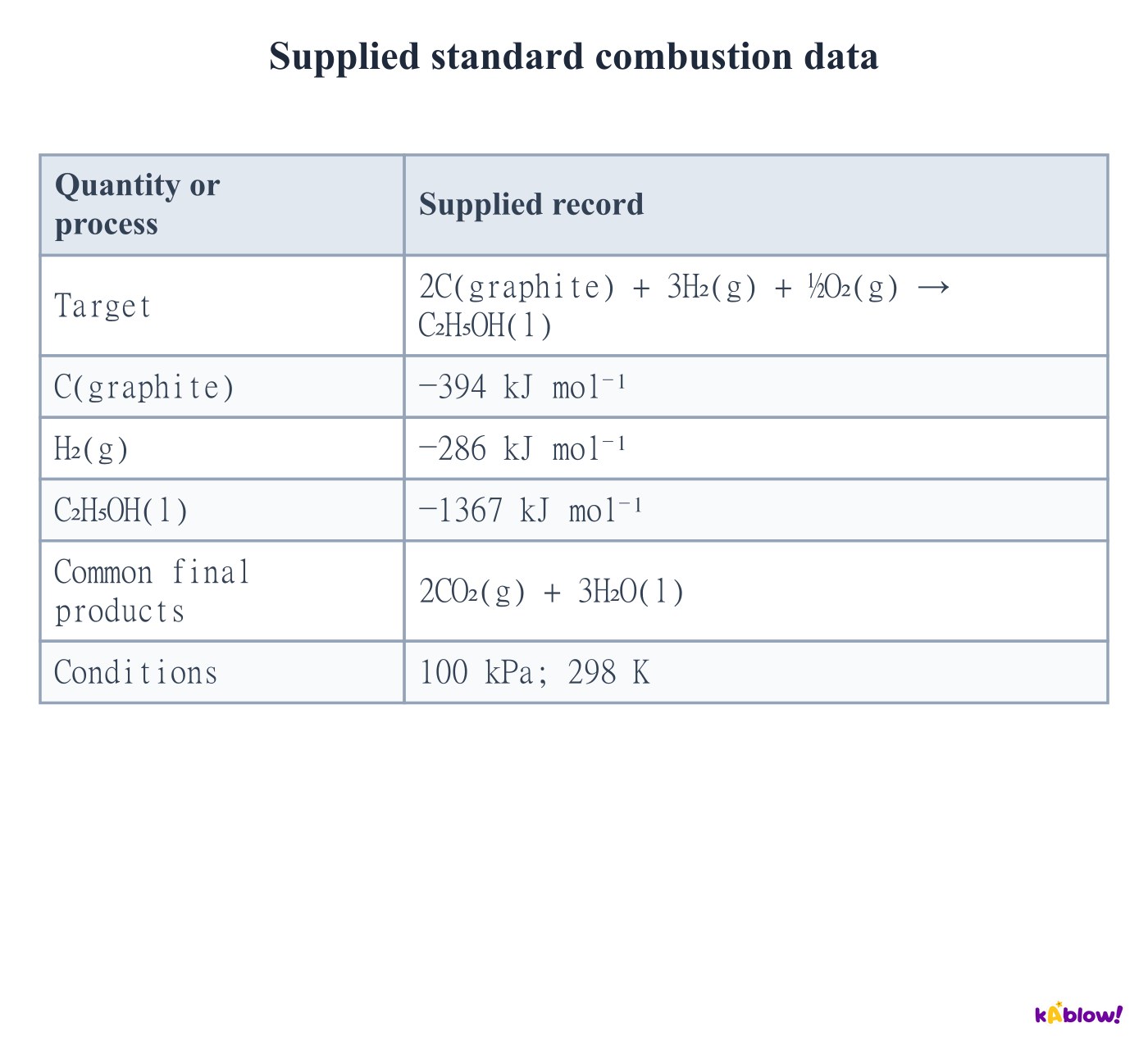
- A combustion Hess cycle takes both sides of a target equation to the same final products in the same states. Oxygen amounts must also balance across the combined route.
- For formation of ethanol, compare combustion of 2C(graphite) + 3H₂(g) with combustion of one mole of ethanol to 2CO₂(g) + 3H₂O(l). Reverse the ethanol-combustion route when returning to ethanol.
- With the supplied values, ΔHf = 2(−394) + 3(−286) − (−1367) = −279 kJ mol⁻¹. Do not subtract an already negative value without tracking the reversal.
Supplied standard combustion data
Build a cycle by cancelling equations
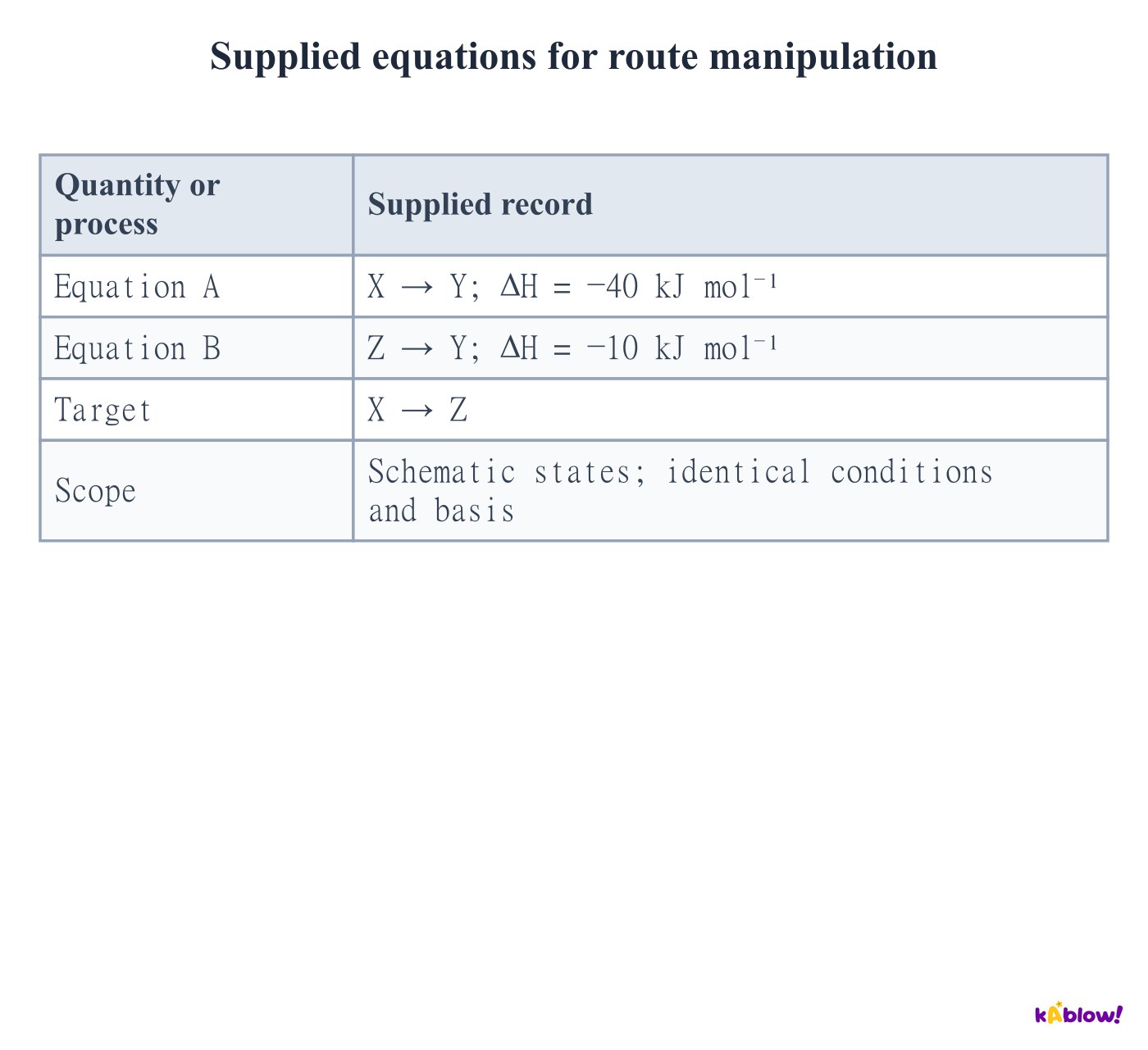
- Write the target equation, then manipulate the available equations so unwanted intermediates cancel. A reversed equation carries the opposite enthalpy change.
- Check atoms, charge and state symbols after addition. A correct numerical sum cannot repair an unbalanced chemical route.
- Hess cycles can link experimentally accessible changes to an inaccessible target. For example, hydration of an anhydrous salt can be related to dissolution of the anhydrous and hydrated forms to the same final solution.
Supplied equations for route manipulation
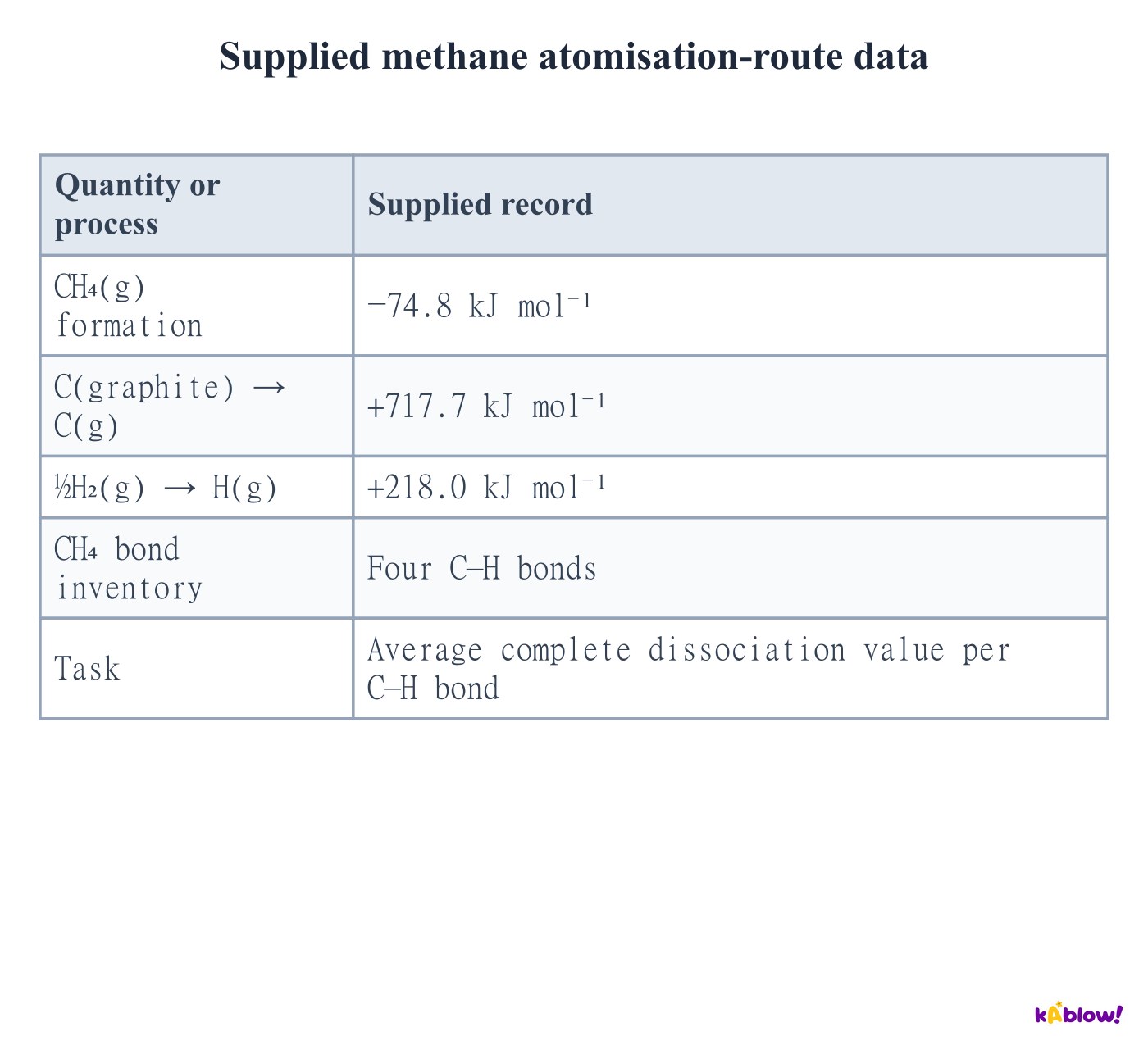
Relate atomisation to a molecular bond average
- Standard atomisation forms one mole of gaseous atoms from an element in its reference state at standard pressure and the stated temperature.
- A Hess route can compare a molecule with its separated gaseous atoms. For methane, use carbon atomisation, four hydrogen atomisations and the reverse of methane formation.
- Dividing the complete methane atomisation enthalpy by four gives its average C–H dissociation value. This does not require its four successive bond dissociations to have equal energies.
Supplied methane atomisation-route data
Estimate a gas-phase reaction from mean bond enthalpies
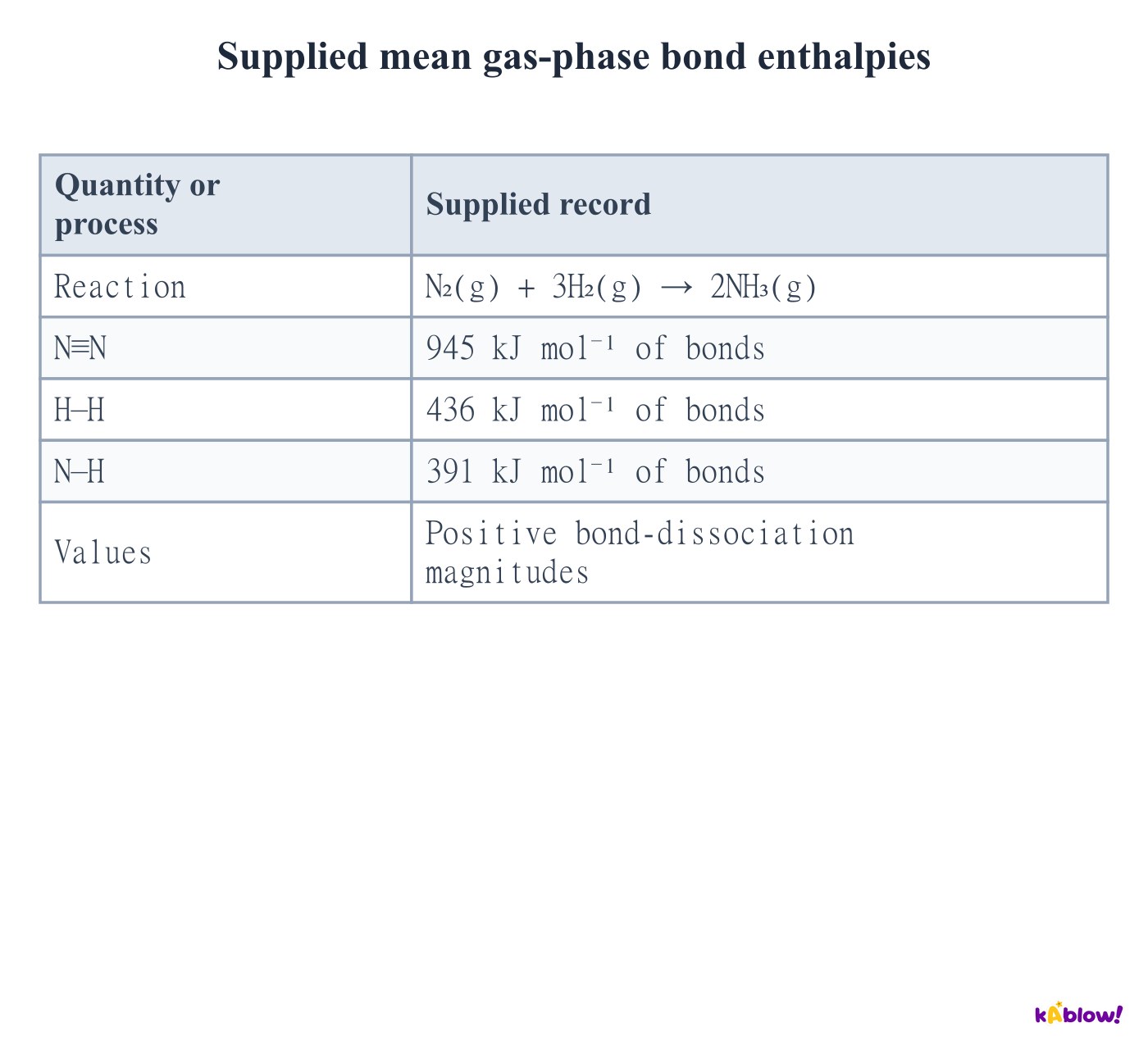
- Mean bond enthalpy is a gaseous bond-dissociation enthalpy averaged across relevant molecular environments. It estimates a bond type’s behaviour rather than giving an exact value for every molecule.
- Count every affected bond using the balanced equation. For N₂ + 3H₂ → 2NH₃, break one N≡N and three H–H bonds and form six N–H bonds.
- Using the supplied positive dissociation values, the estimate is 945 + 3(436) − 6(391) = −93 kJ mol⁻¹ of reaction as written, which produces two moles of ammonia.
Supplied mean gas-phase bond enthalpies
Correct phase differences and recognise approximations
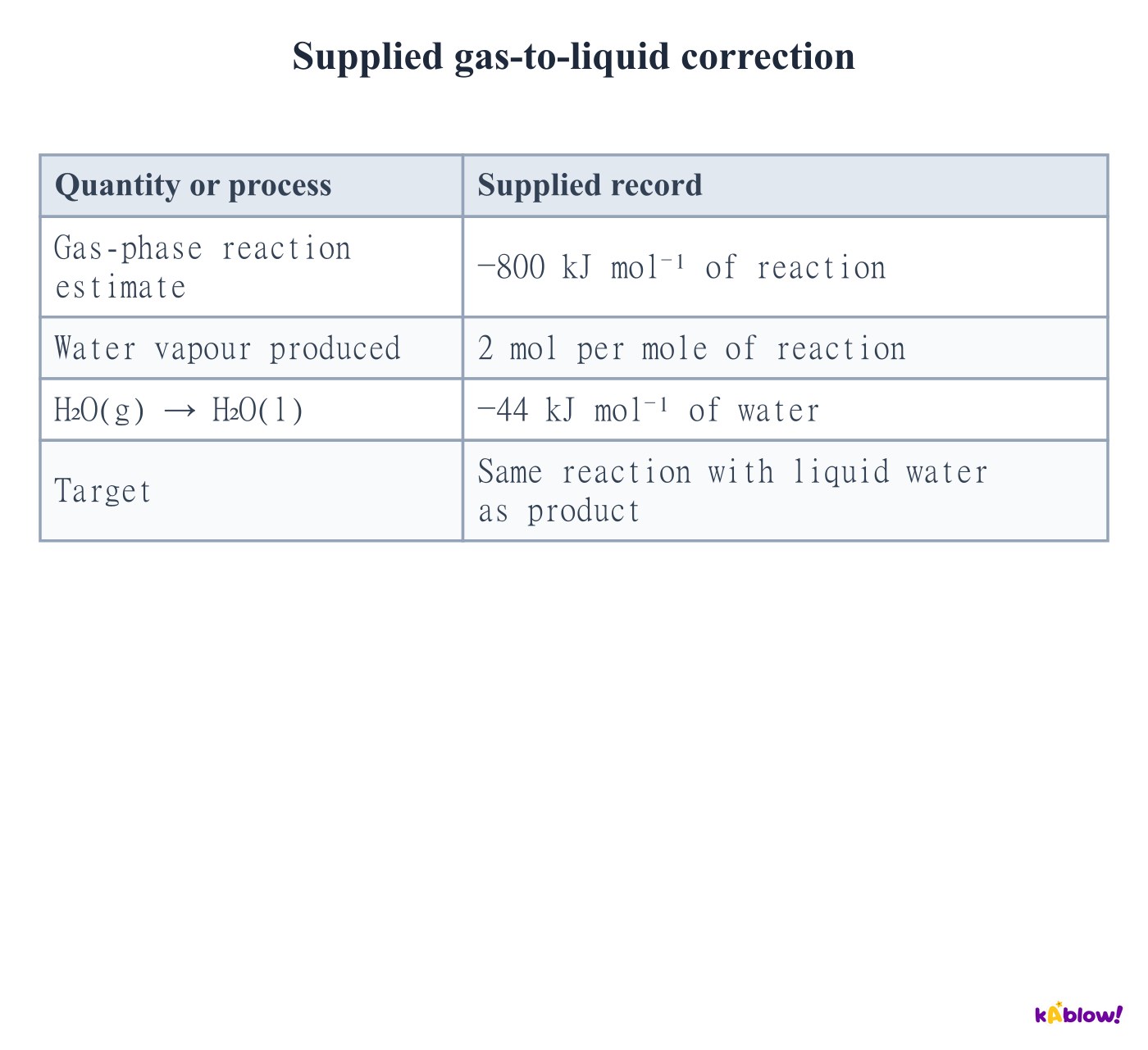
- A mean-bond calculation describes the specified gaseous species. A target reaction containing liquid water needs a condensation contribution if the bond calculation first produces water vapour.
- For two moles of water vapour becoming liquid, add twice the supplied molar condensation enthalpy to the gaseous reaction value.
- Mean bond enthalpy calculations also use Hess’s law. Differences from compound-specific data arise from averaging and possibly different states, not from a failure of path independence.
Supplied gas-to-liquid correction
Report uncertainty and evaluate a comparison
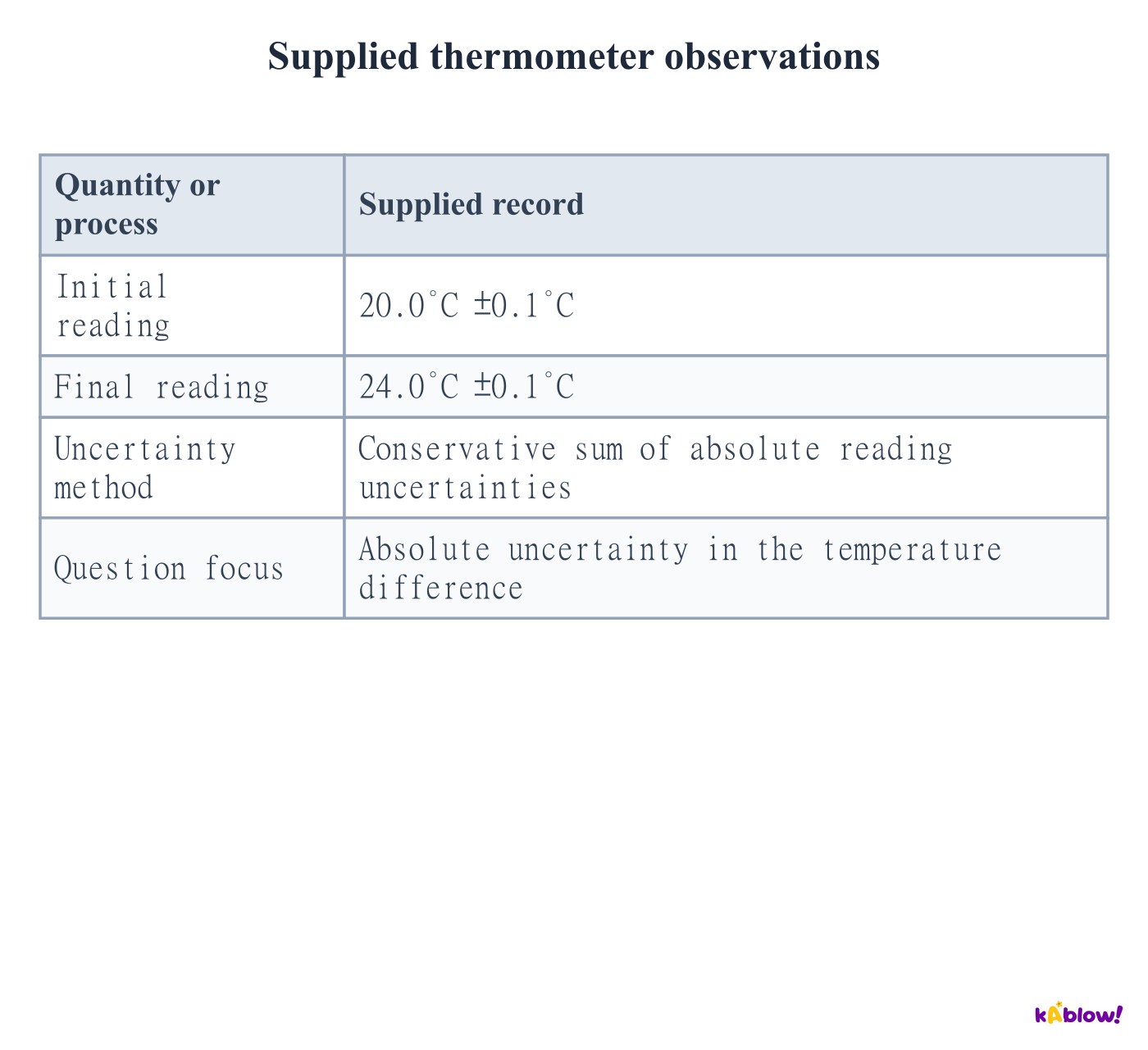
- Retain unrounded intermediate values and round the final result to a precision justified by the measurements. Exact stoichiometric coefficients do not limit significant figures.
- A temperature rise calculated from two thermometer readings has uncertainty from both readings. For a conservative absolute-uncertainty estimate, add their absolute uncertainties.
- Distinguish random spread, systematic error and model assumptions when comparing an experimental result with a reference value. Agreement to many decimal places is not meaningful if the measurements are much less precise.
Supplied thermometer observations
Diapos
Sign up free to view the lesson slides
Step through every slide for this topic — plus flashcards and revision notes — with a free account.
Questions d'entraînement
Aperçu gratuit — 8 sur 60 questions. Inscris-toi pour toutes les voir.
1.In the supplied energy-transfer record, what is the heat received by the reacting system?
Medium- A−250 J
- B+250 J
- C0 J
- D−250 kJ
2.What estimated reaction enthalpy follows from the supplied positive bond-energy totals?
Medium- A+80 kJ mol⁻¹
- B−80 kJ mol⁻¹
- C+920 kJ mol⁻¹
- D−920 kJ mol⁻¹
3.What is ΔH for the forward change in the supplied profile?
Medium- A−30 kJ mol⁻¹
- B+30 kJ mol⁻¹
- C+60 kJ mol⁻¹
- D+90 kJ mol⁻¹
4.What is the forward activation barrier in the supplied second profile?
Medium- A30 kJ mol⁻¹
- B60 kJ mol⁻¹
- C90 kJ mol⁻¹
- D100 kJ mol⁻¹
5.Which supplied condition set uses standard pressure with an explicitly stated temperature?
Medium- AA only
- BB only
- CC only
- DNone
6.Which supplied equation represents formation of exactly one mole of liquid water from reference elements?
Medium- AA
- BB
- CC
- DAll three
7.Which supplied equation is normalised to complete combustion of one mole of methane?
Medium- AA
- BB
- CC
- DA and B
8.What enthalpy change belongs to twice the reverse of the supplied reference equation?
Medium- A−120 kJ
- B−60 kJ
- C+60 kJ
- D+120 kJ
Unlock all 60 questions, flashcards & more
Crée un compte gratuit pour voir toutes les questions, les diapos, les cartes mémo et les notes de révision de ce thème.