
Reactions Of Ions In Aqueous Solution
Apprends en jouant
Réponds à ces questions pour gagner de l'énergie, puis pêche et explore. Sans compte.
Notes de leçon
Read an aqueous cation as a hydrated species
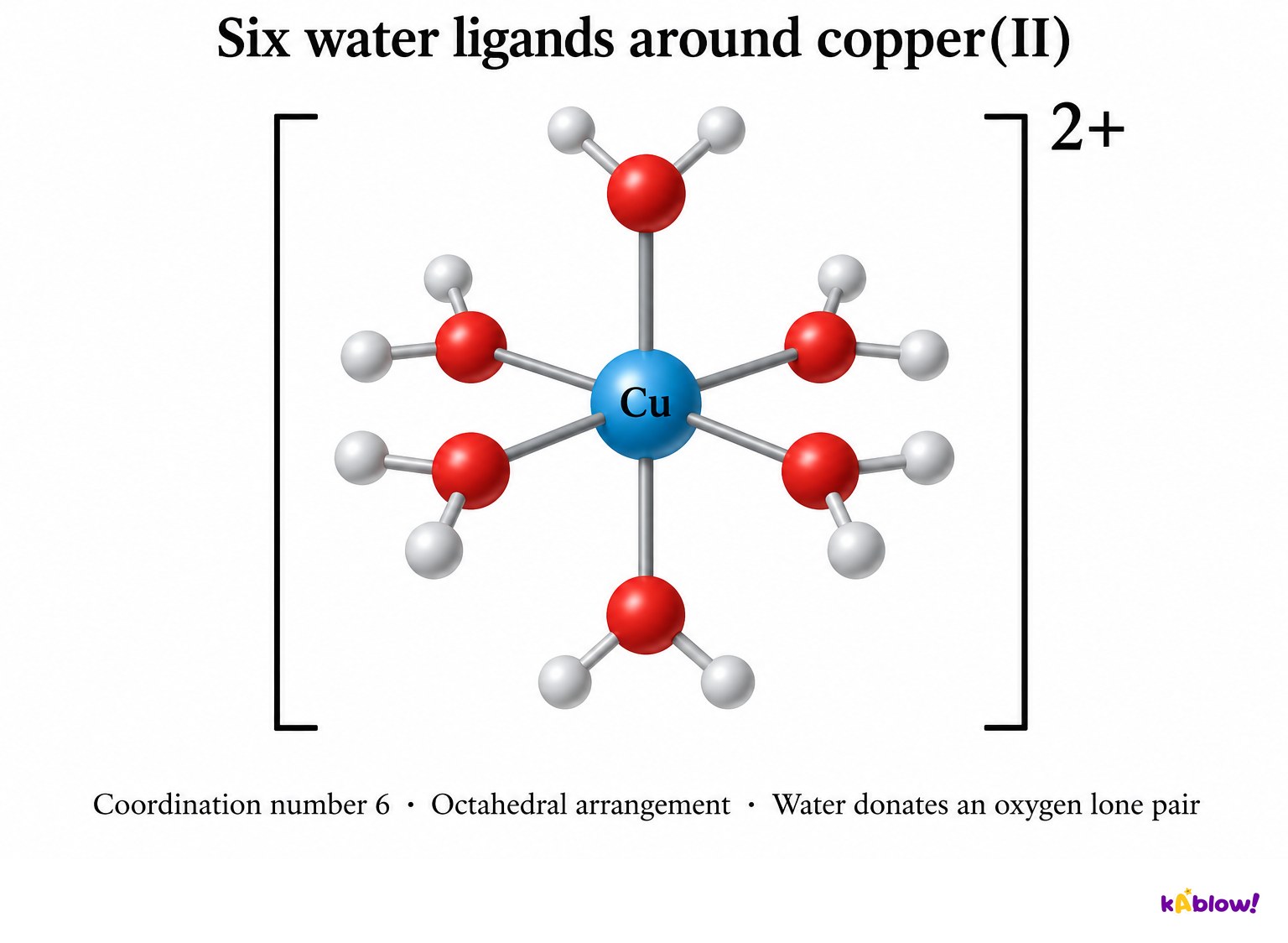
- The copper aqua illustration shows water ligands donating through oxygen around a metal ion. Cu²⁺(aq) is shorthand for a hydrated species, not a bare gas-phase ion.
- The six-water model is[Cu(H₂O)₆]²⁺. Iron(II), iron(III) and aluminium(III) also form the aqua complexes considered in this lesson.
- Aluminium is included because of its aqueous-ion chemistry; it is not a first-row transition metal by the AQA definition. The ideal copper geometry does not assert six equal measured Cu–O distances.
Six water ligands around copper(II)
Separate Lewis bonding from proton transfer
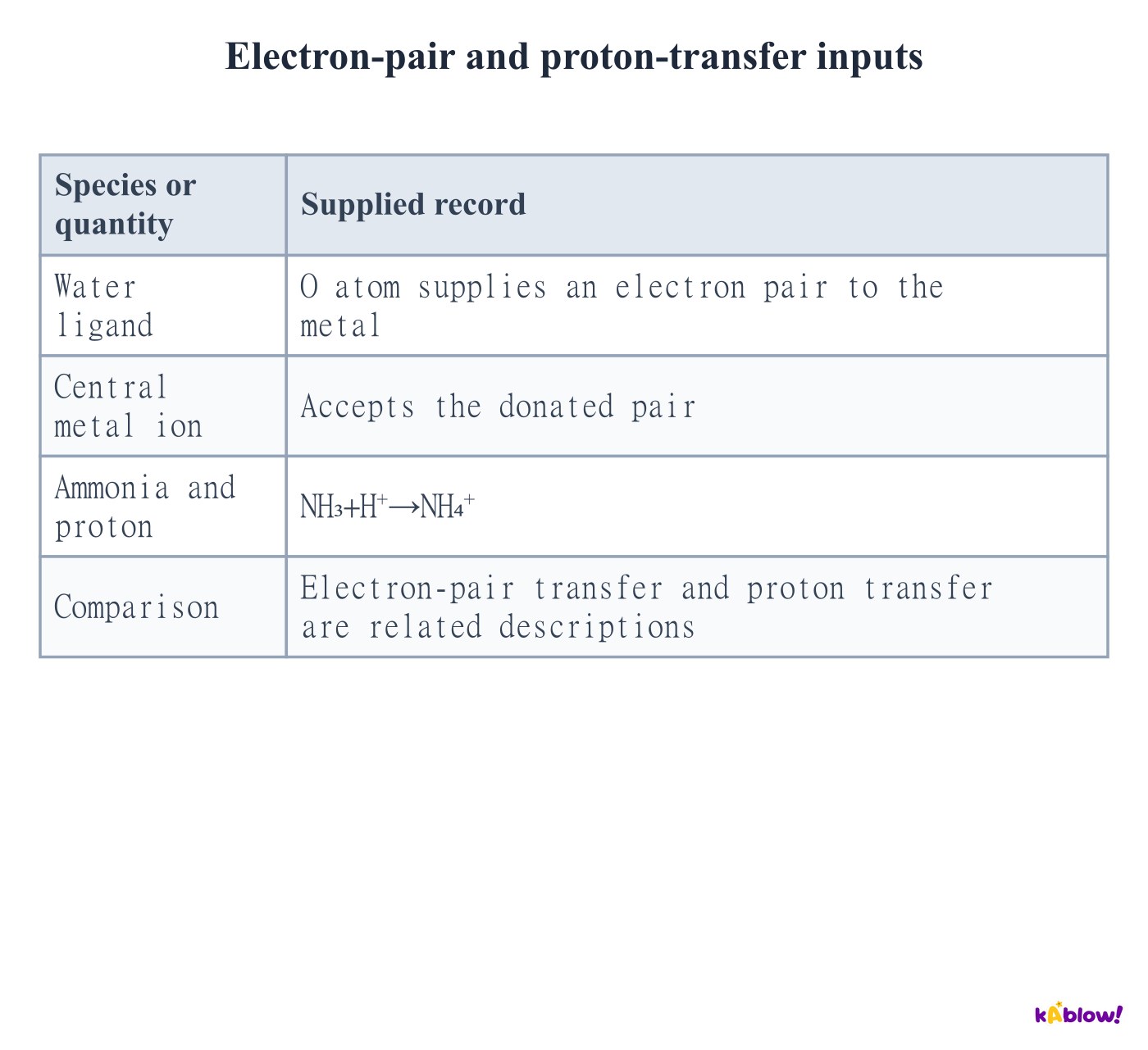
- Water acts as a Lewis base when its oxygen atom donates an electron pair to the central metal, which acts as a Lewis acid. The donor is an oxygen atom in H₂O, not an O₂ molecule.
- A Brønsted–Lowry base accepts a proton. Ammonia can therefore be both an electron-pair donor and a proton acceptor.
- Later aqua-ion reactions remove protons from O–H groups. They need not break every metal–oxygen bond or reduce the metal ion.
Electron-pair and proton-transfer inputs
Keep solvent and spectator ions in balanced bookkeeping
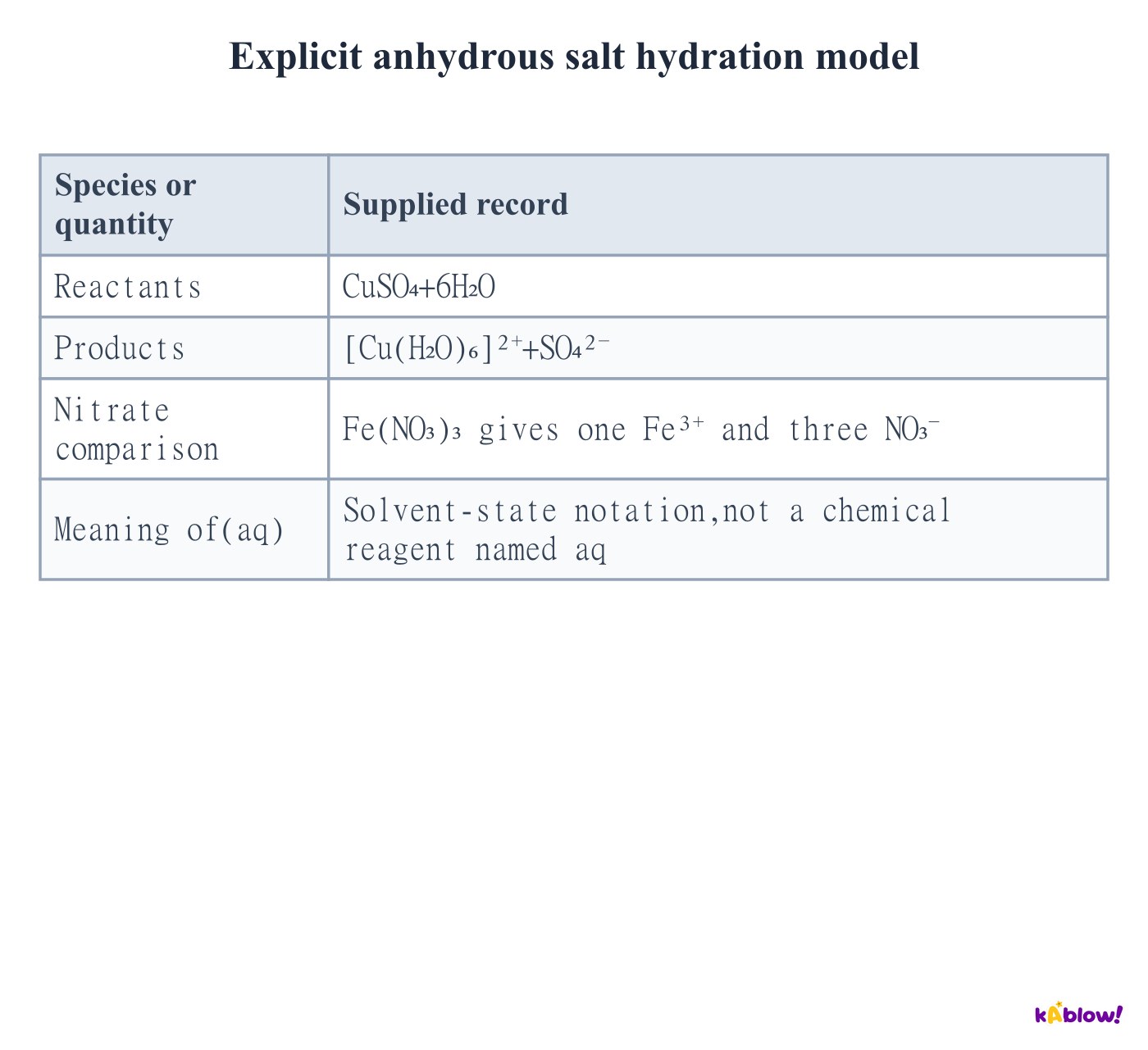
- An explicit anhydrous model is CuSO₄(s)+6H₂O(l)→[Cu(H₂O)₆]²⁺(aq)+SO₄²⁻(aq). Water supplies the ligands and total charge remains zero.
- Shorthand ionic equations often suppress the hydration waters. Use one convention consistently rather than treating aq as an atom-containing species to balance.
- Counter-ions such as nitrate can be spectators in the later base reaction. Their number still matters when writing a complete dissolution equation.
Explicit anhydrous salt hydration model
Explain stronger aqua acidity with charge and size
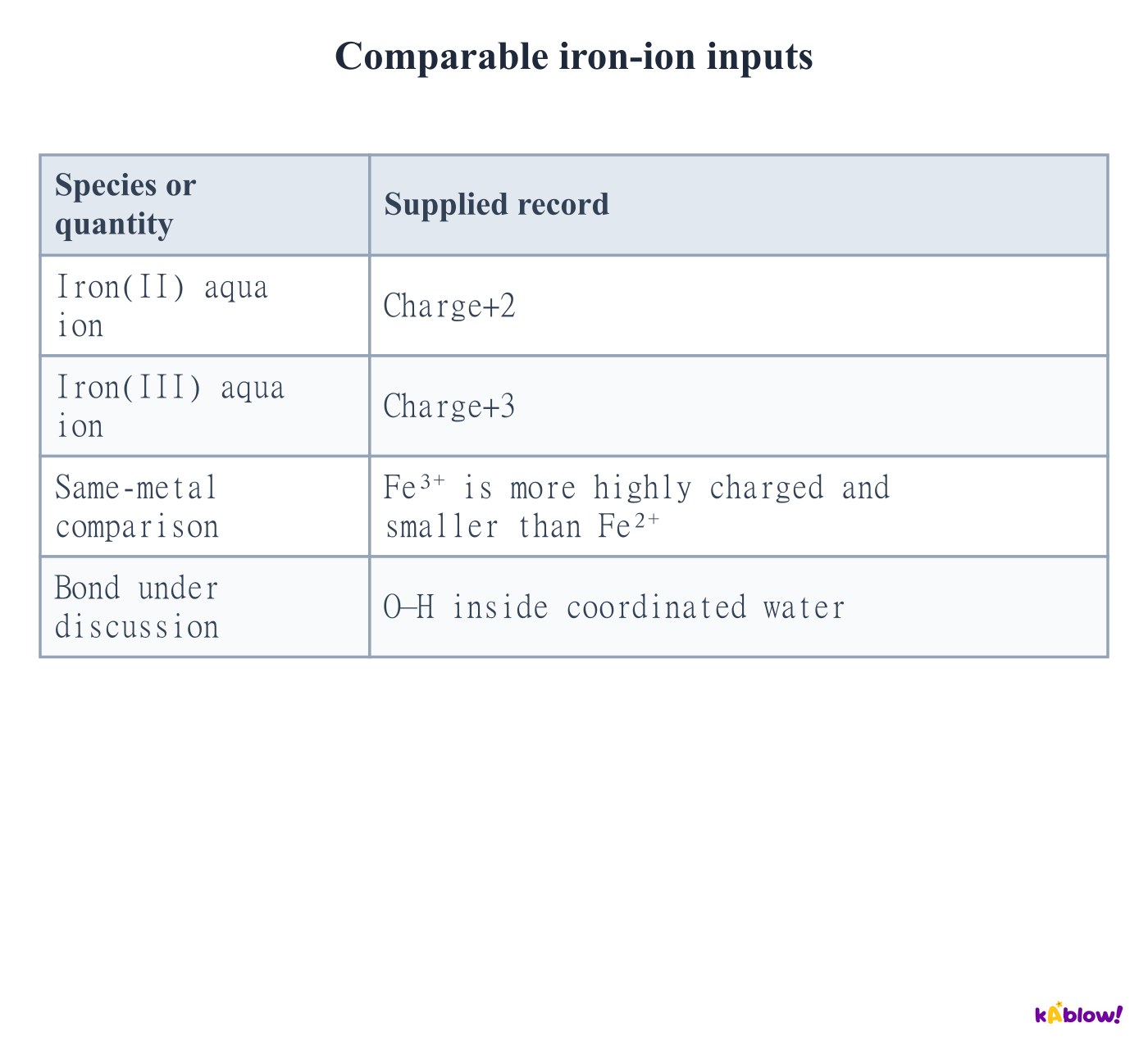
- In the comparable iron pair, Fe³⁺ has greater charge density than Fe²⁺. It attracts electron density from coordinated water more strongly.
- This polarises the O–H bonds and makes proton loss easier. The acidity belongs to coordinated water in the complex, not to a metal ion emitting an H atom it never contained.
- The course pattern compares appropriate common aqua ions. It is not a rule that every 3+ ion is smaller or more acidic than every 2+ ion in all ligand environments.
Comparable iron-ion inputs
Write hydrolysis as an equilibrium
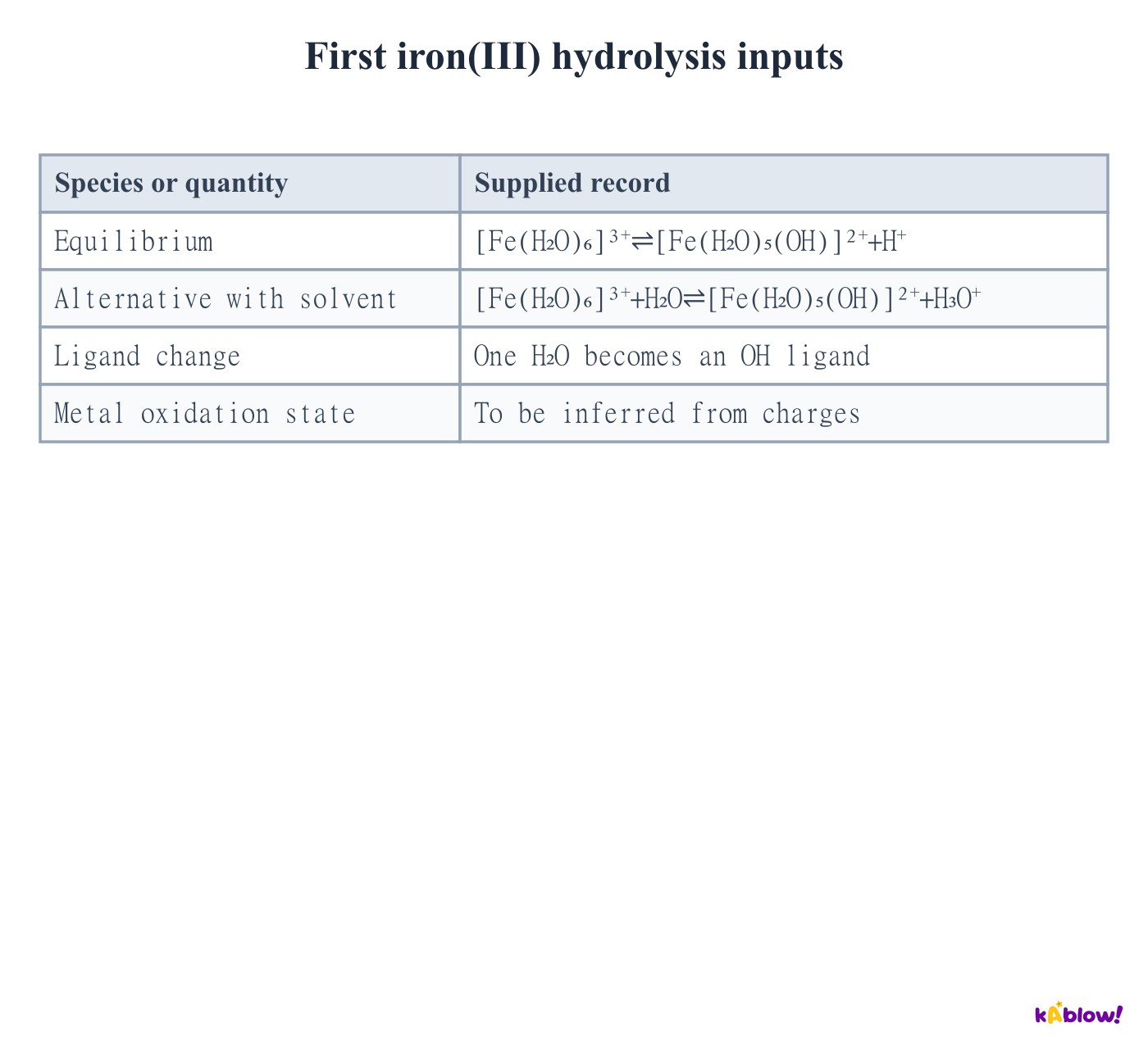
- A coordinated water can lose H⁺:[Fe(H₂O)₆]³⁺⇌[Fe(H₂O)₅(OH)]²⁺+H⁺. The residual complex is one charge less positive.
- Writing H₃O⁺ instead requires an extra water molecule on the reactant side. Both conventions conserve atoms and charge.
- Iron remains +3. Proton loss changes the ligand charge; it does not require electron transfer to or from the metal.
First iron(III) hydrolysis inputs
Compare acid strength without equating pKa and pH
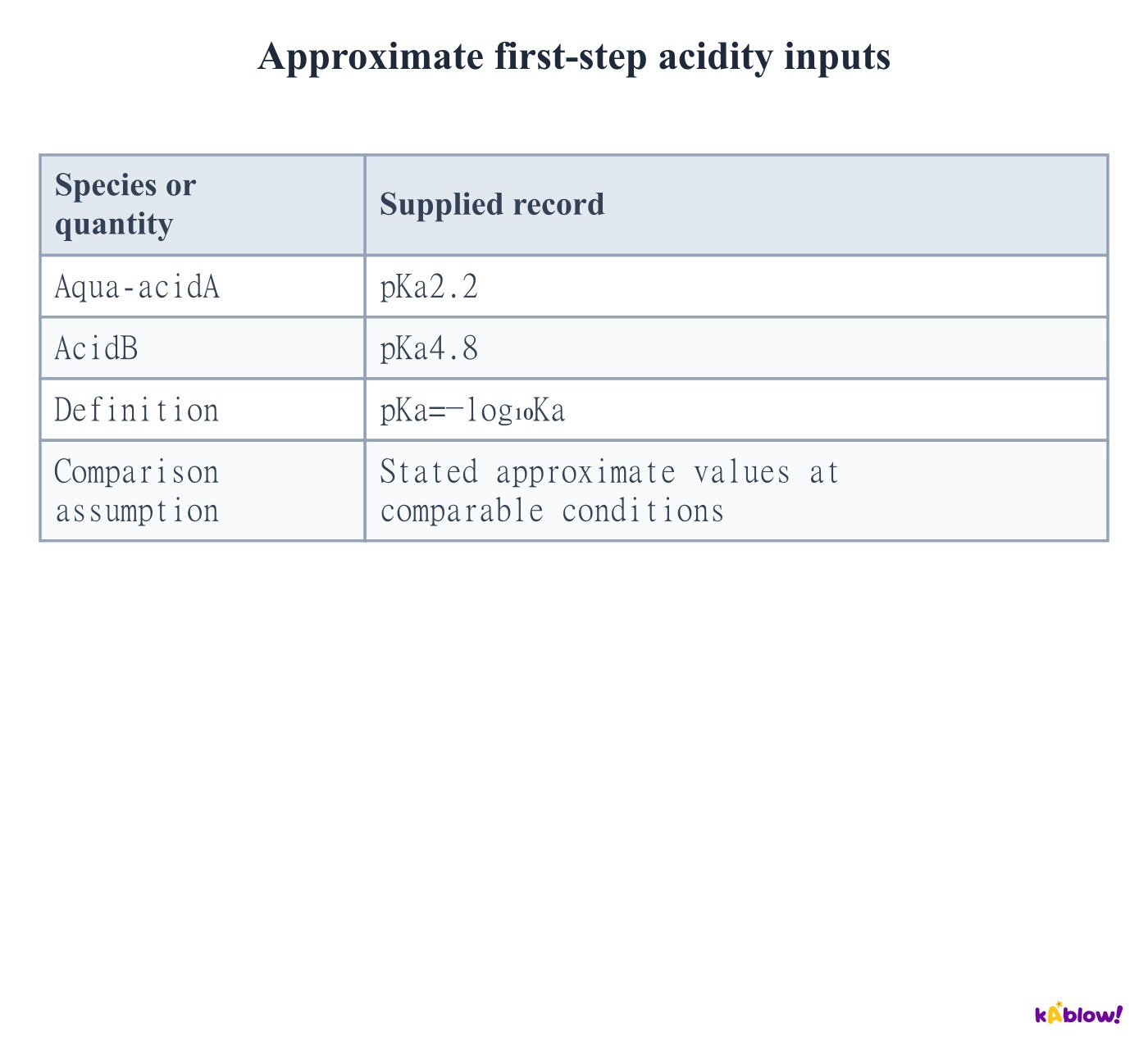
- Lower pKa means larger Ka for the specified dissociation. The supplied aqua-acid example at 2.2 has a larger first-step Ka than the comparison acid at 4.8.
- The Ka ratio is 10^(4.8−2.2), about 398. This ratio is a comparison of dissociation constants, not an automatic 398-fold ratio of hydrogen concentrations.
- Actual pH depends on concentration, other equilibria and conditions. The approximate first-step pKa does not describe every hydrolysis or precipitation step.
Approximate first-step acidity inputs
Track successive proton loss and a hydrated solid model
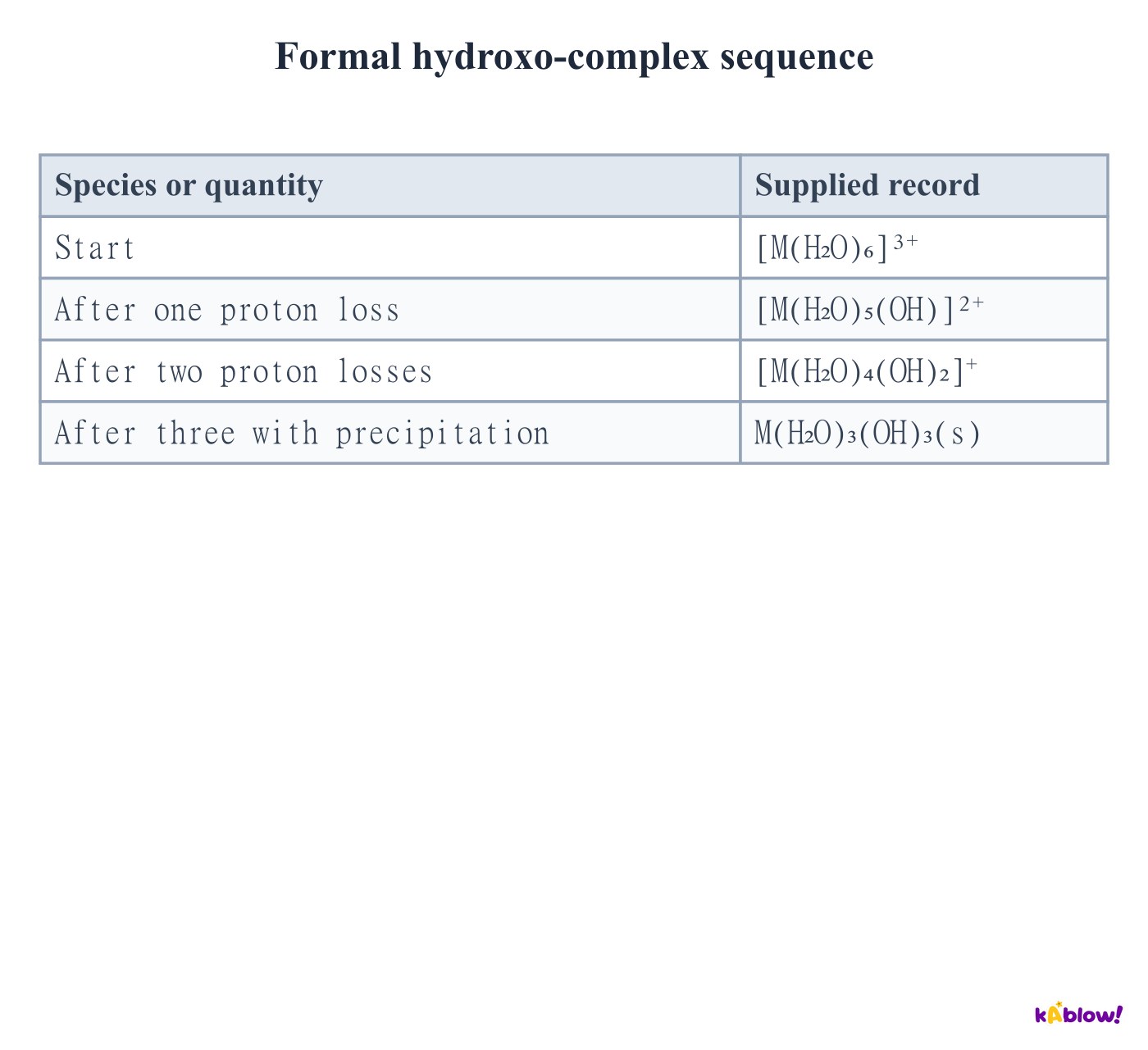
- Each formal proton loss converts one neutral water ligand to OH⁻ and lowers the complex charge by one. The metal oxidation state is unchanged.
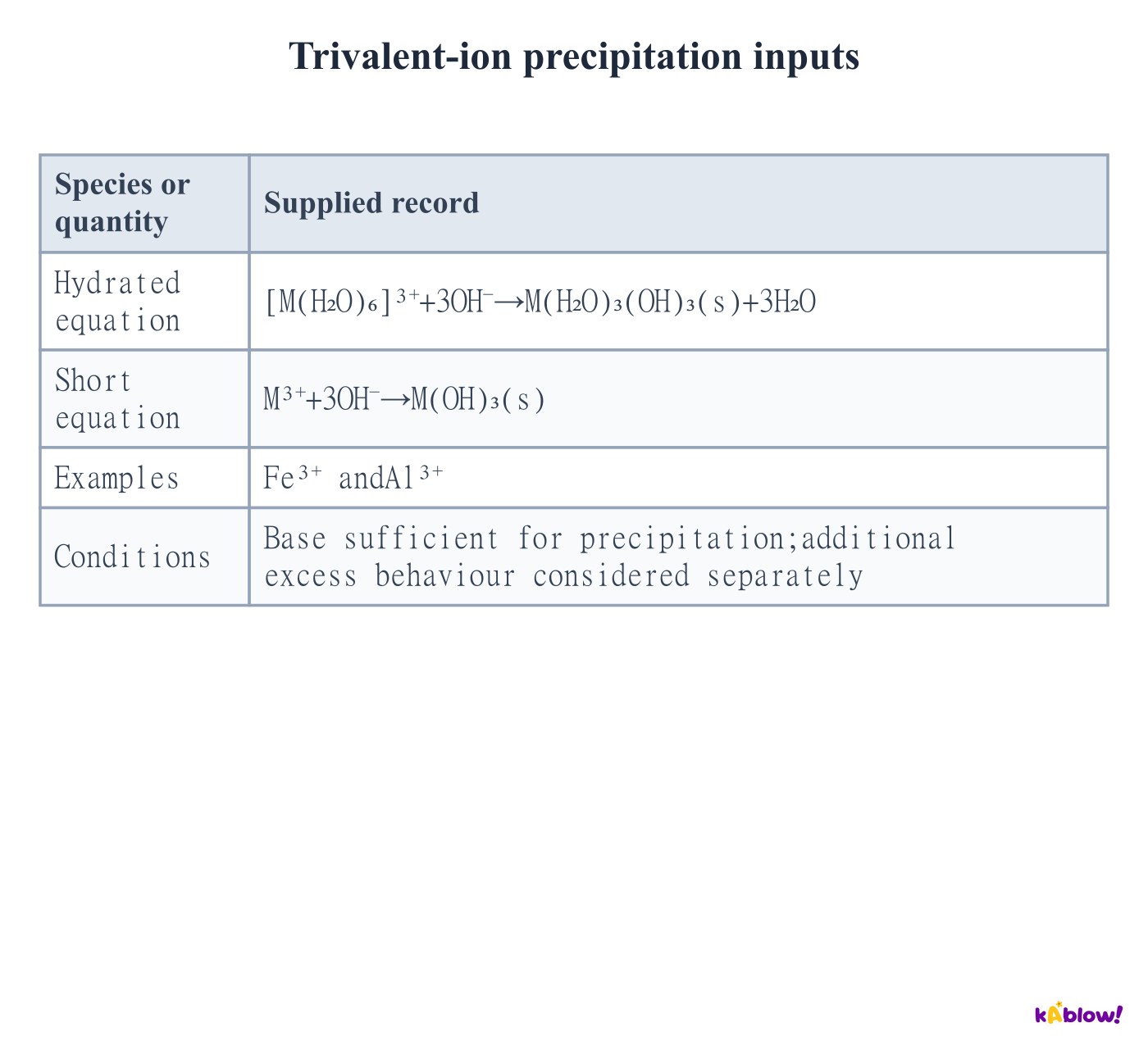
- With suitable base, neutral hydrated hydroxide precipitates. The course may write M(H₂O)₃(OH)₃(s) or use the shorter M(OH)₃(s) bookkeeping.
- A hydrated hydroxide solid is not necessarily made of isolated molecules with precisely this microscopic structure. Do not mix the short and hydrated equations without balancing the water.
Formal hydroxo-complex sequence
Precipitate divalent hydroxides with base
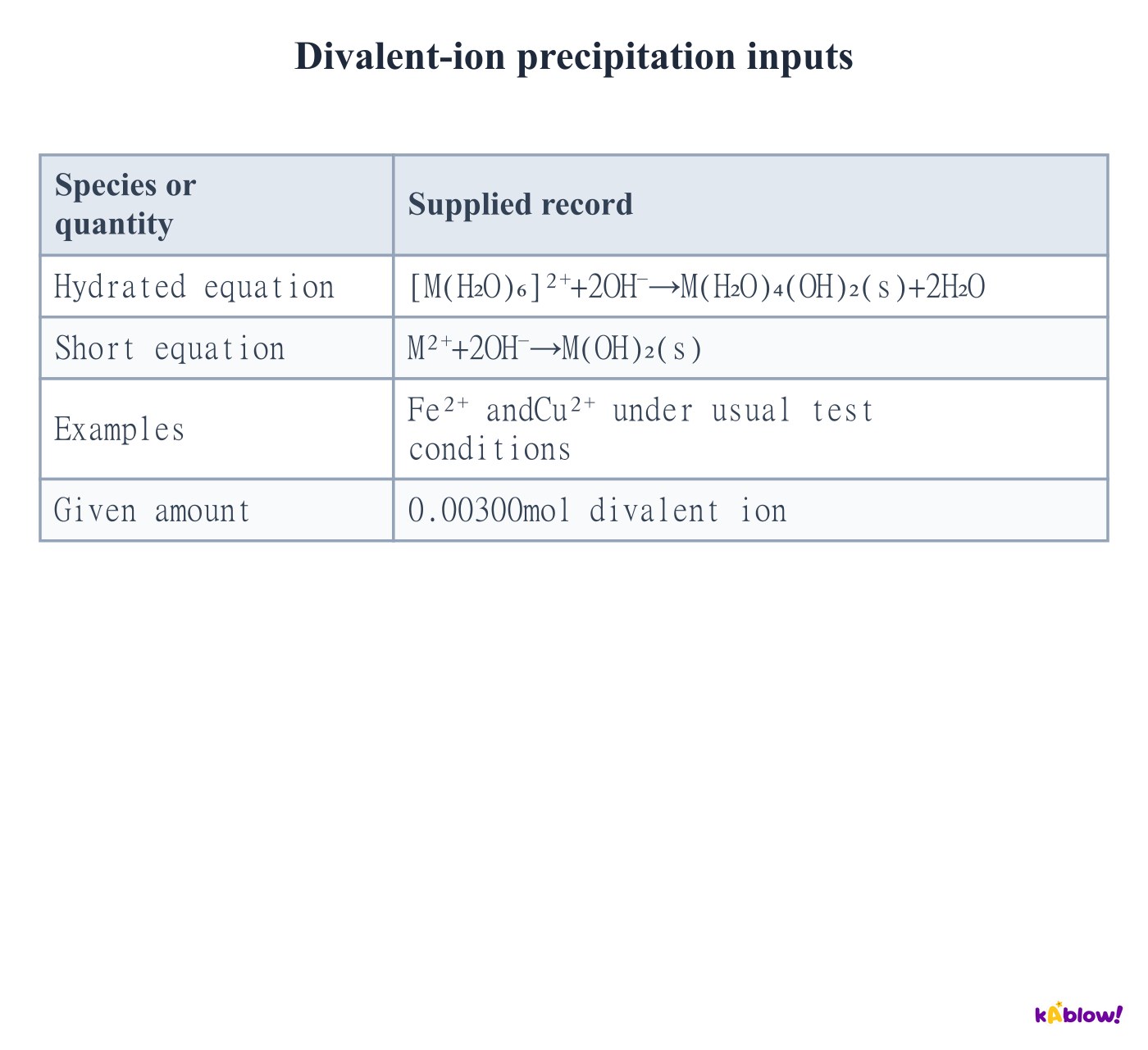
- Hydroxide removes protons from coordinated water. For the two course divalent ions, the usual net stoichiometry is two OH⁻ per metal centre.
- M²⁺+2OH⁻→M(OH)₂(s) is the shortened equation. The hydrated equation explicitly retains four waters and releases two.
- The equation predicts proton equivalents and charge balance. Whether visible solid forms also depends on concentrations and solubility conditions.
Divalent-ion precipitation inputs
Use three base equivalents for the trivalent hydroxide stage
- Iron(III) and aluminium(III) aqua ions form hydroxide-containing precipitates when enough suitable base removes three protons per metal.
- For this stage, M³⁺+3OH⁻→M(OH)₃(s) conserves atoms and charge. The metal stays at+3 rather than becoming a neutral metal atom.
- Further excess OH⁻ can dissolve aluminium hydroxide. Complete precipitation and subsequent redissolution are separate stages with different stoichiometry.
Trivalent-ion precipitation inputs
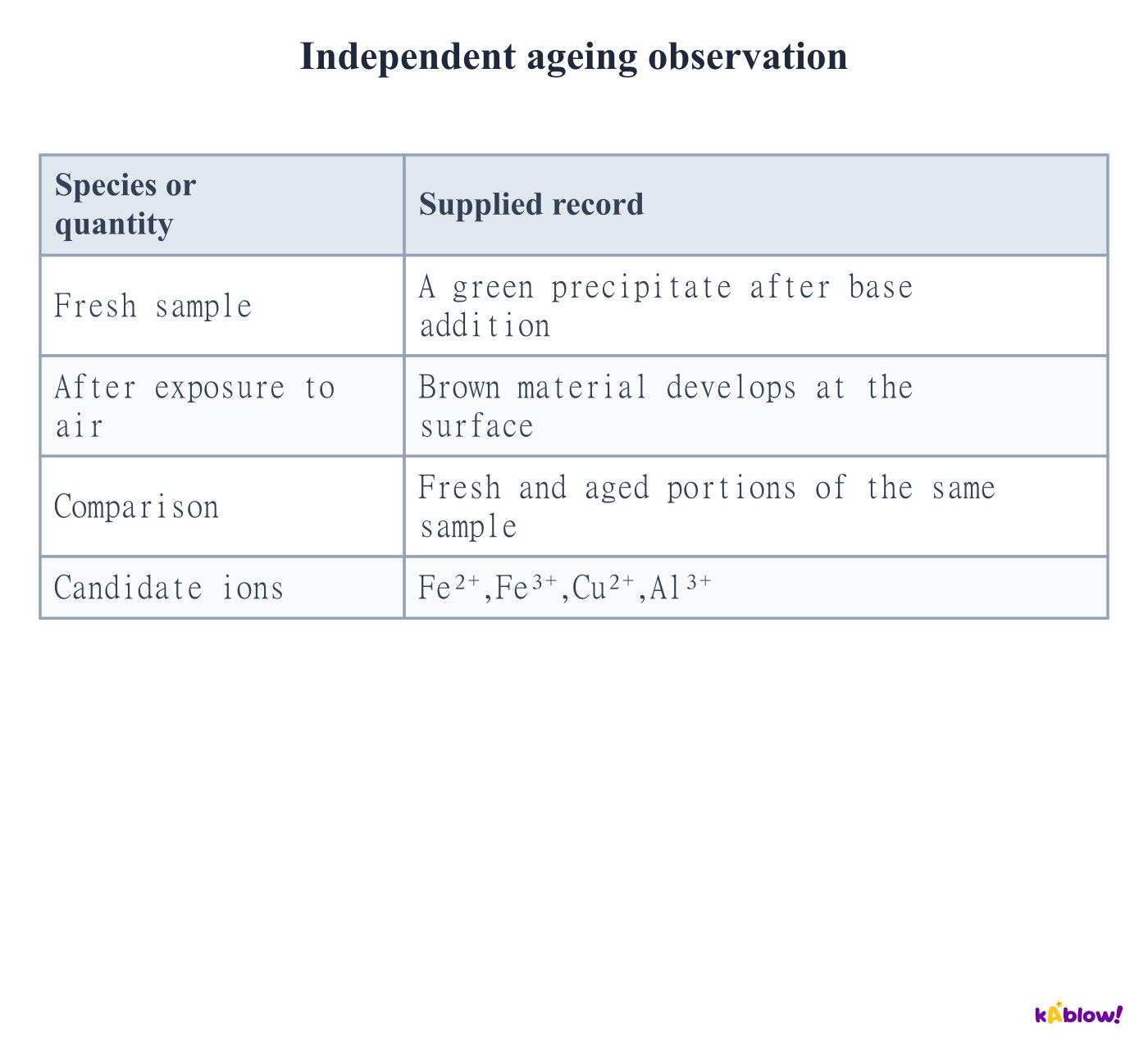
Recognise iron(II) hydroxide and oxidation in air
- A fresh iron(II) sample commonly gives a green hydroxide precipitate with OH⁻ or ammonia. It usually remains in excess of either reagent under the test conditions.
- Air can oxidise iron(II) material to brown iron(III) hydroxide-containing products. One simplified equation is 4Fe(OH)₂+O₂+2H₂O→4Fe(OH)₃.
- Record colour promptly and note ageing. A brown surface on an initially green precipitate is not evidence that the initial solution necessarily contained only iron(III).
Independent ageing observation
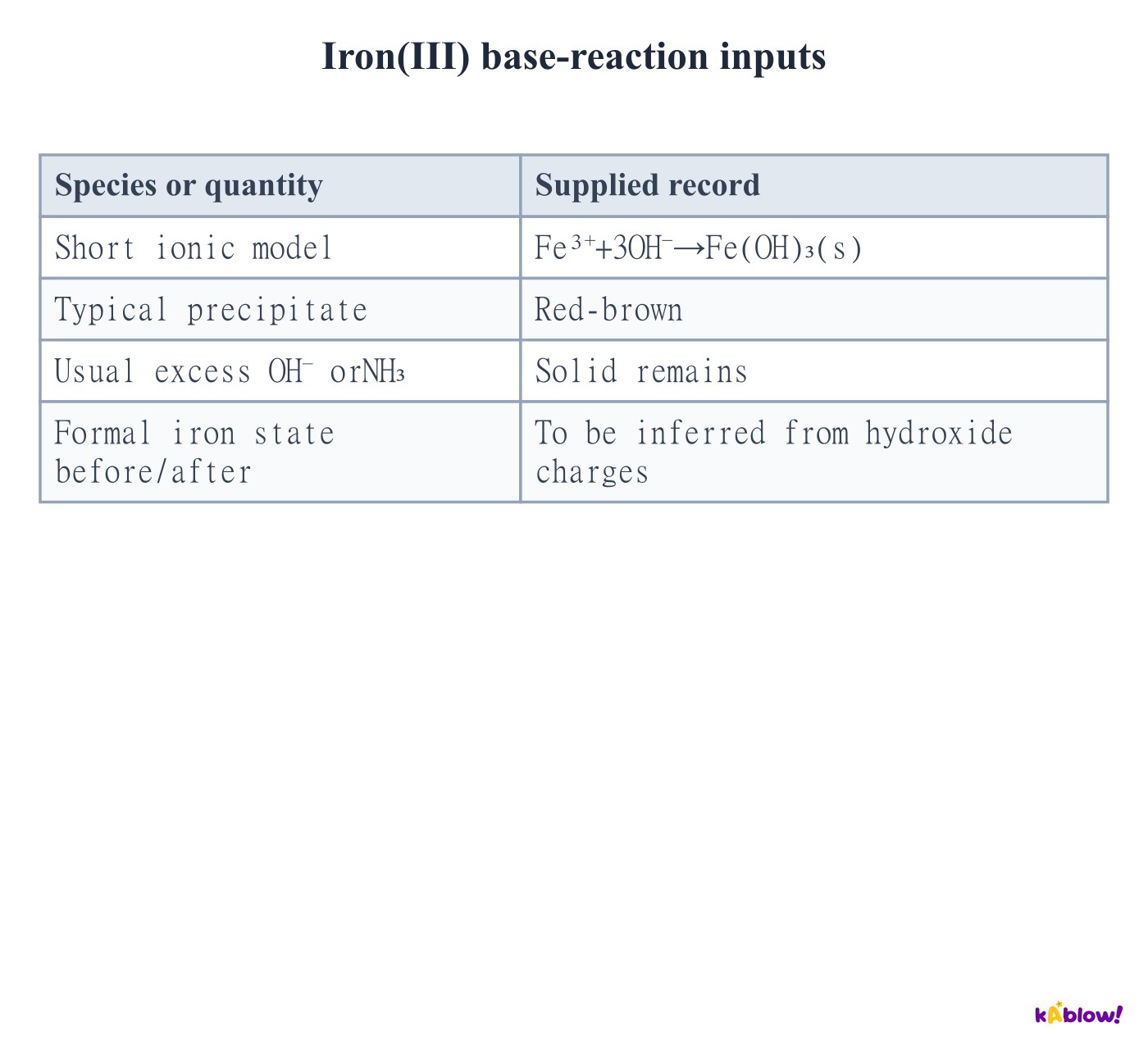
Separate iron(III) precipitation from reduction
- Iron(III) gives a red-brown hydroxide-containing precipitate with OH⁻ or ammonia. It usually remains in excess of these reagents in the course tests.
- Precipitation is acid–base chemistry rather than a reduction to iron metal. In Fe(OH)₃, the three OH⁻ groups still require iron at+3.
- Ordinary yellow or orange aqueous iron(III) solutions can include hydrolysed species; pure hexaaquairon(III) is pale violet. Keep solution colour distinct from precipitate colour.
Iron(III) base-reaction inputs
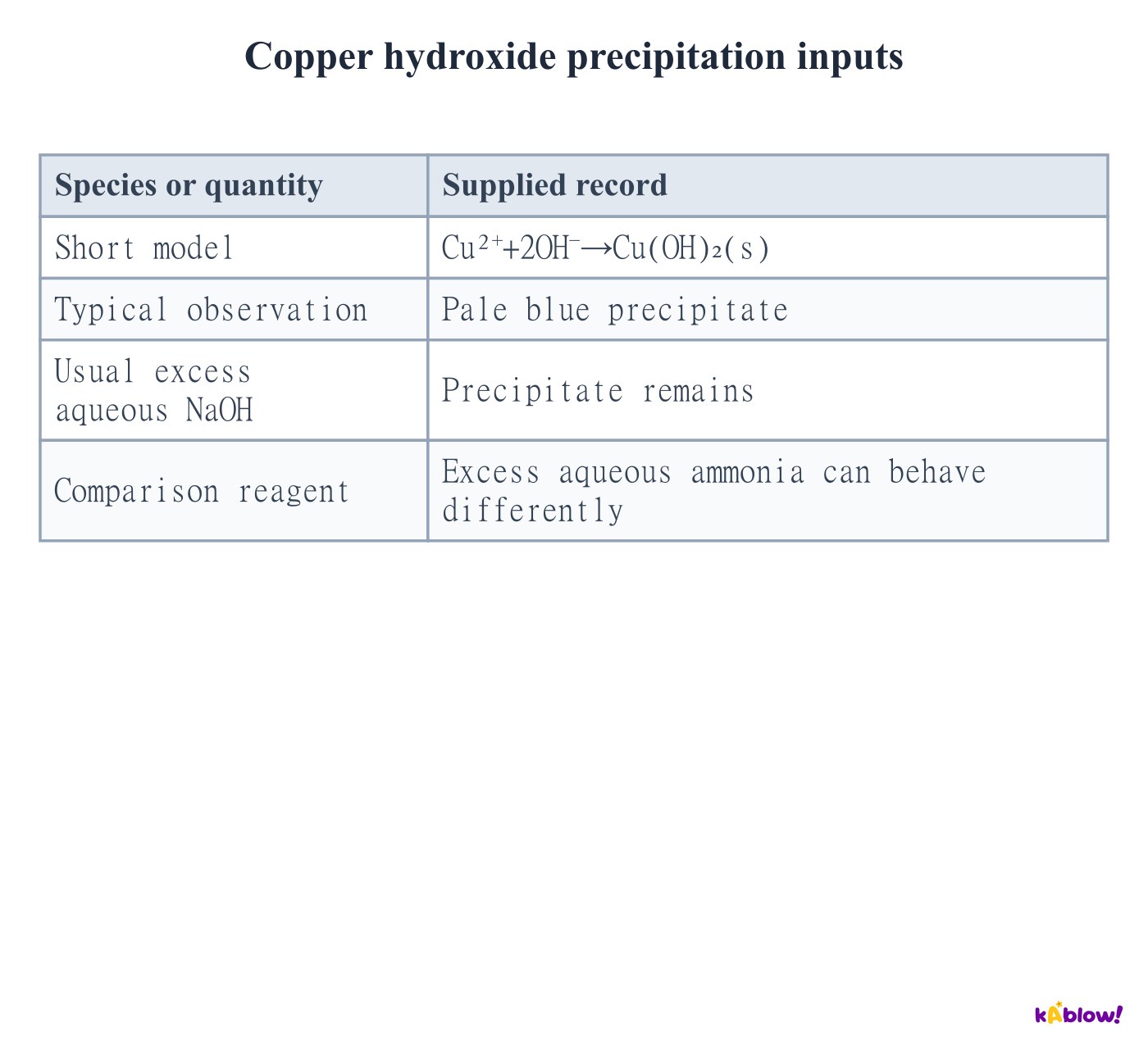
Recognise copper hydroxide without assuming ammonia behaviour
- Copper(II) gives a pale-blue hydroxide-containing precipitate with OH⁻. It normally remains in excess NaOH under the stated school-test conditions.
- A solid precipitate is different from the original pale-blue clear solution. Record clarity and physical state as well as colour.
- Excess ammonia can dissolve the precipitate through complex formation. Do not transfer the excess-NaOH observation to every alkaline reagent.
Copper hydroxide precipitation inputs
Explain ammonia precipitation by proton acceptance
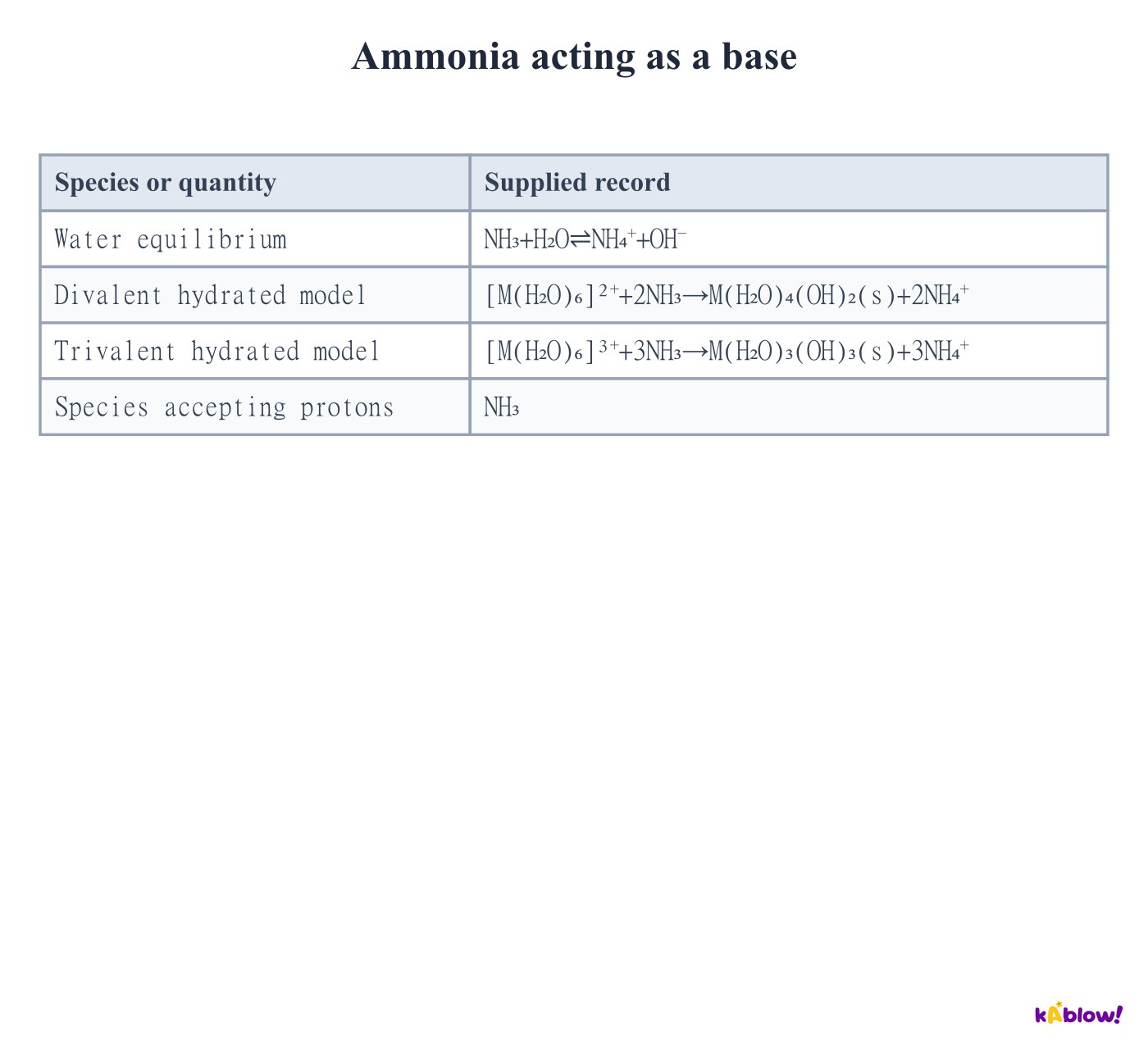
- Ammonia is a weak base in water and can remove protons from coordinated water ligands. The resulting ammonium ions account for the gained protons.
- Two NH₃ per divalent aqua ion or three per trivalent ion appear in the stated hydrated precipitation models. These are net acid–base balances, not assertions of elementary collision steps.
- Do not invent free NH₄OH molecules as a necessary reagent. Use NH₃, NH₄⁺, water and hydroxide equilibria consistently.
Ammonia acting as a base
Explain the copper–ammonia observation sequence
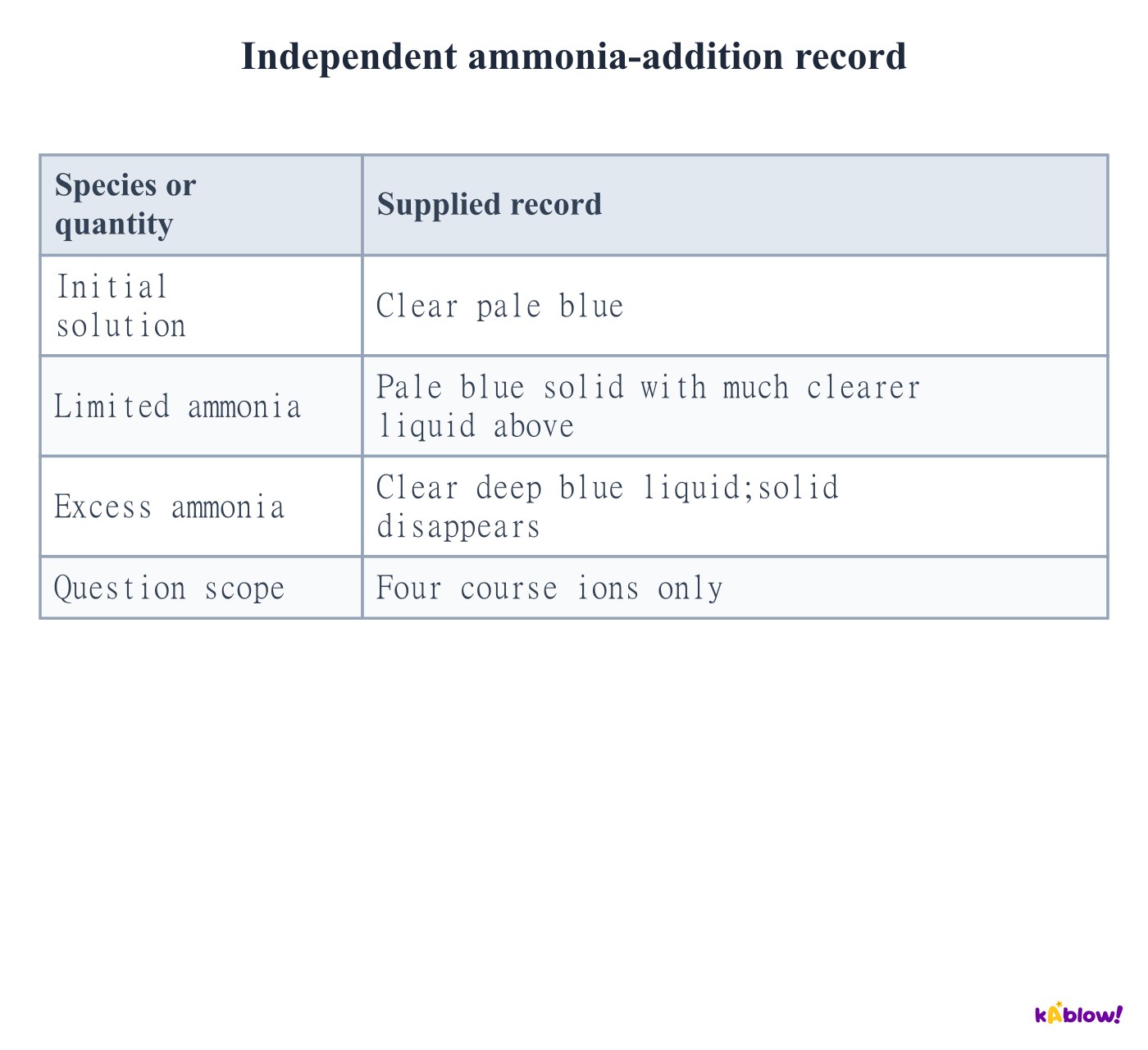
- The three-tube illustration shows the conceptual sequence:left clear pale-blue aqua solution, middle pale-blue precipitate, right clear deep-blue excess-ammonia solution.
- Initially ammonia acts as a base. In excess, it supplies ligands to form[Cu(NH₃)₄(H₂O)₂]²⁺, tetraamminediaquacopper(II). Copper remains +2 and coordination number 6.
- One shortened dissolution model is Cu(OH)₂+4NH₃+2H₂O⇌[Cu(NH₃)₄(H₂O)₂]²⁺+2OH⁻. The water balance differs from the explicitly hydrated-solid version.
Copper(II) through limited and excess ammonia
Distinguish aluminium’s excess-hydroxide and ammonia results
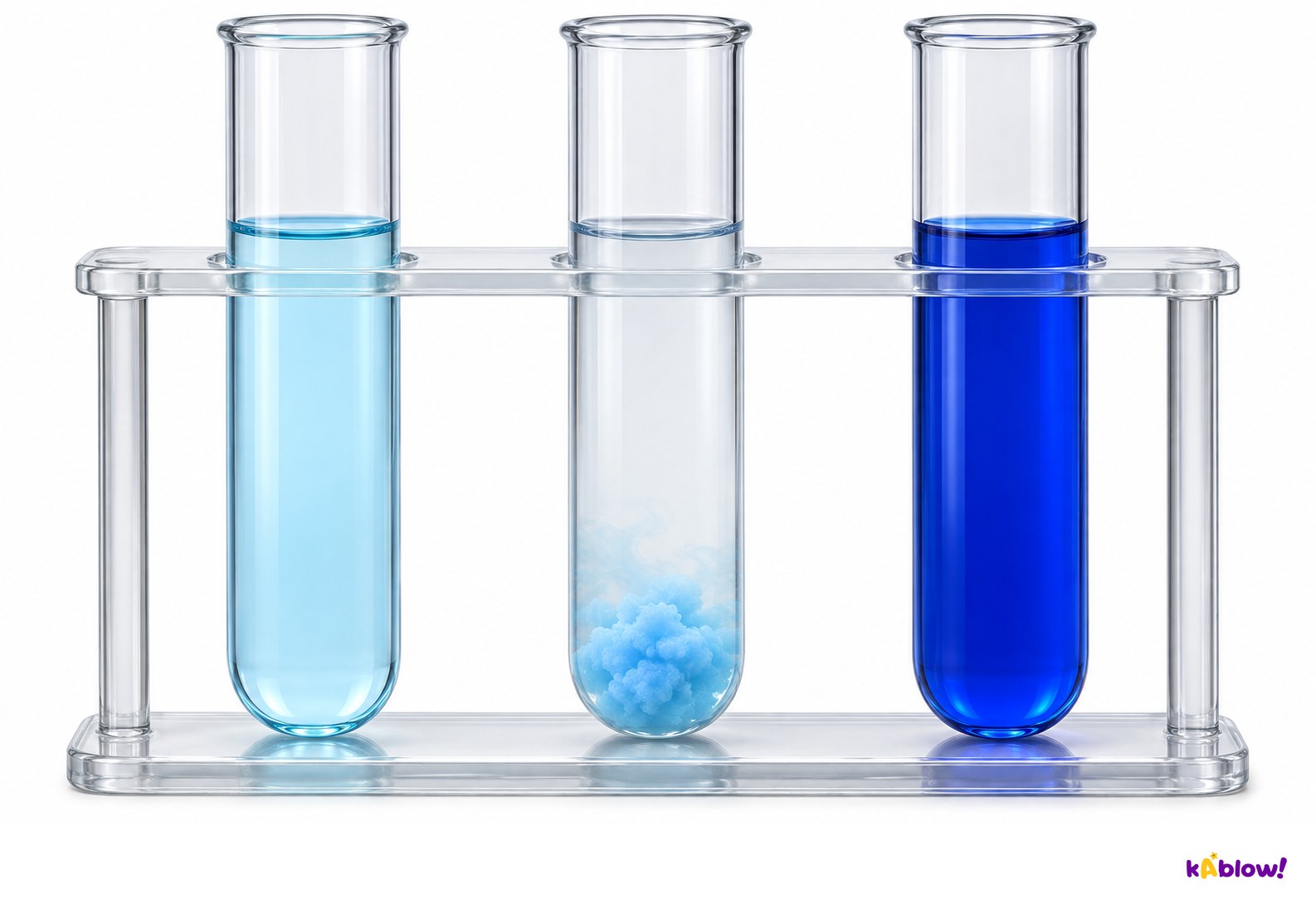
- Aluminium(III) commonly gives a white hydroxide precipitate with either OH⁻ or ammonia. In excess NaOH, it dissolves to a colourless aluminate-containing solution.
- The white precipitate remains in usual excess ammonia. Ammonia’s weak-base equilibrium does not reproduce the high hydroxide availability of excess strong base.
- Within the four course ions, the combined tests support aluminium. A white precipitate alone is insufficient when other possible cations are not excluded.
Independent white-precipitate tests
Show aluminium hydroxide acting as a base toward acid
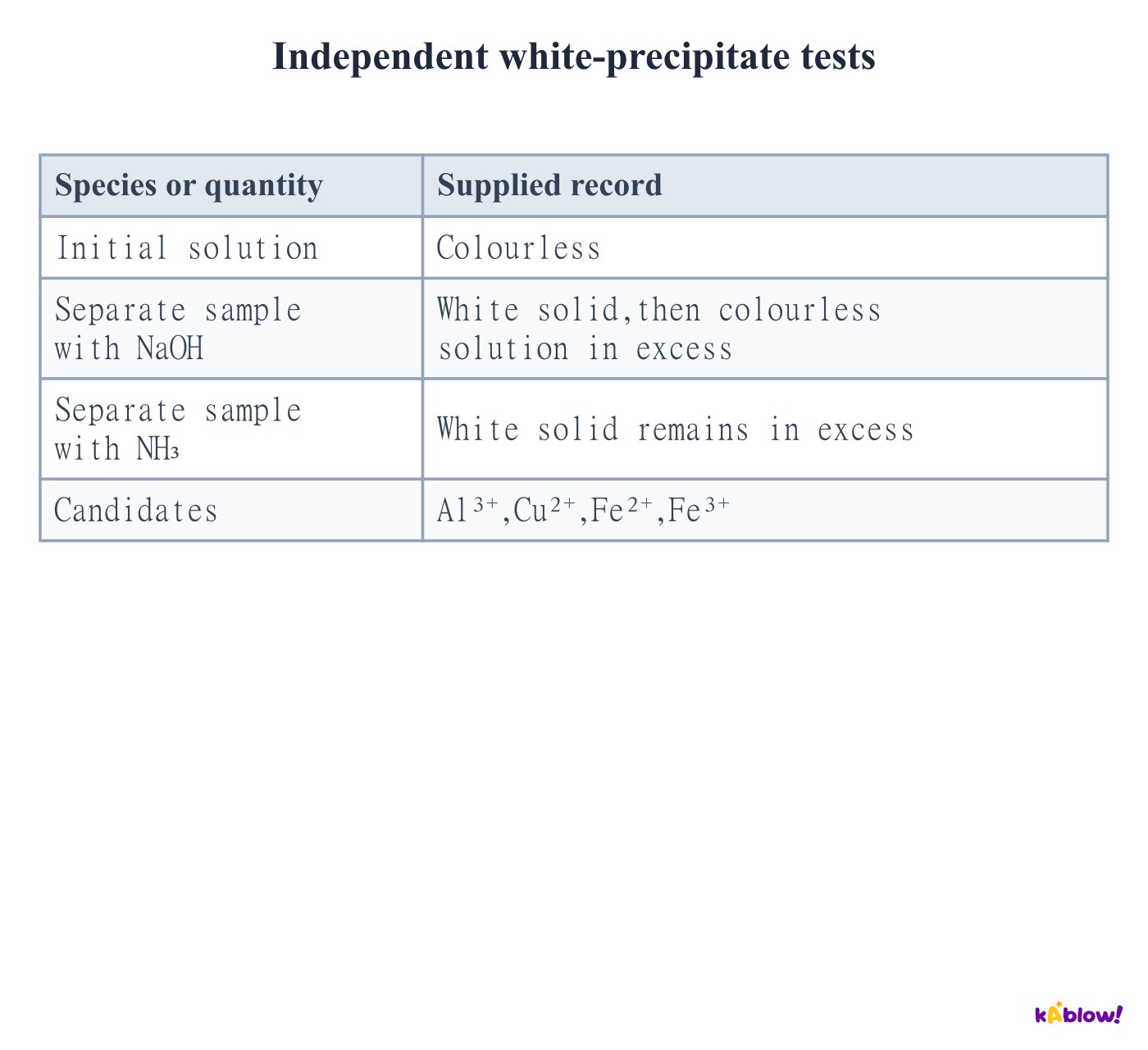
- Aluminium hydroxide dissolves in suitable acid by consuming protons. The short ionic equation is Al(OH)₃+3H⁺→Al³⁺+3H₂O.
- When the retained hydration waters are explicit, Al(H₂O)₃(OH)₃+3H⁺→[Al(H₂O)₆]³⁺is an equivalent balanced convention.
- This acid reaction demonstrates basic behaviour. Amphoterism requires the additional suitable reaction with base.
Aluminium hydroxide acid inputs
Form tetrahydroxoaluminate in excess hydroxide
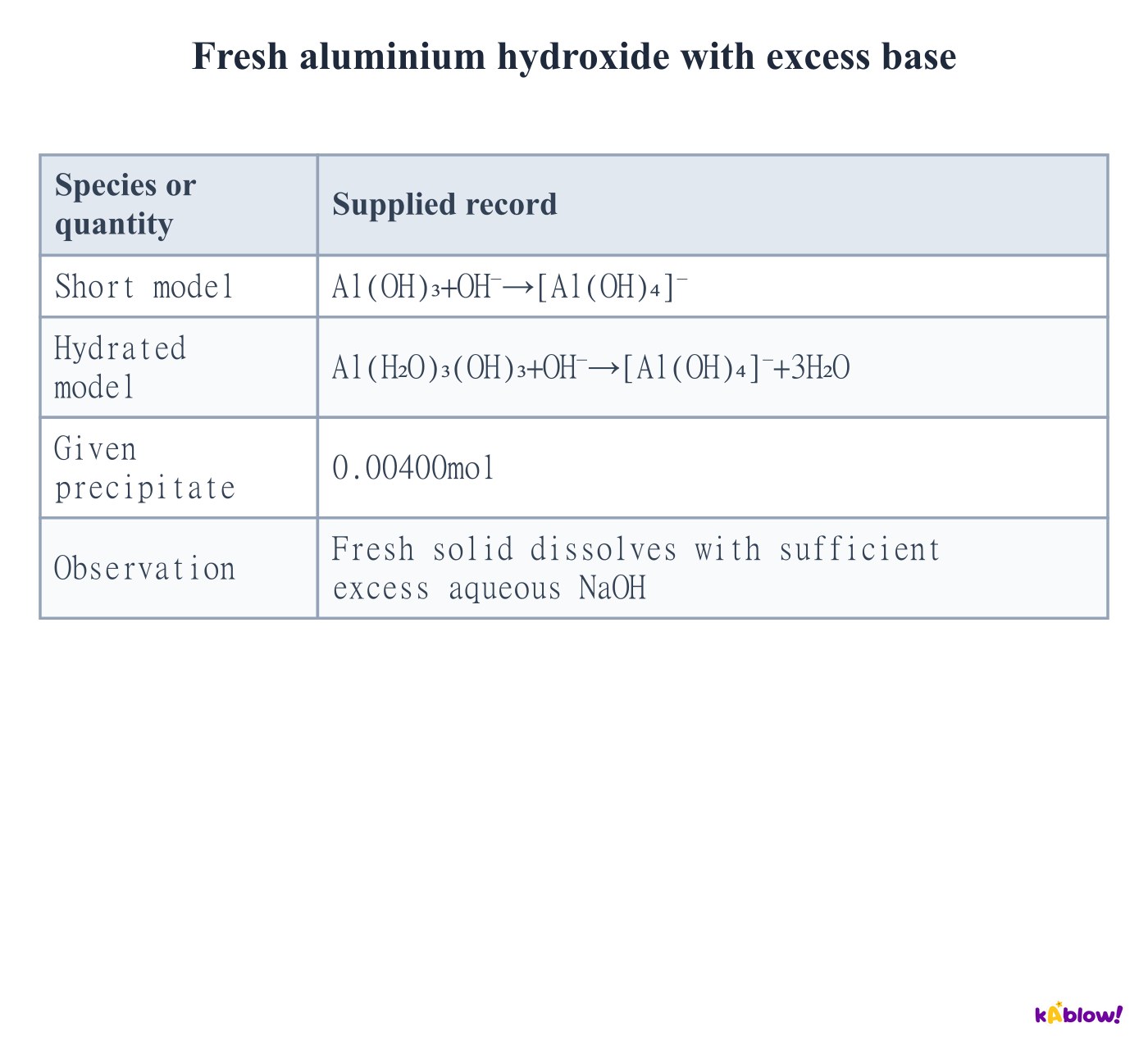
- Fresh aluminium hydroxide can dissolve in sufficient excess aqueous NaOH to give[Al(OH)₄]⁻. Heating is not a universal requirement for this fresh precipitate.
- The short model consumes one additional OH⁻ per Al(OH)₃ after the precipitation stage. Aluminium remains at oxidation state +3.
- The tetrahydroxo representation is the course model; do not silently mix it with a different hydrated-aluminate convention and lose waters or charges.
Fresh aluminium hydroxide with excess base
Demonstrate amphoterism using both reactions
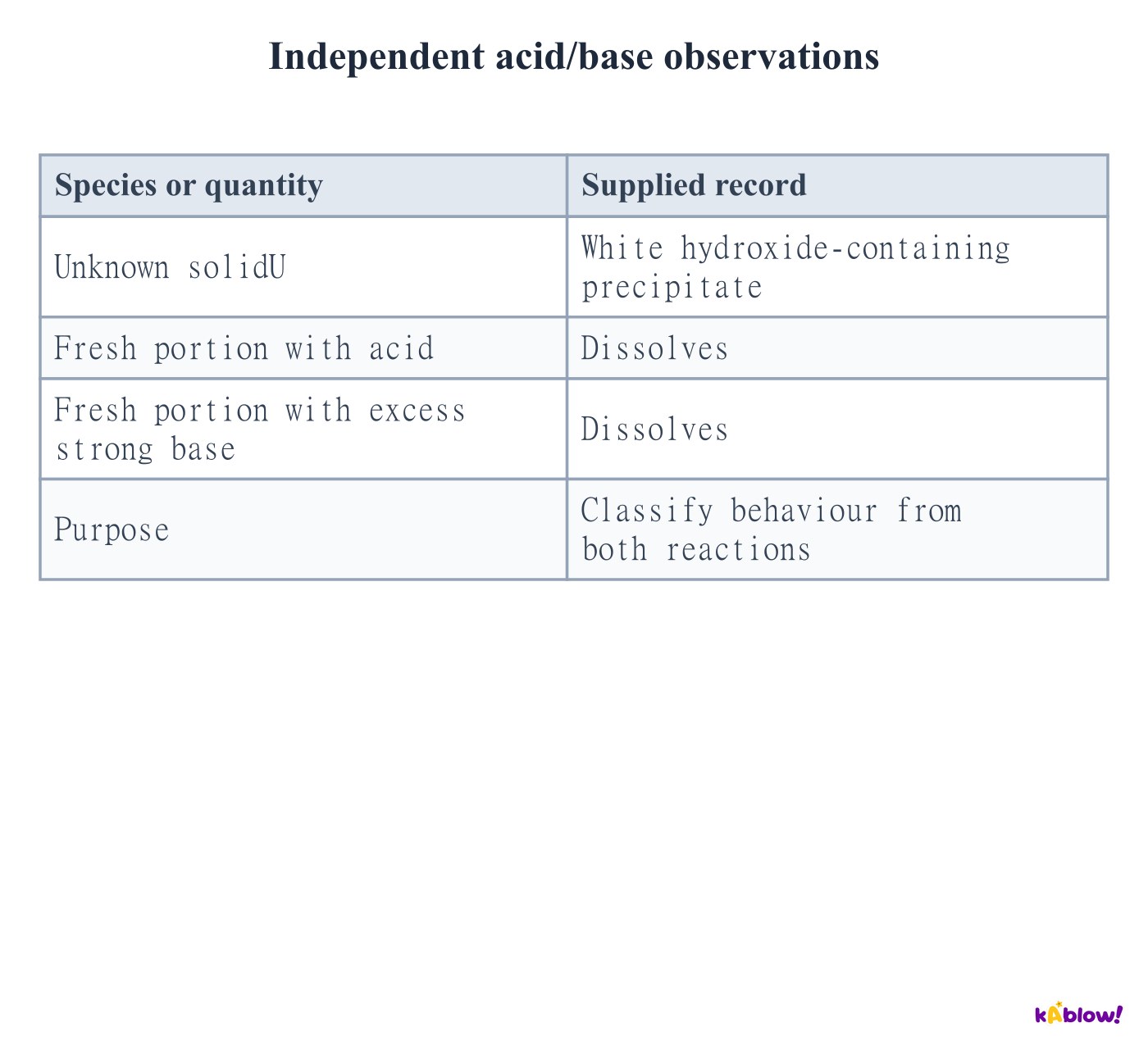
- An amphoteric hydroxide reacts with suitable acid and base. For Al(OH)₃, acid gives an aqua-ion solution and excess OH⁻ gives aluminate.
- A precipitate dissolving in ammonia is not by itself proof of amphoterism; ligand complex formation can be responsible, as in the copper example.
- Use fresh portions and identify the reagent conditions. A missing visible change in one unsuitable reagent does not settle every possible acid–base reaction.
Independent acid/base observations
Qualify the divalent carbonate precipitation model
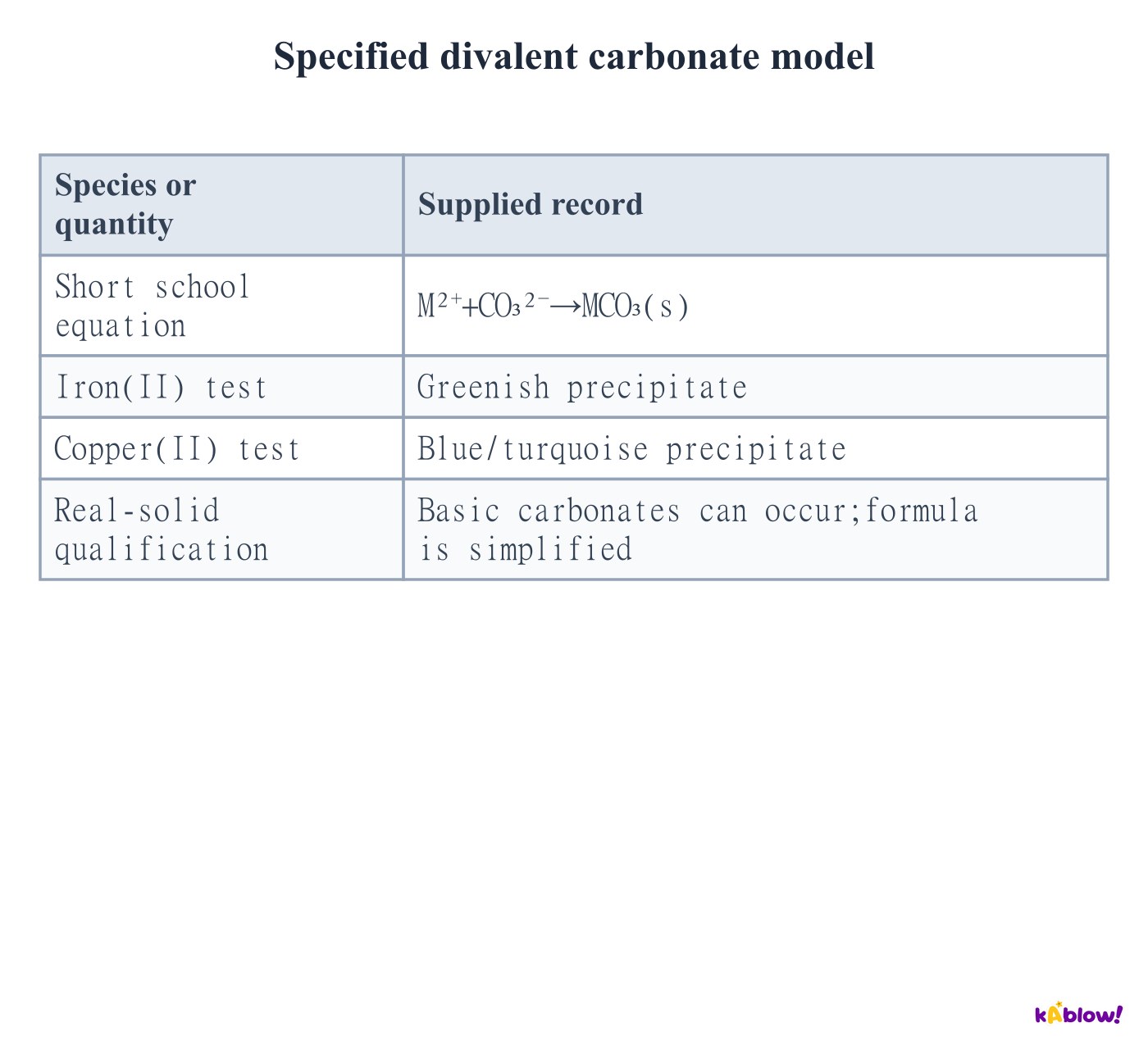
- The course usesM²⁺+CO₃²⁻→MCO₃(s) for divalent carbonate precipitation. Iron(II) and copper(II) give characteristic coloured solids in ordinary tests.
- The copper precipitate is commonly a basic carbonate rather than pure anhydrous CuCO₃. Iron solids can also have condition-dependent composition and ageing.
- Use a stated simplified formula for formal stoichiometry, but do not infer a precise real precipitate mass or crystal identity without composition evidence.
Specified divalent carbonate model
Explain carbonate’s base role with trivalent aqua ions
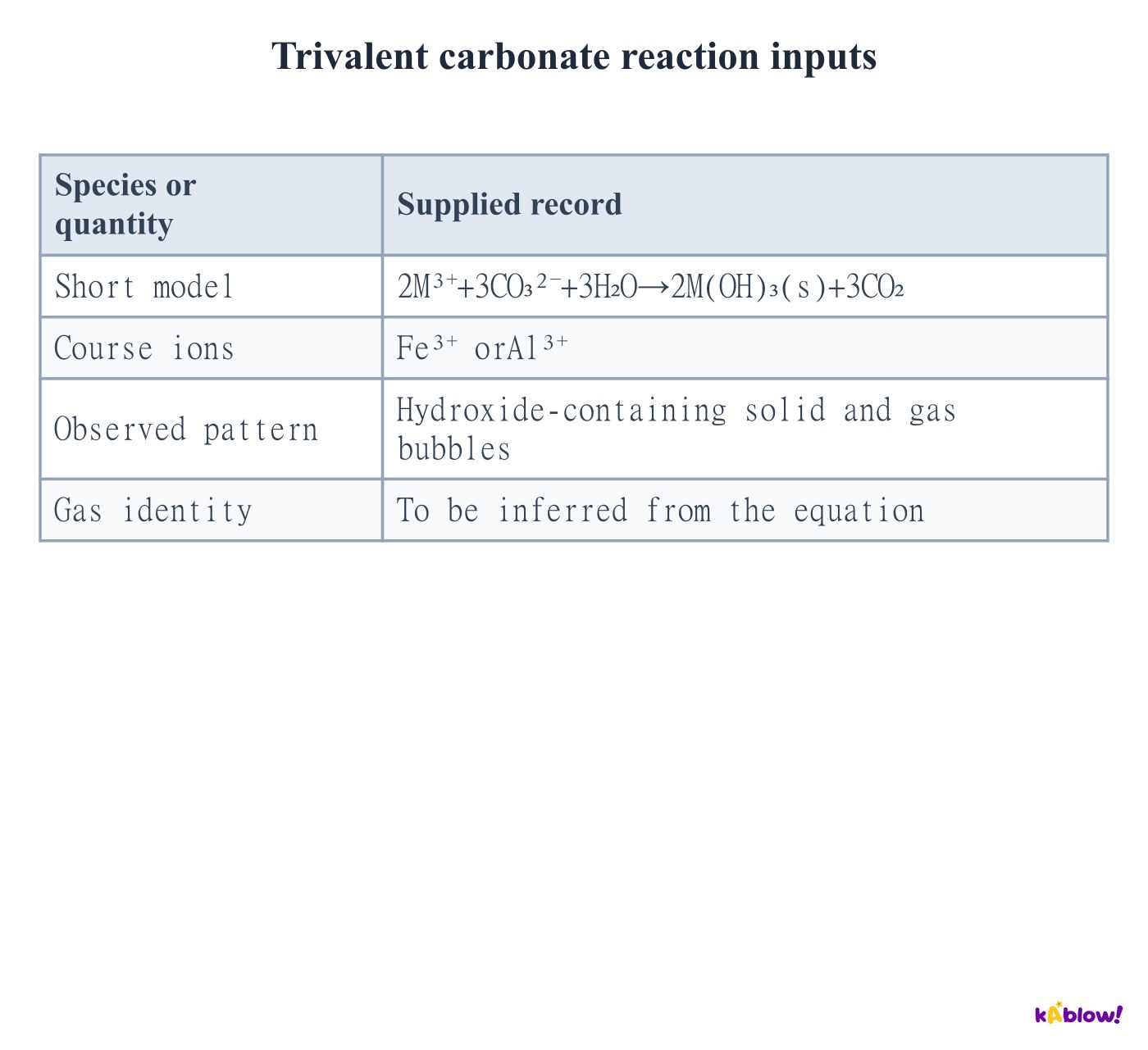
- The more acidic Fe(III) and Al(III) aqua systems can protonate carbonate, releasing CO₂ while hydroxide-containing solid forms. They do not simply give the usual stable M₂(CO₃)₃ precipitate in these tests.
- The shortened model is 2M³⁺+3CO₃²⁻+3H₂O→2M(OH)₃+3CO₂. Explicit hydrated-solid equations retain a different number of water molecules.
- The familiar Fe(III) solid is red-brown and aluminium solid white. The outcome depends on conditions; avoid a universal statement about every 3+ ion and every carbonate environment.
Trivalent carbonate reaction inputs
Combine independent tests for a copper inference
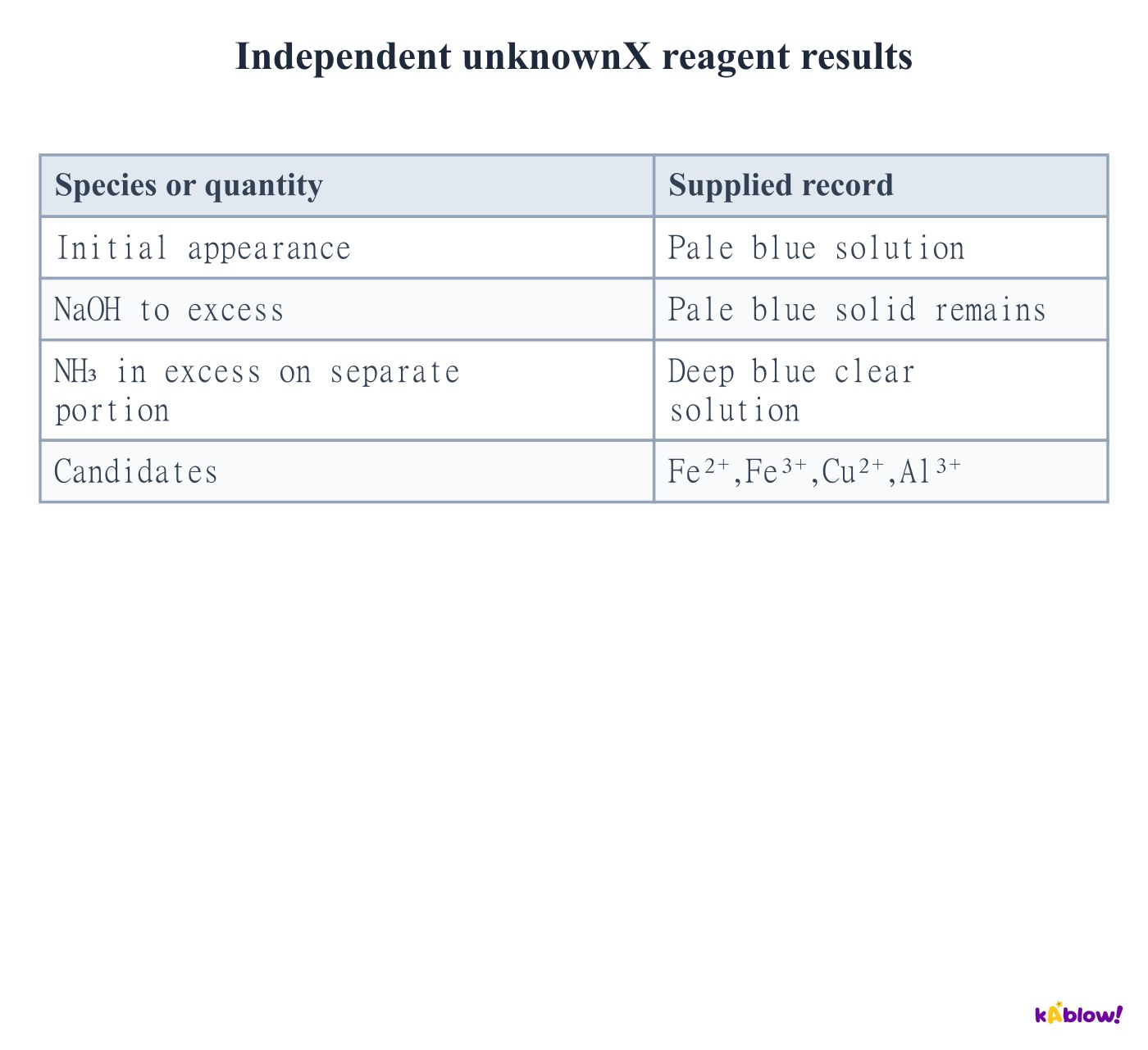
- The supplied unknownX pattern combines solution appearance, precipitation and excess-ammonia dissolution. Within the stated candidates, it supports Cu²⁺.
- Use the combination instead of a single colour word. A pale-blue solid with NaOH is different evidence from a clear deep-blue ammine solution.
- The inference assumes a suitable single-ion sample and comparable reagents. Mixtures or other ligands can complicate the result.
Independent unknownX reagent results
State the limits of an aluminium identification
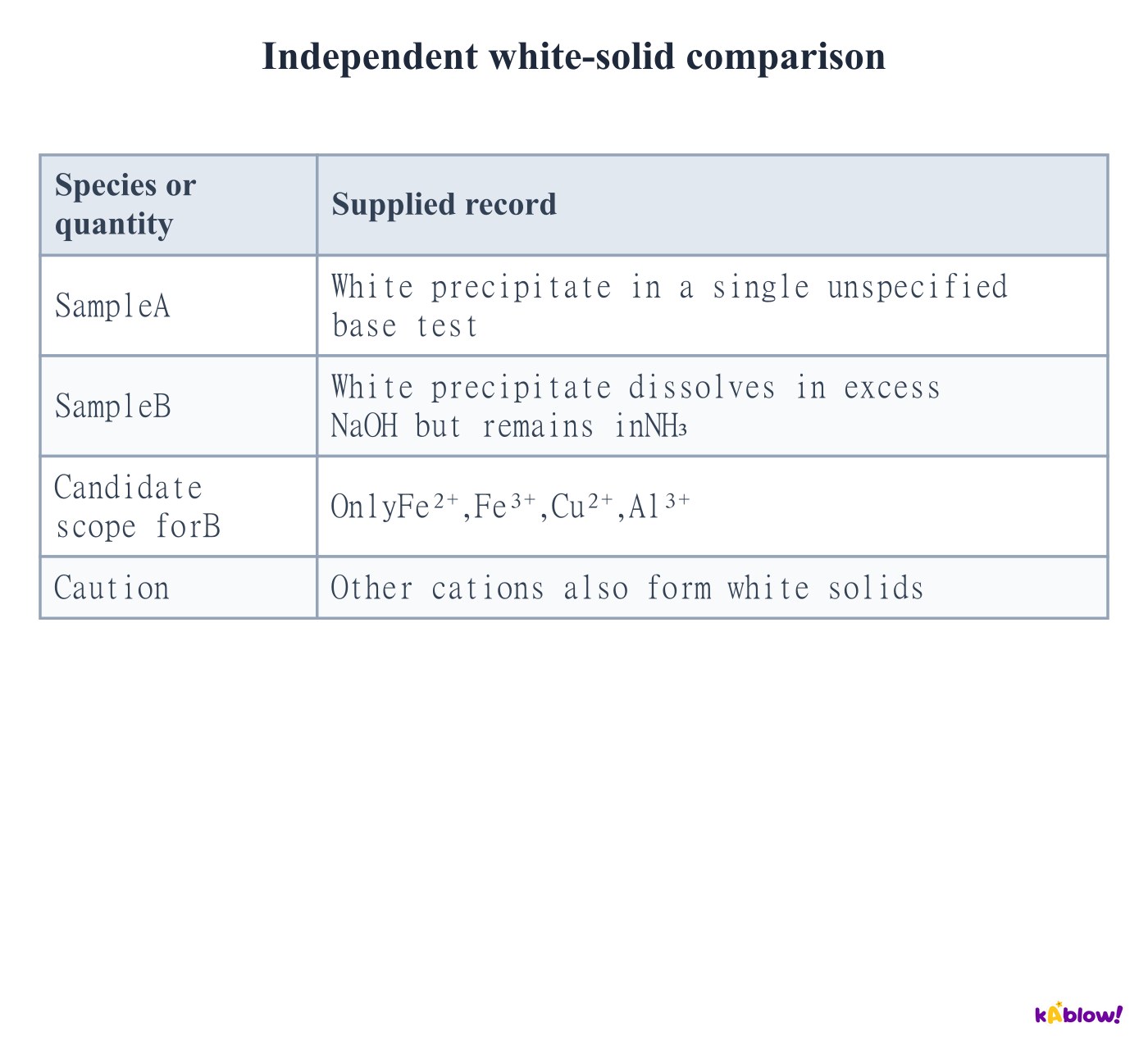
- Within the four-ion course set, the paired excess-reagent behaviour of sampleB supports Al³⁺. The restricted candidate set is part of the inference.
- SampleA’s white solid alone is insufficient to establish aluminium. Other cations, including ions outside this lesson, can produce white precipitates.
- A negative observation needs suitable reagent concentration and sufficient time. Record the test conditions before treating no visible change as decisive.
Independent white-solid comparison
Calculate a limiting-reagent precipitate amount
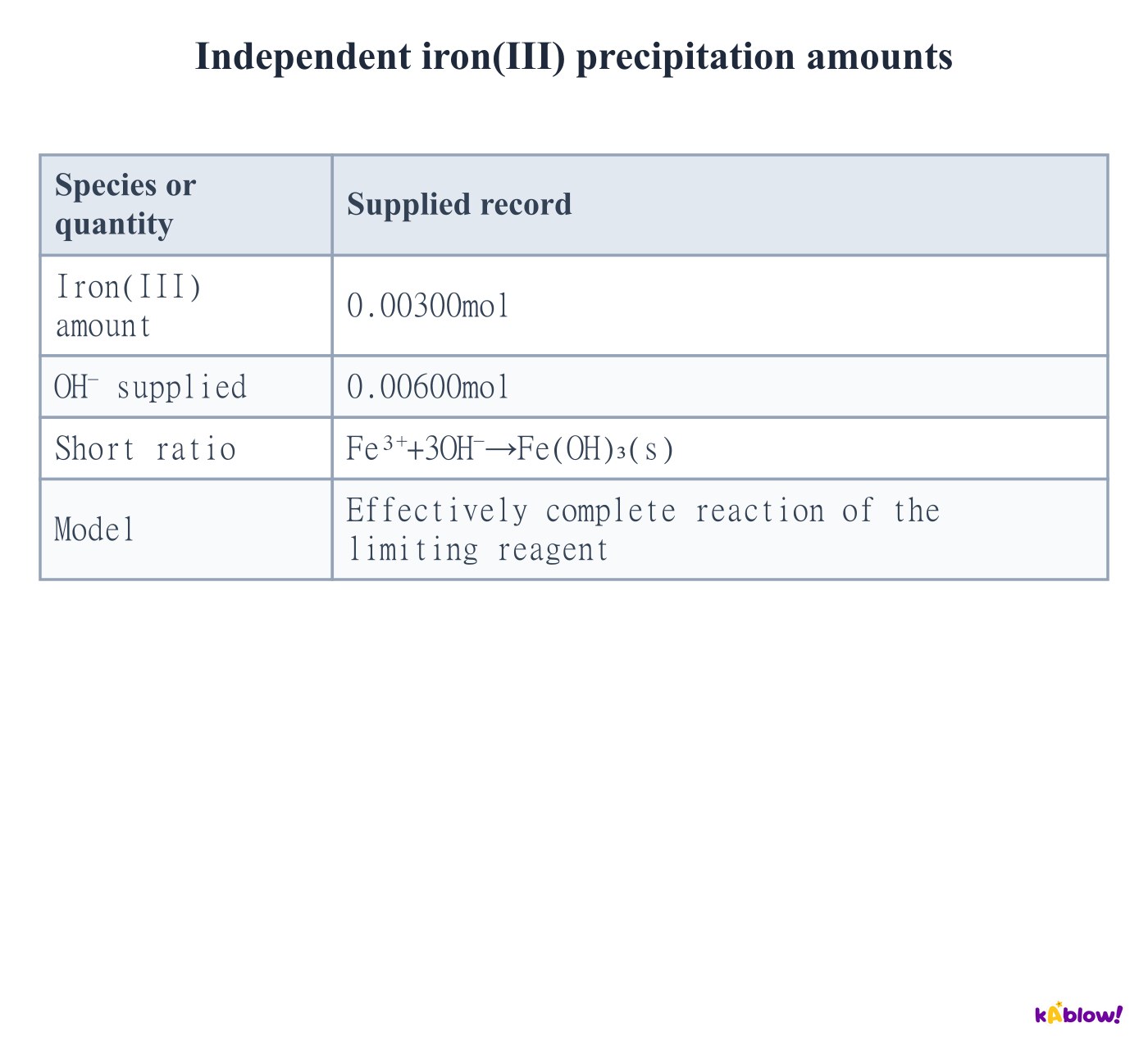
- The supplied 0.00600 mol OH⁻can precipitate 0.00200 mol Fe(OH)₃ at the 3:1ratio. Hydroxide is limiting against 0.00300 mol iron(III).
- The short model leaves 0.00100 mol iron(III) unprecipitated. It does not imply every added base amount must remove all metal from solution.
- For a gravimetric claim, hydration, drying and actual solid composition would need control. Use the explicitly stated formula model for the requested amount.
Independent iron(III) precipitation amounts
Use the carbonate ratio and specified gas conditions
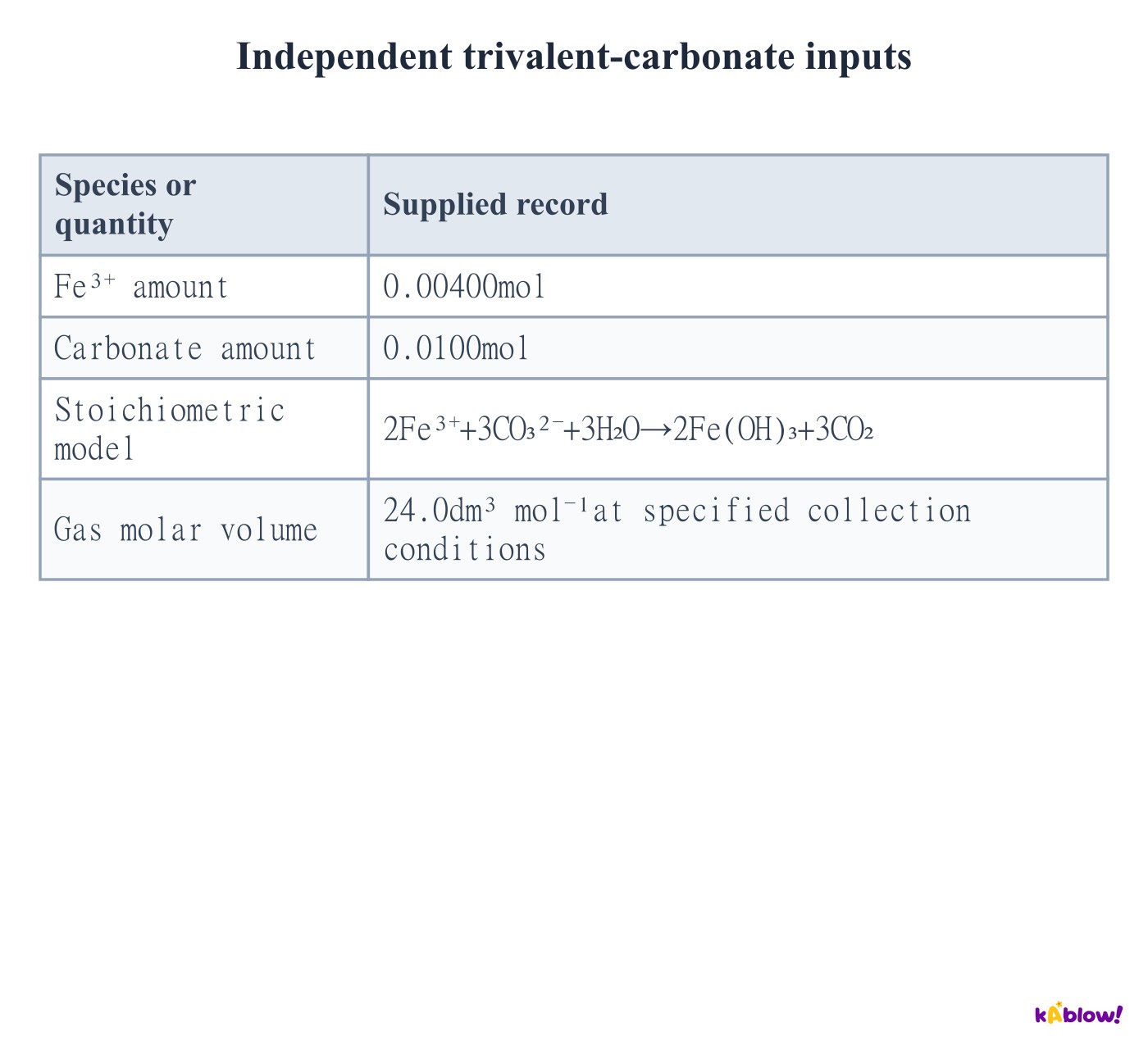
- For the supplied amounts, 0.00400 mol Fe³⁺requires 0.00600 mol carbonate, so carbonate is in excess. The CO₂amount is 0.00600 mol.
- Using the stated molar gas volume gives 0.00600×24.0=0.144dm³. The value 24.0 dm³mol⁻¹belongs to specified collection conditions, not to every temperature and pressure.
- An experimental gas result can also depend on dissolution, leaks and reaction completeness. State the ideal model before comparing with observation.
Independent trivalent-carbonate inputs
Record evidence so that a test remains interpretable
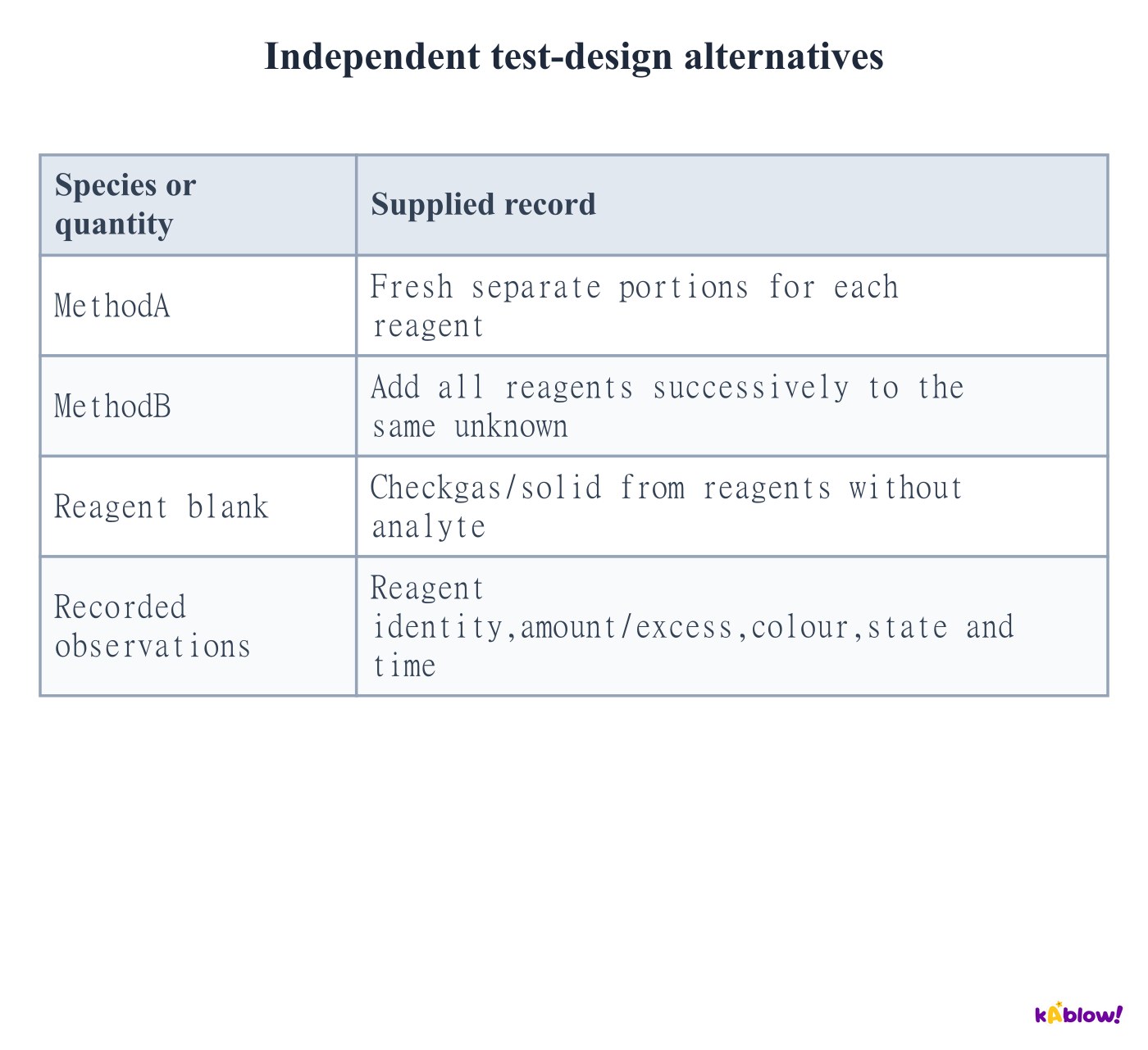
- Use separate sample portions when comparing OH⁻, ammonia and carbonate. Reagent carry-over can change acidity, ligands and later precipitates.
- A reagent blank helps distinguish a metal-related observation from contamination or pre-added acid. Carbonate bubbles alone do not establish a particular metal ion.
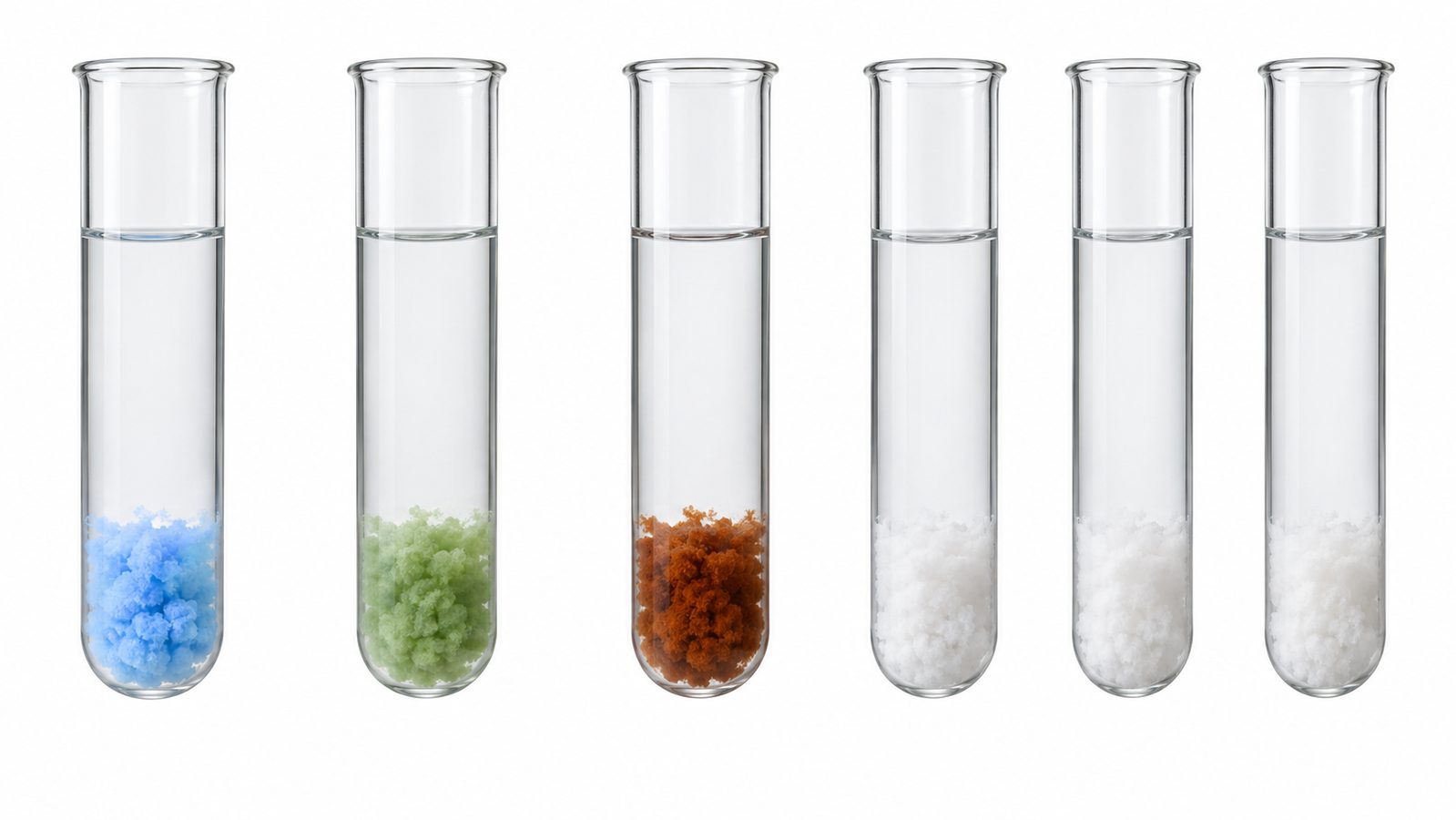
- The precipitate illustration compares blue, green, brown and white solids qualitatively. Its additional white samples show why colour alone cannot identify every cation; it is not a set of quantitative yields.
Qualitative appearances of hydroxide precipitates
Diapos
Sign up free to view the lesson slides
Step through every slide for this topic — plus flashcards and revision notes — with a free account.
Questions d'entraînement
Aperçu gratuit — 8 sur 60 questions. Inscris-toi pour toutes les voir.
1.What is the total ligand charge in the supplied copper aqua formula?
Medium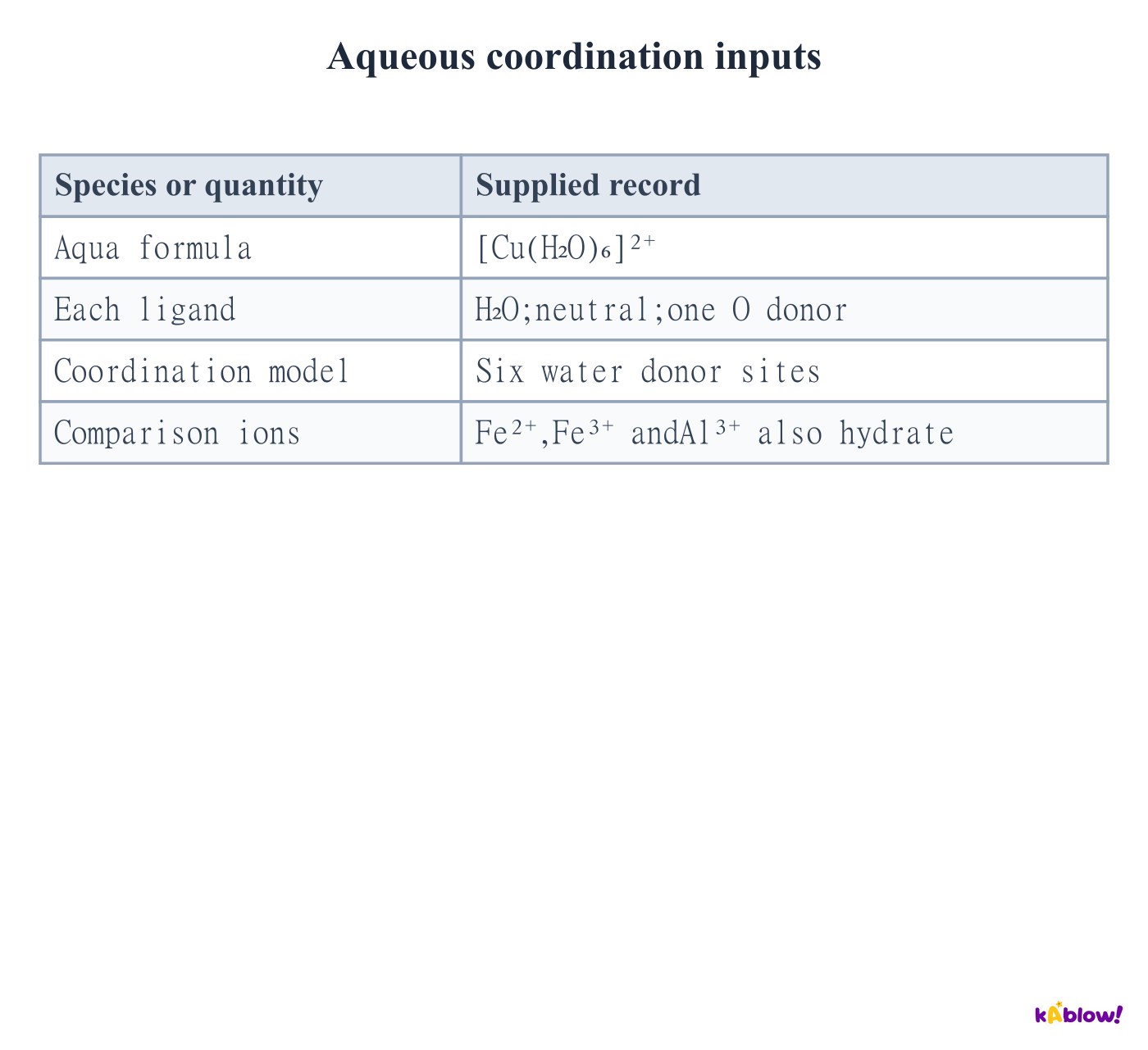
- A0
- B+2
- C−6
- D+6
2.How many hydrogen atoms are in the ammonium product in the supplied proton-transfer equation?
Medium- A1
- B4
- C3
- D5
3.How many oxygen atoms belong to the nitrate ions accompanying one iron in the supplied Fe(NO₃)₃ formula?
Medium- A1
- B3
- C9
- D6
4.Why is proton loss easier in the comparable iron(III) aqua system?
Medium- AIron changes into a hydrogen atom
- BThe water ligands have no O–H bonds
- COnly the nitrate counter-ion gains electrons
- DGreater charge density polarises bound-water O–H bonds more strongly
5.What iron oxidation state follows for[Fe(H₂O)₅(OH)]²⁺ with five neutral waters and one OH⁻ ligand?
Medium- A+3
- B+2
- C+1
- D0
6.Which Ka ratio follows for A:B from the supplied pKa values?
Medium- A10 to the power −2.6
- B10 to the power +2.6
- C4.8/2.2
- D2.2/4.8
7.How many hydrogen atoms are present in the formal[ M(H₂O)₄(OH)₂ ]⁺species supplied for the second proton-loss stage?
Medium- A12
- B11
- C10
- D9
8.How much OH⁻ is required for the supplied 0.00300 mol divalent ion under complete precipitation?
Medium- A0.00150 mol
- B0.00300 mol
- C0.00900 mol
- D0.00600 mol
Unlock all 60 questions, flashcards & more
Crée un compte gratuit pour voir toutes les questions, les diapos, les cartes mémo et les notes de révision de ce thème.