
Textiles and fashion
Apprends en jouant
Réponds à ces questions pour gagner de l'énergie, puis pêche et explore. Sans compte.
Pour les enseignants : diapos de leçon, notes de révision prêts à l'emploi pour Textiles and fashion (Art and Design, Materials and Processes) — utilise-les en cours, ou lance le thème en activité de classe interactive que tes apprenants jouent en direct.
Notes de leçon
Surface, structure and manipulation
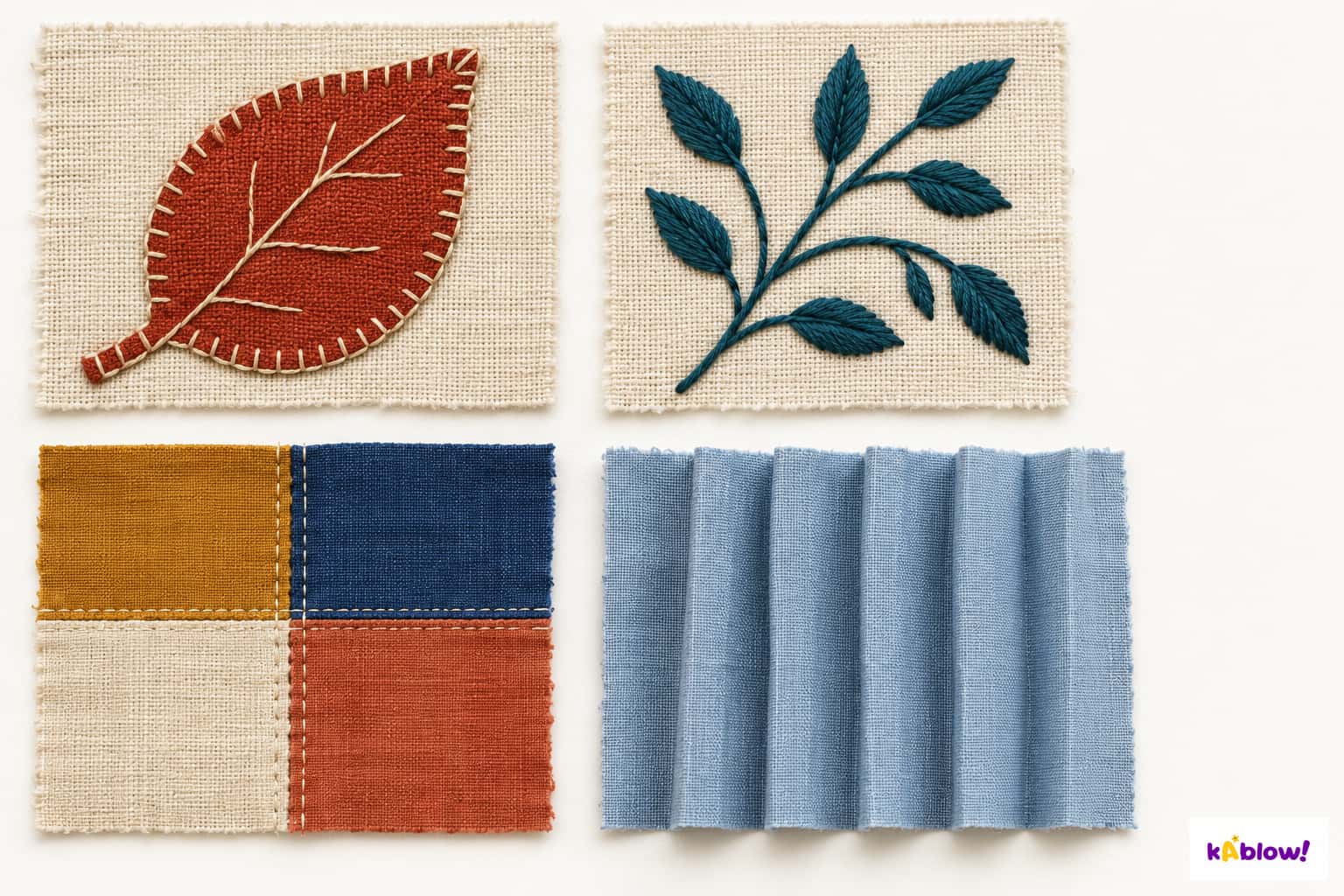
- Appliqué attaches fabric shapes to a base, often by stitching; embroidery makes decorative marks with needleworked thread. Patchwork joins fabric pieces; quilting stitches through layers, commonly including wadding. One item can combine these processes.
- The original sampler shows appliqué, embroidery, patchwork and pleating. Pleats make folds in cloth; gathering and smocking provide other manipulations. The samples are illustrative teaching artwork rather than named designers’ work or real student submissions.
Compare four textile studies
Other textile processes
- Weaving interlaces thread systems such as warp and weft; knitting forms connected loops. Felting mats suitable fibres: wet and needle felting use distinct processes, so water and soap do not define every kind.
- Batik uses wax resist; tie-dye uses binding to restrict dye access. Printing, painting and mixed-media methods can also work with compatible fabric. Study specific cultural traditions through named sources rather than treating all patterns as interchangeable.
Develop and test a garment
- Drawings, samples, pattern development and draping can inform each other. A toile is a trial garment or part; choose test cloth appropriate to the fit, drape or construction being investigated. Patterns may be paper or digital.
- Plan seams, fastenings, movement and finishing for the intended wearer or display. Revise after testing rather than treat the sequence as fixed. Ready-to-wear uses standard sizes; haute couture is a specific designated French system, not simply any expensive made-to-measure clothing.
Iterate a garment proposal
Practitioner references and context
- Dior’s first collection in 1947 became associated with the nickname New Look, including the Corolle and En 8 lines. Quant is a key figure in the 1960s British miniskirt story, while Westwood’s early work offers punk references. Choose a specific design and investigate its context.
- Miyake’s PLEATS PLEASE uses garment pleating. Albers’s weaving and printmaking show why artists cannot be confined to one medium; Perry’s The Vanity of Small Differences offers a narrative tapestry reference. Analyse a chosen feature and develop a personal response instead of copying an entire work.
Develop a sourced enquiry
Environmental decisions with limitations
- Consider sourcing, processing, cutting waste, longevity, repair, care and end-of-use together. Suitable recovered cloth, efficient cutting and repairable construction can address particular impacts, depending on what the garment replaces and how it is used.
- Recycled polyester still needs processing and can release microfibres. Natural or organic fibres also have resource demands. Explain a material choice against the intended function and acknowledge uncertainty rather than label any fabric impact-free.
Evaluate material and use
Taught studio procedures
- Use the specified equipment and supervision for sewing machines, scissors, pins, irons and any heat-setting. Keep pins and needles accounted for and follow the taught method for adjustments and storage.
- Dyes, wax and adhesives need compatible materials and product instructions. This lesson compares processes; it does not provide an independent hot-wax, chemical-dye or machine-operation recipe.
Follow the studio system
Evaluate from samples
- Record what each sample tests, the material used and the observed result. Explain how a stitch, seam, fastening or manipulation serves the intention rather than simply listing techniques.
- A sample can reveal a local property but cannot prove every full-garment fit or lifetime outcome. Identify what further testing or revision would make the decision stronger.
Write a useful sample evaluation
Diapos
Sign up free to view the lesson slides
Step through every slide for this topic — plus flashcards and revision notes — with a free account.
Questions d'entraînement
Aperçu gratuit — 8 sur 33 questions. Inscris-toi pour toutes les voir.
1.What is appliqué?
Easy- Aattaching fabric shapes to a base fabric, often by stitching
- Bwax and dye
- Cweaving
- Dknitting
2.What is embroidery?
Easy- Aprinting
- Bweaving
- Cdyeing
- Ddecorating a surface with needleworked thread or yarn
3.What is batik?
Easy- Aa fabric
- Ba weave
- Ca wax resist dyeing technique
- Da stitch
4.Which description fits wet felting of suitable wool fibres?
Easy- Adyeing
- Bmatting fibres through moisture, friction and a suitable taught process
- Cstitching
- Dprinting
5.What is tie-dye?
Easy- Atying fabric before dyeing to make patterns
- Bstitching
- Cprinting
- Dweaving
6.What is quilting?
Easy- Aprinting
- Bfelting
- Cknitting
- Dstitching through fabric layers, often with padding between them
7.What is patchwork?
Easy- Afelting
- Bprinting
- Cjoining pieces of fabric into a design
- Ddyeing
8.What is a toile?
Easy- Aa dye
- Ba trial garment or part made to test a design and fit
- Ca final garment
- Da fabric
Unlock all 33 questions & more
Crée un compte gratuit pour voir toutes les questions, les diapos, les cartes mémo et les notes de révision de ce thème.
Annales
Les annales d'entraînement pour ce thème arrivent bientôt.
Bientôt disponible