
Flowcharts and pseudocode
Apprends en jouant
Réponds à ces questions pour gagner de l'énergie, puis pêche et explore. Sans compte.
Pour les enseignants : diapos de leçon, notes de révision prêts à l'emploi pour Flowcharts and pseudocode (Computer Science, Algorithms) — utilise-les en cours, ou lance le thème en activité de classe interactive que tes apprenants jouent en direct.
Notes de leçon
Flowcharts
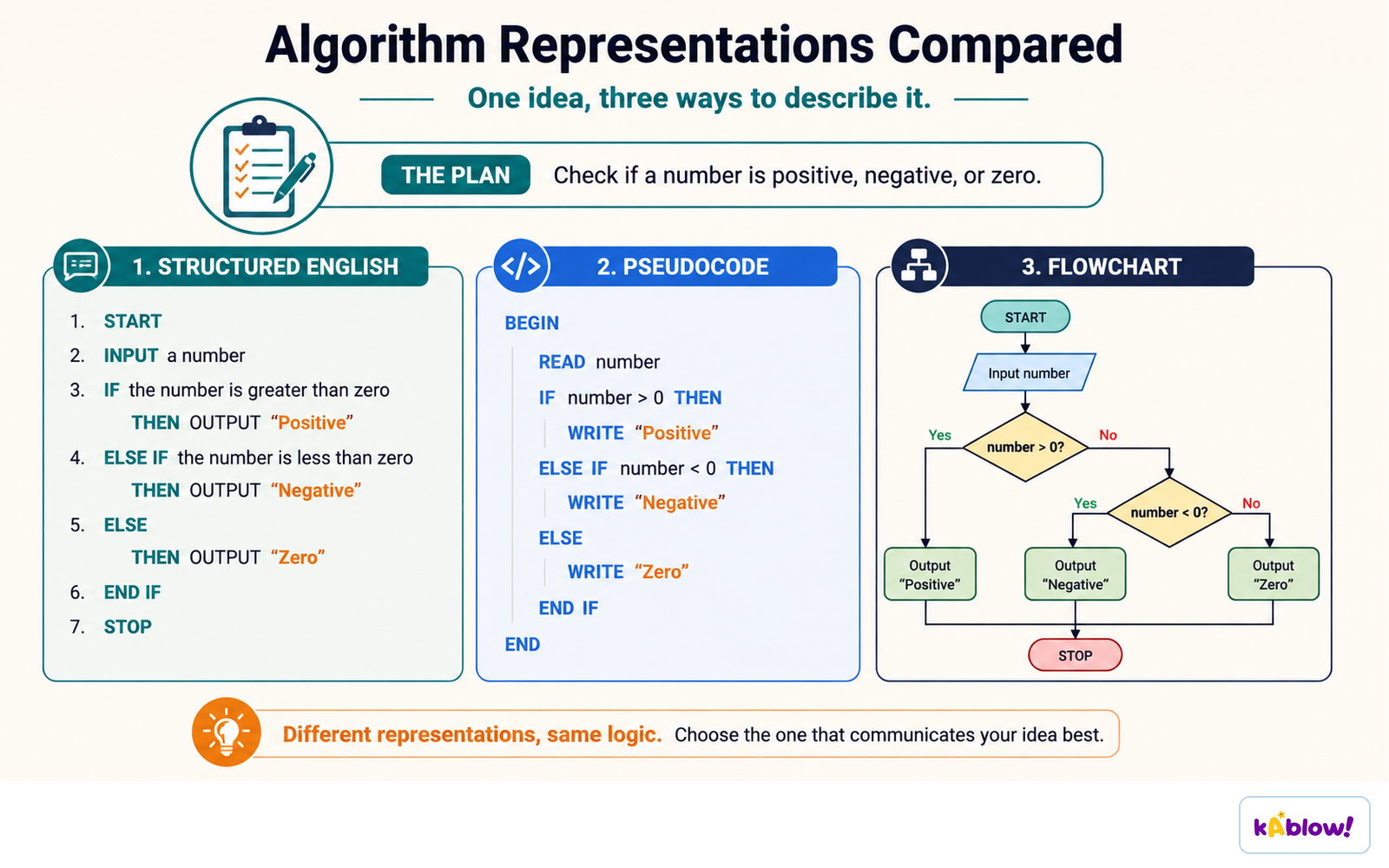
- A flowchart is a diagram of an algorithm. Standard symbols: terminator (rounded box, start/end), process (rectangle), decision (diamond, with yes/no or true/false branches), input/output (parallelogram) and arrows showing flow.
- Rules: one start, at least one end, one arrow in and out of each process; decisions have two exits.
Read, test and report
Pseudocode
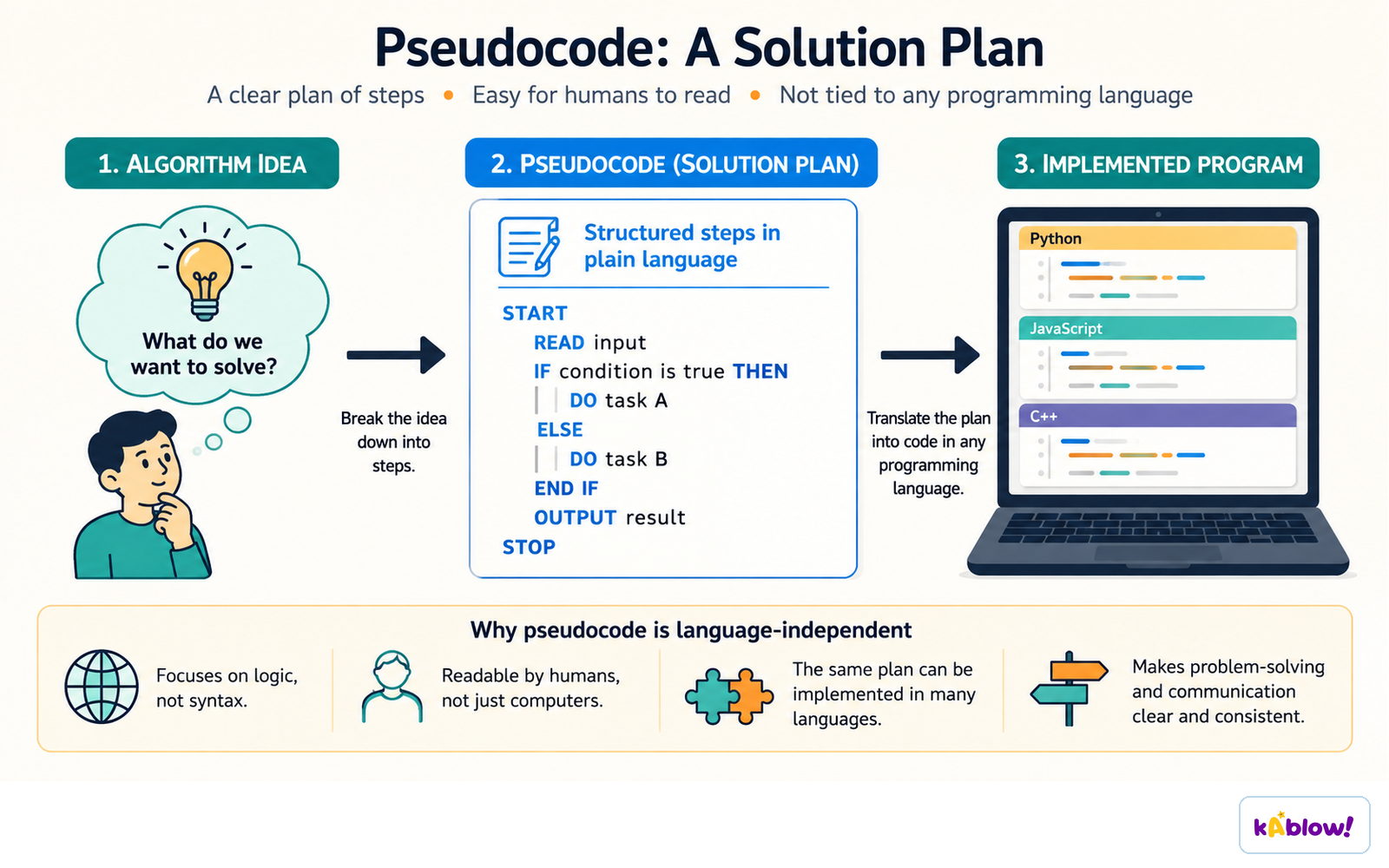
- Pseudocode is a structured, language-independent way to write algorithms. It is not a real language but uses programming-like keywords such as INPUT, OUTPUT, IF ... THEN ... ELSE ... ENDIF, WHILE ... ENDWHILE, FOR ... NEXT.
- Example: age = INPUT; IF age ≥ 18 THEN OUTPUT "Adult" ELSE OUTPUT "Minor" ENDIF.
Planning with pseudocode
Converting between forms
- Translate the algorithm’s meaning, not just its appearance: decision nodes can express IF branches or loop conditions.
- A loop-back edge indicates repetition. Preserve initialisation, the condition, updates and both possible exits when changing representation.
Algorithm representations
Trace tables
- A trace table records the values of variables as an algorithm runs, showing the output and helping to find logic errors.
Why use them?
- They help plan before coding, communicate with others and test logic.
Diapos
Sign up free to view the lesson slides
Step through every slide for this topic — plus flashcards and revision notes — with a free account.
Questions d'entraînement
Aperçu gratuit — 8 sur 33 questions. Inscris-toi pour toutes les voir.
1.What is a flowchart?
Easy- Aa diagram showing the steps of an algorithm
- Ba type of program
- Ca database
- Da network
2.What is pseudocode?
Easy- Aa way of writing algorithms using programming-like statements
- Ba real language
- Ca diagram
- Da hardware part
3.Which symbol marks start and end?
Easy- Aterminator
- Bdecision
- Cprocess
- Dinput
4.Which symbol is used for a calculation?
Easy- Aprocess rectangle
- Bdiamond
- Cparallelogram
- Doval
5.What does an arrow show?
Easy- Athe direction of flow
- Bthe value
- Cthe error
- Dthe end
6.What is the output? total = 3 + 4 OUTPUT total
Easy- A7
- B34
- C3
- D4
7.What is the output? x = 5 IF x > 3 THEN OUTPUT "big" ELSE OUTPUT "small" ENDIF
Easy- Abig
- Bsmall
- C5
- Dnothing
8.Using inclusive FOR bounds and a step of one, which header repeats its body five times?
Easy- AFOR i = 1 TO 5
- BIF i = 5
- CINPUT i
- DOUTPUT i
Unlock all 33 questions & more
Crée un compte gratuit pour voir toutes les questions, les diapos, les cartes mémo et les notes de révision de ce thème.
Annales
Les annales d'entraînement pour ce thème arrivent bientôt.
Bientôt disponible