
Strings and string handling
Apprends en jouant
Réponds à ces questions pour gagner de l'énergie, puis pêche et explore. Sans compte.
Pour les enseignants : diapos de leçon, notes de révision prêts à l'emploi pour Strings and string handling (Computer Science, Programming) — utilise-les en cours, ou lance le thème en activité de classe interactive que tes apprenants jouent en direct.
Notes de leçon
What a string is
- A string is a sequence of characters (letters, digits, symbols). Strings are written in quotation marks: "Hello".
Zero-based string positions
Common operations
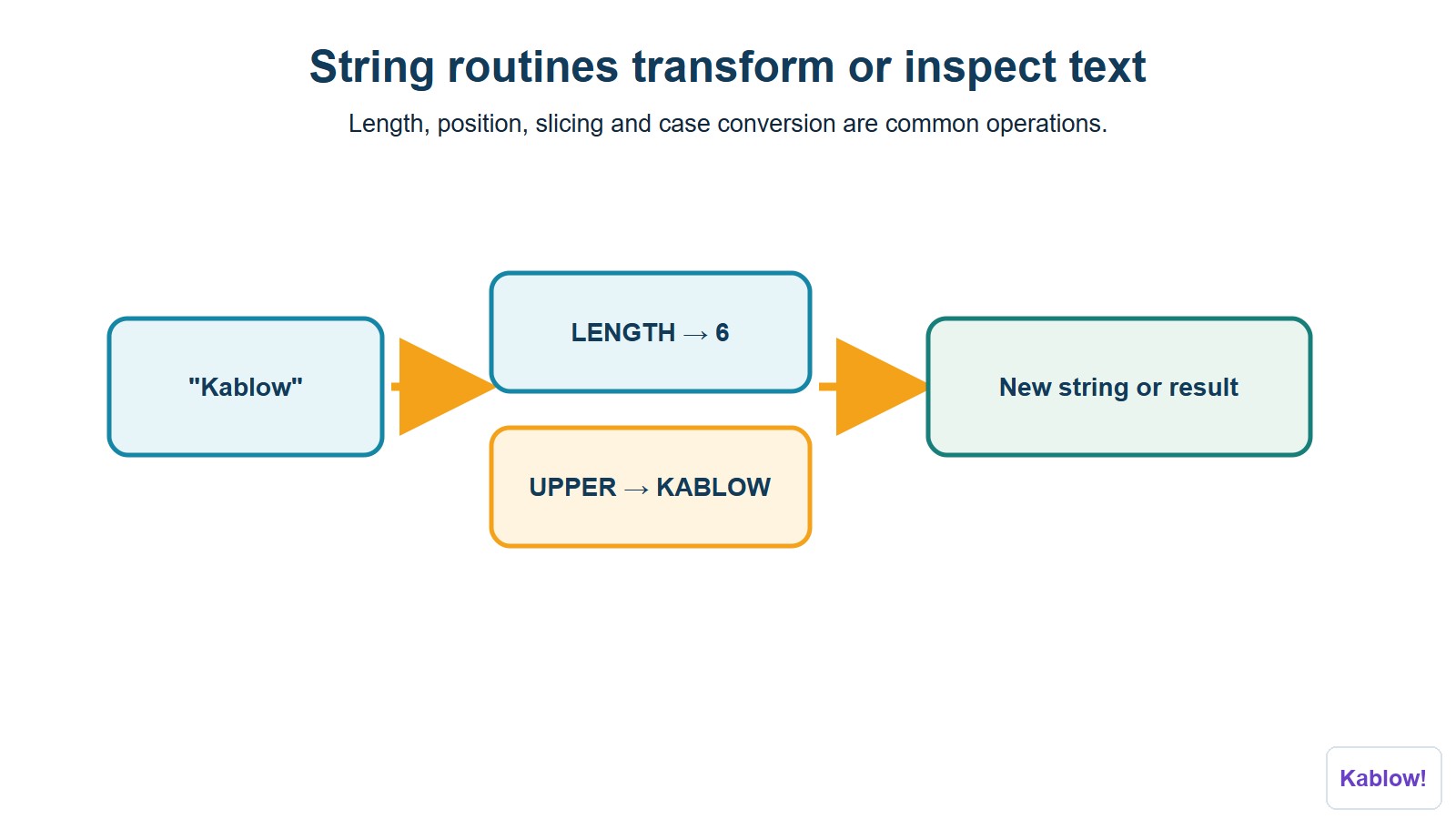
- Length: LEN("Hello") = 5.
- Concatenation: joining strings: "Hello" + " " + "World" = "Hello World".
- Substrings: part of a string by position (usually starting at 0): "Computer".SUBSTRING(0,3) = "Com".
- Case: UPPER and LOWER convert the case.
- Position/indexing: the first character is at index 0.
- Searching: finding where a character or word appears; checking if a string contains a substring.
- ASCII conversion: ASC("A") = 65 and CHR(65) = "A".
String length and case
Comparing strings
- For the simple ASCII examples here, comparison is case-sensitive and follows character codes: apple comes before banana and A differs from a.
- Language-specific collation and Unicode processing can differ; state comparison and normalisation rules when needed.
Common tasks
- Reverse a non-empty string by visiting indices LEN(s) − 1 down to 0 and appending each character to an initially empty result.
- A palindrome equals its reverse under the chosen comparison rules. Check for an empty string before accessing s[0]; counting vowels can use traversal and selection.
Casting and conversion
- Convert numbers to strings and back when joining or calculating.
ASCII conversion
- ASC gives a character code
- CHR gives the character
- ASC("A") = 65
Characters and ASCII codes
Diapos
Sign up free to view the lesson slides
Step through every slide for this topic — plus flashcards and revision notes — with a free account.
Questions d'entraînement
Aperçu gratuit — 8 sur 33 questions. Inscris-toi pour toutes les voir.
1.What is a string?
Easy- Aa sequence of characters
- Ba whole number
- CTrue or False
- Da decimal
2.What is concatenation?
Easy- Ajoining strings together
- Bsplitting strings
- Cdeleting strings
- Dsorting strings
3.Using the zero-based indexing convention in this lesson, what is the first character’s index?
Easy- A0
- B1
- C-1
- D2
4.What does UPPER("abc") return?
Easy- A"ABC"
- Bthe number 3
- C"CBA"
- Dan error
5.What does LEN do?
Easy- Areturns the number of characters
- Breturns the first character
- Cjoins strings
- Ddeletes characters
6.Using zero-based start and a length argument, what is "Hello".SUBSTRING(1,3)?
Easy- A"ell"
- B"Hel"
- C"llo"
- D"Hello"
7.What is LEN("Hello World")?
Easy- A11
- B10
- C12
- D2
8.What is "Good" + " " + "Day"?
Easy- A"Good Day"
- B"GoodDay"
- C"Good Day"
- D"Day Good"
Unlock all 33 questions & more
Crée un compte gratuit pour voir toutes les questions, les diapos, les cartes mémo et les notes de révision de ce thème.
Annales
Les annales d'entraînement pour ce thème arrivent bientôt.
Bientôt disponible