
Festivals, customs and traditions
Apprends en jouant
Réponds à ces questions pour gagner de l'énergie, puis pêche et explore. Sans compte.
Pour les enseignants : diapos de leçon, notes de révision prêts à l'emploi pour Festivals, customs and traditions (German, Identity and Culture) — utilise-les en cours, ou lance le thème en activité de classe interactive que tes apprenants jouent en direct.
Notes de leçon
Festivals
- Weihnachten Christmas, Ostern Easter, Silvester New Year’s Eve and Neujahr New Year’s Day are useful names. Heiligabend is Christmas Eve, 24 December. Nikolaustag is 6 December; some households follow customs of small gifts, fruit, nuts or sweets. Nikolaus can name Saint Nicholas or a person as well.
- Karneval, Fasching and Fastnacht name related carnival traditions with regional variation. The original Oktoberfest is Munich’s large folk festival, normally extending from September into early October, with rides, food and beer tents. These examples do not describe every household or all German-speaking communities.
Distinguish the celebration names
Other celebrations
- Der Geburtstag means birthday, die Hochzeit wedding, die Taufe baptism, die Konfirmation confirmation in a Protestant context and die Kommunion communion in a relevant Christian context. A religious rite is not a universal stage for every family.
- Das Fest and die Feier refer to a festival or celebration depending on context. Original model: Wir haben ein Sommerfest gefeiert. Use a real or invented event for practice without requiring private or religious disclosure.
Choose the named celebration
Describing past events
- Wir haben gefeiert and ich habe gegessen use perfect haben plus participle; ich bin gegangen perfect sein plus gegangen. Es war toll and das Wetter war schön use Präteritum sein. Das Wetter ist schön gewesen is also grammatical, but uses perfect rather than the specifically requested Präteritum.
- Do not assign sein to every movement verb. Gehen takes sein here, but other verbs vary by meaning and construction; schwimmen can use haben or sein in suitable uses. Gestern, letztes Jahr and vor zwei Tagen indicate past time; am Wochenende is ambiguous without context.
Select the actual past construction
German-speaking countries
- Deutschland Germany, Österreich Austria, die Schweiz Switzerland and Liechtenstein Liechtenstein are useful country names, not a complete list of German-speaking communities. Countries and households can be multilingual and culturally diverse.
- The Berlin Wall’s border crossings opened on 9 November 1989, commonly called its fall; physical removal continued later. Reunification took place on 3 October 1990, commemorated by der Tag der Deutschen Einheit on 3 October. Keep the events and dates distinct.
Keep the historical dates distinct
Customs
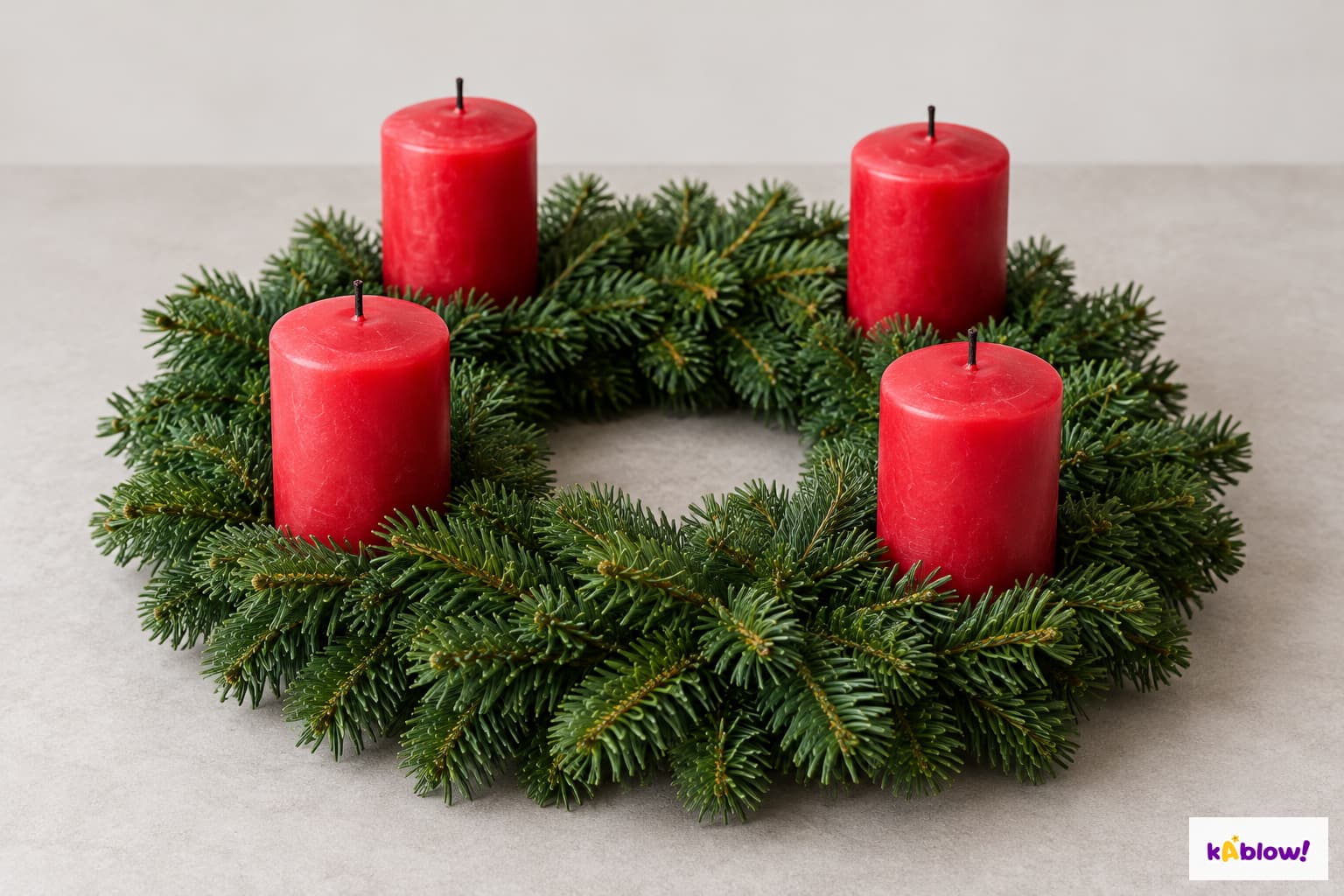
- The original generated Advent-wreath picture shows an evergreen ring and four unlit red candles: ein Adventskranz mit vier Kerzen. A familiar modern form relates four candles to four Advent Sundays. It is not a claim about every historical form or every household’s practice.
- Der Adventskalender is an Advent calendar, der Weihnachtsmarkt Christmas market and der Lebkuchen gingerbread or a related spiced baked sweet. Glühwein is hot spiced wine, but not every visitor drinks it. Regional lantern traditions associated with Saint Martin also vary; no national participation rule is implied.
A modern four-candle Advent wreath
Comparing traditions
- Compare the supplied accounts: Bei uns gibt es Geschenke am 24. Dezember. Bei meiner Freundin gibt es Geschenke am 25. Dezember. The dates differ between these fictional households.
- Ähnlich means similar and anders different. Attribute the example with bei uns or bei meiner Freundin rather than making a blanket In Deutschland everyone… assertion. Customs can vary within as well as across countries.
Compare the supplied household accounts
Opinions
- Original model: Mein Lieblingsfest ist das Sommerfest, weil ich gern mit Freunden feiere. Name the preference and give a relevant reason; the finite verb feiere closes this weil clause.
- You may describe another event, an imagined preference or no favourite at all. Accuracy and relevance matter; there is no compulsory religious preference, national custom or requirement to disclose personal celebrations.
Develop the preference coherently
Diapos
Sign up free to view the lesson slides
Step through every slide for this topic — plus flashcards and revision notes — with a free account.
Questions d'entraînement
Aperçu gratuit — 8 sur 38 questions. Inscris-toi pour toutes les voir.
1.What does "Weihnachten" mean?
Easy- AChristmas
- BEaster
- CNew Year
- Dbirthday
2.What does "Ostern" mean?
Easy- AEast
- BChristmas
- CWhitsun
- DEaster
3.What does "der Geburtstag" mean?
Easy- Awedding
- Bholiday
- Cbirthday
- Dbirth certificate
4.What does "der Weihnachtsbaum" mean?
Easy- Athe Christmas meal
- Bthe Christmas tree
- Cthe Christmas card
- Dthe Christmas star
5.What does "die Geschenke" mean?
Easy- Apresents
- Bcards
- Ccakes
- Dcandles
6.In Wir feiern ihre Hochzeit, what does Hochzeit mean?
Easy- Ahigh time
- Bholiday
- Cbirthday
- Dwedding
7.What does "der Osterhase" mean?
Easy- Athe Easter lamb
- Bthe Easter basket
- Cthe Easter bunny
- Dthe Easter egg
8.In a calendar of celebrations, what does Silvester mean?
Easy- Athe end of summer
- BNew Year's Eve
- CChristmas Eve
- Dthe first day of spring
Unlock all 38 questions & more
Crée un compte gratuit pour voir toutes les questions, les diapos, les cartes mémo et les notes de révision de ce thème.
Annales
Les annales d'entraînement pour ce thème arrivent bientôt.
Bientôt disponible