
Group 7 (17), The Halogens
खेलकर सीखें
इन सवालों के जवाब देकर एनर्जी कमाएं, फिर मछली पकड़ें और घूमें। कोई अकाउंट नहीं चाहिए।
लेसन नोट्स
Connect halogens,halides and diatomic molecules
- Group 17 is the modern name for the main-group column historically called Group 7. The neutral F–I atoms have seven outer electrons, ns²np⁵.
- The elemental substances in this range contain X₂ molecules. A halide ion is X⁻, formed by one-electron gain; it is different from a neutral atom or an X₂ molecule.
- For example, Cl₂+2e⁻→2Cl⁻ requires two electrons per molecule. Fluorine reacts with water and is not an ordinary school aqueous-displacement reagent.
Neutral halogen and halide records
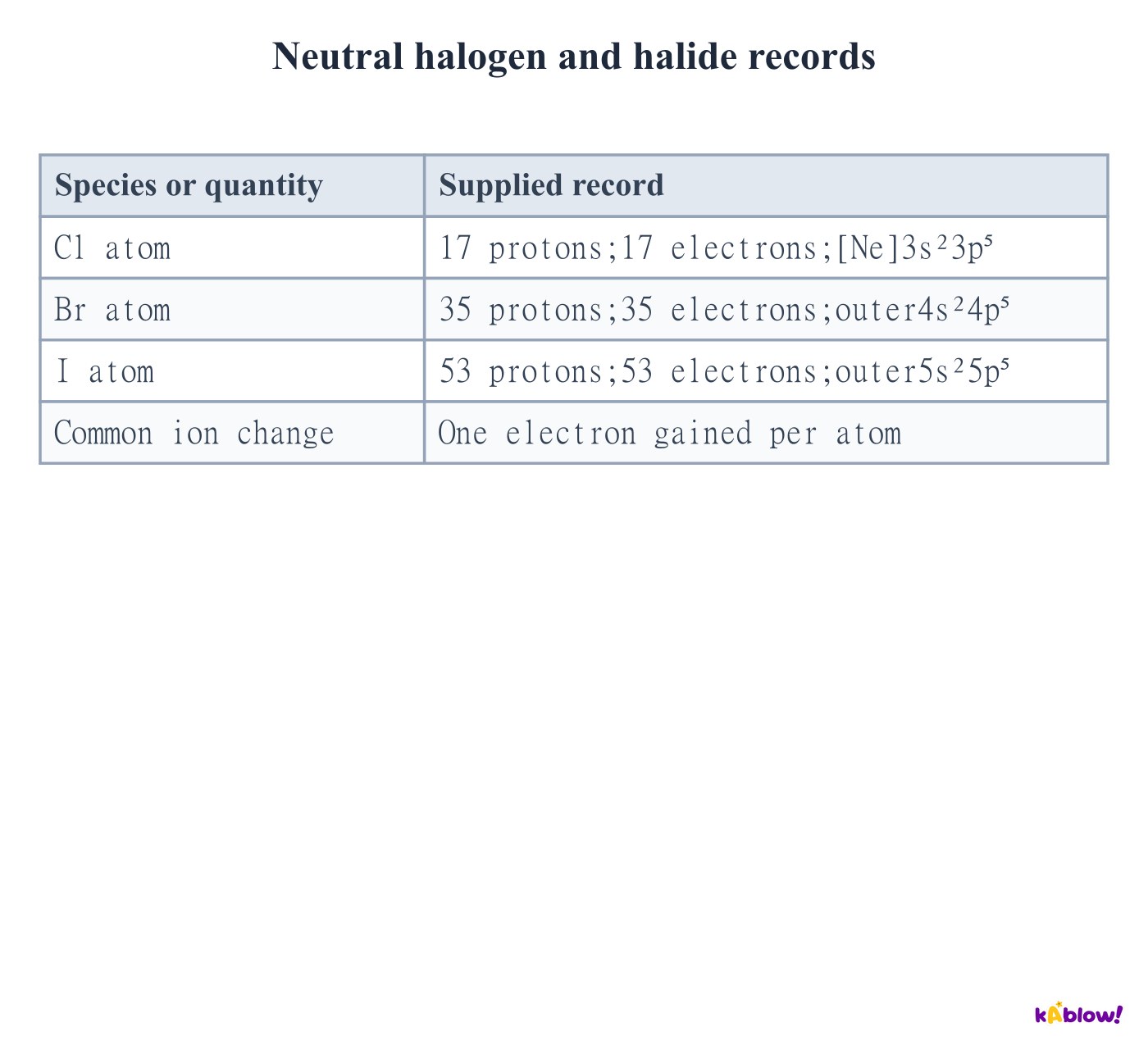
Describe colour together with phase and solvent
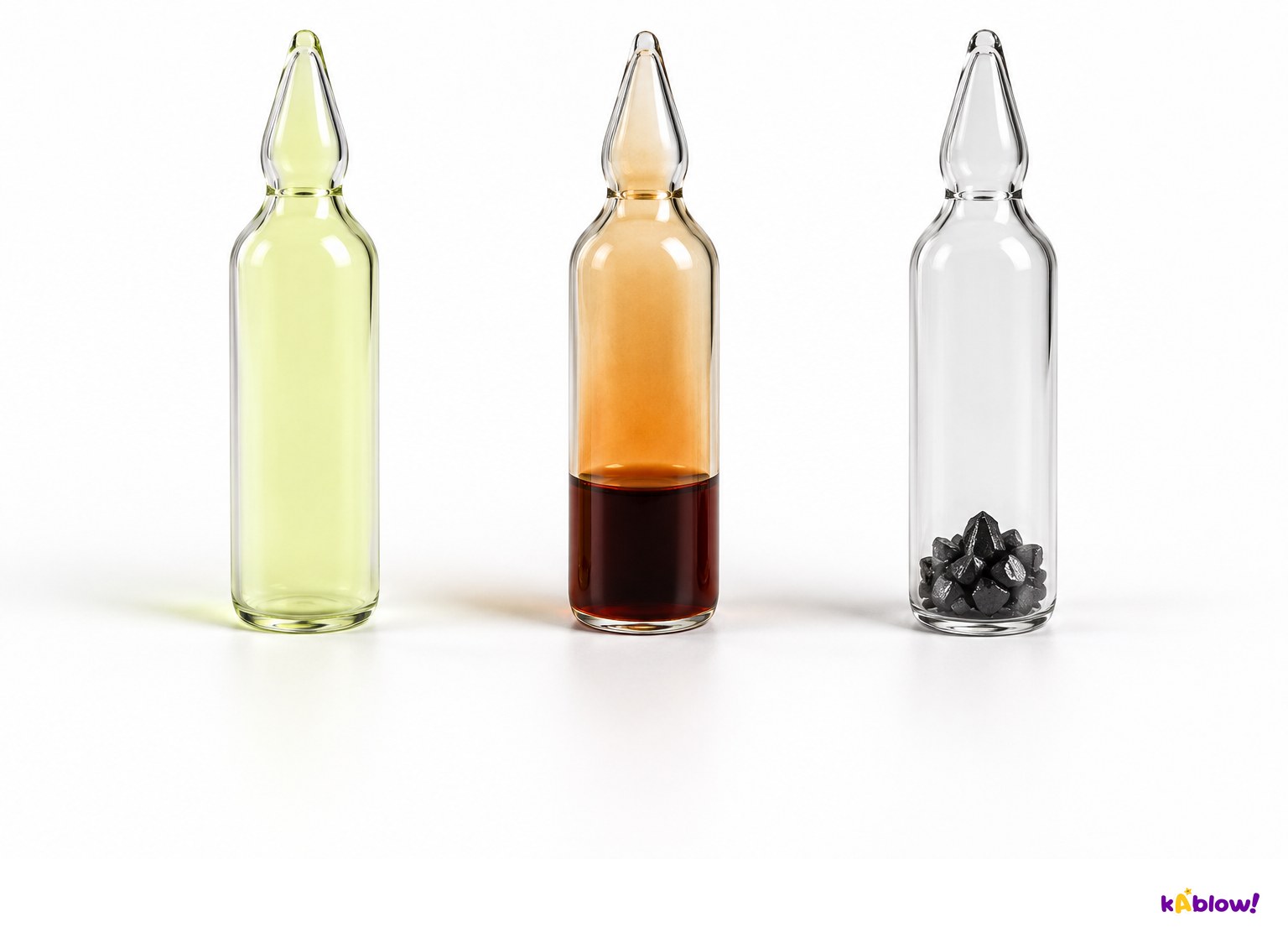
- The reviewed sealed-sample illustration shows chlorine gas, bromine liquid with vapour, and iodine crystals. The colours belong to the stated forms and conditions.
- Aqueous iodine is brown, whereas iodine in a suitable nonpolar solvent is violet. A simple iodide solution is colourless; iodide and iodine are different species.
- A colour observation should name the phase or solvent. Do not infer that iodine must always be purple or that every coloured solution contains a halide ion.
Three halogens at room temperature
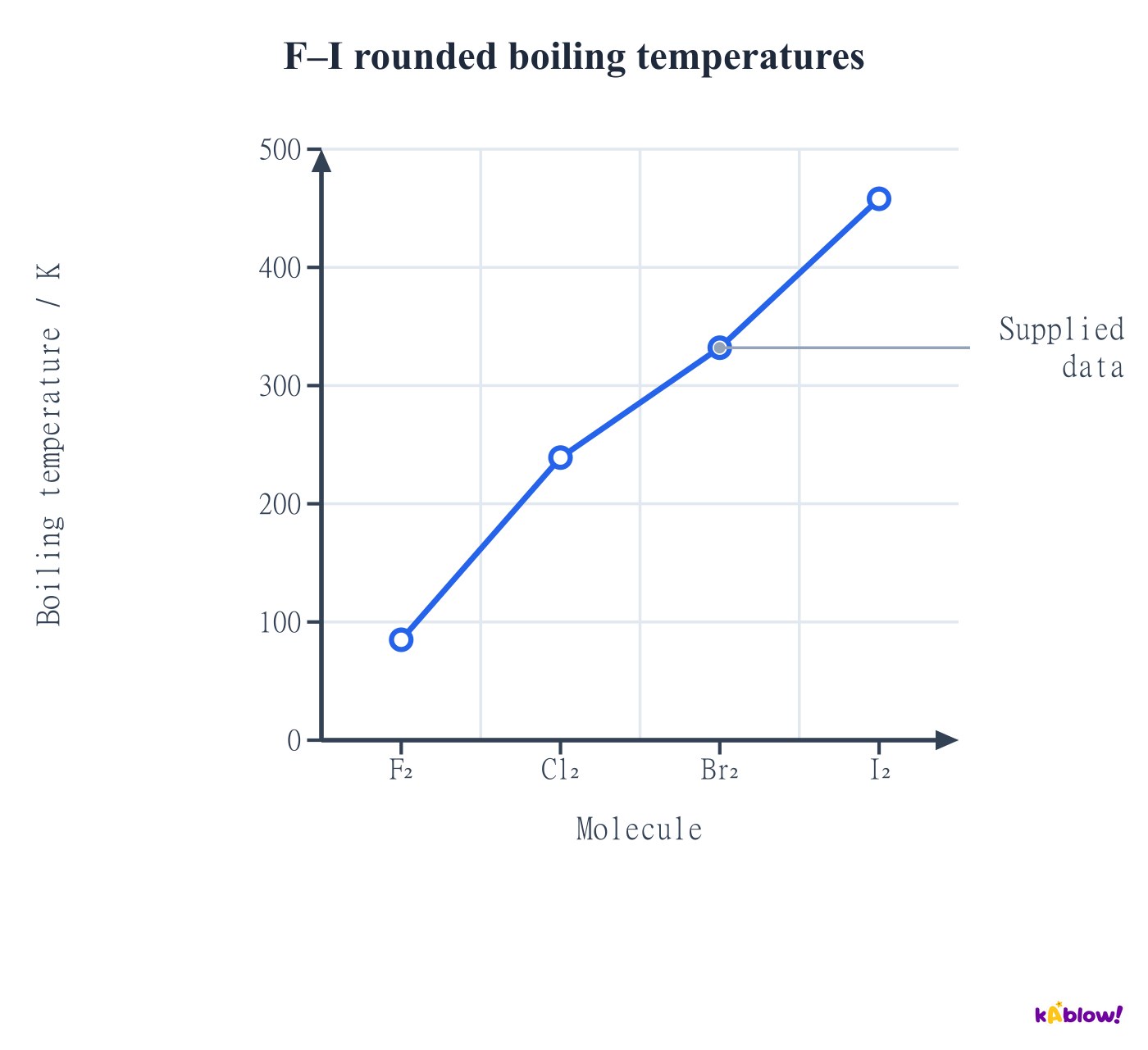
Read boiling point and volatility as different descriptions
- The rounded RSC values rise from F₂ 85 K through Cl₂ 239 K and Br₂ 332 K to I₂ 458 K. These compare boiling at the same reference-pressure convention.
- At comparable conditions, the lower-boiling substances are more volatile. From F₂ to I₂, volatility generally decreases.
- Boiling separates molecules into the gas phase. It does not normally break every X–X covalent bond into individual atoms.
F–I rounded boiling temperatures
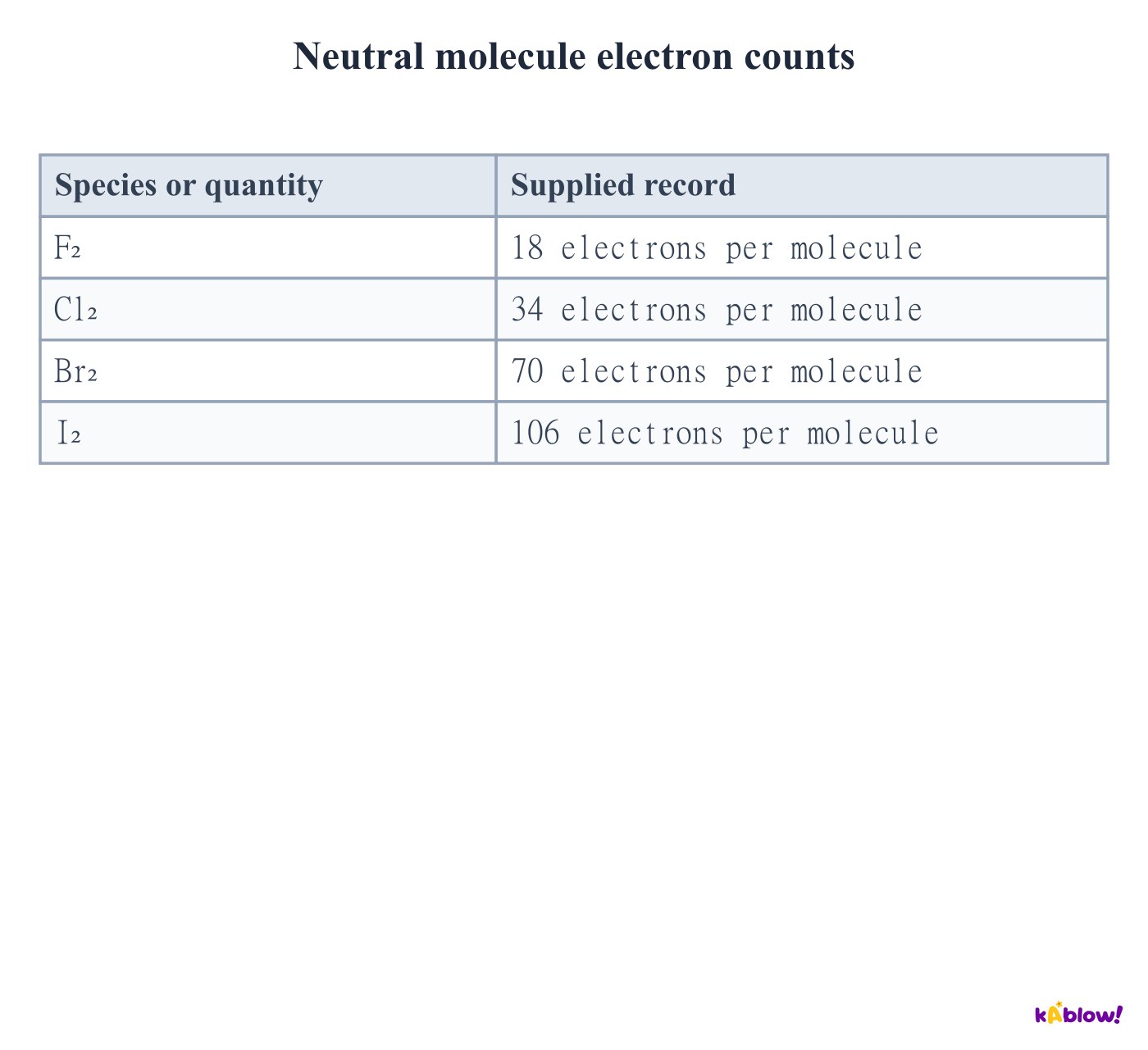
Explain boiling with intermolecular dispersion
- F₂, Cl₂, Br₂ and I₂ are nonpolar diatomic molecules. Correlated instantaneous and induced dipoles create London dispersion attractions between molecules.
- Larger, more polarizable electron clouds down this set produce stronger dispersion attractions, so separating the molecules requires more energy.
- These attractions are between molecules. Keep them separate from the covalent X–X bonds inside each molecule, and do not describe all nonpolar molecules as having no attractions.
Neutral molecule electron counts
Recognise the fluorine exception in bond strength
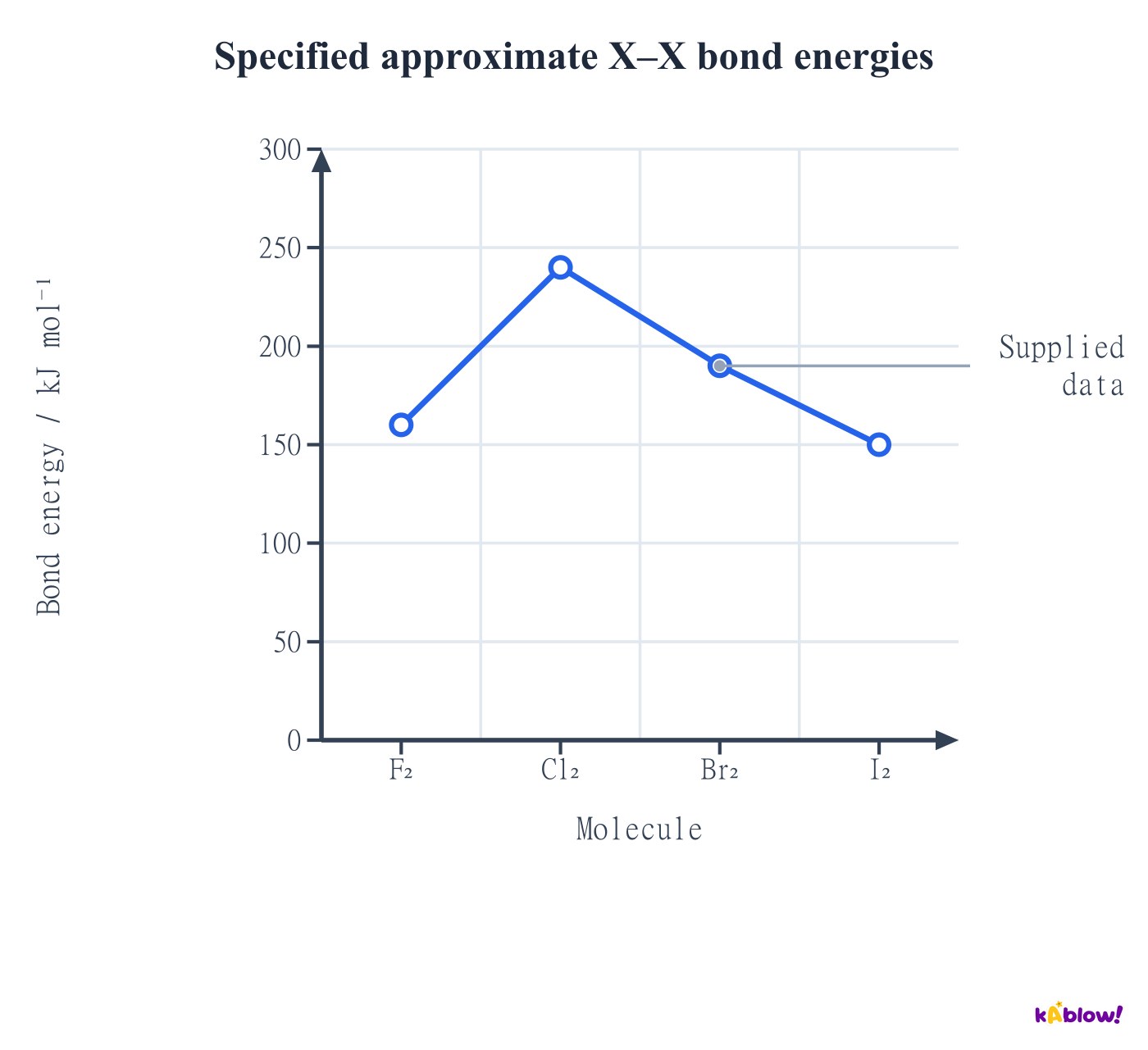
- The supplied approximate gas-phase bond energies illustrate Cl–Cl>Br–Br>I–I. Increasing bond length and less effective overlap help explain that part of the pattern.
- F–F is weaker than Cl–Cl despite fluorine’s small atoms. Repulsion between nearby lone-pair electrons is important in this exception.
- Do not use a single monotonic bond-strength rule from F₂ to I₂. Bond energy and boiling temperature involve different processes and can show different trends.
Specified approximate X–X bond energies
Explain the electronegativity decrease
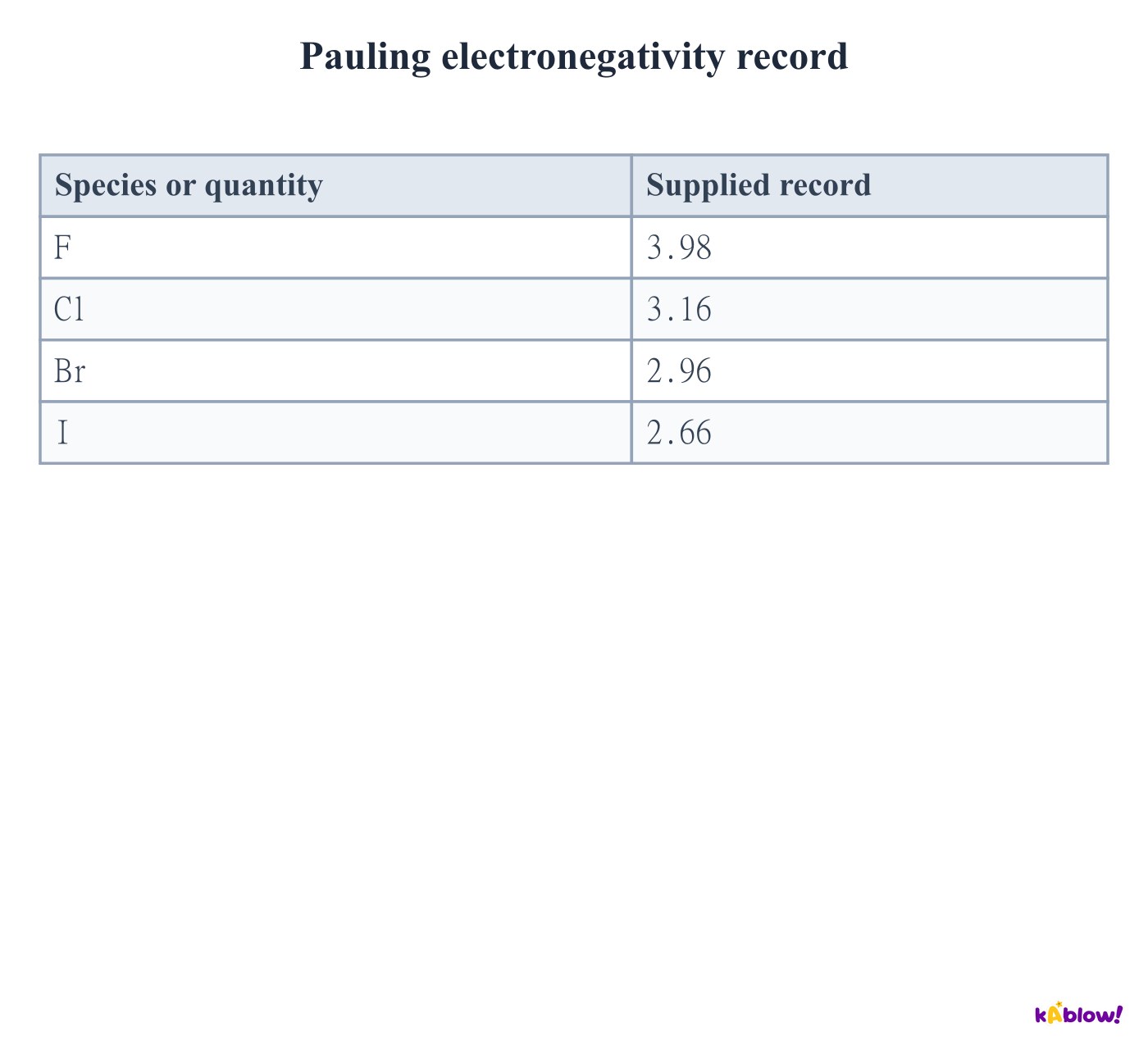
- Electronegativity describes attraction for an electron pair in a covalent bond. The supplied Pauling values decrease from F to I.
- Down the group, larger size and greater shielding reduce attraction for the bonding pair despite increasing nuclear charge.
- Electronegativity is not the same quantity as electron affinity or aqueous oxidising power. Redox energetics also include bond breaking, electron attachment and solvation.
Pauling electronegativity record
Identify the halogen as an oxidising agent
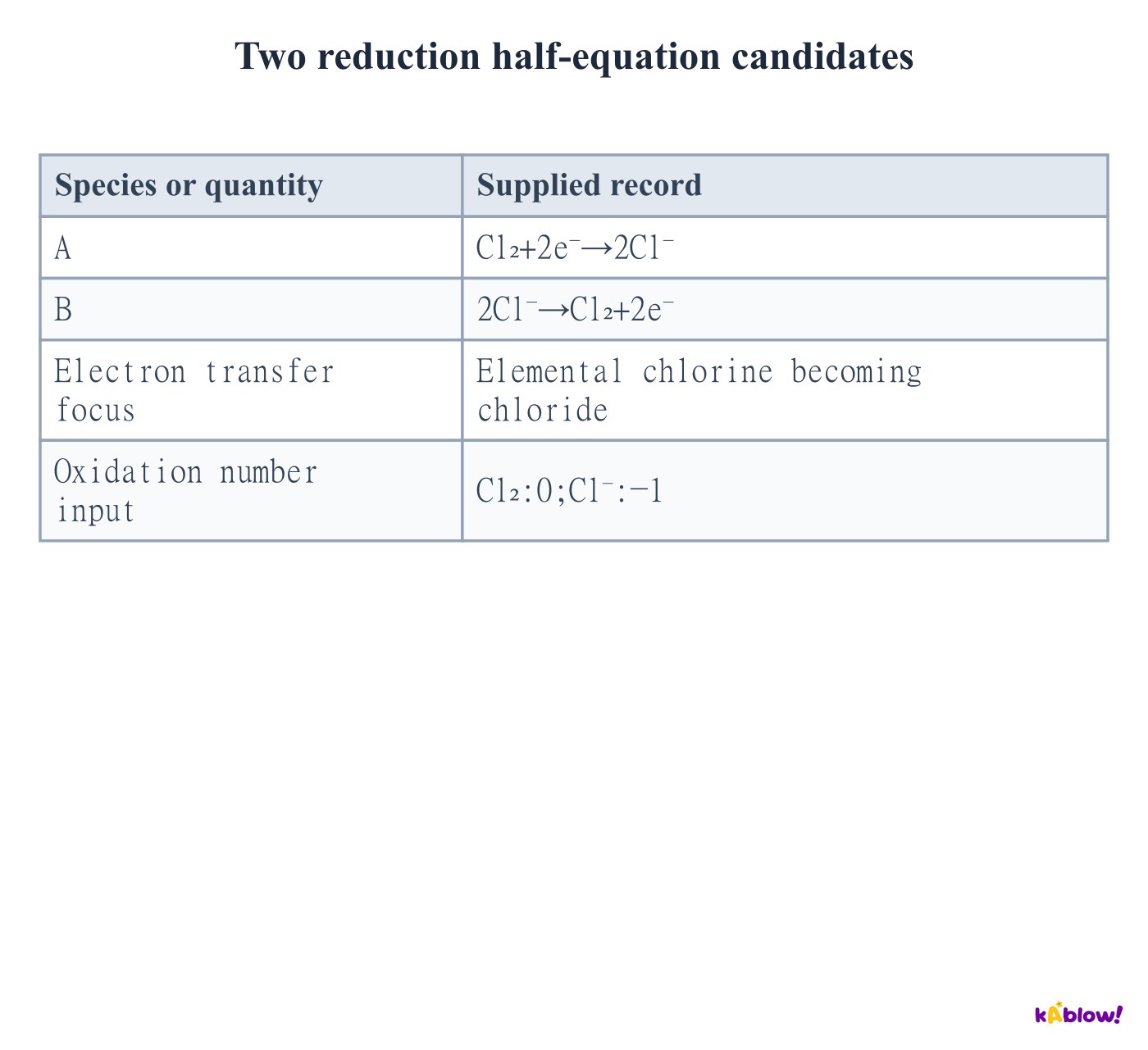
- An oxidising agent accepts electrons and is itself reduced. X₂+2e⁻→2X⁻ shows this role for an elemental halogen.
- Chlorine changes from oxidation state0 to−1 when reduced to chloride. The species donating those electrons is oxidised.
- For the usual aqueous Cl₂/Br₂/I₂ comparisons, oxidising ability decreases Cl₂>Br₂>I₂. State the species and conditions rather than calling every form of chlorine an oxidant.
Two reduction half-equation candidates
Predict a halogen–halide displacement
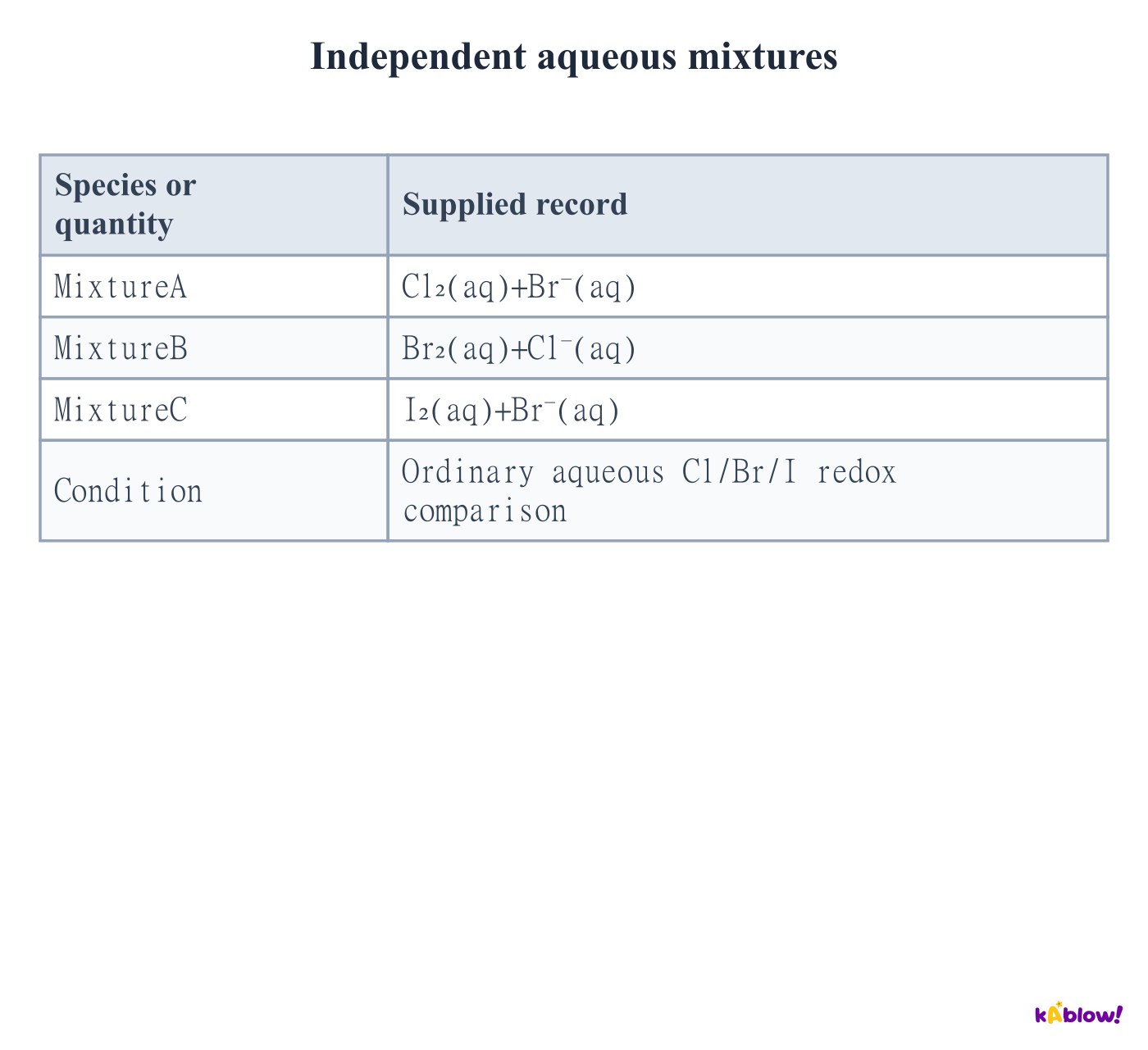
- Chlorine oxidises bromide:Cl₂+2Br⁻→2Cl⁻+Br₂. Chlorine is reduced while bromide is oxidised.
- A stronger oxidising halogen can displace a weaker one from its halide ions under the stated conditions. Br₂ does not similarly oxidise Cl⁻ in this comparison.
- The starting solution contains bromide ions, not merely bromine water. The distinction between Br⁻ and Br₂ is essential to the reaction.
Independent aqueous mixtures
Use a phase observation without confusing ions and elements
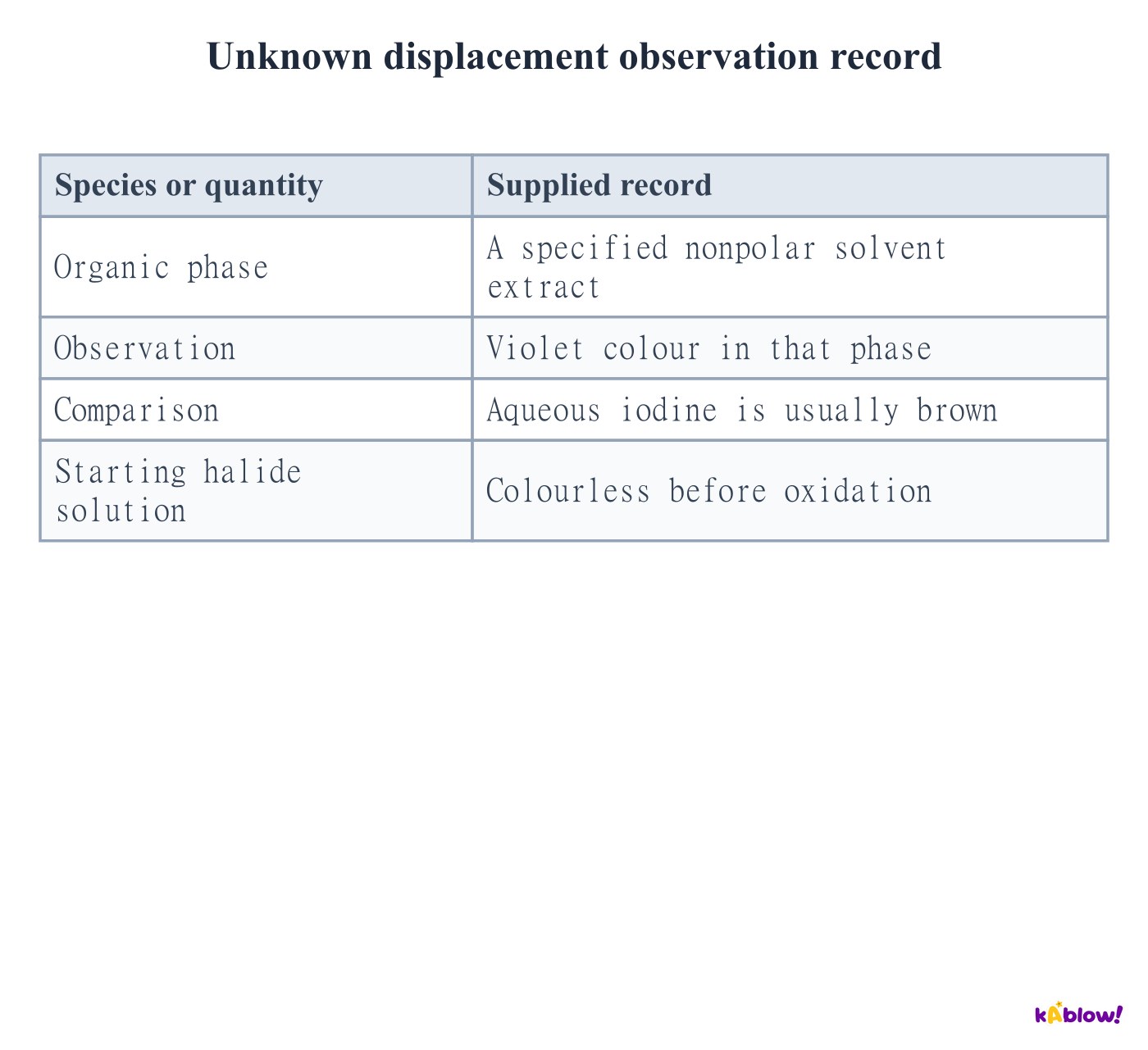
- A nonpolar solvent can help distinguish the colours of dissolved elemental halogens. Violet iodine in the specified organic phase is evidence for I₂, not for a colourless I⁻ ion.
- The solvent identity and phase must be recorded. Do not assume the organic layer is always above water without density information.
- Colour intensity also depends on concentration and mixtures. Use the reaction context and appropriate controls along with the observation.
Unknown displacement observation record
Explain the opposite reducing-agent trend
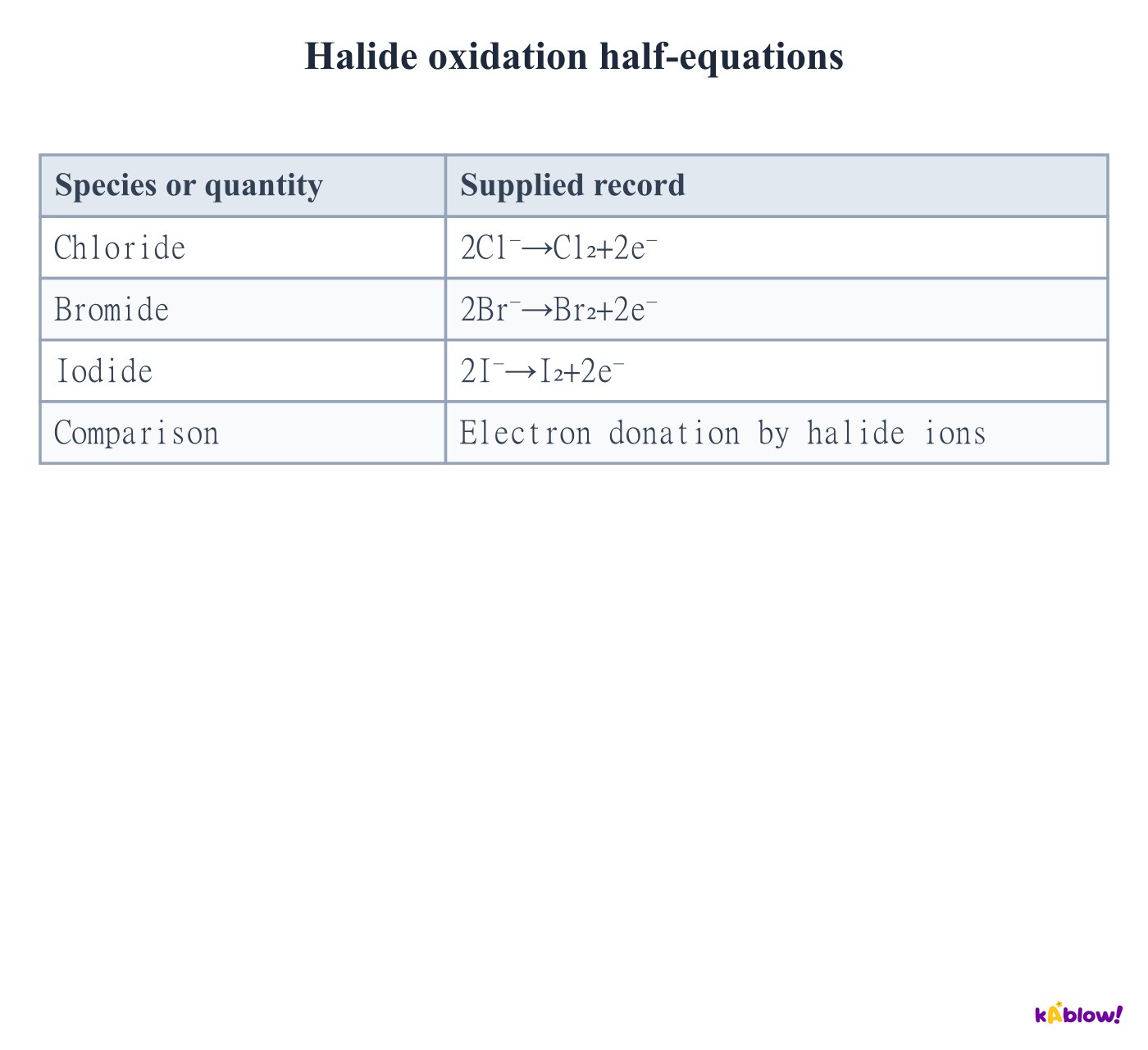
- Halide ions can donate electrons and become elemental halogens. In that reaction, the halide is oxidised and acts as a reducing agent.
- Reducing ability increases Cl⁻<Br⁻<I⁻ in the usual comparisons. The larger iodide ion holds its outer electrons less tightly in the simple size-and-shielding explanation.
- This is the opposite ordering to elemental-halogen oxidising ability. Do not swap the trend for X⁻ with the trend for X₂.
Halide oxidation half-equations
Acidify with nitric acid before the silver test
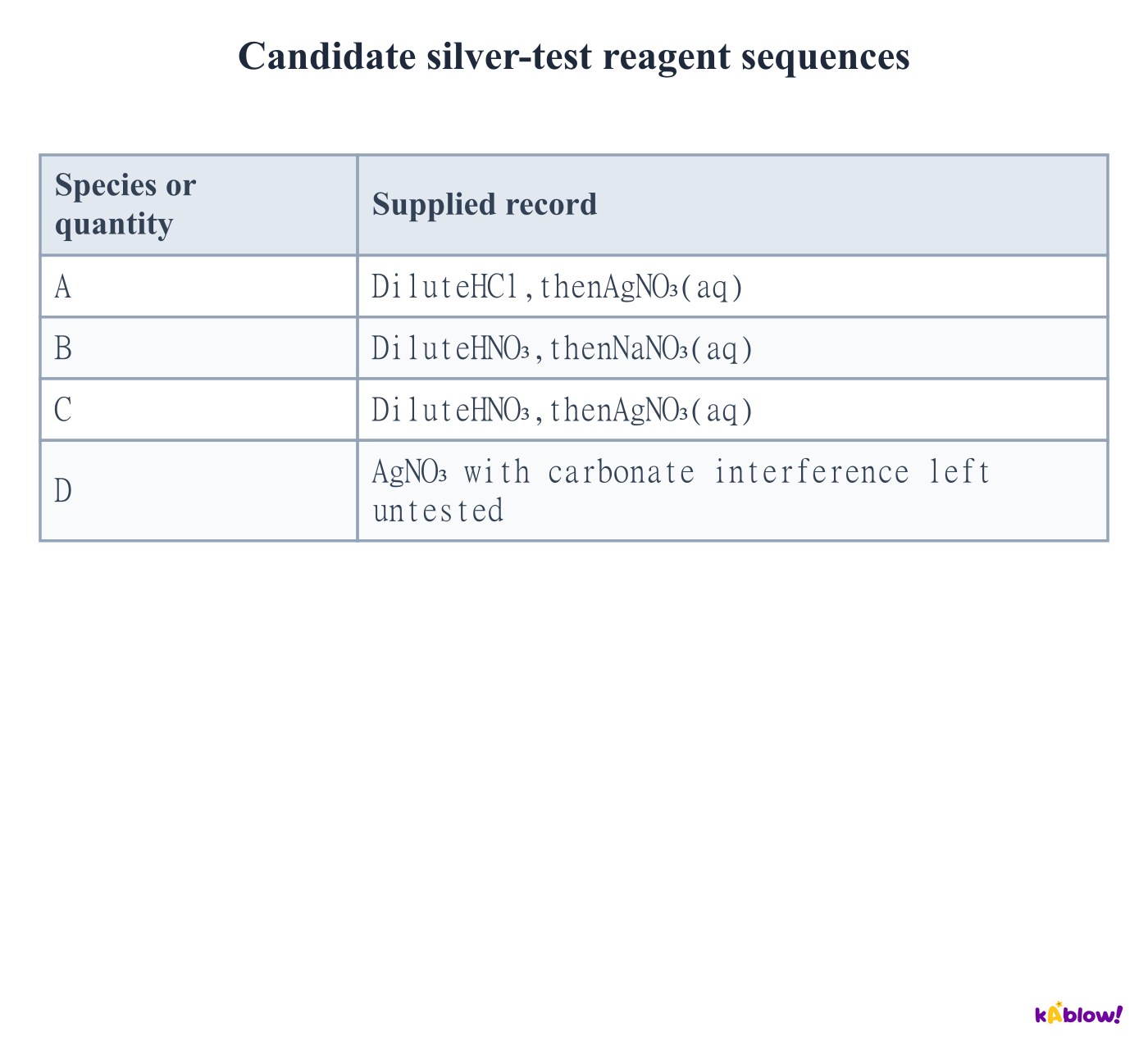
- For an aqueous chloride, bromide or iodide sample, acidify with dilute HNO₃ before adding AgNO₃ solution. Nitric acid helps remove carbonate interference.
- Do not use HCl to acidify this test:it introduces chloride and can produce a false AgCl result. Acidifying an existing solution is different from dissolving a solution.
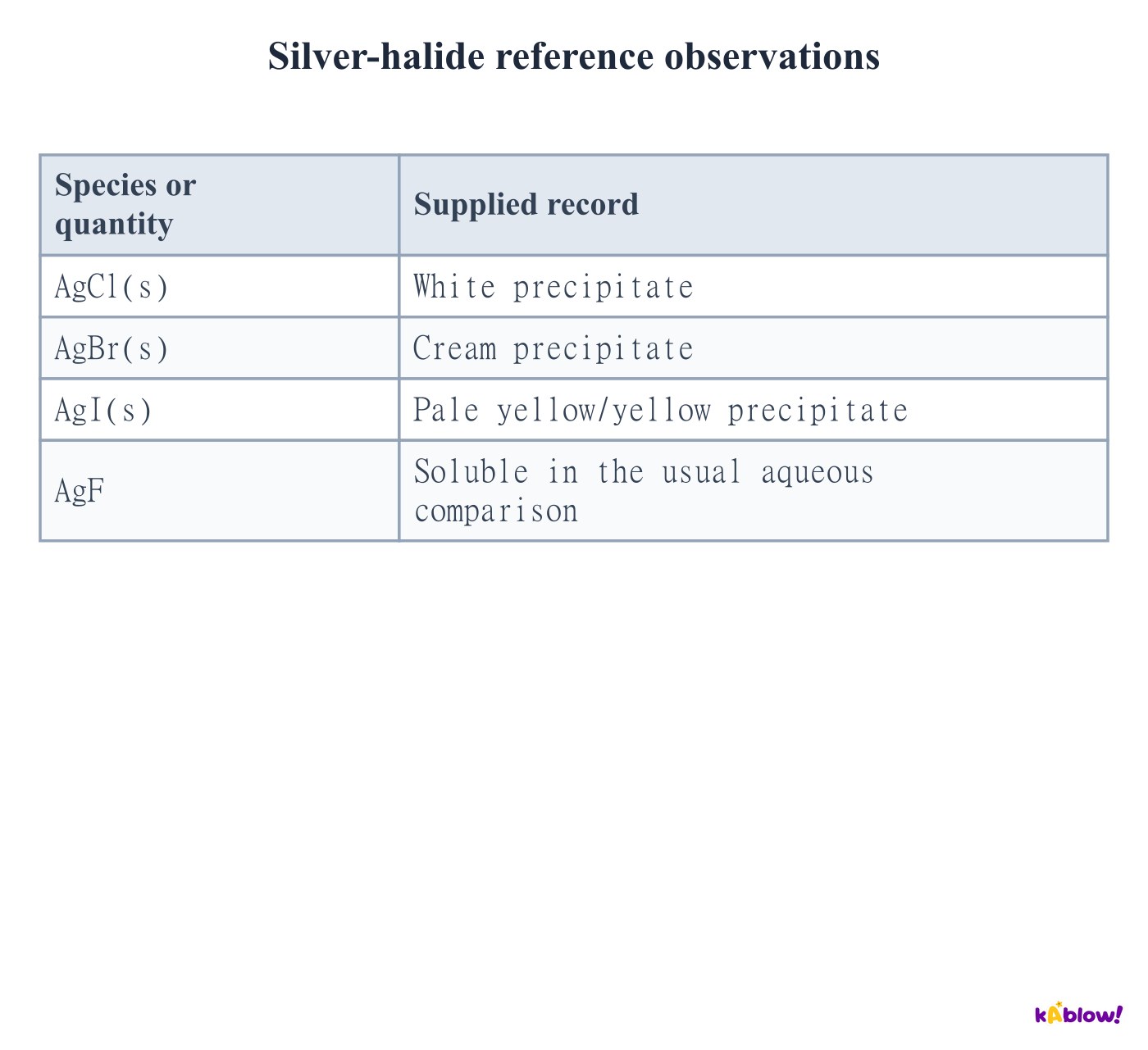
- The net precipitation equation is Ag⁺(aq)+X⁻(aq)→AgX(s) for these three halides. AgF is soluble, so the statement every halide gives this precipitate is too broad.
Candidate silver-test reagent sequences
Name the precipitate rather than a coloured solution
- Silver chloride is white, silver bromide cream and silver iodide pale yellow or yellow. These observations refer to solid precipitates dispersed in the liquid.
- Colour can be difficult to distinguish for small amounts or mixtures. An ammonia follow-up is useful when the stated sample and conditions permit it.
- Use precise language:the precipitate forms or dissolves. The phrase silver-halide solution is misleading when describing the insoluble solid.
Silver-halide reference observations
Combine ammonia behaviour with colour
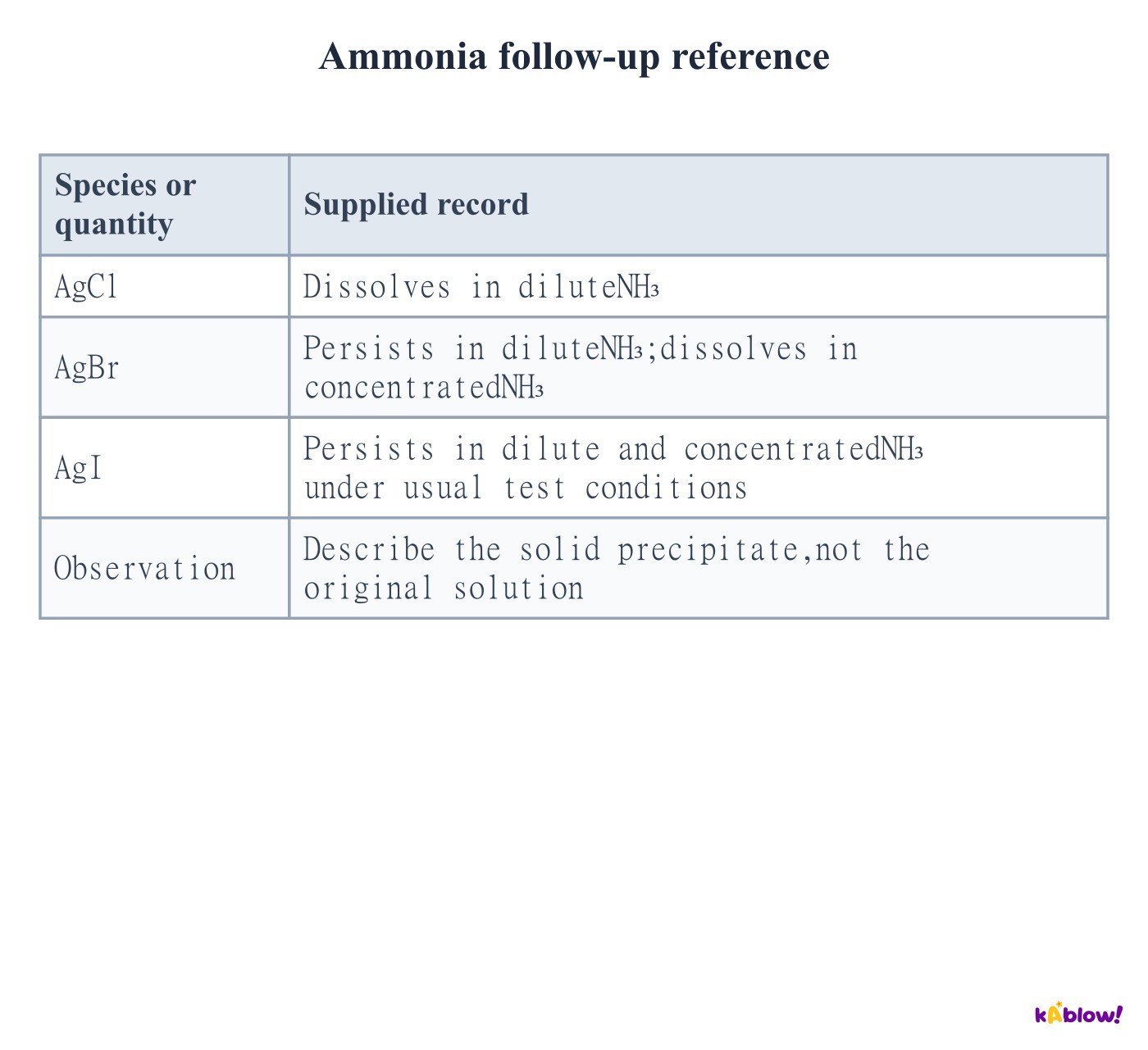
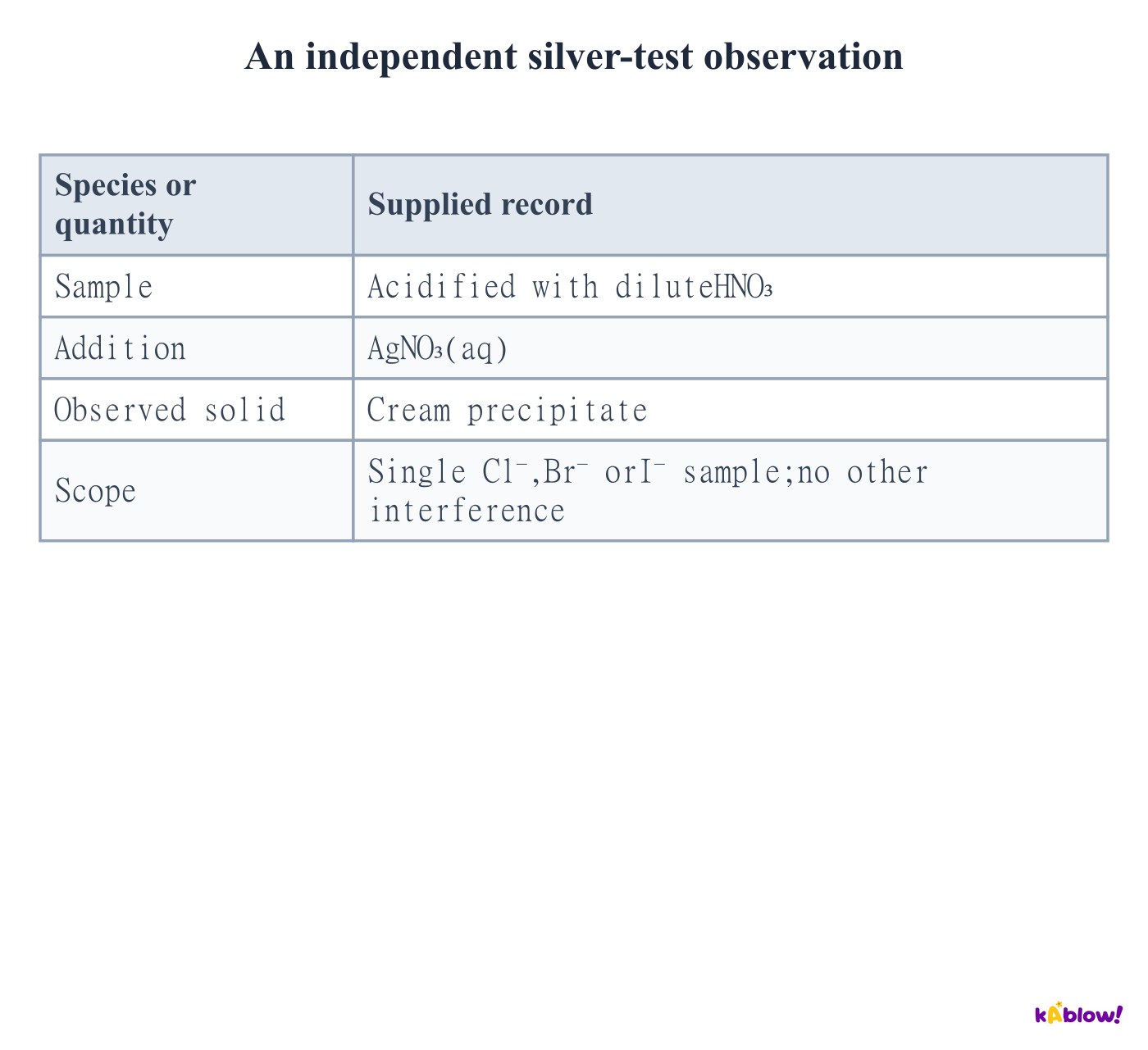
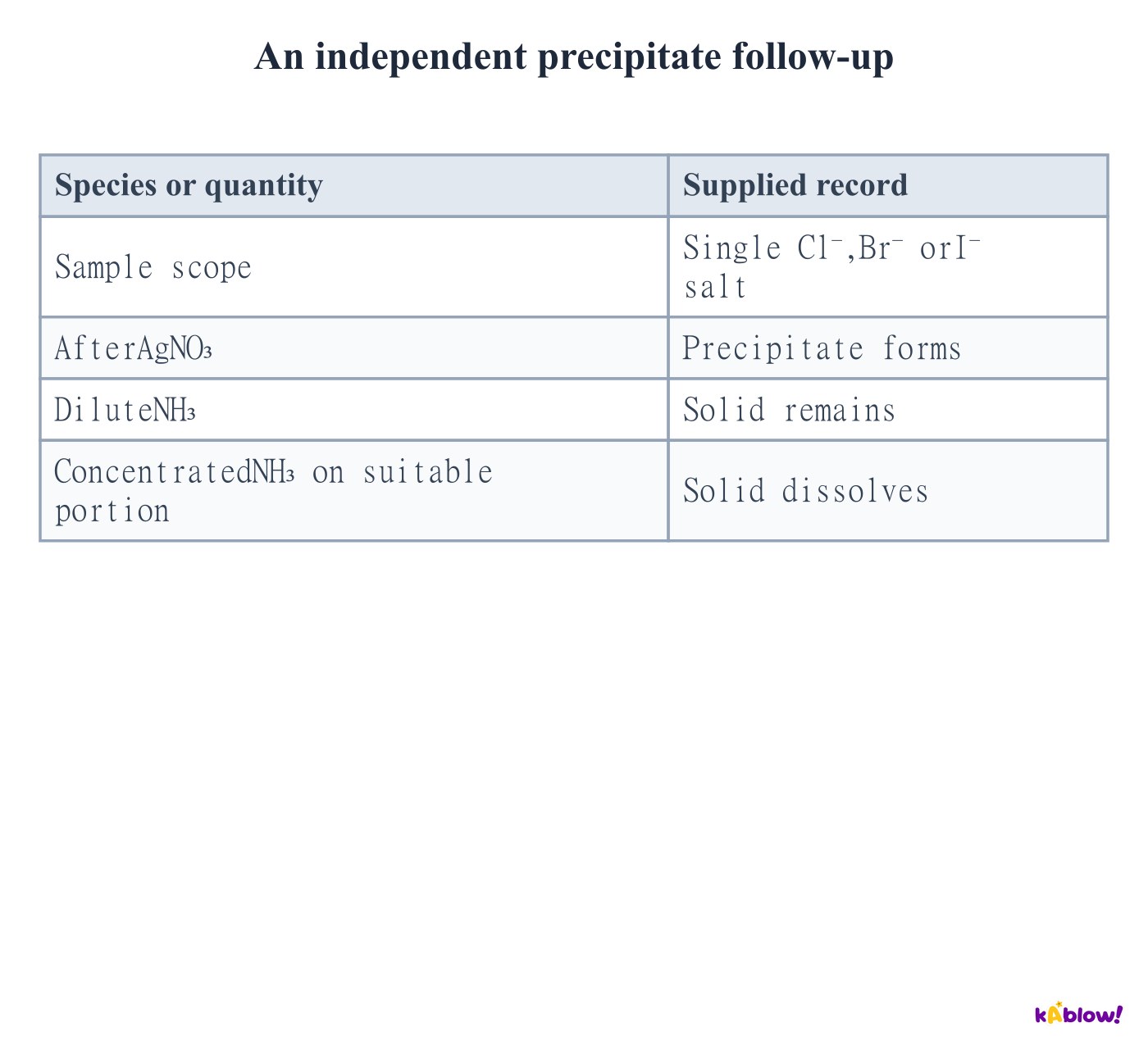
- AgCl dissolves in dilute ammonia; AgBr generally requires concentrated ammonia; AgI remains under the usual test conditions.
- The independent follow-up record therefore supports bromide. Use appropriate portions and sufficient reagent when comparing dilute and concentrated ammonia.
- Do not say that iodide ions become insoluble in ammonia:the observation concerns AgI solid and its dissolution equilibrium.
Ammonia follow-up reference
Explain ammonia dissolution with complex formation
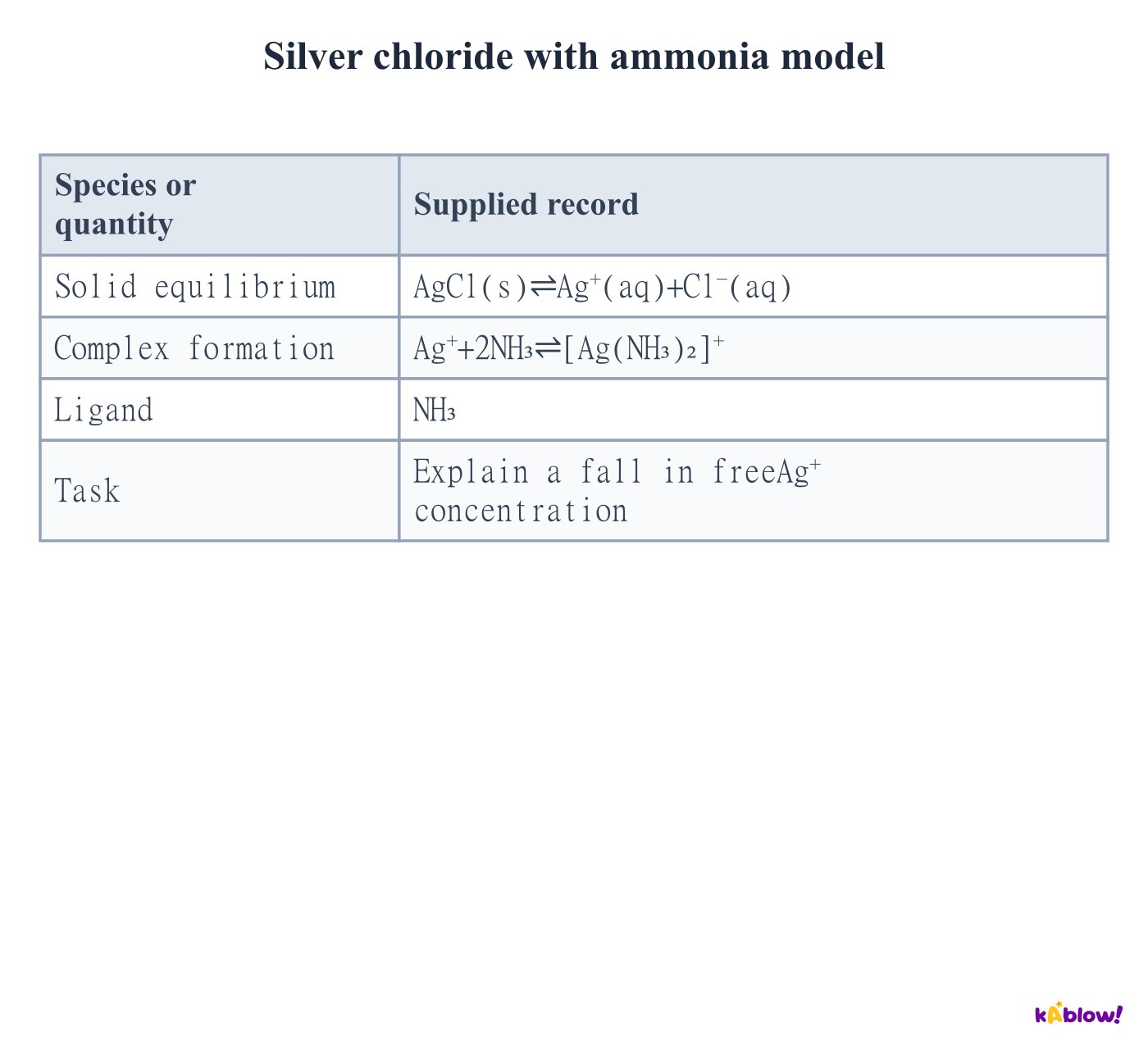
- Ammonia binds Ag⁺ to form [Ag(NH₃)₂]⁺. Lowering free Ag⁺ can shift AgCl dissolution toward more dissolved material.
- The overall relation is AgCl(s)+2NH₃(aq)⇌[Ag(NH₃)₂]⁺(aq)+Cl⁻(aq). It conserves atoms and charge.
- Silver remains in oxidation state+1; this is complex formation coupled to solubility, not oxidation of chloride or a loss of silver’s nuclear protons.
Silver chloride with ammonia model
Calculate silver-halide yield from the limiting ion
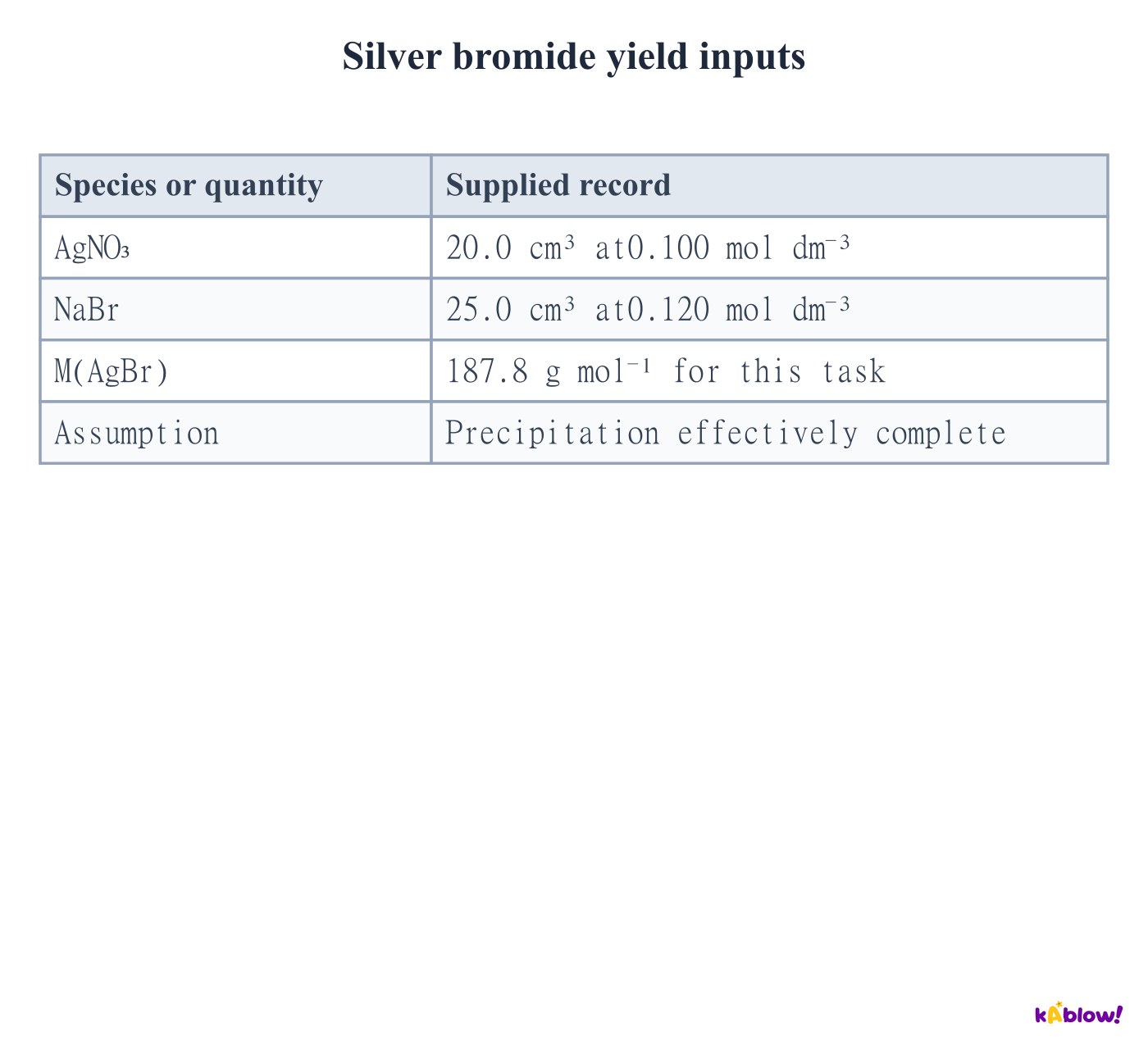
- Ag⁺+Br⁻→AgBr(s) has a1:1 ion ratio. The supplied solutions contain2.00 mmol Ag⁺ and3.00 mmol Br⁻.
- Silver ions limit the effectively complete precipitation to 2.00 mmol AgBr. The calculated solid mass is0.3756 g using the supplied molar mass.
- Convert cm³ to dm³ before multiplying concentration by volume. A mass calculation must use the limiting amount, not the larger available ion amount.
Silver bromide yield inputs
Separate acid–base formation of HCl from redox
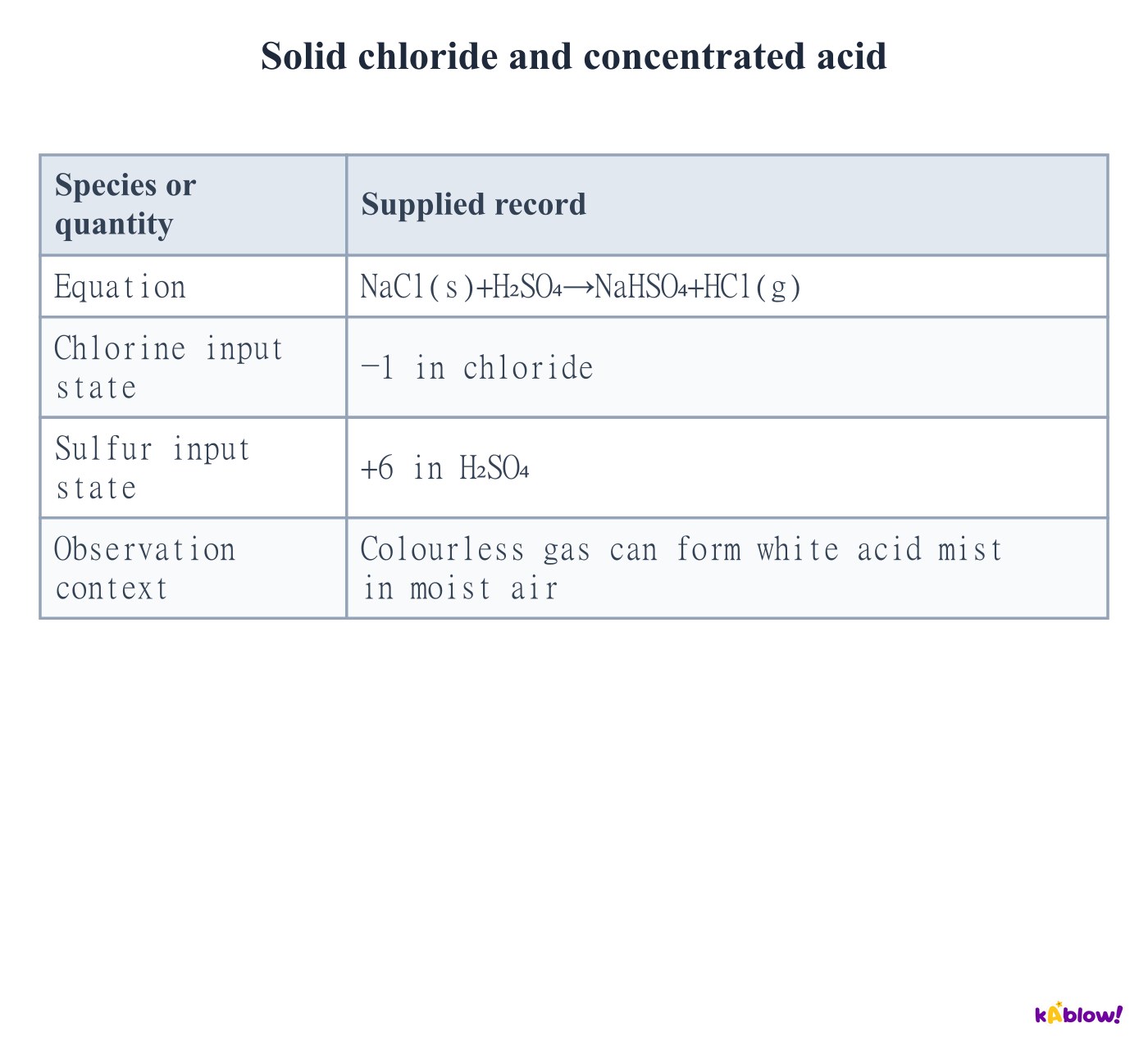
- Solid NaCl with concentrated H₂SO₄ can form HCl and sodium hydrogensulfate. In this step chloride is protonated.
- Chlorine remains−1 and sulfur remains+6, so this acid–base step is not a redox reaction. Chloride is not a sufficiently strong reducing agent for the later sulfate reductions in the usual comparison.
- HCl gas is colourless; white fumes in moist air are acid mist. Observations here describe supervised laboratory chemistry, not an instruction to identify gases by smelling.
Solid chloride and concentrated acid
Explain the further bromide redox step
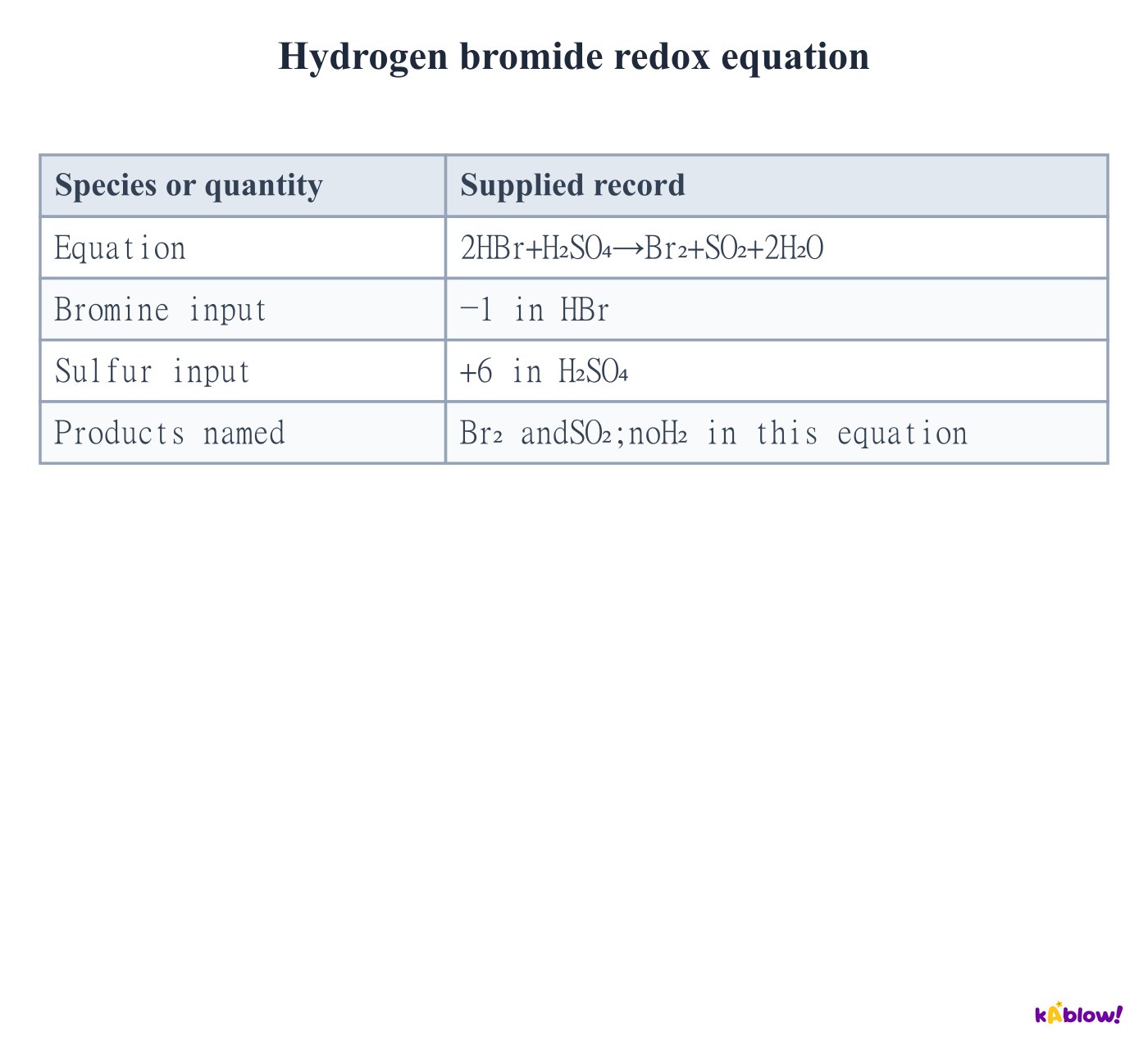
- After HBr formation, the concentrated sulfuric acid can oxidise bromide/HBr to Br₂ while sulfur is reduced to SO₂.
- In 2HBr+H₂SO₄→Br₂+SO₂+2H₂O, bromine goes−1→0 and sulfur+6→+4. Two electrons are transferred overall.
- The balanced equation does not produce hydrogen gas. Bromine vapour is red-brown; SO₂ and hydrogen halides are colourless gases whose observations must be interpreted appropriately.
Hydrogen bromide redox equation
Account for iodide reducing sulfate to sulfur dioxide
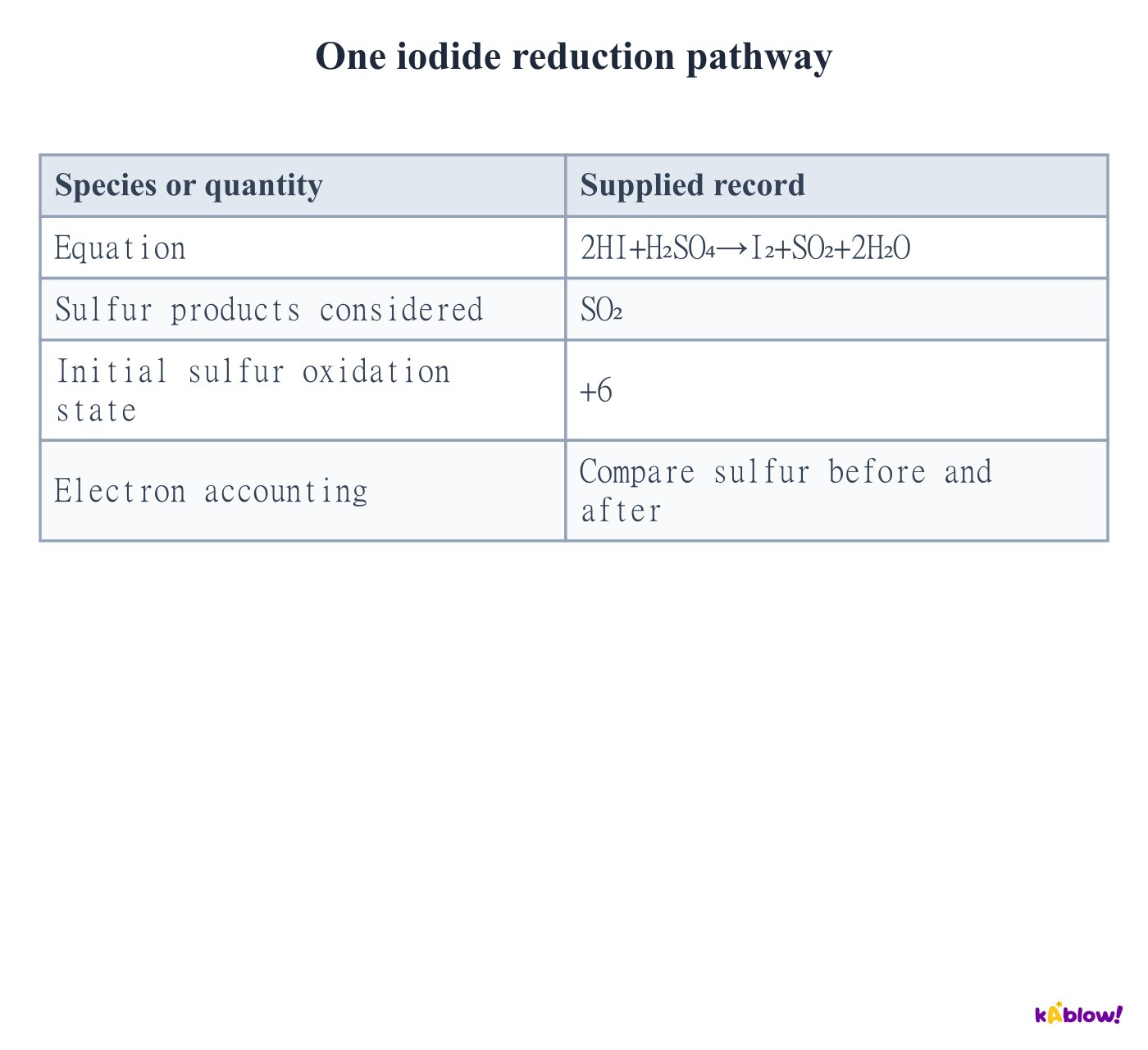
- Iodide is a stronger reducing agent than bromide and can reduce concentrated sulfuric acid through several product pathways. One gives SO₂.
- For 2HI+H₂SO₄→I₂+SO₂+2H₂O, sulfur changes+6→+4 and accepts two electrons; two iodides supply those electrons.
- The initial protonation step and later redox step are distinct. The reaction can be a mixture of pathways, so one equation is not a claim that SO₂ is always the only sulfur product.
One iodide reduction pathway
Account for formation of elemental sulfur
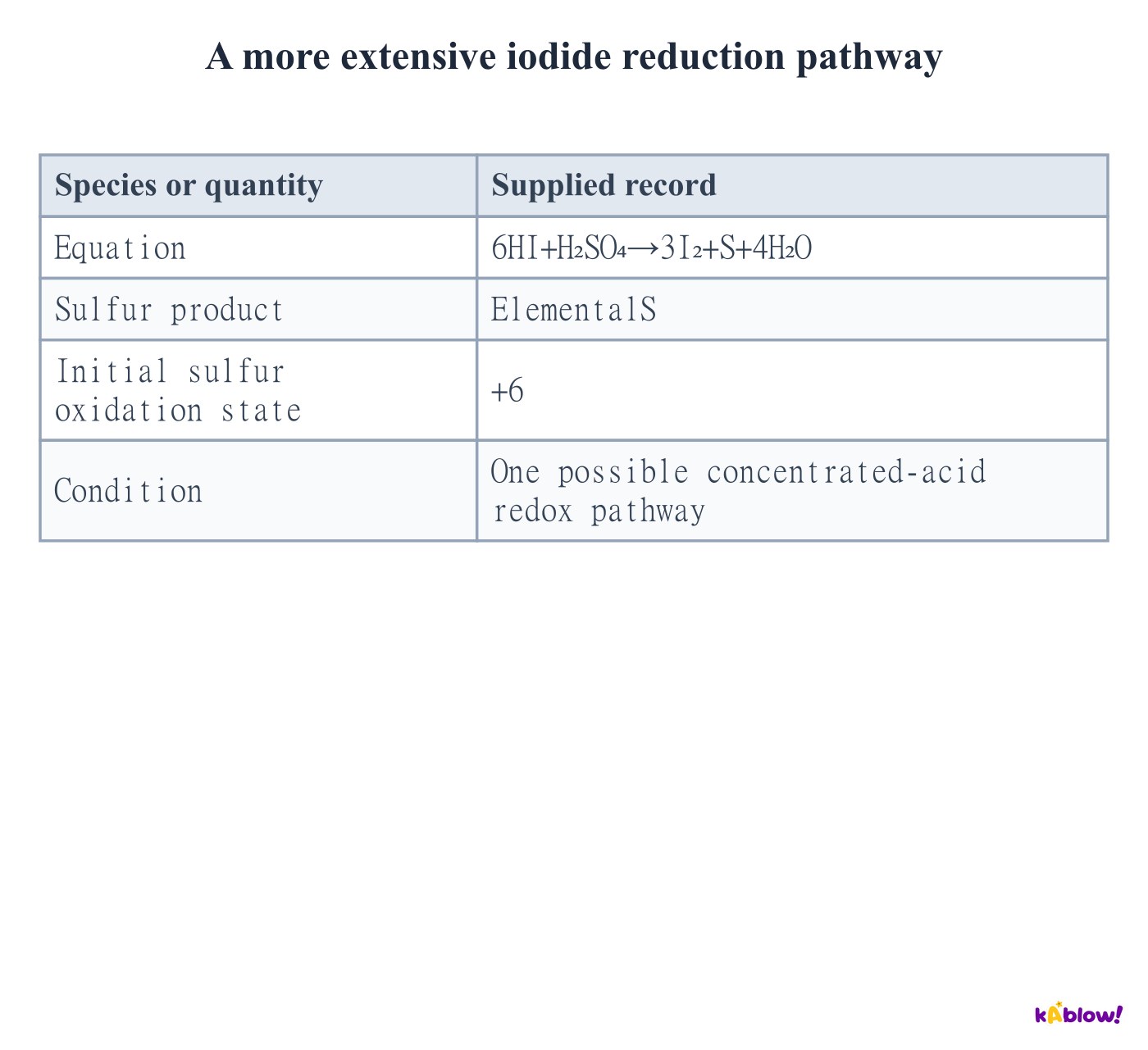
- In6HI+H₂SO₄→3I₂+S+4H₂O, sulfur changes from+6 to 0 and accepts six electrons. Six iodides each lose one electron.
- The product elemental sulfur is a yellow solid. The balanced equation has four water molecules per sulfuric-acid molecule in this net pathway.
- Do not confuse sulfur’s element symbol with sulfide or sulfate. Each has a different oxidation-state description and a different role in the equation.
A more extensive iodide reduction pathway
Account for the hydrogen sulfide pathway
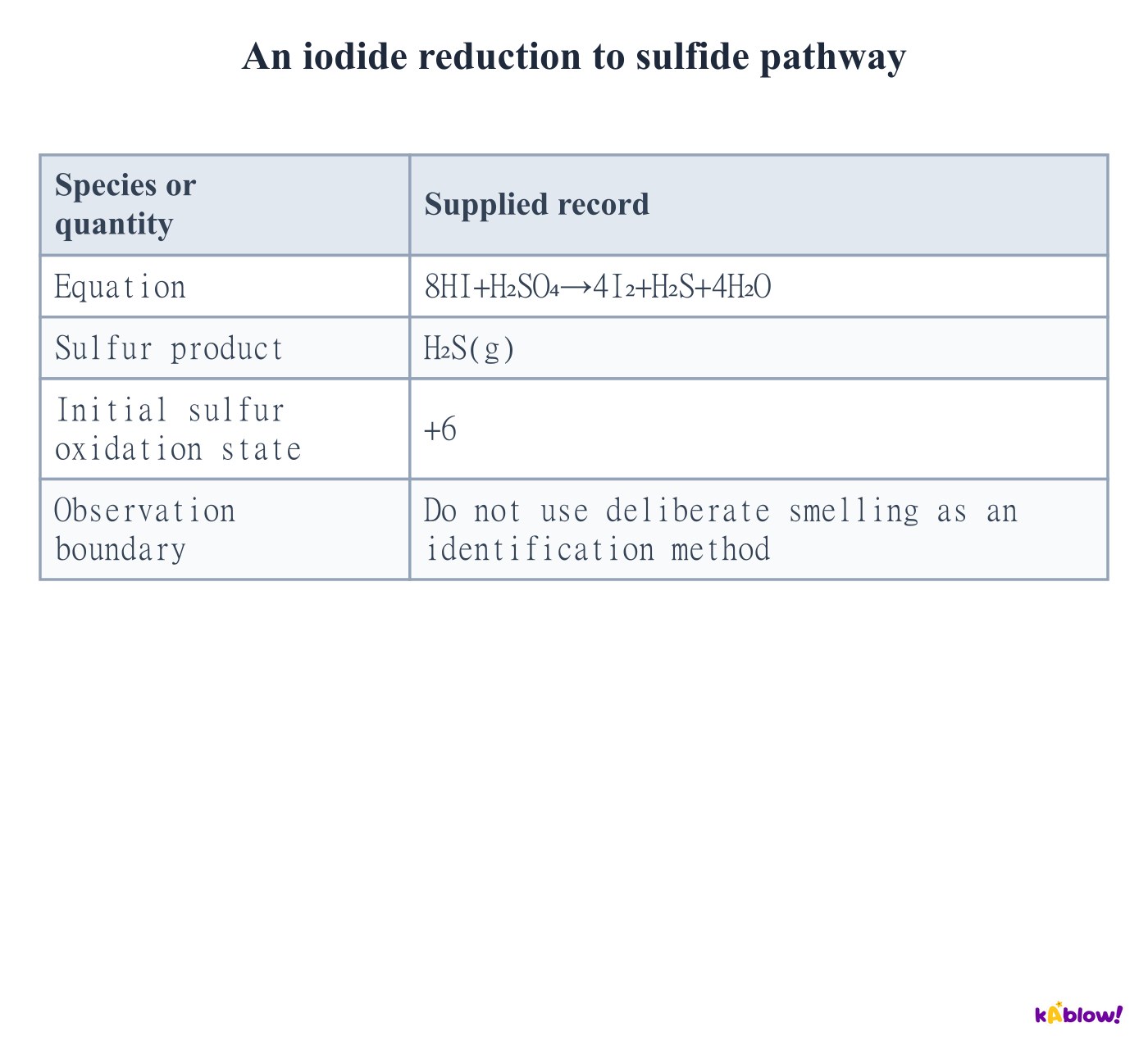
- In8HI+H₂SO₄→4I₂+H₂S+4H₂O, sulfur changes from+6 to−2 and accepts eight electrons. Eight iodides supply those electrons.
- Hydrogen sulfide is a gas under ordinary laboratory conditions, not the solid state printed in one source equation. Iodine’s observed solid or vapour phase depends on temperature.
- These concentrated-acid reactions can release hazardous gases and belong in the specified supervised fume-cupboard procedure. Deliberate smelling is not an appropriate test.
An iodide reduction to sulfide pathway
Compare extent of reduction without reversing agents
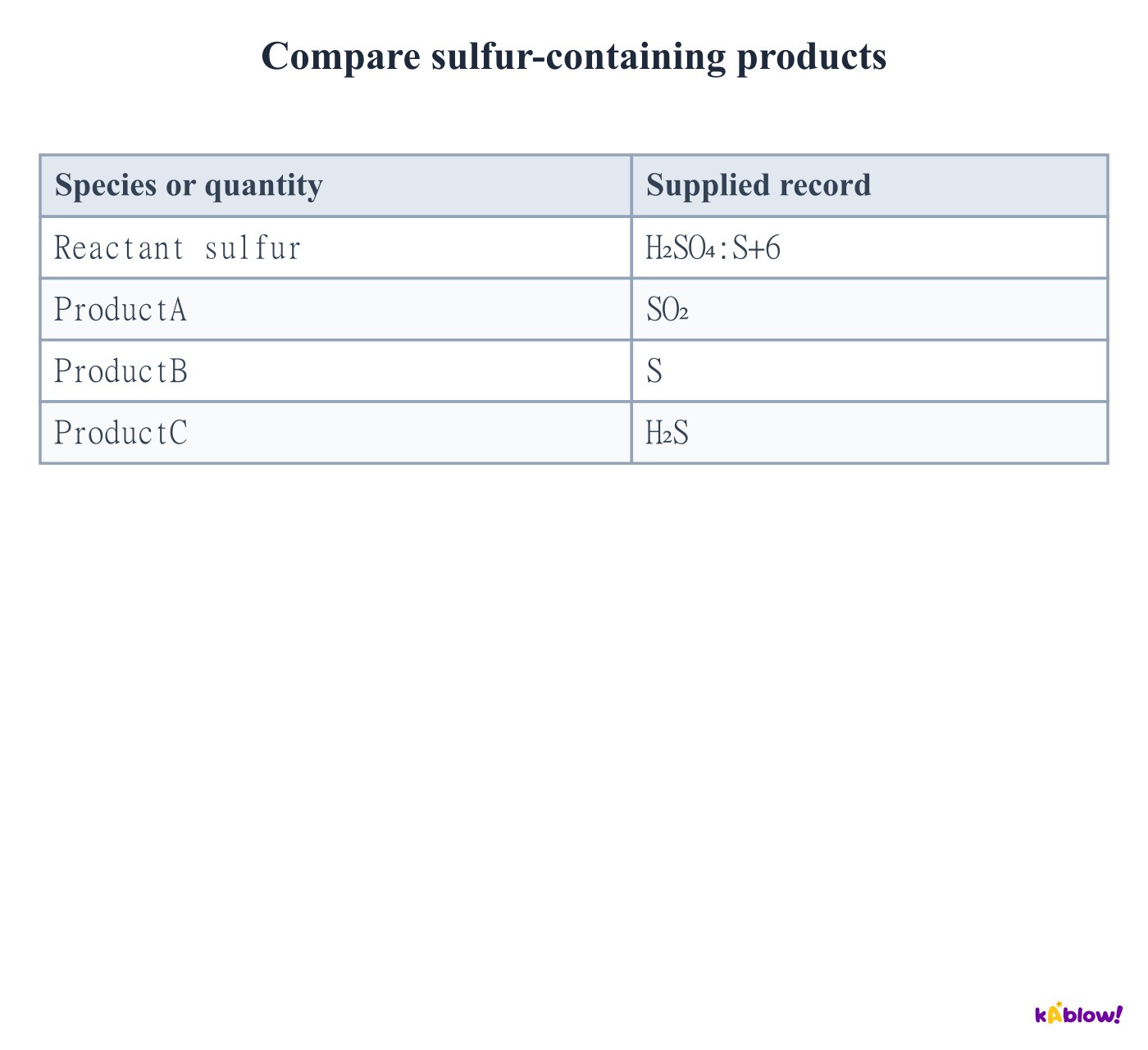
- The sulfur products SO₂, S and H₂S correspond to oxidation states+4, 0 and−2. All are reductions from sulfur’s initial+6 state.
- The required electron amounts per sulfur atom are2, 6 and8 respectively. H₂S represents the largest reduction among these three pathways.
- The halide donating electrons is the reducing agent and is oxidised to X₂. The sulfuric acid accepting electrons is the oxidising agent and is reduced.
Compare sulfur-containing products
Explain cold-alkali disproportionation
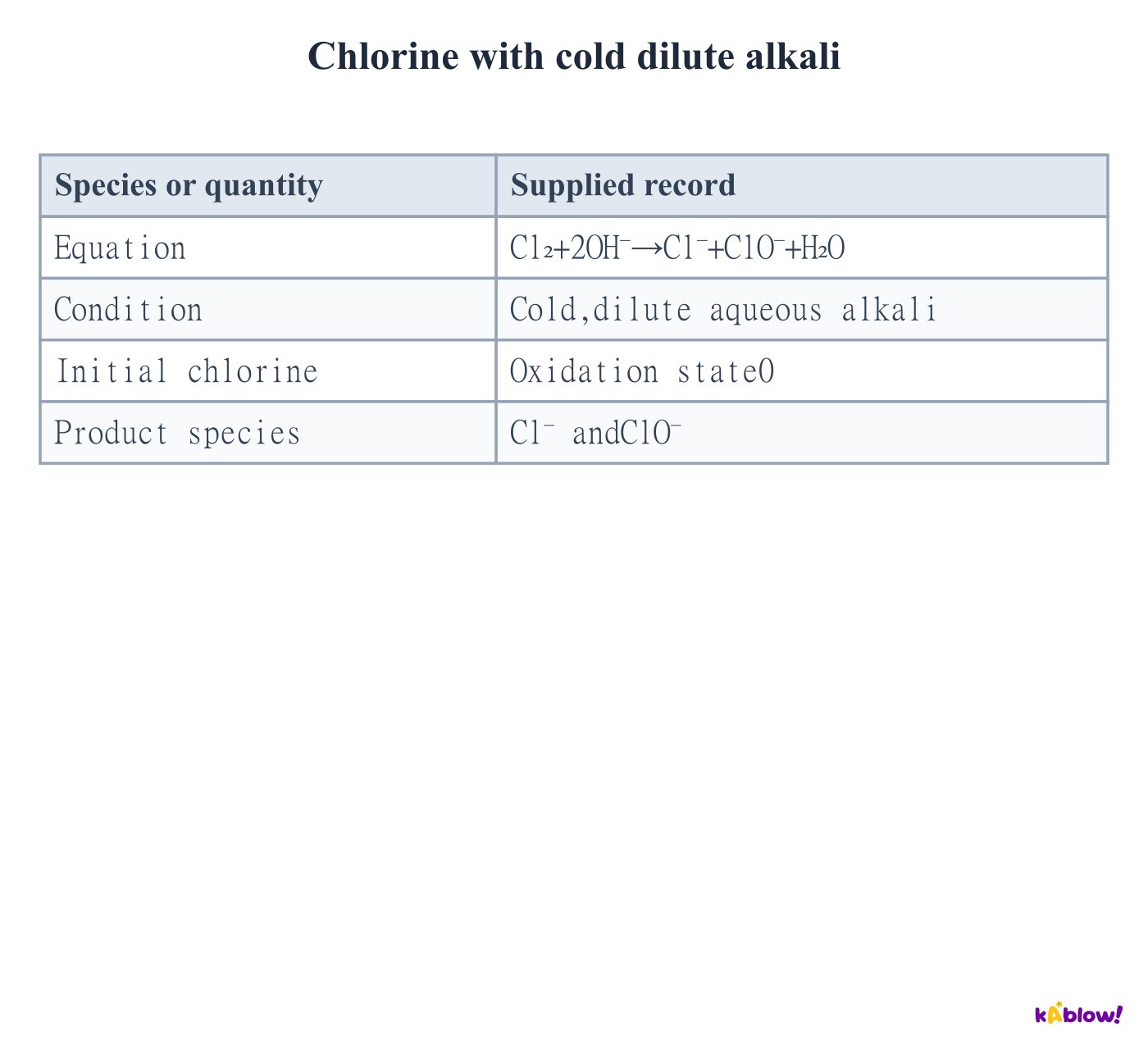
- Chlorine with cold dilute NaOH forms sodium chloride, sodium chlorate(I), also called hypochlorite, and water. The net ionic equation is Cl₂+2OH⁻→Cl⁻+ClO⁻+H₂O.
- Chlorine changes from 0 to−1 in Cl⁻ and from 0 to+1 in ClO⁻. The same elemental reactant is both reduced and oxidised, so this is disproportionation.
- The product names and oxidation states must match:chlorate(I)/hypochlorite is ClO⁻, not chlorate(V), ClO₃⁻.
Chlorine with cold dilute alkali
Write the chlorine-water equilibrium
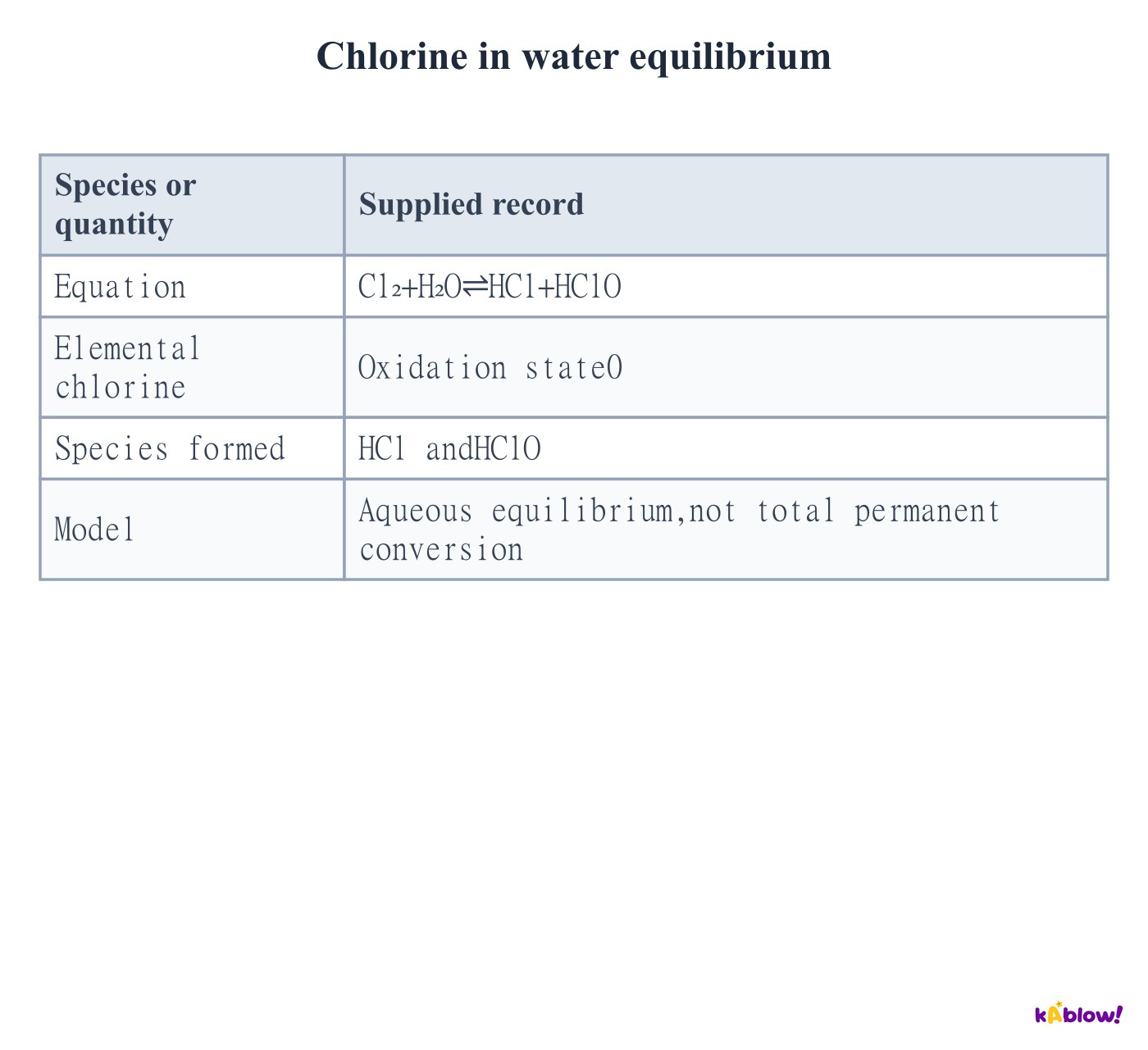
- Chlorine reacts with water according to Cl₂+H₂O⇌HCl+HClO. It is another disproportionation, with chlorine reaching−1 and+1.
- The equilibrium arrow matters:the distribution of dissolved chlorine species depends on solution conditions. The equation is not a claim that every chlorine molecule is permanently converted.
- HClO is chloric(I) acid, also called hypochlorous acid. Distinguish it from chloric(V) acid, HClO₃, and hydrochloric acid, HCl.
Chlorine in water equilibrium
Connect pH with HClO and ClO⁻ proportions
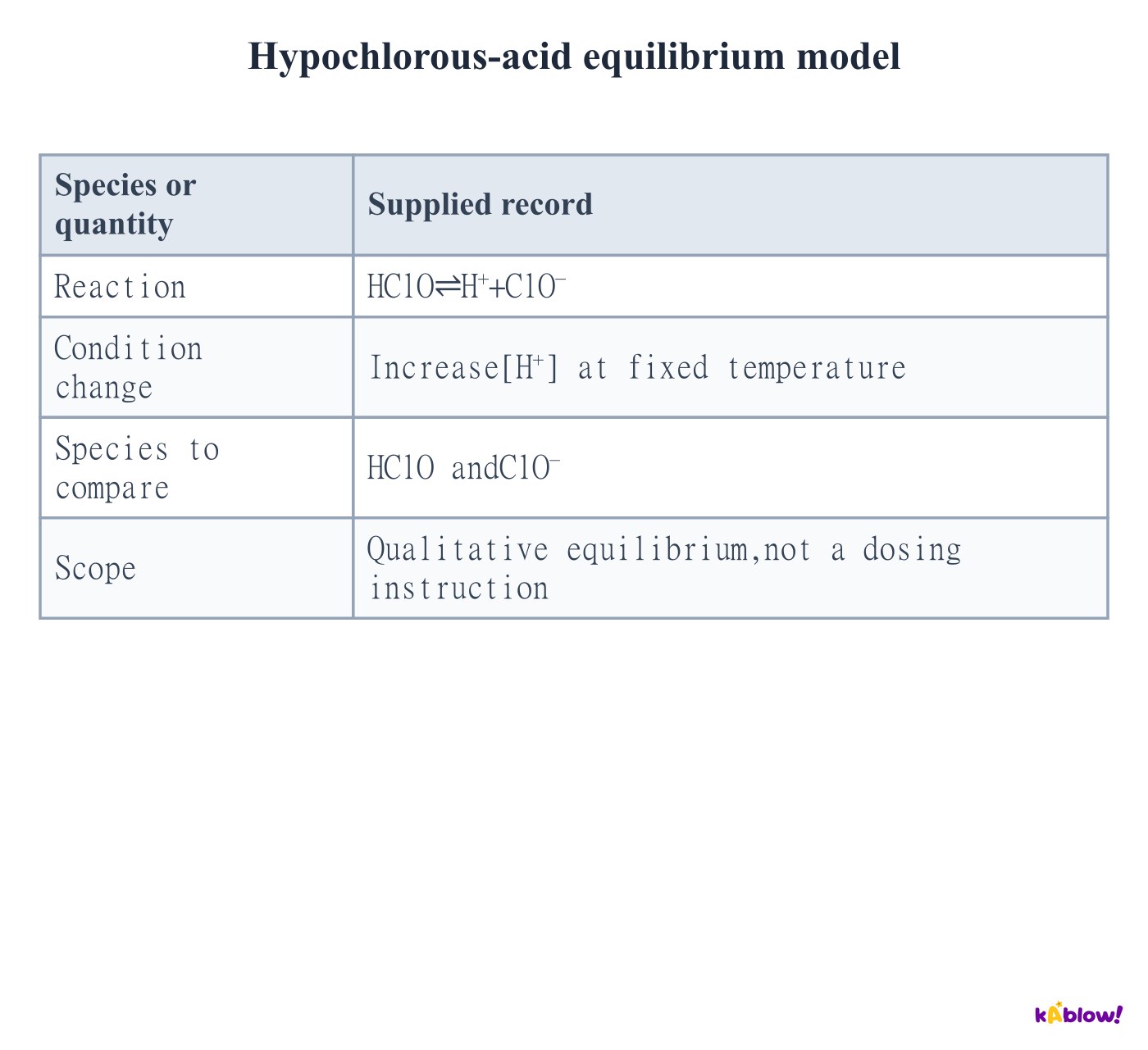
- HClO⇌H⁺+ClO⁻ describes a weak-acid equilibrium. Increasing acidity favours a larger HClO fraction; raising pH favours more ClO⁻.
- Both forms contribute to chlorine-based disinfection, but their effectiveness and reaction behaviour are not identical. The solution conditions influence the active-species balance.
- This equilibrium applies chemical reasoning to water treatment. It does not by itself specify a suitable disinfectant concentration or replace operational monitoring.
Hypochlorous-acid equilibrium model
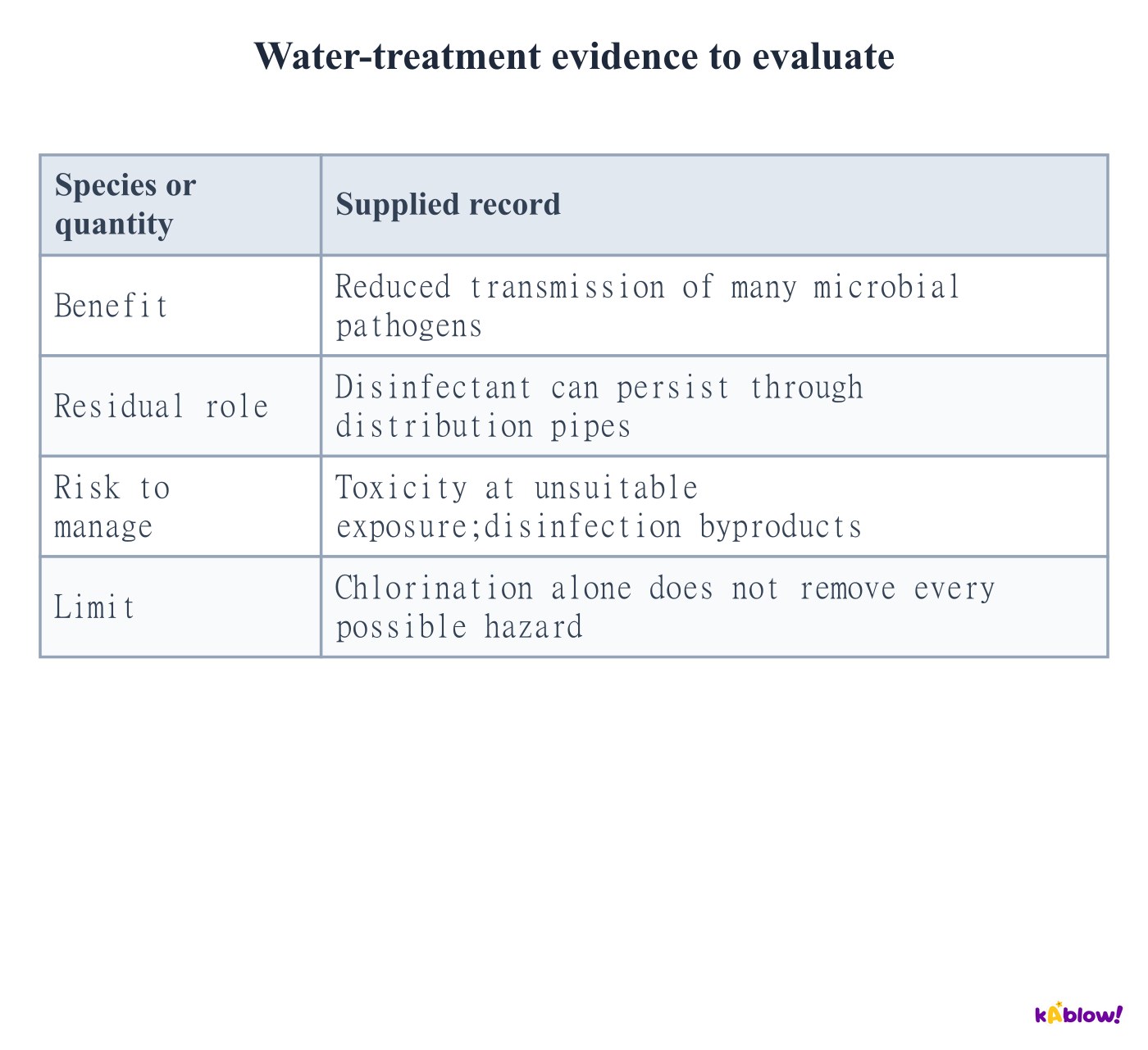
Evaluate chlorination as a controlled public-health process
- Controlled chlorination reduces microbial disease risk and can maintain a disinfecting residual in distribution pipes. This benefit is central to the AQA evaluation.
- Treatment also controls exposure and disinfection byproducts through monitoring and appropriate processes. A statement that any amount is harmless is not a justified evaluation.
- Chlorine is less effective against some resistant organisms and does not remove arbitrary chemical contamination. Water safety depends on a managed treatment system, not one reaction equation alone.
Water-treatment evidence to evaluate
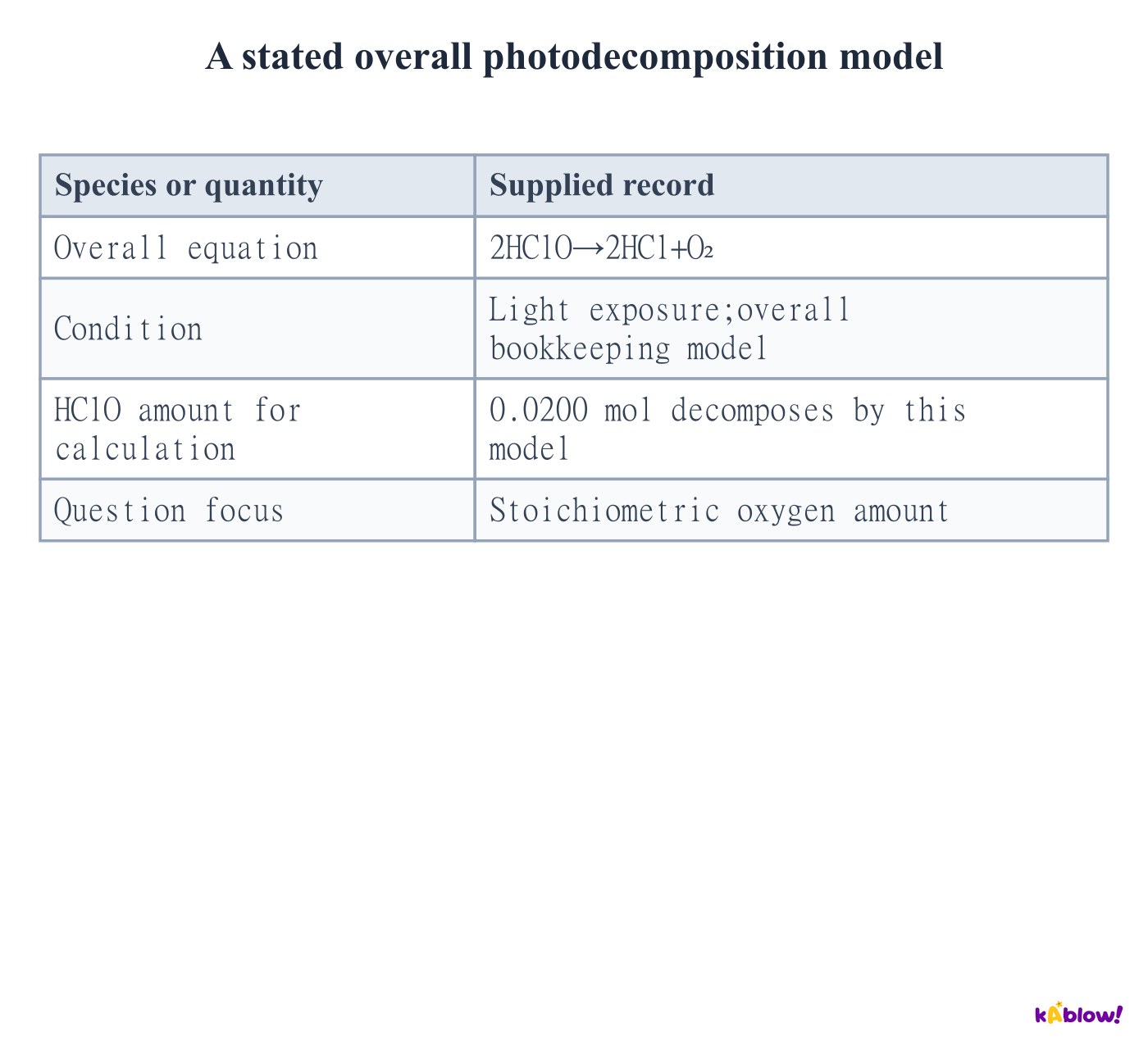
Describe sunlight effects without a universal pool-depth rule
- Light can reduce available free chlorine. The supplied simplified overall model2HClO→2HCl+O₂ conserves atoms and represents one bookkeeping description of photochemical loss.
- For 0.0200 mol HClO decomposing according to this model, 0.0100 mol O₂ forms. Actual photochemistry and loss rates depend on conditions.
- Sunlight exposure, shading, water composition and stabilisation matter. A claim that every shallower pool necessarily loses chlorine at one fixed rate is too broad.
A stated overall photodecomposition model
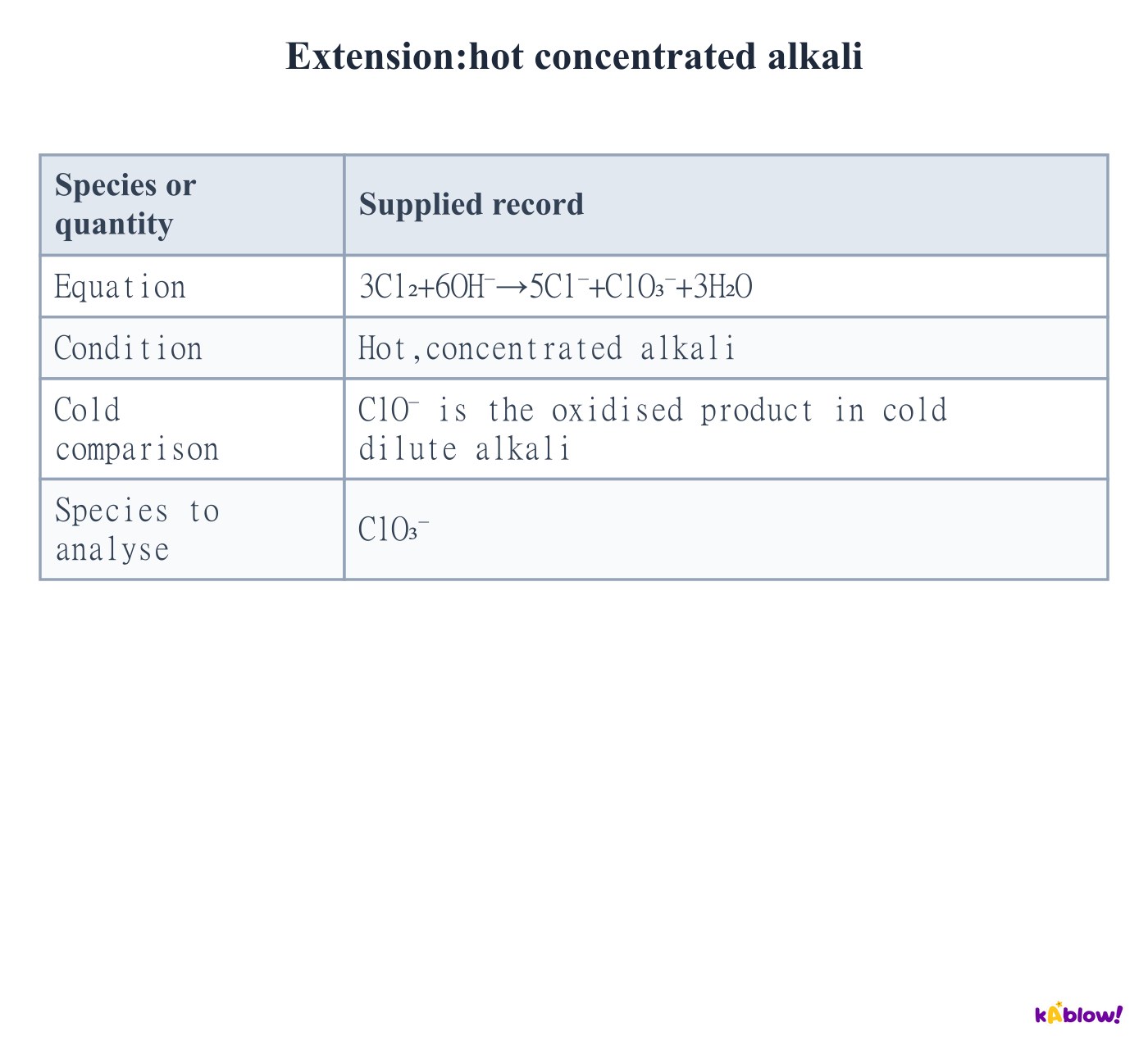
Qualify the hot concentrated alkali extension
- Under hot concentrated alkali conditions, the oxidised chlorine product can be chlorate(V), ClO₃⁻, alongside chloride. This is an extension to the core cold-dilute comparison.
- The supplied balanced equation is3Cl₂+6OH⁻→5Cl⁻+ClO₃⁻+3H₂O. Chlorine is reduced to−1 and oxidised to+5.
- Conditions belong in the answer. Do not apply the cold-dilute hypochlorite product to every alkali reaction, or call ClO₃⁻ chlorate(I).
Extension:hot concentrated alkali
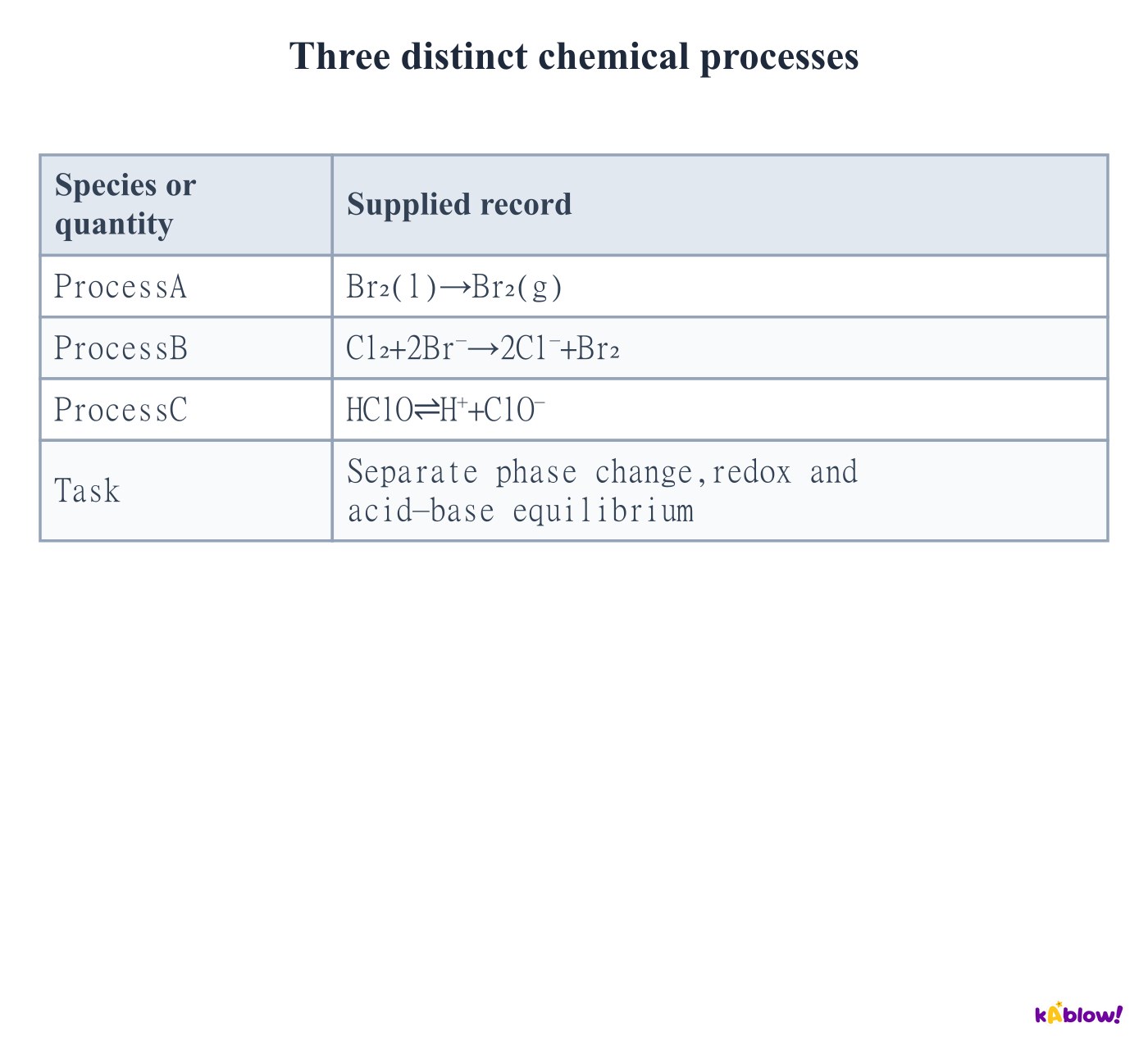
Choose an explanation that matches the process
- Boiling a halogen changes intermolecular separation while preserving X₂ molecules. Halide displacement transfers electrons and changes oxidation states.
- Proton transfer in HClO dissociation changes acid/base forms without changing chlorine’s+1 oxidation state. Complex formation in the silver test is another distinct process.
- Read the species, states, conditions and task before choosing a trend explanation. A balanced equation also needs chemically appropriate species; mass and charge balance alone are not proof of a real reaction.
Three distinct chemical processes
स्लाइड्स
Sign up free to view the lesson slides
Step through every slide for this topic — plus flashcards and revision notes — with a free account.
प्रैक्टिस सवाल
फ्री प्रीव्यू — 60 में से 8 सवाल। सभी देखने के लिए साइन अप करें।
1.How many electrons must one Cl₂ molecule gain overall to form two Cl⁻ ions?
Medium- A2
- B1
- C0
- D4
2.Which observation belongs to an elemental halogen rather than a simple aqueous halide salt?
Medium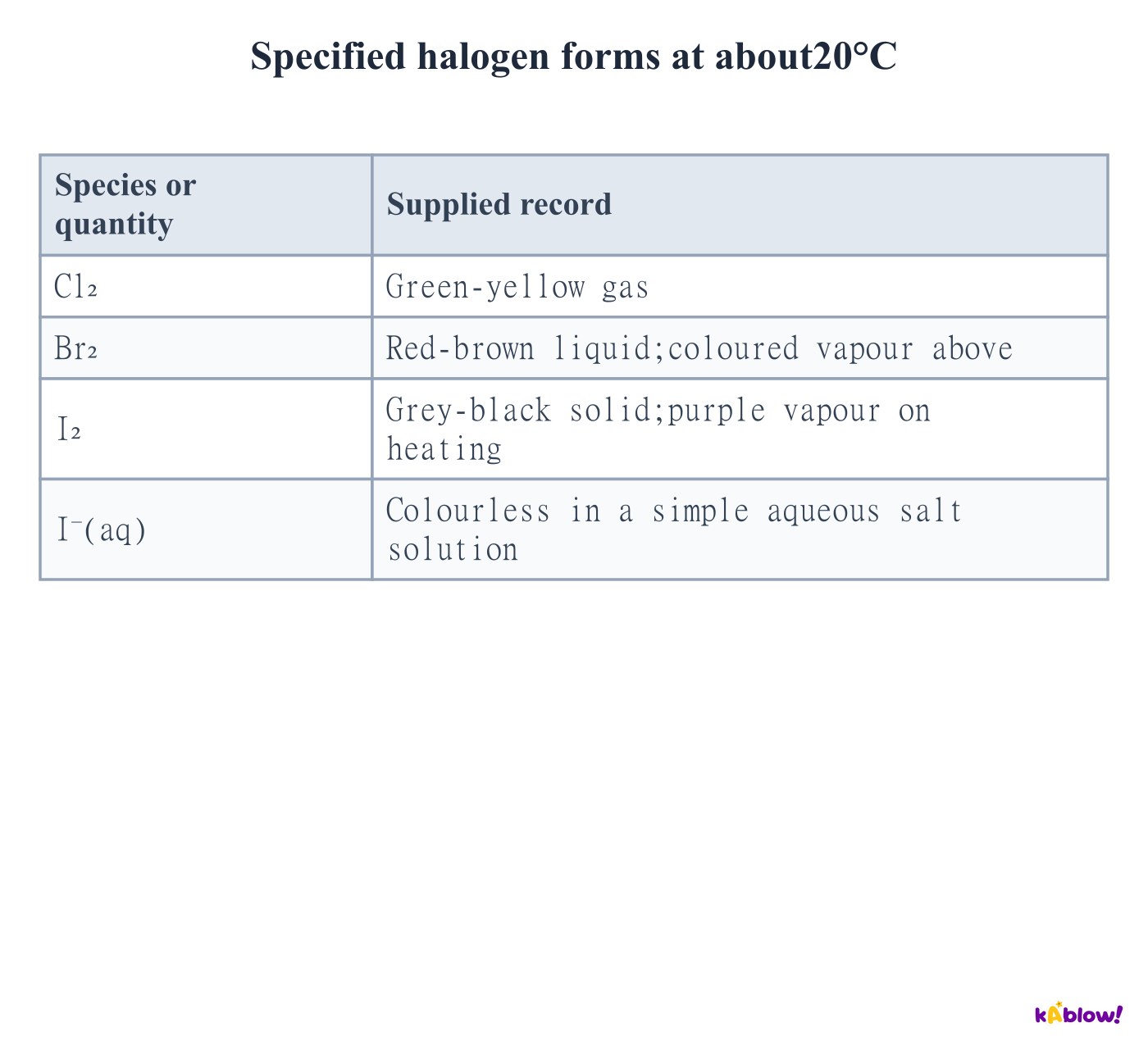
- AColourless aqueous iodide
- BPurple iodine vapour
- CAqueous chloride ions becoming green by definition
- DEvery iodide salt producing a brown solution
3.Which statement fits the supplied boiling data?
Medium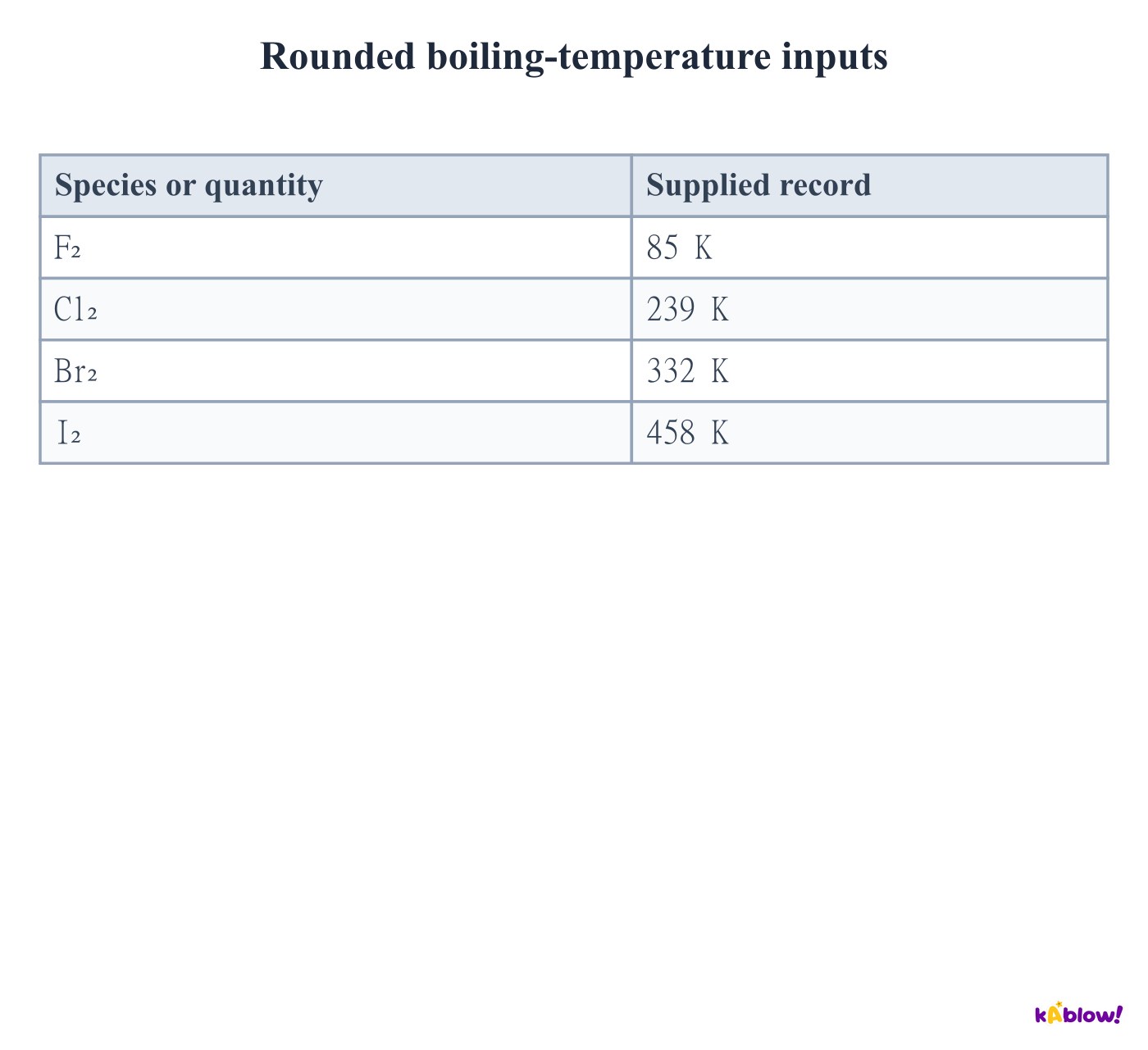
- AI₂ is the most volatile under comparable conditions
- BBoiling point decreases from F₂ to I₂
- CBoiling point increases while volatility generally decreases from F₂ to I₂
- DThe data measure X–X bond-breaking energy
4.Which interaction is chiefly overcome when liquid bromine boils without chemical decomposition?
Medium- AThe Br–Br covalent bond in every molecule
- BIonic bonds between Br²⁺ and Br²⁻
- CHydrogen bonds between HBr molecules
- DDispersion attractions between Br₂ molecules
5.Which conclusion is supported by the supplied bond-energy estimates?
Medium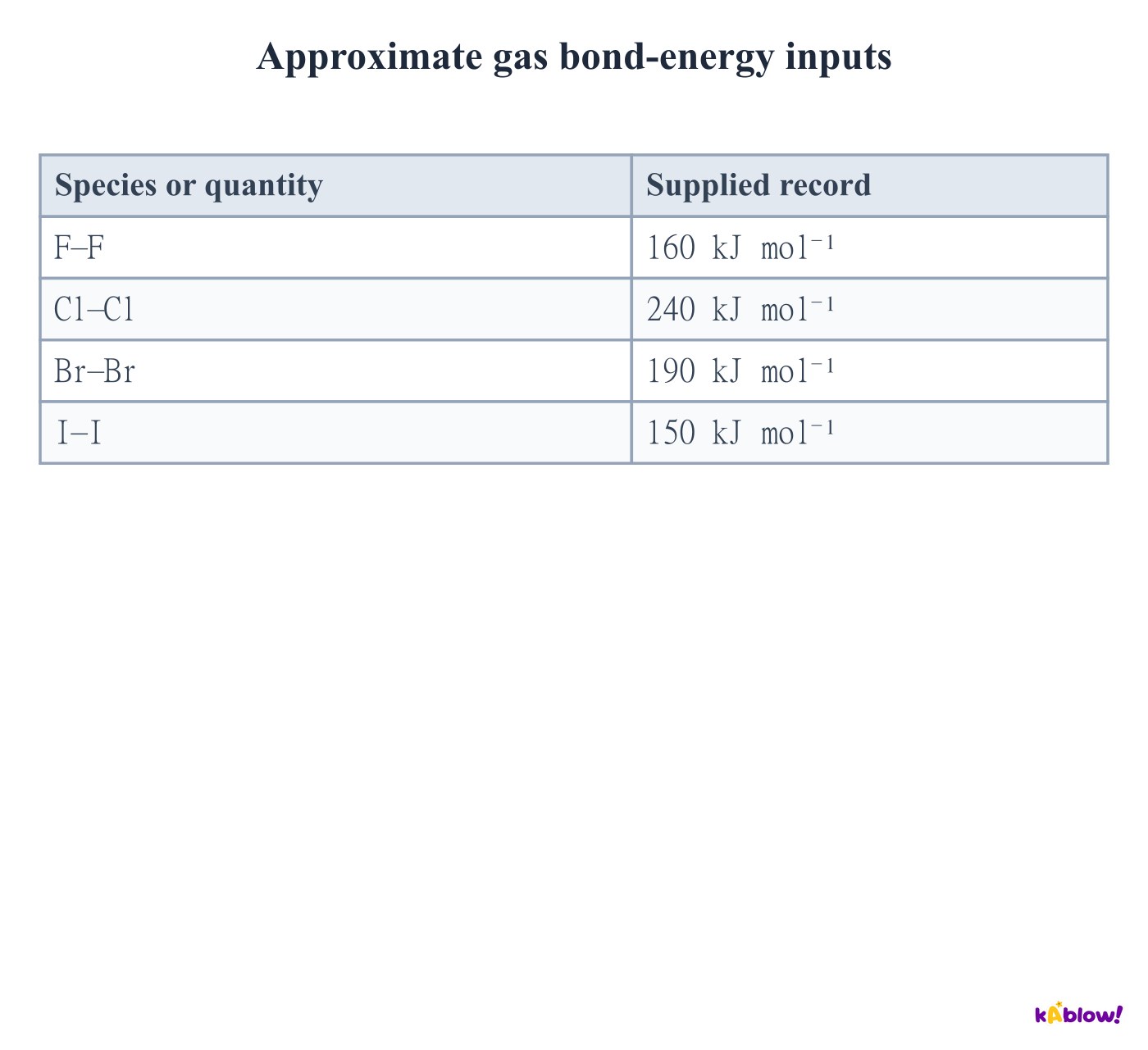
- AF–F is weaker than Cl–Cl, so a monotonic F–I rule fails
- BF–F is the strongest listed bond
- CBoiling I₂ must require240 kJ per mole of molecules
- DEvery bond becomes stronger with larger atoms
6.Which property is described directly by electronegativity?
Medium- AThe mass of a molecule
- BAttraction for a shared electron pair in a covalent bond
- CA universal rate constant for every halogen reaction
- DThe colour of every aqueous salt
7.Which supplied half-equation shows reduction of elemental chlorine?
Medium- AB only
- BBoth represent electron gain
- CA only
- DNeither conserves charge
8.Which supplied mixture is expected to form a new elemental halogen by displacement?
Medium- AB only
- BC only
- CAll three
- DA only
Unlock all 60 questions, flashcards & more
इस टॉपिक के हर सवाल, स्लाइड्स, फ्लैशकार्ड और रिवीज़न नोट्स देखने के लिए फ्री अकाउंट बनाएं।