
Periodicity
खेलकर सीखें
इन सवालों के जवाब देकर एनर्जी कमाएं, फिर मछली पकड़ें और घूमें। कोई अकाउंट नहीं चाहिए।
लेसन नोट्स
Explain what repeats in periodicity
- The modern Periodic Table orders elements by proton number. Periodicity is the recurrence of related physical and chemical behaviour as electronic structures repeat.
- Periods are rows and groups are columns. Related outer-electron arrangements explain many group similarities; atomic masses do not define the ordering.
- A trend describes a pattern in specified data. It does not guarantee that every property changes smoothly or in the same direction.
Element records for classification
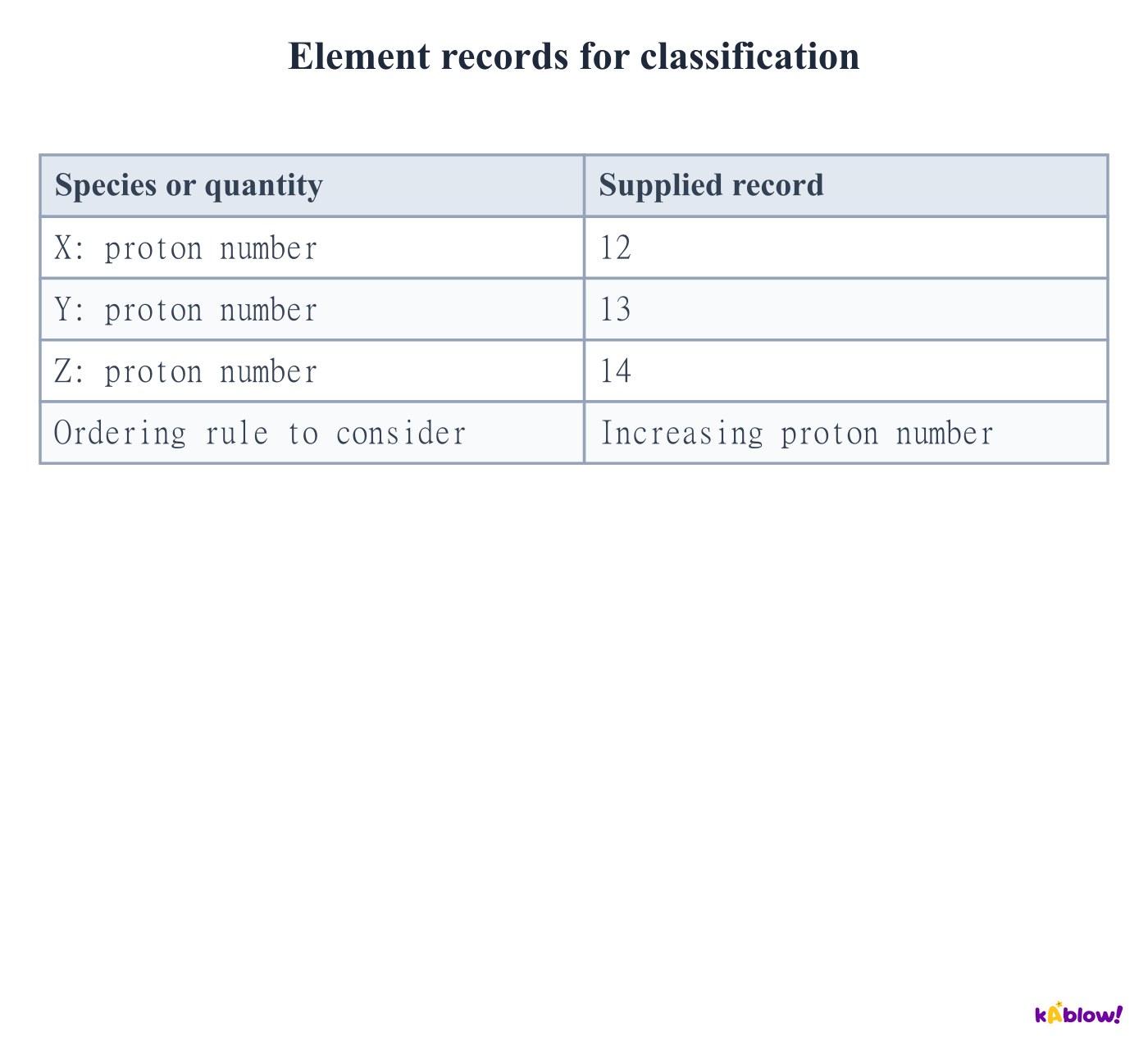
Link period and group to main-group electrons
- Neutral Period 3 main-group atoms have occupied shells n=1, 2 and 3. Their outer electrons occupy 3s and then 3p subshells.
- Na and Mg occupy groups 1 and 2; Al to Ar occupy groups 13 to 18. For these main-group examples, related outer configurations identify group relationships.
- Helium has 1s² and belongs to group 18 because of its noble-gas chemistry, although its electronic block is s. Hydrogen is conventionally placed in group 1 but has distinctive chemistry.
Neutral main-group configurations
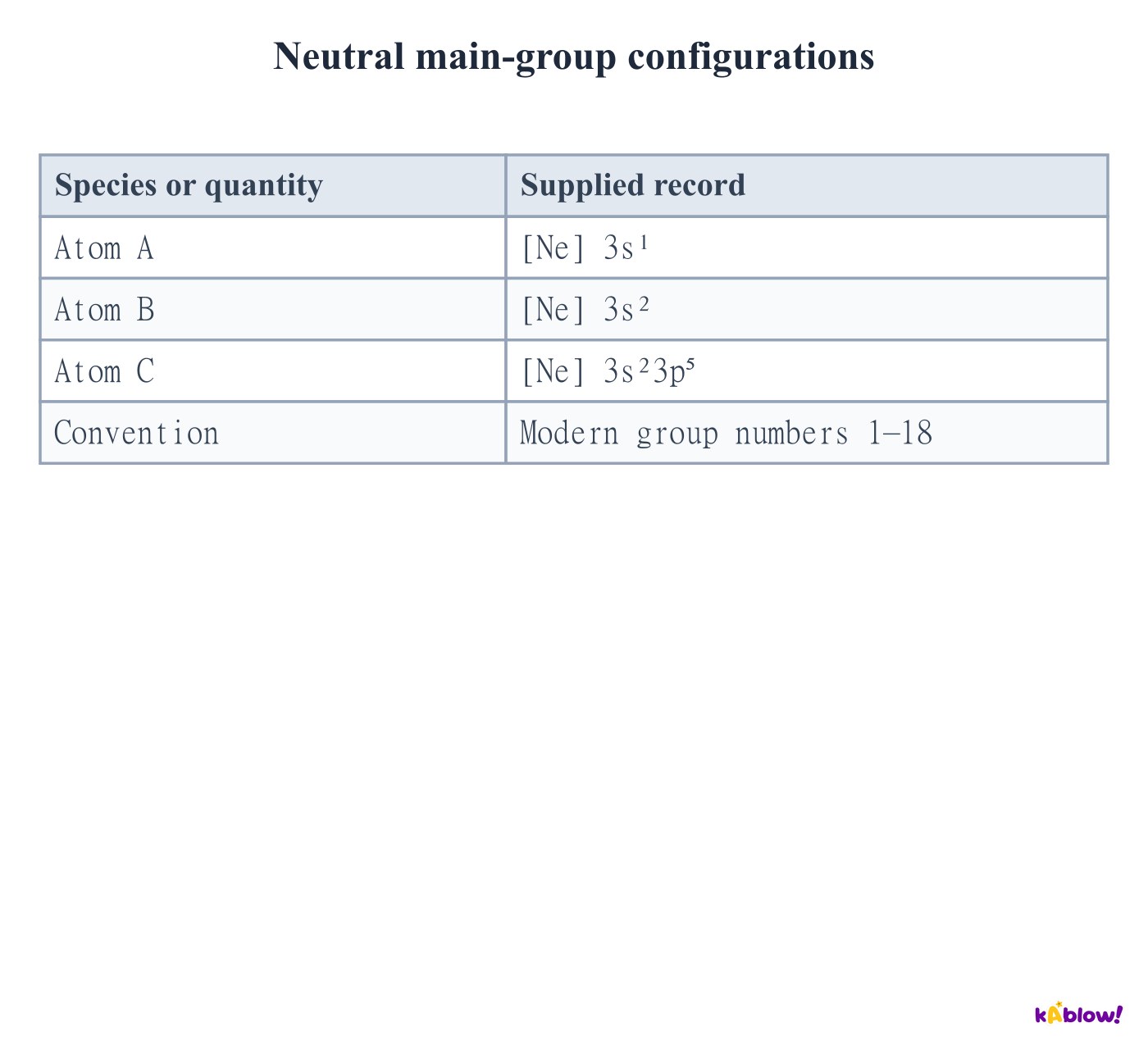
Classify s, p, d and f blocks carefully
- Blocks describe the subshell sequence associated with each region of the Periodic Table. Na and Mg are s-block; Al to Ar are p-block.
- The central d block involves filling a d subshell; the detached f-block rows involve f subshells. These are position and electronic-structure classifications.
- Do not define every d-block atom as requiring an occupied outer s subshell. Palladium is a d-block counterexample with [Kr]4d¹⁰; real configurations include exceptions.
Electronic records and block assignment
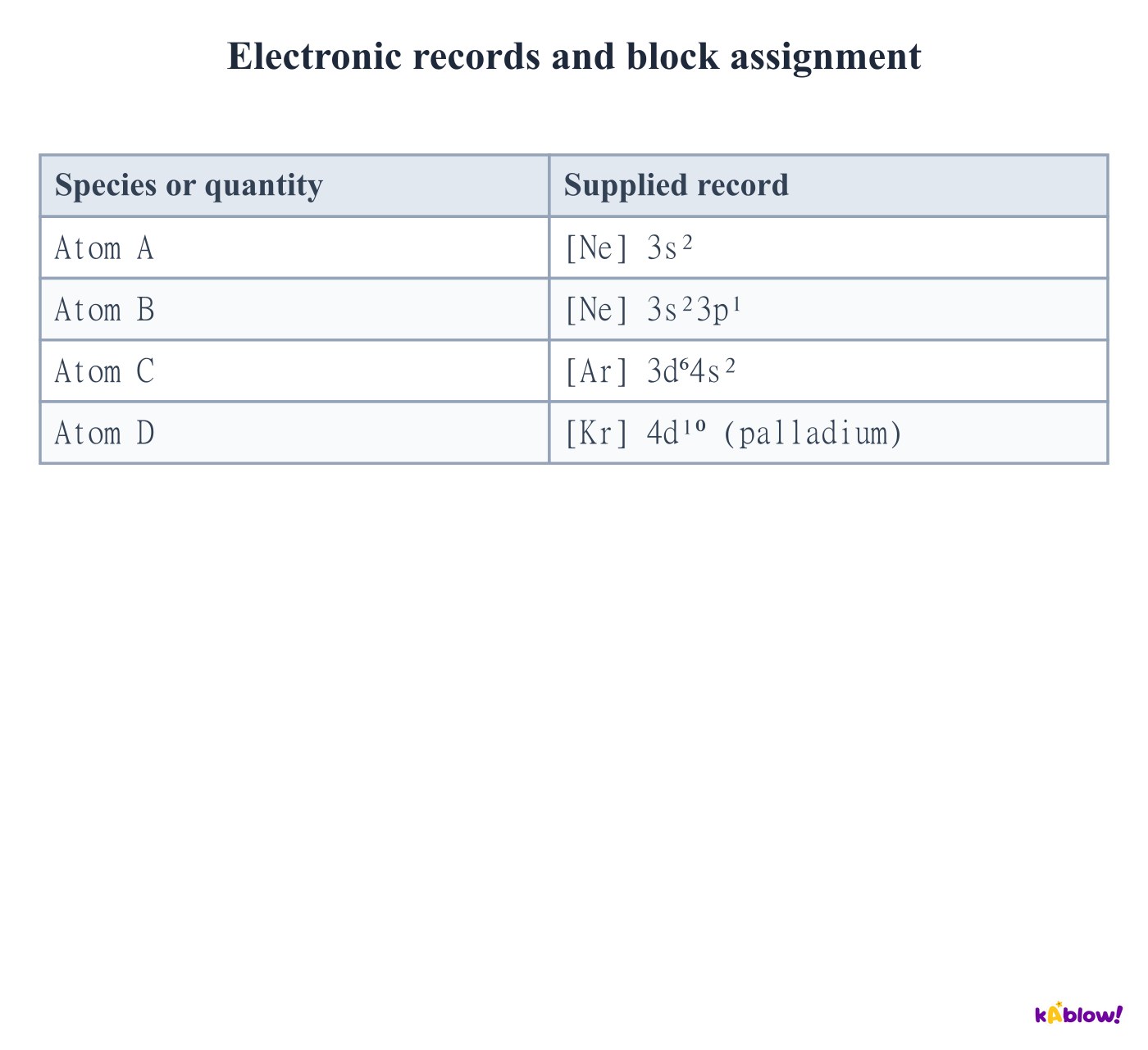
Connect shell counts with subshell notation
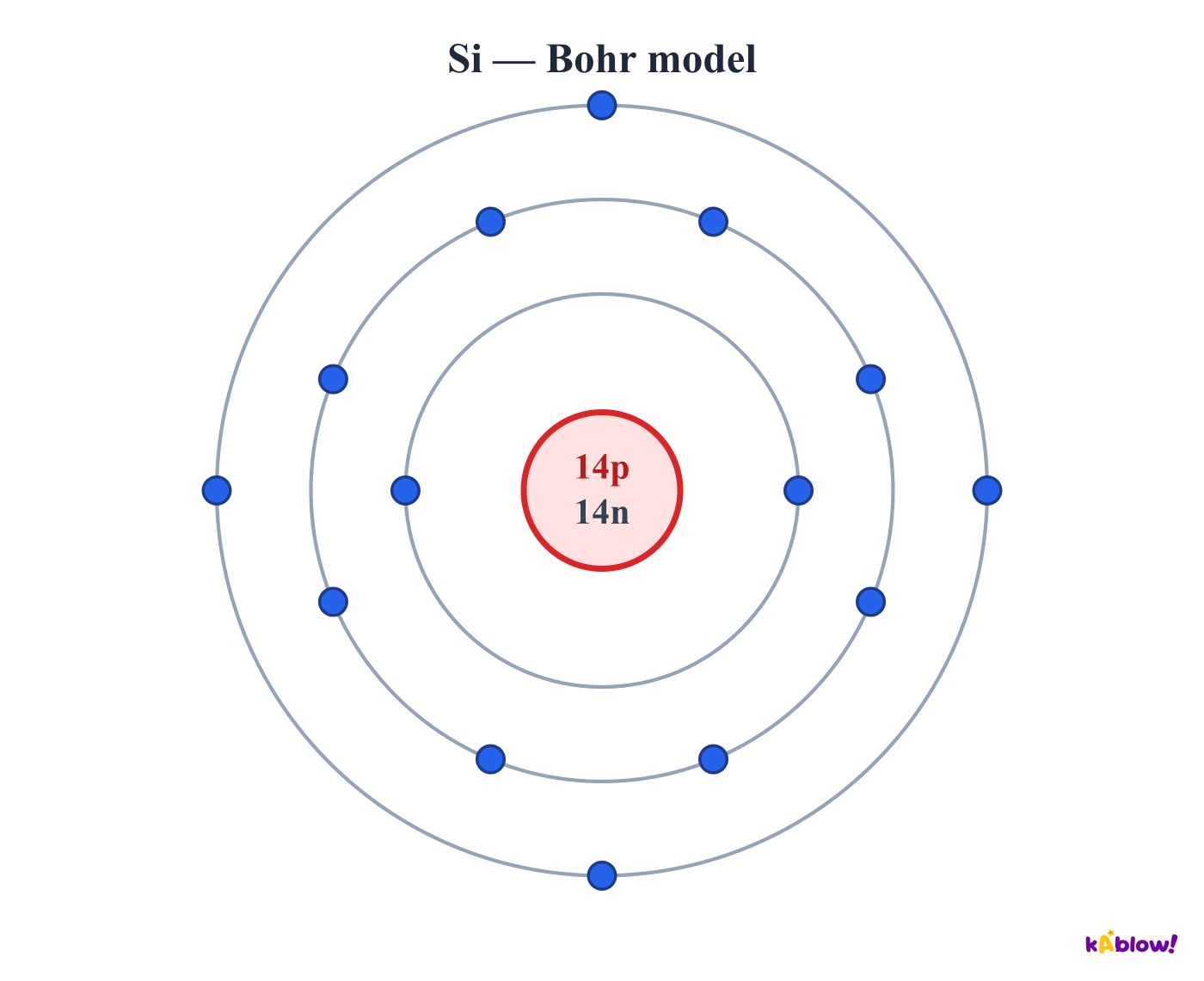
- The supplied schematic represents a neutral silicon-28 atom: 14 protons, 14 neutrons and 14 electrons arranged 2,8,4. The circles are a shell model, not literal electron paths.
- The more informative ground-state notation is [Ne]3s²3p². The [Ne] core contains ten electrons, leaving four in n=3.
- A shell model does not resolve individual s and p orbitals, nor does its drawn radius measure the actual atomic radius. Use it to count and organise electrons.
Silicon schematic electron shells
Define a radius using a clear convention
- An atom has an electron cloud rather than a hard outer surface. A numerical atomic radius depends on the chosen measurement convention.
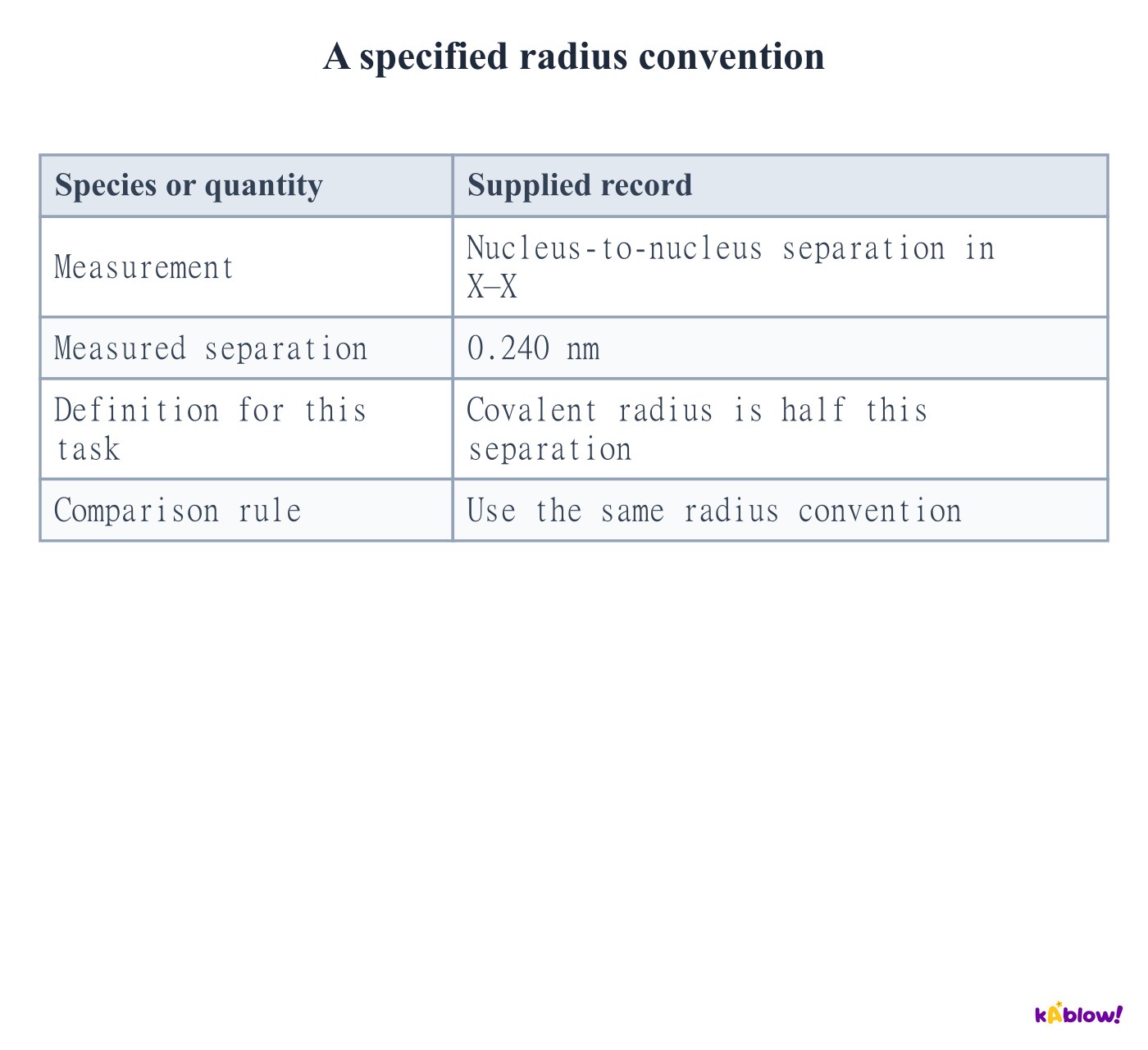
- For two identical covalently bonded atoms, the covalent radius is half the specified internuclear separation. A separation of 0.240 nm gives 0.120 nm.
- Metallic, covalent and nonbonded radii describe different environments. Do not mix them uncritically, especially when adding nonbonded argon to a bonded-radius series.
A specified radius convention
Explain the general atomic-radius decrease
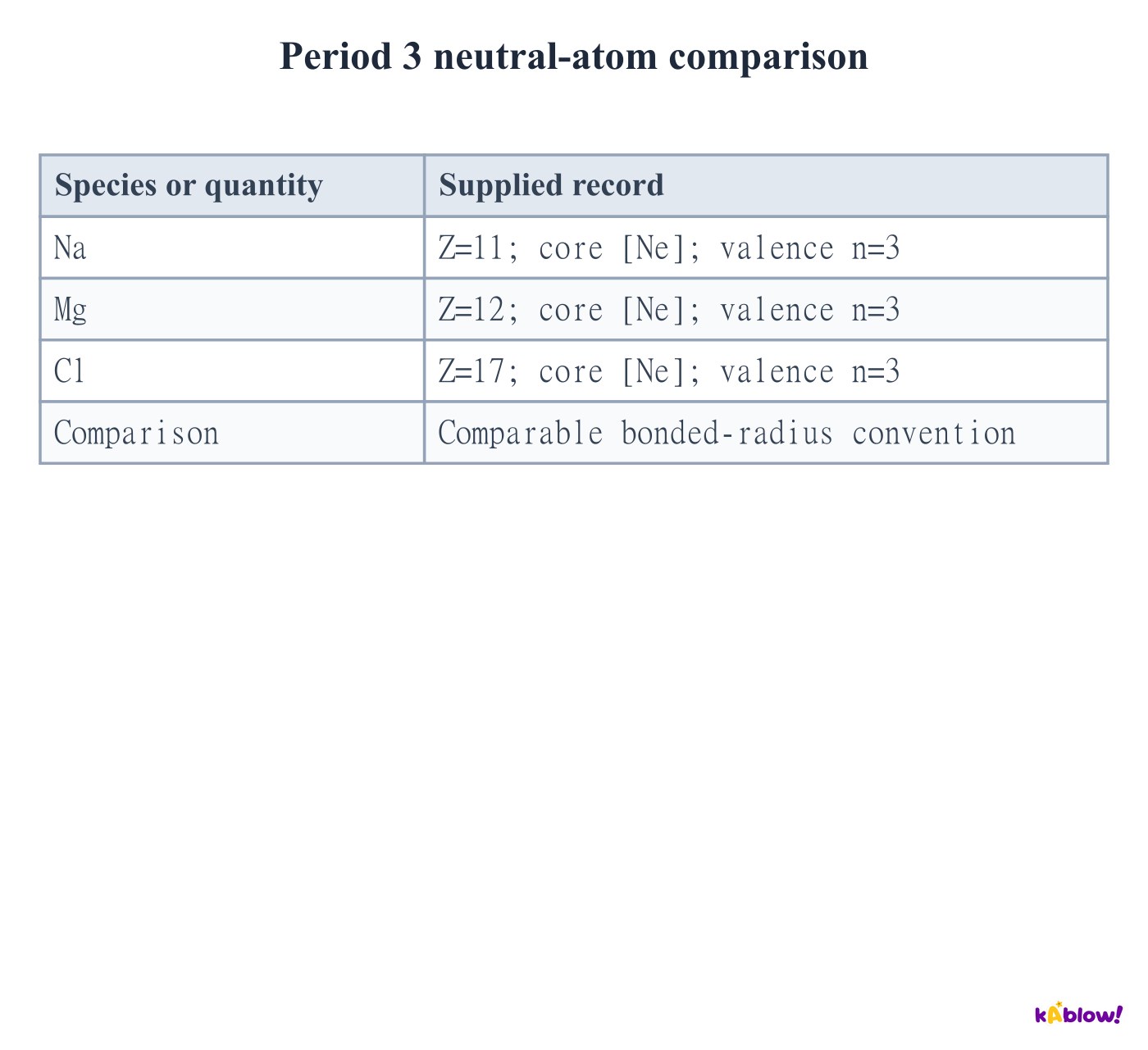
- From Na toward Cl, the increasing proton number increases nuclear attraction while the added electrons enter the same main shell.
- Inner-shell shielding remains approximately similar, so the outer electrons experience greater effective attraction and the comparable atomic radius generally decreases.
- Shielding is not exactly unchanged: same-shell electron repulsion also matters. The explanation needs nuclear charge, occupied shell and approximate shielding together.
Period 3 neutral-atom comparison
Explain why these cations are smaller
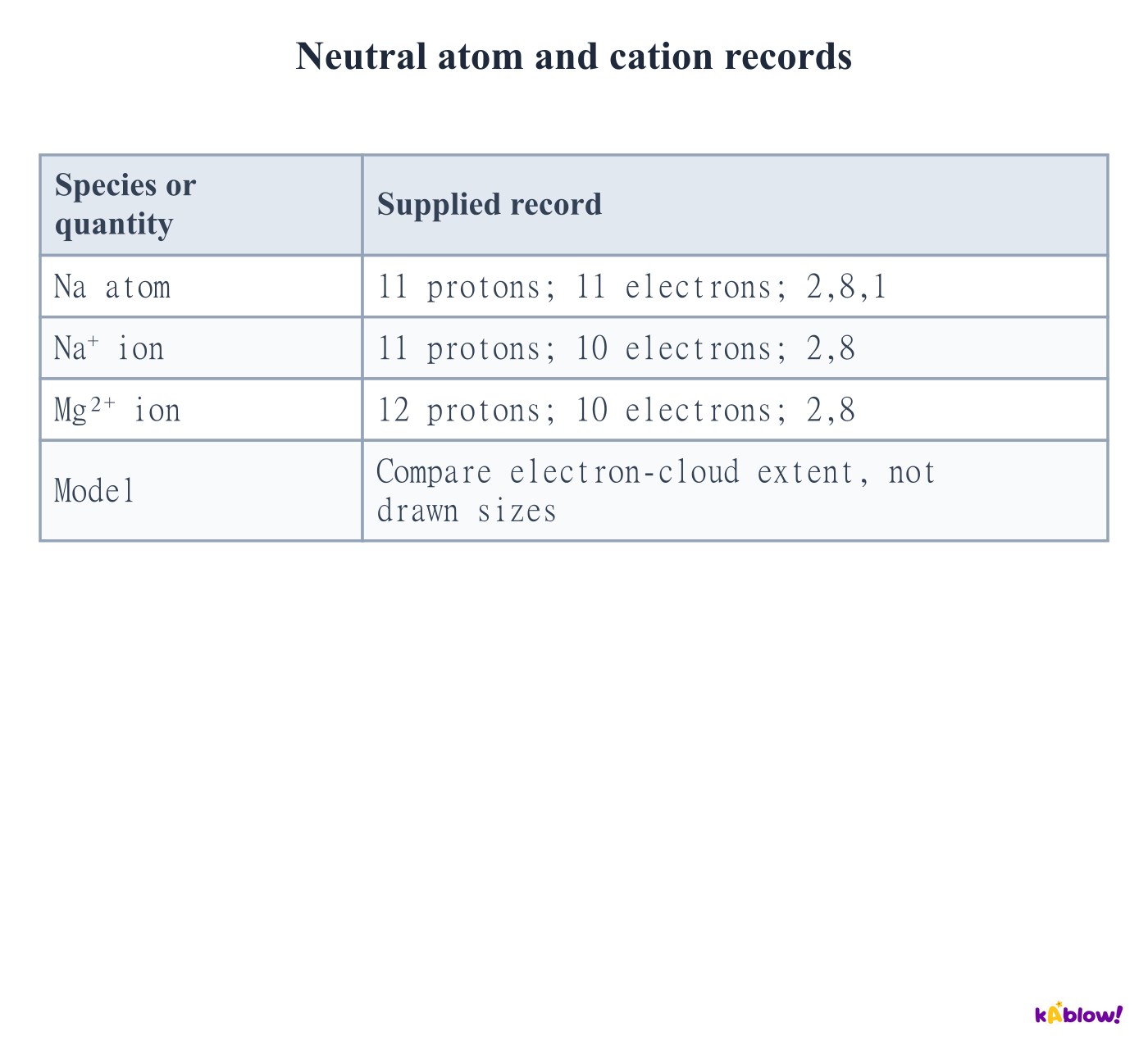
- Na loses its n=3 electron to form Na⁺, removing the occupied outer shell. The nuclear proton count stays 11.
- With fewer electrons and reduced electron repulsion, the remaining electrons are held more tightly. Similar reasoning applies to formation of Mg²⁺ and Al³⁺ from their atoms.
- An ion does not become smaller because its nucleus loses protons. Charge changes result from electron transfer in these examples.
Neutral atom and cation records
Explain why anions expand relative to their atoms
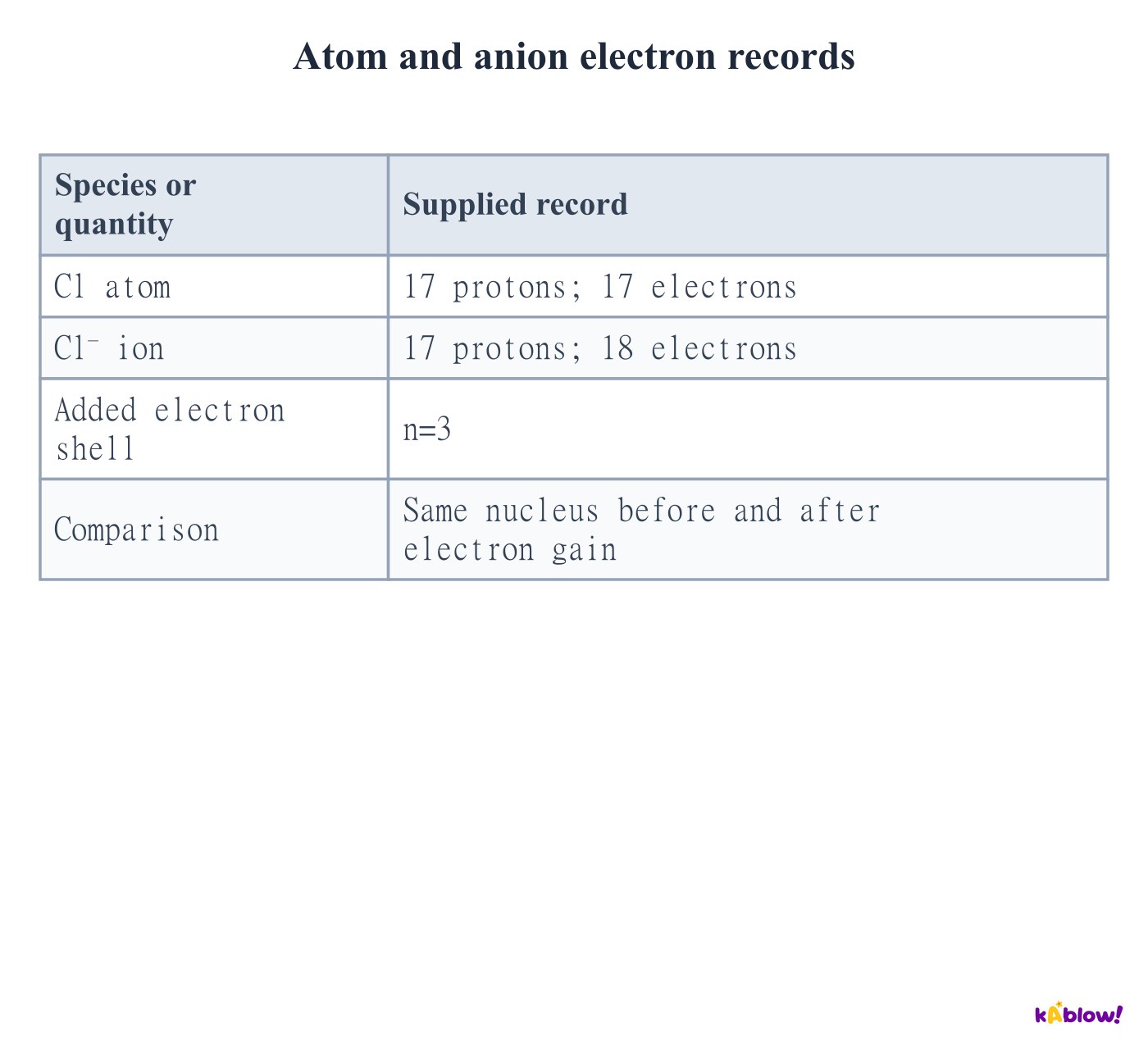
- Cl gains one electron to form Cl⁻ without changing nuclear charge. The added electron enters the existing n=3 valence shell.
- Increased electron–electron repulsion expands the electron cloud, so Cl⁻ is larger than the corresponding neutral atom in the appropriate comparison.
- Ionic radii depend on coordination and environment; quote a specified data convention when making numerical comparisons.
Atom and anion electron records
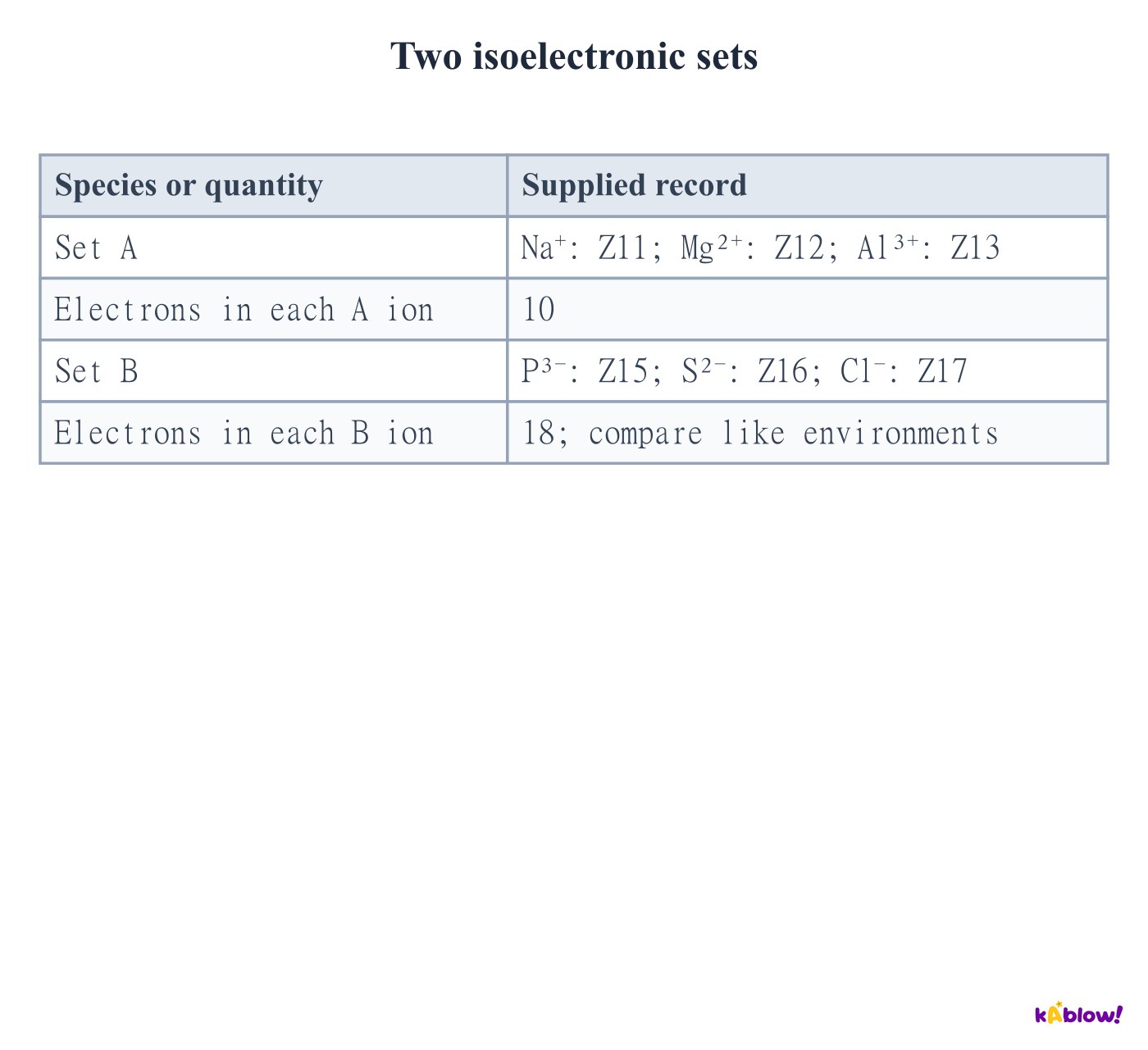
Compare radii within isoelectronic sets
- Isoelectronic species have the same electron number and arrangement in the simple model. Within Na⁺, Mg²⁺ and Al³⁺, increasing nuclear charge draws the same ten-electron cloud closer.
- The predicted radius order is Na⁺>Mg²⁺>Al³⁺. Within the formal 18-electron anion set, it is P³⁻>S²⁻>Cl⁻ under comparable conditions.
- Compare within a set rather than drawing one uninterrupted decrease across cations and anions. Simple Si⁴⁺ is not a common free aqueous ion and is unnecessary for this argument.
Two isoelectronic sets
Define first ionisation energy precisely
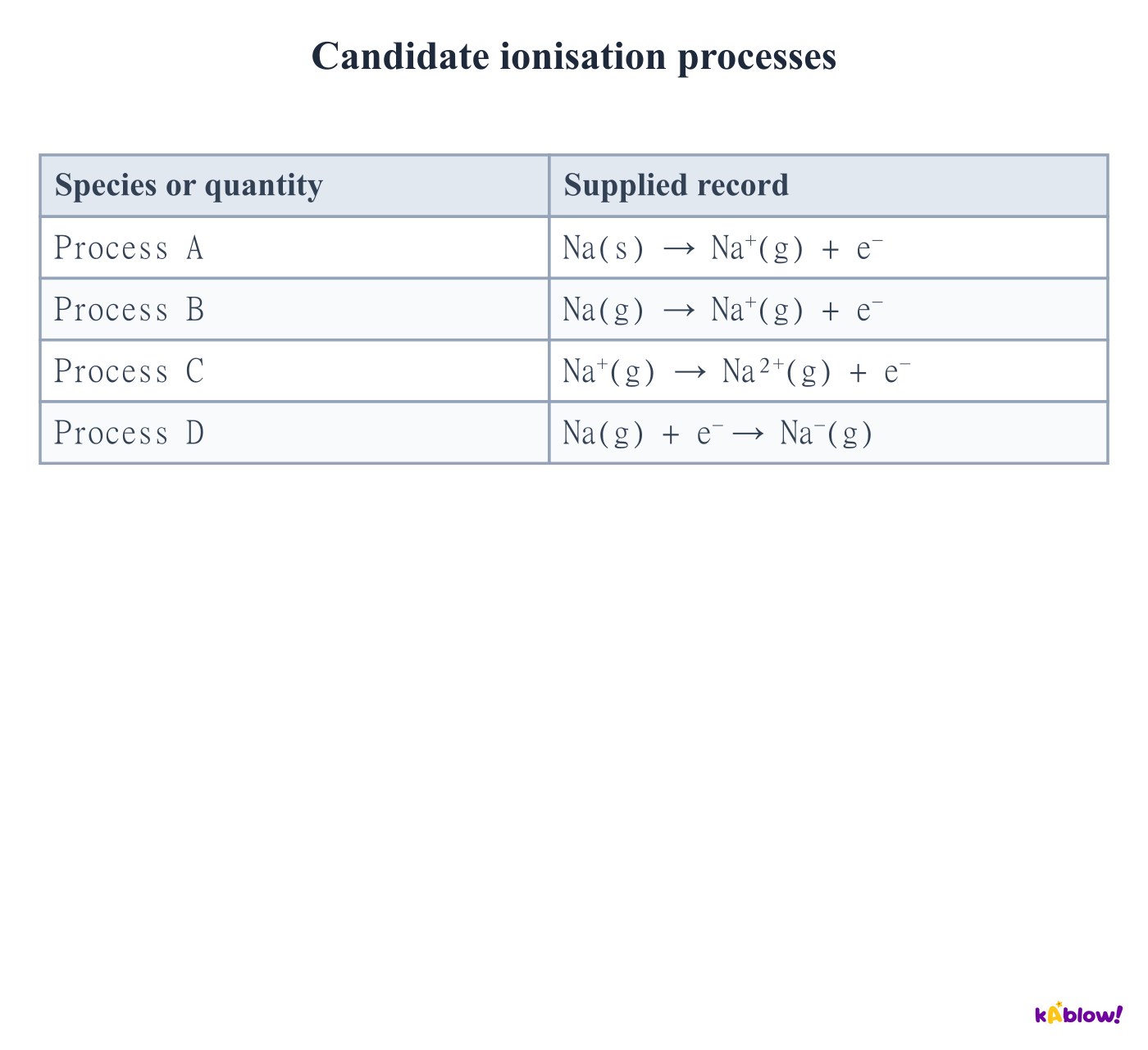
- First ionisation energy is the energy required to remove one mole of electrons from one mole of ground-state gaseous atoms, forming one mole of gaseous 1+ ions.
- The equation is X(g)→X⁺(g)+e⁻. The molar energy is positive because energy is supplied to overcome attraction.
- Gaseous atoms isolate the electron-removal process from melting, vaporisation or lattice effects. Removing an electron from an existing cation is a later ionisation.
Candidate ionisation processes
Read the general ionisation-energy trend
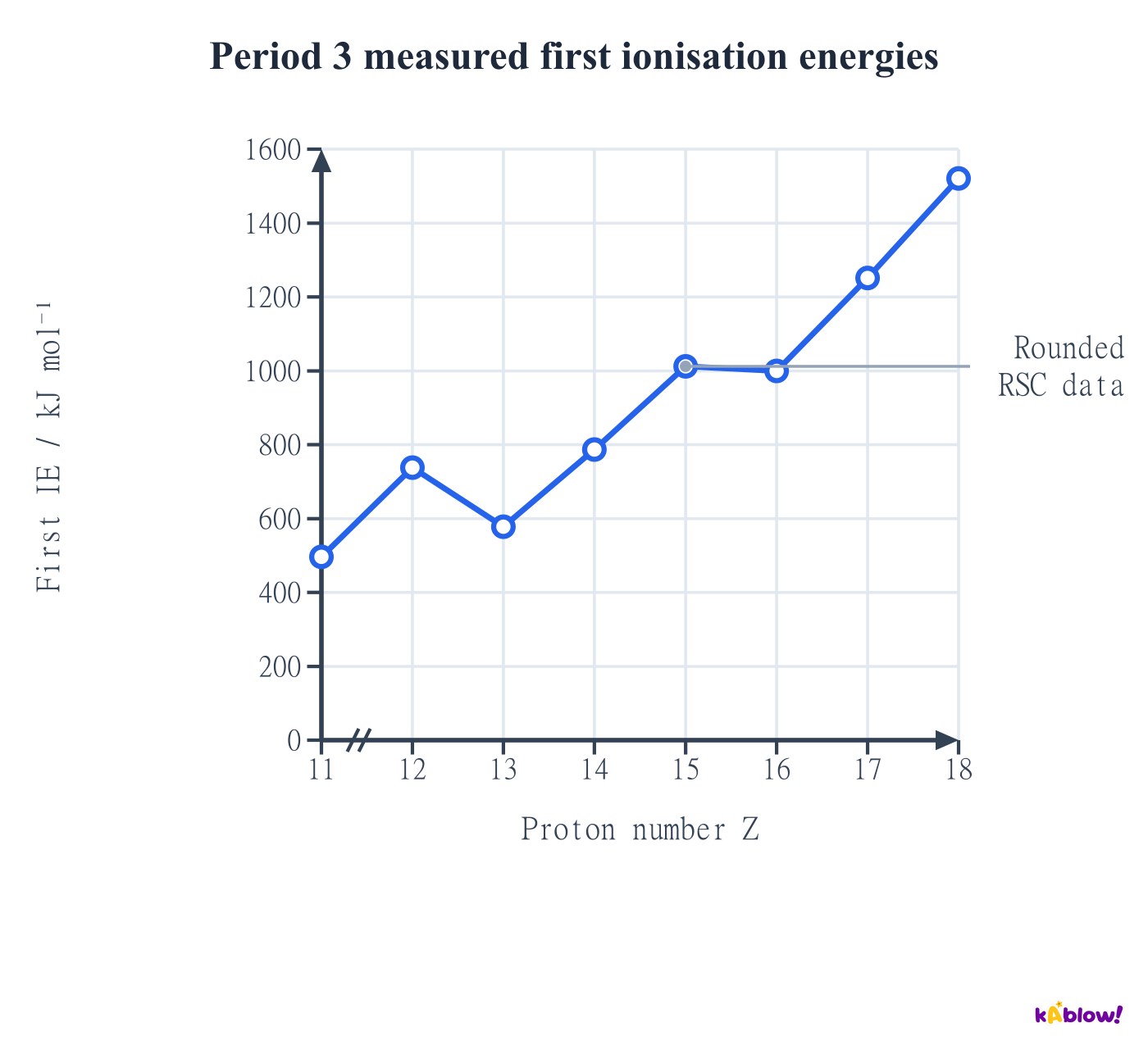
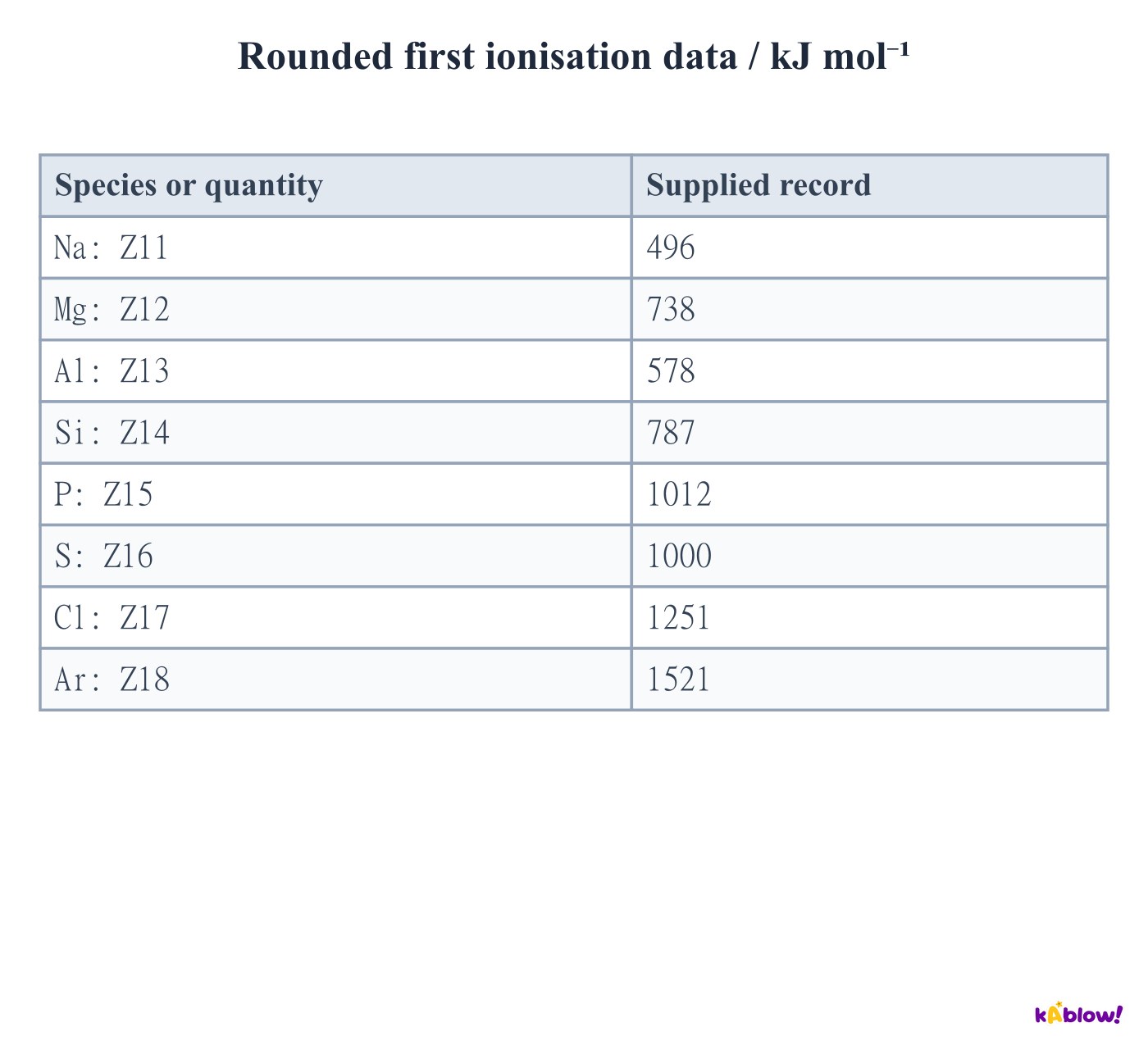
- The rounded RSC data plot uses Z=11–18 for Na, Mg, Al, Si, P, S, Cl and Ar. First ionisation energy generally rises across this period.
- Increasing nuclear charge with approximately similar inner shielding gives stronger attraction to the outer electron. The generally smaller radius also supports harder removal.
- The trend has two dips: Mg→Al and P→S. Explain those using subshell energy and electron pairing rather than ignoring them or inventing a new shell.
Period 3 measured first ionisation energies
Explain the Mg-to-Al dip with subshell energy
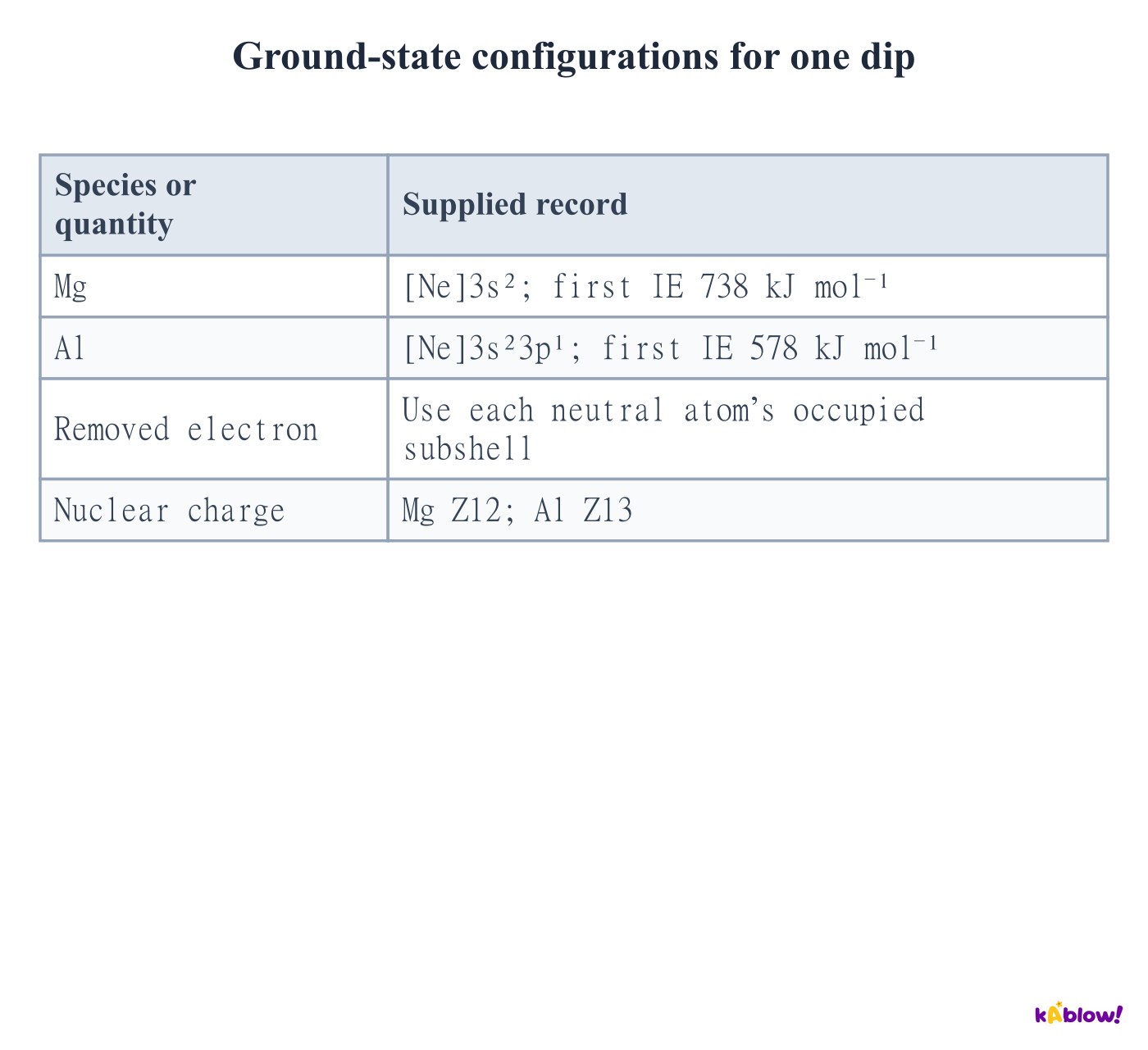
- Magnesium’s first electron is removed from 3s; aluminium’s is removed from the higher-energy 3p subshell.
- The 3p electron is easier to remove despite aluminium’s greater nuclear charge. Subshell energy and shielding outweigh the simple across-period expectation here.
- Both outer subshells belong to n=3. Saying aluminium gains an entirely new principal shell gives the wrong explanation.
Ground-state configurations for one dip
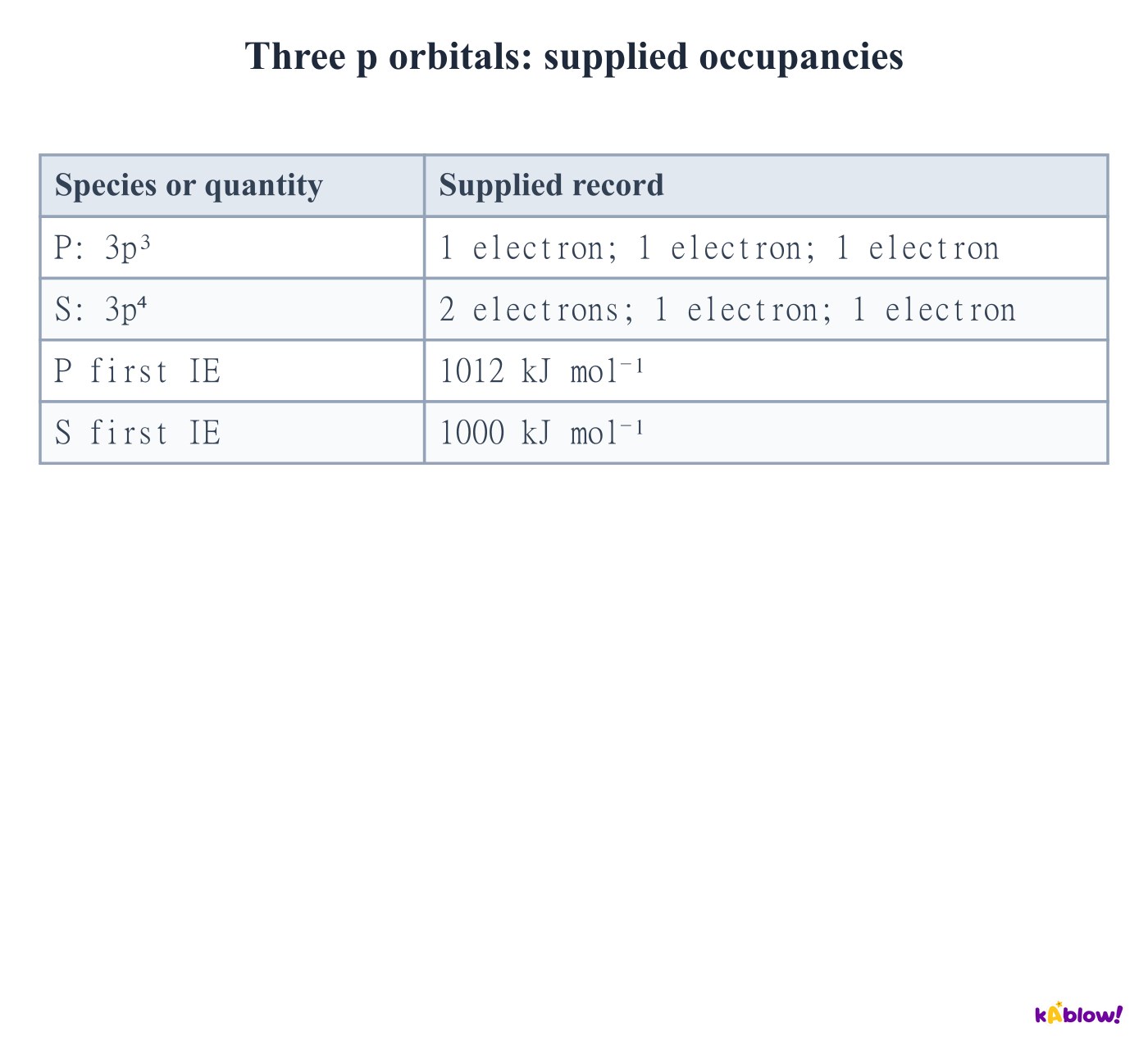
Explain the P-to-S dip with paired-electron repulsion
- Phosphorus has three singly occupied 3p orbitals in its ground state. Sulfur’s fourth 3p electron pairs with another electron in one orbital.
- Repulsion within the occupied pair makes one of sulfur’s paired electrons easier to remove. This gives sulfur a slightly lower first ionisation energy despite greater nuclear charge.
- The explanation concerns pairing within 3p, not the appearance of a new shell or a change from 3s to 3p at this step.
Three p orbitals: supplied occupancies
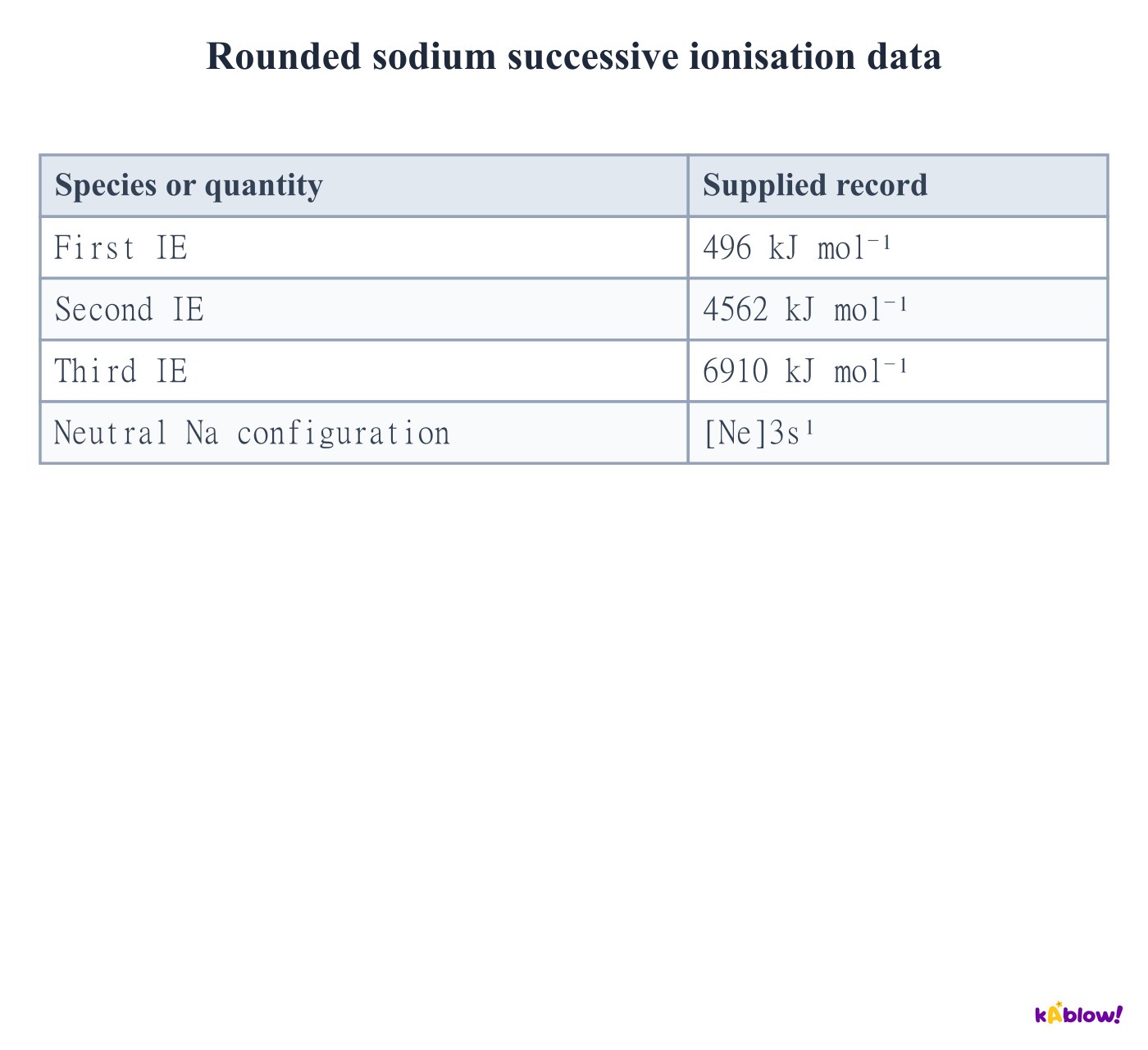
Connect a large successive-ionisation jump to the shell model
- Sodium’s first ionisation removes its 3s electron. The second removes an electron from the more strongly held inner [Ne] core of Na⁺.
- The large first-to-second jump supports one outer electron. The second equation is Na⁺(g)→Na²⁺(g)+e⁻, not a repetition of neutral-atom ionisation.
- These are successive energies for one element. Do not confuse them with a first-ionisation plot comparing different elements across a period.
Rounded sodium successive ionisation data
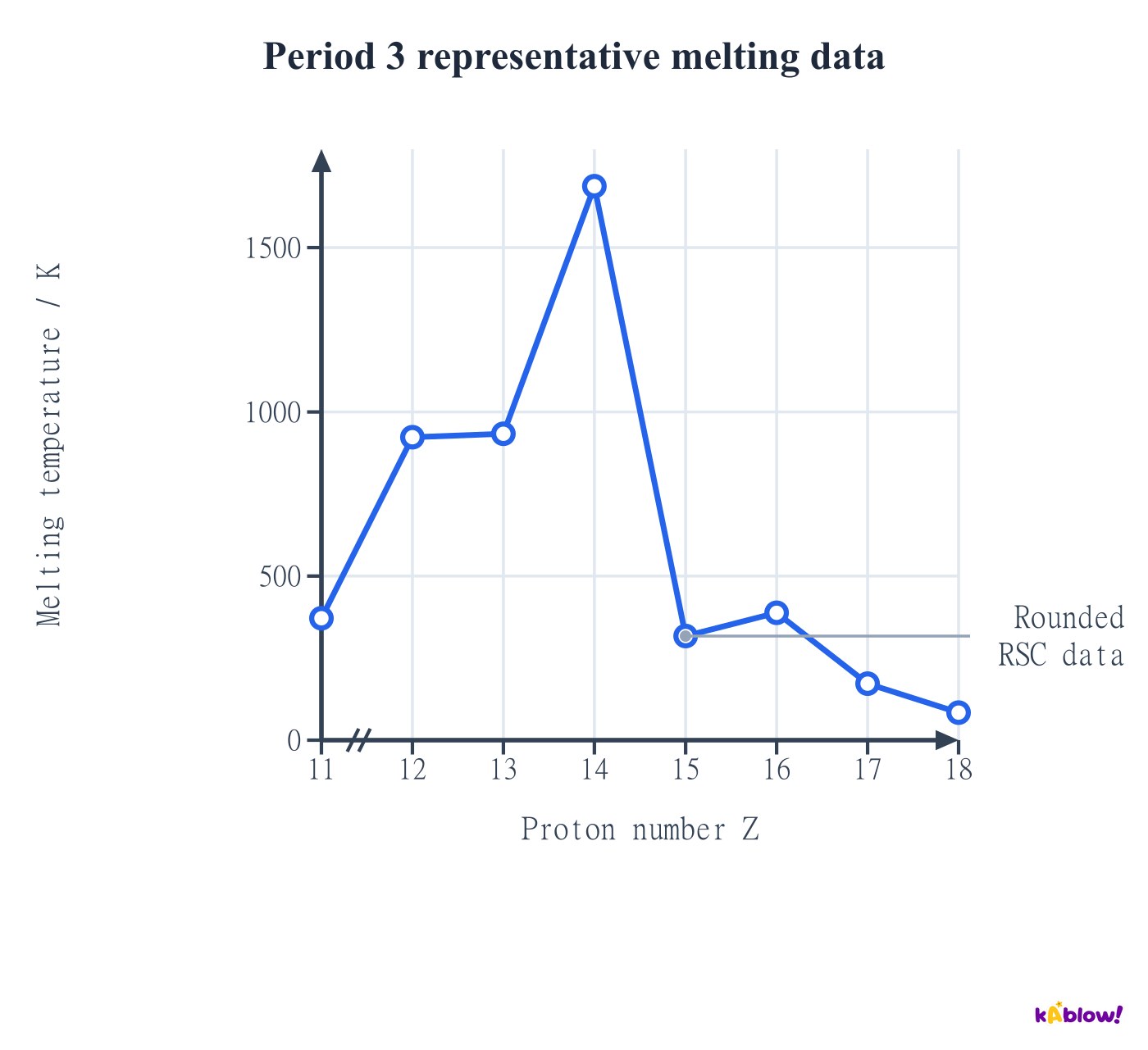
Relate melting data to changes of structure
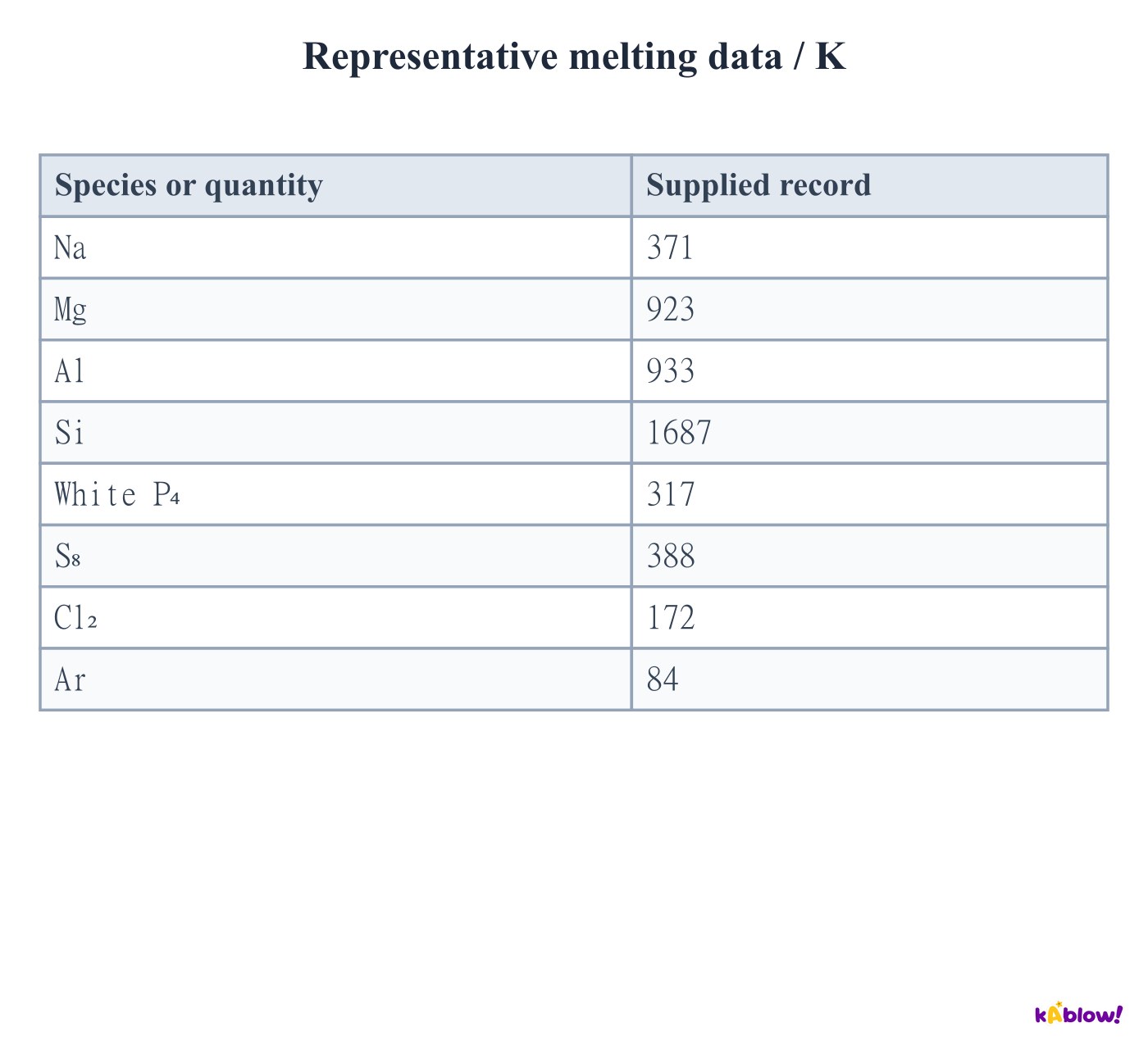
- The supplied rounded RSC data refer to representative elemental forms: Na371, Mg923, Al933, Si1687, white P317, S388, Cl172 and Ar84 K. Allotrope and conditions matter.
- Silicon has the highest value here; the drop from Si to molecular white phosphorus is large. A single atomic-radius explanation cannot account for this whole pattern.
- A good explanation identifies structure, the attractive interactions weakened on melting and their relative strength. Use the supplied numbers rather than mixing datasets.
Period 3 representative melting data
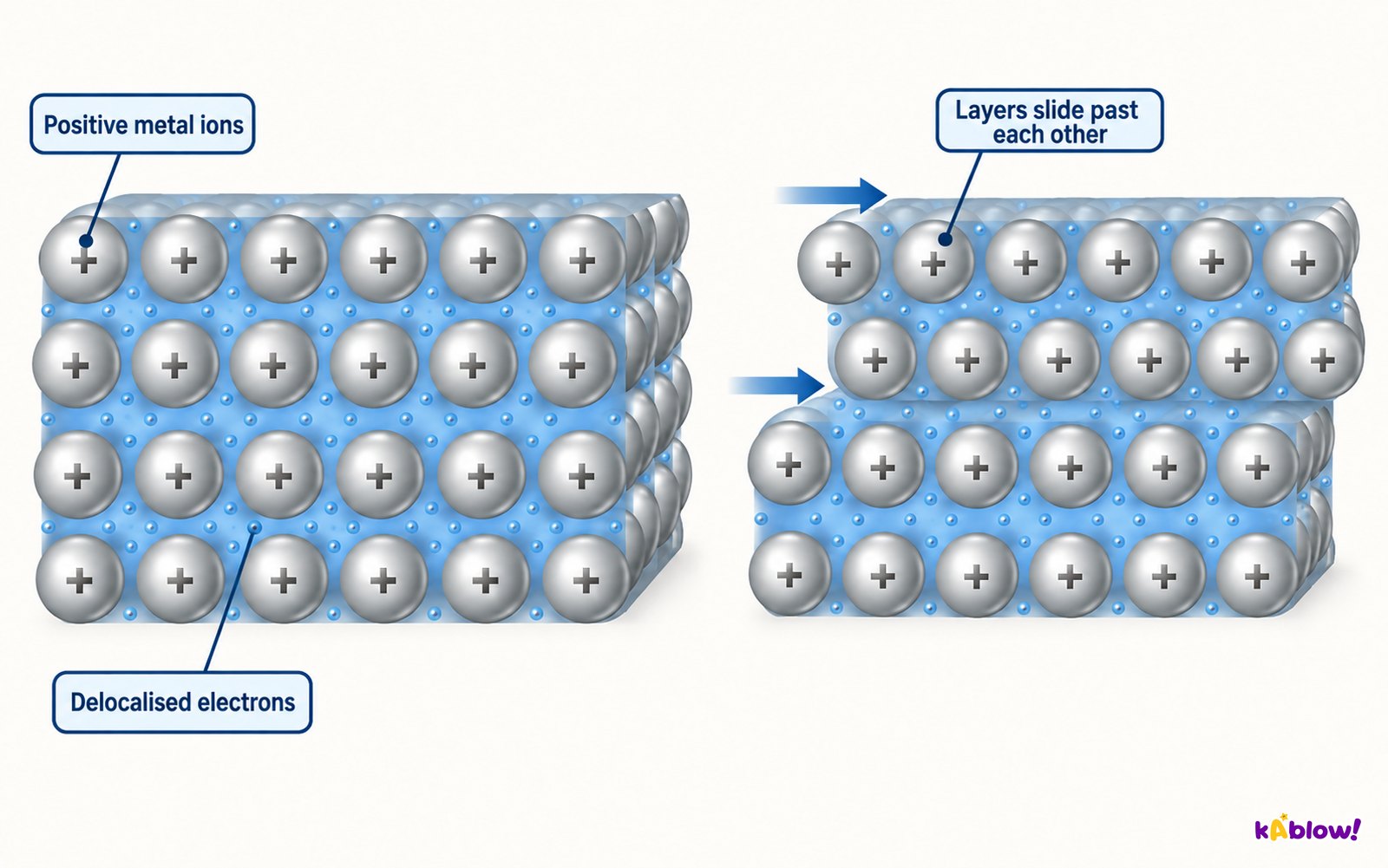
Explain the metallic segment Na to Al
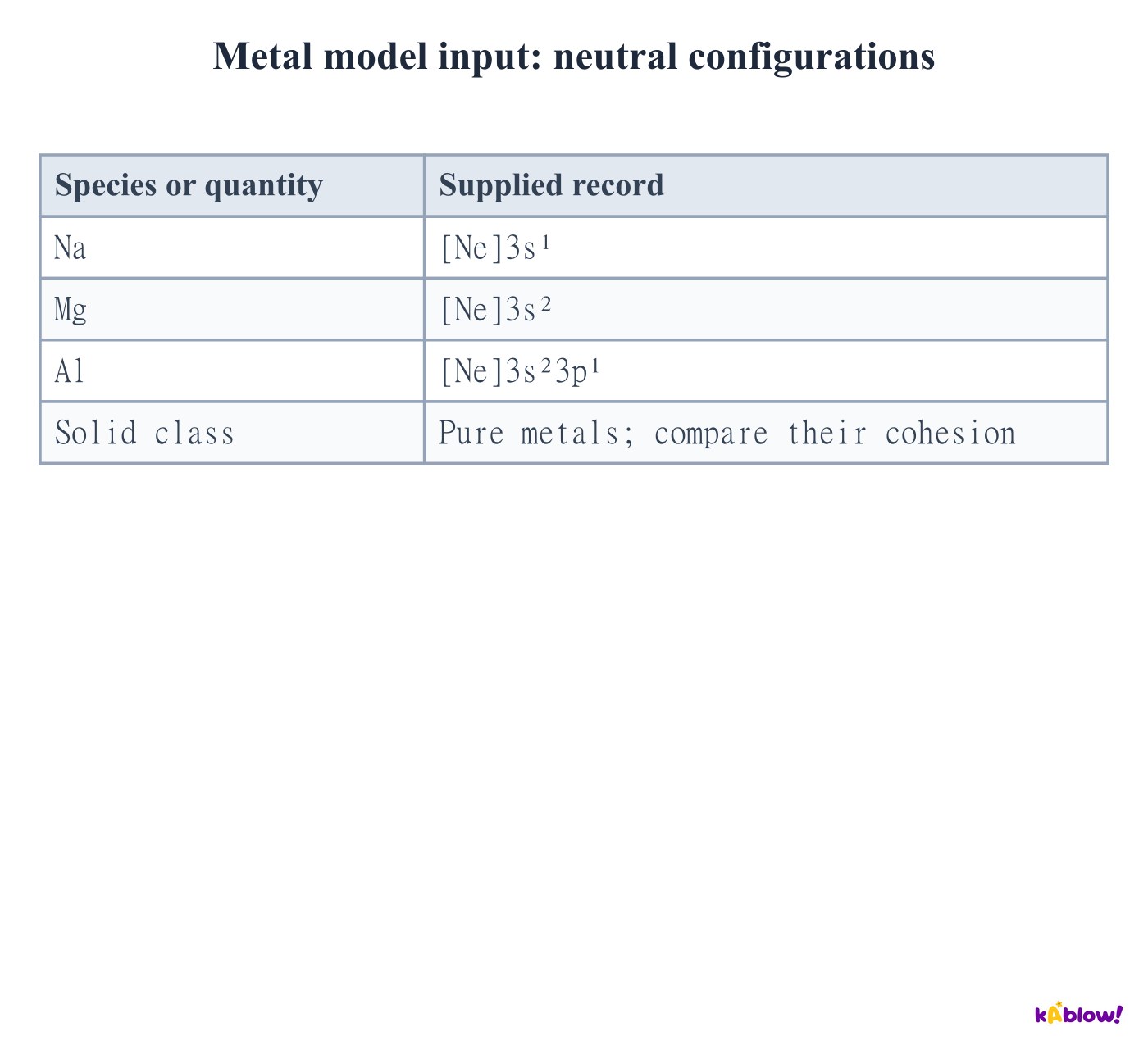
- Na, Mg and Al have giant metallic structures with positive ionic cores and delocalised electrons. Electrostatic attraction holds the metal together.
- Across these three examples, greater positive core charge, more delocalised valence electrons per atom and smaller core size strengthen metallic cohesion overall. Their melting temperatures rise.
- The model is not a lattice of isolated neutral molecules. Metallic melting points across the entire Periodic Table cannot be predicted from valence-electron count alone.
Metallic cohesion during slip
Explain silicon’s high melting temperature
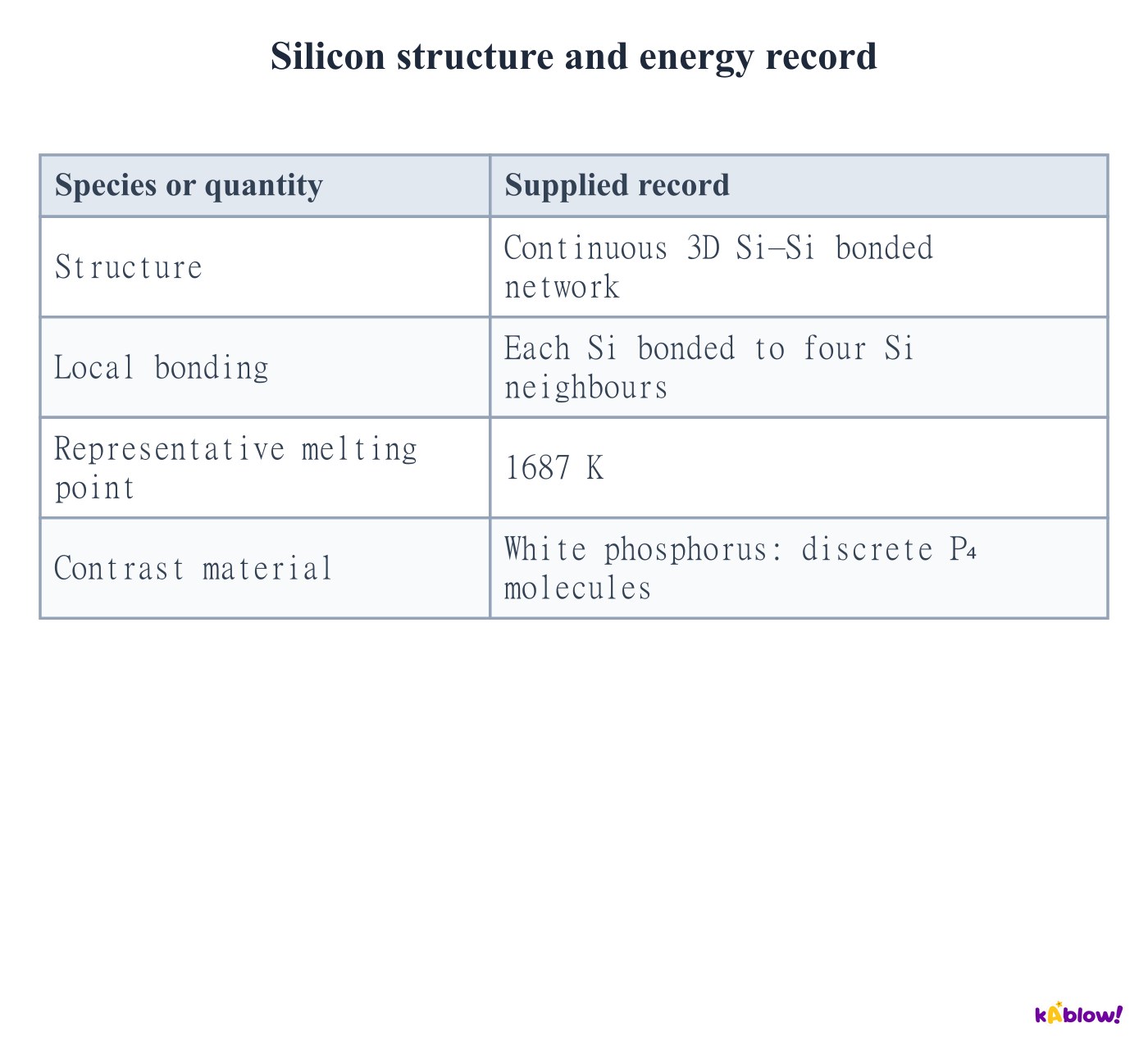
- Silicon has a giant covalent network in which each Si atom is covalently bonded to four neighbours. It is not a collection of separate Si₄ molecules.
- Melting requires substantial disruption of the extended strong covalent network, so a large energy input is needed compared with melting a molecular elemental solid.
- A high melting point alone does not establish ionic bonding: the structure and the kind of attraction must also be identified.
Silicon structure and energy record
Separate molecular particles from monatomic argon
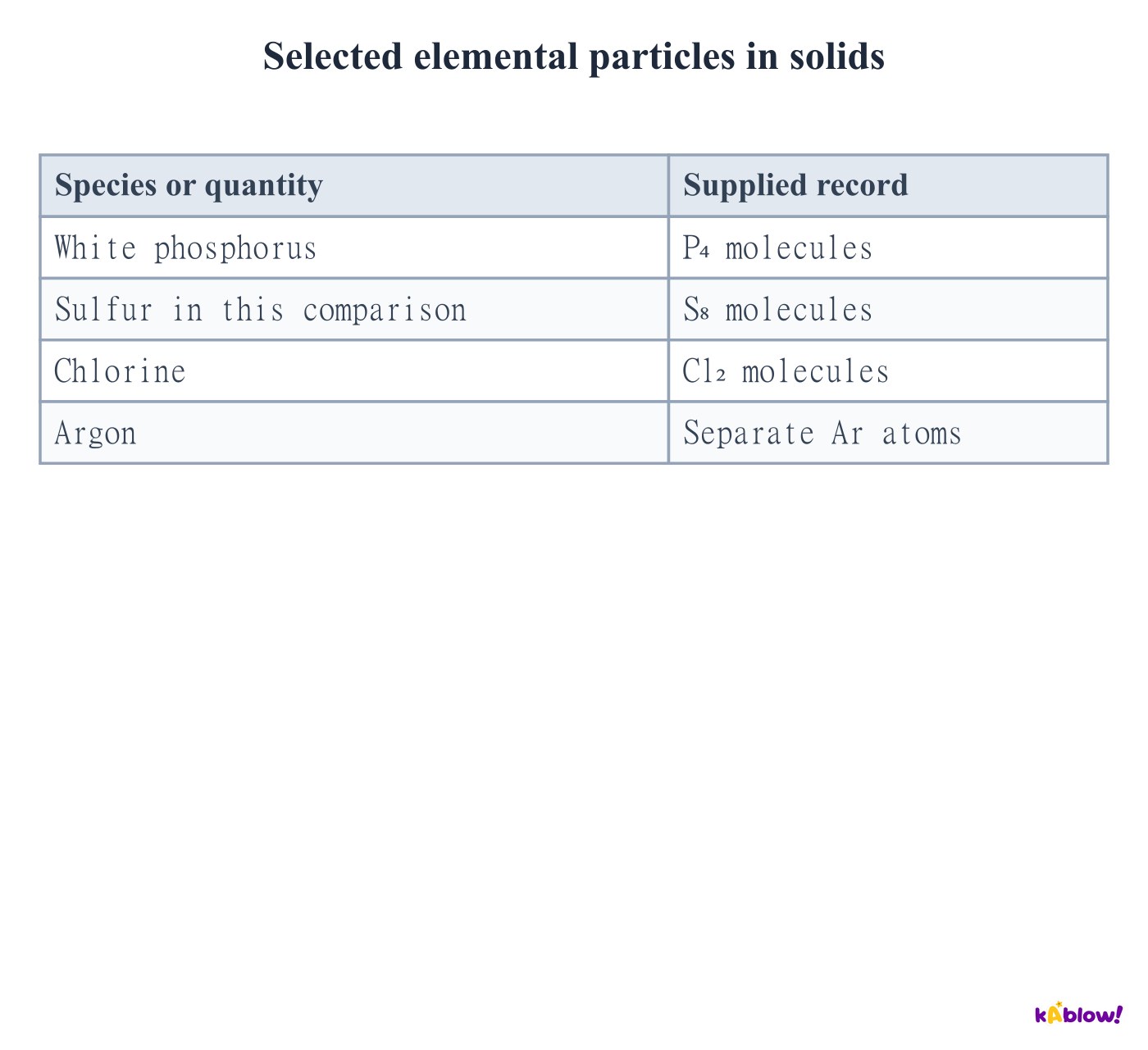
- White phosphorus consists of P₄ molecules, sulfur here of S₈ molecules and chlorine of Cl₂ molecules. Strong covalent bonds hold each molecule together.
- Argon is monatomic; calling it a simple molecule is inaccurate. Both atomic Ar and these nonpolar molecules experience London dispersion attractions between particles.
- Melting these molecular solids primarily weakens intermolecular attractions while the molecules remain intact. Red and black phosphorus have different structures from white P₄.
Selected elemental particles in solids
Use dispersion forces without reducing everything to mass
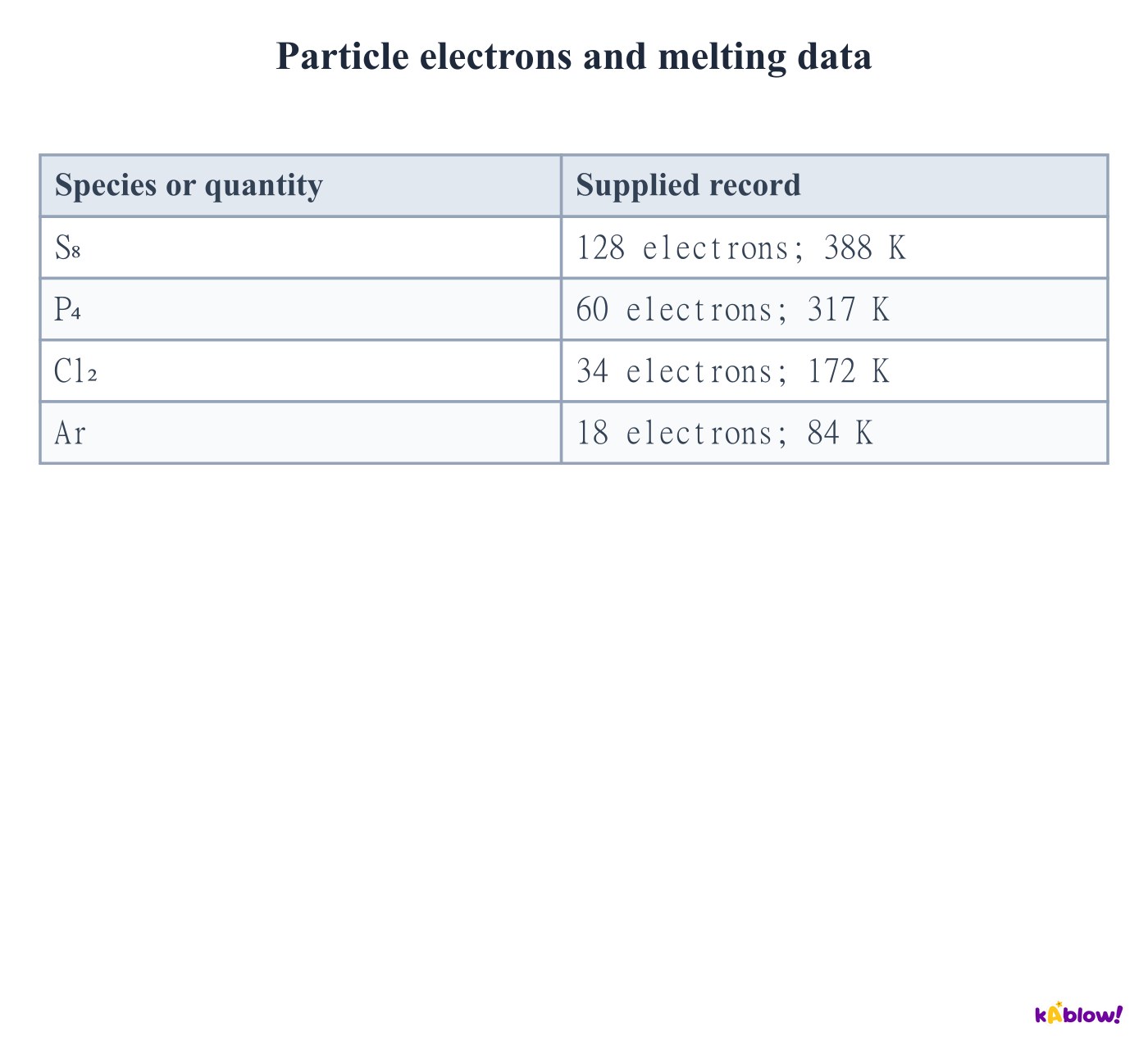
- In this selected set, S₈ has a larger, more polarizable electron cloud than P₄, Cl₂ or Ar, supporting stronger dispersion attractions between its particles.
- The supplied melting temperatures follow S₈>P₄>Cl₂>Ar. These are interparticle attractions, not a claim that every individual S–S bond is stronger than every P–P bond.
- Shape, contact and crystal packing also affect melting. Electron count or relative mass alone is not a universal melting-point formula.
Particle electrons and melting data
Explain why argon has high first IE but low melting point
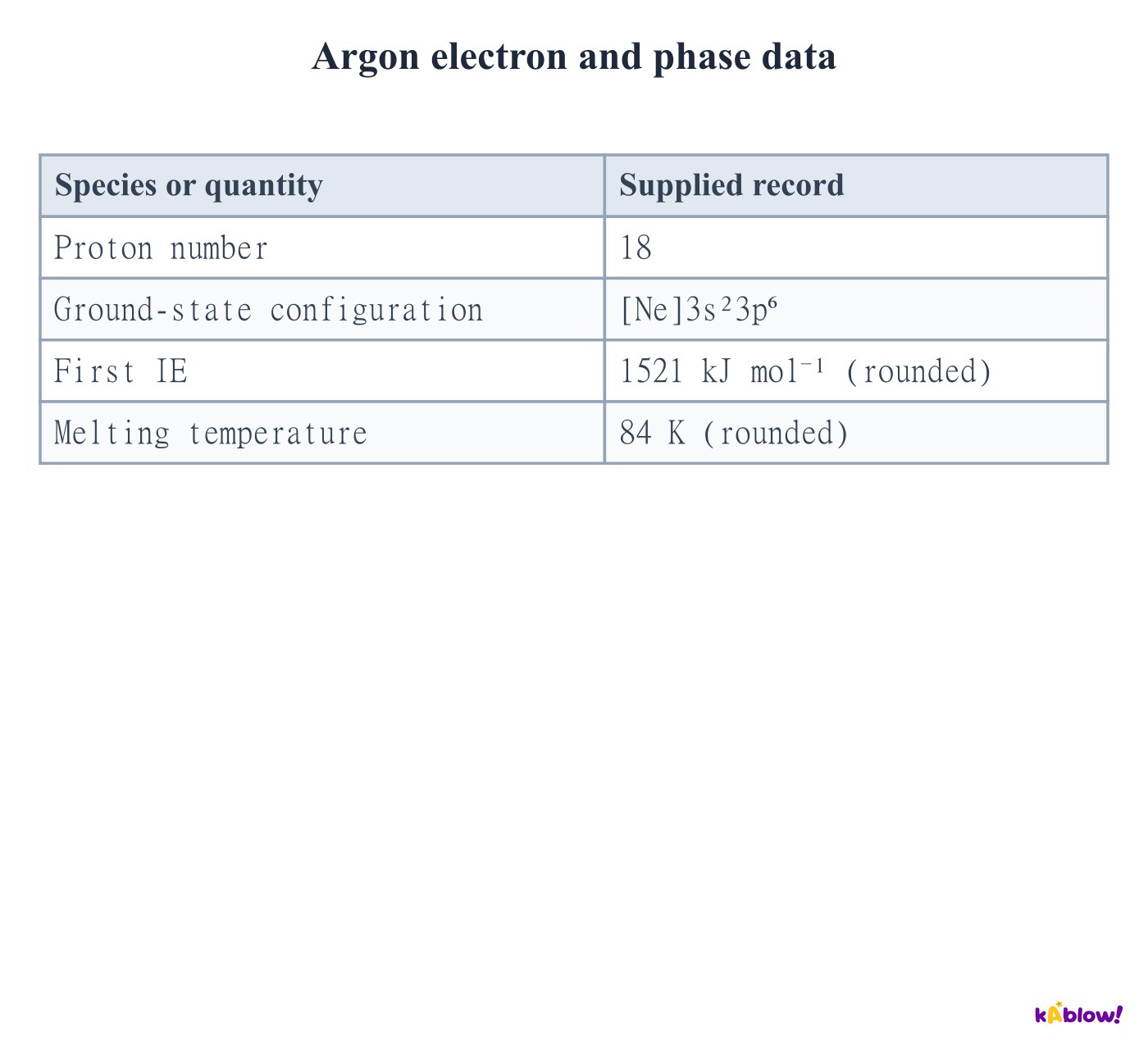
- Removing an electron from a gaseous argon atom requires a large energy because of strong nuclear attraction to its filled valence shell.
- Melting solid argon separates neighbouring atoms against comparatively weak dispersion attractions. It does not require removal of their electrons.
- Different measured properties involve different processes. High first ionisation energy therefore does not imply a high melting temperature.
Argon electron and phase data
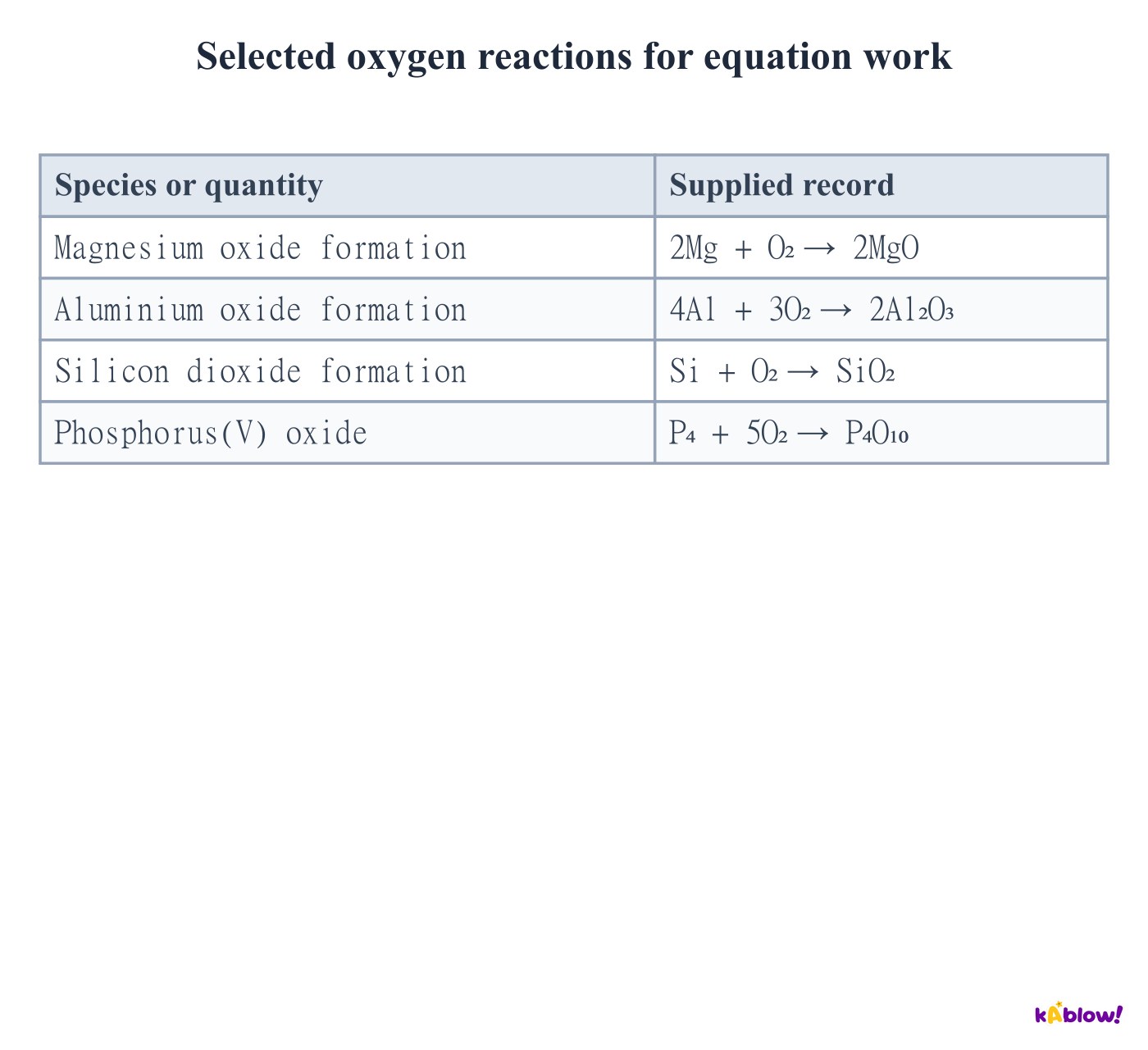
Use selected oxygen reactions as chemical context
- The supplied equations conserve each element. Magnesium and aluminium form metal oxides; silicon forms the extended covalent oxide SiO₂.
- In sufficient oxygen, P₄+5O₂→P₄O₁₀ describes phosphorus(V) oxide formation. Sulfur combustion commonly forms SO₂.
- Products and observations depend on conditions. Sodium can form different oxygen compounds, so Na₂O must not be presented as its only possible oxygen product.
Selected oxygen reactions for equation work
Avoid treating every chlorine compound as ionic
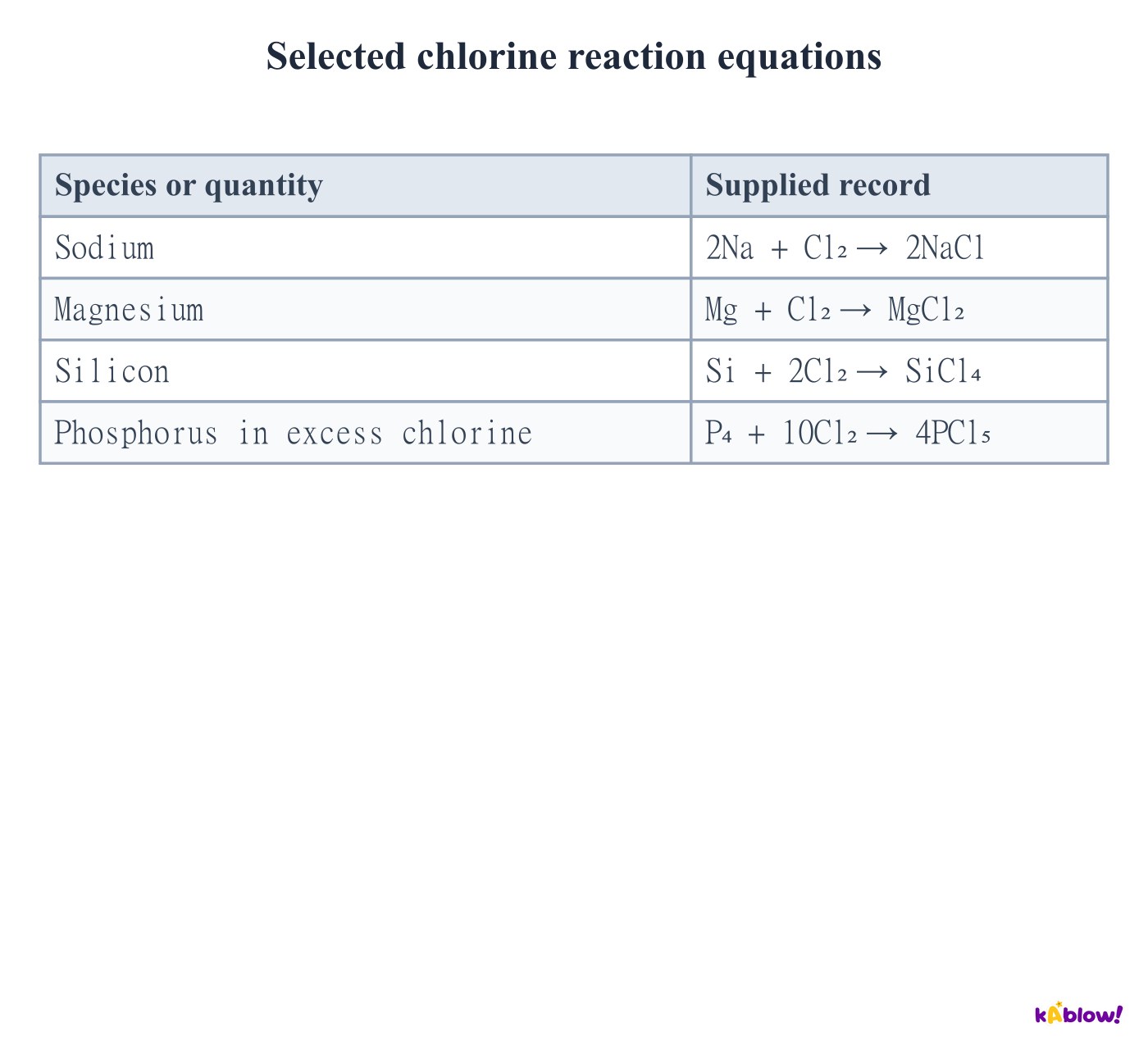
- Sodium chloride and magnesium chloride provide familiar ionic-solid examples. Their formulas follow charge balance for Na⁺ or Mg²⁺ with Cl⁻.
- Silicon tetrachloride is a molecular covalent compound; the formula SiCl₄ does not establish a lattice of free Si⁴⁺ ions.
- Chlorination products depend on the reagent conditions. Aluminium chloride has substantial covalent character, and phosphorus can form different chlorides; use the specified equation.
Selected chlorine reaction equations
Compare sodium and magnesium with water
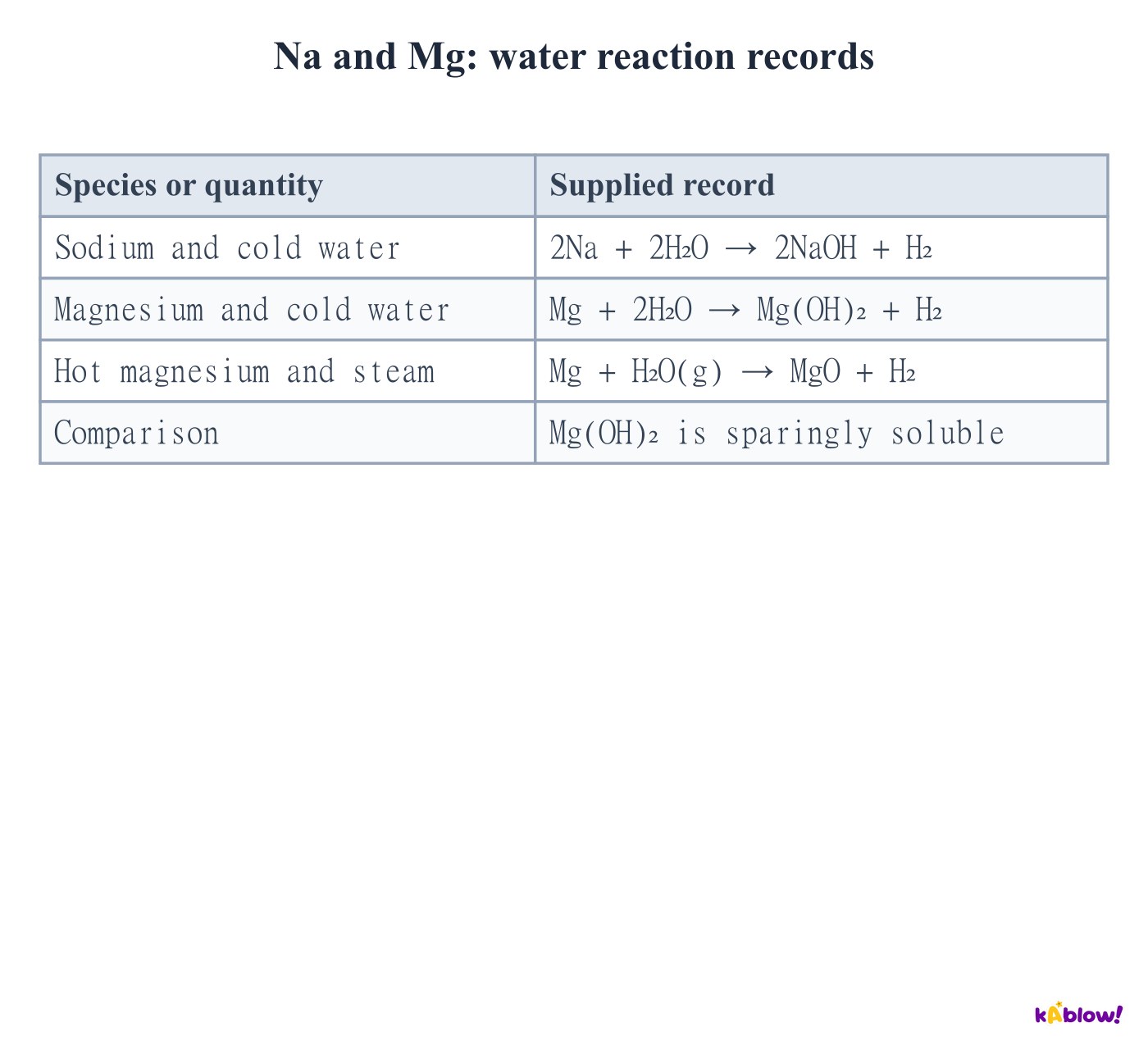
- Sodium reacts vigorously with cold water, producing sodium hydroxide and hydrogen. The resulting solution is alkaline, but its pH depends on concentration and temperature.
- Magnesium reacts very slowly with cold water; sparingly soluble Mg(OH)₂ and a surface layer affect the observed reaction. Do not label all the hydroxide as dissolved.
- Heated magnesium reacts with steam to give MgO and hydrogen. The different conditions produce a different oxide/hydroxide product, so include conditions in an equation answer.
Na and Mg: water reaction records
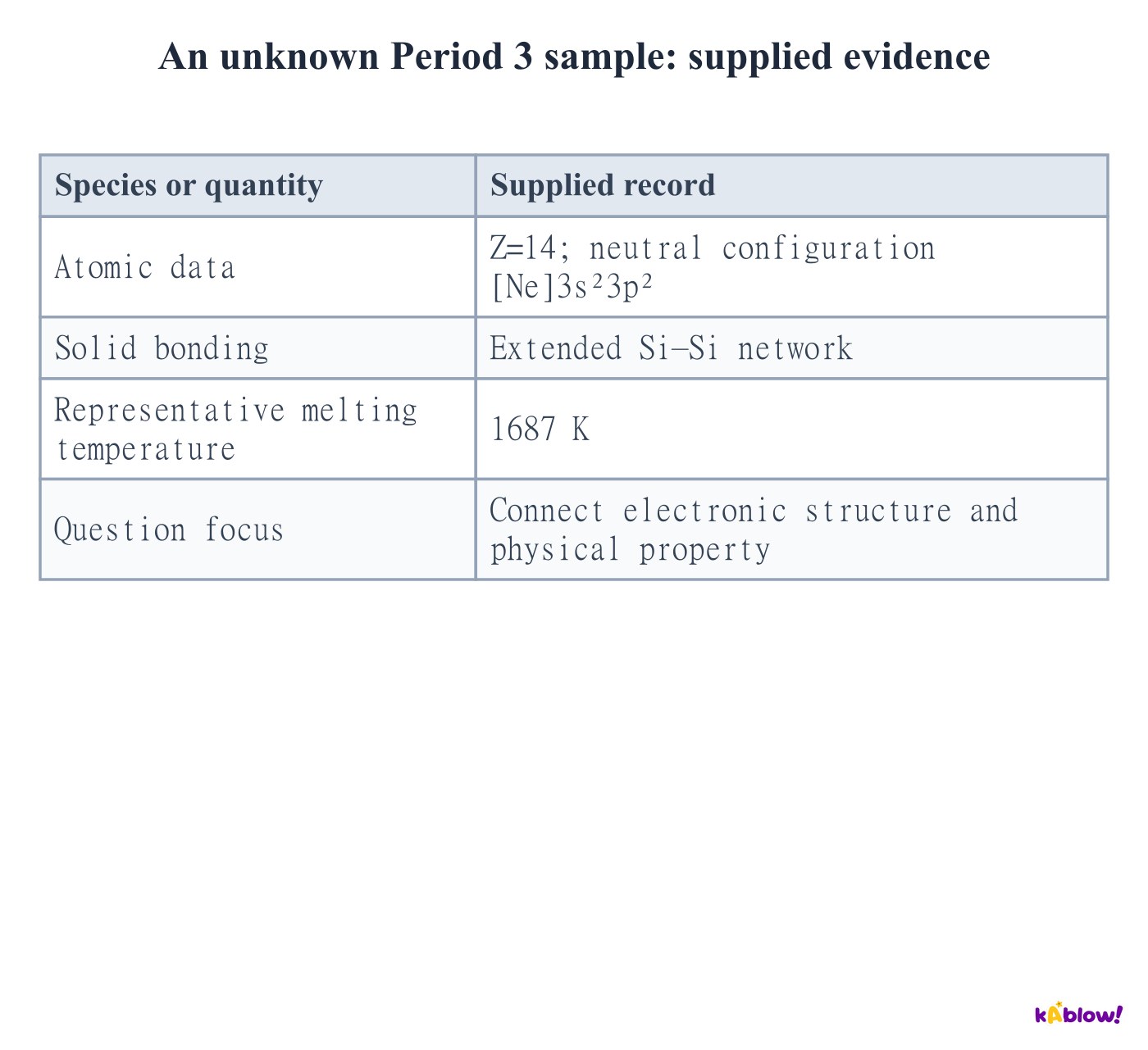
Build a complete explanation from structure and evidence
- Start by identifying the relevant process: atomic size, removal of an electron or melting of a solid. They require related but distinct explanations.
- For an ionisation dip, identify the subshell or paired electron. For a melting comparison, identify giant metallic, giant covalent, molecular or monatomic structure and the attraction involved.
- Use the supplied data and qualify conditions or allotropes. A statement such as more protons means every property rises cannot explain the observed Period 3 changes.
An unknown Period 3 sample: supplied evidence
स्लाइड्स
Sign up free to view the lesson slides
Step through every slide for this topic — plus flashcards and revision notes — with a free account.
प्रैक्टिस सवाल
फ्री प्रीव्यू — 60 में से 8 सवाल। सभी देखने के लिए साइन अप करें।
1.In which order should the supplied elements appear across a period?
Medium- AX, Y, Z
- BZ, Y, X
- CY, X, Z
- DOrder cannot use proton number
2.Which modern group contains atom C?
Medium- A3
- B17
- C7 only, with no modern equivalent
- D18
3.Which supplied atom is a p-block example?
Medium- AA
- BC
- CB
- DD
4.How many electrons occupy the outer shell of the supplied neutral-atom model?
Medium- A2
- B8
- C14
- D4
5.What radius follows from the supplied covalent measurement?
Medium- A0.120 nm
- B0.240 nm
- C0.480 nm
- D0.0600 nm
6.Why does the comparable atomic radius generally decrease from Na toward Cl?
Medium- AA new occupied shell is lost at every step
- BNuclear attraction increases with approximately similar inner shielding
- CThe number of protons decreases
- DEvery atom loses all its outer electrons
7.Which change occurs when Na forms Na⁺?
Medium- AThe nucleus loses one proton
- BA fourth shell is occupied
- CThe n=3 electron is removed
- DA neutron becomes an electron
8.What changes when the supplied atom forms its anion?
Medium- AProton number rises to 18
- BAn entire n=4 shell must be added
- CThe nuclear charge becomes negative
- DElectron number rises while proton number stays fixed
Unlock all 60 questions, flashcards & more
इस टॉपिक के हर सवाल, स्लाइड्स, फ्लैशकार्ड और रिवीज़न नोट्स देखने के लिए फ्री अकाउंट बनाएं।