
Textiles and fashion
खेलकर सीखें
इन सवालों के जवाब देकर एनर्जी कमाएं, फिर मछली पकड़ें और घूमें। कोई अकाउंट नहीं चाहिए।
शिक्षकों के लिए: Textiles and fashion (Art and Design, Materials and Processes) के लिए इस्तेमाल के लिए तैयार लेसन स्लाइड्स, रिवीज़न नोट्स — इन्हें अपने लेसन में इस्तेमाल करें, या टॉपिक को एक इंटरैक्टिव क्लास एक्टिविटी की तरह चलाएं जिसे आपके शिक्षार्थी लाइव गेम की तरह खेलें।
लेसन नोट्स
Surface, structure and manipulation
- Appliqué attaches fabric shapes to a base, often by stitching; embroidery makes decorative marks with needleworked thread. Patchwork joins fabric pieces; quilting stitches through layers, commonly including wadding. One item can combine these processes.
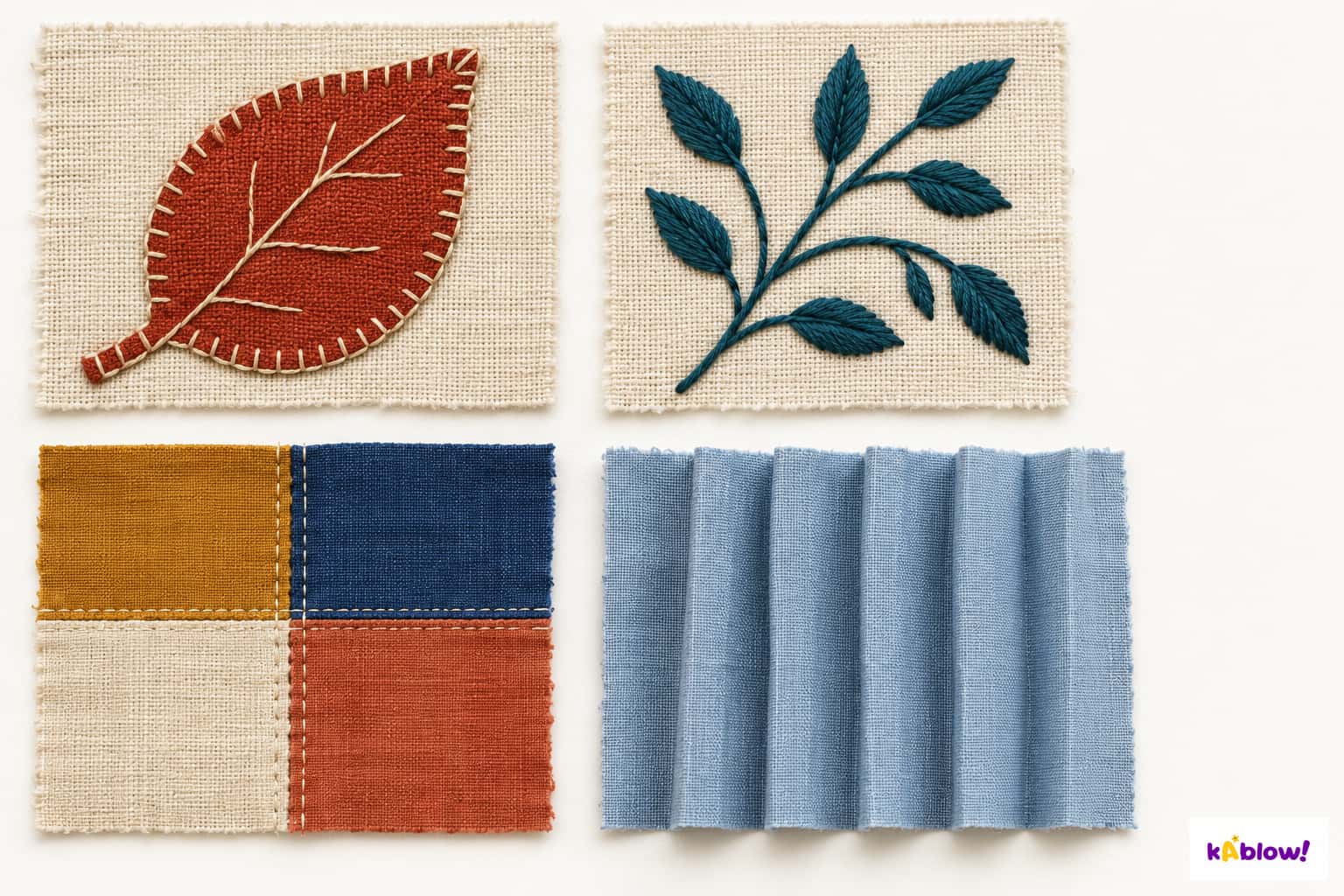
- The original sampler shows appliqué, embroidery, patchwork and pleating. Pleats make folds in cloth; gathering and smocking provide other manipulations. The samples are illustrative teaching artwork rather than named designers’ work or real student submissions.
Compare four textile studies
Other textile processes
- Weaving interlaces thread systems such as warp and weft; knitting forms connected loops. Felting mats suitable fibres: wet and needle felting use distinct processes, so water and soap do not define every kind.
- Batik uses wax resist; tie-dye uses binding to restrict dye access. Printing, painting and mixed-media methods can also work with compatible fabric. Study specific cultural traditions through named sources rather than treating all patterns as interchangeable.
Develop and test a garment
- Drawings, samples, pattern development and draping can inform each other. A toile is a trial garment or part; choose test cloth appropriate to the fit, drape or construction being investigated. Patterns may be paper or digital.
- Plan seams, fastenings, movement and finishing for the intended wearer or display. Revise after testing rather than treat the sequence as fixed. Ready-to-wear uses standard sizes; haute couture is a specific designated French system, not simply any expensive made-to-measure clothing.
Iterate a garment proposal
Practitioner references and context
- Dior’s first collection in 1947 became associated with the nickname New Look, including the Corolle and En 8 lines. Quant is a key figure in the 1960s British miniskirt story, while Westwood’s early work offers punk references. Choose a specific design and investigate its context.
- Miyake’s PLEATS PLEASE uses garment pleating. Albers’s weaving and printmaking show why artists cannot be confined to one medium; Perry’s The Vanity of Small Differences offers a narrative tapestry reference. Analyse a chosen feature and develop a personal response instead of copying an entire work.
Develop a sourced enquiry
Environmental decisions with limitations
- Consider sourcing, processing, cutting waste, longevity, repair, care and end-of-use together. Suitable recovered cloth, efficient cutting and repairable construction can address particular impacts, depending on what the garment replaces and how it is used.
- Recycled polyester still needs processing and can release microfibres. Natural or organic fibres also have resource demands. Explain a material choice against the intended function and acknowledge uncertainty rather than label any fabric impact-free.
Evaluate material and use
Taught studio procedures
- Use the specified equipment and supervision for sewing machines, scissors, pins, irons and any heat-setting. Keep pins and needles accounted for and follow the taught method for adjustments and storage.
- Dyes, wax and adhesives need compatible materials and product instructions. This lesson compares processes; it does not provide an independent hot-wax, chemical-dye or machine-operation recipe.
Follow the studio system
Evaluate from samples
- Record what each sample tests, the material used and the observed result. Explain how a stitch, seam, fastening or manipulation serves the intention rather than simply listing techniques.
- A sample can reveal a local property but cannot prove every full-garment fit or lifetime outcome. Identify what further testing or revision would make the decision stronger.
Write a useful sample evaluation
स्लाइड्स
Sign up free to view the lesson slides
Step through every slide for this topic — plus flashcards and revision notes — with a free account.
प्रैक्टिस सवाल
फ्री प्रीव्यू — 33 में से 8 सवाल। सभी देखने के लिए साइन अप करें।
1.What is appliqué?
Easy- Aattaching fabric shapes to a base fabric, often by stitching
- Bwax and dye
- Cweaving
- Dknitting
2.What is embroidery?
Easy- Aprinting
- Bweaving
- Cdyeing
- Ddecorating a surface with needleworked thread or yarn
3.What is batik?
Easy- Aa fabric
- Ba weave
- Ca wax resist dyeing technique
- Da stitch
4.Which description fits wet felting of suitable wool fibres?
Easy- Adyeing
- Bmatting fibres through moisture, friction and a suitable taught process
- Cstitching
- Dprinting
5.What is tie-dye?
Easy- Atying fabric before dyeing to make patterns
- Bstitching
- Cprinting
- Dweaving
6.What is quilting?
Easy- Aprinting
- Bfelting
- Cknitting
- Dstitching through fabric layers, often with padding between them
7.What is patchwork?
Easy- Afelting
- Bprinting
- Cjoining pieces of fabric into a design
- Ddyeing
8.What is a toile?
Easy- Aa dye
- Ba trial garment or part made to test a design and fit
- Ca final garment
- Da fabric
Unlock all 33 questions & more
इस टॉपिक के हर सवाल, स्लाइड्स, फ्लैशकार्ड और रिवीज़न नोट्स देखने के लिए फ्री अकाउंट बनाएं।
पास्ट पेपर
इस टॉपिक के लिए पास्ट-पेपर प्रैक्टिस जल्द आ रही है।
जल्द आ रहा है