
Operating systems and software
खेलकर सीखें
इन सवालों के जवाब देकर एनर्जी कमाएं, फिर मछली पकड़ें और घूमें। कोई अकाउंट नहीं चाहिए।
शिक्षकों के लिए: Operating systems and software (Computer Science, Computer Systems) के लिए इस्तेमाल के लिए तैयार लेसन स्लाइड्स, रिवीज़न नोट्स — इन्हें अपने लेसन में इस्तेमाल करें, या टॉपिक को एक इंटरैक्टिव क्लास एक्टिविटी की तरह चलाएं जिसे आपके शिक्षार्थी लाइव गेम की तरह खेलें।
लेसन नोट्स
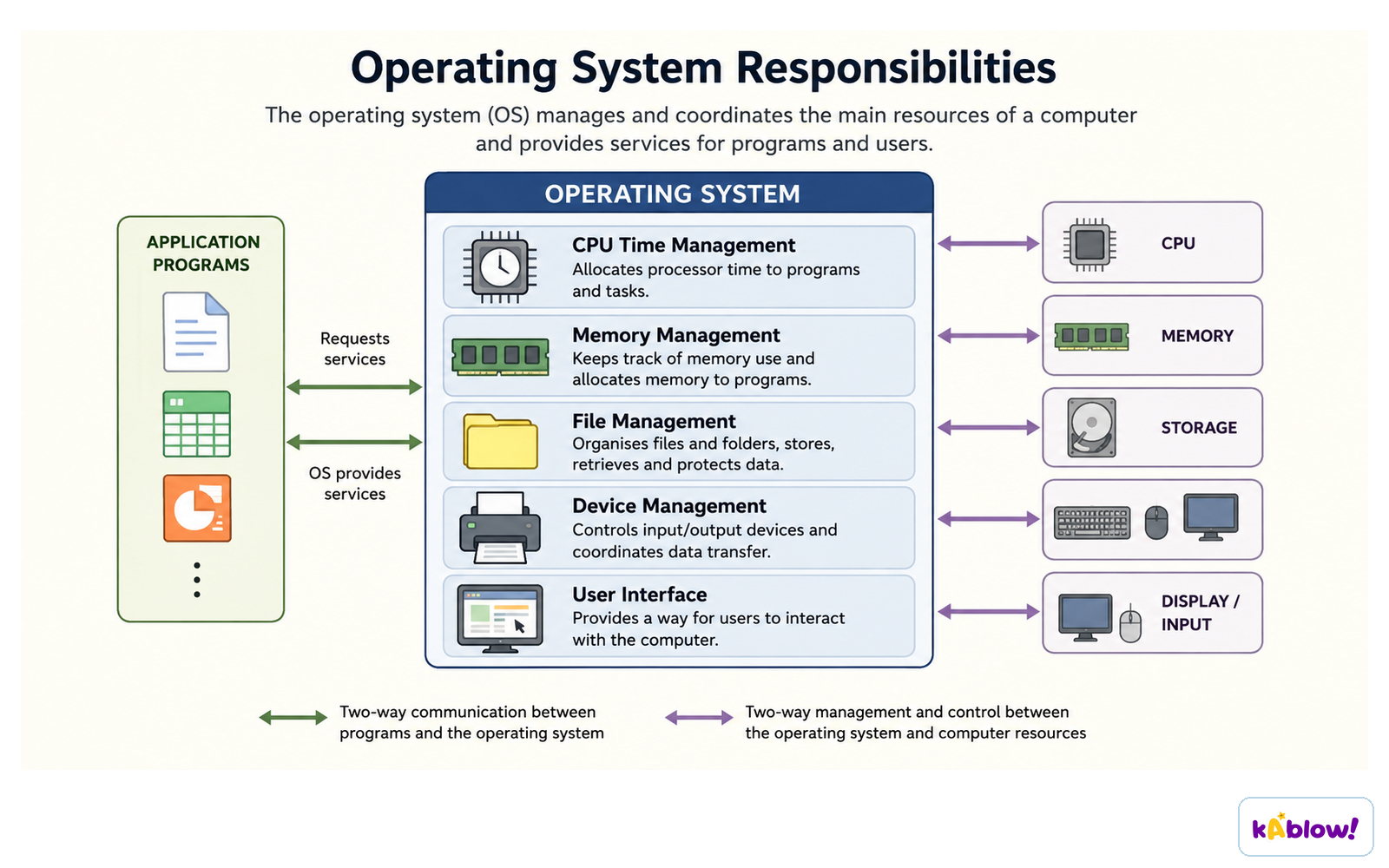
Operating systems (OS)
- An operating system manages the computer's hardware and provides services for software. Functions: user interface (GUI or command line), memory management, multitasking (process scheduling), file management, device management (drivers) and security (accounts, permissions).
- Examples: Windows, macOS, Linux, Android, iOS.
Operating system responsibilities
Types of software
- System software: OS and utility software (antivirus, backup, disk defragmenter, compression).
- Application software: performs tasks for users (word processor, web browser, games).
System and application software
Programming languages
- High-level languages use readable abstractions and can be implemented on different platforms; a suitable translator or runtime and libraries are still needed.
- Machine code and assembly are low-level and processor-specific. They permit close hardware control, but are harder to write and maintain.
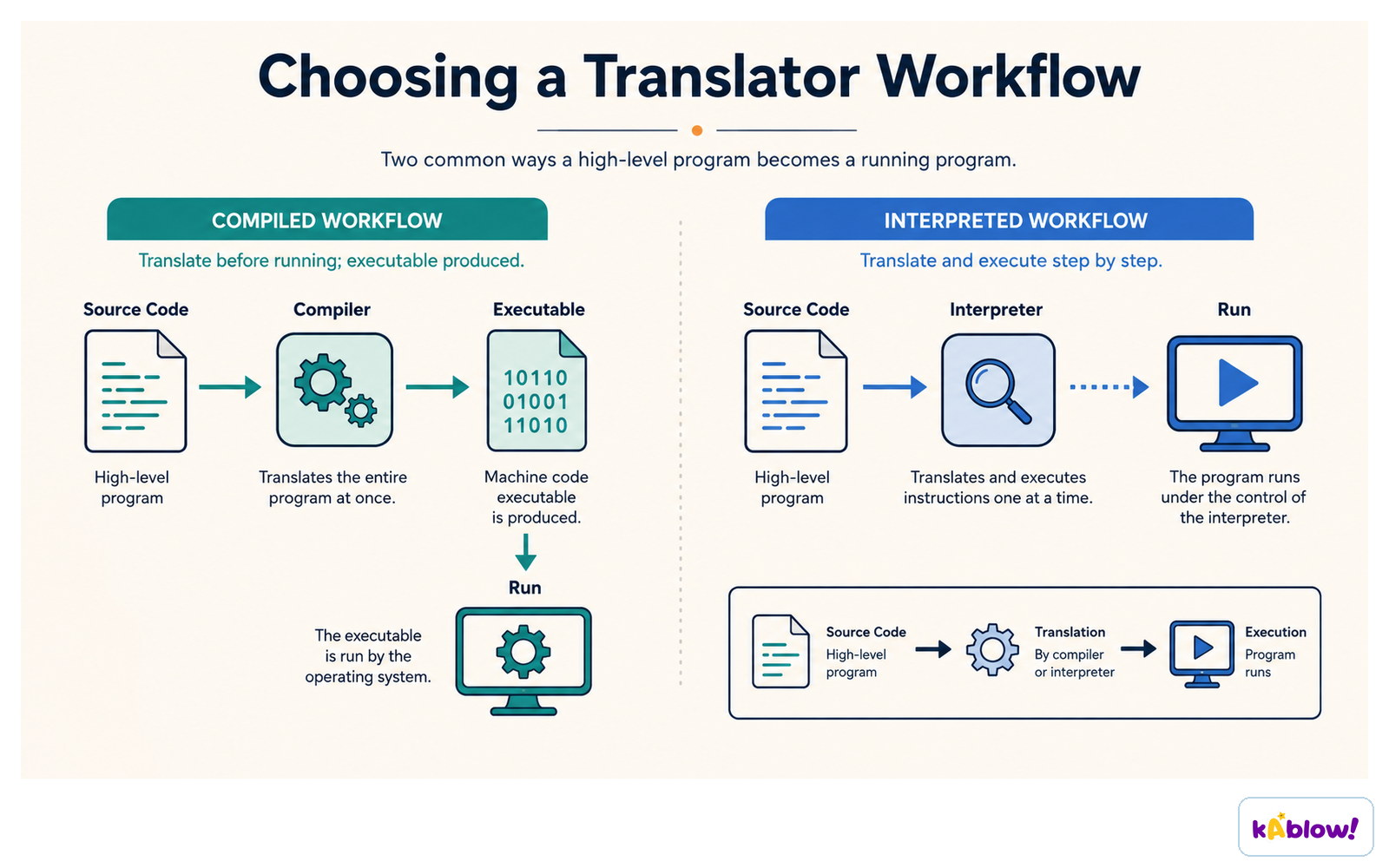
Translating and running source code
Translators
- In the simplified GCSE model, a compiler translates source before execution, often producing a native executable; an interpreter translates and executes as the program runs.
- An assembler translates assembly notation to machine code. Real systems may combine interpretation, bytecode and just-in-time compilation.
- Compiled code often runs faster, while interpretation can support interactive debugging; neither is a universal speed rule.
Open source vs proprietary
- Open-source licences provide source-code access and permissions to use, modify and redistribute under specified conditions.
- Proprietary licences reserve more control to the rights holder. Proprietary software may be paid or free; price alone does not determine the licence category.
स्लाइड्स
Sign up free to view the lesson slides
Step through every slide for this topic — plus flashcards and revision notes — with a free account.
प्रैक्टिस सवाल
फ्री प्रीव्यू — 33 में से 8 सवाल। सभी देखने के लिए साइन अप करें।
1.What is an operating system?
Easy- Asoftware that manages the computer
- Ba word processor
- Ca game
- Da browser
2.What is application software?
Easy- Asoftware that performs tasks for the user
- Bthe OS
- Cfirmware
- Ddrivers
3.Which is an example of an operating system?
Easy- AWindows
- BExcel
- CChrome
- DPhotoshop
4.Which is utility software?
Easy- Aantivirus
- Ba game
- Ca spreadsheet
- Da browser
5.What is a high-level language?
Easy- Aa programming language close to human language
- Bmachine code
- Cassembly
- Dbinary
6.What is machine code?
Easy- Abinary instructions the CPU executes directly
- BPython code
- CEnglish text
- Da flowchart
7.What is assembly language?
Easy- Aa low-level language using mnemonics
- Ba high-level language
- Ca database
- Da network
8.What does a compiler do?
Easy- Atranslates the whole program before it runs
- Bruns one line at a time
- Cstores data
- Dcompresses files
Unlock all 33 questions & more
इस टॉपिक के हर सवाल, स्लाइड्स, फ्लैशकार्ड और रिवीज़न नोट्स देखने के लिए फ्री अकाउंट बनाएं।
पास्ट पेपर
इस टॉपिक के लिए पास्ट-पेपर प्रैक्टिस जल्द आ रही है।
जल्द आ रहा है