
Energy generation and storage
खेलकर सीखें
इन सवालों के जवाब देकर एनर्जी कमाएं, फिर मछली पकड़ें और घूमें। कोई अकाउंट नहीं चाहिए।
शिक्षकों के लिए: Energy generation and storage (Design and Technology, Core Technical Principles) के लिए इस्तेमाल के लिए तैयार लेसन स्लाइड्स, रिवीज़न नोट्स — इन्हें अपने लेसन में इस्तेमाल करें, या टॉपिक को एक इंटरैक्टिव क्लास एक्टिविटी की तरह चलाएं जिसे आपके शिक्षार्थी लाइव गेम की तरह खेलें।
लेसन नोट्स
Non-renewable energy
- Coal, oil and natural gas are finite fossil resources. A conventional coal station burns fuel to heat a steam cycle whose turbine drives a generator, but gas stations can use hot combustion gases directly and sometimes a combined gas-and-steam cycle. Burning fossil carbon releases carbon dioxide and other emissions depending on the process.
- Nuclear fission releases heat without burning a carbon fuel, giving low direct operational carbon-dioxide emissions. Construction, fuel processing, radioactive material management and decommissioning remain relevant. Output can be substantial when available, but no plant type guarantees uninterrupted supply.
Conventional coal station: simplified route
Renewable energy
- Wind, PV, hydropower and tidal use renewable flows with different conversion mechanisms and siting limits. PV converts incident light directly to electricity; solar thermal provides heat. Water flowing through a height difference can drive a turbine-generator. Renewability does not imply no land, material or ecological effects.
- Wind and solar outputs vary with weather or daylight. Tidal timing is predictable, but its output still changes through the cycle; wave conditions are a different resource influenced by weather. Storage, networks, flexible demand and other generation can contribute to balancing rather than one universal local-battery requirement.
- Biomass is material of biological origin used as fuel or through other conversion routes. Combustion releases carbon dioxide. The carbon outcome depends on sustainable sourcing, land and carbon stocks, regrowth timescale, processing and transport; do not assume every biomass use is automatically carbon neutral. Geothermal suitability depends on accessible heat and site conditions.
Renewable flows use different mechanisms
Energy storage
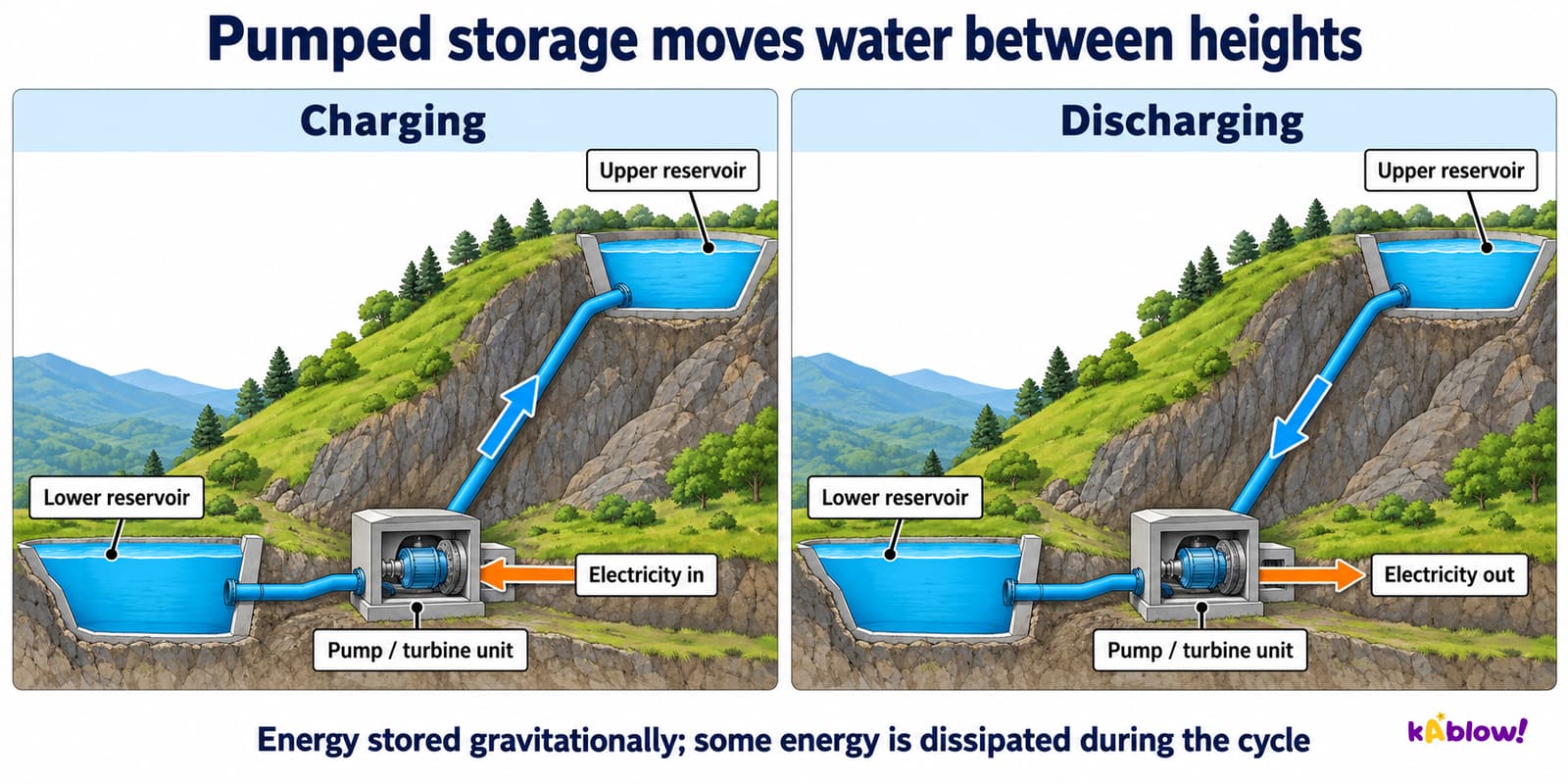
- Rechargeable batteries convert electrical input into chemical energy storage and return some electrical energy during discharge. Pumped storage raises water, increasing gravitational potential energy, then recovers part of it through a turbine-generator. The original comparison shows uphill charging and downhill discharge in the same closed-loop arrangement.
- The illustrated pump/turbine unit stands for the hydraulic machinery and its coupled electrical motor/generator roles. Water connections enter the reservoirs, and arrows reverse between modes. It is a conceptual landscape, not equipment design, a capacity estimate or a claim that the cycle creates energy.
- Storage has energy capacity, charge/discharge power, duration and loss constraints. A smart grid can use information and control to coordinate a system but cannot create the energy needed. Storage can serve several sources, including nuclear and fossil generation, as well as variable renewables.
Pumped storage: charge and discharge
Choosing
- Start from the required service and demand profile. Compare resource measurements, site, infrastructure, reliability needs, finance, lifetime cost, maintenance, environmental and community effects. A strong island wind resource makes wind worth assessing, not automatically affordable or sufficient.
- Power is the rate of energy transfer; energy capacity is the amount available. In an ideal calculation, usable 50 Wh at constant 5 W lasts 10 h. Real usable capacity, conversion losses, temperature and changing demand can alter duration.
- Carbon-neutral claims need a defined emissions/removals boundary and period, not merely a label saying renewable. Compare direct operation and full life-cycle effects separately; a low-carbon source can still have other important environmental impacts.
Capacity and rate are different
Hydrogen and fuel cells
- A hydrogen supply can store chemical energy for later conversion. A hydrogen fuel cell uses supplied hydrogen and oxygen to produce electricity, heat and water through electrochemical reactions; it is the converter rather than the fuel tank. Other fuel-cell types and fuels exist.
- Hydrogen is an energy carrier, not a free primary source. Its production, compression or other handling, distribution and conversion affect efficiency and emissions. A water-only direct reaction product does not establish a zero-impact full supply chain.
Distinguish stores from converters
Check storage efficiency
- Round-trip efficiency compares returned electrical energy with charging electrical input using the same boundary. Invented example: 80 Wh returned from 100 Wh input gives 80%. This is not a measured value for a real storage technology or installation.
- The difference represents energy transferred to other outputs or remaining stores within the selected cycle boundary, not destruction of energy. Compare the same service and assumptions when evaluating options, and distinguish energy efficiency from affordability or resource availability.
Invented round-trip calculation
स्लाइड्स
Sign up free to view the lesson slides
Step through every slide for this topic — plus flashcards and revision notes — with a free account.
प्रैक्टिस सवाल
फ्री प्रीव्यू — 35 में से 8 सवाल। सभी देखने के लिए साइन अप करें।
1.What is a renewable energy source?
Easy- Aone that replenishes naturally
- Bone that runs out
- Ccoal
- Doil
2.What is a fossil fuel?
Easy- Awind
- Bsolar
- Chydro
- Dcoal, oil or gas
3.What does burning fossil fuels release?
Easy- Ahydrogen only
- Bnothing
- Ccarbon dioxide
- Doxygen only
4.What spins a generator in a coal power station?
Easy- Atides
- Bsteam turbines
- Cwind
- Dsunlight
5.What does a PV cell do?
Easy- Aconverts sunlight to electricity
- Bheats water
- Cstores wind
- Dburns fuel
6.What is an advantage of wind power?
Easy- Aconstant supply
- Bno visual impact
- Cno cost
- Dno combustible fuel purchase and no direct fuel burning during generation
7.What is a disadvantage of wind power?
Easy- Ait uses coal
- Bit is non-renewable
- Cit is intermittent
- Dit produces CO2
8.What is an advantage of nuclear power?
Easy- Ano risk
- Bsubstantial output with low direct operational carbon-dioxide emissions
- Cno waste
- Dno cost
Unlock all 35 questions & more
इस टॉपिक के हर सवाल, स्लाइड्स, फ्लैशकार्ड और रिवीज़न नोट्स देखने के लिए फ्री अकाउंट बनाएं।
पास्ट पेपर
इस टॉपिक के लिए पास्ट-पेपर प्रैक्टिस जल्द आ रही है।
जल्द आ रहा है