
Polymers
खेलकर सीखें
इन सवालों के जवाब देकर एनर्जी कमाएं, फिर मछली पकड़ें और घूमें। कोई अकाउंट नहीं चाहिए।
शिक्षकों के लिए: Polymers (Design and Technology, Materials) के लिए इस्तेमाल के लिए तैयार लेसन स्लाइड्स, रिवीज़न नोट्स — इन्हें अपने लेसन में इस्तेमाल करें, या टॉपिक को एक इंटरैक्टिव क्लास एक्टिविटी की तरह चलाएं जिसे आपके शिक्षार्थी लाइव गेम की तरह खेलें।
लेसन नोट्स
Types of polymer
- Polymers contain large molecules with repeating units, in chains or networks; they include natural polymers as well as those used in synthetic plastics. A plastic is a material based on polymer with a formulation that may include additives, fillers or reinforcements.
- Thermoplastics soften for shaping within an appropriate range. Some GCSE lists call this category thermoforming polymers, but thermoforming also names sheet-shaping processes. Acrylic PMMA, HIPS, PVC, PP, HDPE, ABS, nylon and PET are familiar thermoplastic examples; grades and formulations vary.
- Thermosetting resins cure through reactions that create a crosslinked network. Curing need not always require external heat: the system can depend on mixed curing agents or other conditions. Cured epoxy, melamine-formaldehyde and suitable polyester-resin systems cannot simply be remelted for reshaping. A thermoplastic polyester such as PET is not interchangeable with a thermosetting polyester-resin system.
Curing and softening are different
Forming processes
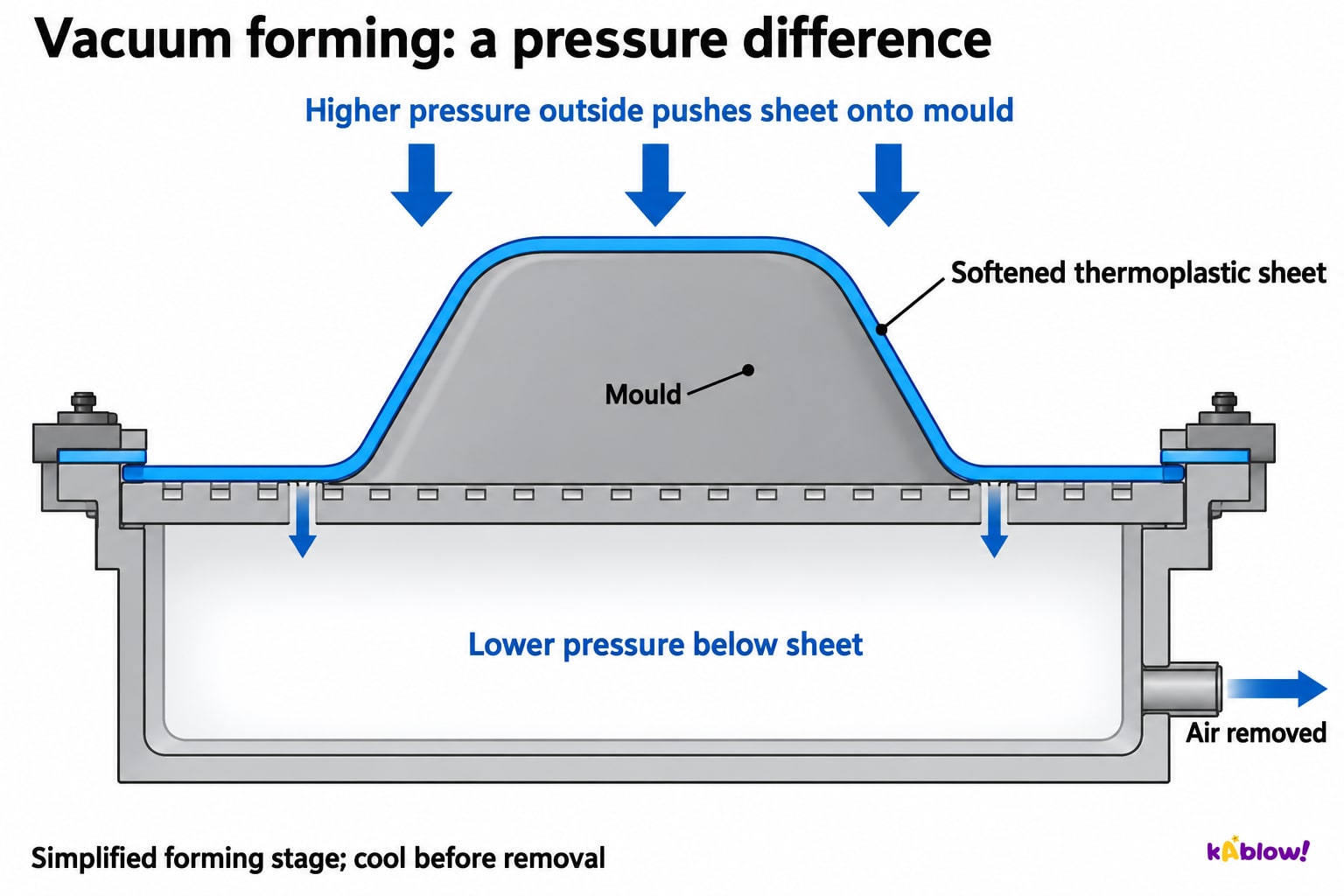
- Vacuum forming softens suitable thermoplastic sheet and lowers pressure between the sheet and mould. Higher pressure outside presses it onto the mould. Cooling precedes release and trimming; sheet thinning, draw depth, corners and tool geometry affect the result. The original section illustrates the pressure mechanism, not machine design or a uniform-wall-thickness guarantee.
- Thermoplastic injection moulding fills a mould with softened or molten polymer, allows enough cooling and solidification, then ejects the part. Tooling can support repeat high-volume production, but setup cost, shrinkage, defects and demand affect suitability. Some thermoset injection processes instead rely on cure.
- Blow moulding expands a softened parison or preform with gas pressure against a mould. PET drinks bottles commonly use reheated preforms and stretch-blow moulding. Extrusion creates continuous profiles; line bending softens a narrow region of suitable sheet. Compression moulding can process suitable materials, including some thermoset systems.
Vacuum forming: a pressure difference
Properties
- Useful polymer properties can include low density, electrical insulation, mouldability or resistance to particular contents. These are tendencies of selected formulations, not guarantees that every polymer is waterproof, heat-resistant, chemically inert or suitable for food contact.
- Clear acrylic can suit displays but may scratch or fracture; ABS can suit selected impact-resistant mouldings; PP can suit a well-designed living hinge. PVC can be rigid or plasticised and flexible. PS, HIPS and expanded PS have different properties and forms. Match grade, additives, geometry and service conditions to the requirement.
- A suitable PET bottle grade can offer clarity, strength, barrier properties and processability for specified drinks. Verify food-contact, pressure and temperature requirements. A melamine laminate worktop is a layered product with service limits, not proof that thermosets are fireproof or tolerate any hot object.
A polymer name is a starting point
Environmental issues
- Polymers can involve fossil resource use, production emissions, persistent waste and shedding of microplastics. Some use bio-based feedstocks, but bio-based does not automatically mean biodegradable or lower impact across every life-cycle measure.
- PLA is commonly bio-based and thermoplastic. Some particular final products compost in specified industrial facilities, but product testing and facility acceptance matter. Do not infer home-compostability, rapid marine breakdown or harmless litter from the resin name.
- Thermoplastic remelting is a material behaviour, not a promise of recycling in practice. Collection, mixtures, additives, format, contamination and degradation constrain recovery. Cured thermosets cannot simply remelt, although specialist recovery routes may exist. Resin codes identify material rather than guarantee a local route.
- Reduce unnecessary single use and compare alternatives providing the same service. Actual reuse, cleaning, lifetime, mass and available recovery systems affect the result. A reusable or compostable label alone is insufficient evidence of the best overall outcome.
Separate four environmental questions
Choose a forming route
- Start from the required form and production context: a shaped sheet tray, hollow bottle, continuous section and local sheet bend involve different process principles. Material grade, geometry, quantity, tolerance and finish guide the selection.
- A high-volume moulding route can spread tool costs but still requires sufficient saleable demand and process control. Explain the link from process to product rather than assuming every polymer can use every process or that one route is always cheapest.
Match form to process principle
स्लाइड्स
Sign up free to view the lesson slides
Step through every slide for this topic — plus flashcards and revision notes — with a free account.
प्रैक्टिस सवाल
फ्री प्रीव्यू — 33 में से 8 सवाल। सभी देखने के लिए साइन अप करें।
1.What is a polymer?
Easy- Aa substance made of large molecules with repeating units, in chains or networks
- Ba metal
- Ca timber
- Da fabric
2.What does thermosetting mean?
Easy- Asoftens when heated
- Bmelts easily
- Cis recyclable
- Dcures into a network that cannot simply be remelted for reshaping
3.Which is a thermoplastic, also called a thermoforming polymer in some GCSE materials lists?
Easy- Amelamine formaldehyde
- Burea formaldehyde
- Cacrylic
- Depoxy resin
4.Which is a thermosetting polymer?
Easy- Apolypropylene
- Bepoxy resin
- Cacrylic
- DPVC
5.What is acrylic used for?
Easy- Aclear displays and signs
- Bdrink bottles
- Celectrical fittings
- Dkitchen worktops
6.What is HDPE used for?
Easy- Aworktops
- BPCBs
- Cfire-proof gear
- Dbottles and tubs
7.What is PET used for?
Easy- Awires
- Bfurniture
- Cdrinks bottles
- Dkitchen worktops
8.What is ABS used for?
Easy- Acloth
- Btough items like toy bricks
- Cclear signs
- Dpaper
Unlock all 33 questions & more
इस टॉपिक के हर सवाल, स्लाइड्स, फ्लैशकार्ड और रिवीज़न नोट्स देखने के लिए फ्री अकाउंट बनाएं।
पास्ट पेपर
इस टॉपिक के लिए पास्ट-पेपर प्रैक्टिस जल्द आ रही है।
जल्द आ रहा है