Cells
Learn it by playing
Answer these questions to earn energy, then fish and explore. No account needed.
Lesson notes
Cell Theory and Discovery
- Cells are the basic structural and functional unit of all living organisms.
- Robert Hooke discovered cells in 1665 after observing cork under a microscope.
- Cell theory (Schleiden & Schwann, 1839): all organisms are made of one or more cells, cells are the fundamental unit of life, and all cells arise from pre-existing cells.
Prokaryotic vs Eukaryotic Cells
- Prokaryotes (bacteria & archaea) lack a membrane-bound nucleus; their DNA is in a nucleoid region.
- Eukaryotes (animals, plants, fungi, protists) have a membrane-bound nucleus and other organelles.
- Prokaryotes are generally smaller (0.1–5.0 μm) and simpler; eukaryotes are larger and more complex.
- All prokaryotes are single-celled; eukaryotes can be single-celled (e.g., yeast) or multicellular.
Plant vs Animal Cells
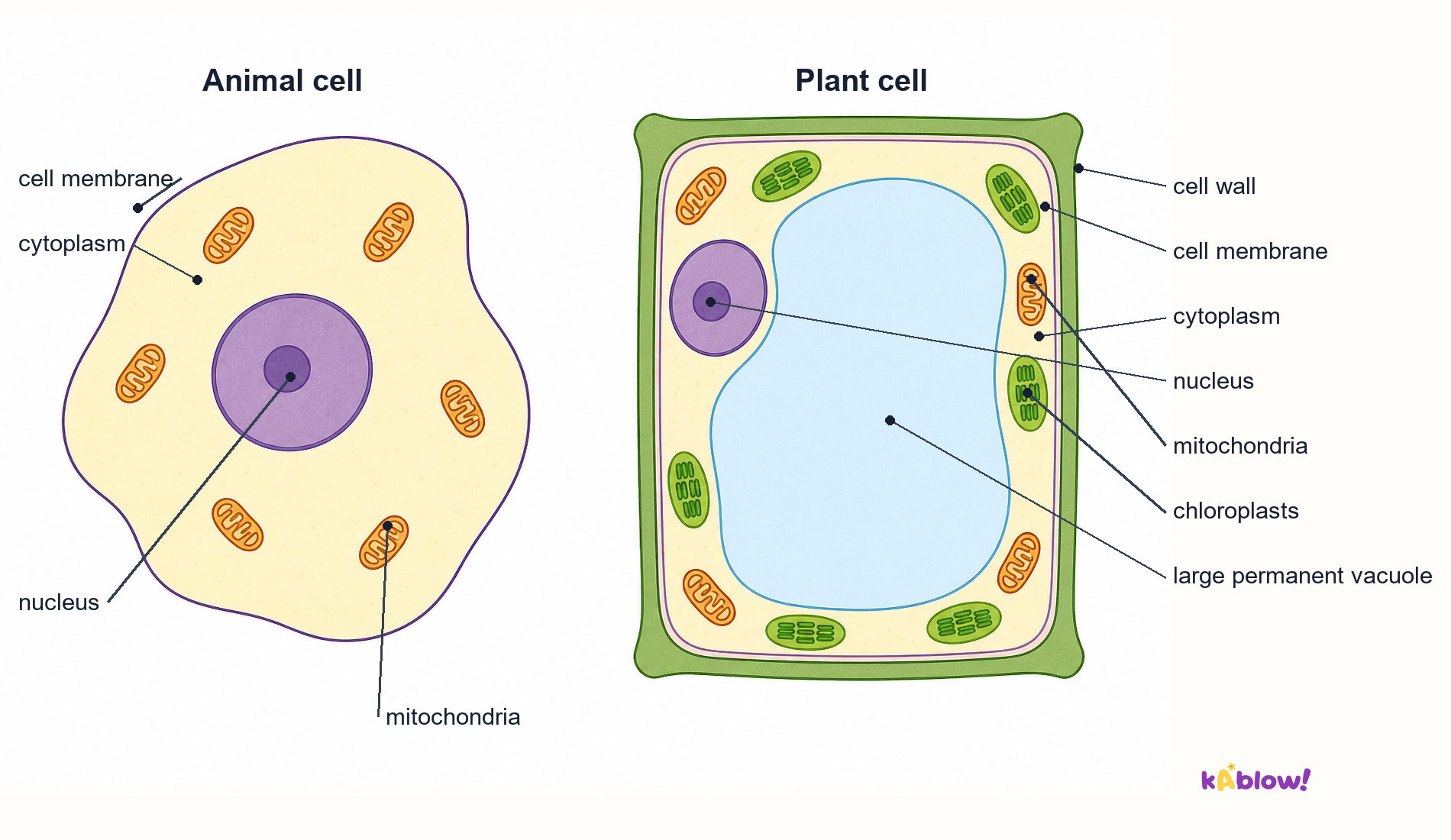
- Both have a cell membrane, cytoplasm, nucleus, mitochondria, ribosomes, and endoplasmic reticulum.
- Plant cells have a cell wall (cellulose), chloroplasts (photosynthesis), and a large central vacuole.
- Animal cells have no cell wall, no chloroplasts, and smaller vacuoles (if any).
- Plant cells are typically rectangular; animal cells are irregular or rounded.
Plant and animal cells side by side, showing which structures they share and which they do not.
Key Organelles and Their Functions
- Nucleus: contains genetic material (DNA); controls cell activities.
- Cell membrane: semipermeable; controls entry/exit of substances.
- Cytoplasm: jelly-like fluid where chemical reactions occur.
- Mitochondria: site of aerobic respiration; produce ATP (energy).
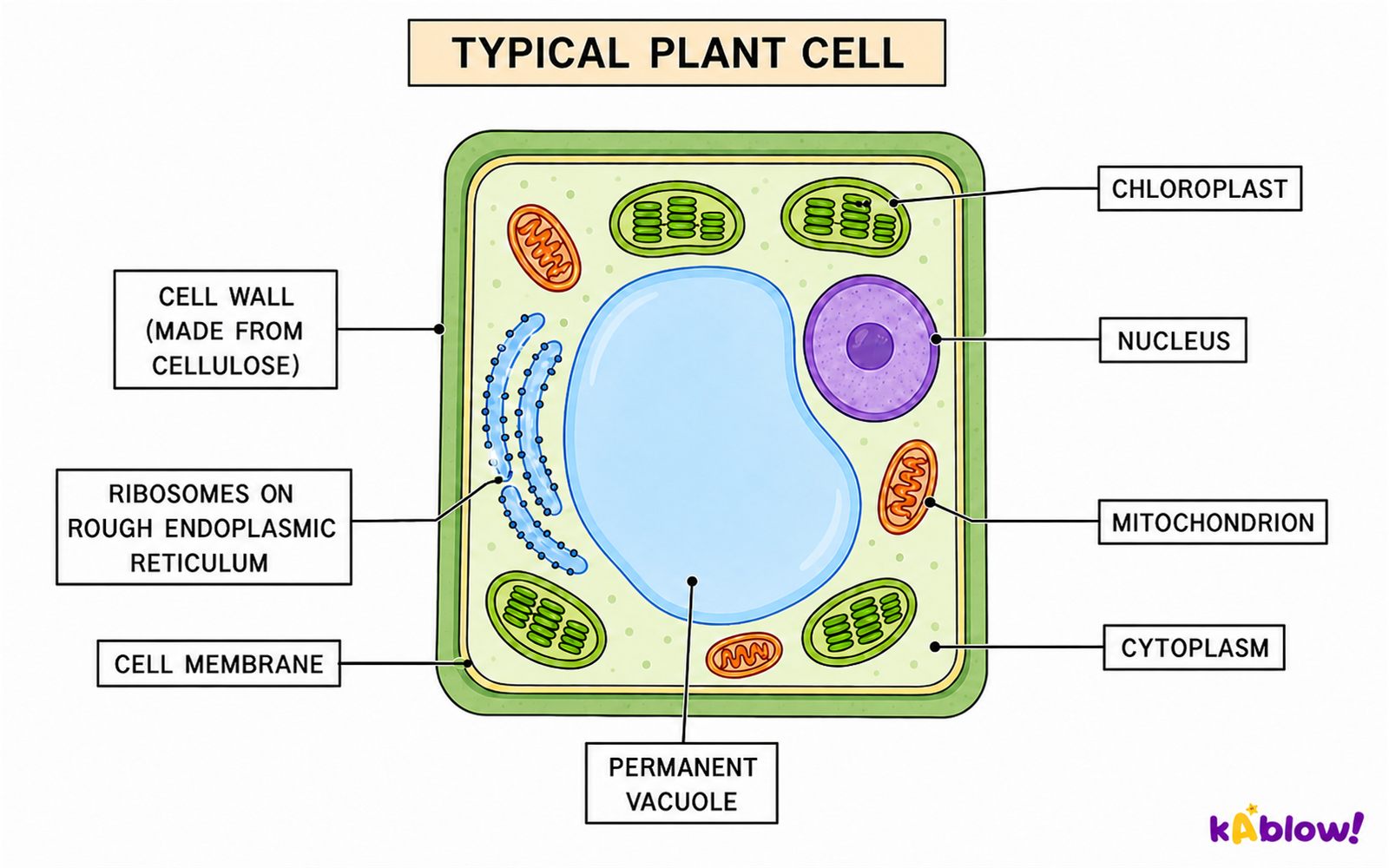
- Chloroplasts (plants): contain chlorophyll; site of photosynthesis.
- Vacuole (plants): stores sap; maintains turgor pressure.
- Ribosomes: synthesise proteins.
- Cell wall (plants, bacteria): provides structural support and protection.
A typical plant cell, with a cell wall, vacuole and chloroplasts as well as the organelles an animal cell has.
Prokaryotic Cell Structure
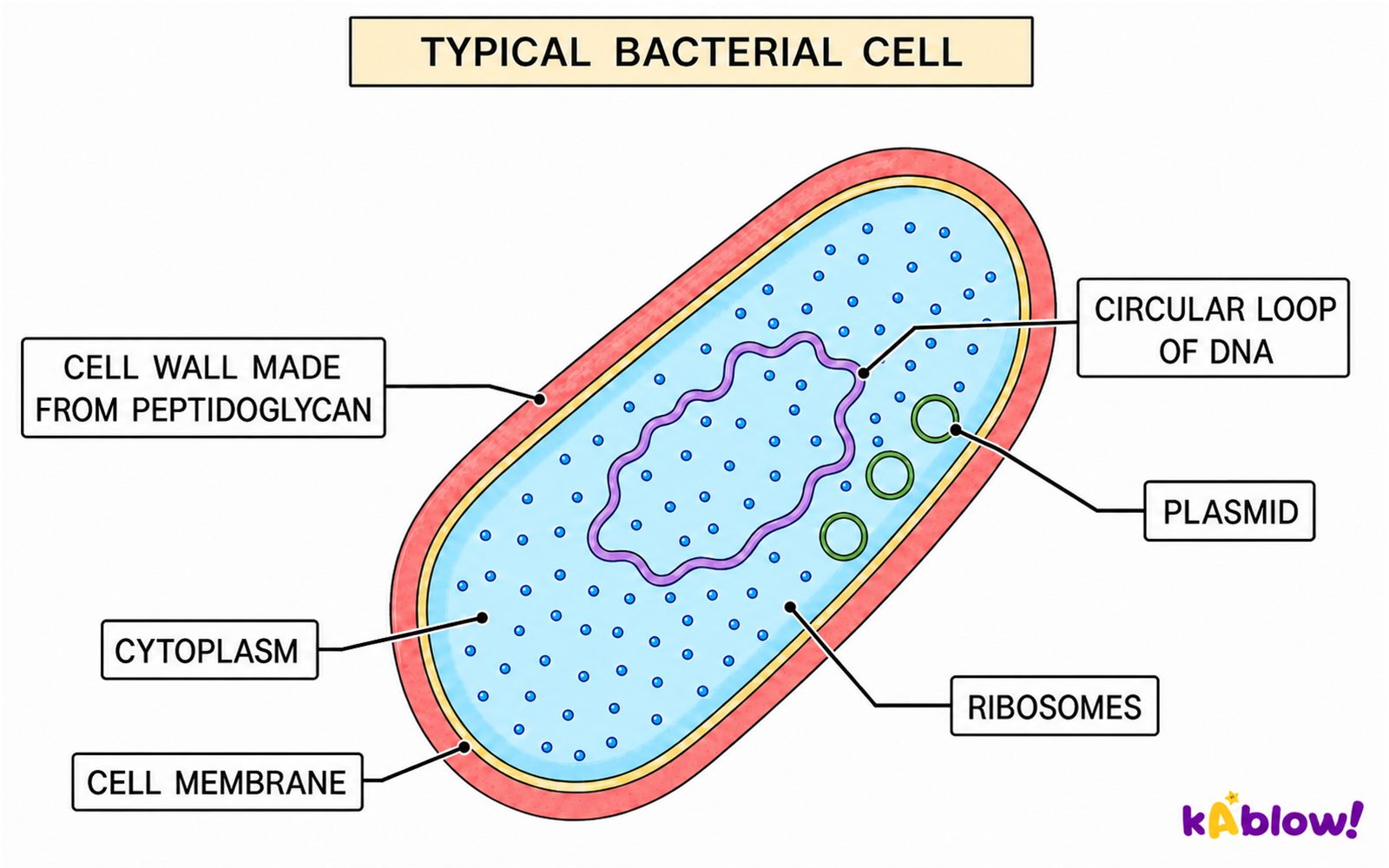
- Prokaryotes have a cell envelope: plasma membrane + cell wall (peptidoglycan); some have a capsule.
- DNA is a single circular chromosome in the nucleoid; plasmids (extra DNA) may be present.
- Ribosomes are smaller than eukaryotic ribosomes (70S).
- Some have flagella (movement) and pili (attachment/conjugation).
- No membrane-bound organelles; some have microcompartments (e.g., gas vesicles, magnetosomes).
A bacterial cell has no nucleus: its DNA sits loose in the cytoplasm.
Microscopy
- Most cells are microscopic and require a microscope to be seen.
- Light microscopes use visible light; can magnify up to ~1000×.
- Electron microscopes use electron beams; much higher magnification and resolution.
- Stains (e.g., methylene blue) help highlight cell structures.
Animal cell structure showing key organelles.
Plant cell structure with cell wall, chloroplasts and large vacuole.
Prokaryotic cell (bacterium) with key features.
Slides
Sign up free to view the lesson slides
Step through every slide for this topic — plus flashcards and revision notes — with a free account.
Practice questions
Free preview — 8 of 68 questions. Sign up to see them all.
1.What is the basic structural and functional unit of all living organisms?
Easy- ACell
- BNucleus
- COrganelle
- DTissue
2.Which structure is found in plant cells but not in animal cells?
Easy- ACell wall
- BCell membrane
- CNucleus
- DMitochondrion
3.The diagram shows a plant cell. Which labelled structure is the chloroplast?
Easy- AA
- BB
- CC
- DD
4.Which of the following is a function of the cell membrane?
Easy- AControls what enters and leaves the cell
- BProvides energy for the cell
- CContains the genetic material
- DSite of protein synthesis
5.Who first discovered cells and named them after their resemblance to monastery cells?
Easy- ARobert Hooke
- BMatthias Schleiden
- CTheodor Schwann
- DAntonie van Leeuwenhoek
6.A student observes a cell under a microscope. It has a nucleus, mitochondria, and a cell wall. What type of cell is it most likely to be?
Medium- APlant cell
- BAnimal cell
- CBacterial cell
- DFungal cell
7.What is the function of the mitochondria in a cell?
Easy- ATo produce energy (ATP) through respiration
- BTo control cell activities
- CTo carry out photosynthesis
- DTo store water and nutrients
8.The diagram shows a bacterium. Which labelled part contains the genetic material?
Easy- AA (cell wall)
- BB (plasma membrane)
- CC (nucleoid region)
- DD (ribosome)
Unlock all 68 questions, flashcards & more
Create a free account to see every question, the slides, flashcards and revision notes for this topic.