Responding to stimuli and homeostasis
Learn it by playing
Answer these questions to earn energy, then fish and explore. No account needed.
Lesson notes
Homeostasis – Keeping the Internal Environment Stable
- Homeostasis is the maintenance of a stable internal environment despite external changes.
- It ensures optimal conditions for enzyme activity and cell function.
- Key variables regulated include body temperature, blood glucose, pH, and fluid balance.
- Homeostatic mechanisms involve receptors, control centres, and effectors.
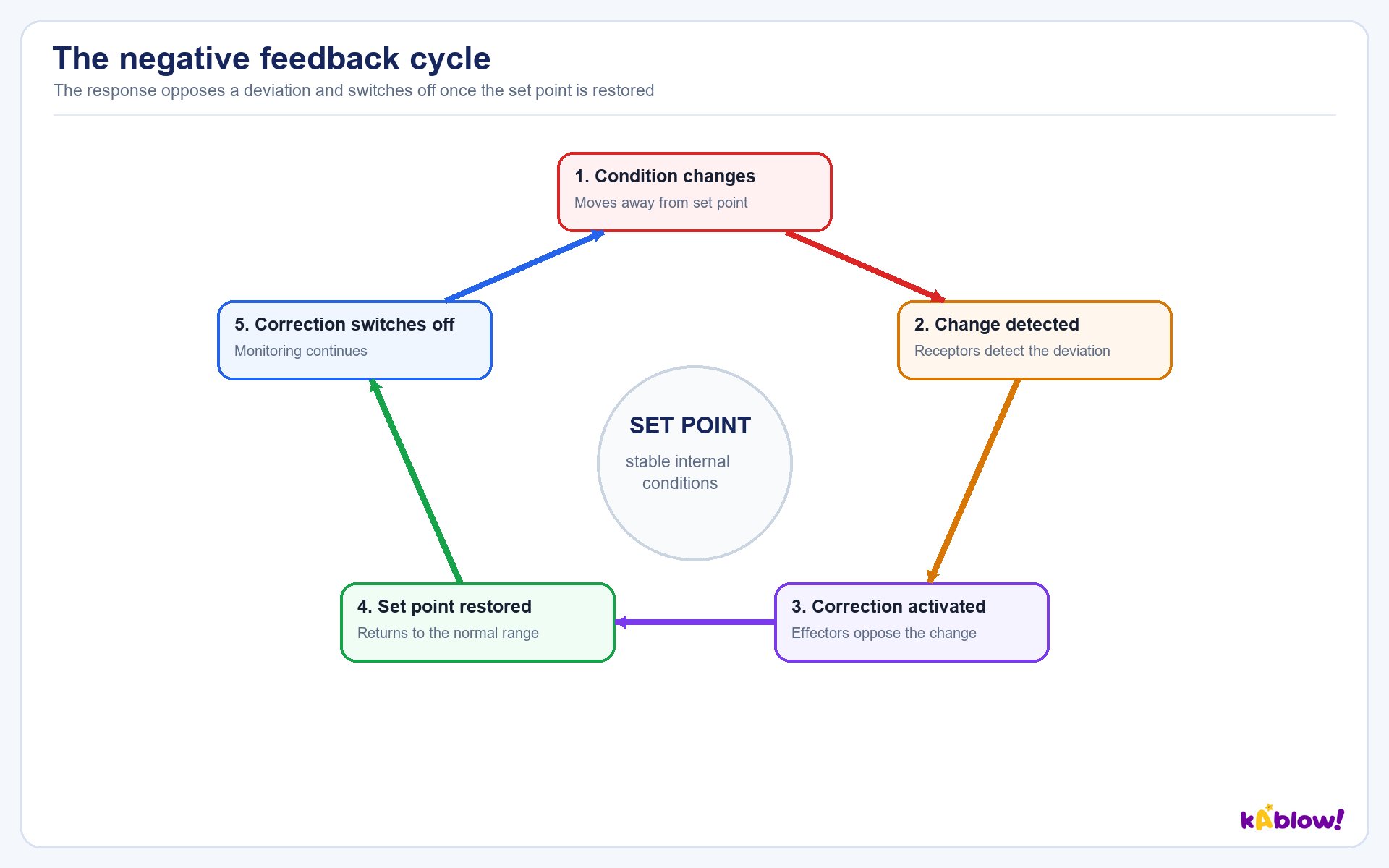
- Most homeostatic control uses negative feedback to reverse a change.
Components of a Homeostatic Control System
- Receptor – detects a change (stimulus) in the environment (e.g., thermoreceptors detect temperature change).
- Control centre – processes the information and determines the response (e.g., hypothalamus in the brain).
- Effector – carries out the response to restore balance (e.g., muscles, glands, or organs).
- The response feeds back to the receptor to reduce or stop the stimulus (negative feedback).
Negative Feedback – The Core Mechanism
- Negative feedback counteracts deviations from the set point, bringing the variable back to normal.
- Example: Body temperature rises → receptors send signal to brain → effectors (sweat glands) cool the body → temperature drops.
- Example: Blood glucose rises after eating → pancreas releases insulin → cells take up glucose → glucose level falls.
- Most homeostatic systems rely on negative feedback to maintain stability.
A corrective response opposes the original deviation
The Nervous System – Rapid Responses
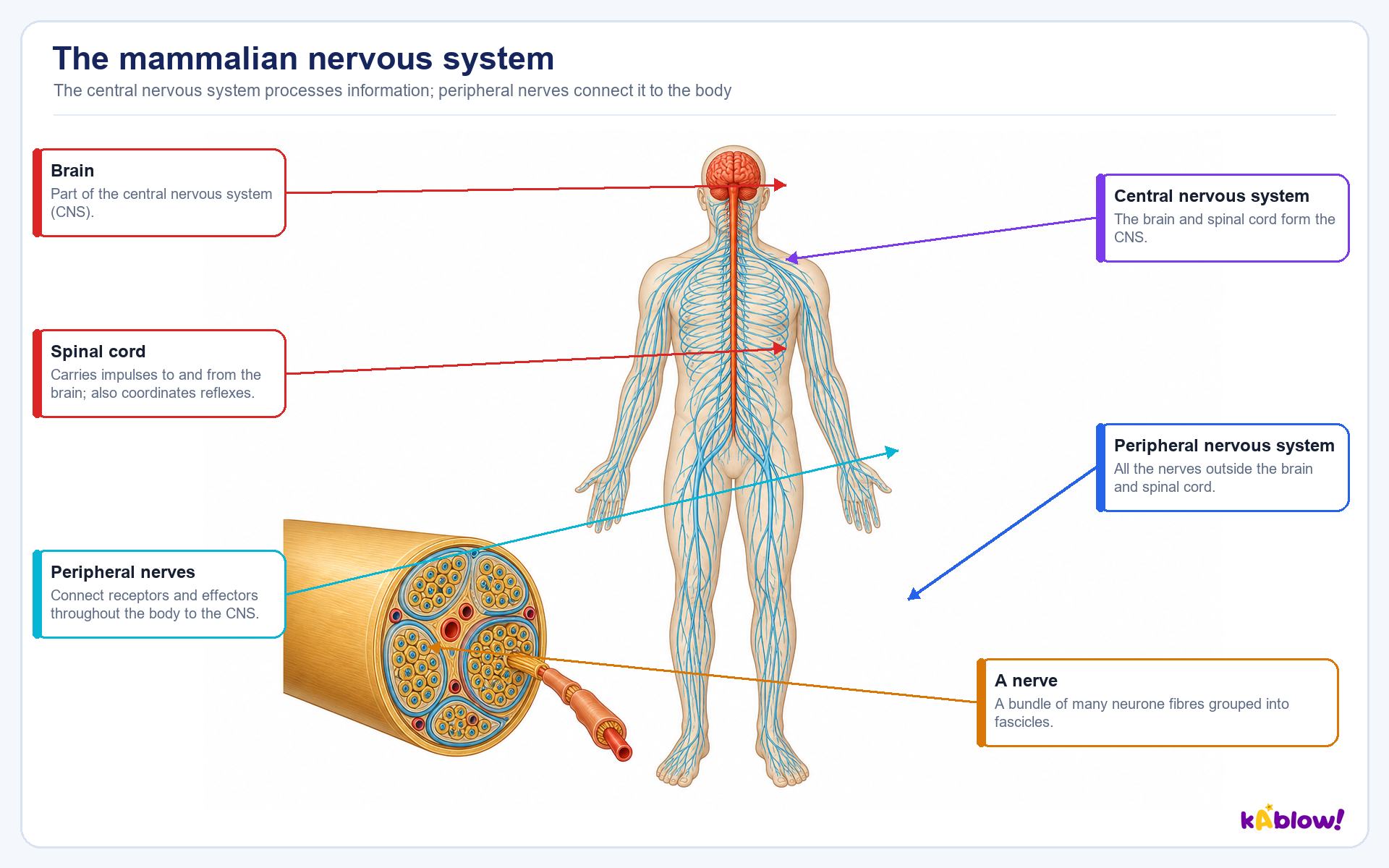
- The nervous system detects stimuli and sends electrical signals (nerve impulses) for rapid, short-lived responses.
- Sensory neurones carry impulses from receptors to the central nervous system (CNS – brain and spinal cord).
- Motor neurones carry impulses from the CNS to effectors (muscles or glands).
- Reflex arcs are automatic, rapid responses that bypass the brain for speed (e.g., pulling hand from a hot object).
CNS, PNS and the structure of a peripheral nerve
The Endocrine System – Slower, Longer-Lasting Responses
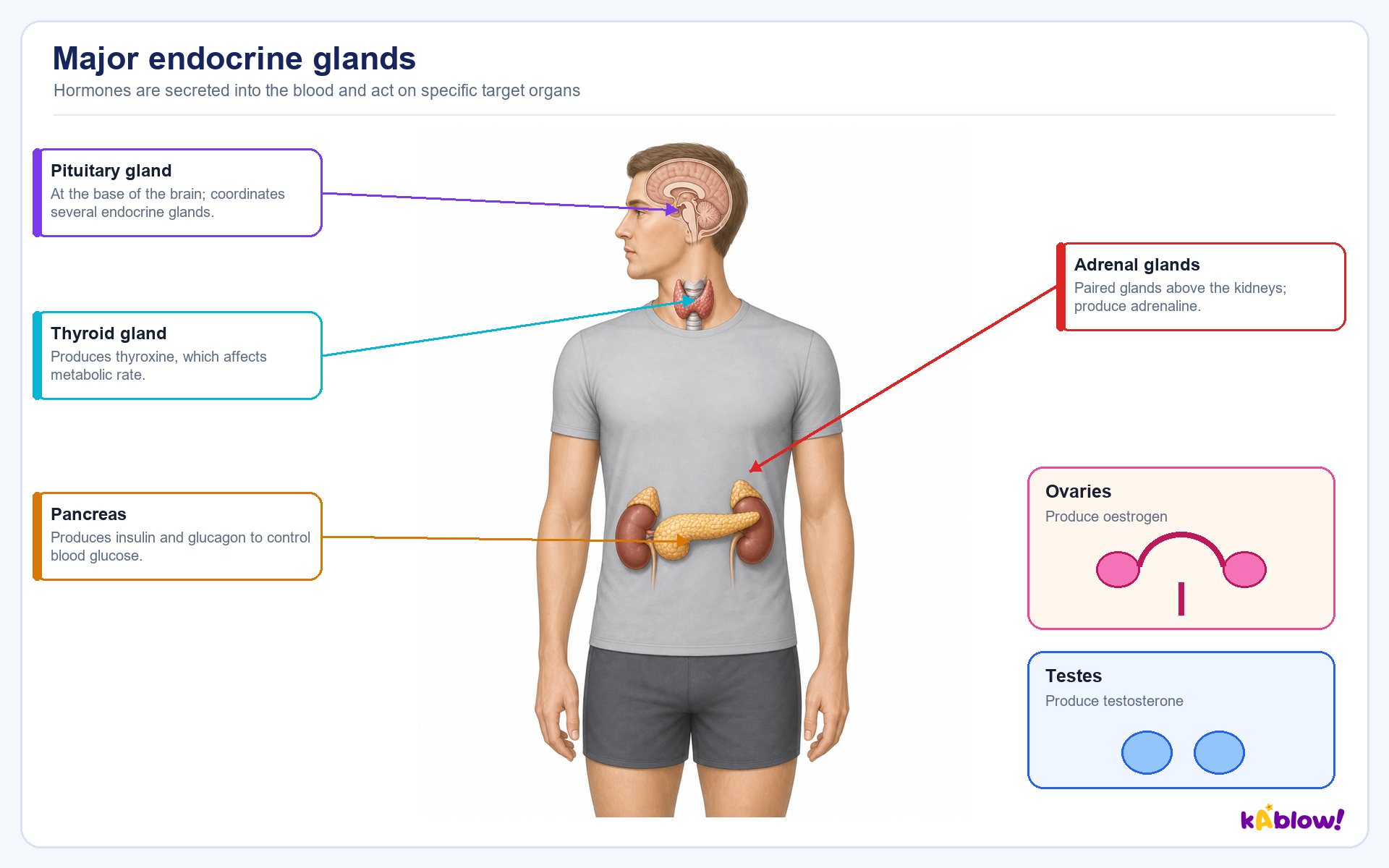
- The endocrine system uses hormones (chemical messengers) released into the blood to target cells.
- Hormones act more slowly than nerve impulses but have longer-lasting effects.
- Example: Adrenaline prepares the body for 'fight or flight' – increases heart rate, breathing rate, and blood glucose.
- Example: Insulin and glucagon regulate blood glucose levels via negative feedback.
Locations and roles of major endocrine glands
Coordination of Nervous and Endocrine Systems
- The hypothalamus links the nervous and endocrine systems; it controls the pituitary gland.
- The pituitary gland releases hormones that regulate other endocrine glands (e.g., thyroid, adrenal).
- Together, the two systems coordinate responses to internal and external stimuli to maintain homeostasis.
Examples of Homeostatic Regulation
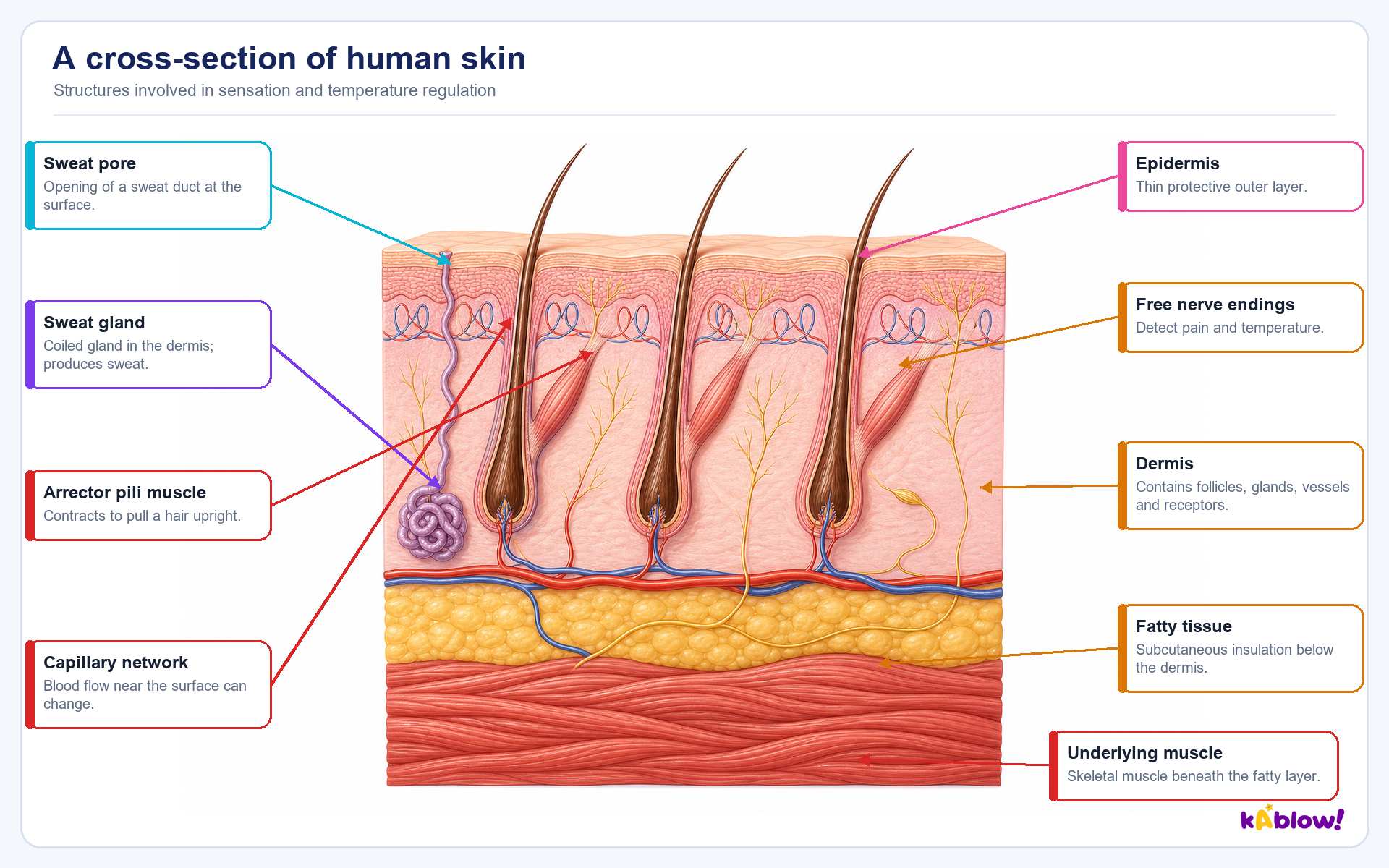
- Thermoregulation: Body temperature kept around 37°C via sweating, shivering, and blood vessel dilation/constriction.
- Osmoregulation: Water and salt balance maintained by the kidneys; antidiuretic hormone (ADH) controls water reabsorption.
- Blood glucose regulation: Insulin lowers glucose; glucagon raises glucose; both are produced by the pancreas.
- pH regulation: Buffers in blood and respiration control CO₂ levels to keep pH near 7.4.
Skin structures involved in thermoregulation
Stimuli and Receptors
- A stimulus is any change in the internal or external environment that triggers a response.
- Receptors are specialised to detect specific stimuli: thermoreceptors (temperature), mechanoreceptors (pressure), chemoreceptors (chemicals), photoreceptors (light).
- Receptors convert stimulus energy into electrical signals (action potentials) for the nervous system.
A spinal reflex arc showing the pathway: stimulus → receptor → sensory neurone → relay neurone → motor neurone → effector (muscle). This is an example of a rapid, involuntary response.
Structure of a motor neurone: dendrites, cell body, axon, myelin sheath, nodes of Ranvier, and axon terminals. Neurones transmit electrical impulses for rapid responses.
Slides
Sign up free to view the lesson slides
Step through every slide for this topic — plus flashcards and revision notes — with a free account.
Practice questions
Free preview — 8 of 59 questions. Sign up to see them all.
1.What term describes the maintenance of a stable internal environment in living organisms?
Easy- AHomeostasis
- BMetabolism
- CEvolution
- DAdaptation
2.Which component of a homeostatic control mechanism detects changes in the environment?
Easy- AReceptor
- BControl center
- CEffector
- DStimulus
3.Which of the following is NOT a variable regulated by homeostasis in humans?
Easy- ABody temperature
- BBlood sugar level
- CHeight
- DpH of extracellular fluid
4.In the reflex arc, which type of neurone carries the action potential from the receptor to the spinal cord?
Easy- ASensory neurone
- BMotor neurone
- CRelay neurone
- DInterneurone
5.Homeostasis keeps the internal environment perfectly constant at all times.
EasyTrue or false?
6.Negative feedback mechanisms work to reverse a change and bring the variable back to its set point.
EasyTrue or false?
7.Match each component of a homeostatic control system with its correct description.
Medium- Receptor
- Control center
- Effector
- Detects changes in the environment
- Determines the appropriate response
- Carries out the response
8.Arrange the following events in the correct order for a homeostatic response:
Medium- Effector responds
- Receptor detects change
- Control center sends signal
- Variable returns to normal
Unlock all 59 questions, flashcards & more
Create a free account to see every question, the slides, flashcards and revision notes for this topic.