Photosynthesis
Learn it by playing
Answer these questions to earn energy, then fish and explore. No account needed.
Lesson notes
What is Photosynthesis?
- Photosynthesis is the process by which green plants, algae, and some bacteria use sunlight to convert carbon dioxide and water into glucose and oxygen.
- It occurs in chloroplasts, which contain the green pigment chlorophyll that absorbs light energy.
- The energy from the sun is transformed into chemical potential energy stored in glucose.
- Photosynthesis is essential for life on Earth because it provides food (glucose) and oxygen for other organisms.
Diagram showing the inputs and outputs of photosynthesis in a plant
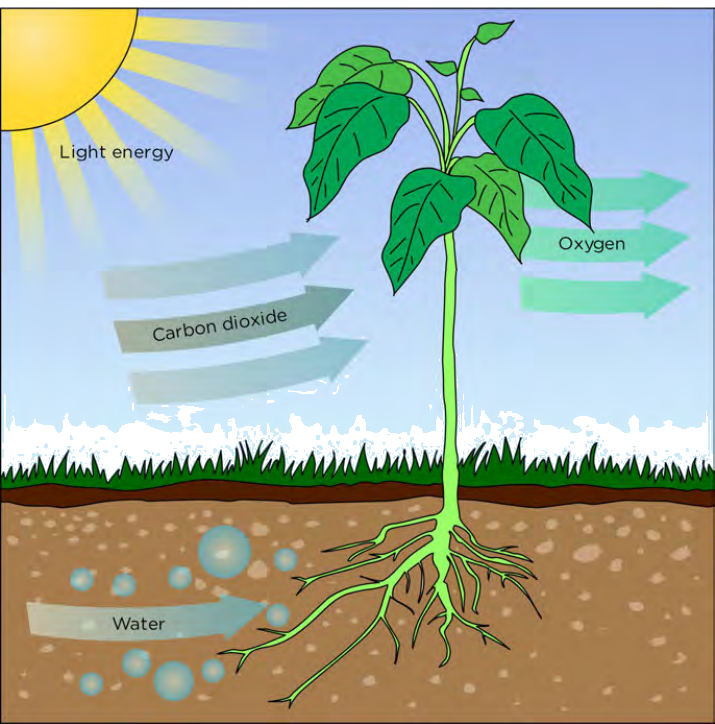
Requirements for Photosynthesis
- Light energy from the sun (radiant energy).
- Carbon dioxide from the air.
- Water from the soil.
- Chlorophyll (the green pigment) and chloroplasts in plant cells.
Products of Photosynthesis
- Glucose (a sugar) is the main product, used for energy and building materials.
- Oxygen is released as a byproduct.
- Glucose can be converted into starch for storage (insoluble in water).
- Glucose can also be converted into cellulose for structural support.
The Chemical Equation
- The simplified equation is: carbon dioxide + water → (in presence of chlorophyll and sunlight) glucose + oxygen.
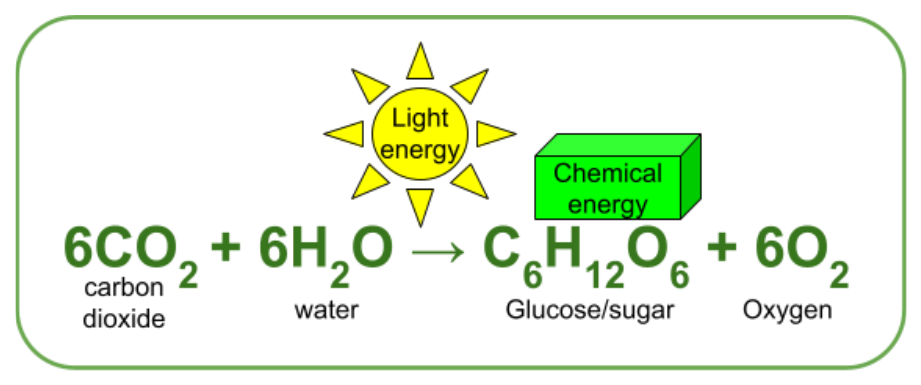
- The balanced chemical equation is: 6CO₂ + 6H₂O → C₆H₁₂O₆ + 6O₂.
- This equation shows the transformation of matter (CO₂ and H₂O) into glucose and oxygen using light energy.
The chemical equation for photosynthesis, showing light energy converted to chemical energy stored in glucose
Glucose Storage and Use
- Plants use glucose for respiration to release energy for life processes.
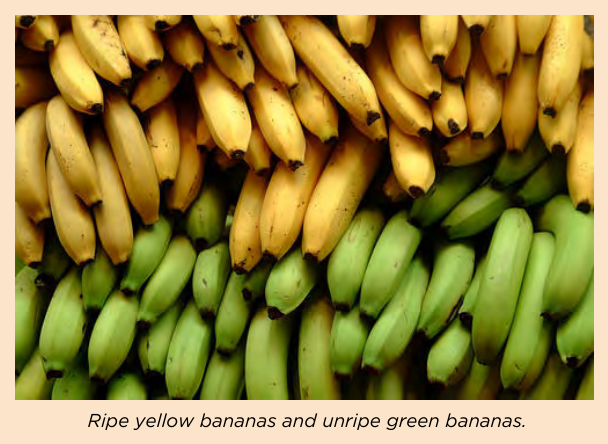
- Excess glucose is stored as starch in leaves, stems, roots, and fruits.
- Starch is insoluble in water, making it suitable for storage.
- Glucose is also converted into other compounds like proteins, oils, and pigments.
Testing for Starch
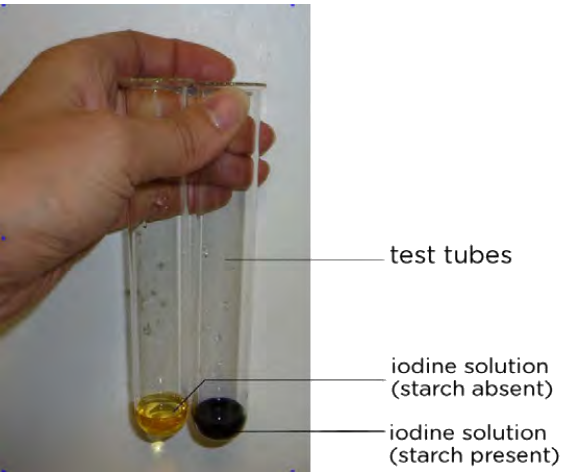
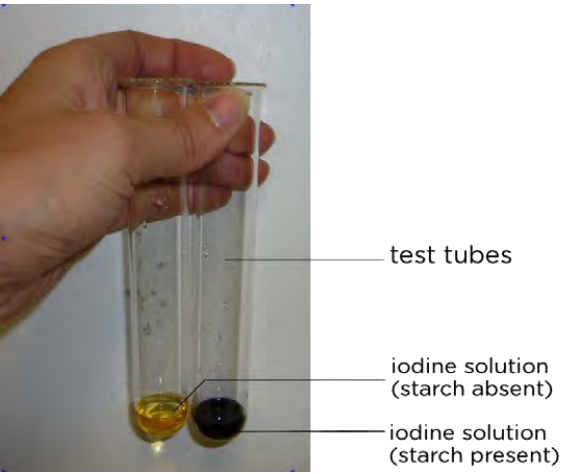
- The iodine test is used to detect starch: iodine solution turns from brownish-orange to dark blue-black in the presence of starch.
- To test a leaf, first remove chlorophyll by boiling in alcohol, then add iodine solution.
- A positive result (blue-black color) indicates starch is present, showing photosynthesis occurred.
- Leaves kept in the dark for 24-48 hours show little or no starch, demonstrating that light is needed for photosynthesis.
Iodine test for starch showing positive (dark blue-black) and negative (brownish-orange) results
Historical Discoveries
- Jan Baptista van Helmont (1600s) showed that a tree's mass comes from water, not soil, but didn't know about carbon dioxide.
- Joseph Priestley (1770s) showed that plants can 'fix' air that candles or mice have 'injured', indicating oxygen production.
- Jan Ingenhousz (1779) showed that plants produce oxygen only in sunlight, linking light to photosynthesis.
Importance of Photosynthesis for Life
- Photosynthesis is the basis of most food chains, as plants are producers.
- It releases oxygen into the atmosphere, essential for aerobic respiration.
- Without photosynthesis, life on Earth would not survive, as energy from the sun would not be captured into food.
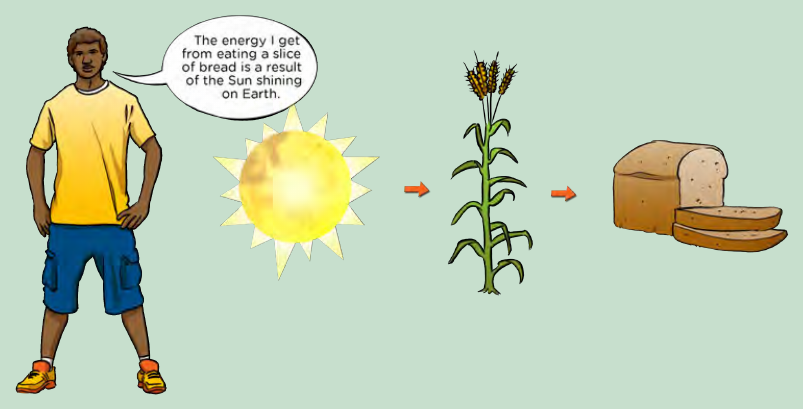
- All organisms ultimately depend on the sun's energy, either directly (plants) or indirectly (herbivores and carnivores).
Flow diagram showing how energy from the sun is captured by wheat through photosynthesis and transferred to humans through bread.
Photosynthesis vs. Respiration
- Photosynthesis uses carbon dioxide and water, produces glucose and oxygen, and requires light energy.
- Respiration uses glucose and oxygen, produces carbon dioxide and water, and releases energy.
- Photosynthesis occurs only in plants, algae, and some bacteria; respiration occurs in all living organisms.
- Photosynthesis happens mainly in daylight; respiration happens all the time (day and night).
Experiments and Investigations
- To show that light is needed for photosynthesis, compare leaves from plants kept in light vs. dark using the starch test.
- Variegated leaves (with green and white parts) can show that only green parts photosynthesize because they contain chlorophyll.
- The lima bean experiment demonstrates that plants need light energy to grow; plants with light grow tall, while those without light die.
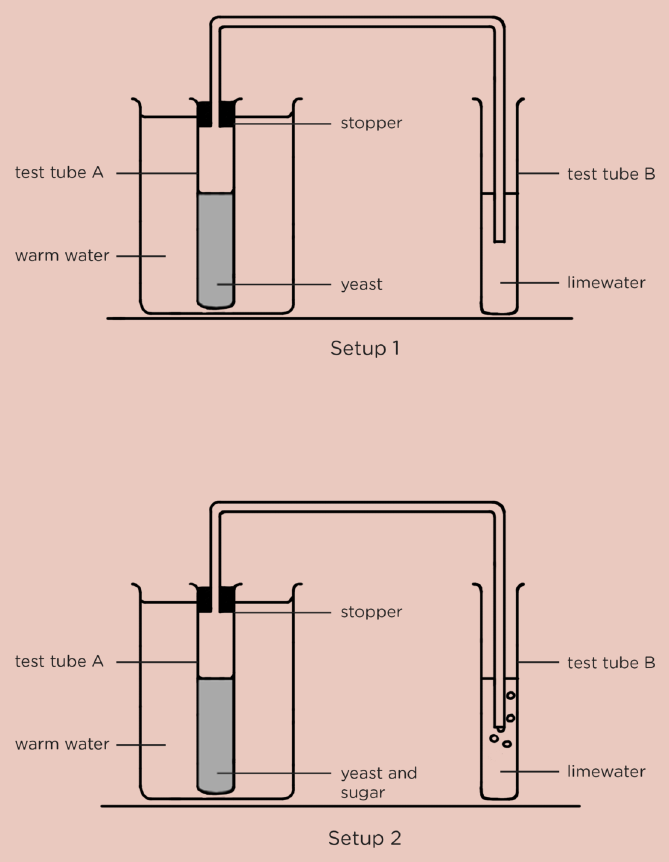
- In the yeast experiment, carbon dioxide is produced by yeast and sugar, which can be detected by limewater turning milky.
Slides
Sign up free to view the lesson slides
Step through every slide for this topic — plus flashcards and revision notes — with a free account.
Practice questions
Free preview — 8 of 45 questions. Sign up to see them all.
1.What is the name of the green pigment that absorbs light energy during photosynthesis?
Easy- Achlorophyll
- Bchloroplast
- Cglucose
- Dstarch
2.Which of the following are raw materials (inputs) for photosynthesis?
Easy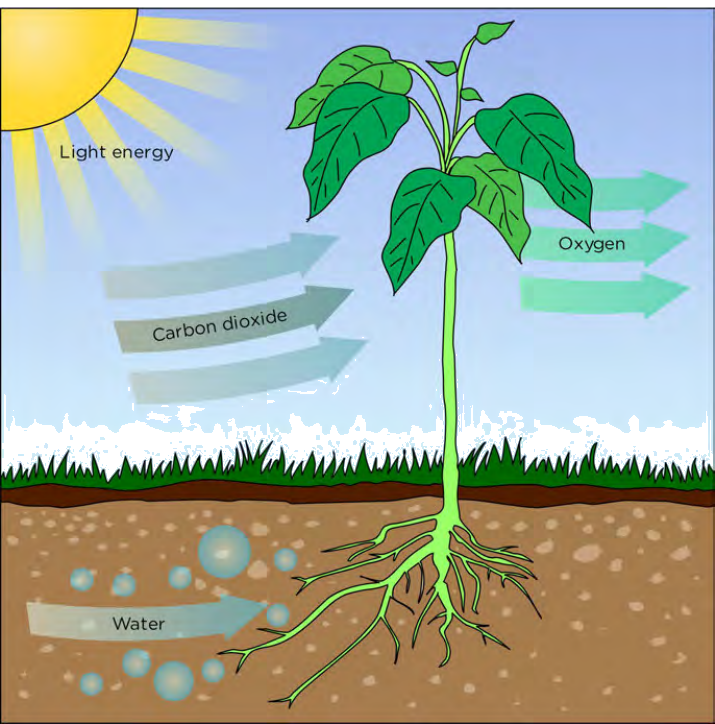
- Acarbon dioxide and water
- Boxygen and glucose
- Csunlight and oxygen
- Dglucose and water
3.Photosynthesis converts radiant energy from the Sun into chemical potential energy stored in glucose.
EasyTrue or false?
4.In which part of a plant cell does photosynthesis take place?
Easy- Achloroplast
- Bnucleus
- Ccell wall
- Dvacuole
5.Plants only photosynthesise during the day, but they respire all the time.
EasyTrue or false?
6.Why do plants convert glucose into starch?
Easy- AStarch is soluble in water and can be transported easily.
- BStarch is insoluble and can be stored without affecting water balance.
- CStarch provides more energy than glucose.
- DStarch is used directly in respiration.
7.A plant is kept in a dark cupboard for 48 hours. When a leaf is tested with iodine solution, what colour would you expect and why?
Easy- ABlue-black; starch is present because photosynthesis continued in the dark.
- BBrown-orange; no starch is present because photosynthesis could not occur without light.
- CGreen; chlorophyll is still present.
- DClear; the leaf has no starch.
8.Match each term with its correct description.
Medium- Chlorophyll
- Glucose
- Starch
- Green pigment that absorbs light
- Soluble sugar produced in photosynthesis
- Insoluble storage form of glucose
Unlock all 45 questions, flashcards & more
Create a free account to see every question, the slides, flashcards and revision notes for this topic.