The fossil record and common ancestry
Learn it by playing
Answer these questions to earn energy, then fish and explore. No account needed.
Lesson notes
Fossil Record Basics
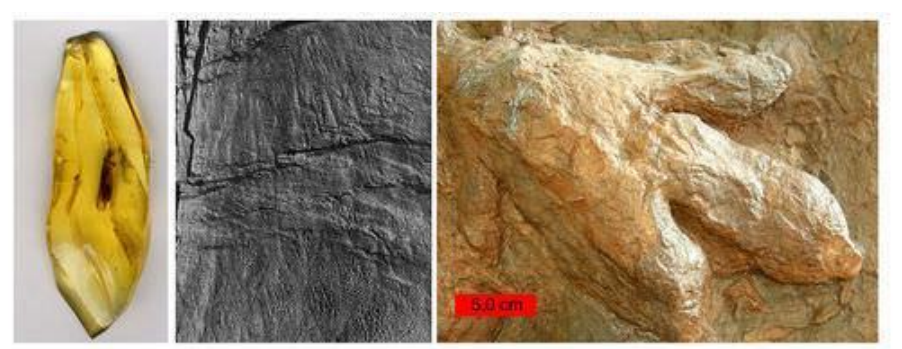
- Fossils are preserved remains of ancient organisms, usually hard parts like bones and teeth, but also footprints, burrows, eggs, and amber.
- Paleontologists study fossils to learn about past life.
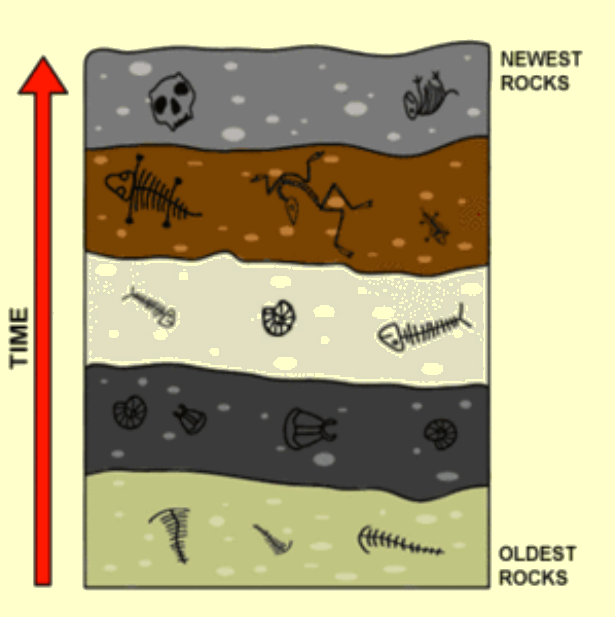
- Fossils are found in rock layers; deeper layers are older, so fossil age can be determined by its layer.
- The fossil record is the ordered appearance of fossils in rock layers, providing evidence of when organisms lived, evolved, and went extinct.
- Fossil record documents existence, diversity, extinction, and change of life forms over Earth's history.
Different types of fossils: amber preserving an insect, stone etching an impression of skin, and a rock preserving a footprint.
Evidence from Rock Layers
- Newer rock layers form on top of older ones, so the deepest layers are the oldest.
- Consecutive rock layers show different species, indicating change over time.
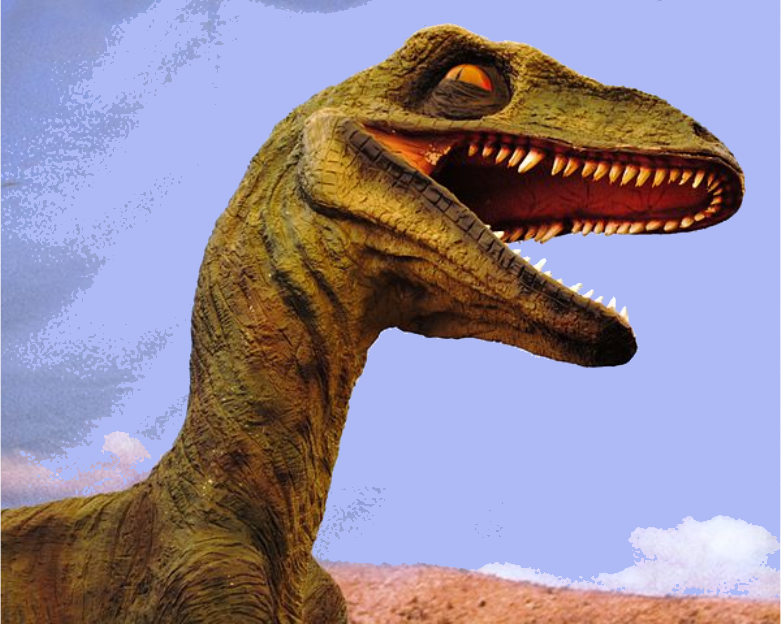
- The Utahraptor fossil, found in 1991, is the largest raptor in Utah and shares traits with modern birds.
- Fossils in rock layers help estimate when and how species change over time.
Rock layers with fossils: newer rocks and their fossils sit on top, older rocks and their fossils sit at the bottom.
Common Descent and Evolution
- Common descent occurs when different species evolve from a common ancestor.
- Paleontologists have found evidence of common descent in the fossil record, supporting the theory of evolution.
- Fossils allow comparison of anatomy to determine relationships, when species lived, and when they went extinct.
Similar Structures in Fossils
- Scientists group animals into families using skeletal structure, skull size/shape, and teeth.
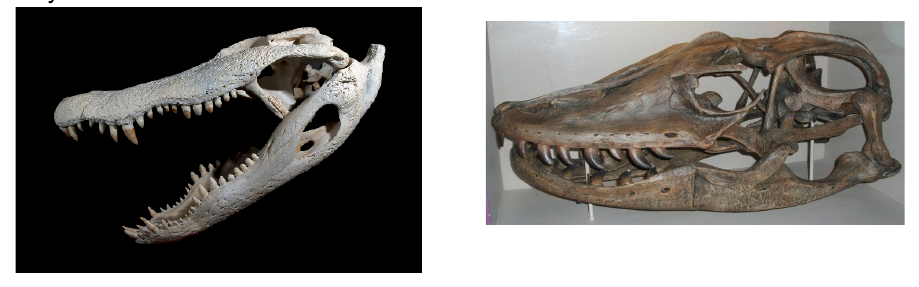
- Example: a modern crocodile skull and the skull of the ancient megalania, one of the crocodile's ancestors, show similar shape and teeth.
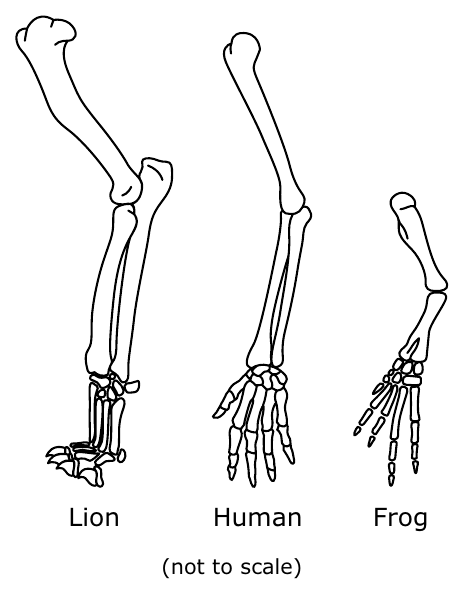
- Comparing ancient and modern organisms reveals patterns of body structure similarities and differences.
A modern crocodile skull next to the skull of the ancient megalania, one of the crocodile's ancestors.
Uintatherium: A Shared Ancestor
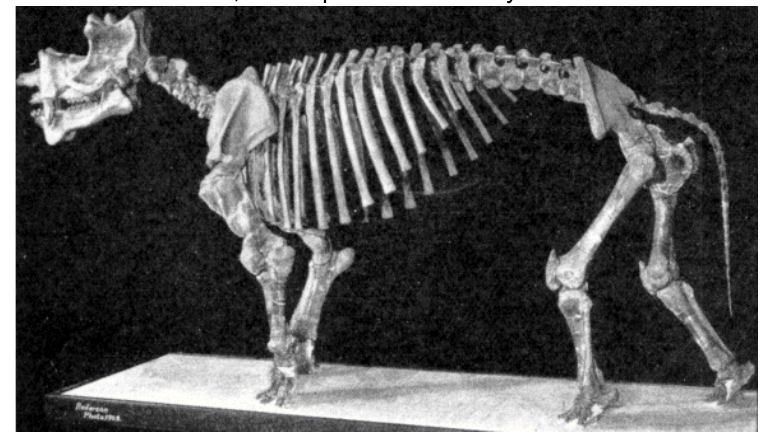
- Both the modern elephant and the modern whale are related to the Uintatherium, an animal that lived over 50,000 years ago.
- Comparing the Uintatherium skeleton to the elephant skeleton shows similarities in the toes.
- Comparing the Uintatherium skeleton to the whale skeleton shows small remnant pelvis and leg bones in the whale, in the same place as the Uintatherium's hip and leg bones.
- These shared, matching bone patterns are evidence that elephants and whales are related through a common ancestor, even though they look very different today.
Skeleton of a Uintatherium.
Vestigial Structures
- Vestigial structures are leftover body parts that had a function in ancestors but are reduced or unused now.
- The human tailbone (coccyx) is a vestigial structure left over from tailed ancestors.
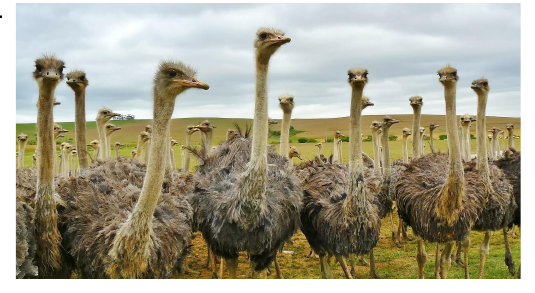
- Ostrich wings are vestigial; they are too small for flight, showing change over generations.
- Vestigial structures support evolution and show how species have changed over time.
A group of ostriches; their wings are too small to allow flight.
Anatomical Evidence for Relationships
- Scientists use bone structures, similarities in teeth, and features of muscle attachment to infer relationships.
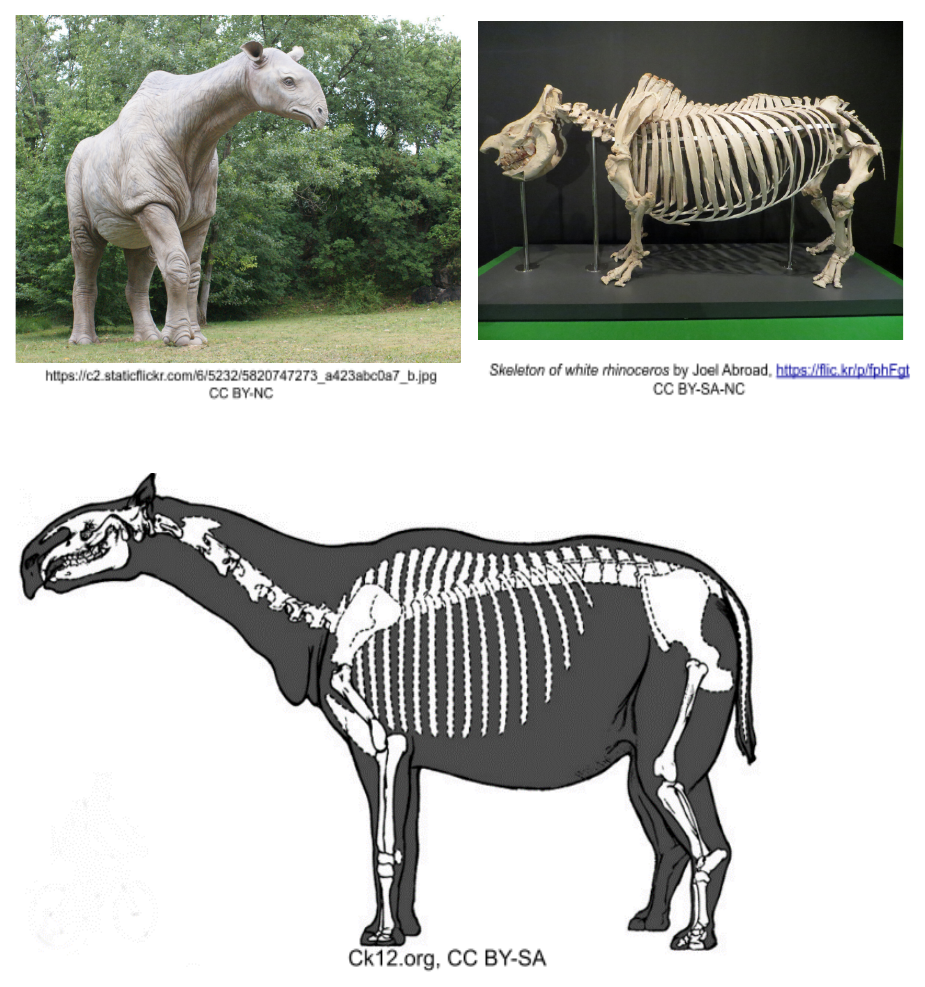
- Example: the extinct Paraceratherium, which stood over 16 feet tall, has a skeleton that closely resembles the skeleton of a modern white rhinoceros.
- Anatomical evidence from fossils helps support the theory of evolution.
A modern white rhinoceros (photo and skeleton) alongside a skeleton reconstruction of the extinct Paraceratherium (bottom).
Comparative Embryology
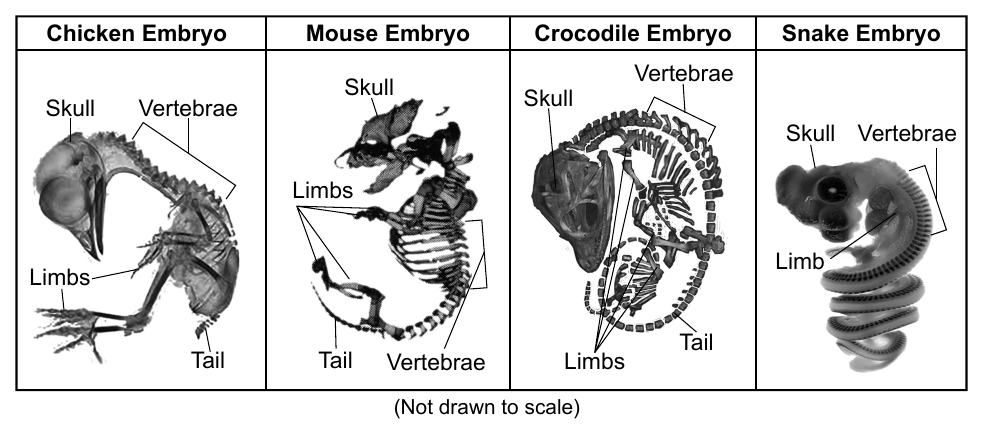
- Comparative embryology is the study of similar patterns among embryos of different species.
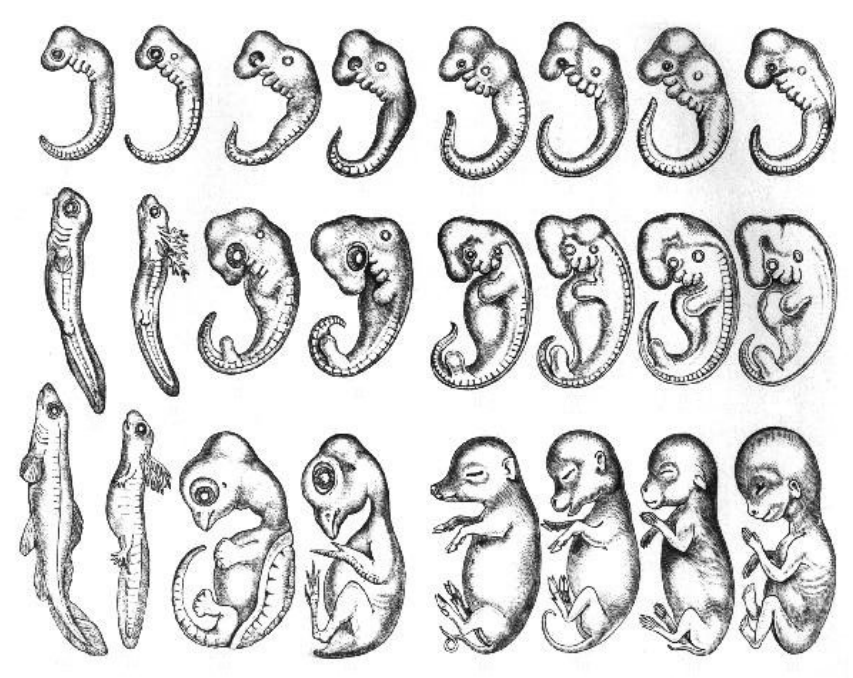
- Early scientists compared drawings of embryos of several species side by side and found strong similarities in early stages.
- All animals with a backbone have gill slits and tails at some point in their embryonic development, even species that never have them as adults.
- These embryonic similarities are evidence of common ancestry, though the original comparison drawings were simplified and are still debated.
Embryos of several backbone-having animals side by side at three developmental stages, showing shared early features such as tails.
Embryonic Development in Humans
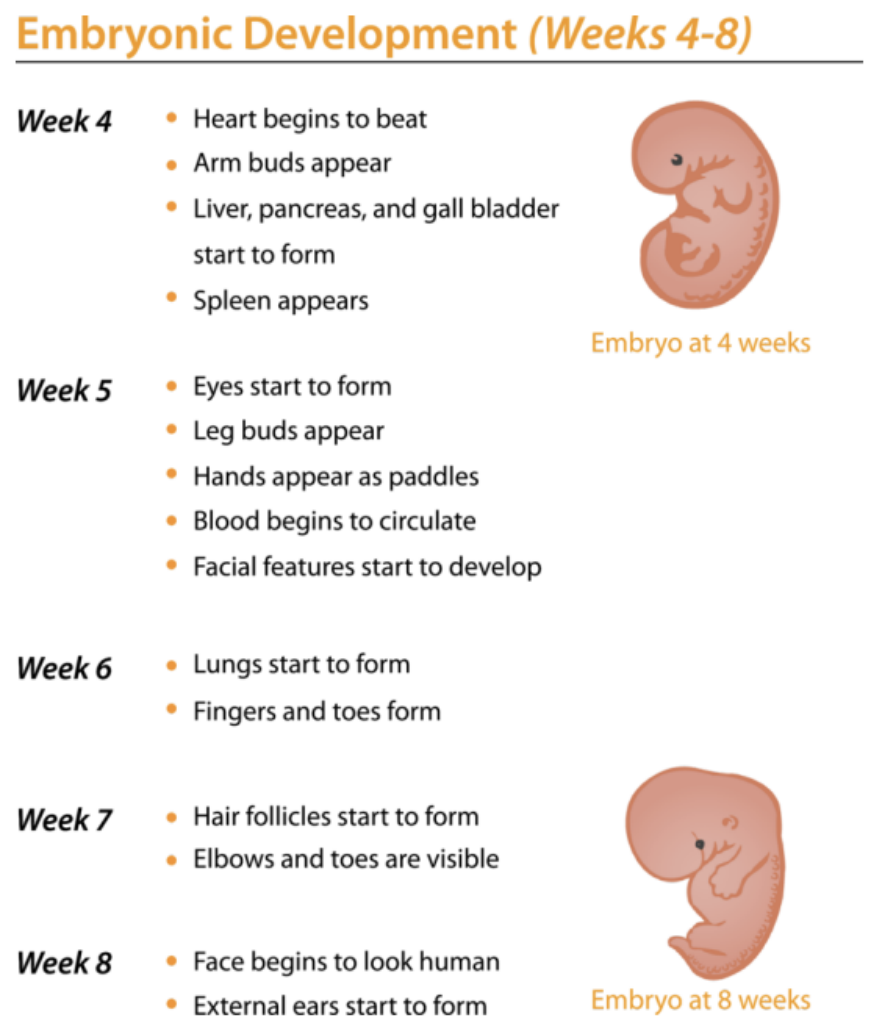
- The human embryonic stage lasts through the eighth week after fertilization.
- During weeks 4-8, the embryo grows, becomes more complex, and develops organs, limb buds, and facial features.
- By week 8, the human embryo is about 30 millimeters long and has begun to move.
- Embryonic similarities across species are evidence of evolution.
Embryonic development from week 4 to week 8: the heart, limb buds, eyes, lungs, and fingers and toes appear in sequence.
Fossil Evidence of Evolution
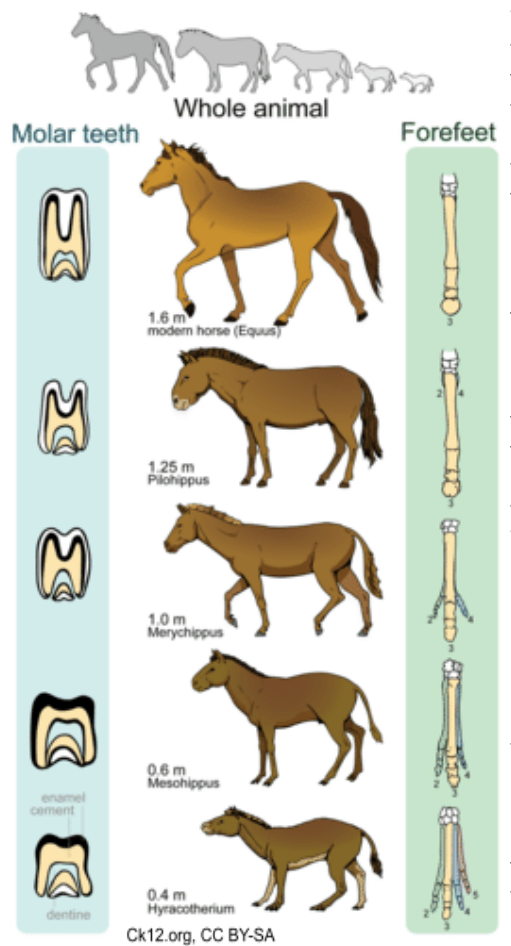
- Horse fossils show evolution: the earliest horses were fox-sized with four long toes and lived in wooded marshlands, eating soft leaves.
- As grasslands replaced marshes, horses changed: they became taller, evolved a single large toe that became a hoof, and developed longer molars covered with cement for grinding tough grasses.
- Similar fossil evidence documents the evolution of the whale, moving from land into the sea.
- Plant fossils show evolution from aquatic green algae to land plants with vascular tissue, seeds, and flowers.
Evolution of the horse: changes in molar teeth, whole-animal size, and forefeet from Hyracotherium to the modern horse.
Slides
Sign up free to view the lesson slides
Step through every slide for this topic — plus flashcards and revision notes — with a free account.
Practice questions
Free preview — 8 of 43 questions. Sign up to see them all.
1.What is the term for the preserved remains of animals, plants, and other organisms from the distant past?
Easy- AFossil
- BEmbryo
- CVestigial structure
- DCommon ancestor
2.Paleontologists are scientists who study fossils to learn about life in the past.
EasyTrue or false?
3.In the fossil record, which layer of rock contains the oldest fossils?
Easy- AThe topmost layer
- BThe deepest layer
- CThe middle layer
- DAll layers are the same age
4.Which of the following is NOT a type of fossil?
Easy- ABones
- BFootprints
- CAmber-preserved insects
- DLiving animals
5.The fossil record provides evidence for when organisms lived, how species evolved, and how some species became extinct.
EasyTrue or false?
6.The deepest rock layers are the oldest, so fossils found there are older than fossils in the layers above.
EasyTrue or false?
7.Match each type of evidence with its description.
Medium- Fossil record
- Comparative embryology
- Vestigial structures
- Preserved remains in rock layers showing change over time
- Similarities in the development of embryos
- Leftover structures with no current function
8.Based on the fossil record, put the following events in horse evolution in the order they occurred, from earliest to latest.
Medium- Horses were fox-sized, had four long toes, and lived in wooded marshlands.
- Grasslands slowly replaced marshes as the climate became drier.
- Horses became taller, which helped them see predators over tall grass.
- Horses evolved a single large toe that became a hoof, helping them run and escape predators.
- Horses evolved longer molars covered with cement, letting them grind tough grasses.
Unlock all 43 questions, flashcards & more
Create a free account to see every question, the slides, flashcards and revision notes for this topic.