Defining engineering problems
Learn it by playing
Answer these questions to earn energy, then fish and explore. No account needed.
Lesson notes
What Is Engineering Design?
- Engineering design is a step-by-step process: engineers build a version of a solution, test it, and use what they learn to improve it.
- Step 1 — Identify the problem. State the problem clearly and define the criteria and constraints it must satisfy.
- Step 2 — Generate ideas. Use research, brainstorming, and collaboration with others to come up with possible solutions.
- Step 3 — Evaluate. Use the criteria and constraints to judge the possible solutions and identify the one that best fits the problem.
- Step 4 — Build and test. Build a prototype and collect data on how well it performs.
- Step 5 — Optimize. Use the test data to suggest or make improvements to the design.
Criteria and Constraints
- Criteria are the requirements a solution must meet to count as successful — for example, that a structure be safe, affordable, or usable for its purpose.
- Constraints are the limits placed on the solution — for example, an available budget, the materials on hand, building codes, or the site itself.
- The same fact can work as both: a $200 million budget is a constraint because it limits what can be built, and "stay within budget" is also a criterion the finished design must meet.
- Defining a problem with real precision means stating criteria and constraints specifically enough that a solution can be judged against them — not just "make it safe."
Considering Stakeholders
- A stakeholder is anyone affected by a design or its outcome — the people who will use it, pay for it, or be put at risk if it fails.
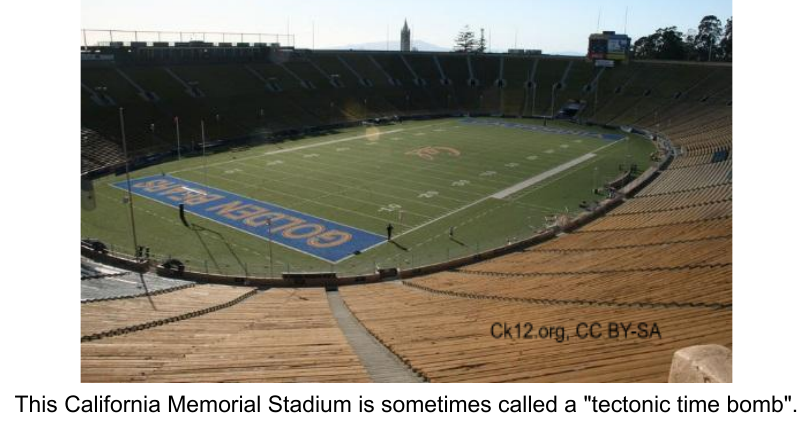
- When California Memorial Stadium was renovated for earthquake safety, the goal was stated in terms of three stakeholder groups: the workers building it, the players using the field, and the fans filling the stands.
- Naming stakeholders sharpens the criteria: a stadium's safety criterion is only precise once it states who must be kept safe, and under what conditions.
- A design that meets every technical requirement but ignores a stakeholder group's needs has not actually solved the problem.
Two Kinds of Engineering Tasks
- A designing task asks the engineer to define the problem, generate several possible solutions, and then optimize one of them.
- An evaluating task skips "generate solutions": several solutions are already provided, and the job is to define criteria and constraints precisely enough to judge which one is best.
- A standard that asks students to "evaluate competing design solutions" is an evaluating task — the criteria and constraints still have to be identified, but the solutions being judged are already on the table.
Worked Example: Defining the Stadium Problem
- California Memorial Stadium, built in 1922, sits directly on the Hayward Fault — the ground beneath both end zones can shift in an earthquake.
- The problem: keep the stadium safe and usable when the ground it sits on could rupture at any time.
- Criteria: the renovated stadium had to protect workers, players, and fans, and remain usable as a football stadium.
- Constraints: the existing 1922 structure had to stay in use, the fault itself could not be moved, and the project had a real budget.
- The renovation cost $321 million and used 10 miles of steel cables and shock absorbers so that the stadium can move independently of the ground on either side of the fault.
California Memorial Stadium, built on the Hayward Fault
Worked Example: Using Hazard Data to Set Constraints
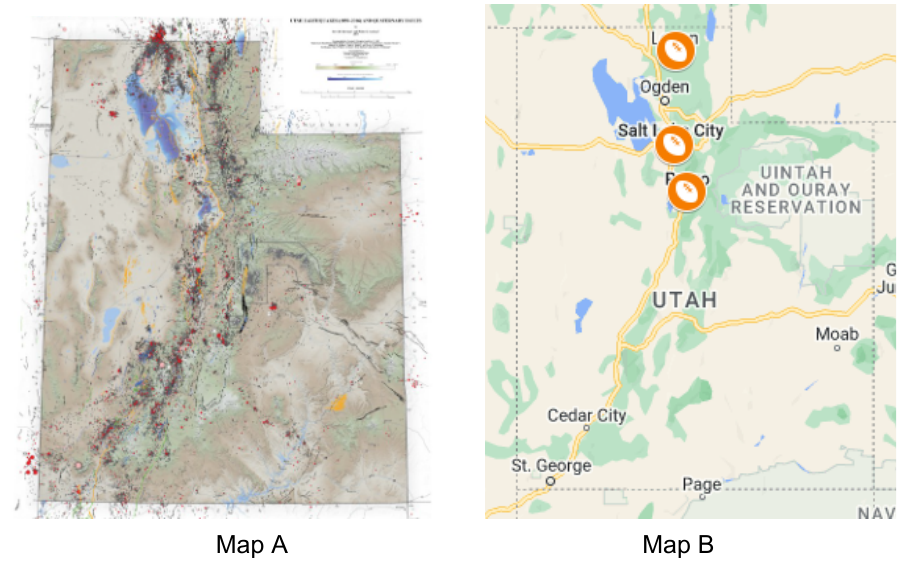
- Utah's three oldest university football stadiums (University of Utah, BYU, Utah State) were built between 1965 and 1998, before earthquake-resistant features were required.
- A geologic hazard map of Utah shows where earthquakes occur most often, concentrated in a band running through the middle of the state.
- Comparing stadium locations to the hazard map lets an engineer state a constraint precisely: is a given site inside the high-frequency band or outside it?
- That comparison is the argument for adding earthquake-resistant features to a stadium sitting inside the high-frequency band, and a weaker argument for one built well outside it.
Utah earthquake frequency (Map A) and stadium locations (Map B)
Cost as a Constraint
- Not every structure in an earthquake zone is built for maximum safety, because sturdier construction costs more.
- Communities have to weigh how severe the hazard is against what different levels of protection would cost, and make an informed decision.
- In 2013, the San Francisco–Oakland Bay Bridge's eastern span was replaced with an earthquake-resistant design — a case where the safety criterion was judged worth the cost.
- Cost is why "make it as safe as possible" is not a usable criterion on its own: a real design problem states how safe, for how much.
Slides
Sign up free to view the lesson slides
Step through every slide for this topic — plus flashcards and revision notes — with a free account.
Practice questions
Free preview — 8 of 26 questions. Sign up to see them all.
1.What is the first step in the engineering design process?
Easy- AIdentifying the problem and defining criteria and constraints
- BGenerating ideas for how to solve the problem
- CBuilding and testing prototypes
- DMaking improvements to prototypes
2.Criteria are the limitations or restrictions that a design must satisfy.
EasyTrue or false?
3.Which of the following is an example of a constraint when designing a building in an earthquake-prone area?
Easy- AThe building must be able to withstand an earthquake of magnitude 7.0
- BThe building must have enough seating for 50,000 people
- CThe building must be completed within a budget of $300 million
- DThe building must provide clear views of the field from all seats
4.What is the primary reason why not all structures in earthquake zones are constructed for maximum safety?
Easy- ALack of engineering knowledge
- BCost considerations
- CBuilding codes prohibit it
- DEarthquakes are rare in those zones
5.An engineer is designing a bridge in an area prone to landslides. Which of the following would be a critical constraint to consider?
Medium- AThe bridge must be aesthetically pleasing
- BThe bridge must be able to withstand sudden rock falls
- CThe bridge must have a specific number of lanes
- DThe bridge must be made of a certain color of concrete
6.An engineer is designing a bridge in an area with frequent earthquakes. Which of the following would be a criterion for the design?
Medium- AThe bridge must be built within a budget of $50 million
- BThe bridge must be completed within two years
- CThe bridge must be able to withstand an earthquake of magnitude 8.0
- DThe bridge must use only locally sourced materials
7.A city is designing a new hospital in an area with a high risk of landslides. Which of the following would be the most important criterion for the design?
Medium- AThe hospital must have a helipad on the roof
- BThe hospital must be able to keep operating during and after a landslide
- CThe hospital must be built within a budget of $100 million
- DThe hospital must have a specific number of beds
8.Which of these was a criterion for the California Memorial Stadium renovation, rather than a constraint?
Medium- AThe existing 1922 structure had to remain in use
- BThe project had a real, limited budget
- CThe renovation had to protect workers, players, and fans
- DThe Hayward Fault could not be relocated

Unlock all 26 questions, flashcards & more
Create a free account to see every question, the slides, flashcards and revision notes for this topic.