Gravity and gravitational interactions
Learn it by playing
Answer these questions to earn energy, then fish and explore. No account needed.
Lesson notes
Gravity: A Force of Attraction
- Gravity is a force of attraction between objects that have mass.
- Any object with mass exerts gravity on other matter, no matter how small.
- Gravity is a field force (non-contact force) that acts over a distance.
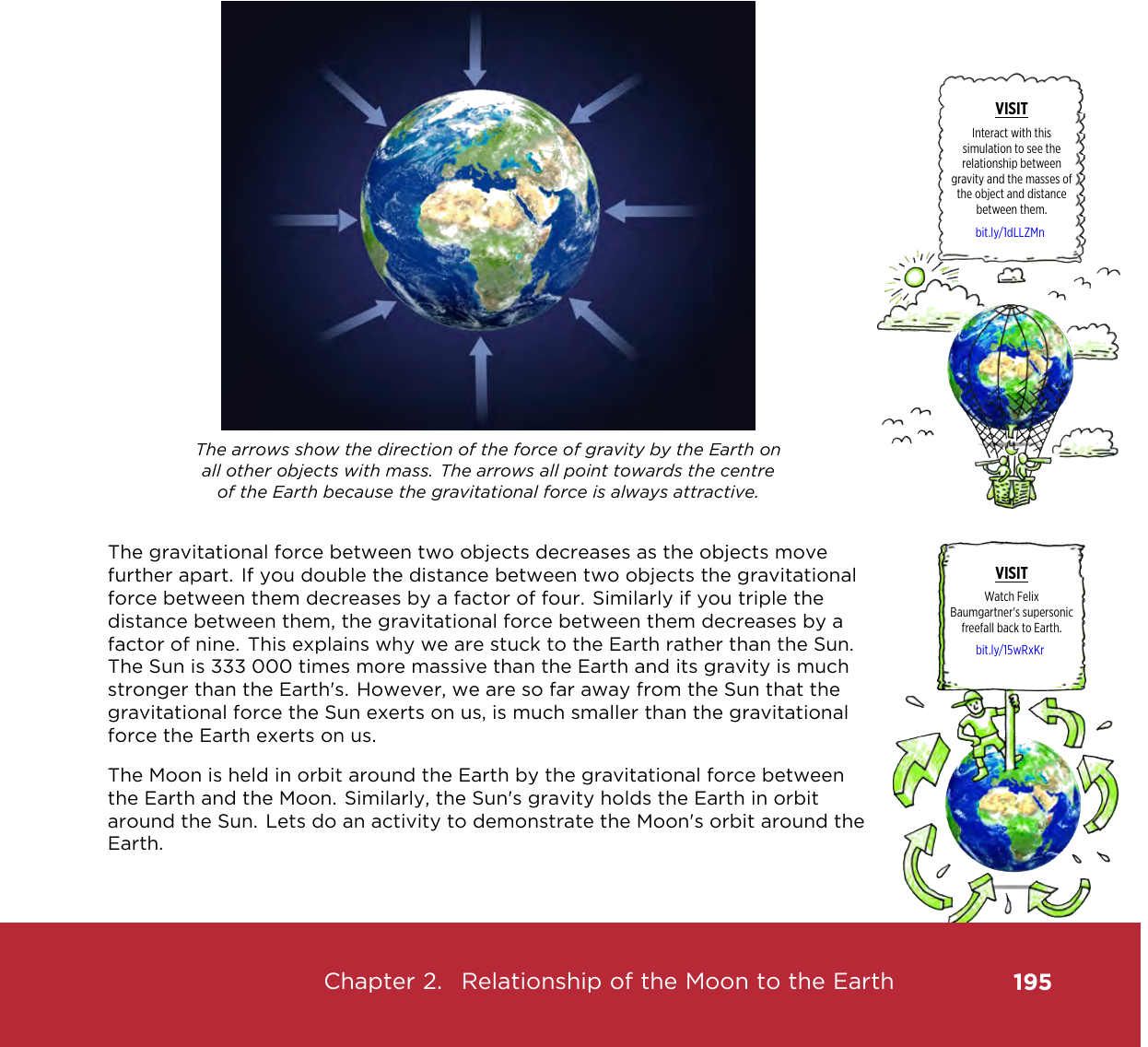
- Gravity is always attractive; it pulls objects toward each other.
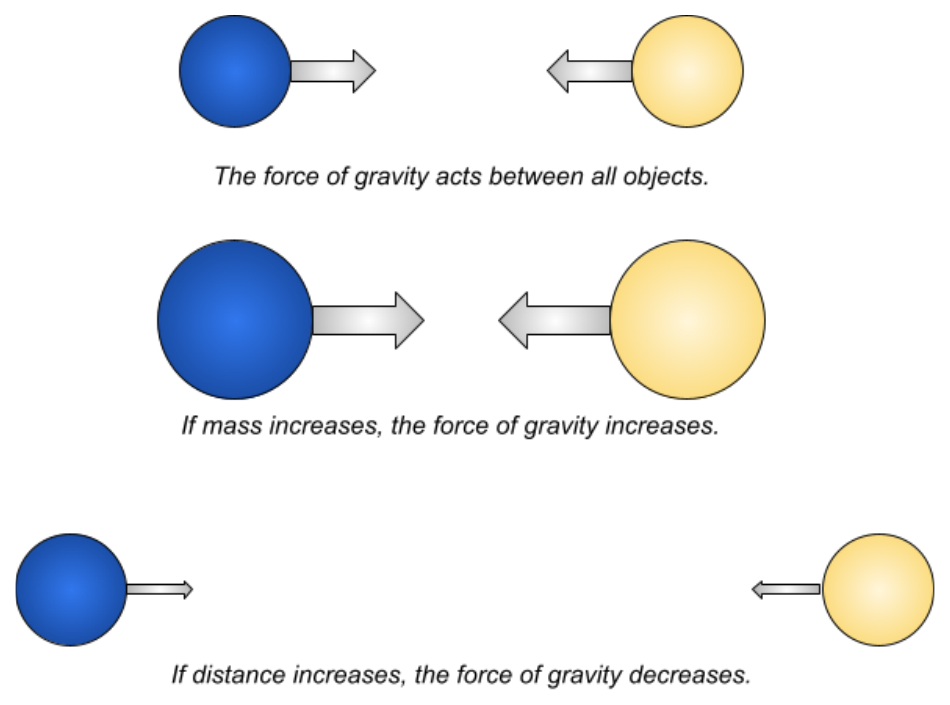
- The gravitational force between objects decreases as the distance between them increases.
Arrows pointing towards the center of the Earth illustrating the direction of gravity.
Factors Affecting Gravitational Strength
- The strength of gravity between two objects depends on two factors: their masses and the distance between them.
- Greater mass results in a stronger gravitational pull.
- Greater distance results in a weaker gravitational force.
- The Sun is 333,000 times more massive than Earth, but we are much closer to Earth, so Earth's gravity affects us more.
Diagrams showing that gravity acts between all objects, gets stronger when mass increases, and gets weaker when distance increases.
Mass vs. Weight
- Mass is the amount of matter in an object, measured in kilograms (kg).
- Mass is independent of location; an object's mass is the same on Earth and the Moon.
- Weight is the force of gravity acting on an object, measured in Newtons (N).
- Weight depends on mass and the strength of gravity (gravitational acceleration, g).
- Weight changes with location; on the Moon, you weigh one-sixth of your Earth weight.
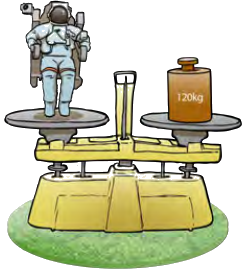
An astronaut on a scale balanced with a 120kg weight
Weight Calculation
- Weight is calculated using the formula: W = m × g
- W is weight in Newtons (N), m is mass in kilograms (kg), and g is gravitational acceleration in m/s².
- On Earth, g ≈ 9.8 m/s²; on the Moon, g ≈ 1.6 m/s².
- Example: A 60 kg person weighs 60 × 9.8 = 588 N on Earth and 60 × 1.6 = 96 N on the Moon.
- A spring scale measures weight; a triple beam balance measures mass.
Gravity in the Solar System
- The Sun's mass is about 98% of the total mass of the solar system.
- The Sun's gravity holds the planets in orbit; the planets exert an equal and opposite force on the Sun.
- The Moon is held in orbit around Earth by gravitational force.
- The gravitational force between objects keeps the planets rotating around the Sun.
- The Moon is slowly moving away from Earth at a rate of 3.8 cm per year.
Gravity and the Apollo 11 Mission
- The Saturn V rocket needed ~898,698 gallons of fuel to escape Earth's gravity.
- The rocket had a mass of 6.2 million kg at launch; the command module returned with a mass of 55,557 kg.
- The fuel needed to leave Earth's gravity was much greater than that needed to leave the Moon's gravity because Earth has more mass than the Moon.
- The Saturn V rocket was ejected after leaving Earth's orbit and fell back to Earth.
- The lunar module used less fuel to lift off from the Moon due to the Moon's weaker gravity.
Gravity and Orbits
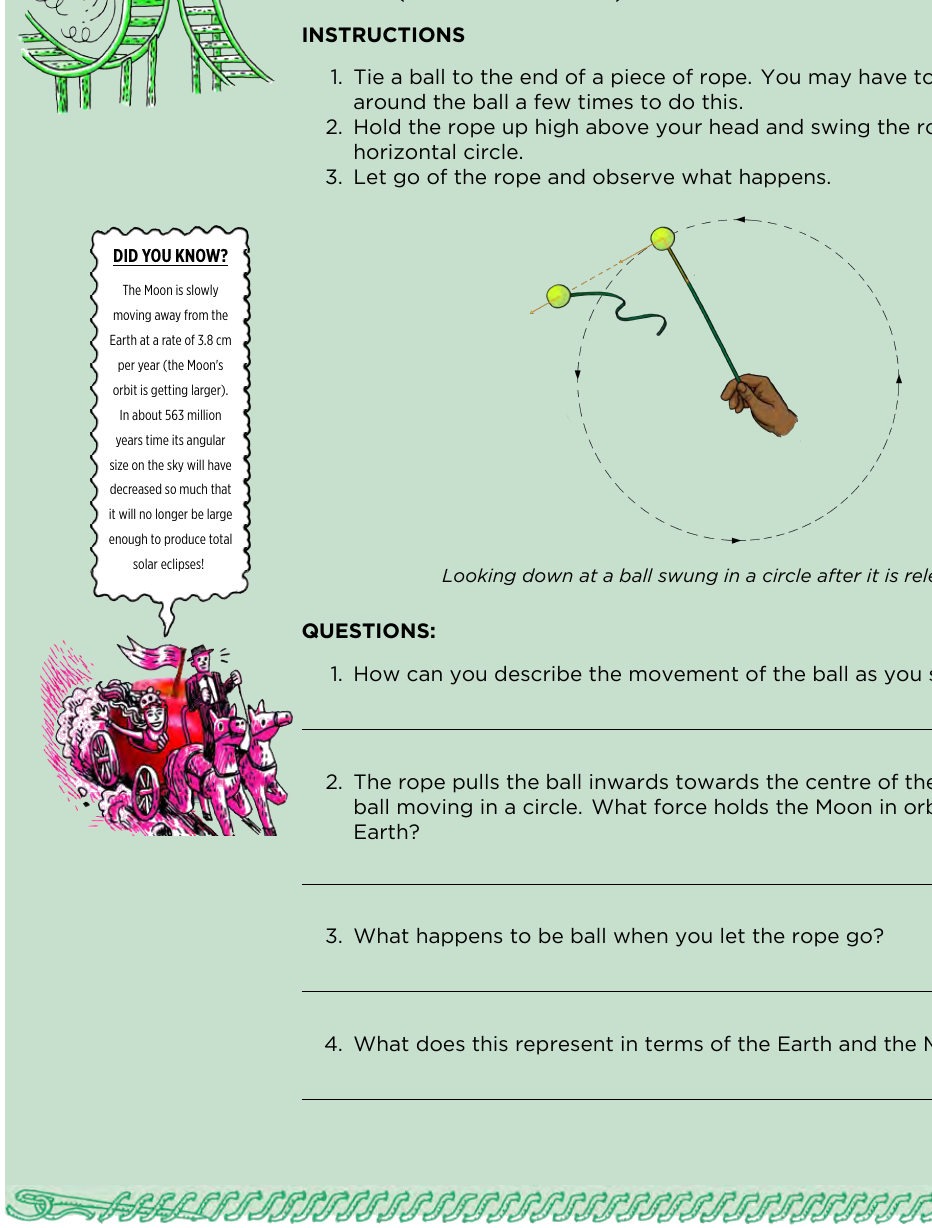
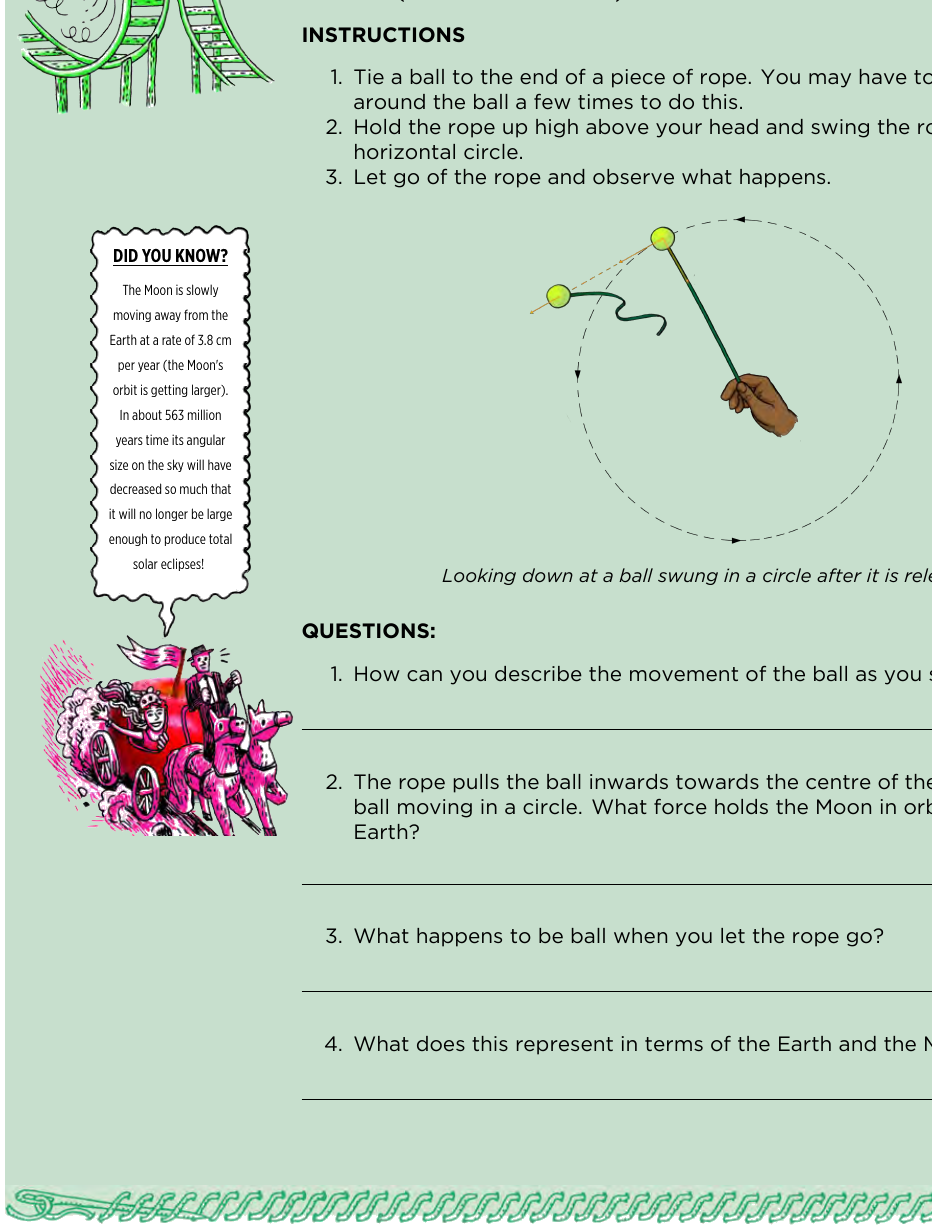
- Gravity provides the centripetal force that keeps objects in orbit.
- The Moon orbits Earth because of the gravitational attraction between them.
- The Sun's gravity holds Earth in orbit around the Sun.
- If the rope is released in the ball-on-a-rope activity, the ball flies off in a straight line, representing what would happen if gravity were absent.
- All components in the Universe are held together by gravity.
A hand swinging a ball on a rope in a circle, illustrating centripetal force and orbits.
Gravity on Other Planets
- The strength of gravity on the Moon is one-sixth that of Earth.
- On Jupiter, you would weigh 2.5 times more than on Earth.
- Gravitational acceleration values vary: Mercury 3.6 m/s², Venus 8.8 m/s², Mars 3.8 m/s², Jupiter 26 m/s², Saturn 11.2 m/s², Uranus 10.5 m/s², Neptune 13.3 m/s².
- Your mass remains the same on any planet; only your weight changes.
- You would feel heavier on planets with stronger gravity (Jupiter, Neptune, Saturn) and lighter on planets with weaker gravity (Mercury, Mars, Moon).
Key Takeaways
- Gravity is a fundamental force that attracts objects with mass.
- The strength of gravity depends on mass and distance.
- Mass is constant; weight varies with gravity.
- Gravity holds planets, moons, and objects in orbit.
- The Apollo 11 mission illustrates the effect of gravity on fuel requirements.
Slides
Sign up free to view the lesson slides
Step through every slide for this topic — plus flashcards and revision notes — with a free account.
Practice questions
Free preview — 8 of 41 questions. Sign up to see them all.
1.Gravity is a force of attraction between objects that have mass.
Easy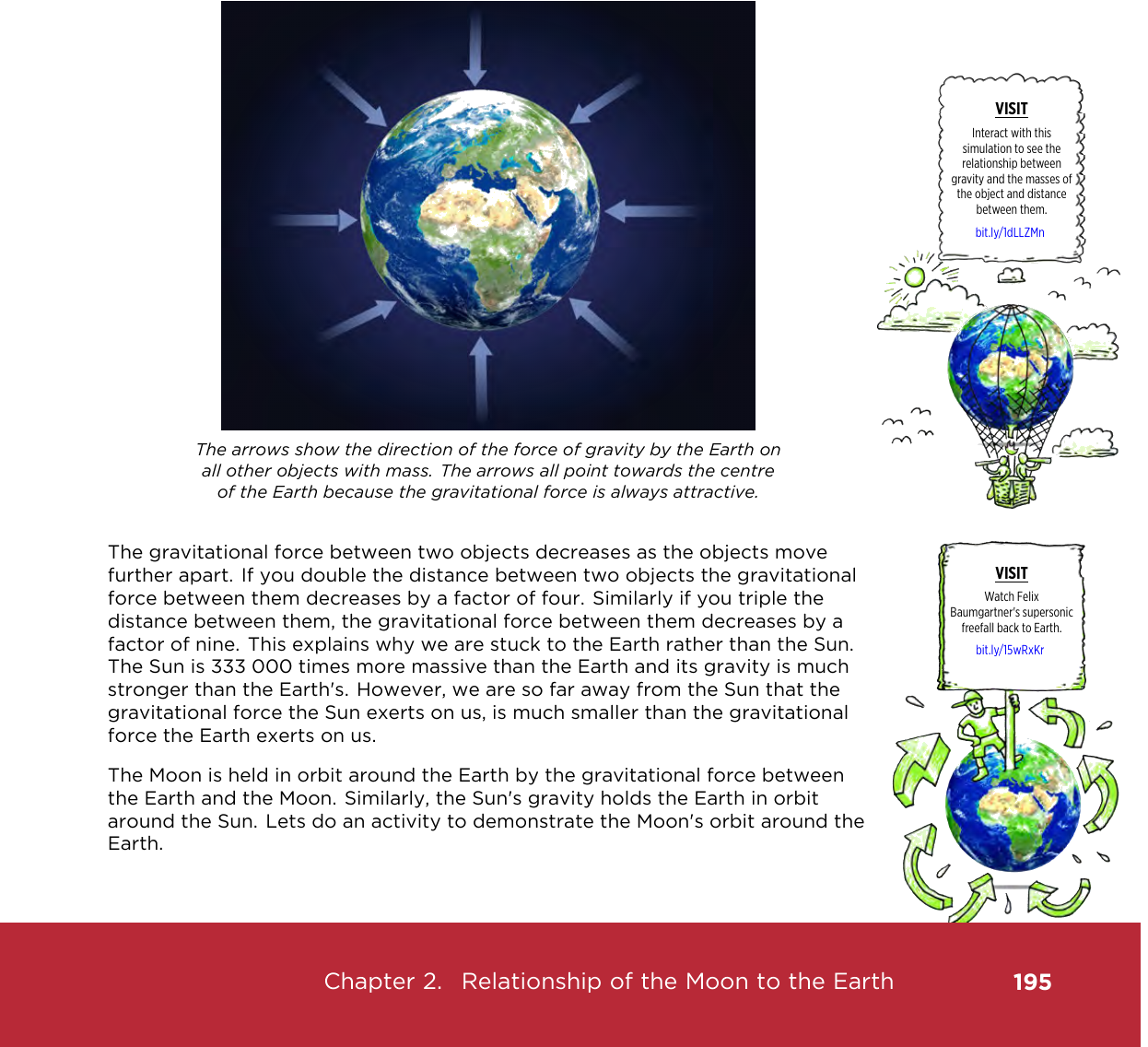
True or false?
2.Gravity can only act between objects that are touching.
EasyTrue or false?
3.Which of the following is the unit of gravitational force?
Easy- ANewton
- BKilogram
- CNewton per kilogram
- DJoule
4.The gravitational force between two objects increases as the distance between them increases.
EasyTrue or false?
5.Which of the following factors affect the gravitational force between two objects?
Easy- AMass and distance
- BMass and temperature
- CDistance and colour
- DTemperature and colour
6.An object's mass is the same everywhere in the universe.
EasyTrue or false?
7.An object's weight is the same everywhere in the universe.
EasyTrue or false?
8.An astronaut has a mass of 80 kg on Earth. What is the astronaut's mass on the Moon?
Easy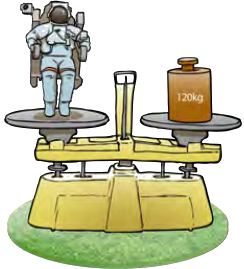
- A80 kg
- B13.3 kg
- C80 N
- D13.3 N
Unlock all 41 questions, flashcards & more
Create a free account to see every question, the slides, flashcards and revision notes for this topic.