The human nervous system
Lerne es beim Spielen
Beantworte diese Fragen für Energie, dann angle und erkunde. Kein Konto nötig.
Lektionsnotizen
The Nervous System: Structure and Function
- The human nervous system consists of the central nervous system (CNS) – the brain and spinal cord – and the peripheral nervous system (PNS) – all of the nerves in the body.
- Information is sent through the nervous system as electrical impulses – electrical signals that pass along nerve cells known as neurones.
- A bundle of neurones is known as a nerve.
- The nervous system enables humans to react to their surroundings and to coordinate their behaviour.
- The pathway through the nervous system is: stimulus → receptor → coordinator → effector → response.
- The CNS is the coordinator that coordinates the response of effectors, which may be muscles contracting or glands secreting hormones.
Neurones and Synapses
- Neurones have a cell body (where the nucleus and main organelles are found) and cytoplasmic extensions called axons and dendrites.
- The axon is insulated by a fatty myelin sheath with small uninsulated sections called nodes, which the impulse jumps along.
- There are three main types of neurones: sensory neurones carry impulses from sense organs to the CNS; relay neurones are found inside the CNS and connect sensory and motor neurones; motor neurones carry impulses from the CNS to effectors (muscles or glands).
- Neurones never touch each other; they are separated by junctions called synapses.
- At a synapse, the electrical impulse triggers the release of chemical messengers called neurotransmitters from vesicles; these diffuse across the synaptic gap and bind with receptor molecules on the postsynaptic membrane.
- The neurotransmitters are then destroyed or recycled to prevent continued stimulation of the second neurone.
- Synapses ensure that impulses only travel in one direction, avoiding confusion within the nervous system.
The Reflex Arc
- A reflex response (involuntary response) does not involve the conscious part of the brain as the coordinator; awareness of the response occurs after it has been carried out.
- Reflex actions are automatic and rapid – this helps to minimise damage to the body and aids survival.
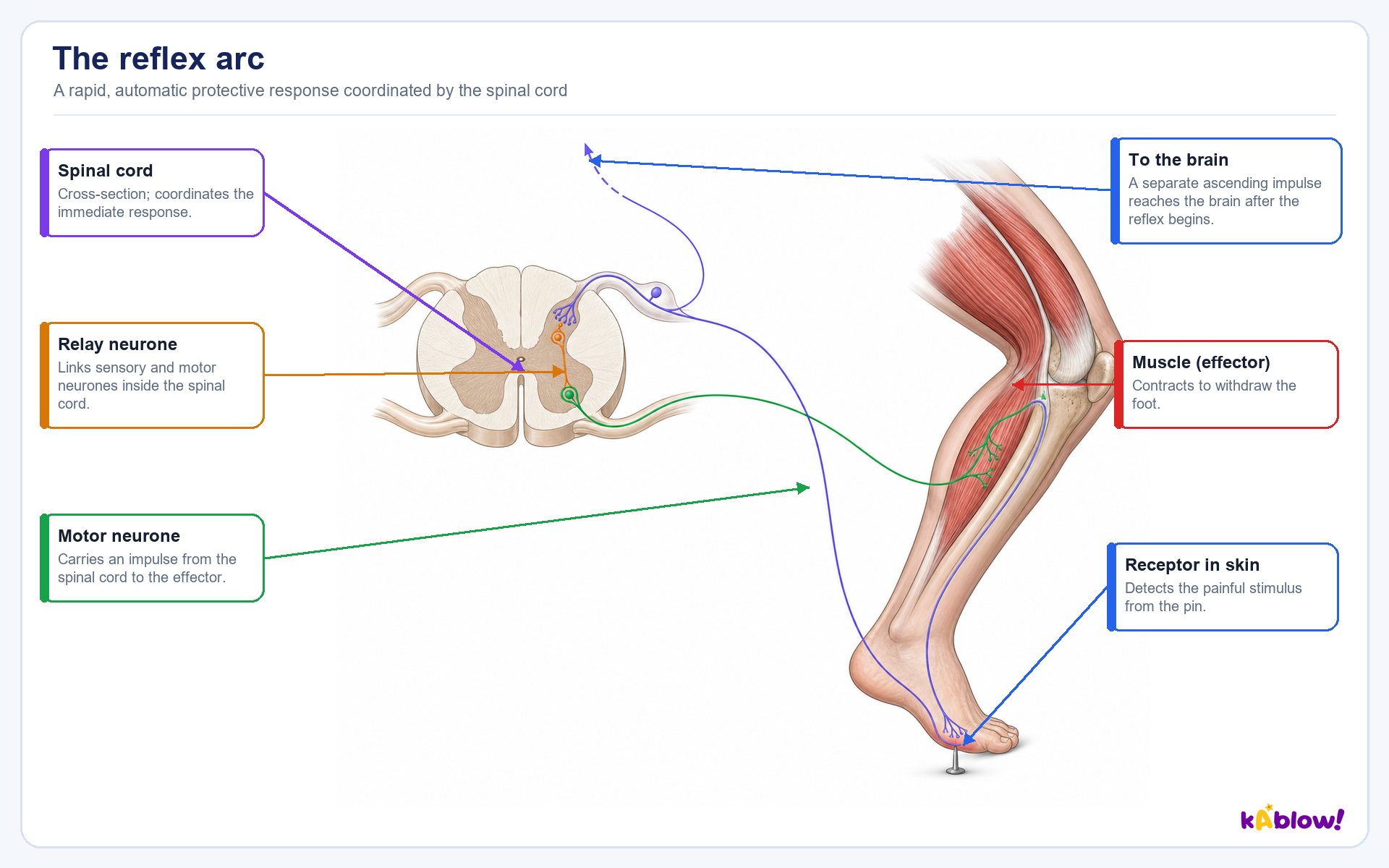
- The reflex arc is the pathway taken by electrical impulses as they travel along neurones.
- Example: pain-withdrawal reflex when stepping on a pin: stimulus detected by a receptor in the skin → sensory neurone sends impulses to the spinal cord (coordinator) → relay neurone in the spinal cord → motor neurone carries impulse to a muscle (effector) → muscle contracts and pulls the foot away (response).
- There are three main types of neurone in a reflex arc: sensory, relay and motor.
- Sensory neurones are long and have a cell body branching off the middle of the axon; relay neurones are short with a small cell body at one end; motor neurones are long with a large cell body at one end.
A reflex arc
Required Practical: Reaction Time
- Reaction time is the time taken to respond to a stimulus; reactions are usually very quick, typically taking less than a second.
- Reaction time can be affected by factors such as age, stress or use of drugs (such as caffeine).
- The ruler drop test measures reaction time: the further down the ruler is caught, the slower the individual's reaction time.
- The experiment can be repeated several times to calculate a mean average distance caught, which can be equated to a reaction time.
- Control variables include: using the dominant hand each time, dropping the same ruler from the same height, and orientating the ruler the same way (0 cm facing down).
- Reaction time can also be recorded in milliseconds which is more accurate than seconds.
The Brain
- The brain is made of billions of interconnected neurones and is responsible for controlling complex behaviours.
- The cerebral cortex is the outer layer, divided into two hemispheres; it is highly folded and responsible for higher-order processes such as intelligence, memory, consciousness and personality.
- The cerebellum is underneath the cerebral cortex and is responsible for balance, muscle coordination and movement.
- The medulla controls unconscious activities such as heart rate and breathing.
- The brain is incredibly complex and delicate, making it extremely difficult for neuroscientists to study; different regions can't be studied in isolation.
- Neuroscientists have mapped regions of the brain by studying patients with brain damage, electrically stimulating different parts of the brain, and using MRI scanning techniques.
- Our limited understanding means that treating brain damage and disease is very difficult; any potential treatment carries risks of further damage.
The Eye: Structure and Function
- The eye is a sense organ containing receptor cells sensitive to light intensity and colour; its purpose is to receive light and focus it onto the retina.
- The retina contains light receptor cells that detect light intensity and colour; the optic nerve carries electrical impulses from the eye to the brain.
- The cornea is the transparent covering of the front of the eye that refracts (bends) light; the iris controls how much light enters the pupil.
- The ciliary muscles are a ring of muscles around the lens which relax and contract to change the shape of the lens; the suspensory ligaments work with the ciliary muscles.
- Accommodation is the process of changing the shape of the lens to focus on near or distant objects.
- Focusing on a near object: ciliary muscles contract, suspensory ligaments loosen, lens becomes thicker and refracts light more strongly.
- Focusing on a distant object: ciliary muscles relax, suspensory ligaments are pulled tight, lens is pulled thin and refracts light less.
The Pupil Reflex and Eye Defects
- The pupil reflex is a reflex action that protects the retina from damage.
- In dim light, the pupil dilates (widens) to allow as much light into the eye as possible.
- In bright light, the pupil constricts (narrows) to prevent too much light from entering and damaging the retina.
- Myopia (short-sightedness) occurs when the lens is more curved than normal or the eyeball is too long, so light is refracted too much and the focal point falls in front of the retina; distant objects appear blurry.
- Hyperopia (long-sightedness) occurs when the lens is less curved than normal or the eyeball is too short, so light is not refracted enough and the focal point falls behind the retina; close objects appear blurry.
- Myopia can be corrected with a concave lens; hyperopia can be corrected with a convex lens.
- Other treatments include contact lenses, laser surgery (changing the shape of the cornea) and lens replacement surgery.
Control of Body Temperature
- The human body needs to maintain a temperature at which enzymes work best, around 37°C.
- Body temperature is monitored and controlled by the thermoregulatory centre in the brain, which contains receptors sensitive to the temperature of the blood.
- The skin contains temperature receptors and sends nervous impulses to the thermoregulatory centre.
- If body temperature is too high: blood vessels dilate (vasodilation) and sweat is produced from sweat glands; both mechanisms cause transfer of energy from the skin to the environment, cooling the body down.
- If body temperature is too low: blood vessels constrict (vasoconstriction), sweating stops and skeletal muscles contract (shiver); these mechanisms reduce heat loss and increase heat released in the body.
- Temperature control is an example of negative feedback.
Folien
Sign up free to view the lesson slides
Step through every slide for this topic — plus flashcards and revision notes — with a free account.
Übungsfragen
Gratis-Vorschau — 8 von 60 Fragen. Registriere dich, um alle zu sehen.
1.Which type of neurone carries electrical impulses from the CNS to effectors?
Easy- ASensory neurone
- BRelay neurone
- CMotor neurone
- DReflex neurone
2.Muscles are one type of effector. Name another type of effector.
Easy- AGland
- BNeurone
- CReceptor
- DSynapse
3.Place the components of a nervous response in the correct order, starting with the stimulus.
Medium- Stimulus
- Receptor
- Coordinator
- Effector
- Response
4.Which sense organ contains receptor cells that respond to changes in light?
Easy- AEar
- BEye
- CSkin
- DNose
5.What is the junction between two neurones called?
Easy- AReflex arc
- BSynapse
- CMotor neurone
- DRelay neurone
6.Which of the following statements about nerve impulses and synapses are true? (Select all that apply.)
Medium- AA nerve impulse is carried across a synapse by an electrical signal.
- BMotor neurones carry chemical signals from the CNS to effectors.
- CReflexes involve the conscious part of the brain.
- DAt a synapse, neurotransmitters diffuse across the synaptic cleft.
- ESynapses ensure impulses travel in only one direction.
7.Which part of the brain is responsible for balance, muscle coordination, and movement?
Easy- ACerebral cortex
- BCerebellum
- CMedulla
- DSpinal cord
8.The pupil dilates (widens) in bright light to protect the retina.
EasyTrue or false?
Unlock all 60 questions, flashcards & more
Erstelle ein Gratis-Konto, um alle Fragen, Folien, Karteikarten und Lernnotizen zu diesem Thema zu sehen.