Carbon dioxide and methane as greenhouse gases
Lerne es beim Spielen
Beantworte diese Fragen für Energie, dann angle und erkunde. Kein Konto nötig.
Lektionsnotizen
The Greenhouse Effect
- Greenhouse gases maintain temperatures on Earth high enough to support life.
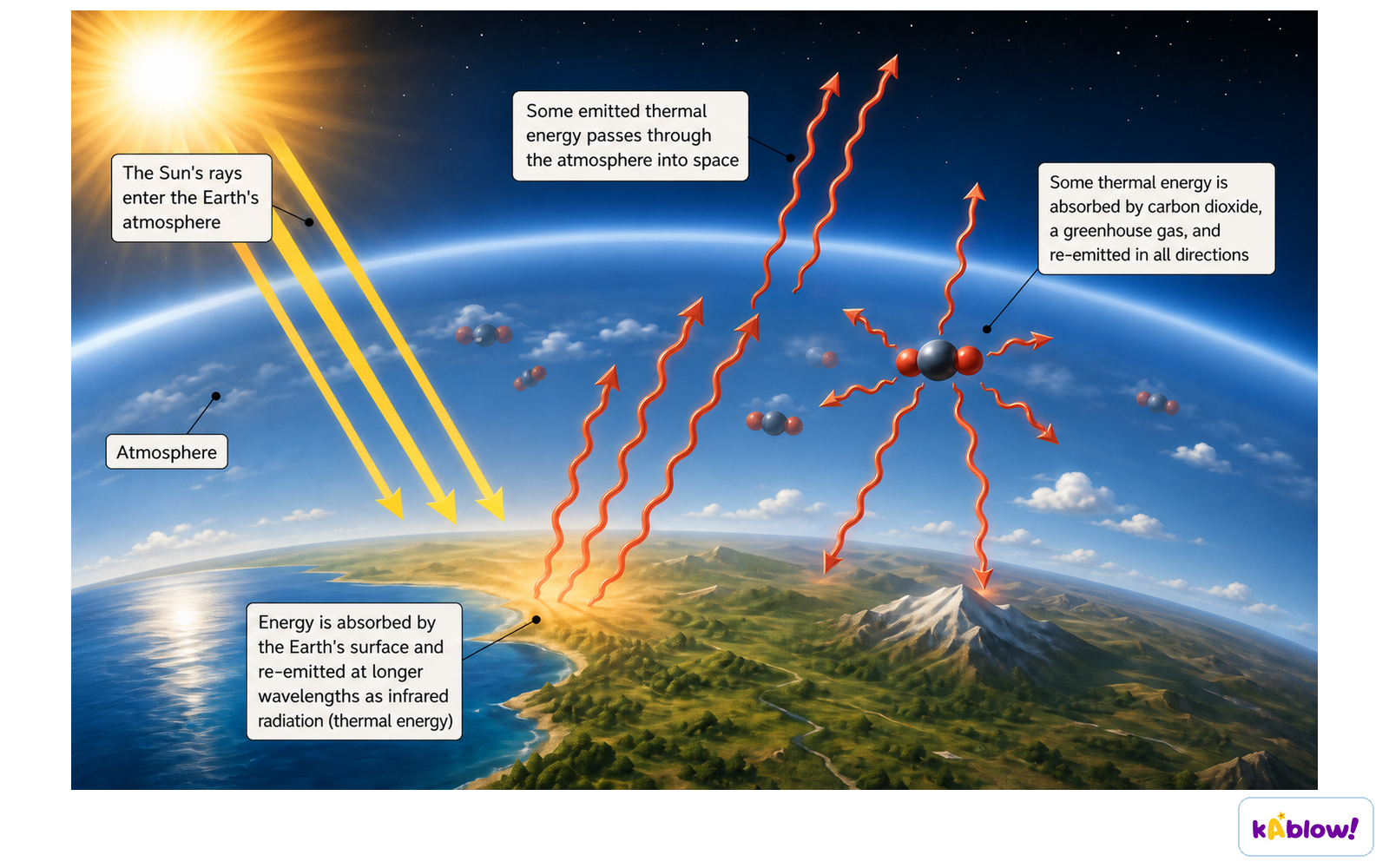
- Short wavelength radiation (ultraviolet) is emitted from the Sun.
- When it strikes the Earth's surface, some is absorbed and some is re-emitted as long wavelength radiation (infrared).
- Greenhouse gases absorb and store this infrared energy, trapping it in the atmosphere.
- Increasing levels of carbon dioxide and methane are trapping extra heat energy, upsetting the Earth's natural conditions.
Diagram showing how the greenhouse effect occurs
Greenhouse Gases
- The three main greenhouse gases are carbon dioxide, methane and water vapour.
- Carbon dioxide and methane are present in only small amounts but have a significant effect.
- Human activity is contributing to the release of carbon dioxide and methane.
Human Activities That Increase Carbon Dioxide
- Burning fossil fuels – increased demand for energy results in more fossil fuels being burned.
- Deforestation – fewer trees means less carbon dioxide is removed from the atmosphere by photosynthesis.
- Photosynthesis: carbon dioxide + water → glucose + oxygen.
- Combustion of methane: methane + oxygen → carbon dioxide + water.
Human Activities That Increase Methane
- Landfill sites – more waste is sent to landfill due to an increasing human population.
- Farming – increased levels of farming, especially cattle, release methane.
Evidence and Peer Review
- Analysis of atmospheric carbon dioxide and temperature changes over hundreds of years provides convincing evidence.
- Evidence is peer-reviewed by other scientists to ensure results are valid and conclusions are reliable.
- Peer-reviewed evidence shows a clear correlation between carbon dioxide levels and temperature changes.
- About 97% of climate scientists believe human activity is causing climate change.
Uncertainty and Historical Data
- Modern data is highly accurate due to advances in science and technology.
- Historical data is less accurate because of a lack of accurate instrumentation and methods.
- Fewer locations were measured in the past due to a lack of satellites and transport.
- Past climate can be estimated using fossil records, tree rings, and gas bubbles trapped in ice.
- These methods are not as precise as modern techniques and may not be globally representative.
- The complexity of the Earth's climate makes it difficult to produce a working model linking global warming and greenhouse gases.
Effects of Global Climate Change
- Rising sea levels – melting polar ice caps and glaciers cause destructive erosion, flooding and habitat destruction.
- Frequent and intense droughts – crop failure and collapse of agricultural production lead to hardship and starvation.
- Storms – warmer ocean surfaces mean more moisture in the atmosphere, making storms and hurricanes more energetic and destructive.
- Extreme heat waves and rainfall – more frequent extreme weather causes loss of life and destruction of infrastructure.
- Changing rainfall patterns lead to uneven distribution of freshwater, causing economic and political instability.
The Carbon Footprint
- Carbon footprint is the total amount of carbon dioxide and other greenhouse gases emitted over the full life cycle of a product, service or event.
- It can be measured using a life cycle assessment (LCA).
- An LCA considers extraction of raw materials, manufacturing, distribution and disposal.
- Obtaining precise measurements is challenging, but assessment raises awareness and encourages alternatives.
Reducing the Carbon Footprint
- Use renewable energy supplies such as solar or wind instead of burning fossil fuels.
- Cut out unnecessary journeys and use public transport rather than private cars.
- Reduce consumption of meat and buy locally sourced foods to reduce food miles.
- Carbon off-setting – paying for reforestation projects to compensate for emissions.
- Switch to electric vehicles and recycle/re-use materials to prevent landfill.
- Carbon capture – trapping carbon dioxide from power generation and storing it deep underground in porous rocks.
Difficulties in Reducing Carbon Footprints
- Alternative technologies are still in their infancy.
- Governments are slow to act due to fear of negative economic impact.
- Individuals resist changing their ways.
- There is a lack of investment for companies to modernise facilities.
- Some believe reducing the global carbon footprint is too expensive, so climate mitigation strategies should also be adopted.
Folien
Sign up free to view the lesson slides
Step through every slide for this topic — plus flashcards and revision notes — with a free account.
Übungsfragen
Gratis-Vorschau — 8 von 60 Fragen. Registriere dich, um alle zu sehen.
1.Which gas is a greenhouse gas along with carbon dioxide and methane?
Easy- AWater vapour
- BOxygen
- CNitrogen
- DArgon
2.What is the name given to the total amount of carbon dioxide and other greenhouse gases emitted over the full life cycle of a product, service or event?
Easy- ACarbon footprint
- BGreenhouse effect
- CGlobal warming
- DCarbon cycle
3.Which human activities contribute to increased levels of carbon dioxide in the atmosphere? (select all that apply)
Medium- ABurning fossil fuels
- BDeforestation
- CFarming
- DSending rubbish to landfill
- ECracking hydrocarbons
4.Which are renewable sources of methane? (select all that apply)
Medium- AProducts of combustion
- BAnimal waste
- CVolcanoes
- DFood in landfill
- ESedimentary rock
5.Which explanation correctly describes a part of the greenhouse effect?
Medium- AShorter wavelength radiation enters the atmosphere from the sun and is re-emitted back by the Earth as longer wavelength radiation
- BLonger wavelength radiation is absorbed by greenhouse gases as it enters the atmosphere
- CLonger wavelength radiation enters the atmosphere from the sun and is re-emitted back by the Earth as shorter wavelength radiation
- DAll wavelengths of radiation are reflected back by the Earth and absorbed by greenhouse gases
6.Which activities increase the amount of methane in the atmosphere? (select all that apply)
Medium- ACattle farming
- BDeforestation
- CCement production
- DLandfill sites
- EBurning fossil fuels
7.The greenhouse effect is harmful and should be completely removed.
EasyTrue or false?
8.Greenhouse gases trap heat by blocking incoming sunlight from reaching the Earth's surface.
EasyTrue or false?
Unlock all 60 questions, flashcards & more
Erstelle ein Gratis-Konto, um alle Fragen, Folien, Karteikarten und Lernnotizen zu diesem Thema zu sehen.