Life cycle assessment and recycling
Lerne es beim Spielen
Beantworte diese Fragen für Energie, dann angle und erkunde. Kein Konto nötig.
Lektionsnotizen
Life Cycle Assessment (LCA)
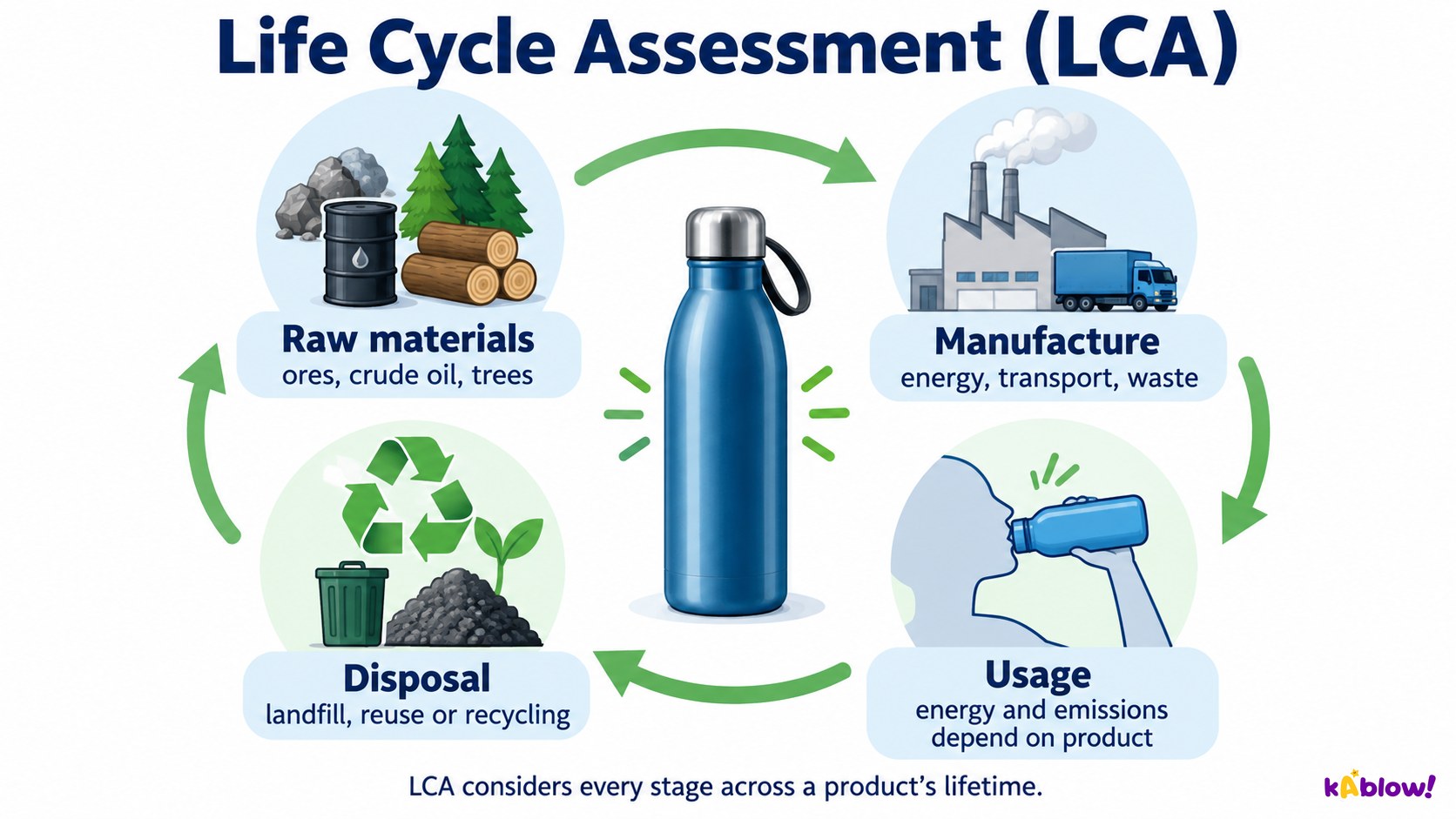
- A life cycle assessment (LCA) analyses the overall environmental impact of a product throughout its entire lifetime.
- An LCA is broken down into four main stages: raw materials, manufacture, usage, and disposal.
- The raw materials stage considers using up limited resources (such as ores and crude oil) and damaging habitats through deforestation or mining.
- The manufacture stage includes using land for factories, burning fossil fuels for production and transport, and producing waste.
- The usage stage depends on the product: a wooden desk has little impact, while a car produces significant air pollution.
- The disposal stage considers using up landfill space and whether the product or its parts can be recycled.
The four stages of a life cycle assessment
Carrying Out an LCA
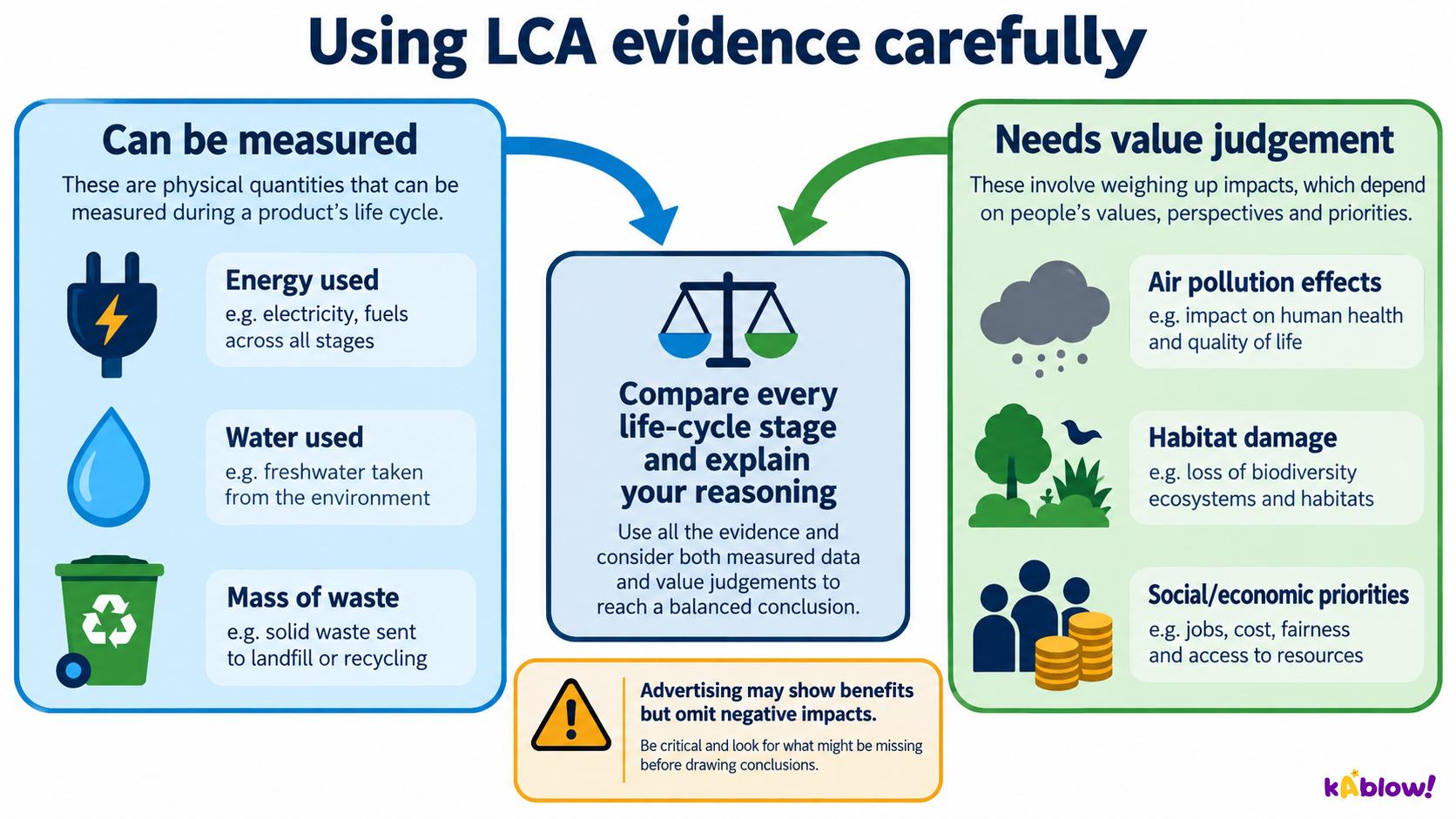
- Some parts of an LCA are easily quantified, for example the amount of water used or the quantity of waste produced.
- Other parts are difficult to give a numerical value to, such as the polluting effect of a product.
- In these cases, people make a value judgement, which is not objective and can be biased.
- There is rarely a product with zero environmental impact, so a compromise is often made between environmental impact and economic factors.
- Abbreviated LCAs may be used in advertising to highlight environmental benefits without showing negative impacts.
Using LCA evidence carefully
Comparative LCA: Plastic vs Paper Bags
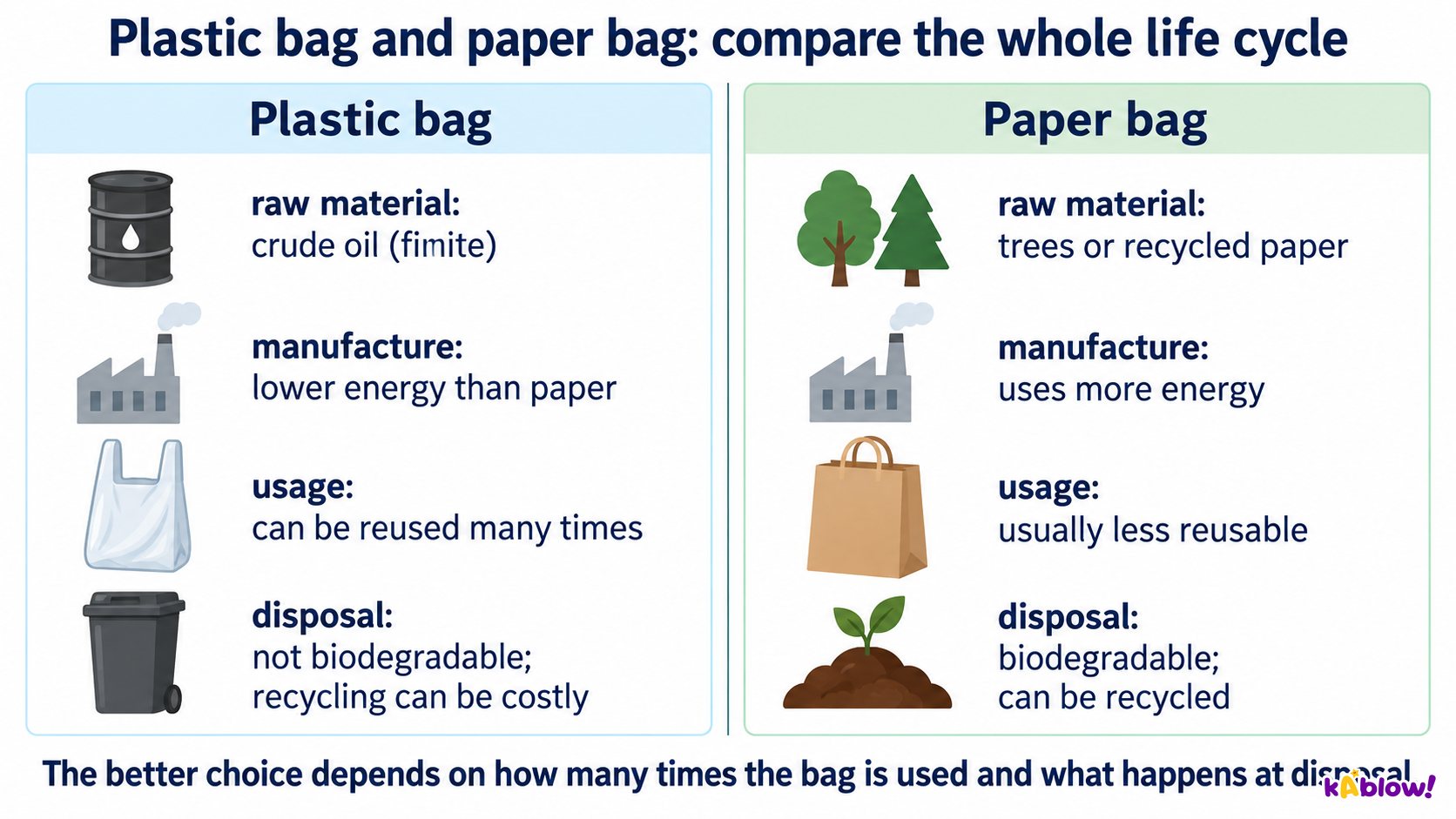
- Plastic bags are made from crude oil, a finite resource; paper bags come from trees or recycled paper.
- Making paper requires more energy than recycling paper, but much less than making plastics.
- Plastic bags are cheap to manufacture and reusable many times; paper bags are biodegradable and non-toxic but most are not reusable.
- Plastic bags can be recycled but this is costly and produces pollution; they are not biodegradable and take up landfill space.
- Overall, the plastic bag may be the better option because it has a much longer lifespan, even though it is not biodegradable.
- The conclusion depends on usage: if a paper bag is recycled it may be more favourable; if a plastic bag is used only once, the argument for plastic is weaker.
Comparing plastic and paper bags using LCA
Reducing Use of Resources
- Everyday materials such as glass, metal, plastics and ceramics are produced from natural but finite sources.
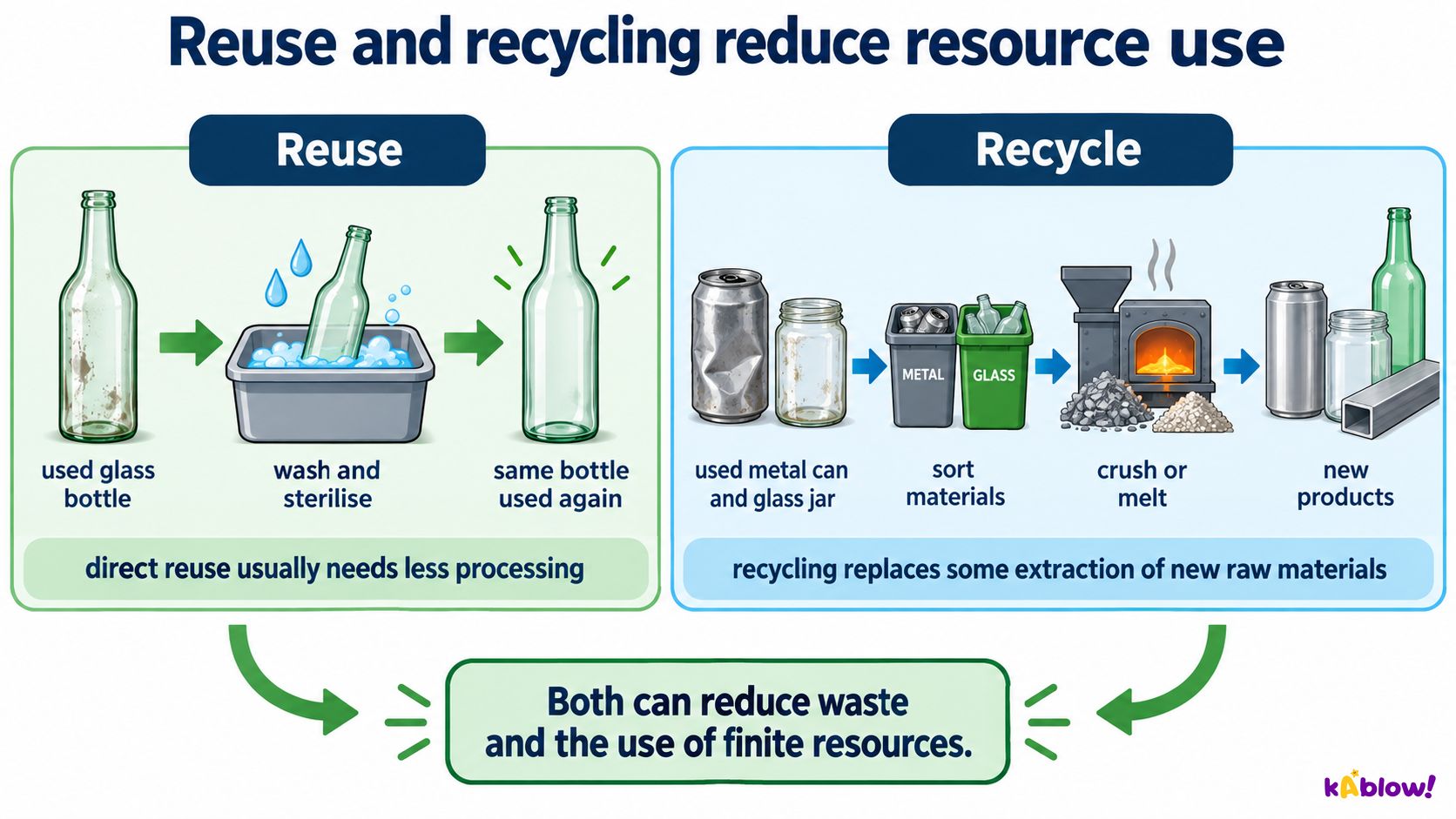
- Reuse and recycling cut down the use of limited material resources, reduce energy use and decrease waste production.
- Some products can be reused directly, which saves energy and decreases environmental impact.
- For example, glass bottles only need to be washed and sterilised before they can be reused.
- Other products cannot be reused but can be processed and recycled for a different use.
Reuse and recycling reduce resource use
Recycling Metals and Glass
- Metals can be recycled by melting and recasting or reforming into new products.
- The amount of separation required depends on the metal and the properties required of the final product.
- In steel making, scrap steel is added to iron from a blast furnace, reducing the amount of iron that needs to be extracted from iron ore.
- Glass that cannot be reused is separated by colour and composition, then crushed, melted and remoulded into new shapes.
- Glass, steel and concrete are usually produced from finite resources.
Reuse and recycling reduce resource use
Advantages of Recycling
- Recycling metals is economically beneficial, especially for metals that are costly to extract such as aluminium.
- Recycling provides employment and is becoming a major industry.
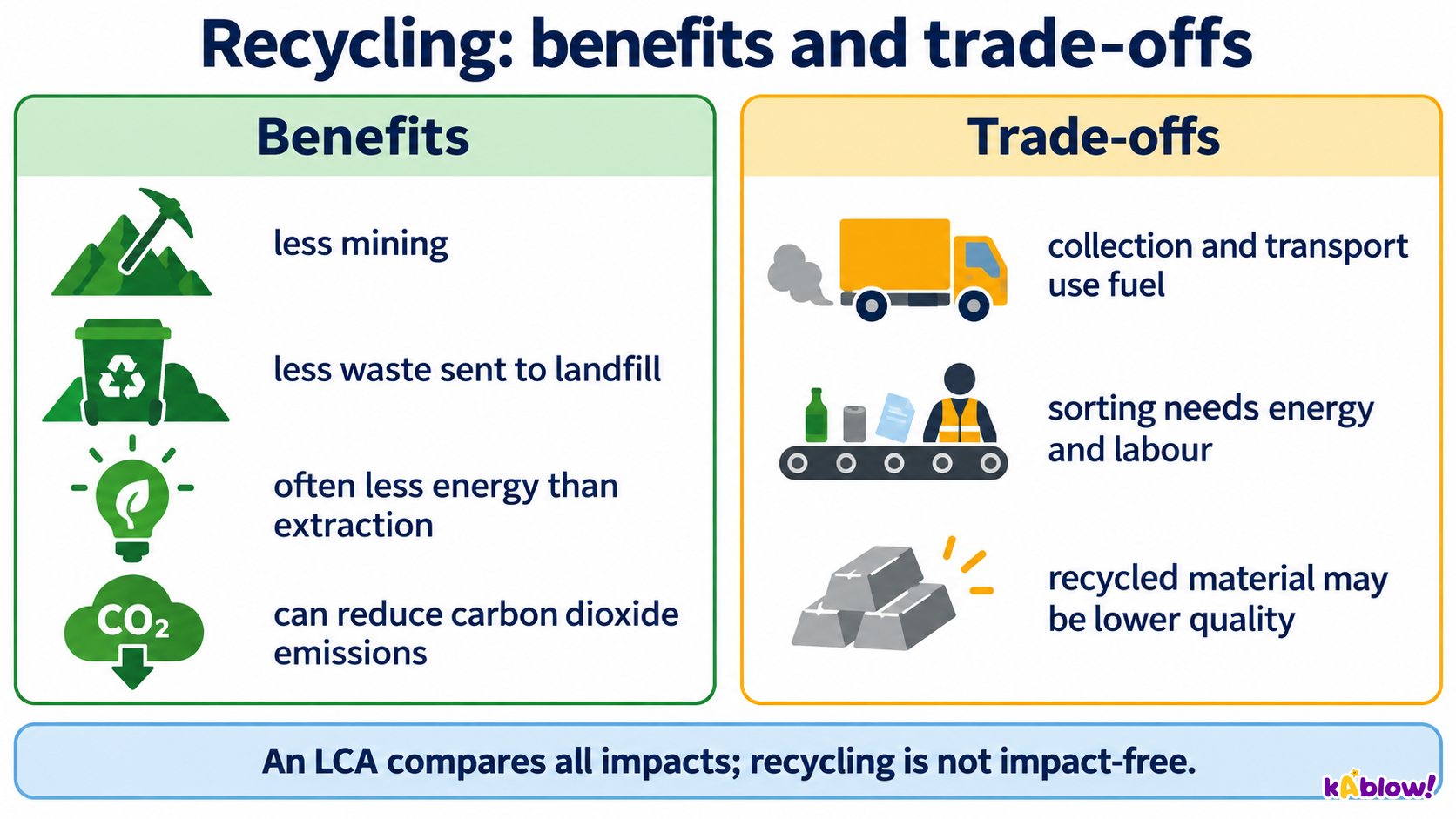
- Recycling means less mining is required, reducing damage to the environment and ecosystems.
- It is much more energy efficient to recycle metals than to extract them, as melting and remoulding requires less energy.
- Recycling decreases waste, reducing the space needed at landfill sites.
- Less mining and less energy use means fewer CO₂ and greenhouse gas emissions, reducing the contribution to global warming.
Disadvantages of Recycling
- Collection and transport of material to be recycled requires energy and fuel.
- Workers, vehicles and work sites need to be organised and maintained.
- Materials need to be sorted before they can be recycled, which requires energy and labour.
- Products made from recycled materials may not always be of the same quality as the original.
Benefits and trade-offs of recycling
Sustainability and Raw Materials
- There is a limited supply of every material on Earth.
- As global populations increase, there is a greater need for effective recycling to attain sustainable development.
- Mining and extraction use up fossil fuels, which contributes to climate change.
- Reducing, reusing and recycling materials by end users reduces the use of limited resources, energy sources, waste and environmental impacts.
Folien
Sign up free to view the lesson slides
Step through every slide for this topic — plus flashcards and revision notes — with a free account.
Übungsfragen
Gratis-Vorschau — 8 von 56 Fragen. Registriere dich, um alle zu sehen.
1.Which of the following is NOT one of the four main stages of a life cycle assessment?
Easy- ARaw materials
- BManufacture
- CAdvertising
- DDisposal
2.Which stage of a life cycle assessment involves the use of fossil-fuelled machines for production and transport?
Medium- ARaw materials
- BManufacture
- CUsage
- DDisposal
3.Why is a life cycle assessment not considered a purely objective process?
Medium- AIt only considers the disposal stage
- BIt requires value judgements when allocating numerical values to pollutant effects
- CIt is always based on incomplete data
- DIt ignores the use of energy
4.Which of the following is an environmental advantage of recycling metals?
Medium- AIt increases the amount of mining required
- BIt uses more energy than extracting metals from ores
- CIt reduces the amount of waste sent to landfill
- DIt produces more CO₂ emissions
5.Which of the following are environmental advantages of recycling? (Select all that apply)
Medium- ALess mining is required
- BLess energy is used compared to extraction
- CMore waste is sent to landfill
- DFewer CO₂ emissions are produced
- ECollection and transport require energy
6.Reuse of a product saves more energy than recycling it.
EasyTrue or false?
7.A life cycle assessment only considers the disposal stage of a product's life.
EasyTrue or false?
8.Match each stage of a life cycle assessment to its environmental impact.
Medium- Raw materials
- Manufacture
- Usage
- Disposal
- Using up limited resources such as ores and crude oil
- Using up land for factories
- Air pollution from a car
- Using up space at landfill sites
Unlock all 56 questions, flashcards & more
Erstelle ein Gratis-Konto, um alle Fragen, Folien, Karteikarten und Lernnotizen zu diesem Thema zu sehen.