Rate of reaction
Lerne es beim Spielen
Beantworte diese Fragen für Energie, dann angle und erkunde. Kein Konto nötig.
Lektionsnotizen
Measuring Rates of Reaction
- The rate of reaction can be measured by how fast a reactant is used up or how fast a product is made.
- Rate = amount of reactant used / time taken OR Rate = amount of product made / time taken.
- Time is usually measured in seconds; the amount of reactant or product may be measured in grams (g) or volume (cm³ or dm³).
- The units of rate depend on the measurement: g/s for mass, cm³/s or dm³/s for volume.
- Several measurements are taken during a reaction to provide sufficient data to establish a conclusion.
- Measuring the amount of product forming is usually easier than measuring the amount of reactant being used up.
Methods for Measuring Rate
- Mass loss: when a gas is produced, it escapes and the mass decreases; the reaction is carried out in a flask on a balance and mass is recorded over time.
- Cotton wool can be placed in the neck of the flask to allow gas to escape while stopping any materials from being ejected.
- The gas must be sufficiently dense for the mass change to be measurable; carbon dioxide (Mr = 44) is suitable but hydrogen (Mr = 2) is not.
- Gas collection: the gas produced is trapped and its volume measured over time, using an inverted measuring cylinder (downward displacement of water) or a gas syringe.
- Precipitation: a precipitate clouds the reaction mixture; the time for a cross to disappear from view is measured.
- The precipitation method is subjective because different people may not agree on the exact moment the cross disappears, and it produces only one data point per experiment so a rate graph cannot be plotted.
Reaction Rates Using Moles
- Rate of reaction can be expressed in mol/s; there is no direct way to measure moles, so first calculate the rate using the rate formula triangle.
- To convert mass per unit time to moles per unit time: moles per unit time = mass per unit time / molar mass of the substance.
- To convert volume per unit time to moles per unit time: moles per unit time = volume per unit time / molar gas volume (24 000 cm³/mol).
- For example, if 6.0 g of CO₂ (Mr = 44.0) is lost in 150 s, moles = 6.0 / 44.0 = 0.137 mol, so rate = 0.137 / 150 = 9.1 × 10⁻⁴ mol/s.
- If 15 cm³ of gas is collected in 360 s, moles = 15 / 24000 = 6.25 × 10⁻⁴ mol, so rate = 6.25 × 10⁻⁴ / 360 = 1.7 × 10⁻⁶ mol/s.
Rate Graphs
- Time is normally plotted on the x-axis, with the concentration of reactant or product on the y-axis.
- If the relationship is directly proportional (e.g. doubling concentration doubles rate), the graph is a straight line through the origin.
- The gradient of the line equals the initial rate of reaction; a steeper gradient means a faster rate.
- An initial rate graph for a product shows a straight line with positive correlation starting from the origin; for a reactant it shows a straight line with negative correlation starting from the y-axis.
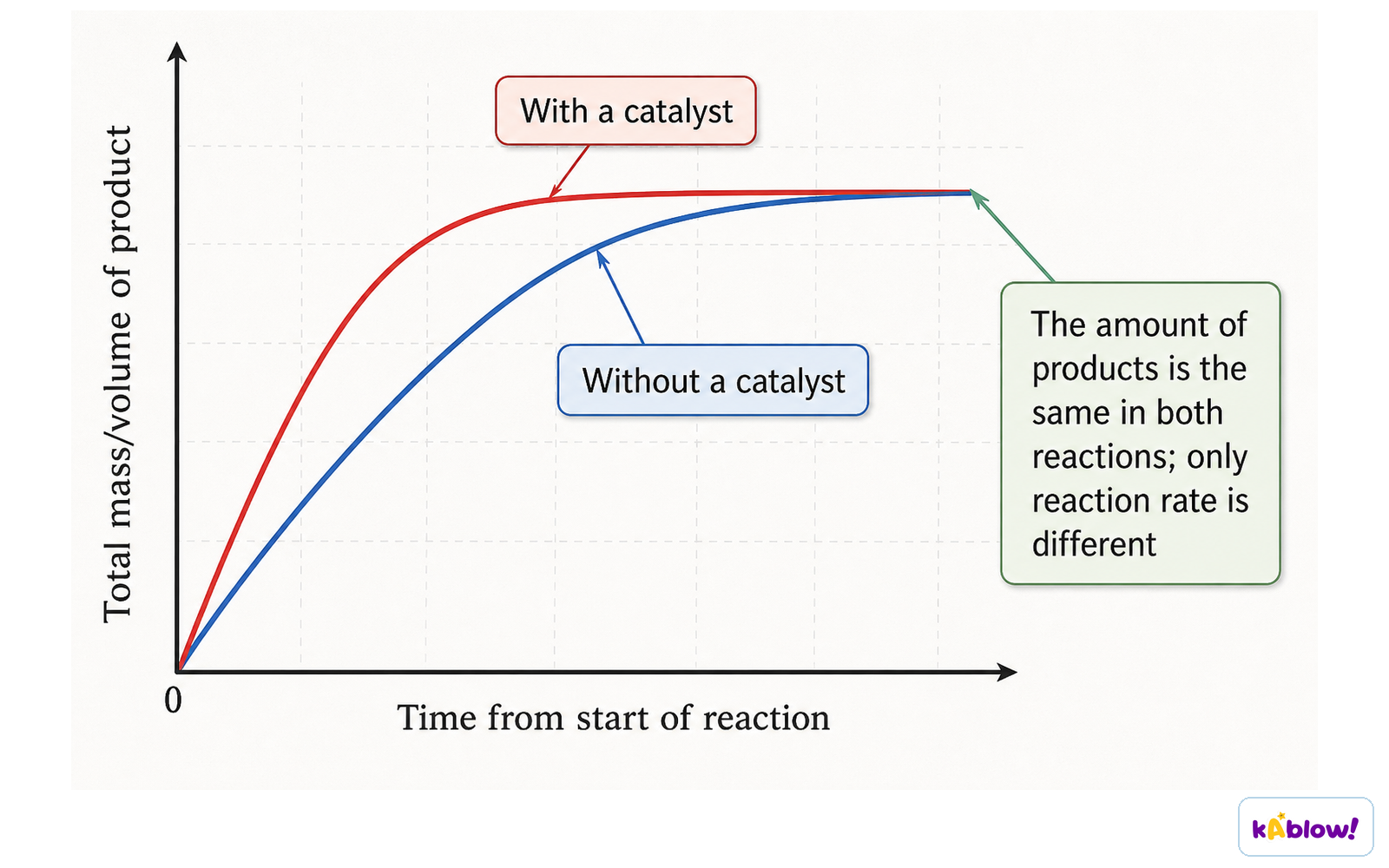
- Plotting a graph until completion shows the rate slowing as reactants are used up; the line becomes less steep and eventually horizontal, indicating the reaction has finished.
- The mean rate of reaction between two points is found by calculating the total change in y divided by the total time taken.
Graph showing the effect of using a catalyst on rate of reaction
Calculating Gradients
- For a curved graph, the rate of reaction is different at each point, so a tangent must be drawn to calculate the rate at a particular point.
- Place a ruler on the point being studied and adjust its position so the space on either side of the point between the ruler and curve are equal.
- Use a ruler and pencil to draw a perfectly straight line that just touches the curve at the chosen point, keeping the curve visible.
- Extend the tangent as far as is convenient to decrease the uncertainty in the calculation.
- The gradient at that point is: gradient = change in product / change in time (rise over run).
- For example, if a tangent at 0 s shows 72 cm³ of product in 20 s, initial rate = 72 / 20 = 3.6 cm³/s.
Factors Affecting Rate
- The rate of reaction is affected by: concentration of reactants in solution or pressure of reacting gases, temperature, surface area of solid reactants, and the presence of a catalyst.
- Increasing concentration or pressure increases the rate: the graph has a steeper gradient at the start, becomes horizontal sooner, but forms the same amount of product.
- Increasing temperature increases the rate: the graph has a steeper gradient at the start, becomes horizontal sooner, but forms the same amount of product.
- Increasing surface area (or decreasing particle size) increases the rate: the graph has a steeper gradient at the start, becomes horizontal sooner, but forms the same amount of product.
- Adding a catalyst increases the rate: the graph has a steeper gradient at the start, becomes horizontal sooner, but forms the same amount of product.
- A higher rate of reaction is of economic interest as it implies a higher rate of production and a more efficient and sustainable process.
Required Practical: Investigating Concentration
- Part 5a – Measuring turbidity: investigate the effect of changing concentration on the rate of reaction by measuring the formation of a precipitate.
- Method: measure 50 cm³ of sodium thiosulfate solution into a conical flask, place the flask on a white paper with a cross, add 10 cm³ of dilute hydrochloric acid, start the stopwatch, and stop when the cross can no longer be seen.
- The reaction produces solid sulfur which precipitates, turning the solution cloudy: Na₂S₂O₃ + 2HCl → 2NaCl + S + SO₂ + H₂O.
- Repeat using different concentrations of sodium thiosulfate solution (mix with water to dilute) and repeat each experiment three times.
- Part 5b – Measuring gas volume: investigate the effect of changing concentration on the rate of reaction by measuring the volume of gas given off.
- Method: measure 50 cm³ of 1.0 mol/dm³ sulfuric acid into a flask, add magnesium ribbon, connect to gas collection equipment, start the stopwatch, and record the volume of gas every 10 seconds; repeat with 1.5 mol/dm³ sulfuric acid.
- Magnesium and sulfuric acid react immediately, so the flask must be connected to the gas syringe straight after adding the magnesium to avoid gas escaping.
Collision Theory and Activation Energy
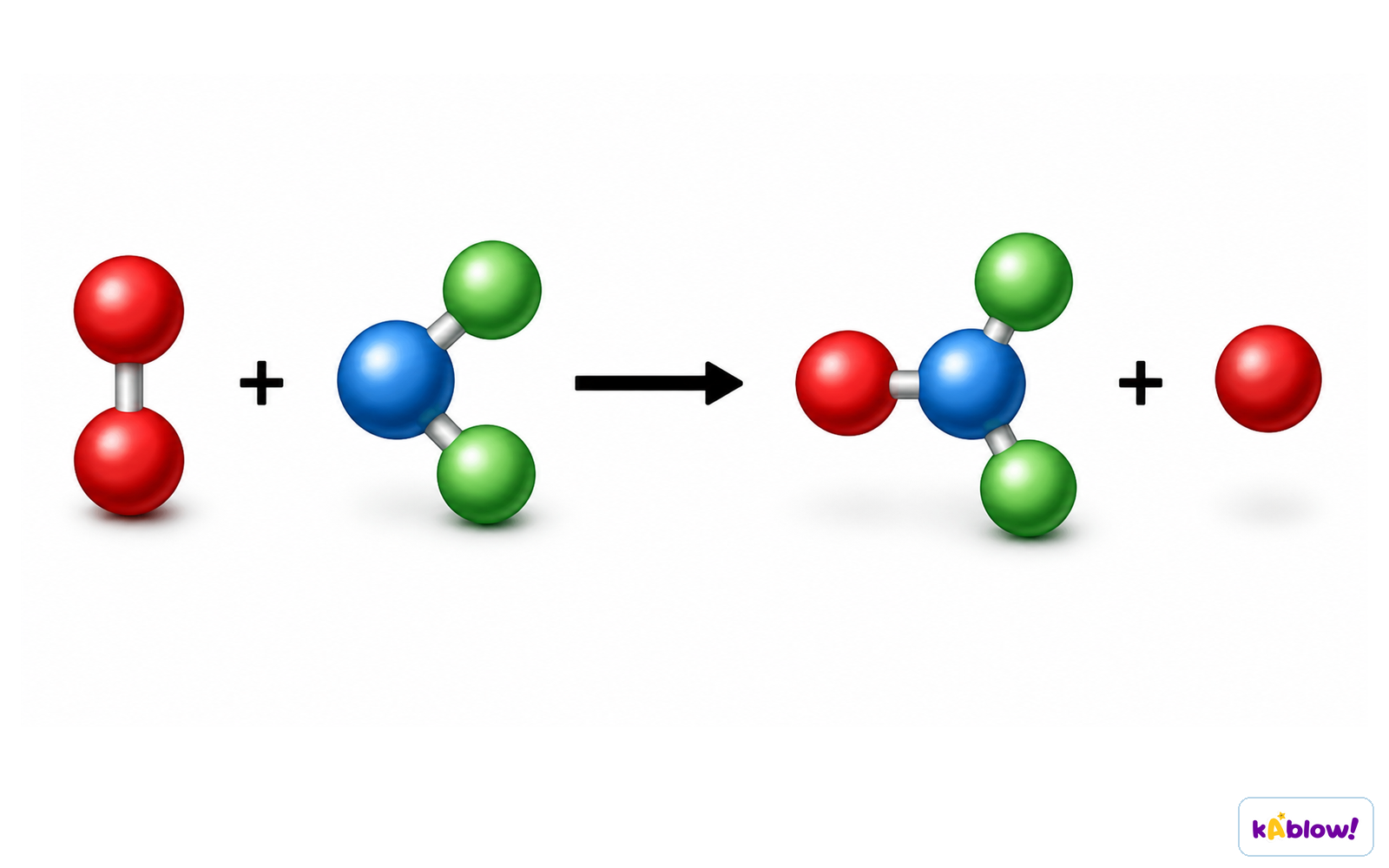
- Chemical reactions occur only when reactant particles collide with sufficient energy to react; the minimum amount of energy needed is called the activation energy.
- A successful collision occurs when particles collide with energy greater than or equal to the activation energy, leading to a rearrangement of atoms to form products.
- An unsuccessful collision occurs when particles collide with less energy than the activation energy; they bounce off each other and remain unchanged.
- The rate of reaction depends on the number of successful collisions per unit time.
- Factors that increase the number of successful collisions: more particles per unit volume, greater frequency of collisions, greater kinetic energy of particles, and lower activation energy.
- Increasing concentration or pressure: more particles in a given volume (or same particles in a smaller volume) causes more frequent successful collisions.
- Increasing temperature: particles have more kinetic energy, causing more frequent and more energetic collisions; a small increase in temperature causes a large increase in rate (roughly doubles for every 10 °C rise).
- Increasing surface area: a greater surface area of particles is exposed to the other reactant, causing more frequent successful collisions.
A successful collision
Catalysts
- A catalyst speeds up the rate of a reaction without itself being altered or consumed; the mass of a catalyst at the beginning and end of a reaction is the same.
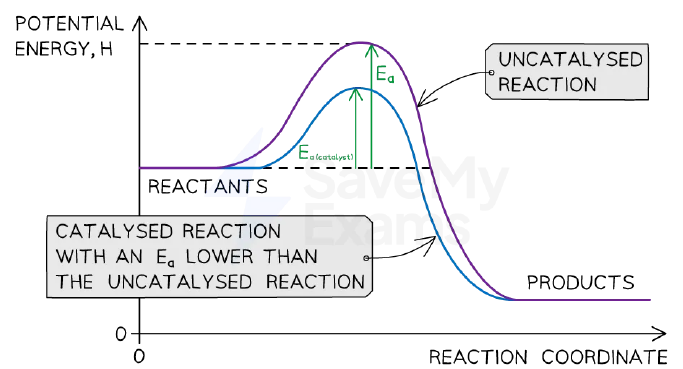
- Catalysts provide an alternative pathway for the reaction that has a lower activation energy.
- This means a higher proportion of reactant particles have energy greater than the activation energy, resulting in more successful collisions per second.
- Catalysts do not form part of the chemical equation but are sometimes shown above or below the reaction arrow.
- Iron is used as a catalyst in the Haber Process for the production of ammonia; iron beads increase the surface area available for catalysis.
- Catalysts work by attracting reactant molecules onto their surface, providing an alternate reaction pathway of lower energy.
- Catalysis is important commercially because catalysts increase the rate of reaction (and production rate) and reduce energy costs.
- Transition metals are widely used as catalysts because they have variable oxidation states, allowing them to readily donate and accept electrons; enzymes act as catalysts in biological systems.
How a catalyst affects rate
Folien
Sign up free to view the lesson slides
Step through every slide for this topic — plus flashcards and revision notes — with a free account.
Übungsfragen
Gratis-Vorschau — 8 von 61 Fragen. Registriere dich, um alle zu sehen.
1.Which piece of equipment is most suitable to measure the volume of hydrochloric acid?
Easy- ABeaker
- BMeasuring cylinder
- CConical flask
- DTest tube
2.In an experiment where calcium carbonate reacts with hydrochloric acid and the volume of gas produced is measured every 30 seconds, which is the dependent variable?
Easy- AVolume of gas collected
- BConcentration of hydrochloric acid
- CMass of calcium carbonate
- DTime
3.A student investigates the rate of reaction between calcium carbonate and hydrochloric acid. They measure the volume of gas produced every 30 seconds. Which of the following would be a suitable control variable?
Medium- AVolume of gas produced
- BTime
- CConcentration of hydrochloric acid
- DRate of reaction
4.In the reaction between calcium carbonate and hydrochloric acid, what is the gas produced?
Medium- AHydrogen
- BOxygen
- CCarbon dioxide
- DSulfur dioxide
5.A student reacts calcium carbonate with hydrochloric acid. They plot a graph of volume of gas produced against time. On the same axes, they sketch a curve for a higher concentration of acid. Which of the following describes the new curve?
Medium- ASteeper gradient and higher final volume
- BSteeper gradient and same final volume
- CLess steep gradient and same final volume
- DSame gradient and higher final volume
6.In the reaction between sodium thiosulfate and hydrochloric acid, what causes the solution to turn cloudy?
Easy- ASulfur dioxide gas
- BSulfur precipitate
- CSodium chloride
- DWater
7.At 30°C, 0.46 g of sulfur was produced in 58 seconds. Calculate the mean rate of reaction in g/s to 2 significant figures.
Medium- A0.0079 g/s
- B0.0080 g/s
- C0.0078 g/s
- D0.008 g/s
8.As the temperature of hydrochloric acid increases, the time taken for the cross to disappear decreases. Which word completes the sentence: The rate of reaction ________ as the temperature increases.
Medium- Aincreases
- Bdecreases
- Cremains the same
- Ddoubles
Unlock all 61 questions, flashcards & more
Erstelle ein Gratis-Konto, um alle Fragen, Folien, Karteikarten und Lernnotizen zu diesem Thema zu sehen.