Black body radiation
Lerne es beim Spielen
Beantworte diese Fragen für Energie, dann angle und erkunde. Kein Konto nötig.
Lektionsnotizen
Thermal Radiation Basics
- All bodies (objects), no matter what temperature, emit a spectrum of thermal radiation in the form of electromagnetic waves.
- These electromagnetic waves usually lie in the infrared region of the spectrum but could be emitted in the form of visible light or other wavelengths, depending on the temperature.
- The hotter the object, the more infrared radiation it radiates in a given time.
- The infrared radiation emitted from a hot object can be detected using a special camera.
- The intensity and wavelength distribution of any emitted waves depends on the temperature of the body.
- This can be represented on a thermal radiation curve (or black body radiation curve).
Hotter objects emit more thermal radiation
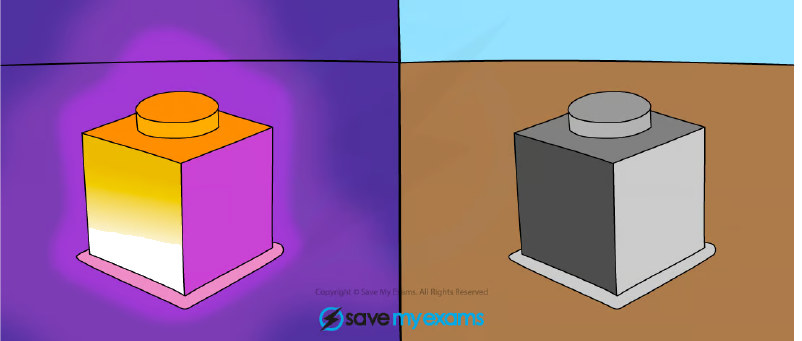
Black Body Radiation
- Black body radiation is the name given to the thermal radiation emitted by all bodies (objects).
- A perfect black body is defined as an object that absorbs all of the radiation incident on it and does not reflect or transmit any radiation.
- Since a good absorber is also a good emitter, a perfect black body would be the best possible emitter too.
- As a result, an object which perfectly absorbs all radiation will be black.
- This is because the colour black is what is seen when all colours from the visible light spectrum are absorbed.
Temperature Effects on Emission
- As the temperature increases, the peak of the thermal radiation curve moves to a lower wavelength and a higher intensity.
- The peak of a thermal radiation curve moves to the left with increasing temperature.
- From the electromagnetic spectrum, waves with a smaller wavelength have higher energy (e.g. UV rays, X-rays).
- When an object gets hotter, the amount of thermal radiation it emits increases.
- This increases the energy emitted and therefore the wavelength of the emitted radiation decreases.
- At room temperature objects emit thermal radiation in the infrared region of the spectrum.
- At around 1000 °C an object will emit a significant amount of red light.
- At 6000 °C an object will mainly emit white or blue light (and some ultraviolet).
- At even higher temperatures objects will emit ultraviolet or even X-rays.
Thermal Equilibrium
- As an object absorbs thermal radiation it will become hotter.
- As it gets hotter it will also emit more thermal radiation.
- The temperature of a body increases when the body absorbs radiation faster than it emits radiation.
- Eventually, an object will reach a point of constant temperature where it is absorbing radiation at the same rate as it is emitting radiation.
- At this point, the object will be in thermal equilibrium.
- An object will remain at a constant temperature if it absorbs heat at the same rate as it loses heat.
Radiation & Temperature Change
- The temperature of a body can be regulated by balancing how much incoming radiation is absorbed and emitted (or reflected).
- If an object starts to absorb radiation at a higher rate than it radiates it, then the object will heat up.
- Likewise, if it loses radiation at a greater rate than it absorbs it, then the object will cool down.
- This is how an emergency blanket works, to keep a trauma victim warm.
- Rescue teams use light-coloured, shiny emergency blankets to keep accident survivors warm.
- A light, shiny outer surface emits a lot less radiation than a dark, matt (non-glossy) surface.
- This keeps the patient warm, as less infrared radiation is emitted than if an ordinary blanket had been used.
Temperature of the Earth
- If the Earth had no atmosphere, the temperature on the surface would drop to about −180 °C at night, the same as the Moon’s surface at night.
- This would happen because the surface would be emitting all the radiation from the Sun into space.
- The Earth receives the majority of its heat in the form of thermal radiation from the Sun.
- At the same time, the Earth emits its own thermal radiation, with a slightly longer wavelength than the thermal radiation it receives (the surface temperature of the Earth is significantly smaller than the surface temperature of the Sun).
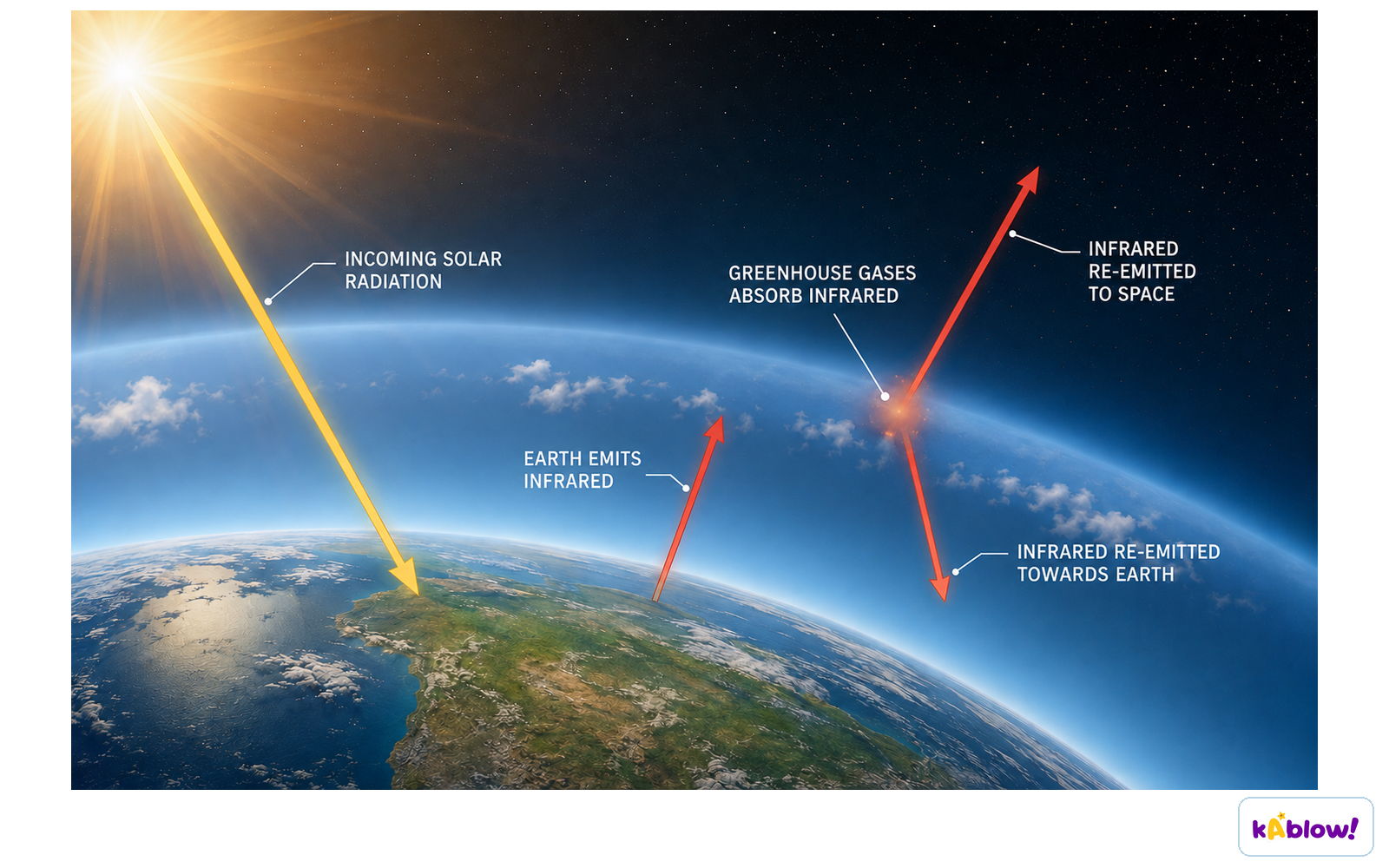
- Some gases in the atmosphere, such as water vapour, methane, and carbon dioxide (greenhouse gases) absorb and reflect back longer-wavelength infrared radiation from the Earth and prevent it from escaping into space.
- These gases absorb the radiation and then emit it back to the surface.
- This process makes the Earth warmer than it would be if these gases were not in its atmosphere.
- The temperature of the Earth depends on several factors, such as the rate that light and infrared radiation from the Sun are reflected back into space, absorbed by the Earth’s atmosphere or surface, and emitted from the Earth’s surface and atmosphere into space.
The Greenhouse Effect
- The rate of absorption and emission of radiation on Earth contributes to the Greenhouse Effect.
- This is the natural process that warms the Earth's surface from the Sun.
- The Sun's thermal radiation reaches the Earth's atmosphere where some radiation is reflected back to space.
- Any radiation not reflected is absorbed and re-radiated by greenhouse gases.
- The absorbed radiation then warms the atmosphere and the surface of the Earth.
- This is similar to what happens in a greenhouse to keep a humid, and warm temperature to grow plants.
The greenhouse effect: radiation from the Sun and Earth
Core Practical: Investigating Thermal Radiation
- Aim: to investigate how the amount of infrared radiation absorbed or radiated by a surface depends on the nature of that surface.
- Independent variable = colour; dependent variable = temperature.
- Control variables: identical flasks (except for their colour), same amounts of hot water, same starting temperature of the water, same time interval.
- Method: set up four identical flasks painted black, grey, white and silver; fill with hot water ensuring the same initial temperature; measure temperatures at regular intervals (e.g. every 30 seconds for 10 minutes).
- All warm objects emit thermal radiation in the form of infrared waves.
- The intensity (and wavelength) of the emitted radiation depends on the temperature of the body, the surface area of the body, and the colour of the surface.
- Most of the heat lost from the beakers will be due to conduction and convection, which is the same for each beaker as colour does not affect heat loss in this way.
- Any difference in heat loss between the beakers must, therefore, be due to infrared (thermal) radiation.
- To compare the rate of heat loss of each flask, plot a graph of temperature on the y-axis against time on the x-axis and draw curves of best fit.
Folien
Sign up free to view the lesson slides
Step through every slide for this topic — plus flashcards and revision notes — with a free account.
Übungsfragen
Gratis-Vorschau — 8 von 63 Fragen. Registriere dich, um alle zu sehen.
1.Which type of electromagnetic radiation do all objects emit as thermal radiation?
Easy- AInfrared
- BUltraviolet
- CGamma
- DRadio
2.All objects, no matter what temperature, emit infrared radiation.
EasyTrue or false?
3.What is a perfect black body?
Easy- AAn object that absorbs all radiation incident on it and reflects or transmits none
- BAn object that only absorbs visible light and reflects all other wavelengths
- CAn object that emits no radiation at all
- DAn object that is always black in colour
4.Which of the following statements about a perfect black body are correct? (select all that apply)
Medium- AIt absorbs all radiation incident on it.
- BIt reflects all radiation incident on it.
- CIt is the best possible emitter of radiation.
- DIt does not emit any radiation.
- EIt does not transmit any radiation.
5.A perfect black body must always appear black in colour.
EasyTrue or false?
6.As the temperature of a black body increases, what happens to the peak of its radiation curve?
Medium- AIt moves to a lower wavelength and a higher intensity.
- BIt moves to a higher wavelength and a lower intensity.
- CIt moves to a higher wavelength and a higher intensity.
- DIt moves to a lower wavelength and a lower intensity.
7.Match each surface colour with its correct property regarding infrared radiation.
Medium- Matt black
- Shiny silver
- White
- Best absorber and emitter
- Poor absorber and emitter, reflects well
- Poor absorber and emitter, reflects some
8.An object at a constant temperature is absorbing radiation at the same rate as it is emitting radiation.
EasyTrue or false?
Unlock all 63 questions, flashcards & more
Erstelle ein Gratis-Konto, um alle Fragen, Folien, Karteikarten und Lernnotizen zu diesem Thema zu sehen.