Domestic uses and safety
Lerne es beim Spielen
Beantworte diese Fragen für Energie, dann angle und erkunde. Kein Konto nötig.
Lektionsnotizen
Direct and Alternating Current
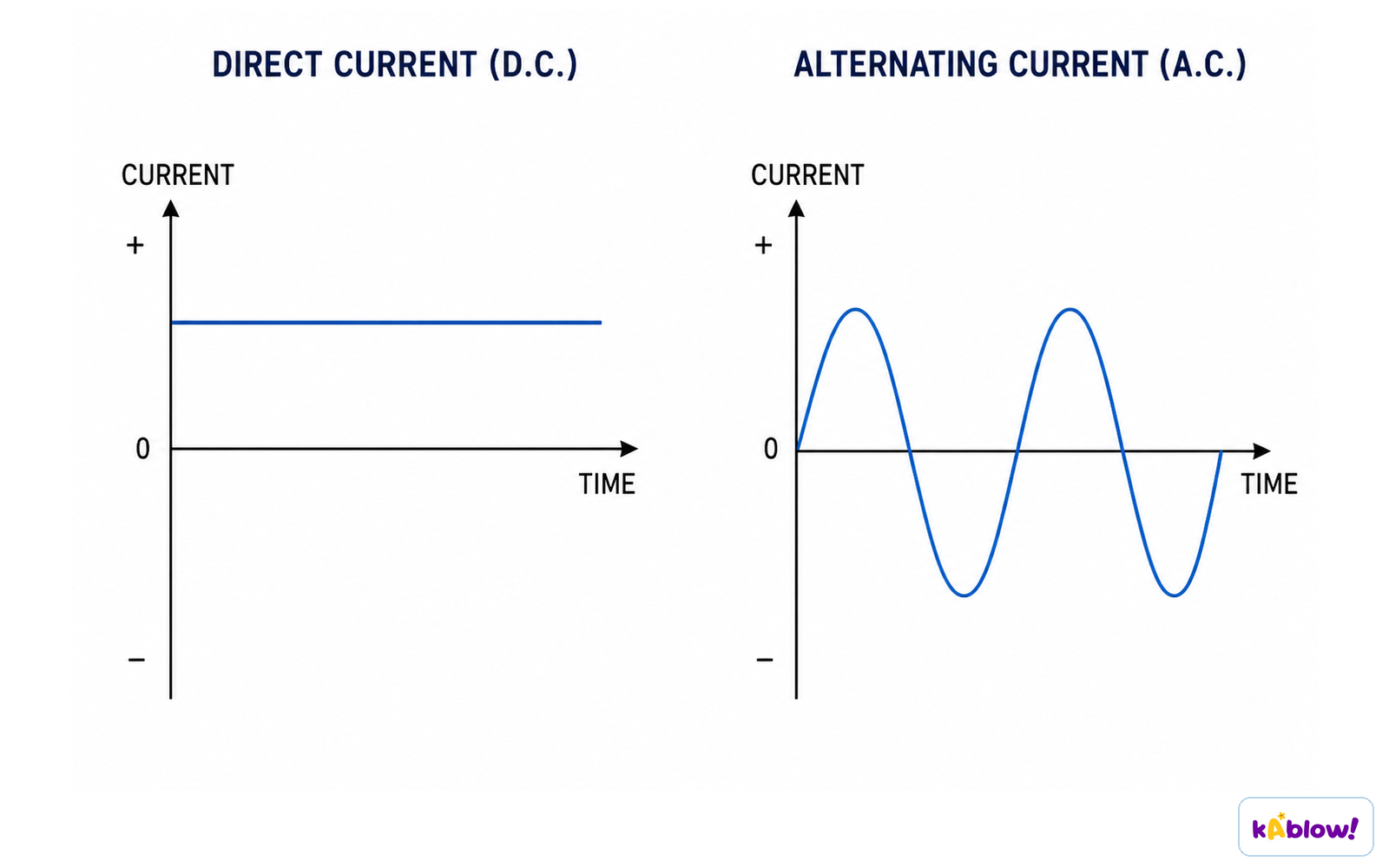
- Direct current (d.c.) flows steadily in one direction around a circuit, from positive to negative.
- A d.c. supply has a fixed positive terminal and a fixed negative terminal, so the current is always in the same direction.
- Cells and batteries produce direct current.
- Alternating current (a.c.) continuously changes direction, going back and forth around a circuit.
- An a.c. supply has two identical terminals that switch between positive and negative.
- The frequency of an alternating current is the number of times it changes direction back and forth each second.
Direct current and alternating current graphs
UK Mains Electricity
- Mains electricity is generated by power stations and transported around the country through the National Grid.
- Mains electricity is an alternating current (a.c.) supply.
- In the UK, the domestic supply has a frequency of 50 Hz and a potential difference of about 230 V.
- A frequency of 50 Hz means the current changes direction back and forth 50 times every second.
- Because mains is a.c., it does not have positive and negative sides; instead the two ends of the circuit are called live and neutral.
Three-Core Cable
- Most electrical appliances are connected to the mains using a three-core cable containing a live wire, a neutral wire and an earth wire.
- The insulation covering each wire is colour coded: live – brown, neutral – blue, earth – green and yellow stripes.
- The live wire carries the alternating potential difference from the supply to the circuit.
- The neutral wire completes the circuit and is at, or close to, earth potential (0 V).
- The earth wire is a safety wire that stops the appliance from becoming live; it only carries a current if there is a fault.
Potential Difference of the Wires
- The live wire has a potential difference of about 230 V and is the most dangerous wire.
- The neutral wire is at, or close to, 0 V and is much less dangerous than the live wire, although it can still deliver a small shock.
- The earth wire is at 0 V and normally carries no current.
- The potential difference between the live wire and earth is about 230 V.
Fuses
- A fuse is a safety device that cuts off the flow of electricity if the current becomes too large.
- A fuse usually consists of a glass cylinder containing a thin metal wire.
- If the current becomes too large, the wire heats up and melts, breaking the circuit and stopping the current.
- Fuses are always connected in the live wire so that when a fuse blows, the device is no longer connected to the live supply.
- A fuse without an earth wire protects the circuit and cabling for a double-insulated appliance.
Circuit Breakers
- A circuit breaker is an automatic electromagnet switch that breaks the circuit if the current exceeds a certain value.
- Circuit breakers have a major advantage over fuses because they do not melt and can be reset and used again.
- Circuit breakers also work much faster than fuses.
- For these reasons, circuit breakers are used in mains electricity in homes, sometimes misleadingly called 'fuse boxes'.
The Earth Wire and Safety
- Many electrical appliances have metal cases, which poses a safety hazard.
- If a live wire inside the appliance touches the metal case, the case becomes electrified and anyone touching it risks electrocution.
- The earth wire provides a low resistance path to the earth if this happens.
- This causes a surge of current in the earth wire and hence also in the live wire.
- The high current through the fuse causes it to melt and break, cutting off the supply and making the appliance safe to touch.
- The earth wire is an additional safety wire that reduces the risk of the appliance becoming live.
Dangers of Mains Electricity
- The live wire, at about 230 V, is the most dangerous wire.
- Because of the large potential difference between the live wire (230 V) and earth (0 V), connecting them together creates a very large current.
- If a person provides the connection between live and earth, a large current can pass through them, giving a potentially lethal shock.
- Even if a device is switched off but the mains supply is on, the live wire can still cause an electric shock.
- Electricians always switch off the mains supply before working on electrical appliances to avoid contact with live wires.
Switches and Fuses in the Live Wire
- Switches and fuses are always connected to the live wire.
- This means that when a switch is turned off or a fuse blows, the device is no longer connected to the live supply.
- If they were connected to the neutral wire, the device could still be live even when switched off, which is dangerous.
Folien
Sign up free to view the lesson slides
Step through every slide for this topic — plus flashcards and revision notes — with a free account.
Übungsfragen
Gratis-Vorschau — 8 von 60 Fragen. Registriere dich, um alle zu sehen.
1.Which of these correctly describes an alternating current?
Easy- AA current that is steady and flows in one direction only
- BA current that continuously changes its direction, going back and forth around a circuit
- CA current that flows only when a switch is closed
- DA current that flows only through the earth wire
2.Which row about the UK domestic supply is correct?
Easy- AType of current: a.c., frequency 50 Hz, voltage 230 V
- BType of current: a.c., frequency 230 Hz, voltage 50 V
- CType of current: d.c., frequency 50 Hz, voltage 230 V
- DType of current: d.c., frequency 230 Hz, voltage 50 V
3.Which of these electrical devices provides direct current?
Easy- AA battery
- BA mains socket
- CA generator at a power station
- DThe National Grid
4.What colour is the insulating cable of the live wire in a UK plug?
Easy- ABlue
- BGreen and yellow stripes
- CBrown
- DRed
5.An electric kettle is plugged into the mains supply. Which of these is the potential difference between the live and neutral wires?
Easy- A0 V
- B120 V
- C230 V
- D460 V
6.Which of the following correctly describes where a fuse should be fitted and how the fuse does its job?
Easy- AWhere: live wire — What it does: reduces the current to the fuse rating
- BWhere: neutral wire — What it does: breaks the circuit
- CWhere: live wire — What it does: breaks the circuit
- DWhere: neutral wire — What it does: reduces the current to the fuse rating
7.A circuit contains a fuse and each ammeter in the circuit reads 1.2 A. Which option correctly describes the fuse that should be fitted in this position?
Medium- A1.0 A
- B3.0 A
- C5.0 A
- D13.0 A
8.The earth wire carries a current in normal operation of an appliance.
EasyTrue or false?
Unlock all 60 questions, flashcards & more
Erstelle ein Gratis-Konto, um alle Fragen, Folien, Karteikarten und Lernnotizen zu diesem Thema zu sehen.