Human impact and conservation
Lerne es beim Spielen
Beantworte diese Fragen für Energie, dann angle und erkunde. Kein Konto nötig.
Lektionsnotizen
Big idea: relationships between people and ecosystems
- Big idea (key concept): Relationships. People are part of ecosystems. We depend on them for food, water and air, and our choices change them.
- Related concept: Consequences. Every human activity has consequences for other living things, and some of these come back to affect people.
- Global context: Globalization and sustainability. Problems such as climate change and overfishing cross borders. Solving them needs countries to cooperate and to use resources in ways that can last.
- Biodiversity is the variety of living things in a habitat, an ecosystem or on the whole Earth. It is often measured as the number of different species.
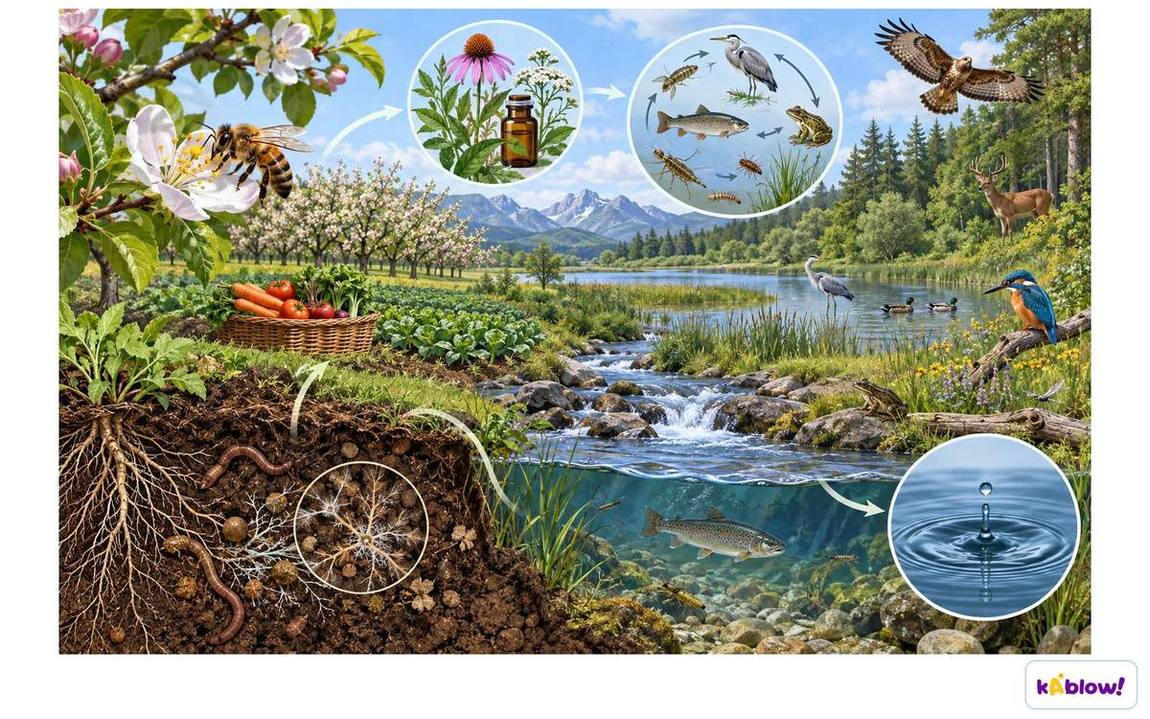
- Biodiverse ecosystems give us ecosystem services: pollination of crops, clean water, fertile soil made by decomposers, food, medicines from plants, and flood control. They also tend to be more stable, because if one species declines others can fill its role.
- The human population grew from about 1 billion in 1800 to more than 8 billion today. More people need more land, food and energy, and produce more waste.
- A species is extinct when no individuals are left alive. The main human causes of species loss are habitat loss, pollution, climate change, overexploitation and invasive species.
What a biodiverse landscape gives us
Habitat loss and land use
- Habitat loss is the biggest threat to wildlife. Land is cleared for farming, housing, roads, mining and timber. Even when some habitat is left, it may be cut into small, separated pieces, which are too small for some species to survive.
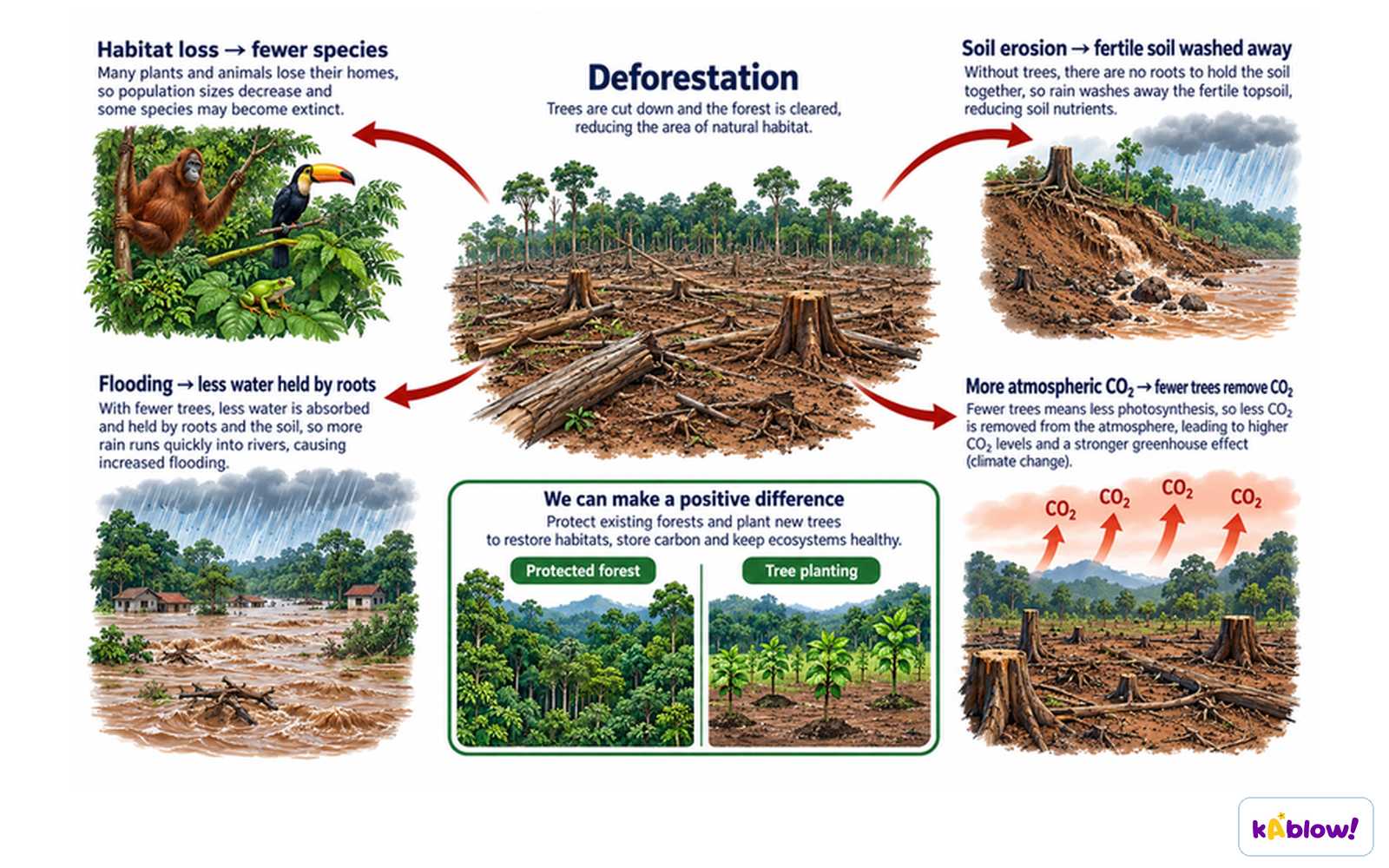
- Deforestation is the clearing of large areas of forest. Without trees, habitats are lost, roots no longer hold the soil so rain causes erosion, less rainwater is absorbed so flooding increases, and less carbon dioxide is removed by photosynthesis.
- Burning or rotting felled trees releases the carbon they stored as carbon dioxide, which adds to climate change.
- A monoculture is a single crop grown over a large area. It provides few habitats and food sources, so fewer species live there, and pests and diseases can spread quickly between identical plants.
- Palm oil is grown in a monoculture in tropical countries, and much of it has replaced rainforest. It gives more oil per hectare than most other oil crops, so replacing it with another crop could need even more land.
- Peat bogs are waterlogged ground that store a huge amount of carbon and support specialist species. Draining them for farming or fuel exposes the peat to air, so it decomposes and releases carbon dioxide.
Consequences of deforestation
Pollution: eutrophication and bioaccumulation
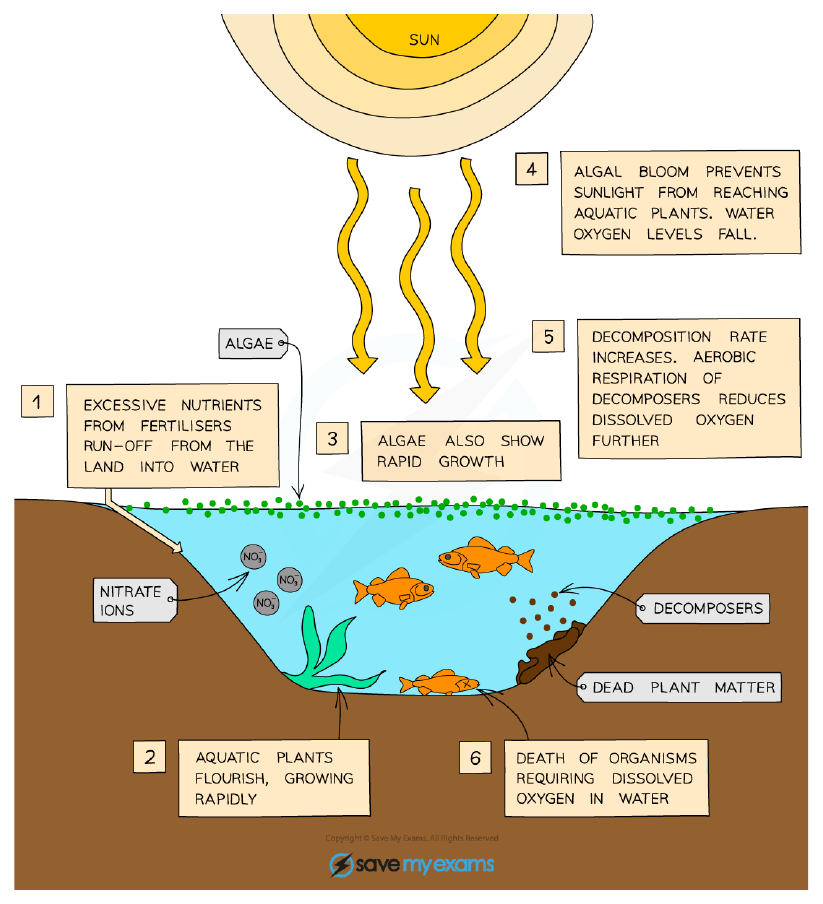
- Eutrophication is what happens when too many nutrients enter water. Fertiliser or sewage run-off adds nitrates and phosphates, which make algae grow rapidly into an algal bloom on the surface.
- The bloom blocks light, so plants below cannot photosynthesise and die. Decomposers such as bacteria multiply as they break down the dead material, and their aerobic respiration uses up the dissolved oxygen. Fish and other animals then die from lack of oxygen.
- Eutrophication can be reduced by using less fertiliser, applying it at the right time, leaving strips of plants between fields and rivers, and treating sewage.
- Plastic waste breaks down very slowly into tiny pieces. Animals swallow it or get tangled in it, and it is found in oceans all over the world.
- Some poisons, such as the pesticide DDT and the metal mercury, are persistent: they are not broken down and not removed from the body. They are stored in the tissues of the organism.
- Bioaccumulation is the build-up of a persistent poison in an organism. Because a predator eats many contaminated prey, the poison becomes more concentrated at each step of a food chain, so top predators are most at risk.
- DDT thinned the eggshells of some birds of prey, such as peregrine falcons, and their numbers fell. It was banned in many countries from the 1970s, and several populations then recovered.
How eutrophication happens
Climate change
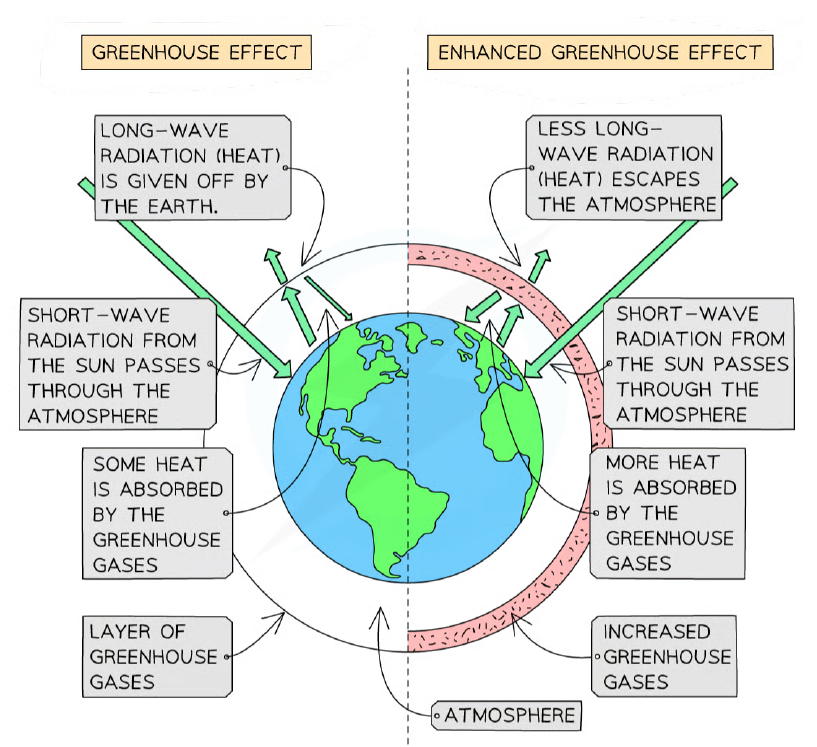
- The natural greenhouse effect keeps the Earth warm enough for life. Short-wave radiation from the Sun passes through the atmosphere, the Earth gives out long-wave heat radiation, and greenhouse gases absorb some of it and warm the air. Without it the average temperature would be about −18 °C instead of about 15 °C.
- Human activity has strengthened the effect. Burning fossil fuels and clearing forests release carbon dioxide. Cattle, rice paddies and landfill release methane.
- Carbon dioxide in the air has risen from about 280 parts per million before the Industrial Revolution to more than 400 today, and the average global temperature has risen by about 1.1 °C. This is the enhanced greenhouse effect, or climate change.
- Climate change harms biodiversity. Habitats shift towards the poles and uphill, so species that cannot move or adapt decline. Mountain species can run out of higher ground. Warmer seas bleach corals, and sea ice melts.
- Climate change can also upset timing. If insects emerge earlier in a warmer spring but birds hatch at the old time, chicks may miss their food.
- The ozone layer is a different problem. The hole in it is not the cause of global warming.
The greenhouse effect and the enhanced greenhouse effect
Overexploitation, conservation and sustainability
- Overexploitation means using a resource faster than it can be replaced. Overfishing is catching fish faster than the population can reproduce, so the stock falls.
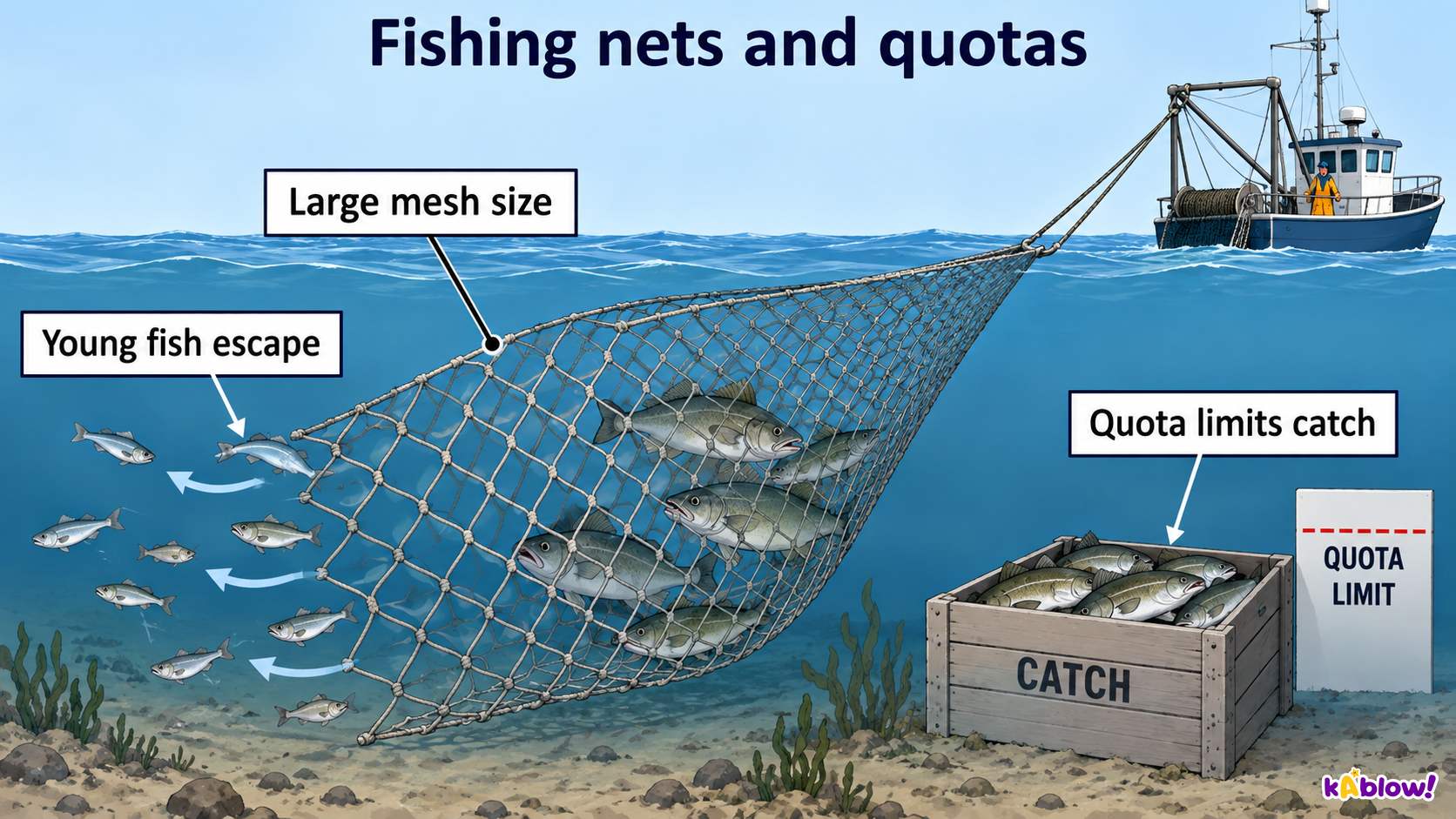
- Sustainable fishing uses quotas (a limit on the catch), a minimum mesh size so young fish escape, protected breeding areas, banning damaging nets such as gillnets, and inspections of catches.
- Sustainable forestry cuts only old trees, plants new ones to replace them, protects young trees, and monitors the forest.
- Conservation is protecting and managing species and habitats. Strategies include national parks and reserves, laws and agreements that control trade in endangered species, captive breeding and reintroduction, seed banks and gene banks, wildlife corridors and green bridges, and education.
- Sustainability means meeting the needs of people today without harming the ability of future generations to meet theirs.
- Most decisions involve trade-offs. A reserve may protect a species but limit farmland, and a quota may protect a fish stock but reduce fishers' income for a while. To evaluate a trade-off, ask who benefits, who pays, what the evidence says, and what happens in the short term and the long term.
Nets and quotas protect fish stocks
Think like a scientist: how does fertiliser affect algae?
- Question: how does the amount of fertiliser in pond water affect the growth of algae? A teacher sets up four identical clear bottles, each with 200 mL of the same pond water. The bottles receive 0, 1, 2 and 4 mL of a fertiliser solution. They are sealed, placed side by side on a bright windowsill and left for 10 days.
- Variables: the independent variable is the volume of fertiliser solution. The dependent variable is the number of algal cells in a 1 mL sample, counted under a microscope. Control variables include the volume and source of pond water, the bottle type, light and temperature, and the time.
- Control: the bottle with 0 mL of fertiliser is the control. It shows how much the algae grow in pond water alone.
- Results (one experiment, mean of three repeats, thousand cells per mL): 0 mL gave 2, 1 mL gave 5, 2 mL gave 11, 4 mL gave 20.
- Pattern: more fertiliser led to more algae in these bottles. The bottles are small and sealed, so the experiment does not show what would happen in a real lake with a stream, fish and changing weather.
- Safety: keep the bottles sealed, never drink the water, and wash hands after handling pond water.
- Inquiry task: write a conclusion using the data. Then evaluate the method: name one source of error, suggest one improvement, and explain how a farmer might use your results when deciding how much fertiliser to use, weighing crop yield against the risk to water.
Folien
Sign up free to view the lesson slides
Step through every slide for this topic — plus flashcards and revision notes — with a free account.
Übungsfragen
Gratis-Vorschau — 8 von 54 Fragen. Registriere dich, um alle zu sehen.
1.What does biodiversity mean?
Easy- AThe total number of individual animals in a habitat today
- BThe amount of energy flowing through a food chain overall
- CThe variety of different species in a habitat or ecosystem
- DThe number of different habitats found within one country
2.Which of these are benefits that a biodiverse ecosystem can provide? (select all that apply)
Easy- APollination of food crops
- BFaster soil erosion
- CPlants that give new medicines
- DClean water from healthy wetlands
- ELess carbon stored in the soil
3.A habitat with more species has higher biodiversity than a similar habitat with fewer species.
EasyTrue or false?
- 4.Easy
Two woodland plots each contain 100 sampled trees.
Woodland Number of tree species A 3 B 7 Which statement is correct?
- AWoodland B has the higher biodiversity because it has more species
- BWoodland A has the higher biodiversity because it has fewer species
- CBoth woodlands have the same biodiversity because both have 100 trees
- DBiodiversity cannot be compared by counting the number of species
5.Match each cause of species loss to an example.
Medium- Habitat loss
- Overhunting
- Invasive species
- Climate change
- Animals are killed faster than they can breed
- Warming melts the sea ice that polar bears hunt from
- A forest is cleared to make farmland
- A non-native rat eats the eggs of ground-nesting birds
6.Sea otters eat sea urchins, and sea urchins graze on kelp. If otters are hunted until almost none remain on a coast, what is the most likely effect on the kelp forest?
Hard- AKelp grows faster because there are fewer predators in the area
- BNothing changes because otters do not eat kelp directly
- CUrchin numbers fall because they lose their main food supply
- DUrchin numbers rise and they overgraze the kelp, so the forest shrinks
7.Explain why humans should care about the loss of biodiversity.
Medium8.What happens to soil on a steep slope when the trees are cut down?
Easy- AIt becomes richer because more sunlight reaches the ground
- BRain washes it away because fewer roots hold it in place
- CIt is protected because the stumps trap all of the water
- DNothing changes because soil is held by rock rather than roots
Unlock all 54 questions, flashcards & more
Erstelle ein Gratis-Konto, um alle Fragen, Folien, Karteikarten und Lernnotizen zu diesem Thema zu sehen.