Cell division: mitosis, meiosis and stem cells
Lerne es beim Spielen
Beantworte diese Fragen für Energie, dann angle und erkunde. Kein Konto nötig.
Lektionsnotizen
Big idea: how cells make more cells
- Big idea (key concept): Change. A single fertilised egg becomes a body of trillions of cells. Cells change by dividing, by specialising, and sometimes by dividing when they should not.
- Related concept: Development. Cell division is how you grew from an embryo, how a cut heals and how sex cells are made for the next generation.
- Global context: Scientific and technical innovation. Understanding cell division has led to new technologies, including stem cell therapies and cancer treatments. Each brings benefits, risks and ethical questions that people discuss and decide together.
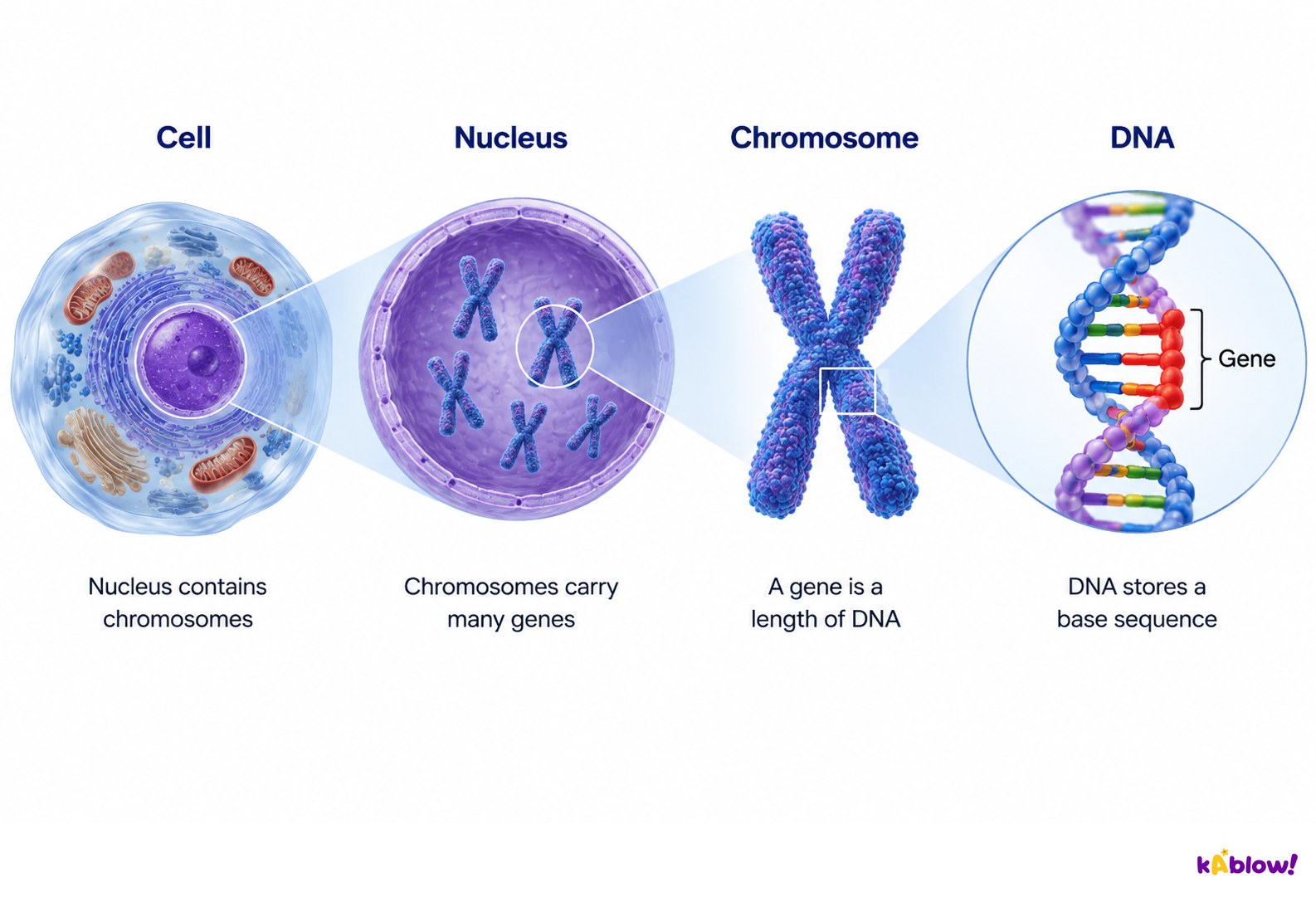
- The nucleus of a cell contains chromosomes. A chromosome is a long molecule of DNA wound up with proteins. A gene is a short section of DNA on a chromosome that codes for a protein.
- Human body cells have 46 chromosomes, arranged as 23 pairs. In each pair, one chromosome came from your mother and one from your father. The two chromosomes in a pair carry the same genes in the same order and are called homologous chromosomes.
- A cell with two sets of chromosomes is diploid (2n). A cell with a single set is haploid (n). Human body cells are diploid with 2n = 46. Human sex cells, or gametes, are haploid with n = 23.
- Different species have different numbers of chromosomes. A fruit fly has 8 in its body cells, a pea plant has 14, a dog has 78 and a human has 46. The number does not tell you how complicated the organism is.
From the cell to the gene
The cell cycle and mitosis
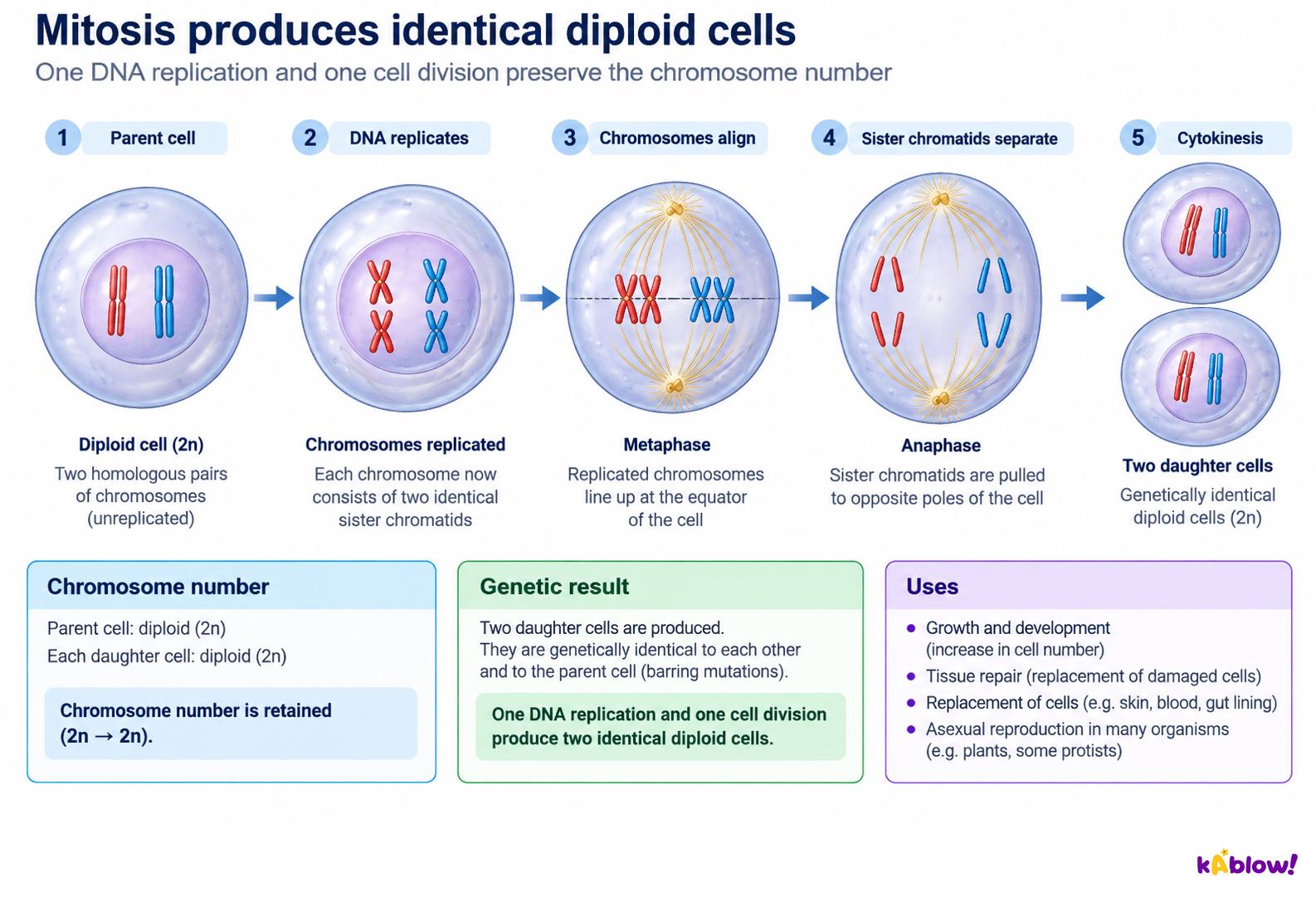
- Cells divide in a repeating series of events called the cell cycle. Most of the cycle is interphase, when the cell is not dividing. In interphase the cell grows, makes new organelles and proteins, and copies (replicates) its DNA. After replication every chromosome is made of two identical sister chromatids joined together.
- Mitosis is the division of the nucleus that follows. It makes two daughter cells that are genetically identical to the parent cell and to each other. Mitosis has stages. In prophase the chromosomes condense and become visible, and the nuclear membrane breaks down. In metaphase the chromosomes line up across the equator of the cell. In anaphase the sister chromatids are pulled apart to opposite poles. In telophase new nuclear membranes form around the two sets of chromosomes.
- Finally the cytoplasm and cell membrane divide in cytokinesis, forming two cells. Each has the same chromosome number as the parent: a diploid cell makes two diploid cells (2n to 2n). In human cells, 46 chromosomes become 46 in each daughter cell.
- Mitosis is used for growth (more cells), repair (replacing damaged cells such as skin, gut lining and blood cells) and asexual reproduction (for example, plants that grow from cuttings, and yeast that bud). Because the daughter cells are identical, asexual reproduction makes clones.
- If one cell divides by mitosis n times, it makes 2 to the power n cells. After 5 divisions there are 32 cells, and after 10 divisions there are 1024 cells. This is why a small number of cells can produce a large number quickly.
- Division is controlled. Cells have checkpoints that make sure DNA is copied correctly before they divide. A cell that does not divide often, such as a mature nerve cell, spends nearly all its life in interphase.
Mitosis: one parent cell makes two identical cells
Meiosis: making gametes
- Meiosis is the cell division that makes gametes: sperm and egg cells in animals, and pollen and egg cells in flowering plants. In humans it takes place in the testes and ovaries.
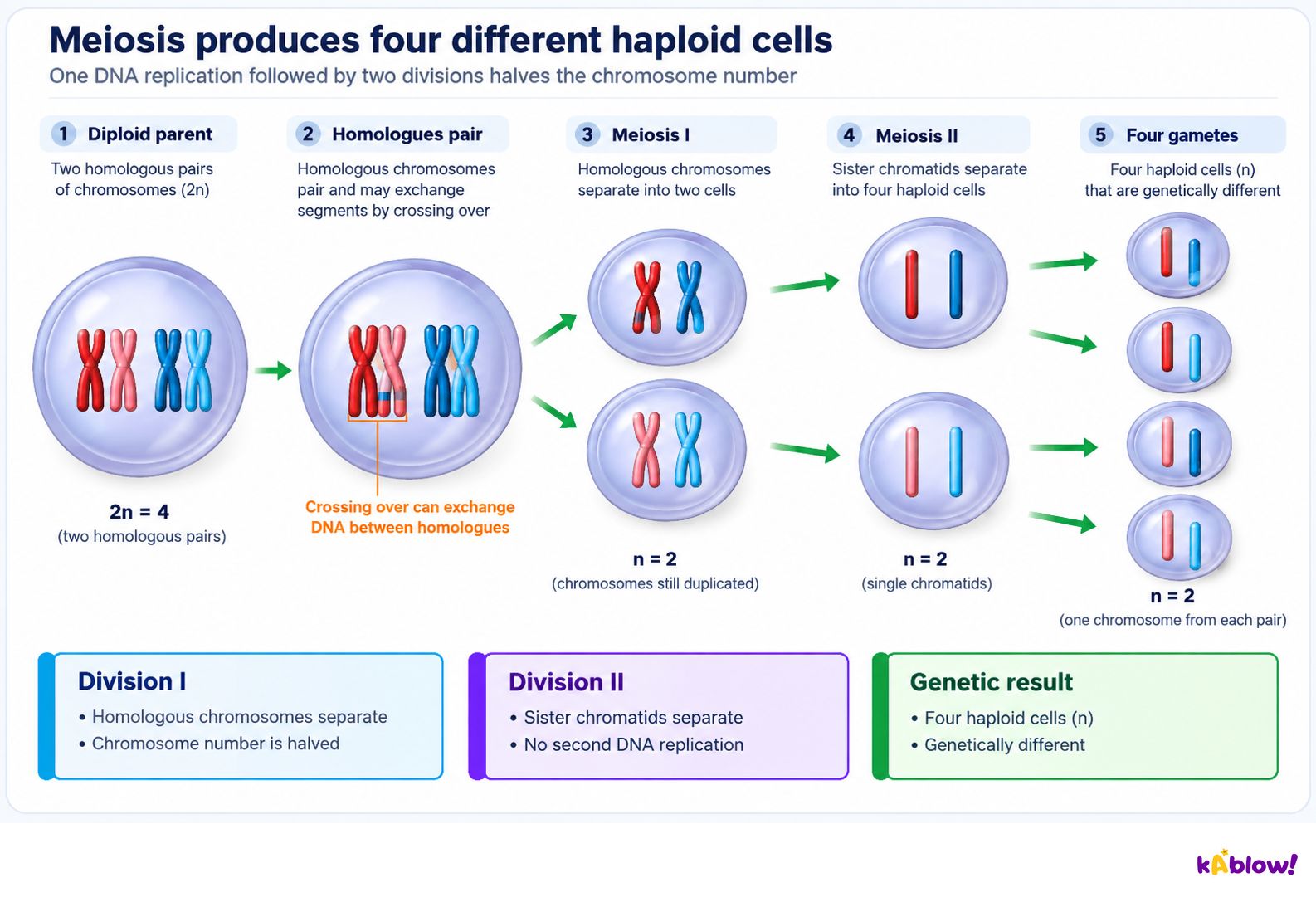
- In meiosis the DNA is copied once, but the cell then divides twice. The result is four daughter cells, each with half the number of chromosomes of the parent cell. A diploid cell makes haploid cells (2n to n). A human cell with 46 chromosomes makes gametes with 23.
- In meiosis I the homologous chromosomes are separated into two cells. In meiosis II the sister chromatids are separated, so four cells result. Compare this with mitosis, where the homologous chromosomes are not separated.
- The four cells are genetically different, which produces variation. First, during meiosis I, homologous chromosomes can swap sections of DNA in crossing over. Second, each pair lines up and separates at random, so the maternal and paternal chromosomes are shuffled. This is independent assortment.
- A cell with 3 pairs of chromosomes (2n = 6) can make 2 to the power 3 = 8 different combinations of chromosomes in its gametes. A human cell with 23 pairs can make 2 to the power 23, which is about 8.4 million, even before crossing over is counted.
- A third source of variation is random fertilisation: which sperm fertilises which egg is a matter of chance. Together these explain why siblings, other than identical twins, are not genetically identical.
Meiosis: one diploid cell makes four different haploid cells
Comparing mitosis and meiosis, and chromosome numbers
- Where: mitosis happens in almost all body cells that divide. Meiosis happens only in the reproductive organs.
- Number of divisions and cells: mitosis has one division and makes two cells. Meiosis has two divisions and makes four cells.
- Chromosome number: mitosis keeps it the same (2n to 2n). Meiosis halves it (2n to n).
- Genetic result: mitosis makes cells that are identical to the parent. Meiosis makes cells that are different from each other and from the parent.
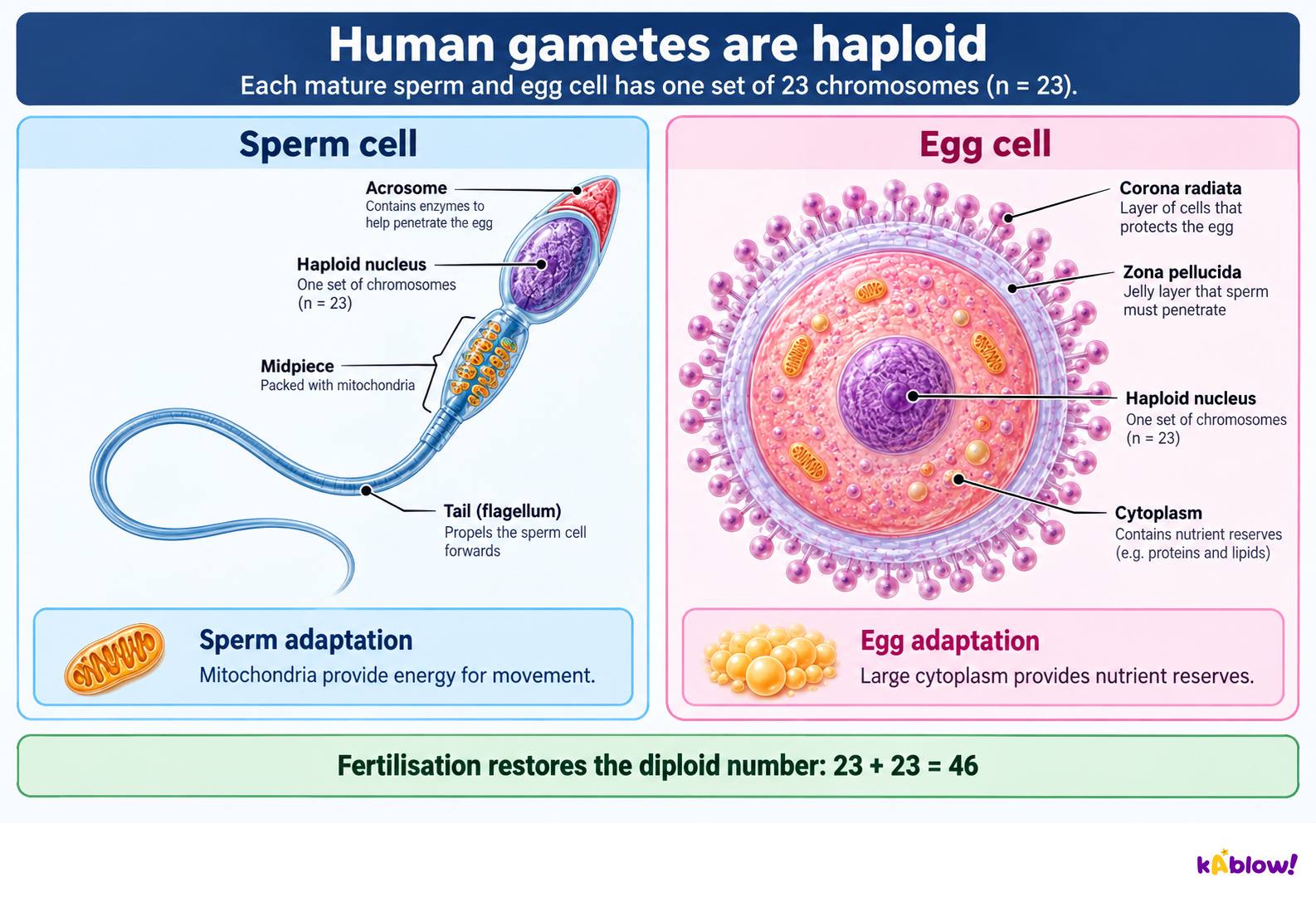
- Fertilisation is the fusion of a sperm and an egg nucleus. The haploid gametes (23 + 23) combine to make a diploid zygote (46). The zygote then divides by mitosis to form the embryo. If gametes had the full 46 chromosomes, each generation would double the number.
- Sometimes chromosomes do not separate properly in meiosis, so a gamete has one chromosome too many or too few. If an egg or sperm with 24 chromosomes fuses with a normal gamete of 23, the zygote has 47. Down syndrome is caused by a person having three copies of chromosome 21 instead of two, giving 47 chromosomes in body cells. People with Down syndrome have a wide range of abilities and needs, and live in all communities.
Human sperm and egg cells are haploid
Stem cells, cancer and the questions they raise
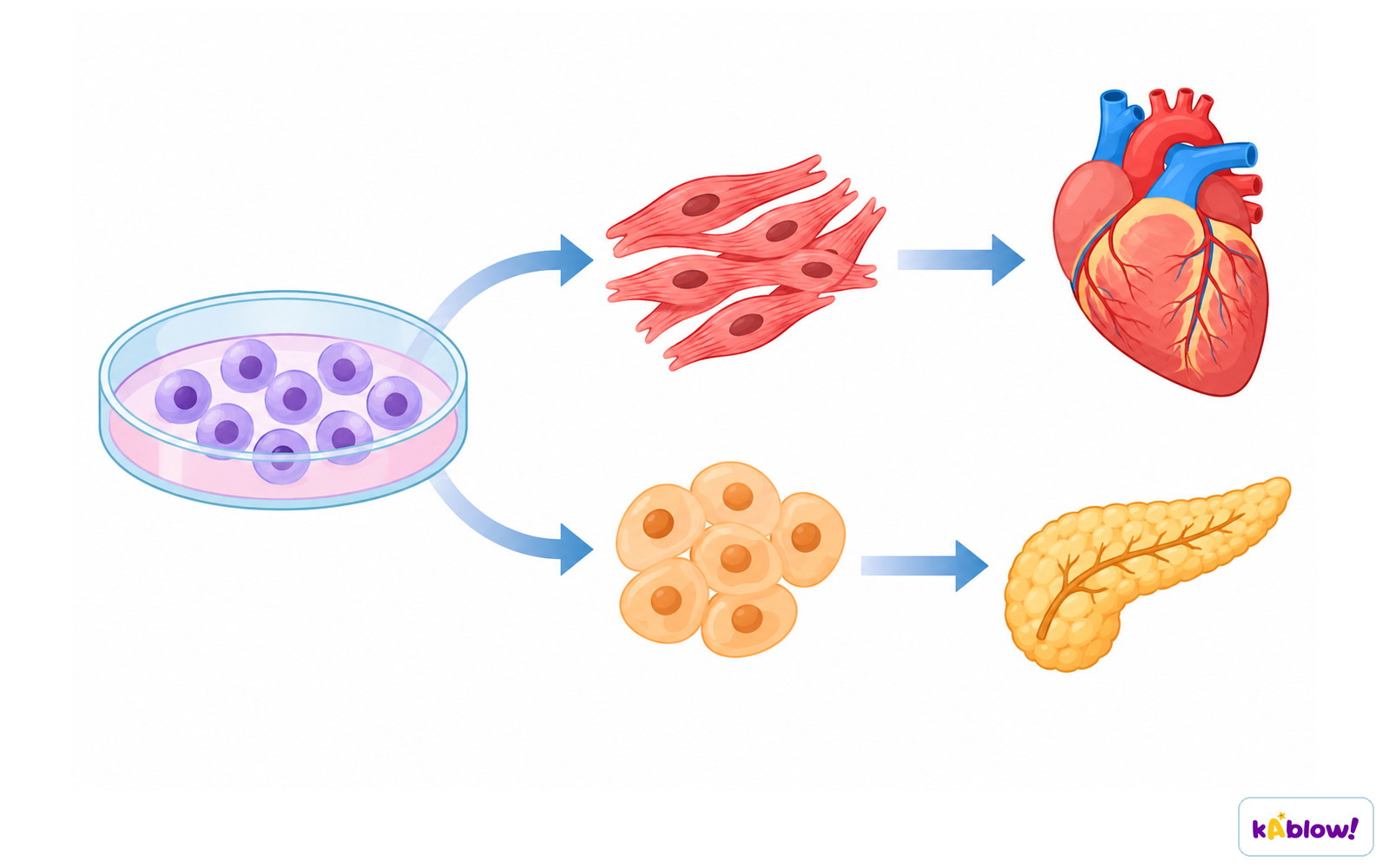
- Most cells in your body are specialised: they have a particular shape and organelles that suit their job. Differentiation is the process in which an unspecialised cell becomes specialised. Stem cells are unspecialised cells that can divide by mitosis and can differentiate into other types of cell.
- Embryonic stem cells come from very early embryos. They can develop into almost any type of cell. Adult stem cells, such as those in bone marrow, are found in the body all through life but can usually make only some cell types, such as blood cells. Plants keep stem cells in meristems at the tips of roots and shoots, which is why cuttings can grow into whole new plants.
- Uses: a bone marrow transplant gives a patient stem cells that make healthy blood cells, and is used to treat some blood diseases. Researchers are exploring whether stem cells can be guided to replace damaged tissue, such as heart muscle, nerve cells or the insulin-making cells lost in type 1 diabetes. Many of these ideas are still being tested in trials and are not yet routine treatments.
- Benefits and risks. Benefits could include treating diseases that currently have no cure and testing new medicines on human cells. Risks include stem cells forming tumours, the immune system rejecting donor cells, high costs, and some clinics selling treatments that have not been properly tested.
- Ethical views. Embryonic stem cells are usually taken from embryos that were made for fertility treatment and are no longer needed. Some people object because they believe an embryo has the right to be protected from the moment of fertilisation. Others argue that the potential to relieve suffering is more important, especially when the embryos would otherwise be destroyed. Scientists have also found ways to reprogram adult cells to behave like stem cells, which avoids using embryos, though these cells need more research. Laws about stem cell research differ between countries.
- Cancer is caused by uncontrolled cell division. A mutation in the genes that control the cell cycle can make a cell divide again and again, forming a mass called a tumour. A benign tumour stays in one place. A malignant tumour invades nearby tissue and can spread through the blood to other parts of the body. Known risk factors include tobacco smoke, UV radiation and some infections, and inheritance of certain alleles. Some cancer treatments, such as chemotherapy, damage rapidly dividing cells, which is why they can also affect hair follicles and the gut lining.
Stem cells and possible medical uses
Think like a scientist: counting cells in a root tip
- Scientists can estimate how long a cell spends in each stage of the cell cycle by looking at a stained slide of an actively growing tissue, such as an onion root tip, under a microscope. At any moment, cells are spread across the stages in proportion to how long each stage lasts.
- To calculate the mitotic index, count the cells that are in mitosis and divide by the total number of cells counted. Mitotic index = (cells in mitosis / total cells) x 100. If a student counts 200 cells and 14 are in mitosis, the mitotic index is 7 per cent.
- To estimate the time in a stage, multiply the fraction of cells in that stage by the total time of the cell cycle. If interphase contains 84 of 100 cells and the whole cycle takes 20 hours, interphase lasts 0.84 x 20 = 16.8 hours.
- To make the data reliable, count several different root tips and at least 100 cells in each. Count the same field of view systematically so that no cell is counted twice. Calculate a mean from the repeats.
- A fair test to compare two conditions changes one independent variable, such as the temperature the roots grew at, and controls the others: the type of plant, the age of the roots, the time of day the tips were cut, the stain and the staining time. The dependent variable is the mitotic index.
- Inquiry task: design an investigation to find out whether the temperature at which onion roots are grown changes the mitotic index. State your variables, say how many root tips and cells you will count and why, describe how you will avoid counting bias, and evaluate one limit of using the mitotic index to compare growth.
Folien
Sign up free to view the lesson slides
Step through every slide for this topic — plus flashcards and revision notes — with a free account.
Übungsfragen
Gratis-Vorschau — 8 von 48 Fragen. Registriere dich, um alle zu sehen.
1.How many chromosomes are there in a normal human body cell?
Easy- A23
- B44
- C46
- D92
- E48
2.How many chromosomes are there in a normal human sperm or egg cell?
Easy- A23
- B46
- C92
- D12
- E48
3.What does mitosis produce from one parent cell?
Easy- AFour genetically different cells
- BTwo genetically different cells
- CFour genetically identical cells
- DTwo genetically identical cells
- EOne cell with double the chromosomes
4.What does meiosis produce from one parent cell?
Easy- ATwo genetically identical diploid cells
- BFour genetically different haploid cells
- CFour genetically identical diploid cells
- DTwo genetically different diploid cells
- EOne haploid cell with double the DNA
5.In humans, meiosis takes place in the ovaries and testes.
EasyTrue or false?
6.Complete the sentence.
EasyA cell with two sets of chromosomes is called ____.
7.Which of these is a use of mitosis?
Easy- AMaking sperm cells
- BReplacing damaged skin cells
- CMaking egg cells
- DHalving the chromosome number
- EProducing variation between siblings
8.Complete the sentence.
EasyA cell with a single set of chromosomes is called ____.
Unlock all 48 questions, flashcards & more
Erstelle ein Gratis-Konto, um alle Fragen, Folien, Karteikarten und Lernnotizen zu diesem Thema zu sehen.