Hormones and the endocrine system
Lerne es beim Spielen
Beantworte diese Fragen für Energie, dann angle und erkunde. Kein Konto nötig.
Für Lehrkräfte: sofort einsetzbare Lektionsfolien, Lernnotizen für Hormones and the endocrine system (MYP Biology, Year 4) — nutze sie in deiner Lektion oder starte das Thema als interaktive Klassenaktivität, die deine Lernenden als Live-Spiel spielen.
Lektionsnotizen
Big idea: chemical messengers keep the body in balance
- Big idea (key concept): Relationships. The glands, the blood and the body's cells form a relationship: the glands send a signal, and only certain cells are able to receive it.
- Related concept: Balance. Many hormones work in pairs or in loops that keep conditions such as blood glucose and metabolic rate steady, even when you eat, rest or exercise.
- Global context: Identities and relationships. Hormones help to decide how you grow, how you react to danger and when you reach puberty. They are part of what shapes each person.
- A hormone is a chemical messenger. It is made in an endocrine gland (a gland with no duct), released directly into the blood, and carried round the whole body in the blood plasma.
- A hormone only affects its target cells. Target cells have receptor molecules with a shape that matches the hormone. Cells with no matching receptor ignore it, even though it reaches them.
- Nervous and hormonal control compared. The nervous system uses electrical impulses along neurones: the response is very fast, short-lived and acts on a precise place. The hormonal system uses chemicals in the blood: the response is slower, longer-lasting and often acts on several parts of the body.
The main endocrine glands
- The pituitary gland at the base of the brain is sometimes called the master gland, because it releases hormones that control other glands. It releases FSH and LH (reproduction), TSH (the thyroid), ADH (water balance) and growth hormone.
- The thyroid gland in the neck releases thyroxine, which controls metabolic rate. The adrenal glands, above the kidneys, release adrenaline.
- The pancreas releases insulin and glucagon, which control blood glucose. The ovaries release oestrogen and progesterone, and the testes release testosterone.
- Hormones in the menstrual cycle (a brief look). FSH from the pituitary makes an egg mature in the ovary and makes the ovary release oestrogen. Oestrogen repairs and thickens the lining of the uterus. LH from the pituitary causes ovulation, the release of the egg, about the middle of the cycle. Progesterone keeps the uterus lining thick.
- Hormones control growth, development, reproduction and the balance of conditions inside the body. You will meet blood glucose control in more detail in the next topic.
Adrenaline and thyroxine
- Adrenaline is released by the adrenal glands when you are frightened, excited or stressed. It prepares the body for fight or flight.
- Adrenaline makes the heart beat faster and breathing faster, which sends more oxygen and glucose to the muscles. It causes the liver to release glucose into the blood, and widens the pupils. Blood is diverted towards the muscles, away from the digestive system.
- The effects start within seconds but fade after a few minutes, because the hormone is broken down and removed from the blood. It acts more slowly than a nerve impulse, but its effect lasts longer.
- Thyroxine is released by the thyroid gland. It controls metabolic rate: how fast the cells use energy. It is needed for normal growth and development.
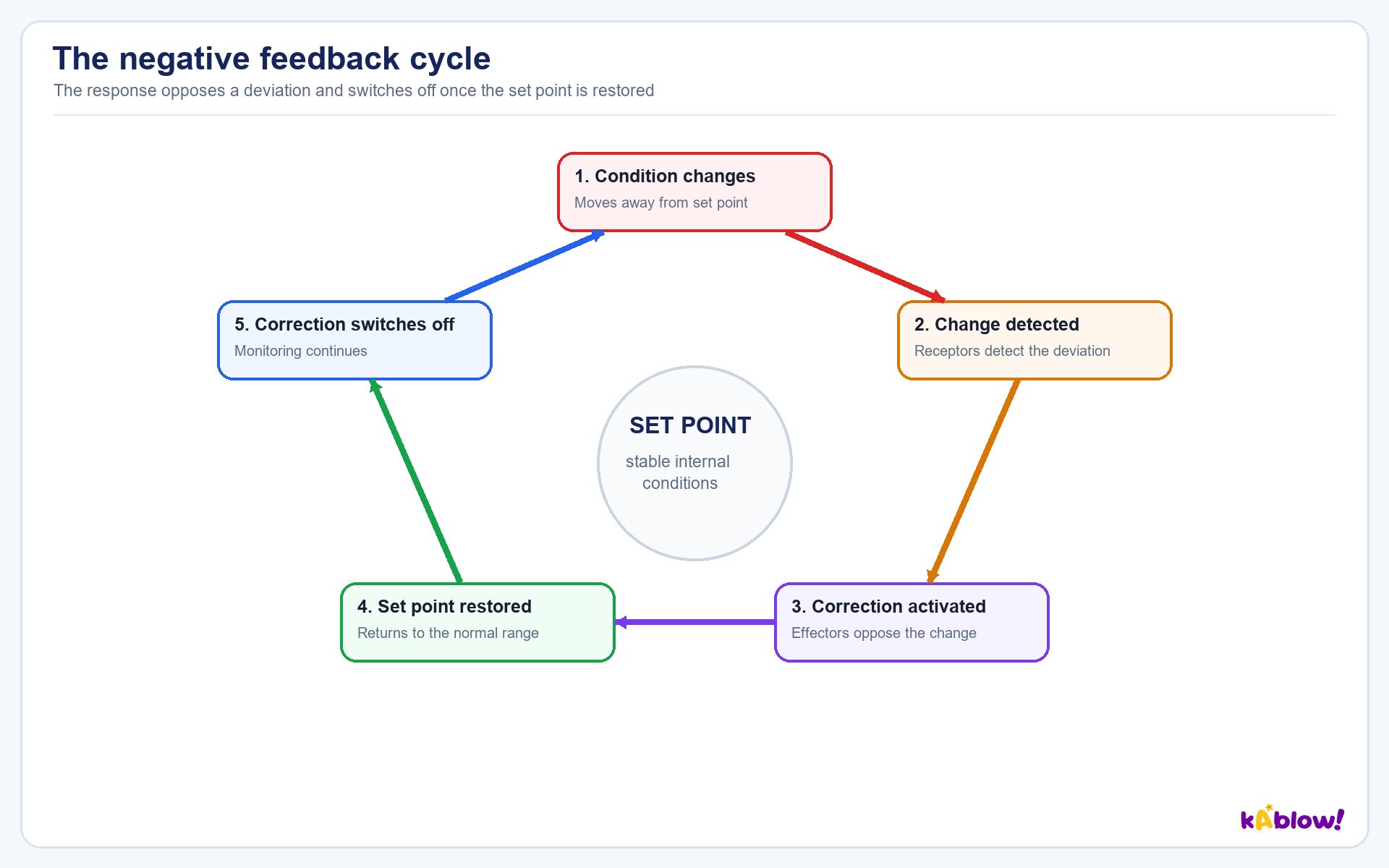
- Thyroxine is controlled by negative feedback. If the level of thyroxine in the blood falls, the pituitary releases more TSH, which tells the thyroid to release more thyroxine. When the level rises again, less TSH is released. The level stays close to the set point.
The negative feedback cycle
Insulin and glucagon: two hormones, one balance
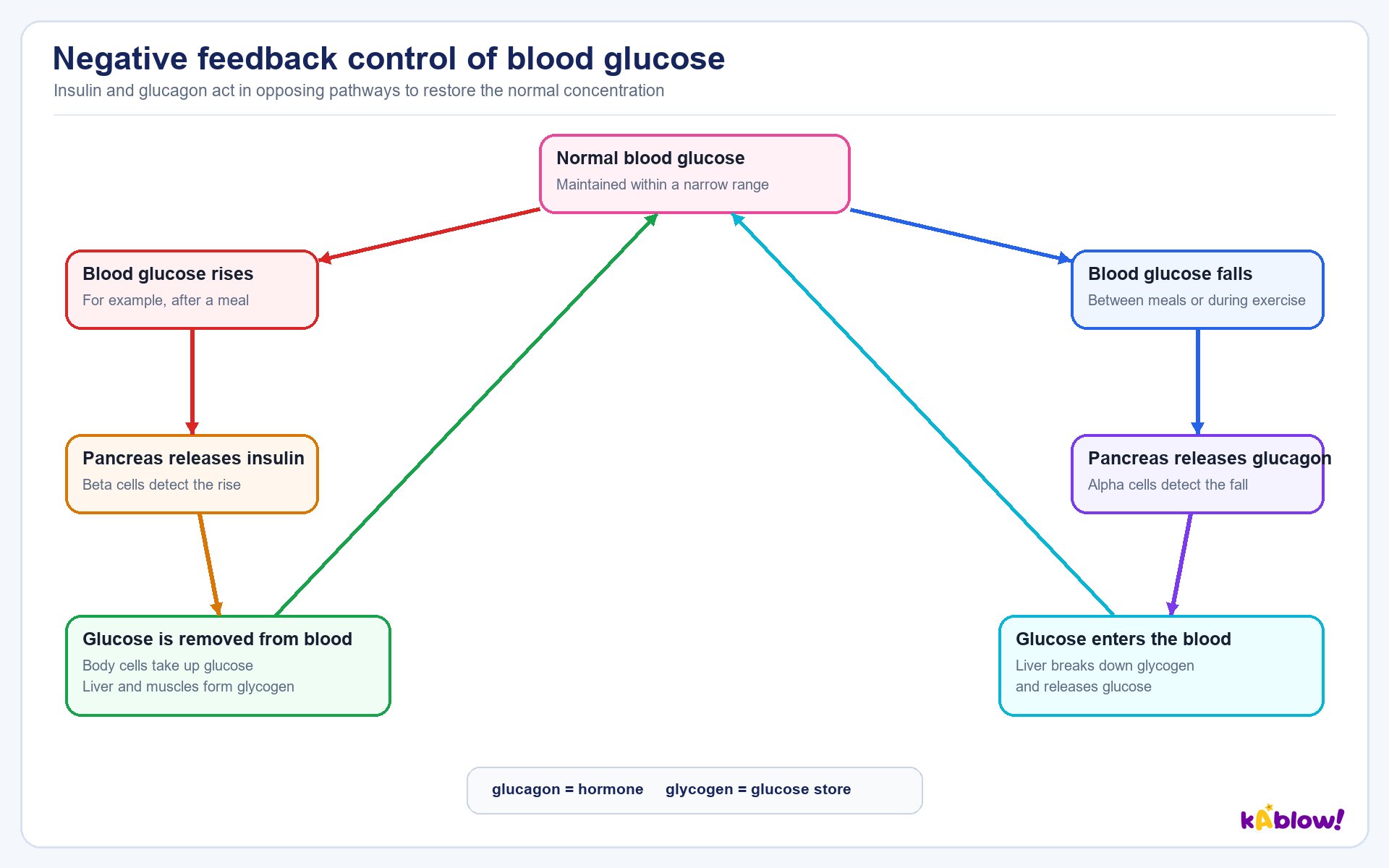
- Cells need a steady supply of glucose for respiration. If the level of glucose in the blood is too high or too low, cells and organs are harmed. The pancreas detects the level and releases the right hormone.
- After a meal, blood glucose rises. The pancreas releases insulin. Insulin makes body cells take up glucose and makes the liver convert glucose into glycogen (a storage carbohydrate). Blood glucose falls back towards normal.
- Between meals or during exercise, blood glucose falls. The pancreas releases glucagon. Glucagon makes the liver break down glycogen into glucose and release it into the blood. Blood glucose rises back towards normal.
- This is negative feedback: the response reverses the change that triggered it. Two hormones with opposite effects give very precise control, as if a driver can both accelerate and brake.
- If blood glucose control fails, the level can stay too high. This is the cause of diabetes, which is studied in the next topic.
Insulin and glucagon control blood glucose
Plant hormones: auxin and tropisms
- Plants also use hormones. Auxin is made in the tips of shoots and roots. It controls growth in a particular direction.
- A tropism is a growth response of a plant to a directional stimulus. Phototropism is a response to light and gravitropism is a response to gravity. Growing towards the stimulus is positive, and growing away from it is negative.
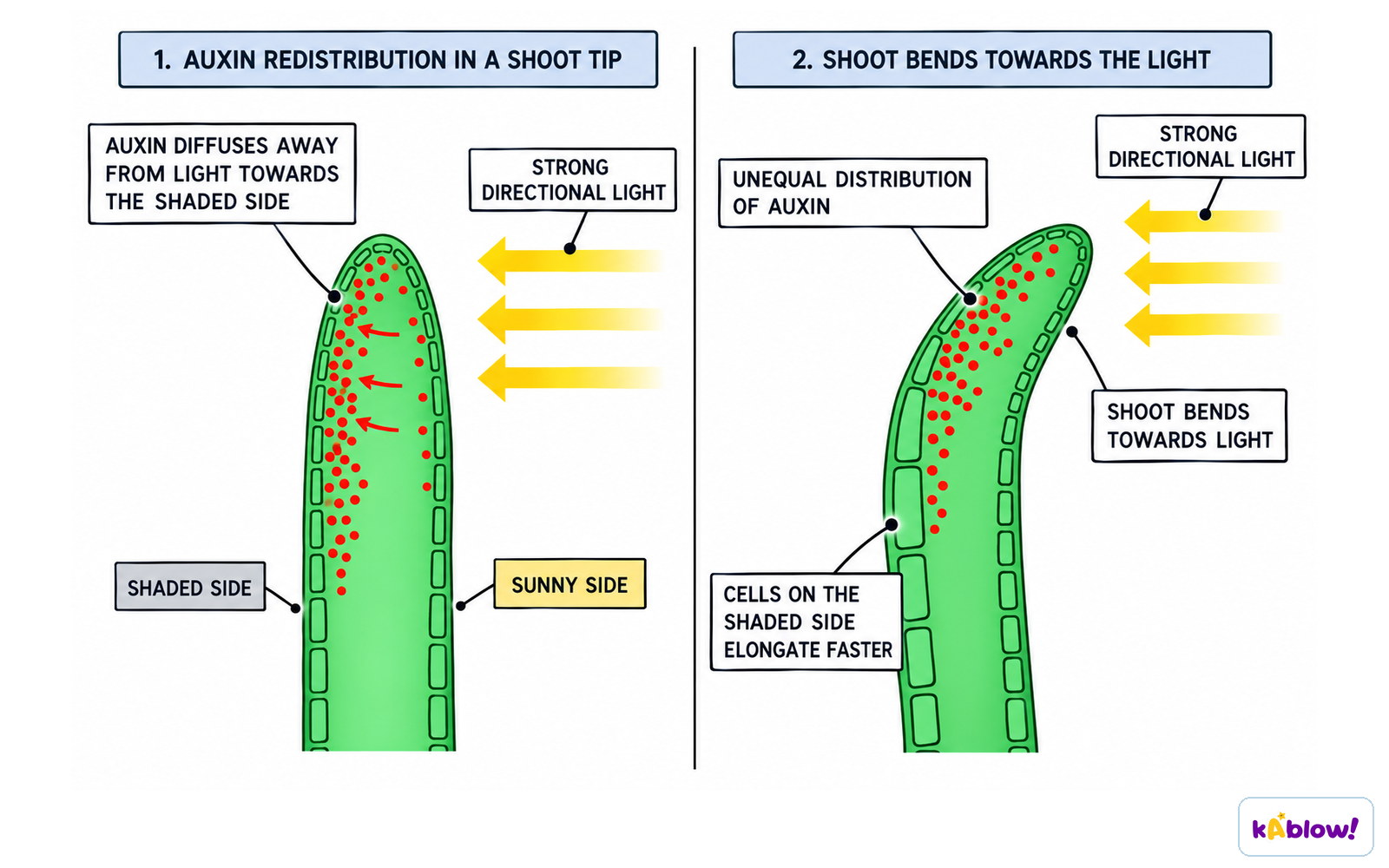
- Phototropism in a shoot: light from one side makes auxin move to the shaded side. Auxin makes cells elongate, so cells on the shaded side grow longer than cells on the lit side, and the shoot bends towards the light. This helps the leaves to absorb more light for photosynthesis.
- Gravitropism: in a shoot lying on its side, auxin collects on the lower side and makes cells there elongate, so the shoot grows upwards (negative gravitropism). In a root, auxin collects on the lower side too, but here it slows elongation, so the upper side grows faster and the root bends downwards (positive gravitropism).
- Auxin has uses in farming and gardening: some synthetic auxins are used as selective weedkillers that harm broad-leaved weeds but not cereals, and as rooting powder for cuttings.
Auxin and phototropism in a shoot tip
Think like a scientist: does the shoot tip detect the light?
- Question: which part of a young shoot detects light, and which part bends? Use identical seedlings (for example cress or oat seedlings) with light shining from one side only.
- Compare four treatments: A, intact seedlings; B, the tip removed; C, the tip covered with a small foil cap; D, the tip uncovered but the lower part covered with foil. The independent variable is the treatment. The dependent variable is how much the shoot bends (angle) or grows (mm) after a set time.
- Control variables: the species and age of the seedlings, the light intensity and its distance, the temperature, the water supply and the time.
- To make results reliable, use at least five seedlings per treatment and calculate a mean. Say what you would do about any result that looks like an anomaly.
- Inquiry task 1: predict the result for each treatment A to D and explain your predictions using auxin. Inquiry task 2: a student uses one seedling per treatment and concludes that the tip makes auxin. Evaluate the evidence and suggest two improvements.
Folien
Sign up free to view the lesson slides
Step through every slide for this topic — plus flashcards and revision notes — with a free account.
Übungsfragen
Gratis-Vorschau — 8 von 50 Fragen. Registriere dich, um alle zu sehen.
1.What is a hormone?
Easy- AA muscle that carries out a response
- BA chemical messenger carried in the blood
- CA cell that detects a stimulus
- DAn electrical impulse in a neurone
2.How do hormones travel to their target organs?
Easy- AThrough the air
- BAlong neurones
- CAlong the digestive system
- DIn the blood plasma
3.Hormones are made by endocrine glands.
EasyTrue or false?
4.What is a target cell?
Easy- AA cell that has receptors matching a particular hormone
- BA cell found only in the brain
- CA cell that destroys hormones
- DA cell that makes every hormone in the body
5.Which gland makes insulin?
Easy- AThe adrenal glands
- BThe pituitary
- CThe thyroid
- DThe pancreas
6.Which glands release adrenaline?
Easy- AThe pancreas
- BThe ovaries
- CThe adrenal glands
- DThe thyroid
7.Match each gland to the hormone it releases.
Easy- Thyroid
- Adrenal glands
- Ovary
- Pancreas
- Insulin
- Thyroxine
- Oestrogen
- Adrenaline
8.Complete the sentence.
EasyThyroxine controls the body's ____ rate.
Unlock all 50 questions, flashcards & more
Erstelle ein Gratis-Konto, um alle Fragen, Folien, Karteikarten und Lernnotizen zu diesem Thema zu sehen.
Altklausuren
Altklausuren-Übungen für dieses Thema kommen bald.
Bald verfügbar