Heart disease, exercise and circulation
Lerne es beim Spielen
Beantworte diese Fragen für Energie, dann angle und erkunde. Kein Konto nötig.
Lektionsnotizen
Big idea: a pump that works for a lifetime, and what can go wrong
- Big idea (key concept): Systems. The heart, the blood vessels and the blood form one transport system. If one part is damaged, the whole system, and the cells that depend on it, are affected.
- Related concept: Consequences. Choices, genes and age change the chance of heart disease. In this topic you will weigh up evidence for the consequences of risk factors, and for the consequences of treatments.
- Global context: Identities and relationships. Heart health is shaped by how people live, by their families and by the communities and health services around them. Cardiovascular disease is one of the leading causes of death in the world.
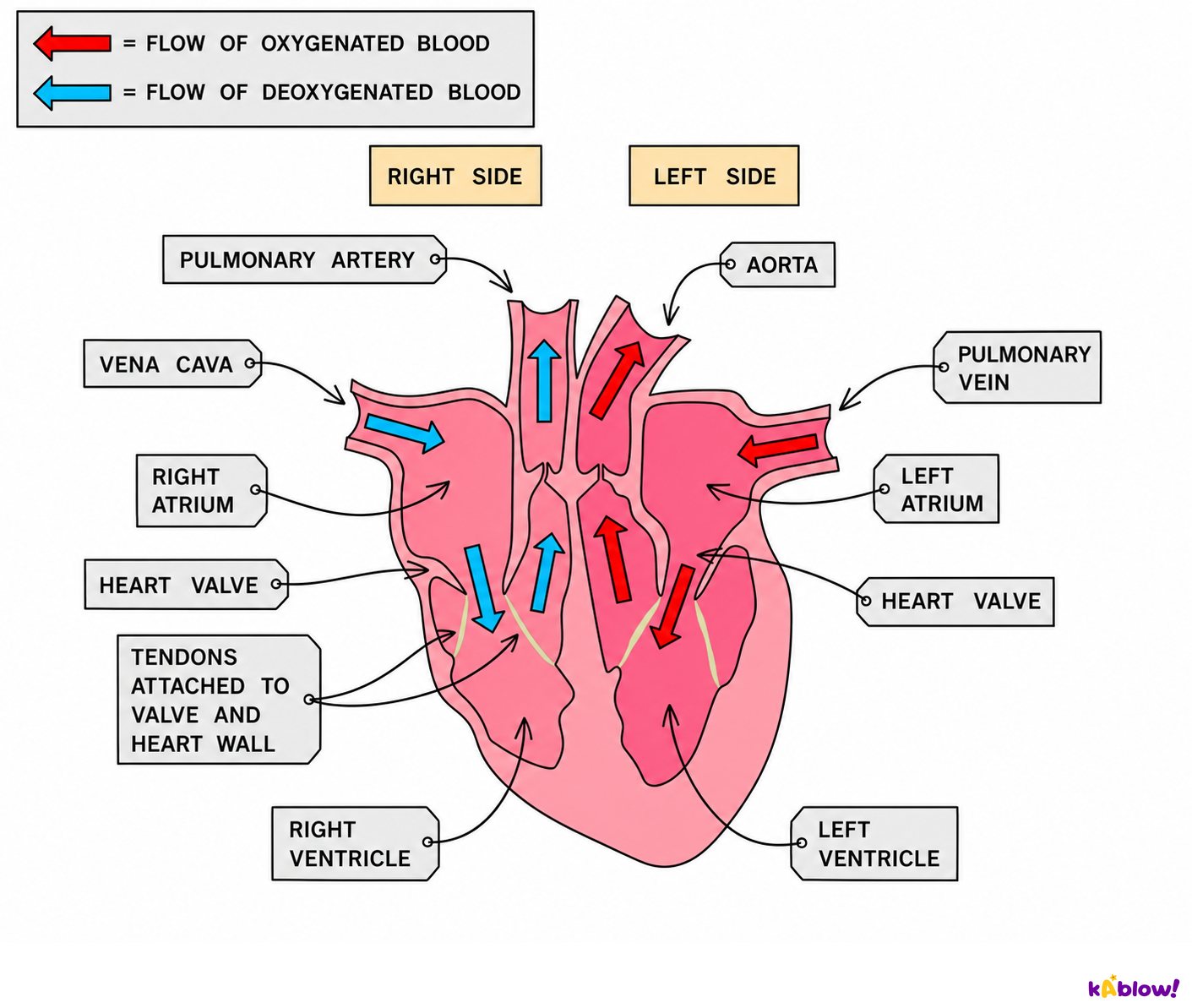
- The double circulation. The right side of the heart pumps deoxygenated blood to the lungs (the pulmonary circulation). The left side pumps oxygenated blood to the rest of the body (the systemic circulation). Blood passes through the heart twice on each full circuit.
- The left ventricle has a thicker muscular wall than the right ventricle because it pumps blood at higher pressure around the whole body. Valves between the chambers and in the exits stop blood flowing backwards.
- Arteries carry blood away from the heart at high pressure and have thick, elastic, muscular walls. Veins carry blood back to the heart at low pressure, have thinner walls and valves. Capillaries have walls one cell thick so that substances can be exchanged with the tissues.
Inside the heart: chambers, valves and blood flow
Coronary heart disease
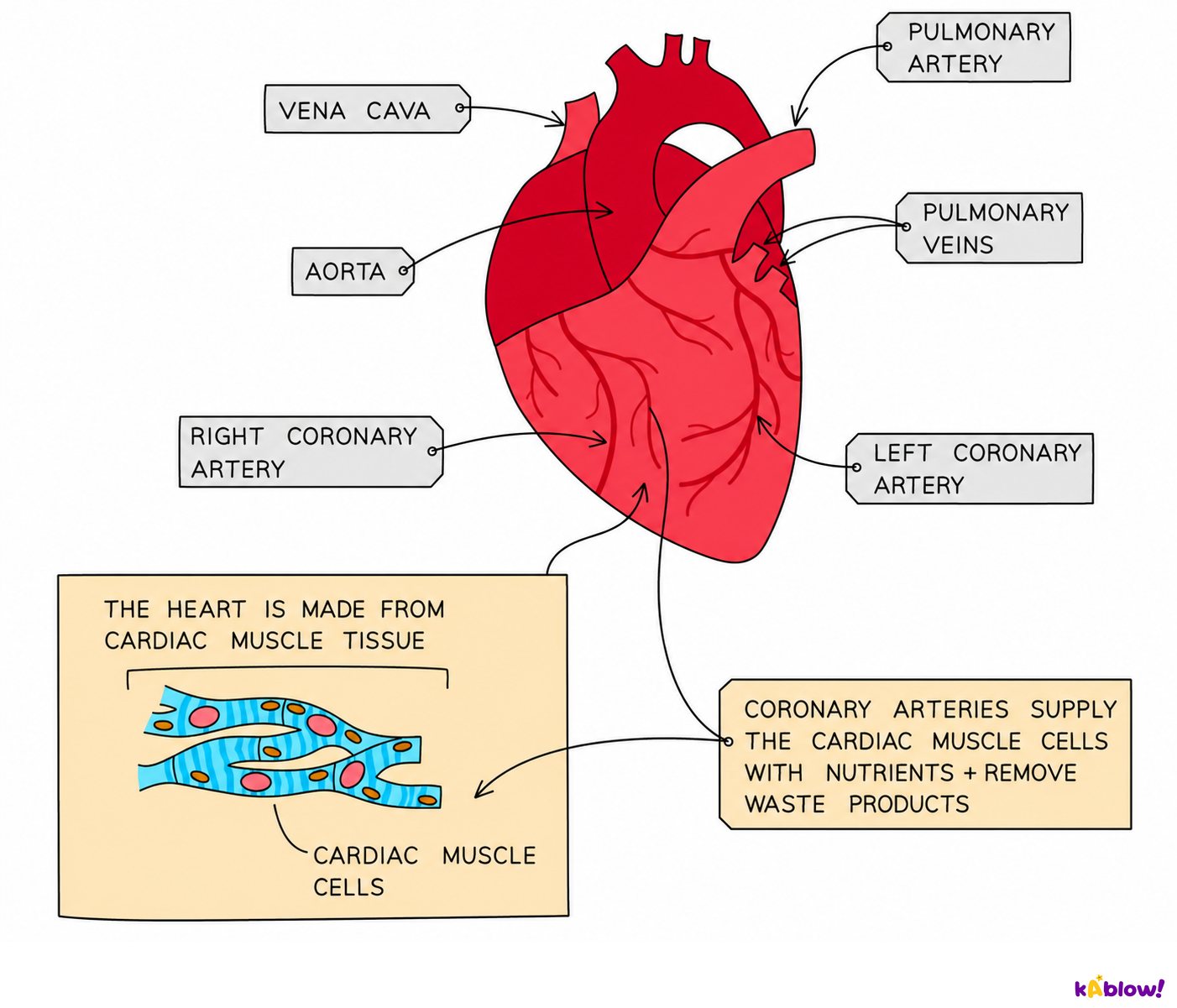
- The heart is made of cardiac muscle. Its thick wall cannot get enough oxygen and glucose by diffusion from the blood inside the chambers, so it has its own blood supply: the coronary arteries, which branch from the aorta and run over the surface of the heart.
- Coronary heart disease (CHD) happens when the coronary arteries become narrowed. Fatty material, including cholesterol, builds up in the artery wall as atheroma (plaque). The lumen (the space inside) gets smaller, so less blood reaches the heart muscle.
- If the muscle gets too little oxygen when it works hard, it can cause chest pain called angina. The muscle cells respire anaerobically and the pain goes when the person rests.
- If an atheroma breaks open, a blood clot can form and block the artery completely. The part of the heart muscle that the artery supplied gets no oxygen or glucose, and its cells begin to die. This is a heart attack.
- The chain is: atheroma builds up, the artery narrows, a clot blocks it, muscle is starved, cells die. A larger blockage, or one in a larger artery, damages more muscle.
- CHD develops slowly over many years, so the risk factors act over a long time. This is one reason why they are hard to study.
The coronary arteries on the surface of the heart
Risk factors and the evidence for them
- A risk factor is something linked with a higher chance of developing a disease. It does not mean that everyone with the factor will get the disease, or that people without it are safe.
- Factors linked with CHD that can change: smoking (carbon monoxide reduces the oxygen the blood can carry, nicotine raises heart rate and blood pressure, and chemicals damage the artery lining); a diet high in saturated fat (raises LDL cholesterol in the blood); high salt intake and obesity (linked with high blood pressure); lack of exercise; diabetes.
- Factors that cannot be changed: age (risk rises as people get older), sex (men are at higher risk at a younger age) and inheritance (a close relative who had CHD at a young age raises the risk).
- Correlation is not causation. Two things can rise together without one causing the other. A third factor, a confounding variable, may cause both. For example, people who eat a lot of fried food may also exercise less and smoke more.
- Scientists build the case in steps: large cohort studies that follow thousands of people over many years and compare rates of disease; a plausible mechanism (for example, how carbon monoxide affects haemoglobin); and controlled trials in which people are randomly put into groups.
- Reading study data. Compare rates, not raw numbers: 120 cases among 4000 people (3.0%) is a higher rate than 90 cases among 6000 people (1.5%), even though the numbers of cases are close.
Exercise: how the heart and breathing respond
- During exercise the muscle cells respire faster. They need more oxygen and glucose and must lose more carbon dioxide and heat. The heart and lungs respond together.
- Heart: the heart rate rises and each beat pushes out more blood. The stroke volume is the volume of blood pumped by one ventricle in one beat. Cardiac output = heart rate x stroke volume. At rest, 75 beats per minute x 70 cm3 per beat = 5250 cm3 per minute (about 5.3 litres per minute).
- Breathing: the rate and the depth of breathing both increase. The ventilation rate (volume of air breathed per minute) = breathing rate x tidal volume. The brain detects a rise in carbon dioxide in the blood and speeds up breathing.
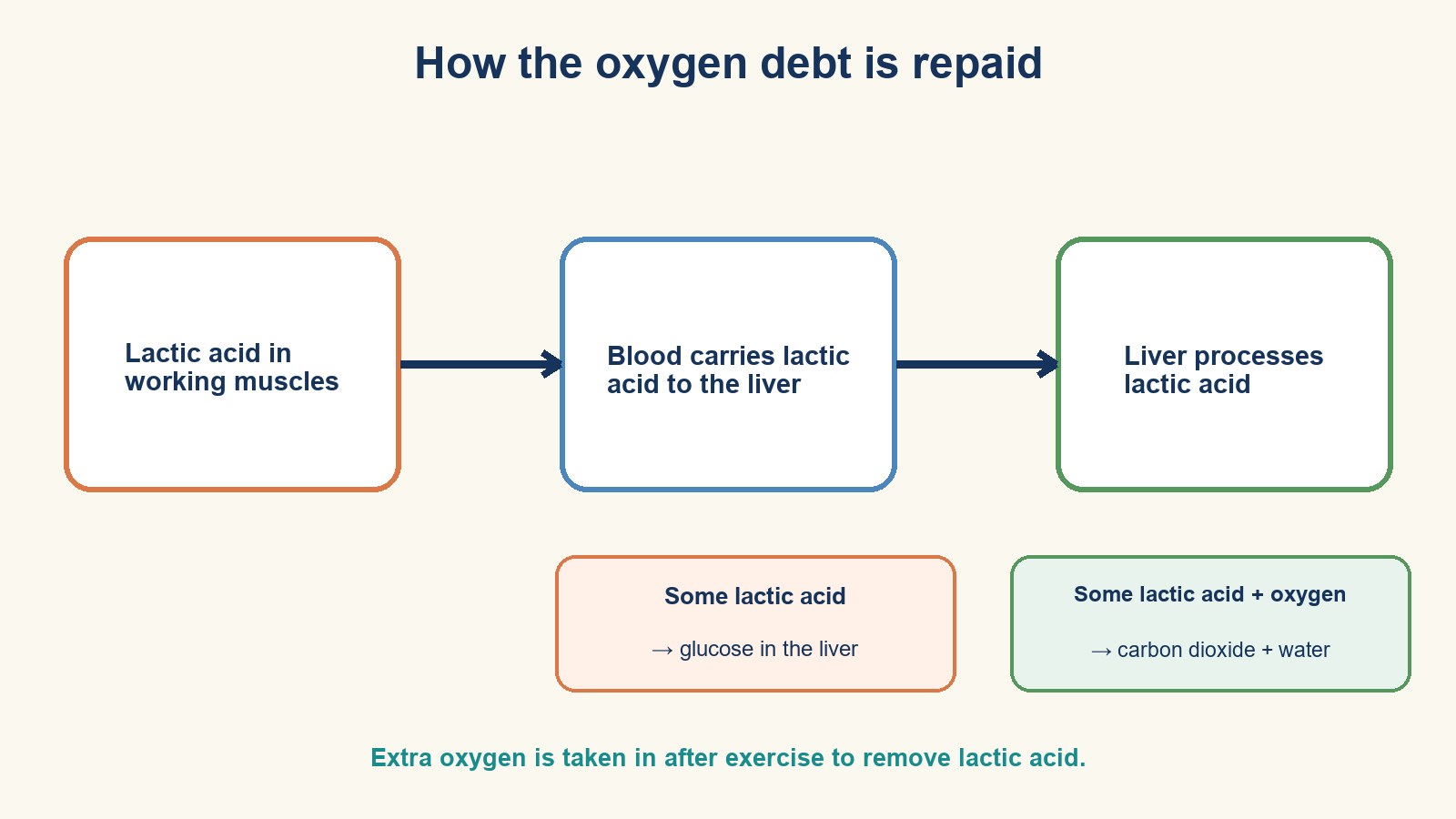
- If oxygen cannot reach the muscle cells fast enough, they also respire anaerobically, producing lactic acid. After exercise, extra oxygen is needed to break down the lactic acid. This is the oxygen debt, and it is why breathing and heart rate stay high for a while after exercise stops.
- Training changes the body over weeks and months. The heart muscle becomes stronger, stroke volume at rest increases and the resting heart rate falls. After exercise, a fitter person's heart rate also returns to normal faster.
- Heart rate can be measured by counting the pulse for a set time (for example, beats in 15 s x 4), by a heart-rate monitor, or by an ECG, which records the electrical activity of the heart. On an ECG trace, the time between two beats gives the rate: heart rate = 60 / time between beats in seconds.
Repaying the oxygen debt after hard exercise
Treating coronary heart disease
- Statins are drugs that lower the level of LDL cholesterol in the blood, which slows the growth of atheroma. They are taken as tablets, usually for life. Some people have side effects such as muscle pain. Statins reduce the chance of a heart attack but do not remove a blockage that is already there.
- A stent is a small mesh tube. A surgeon passes a thin tube through an artery to the narrowed coronary artery, inflates a small balloon to widen it, and leaves the stent in place to keep it open. It is less invasive than major surgery, but the artery can narrow again and the patient needs drugs to stop clots forming.
- Coronary bypass surgery uses a blood vessel taken from elsewhere (for example the leg or the chest) to carry blood around a blocked section of a coronary artery. It is major surgery with a longer recovery, but it can treat several blockages.
- A heart transplant replaces a failing heart with a healthy donor heart. There are far fewer donor hearts than patients who need them, and the patient must take immunosuppressant drugs for life so that the immune system does not reject the new heart. These drugs make infections more likely.
- Doctors and patients weigh benefits, risks, costs and the person's wishes. Treatments are tested in trials before use. Prevention at the level of a population, such as lowering salt in food, can also reduce CHD.
Think like a scientist: how fast does your heart recover?
- Question: does the length of time spent exercising change how long the heart rate takes to return to its resting rate? A group of healthy volunteers, who choose to take part, do step-ups on a low, stable step at a steady rhythm. Anyone who feels unwell stops at once.
- The independent variable is the time spent exercising (for example 1, 2 and 3 minutes). The dependent variable is the recovery time: the time for the pulse to return to within 5 beats per minute of the resting pulse.
- Control variables: the type and rhythm of the exercise, the step height, the volunteer (or volunteers of similar age), the room temperature, the rest period between trials, and the way the pulse is measured.
- Reliability: repeat each time-length at least three times and calculate a mean. Identify any anomaly, for example a result far from the others, and say whether you would include it. Counting a pulse for 15 s and multiplying by 4 is less precise than using a heart-rate monitor.
- Inquiry task 1: write a plan with a results table, including how you will decide when the pulse has recovered. Inquiry task 2: a student uses one volunteer, one trial per time-length, and concludes that exercise time causes slower recovery. Evaluate the conclusion and suggest three improvements.
Folien
Sign up free to view the lesson slides
Step through every slide for this topic — plus flashcards and revision notes — with a free account.
Übungsfragen
Gratis-Vorschau — 8 von 55 Fragen. Registriere dich, um alle zu sehen.
1.Which chamber of the heart pumps oxygenated blood to the whole body?
Easy- AThe right ventricle
- BThe left atrium
- CThe left ventricle
- DThe right atrium
2.Which vessel carries oxygenated blood away from the heart to the body?
Easy- AThe aorta
- BThe vena cava
- CThe pulmonary artery
- DThe pulmonary vein
3.Why is the wall of the left ventricle thicker than the wall of the right ventricle?
Easy- AIt has to hold a much larger volume of blood than any other chamber can
- BIt pumps blood only a short distance, to the lungs
- CIt contains the valves that stop blood flowing backwards
- DIt must pump blood at a higher pressure to reach the whole body
4.Blood passes through the heart twice during one complete circuit of the body.
EasyTrue or false?
5.Arteries carry blood away from the heart.
EasyTrue or false?
6.Put the parts of the circulation in order, starting with blood returning from the body.
Easy- Left atrium
- Right atrium
- Body tissues
- Lungs
- Left ventricle
- Right ventricle
7.Which feature is found in veins but not in arteries?
Medium- AA thick muscular wall that resists high pressure
- BValves that stop the blood flowing backwards
- CA very narrow lumen with walls one cell thick
- DBlood moving in pulses with every heartbeat
8.Explain why the heart needs its own blood supply, even though it is full of blood. [2 marks]
Medium
Unlock all 55 questions, flashcards & more
Erstelle ein Gratis-Konto, um alle Fragen, Folien, Karteikarten und Lernnotizen zu diesem Thema zu sehen.