Particles and states of matter
Lerne es beim Spielen
Beantworte diese Fragen für Energie, dann angle und erkunde. Kein Konto nötig.
Lektionsnotizen
Big idea: matter is a system of moving particles
- Big idea. Key concept: Systems. Everything around you is matter, and matter behaves like a system of tiny particles that are always interacting.
- Related concept: Models. The particle model is a simple picture that scientists use to explain what we see, such as why ice melts and why smells spread.
- Global context: Scientific and technical innovation. Engineers use the particle model to design everything from fridges and pressure cookers to the fuel tanks of rockets.
- Matter is anything that has mass and takes up space. Rock, water, air and your own body are all matter.
- Matter exists in three main states: solid, liquid and gas. The state depends on how the particles are arranged and how they move.
- A model is never the full truth. It leaves things out so that we can explain and predict. Later in this lesson you will test the particle model against real observations.
Solids, liquids and gases
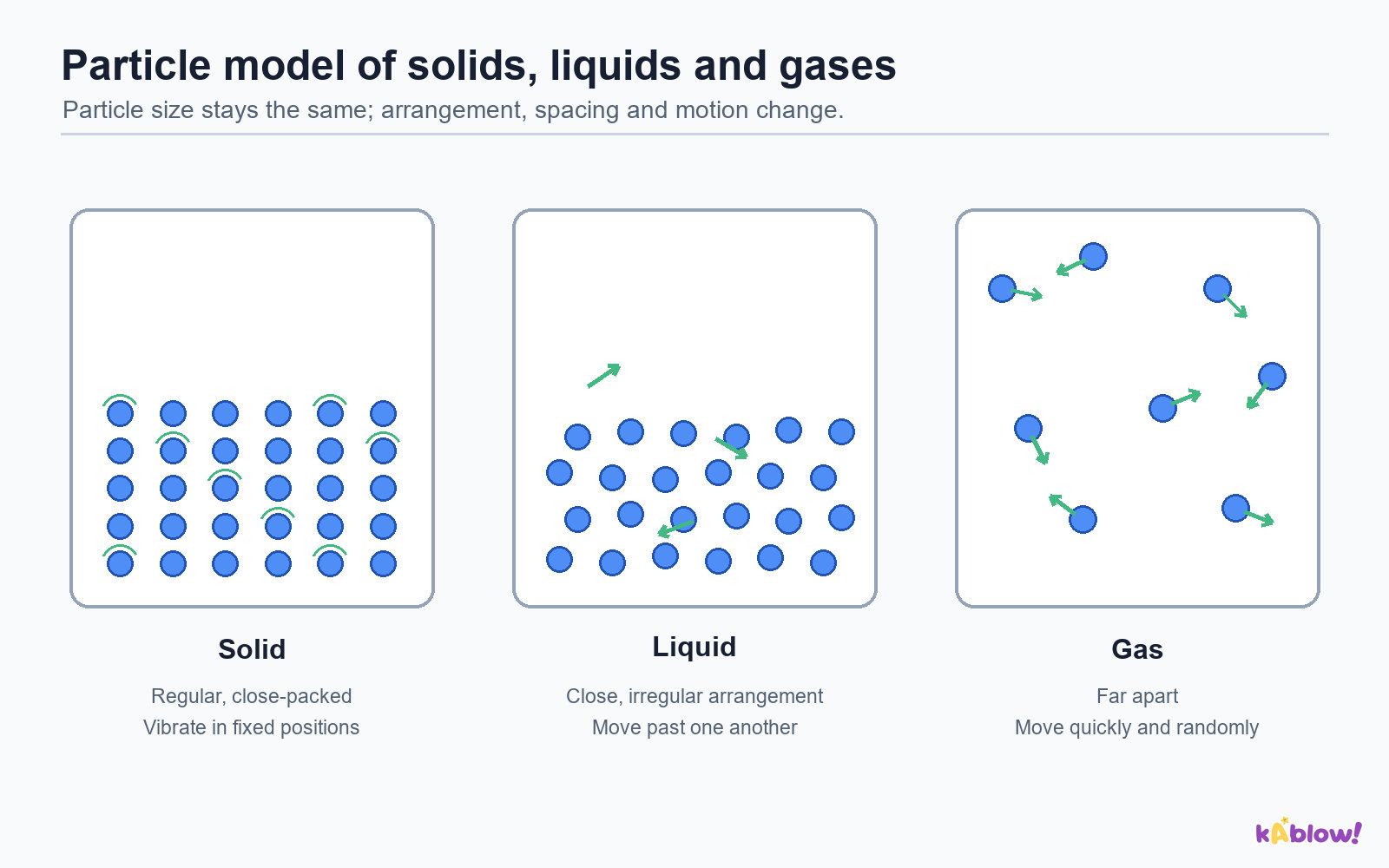
- In a solid, the particles are close together in a regular pattern. They cannot move from place to place, but they vibrate on the spot. So a solid has a fixed shape and a fixed volume.
- In a liquid, the particles are still touching, but they are arranged in an irregular way and can slide past one another. So a liquid flows and takes the shape of its container, but its volume stays fixed.
- In a gas, the particles are far apart and move quickly in random directions. So a gas spreads out to fill its container and has no fixed shape or volume.
- Gases are easy to compress (squash into a smaller volume) because there is lots of empty space between the particles. Solids and liquids are very hard to compress because their particles are already touching.
- The particles themselves do not change size or change into something else when the state changes. Only their arrangement, spacing and movement change.
- Remember that the particle drawings are a model. Real particles are far too small to see, and they do not look like coloured balls.
Particles in a solid, a liquid and a gas
Changes of state
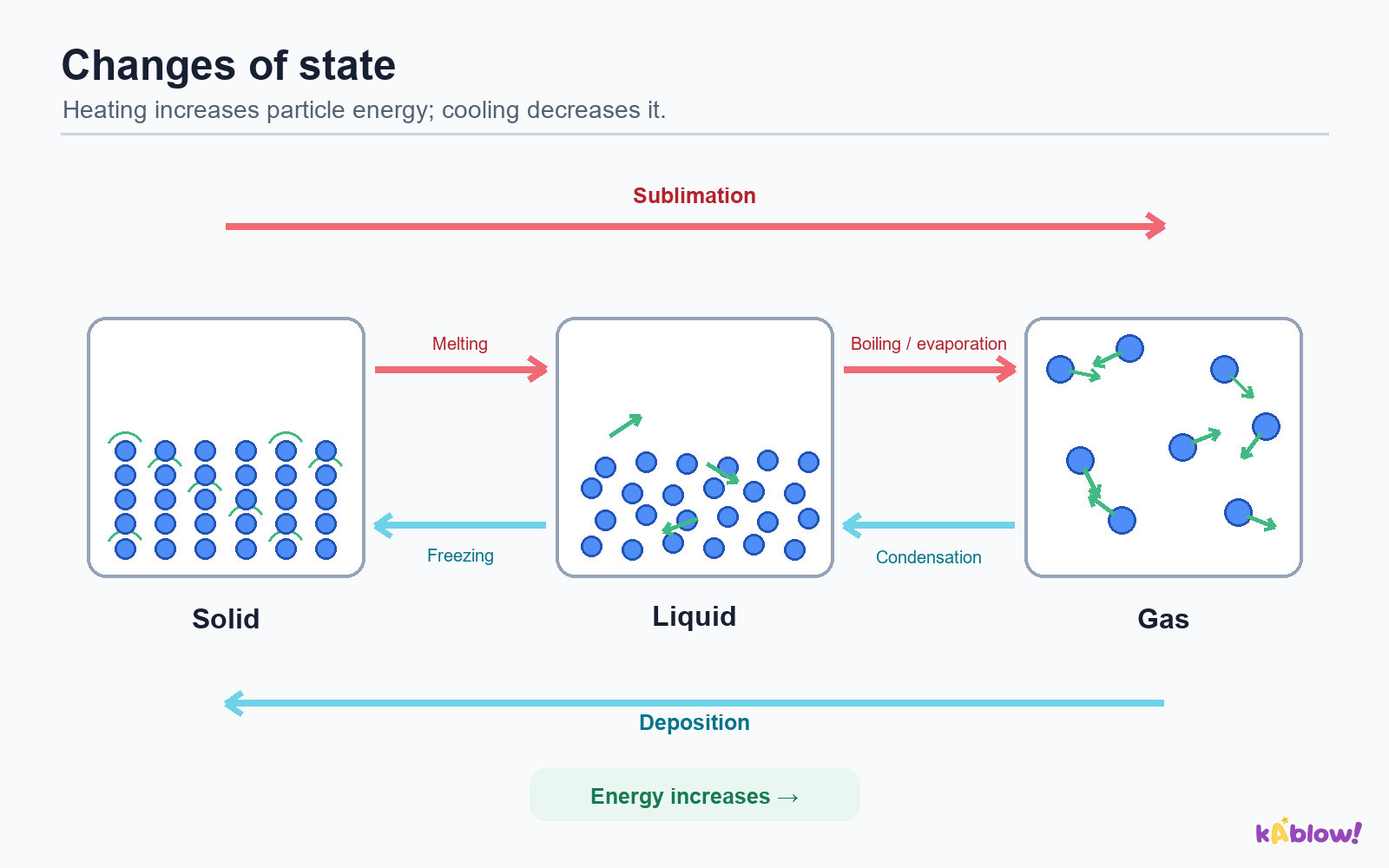
- A change of state happens when a substance turns from one state into another. It is a physical change, so the substance is still the same substance. Ice and steam are both water.
- Melting is solid to liquid. Freezing is liquid to solid. Boiling and evaporation are liquid to gas. Condensation is gas to liquid.
- Sublimation is solid straight to gas, with no liquid stage. Solid carbon dioxide (dry ice) does this. The reverse change, gas straight to solid, is called deposition.
- To melt or boil a substance, energy must be transferred to it. The particles gain energy, vibrate or move faster, and overcome the forces holding them together. Cooling takes energy away and reverses the changes.
- Boiling happens throughout the liquid at one particular temperature, the boiling point. Evaporation happens only at the surface and can happen at any temperature, so a puddle dries without ever reaching 100 °C.
- Mass is conserved in a change of state. If 50 g of ice melts, you get 50 g of water, because no particles are lost.
Changes of state between solid, liquid and gas
Melting points, boiling points and heating curves
- The temperature at which a solid turns into a liquid is its melting point. The temperature at which a liquid boils is its boiling point. A pure substance has one fixed value for each.
- Water melts at 0 °C and boils at 100 °C. Ethanol melts at −114 °C and boils at 78 °C. Iron melts at about 1538 °C. Mercury melts at −39 °C, so it is a liquid at room temperature.
- To find the state of a substance at a given temperature, compare the temperature with the two fixed points. Below the melting point it is a solid. Between the melting point and the boiling point it is a liquid. Above the boiling point it is a gas.
- A heating curve is a graph of temperature against time as a substance is heated steadily. It slopes upwards while one state warms up, but it goes flat (a plateau) while the substance melts or boils.
- During a plateau the temperature does not rise even though energy is still being transferred. The energy is being used to separate the particles and overcome the forces between them, not to make them move faster.
- When the substance has finished melting or boiling, the temperature starts to rise again.
Diffusion and gas pressure
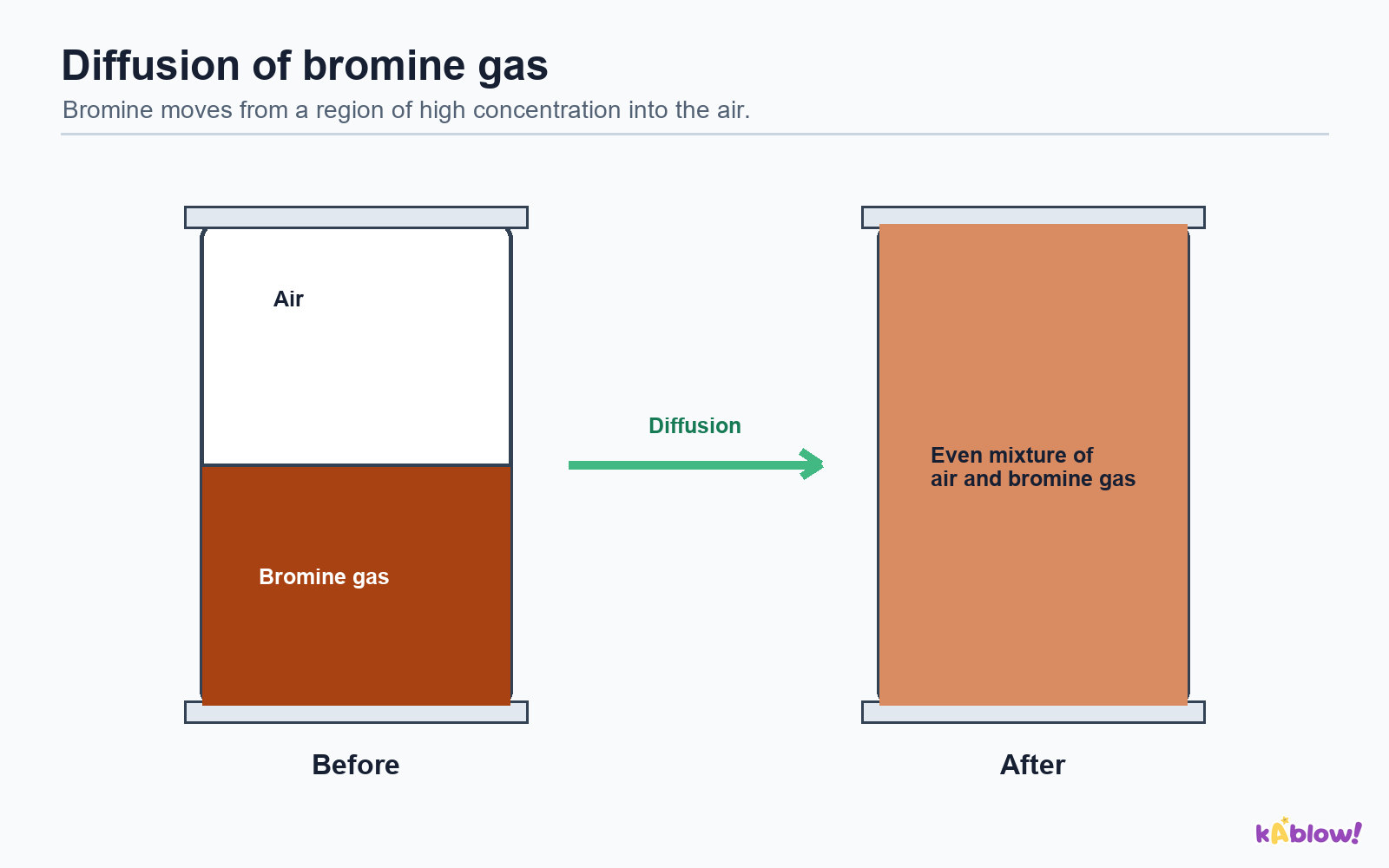
- Diffusion is the net movement of particles from a region where they are at a higher concentration to a region where they are at a lower concentration. It happens because particles move randomly and collide.
- Diffusion explains why the smell of cooking spreads across a house, and why a drop of food colouring slowly spreads through still water without anyone stirring it.
- Diffusion is much faster in gases than in liquids, because gas particles are far apart and move quickly. It is faster when the substance is warmer, because the particles have more energy and move faster.
- Gas particles move randomly and collide with the walls of their container. Each collision pushes on the wall. Millions of collisions every second add up to gas pressure.
- If you squeeze the same gas into a smaller volume, the particles hit the walls more often, so the pressure goes up. If you heat a gas in a sealed container, the particles move faster and hit the walls harder and more often, so the pressure also goes up.
- A gas does not stop at the surface of the liquid or solid below it. Its particles keep moving, which is why a bottle left open loses its fizz and a smell reaches you from across a room.
Bromine gas spreading out until it is evenly mixed with air
Think like a scientist: does temperature affect diffusion?
- Question. Does the temperature of the water change how fast a drop of food colouring spreads? A class could test this with beakers of water at different temperatures. The water must be warm, not hot enough to burn, and your teacher sets up the warm water.
- The independent variable is the one you change on purpose: the temperature of the water, for example 10 °C, 20 °C, 30 °C and 40 °C.
- The dependent variable is the one you measure: the time, in seconds, for the colour to spread evenly through the water.
- The control variables must stay the same to keep the test fair: the volume of water, the same type of beaker, the same number of drops of colouring, and no stirring.
- Repeat each temperature at least three times and calculate a mean. Repeating shows whether your results are reliable and helps you spot an anomaly.
- Inquiry task. Predict what the results will be, using the particle model to explain your prediction. Then plan a table for the results. After the investigation, evaluate it: how could the method be improved to measure “evenly spread” more accurately?
Folien
Sign up free to view the lesson slides
Step through every slide for this topic — plus flashcards and revision notes — with a free account.
Übungsfragen
Gratis-Vorschau — 8 von 50 Fragen. Registriere dich, um alle zu sehen.
1.Which state of matter has a fixed shape and a fixed volume?
Easy- ASolid
- BLiquid
- CGas
- DLiquid and gas
2.Which sentence describes the particles in a gas?
Easy- AThey are close together in a regular pattern and only vibrate.
- BThey are far apart and move quickly in random directions.
- CThey touch one another and slide past each other.
- DThey are close together and cannot move at all.
3.Which state of matter takes the shape of its container but keeps a fixed volume?
Easy- ASolid
- BGas
- CLiquid
- DNone of them
4.What is the name for a liquid turning into a gas from its surface at any temperature?
Easy- ACondensation
- BMelting
- CSublimation
- DEvaporation
5.What is the name for a gas turning into a liquid?
Easy- ACondensation
- BFreezing
- CEvaporation
- DMelting
6.What happens to the particles in a solid when it is heated, before it melts?
Easy- AThey get bigger.
- BThey vibrate more strongly.
- CThey stop moving.
- DThey turn into a different substance.
7.Why can a gas be compressed much more easily than a liquid?
Easy- AThe particles in a gas are bigger than those in a liquid, so they squash more easily.
- BGas particles are lighter than liquid particles, so they are easier to push together.
- CThe particles in a gas are far apart, so there is empty space to squash them into.
- DGas particles do not move, so nothing resists the squeezing.
8.Why does a solid keep its shape?
Easy- AIts particles are not moving at all, so nothing can change their positions.
- BIts particles are larger than liquid particles and cannot fit past each other.
- CIts particles are far apart and are held in place by the surrounding air.
- DStrong forces hold its particles in fixed positions, so they can only vibrate.
Unlock all 50 questions, flashcards & more
Erstelle ein Gratis-Konto, um alle Fragen, Folien, Karteikarten und Lernnotizen zu diesem Thema zu sehen.