Rates of reaction
Lerne es beim Spielen
Beantworte diese Fragen für Energie, dann angle und erkunde. Kein Konto nötig.
Lektionsnotizen
Big idea: why do some reactions race and others crawl?
- Big idea (key concept): Change. Chemical reactions happen at very different speeds, and we can change that speed on purpose.
- Related concept: Energy. Particles need enough energy when they collide, so temperature and energy decide how fast a reaction goes.
- Global context: Scientific and technical innovation. Industry, medicine and food safety all depend on controlling reaction speed: making fertiliser quickly, keeping food fresh, or cleaning car exhausts.
- The rate of a reaction is how fast reactants are used up or products are made. A firework is over in a moment, but rusting takes weeks.
- mean rate = amount of reactant used or product formed ÷ time taken. For a gas the unit is cm³/s, and for mass loss it is g/s.
- Four things change the rate: concentration, temperature, surface area and a catalyst. For gases, pressure acts like concentration.
Collision theory, concentration and surface area
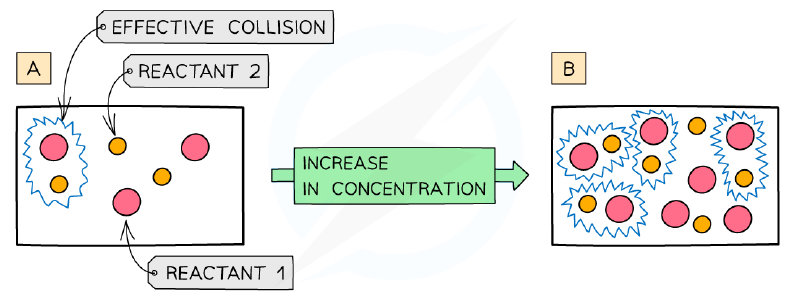
- Collision theory: for a reaction to happen, particles must collide, and the collision must have at least the activation energy. A collision that does this is a successful collision.
- Most collisions are not successful. Particles bounce off each other with too little energy to break bonds.
- Concentration: more particles in the same volume means more frequent collisions, so a higher rate. Pushing gas particles into a smaller volume (higher pressure) works the same way.
- Surface area: only the particles on the outside of a solid can be hit. Breaking a lump into powder exposes far more surface, so there are more collisions each second.
- Surface area changes how fast the product forms, not how much. The same mass of reactant gives the same total product.
- Fine dust such as flour can burn explosively because its surface area is huge. Flour mills therefore control the dust in the air.
Higher concentration means more particles in the same volume
Temperature and catalysts
- Temperature: at a higher temperature the particles move faster. They collide more often, and a larger fraction of collisions have at least the activation energy. The second effect matters most.
- As a rough guide, a 10 °C rise roughly doubles the rate of many reactions. Food kept in a fridge goes off more slowly for this reason.
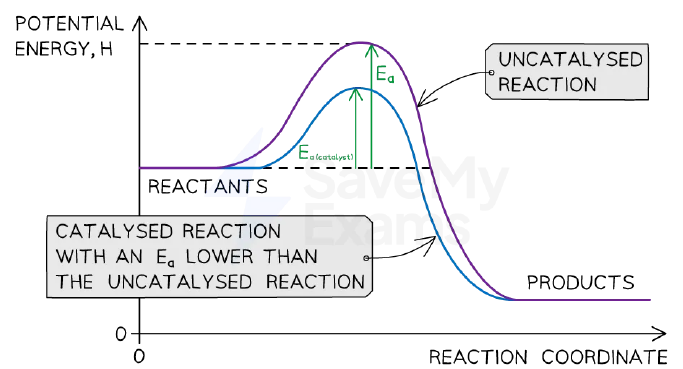
- A catalyst speeds up a reaction without being used up. It gives the reaction an alternative pathway with a lower activation energy, so more collisions are successful.
- A common example is manganese dioxide, which speeds up the breakdown of hydrogen peroxide: hydrogen peroxide → water + oxygen, or 2H₂O₂ → 2H₂O + O₂.
- A catalyst does not change the total amount of product made. It only changes how fast it forms.
- Catalysts are used in industry to save energy and money, in catalytic converters to clean car exhausts, and as enzymes in our bodies.
A catalyst lowers the activation energy
Measuring the rate of a reaction
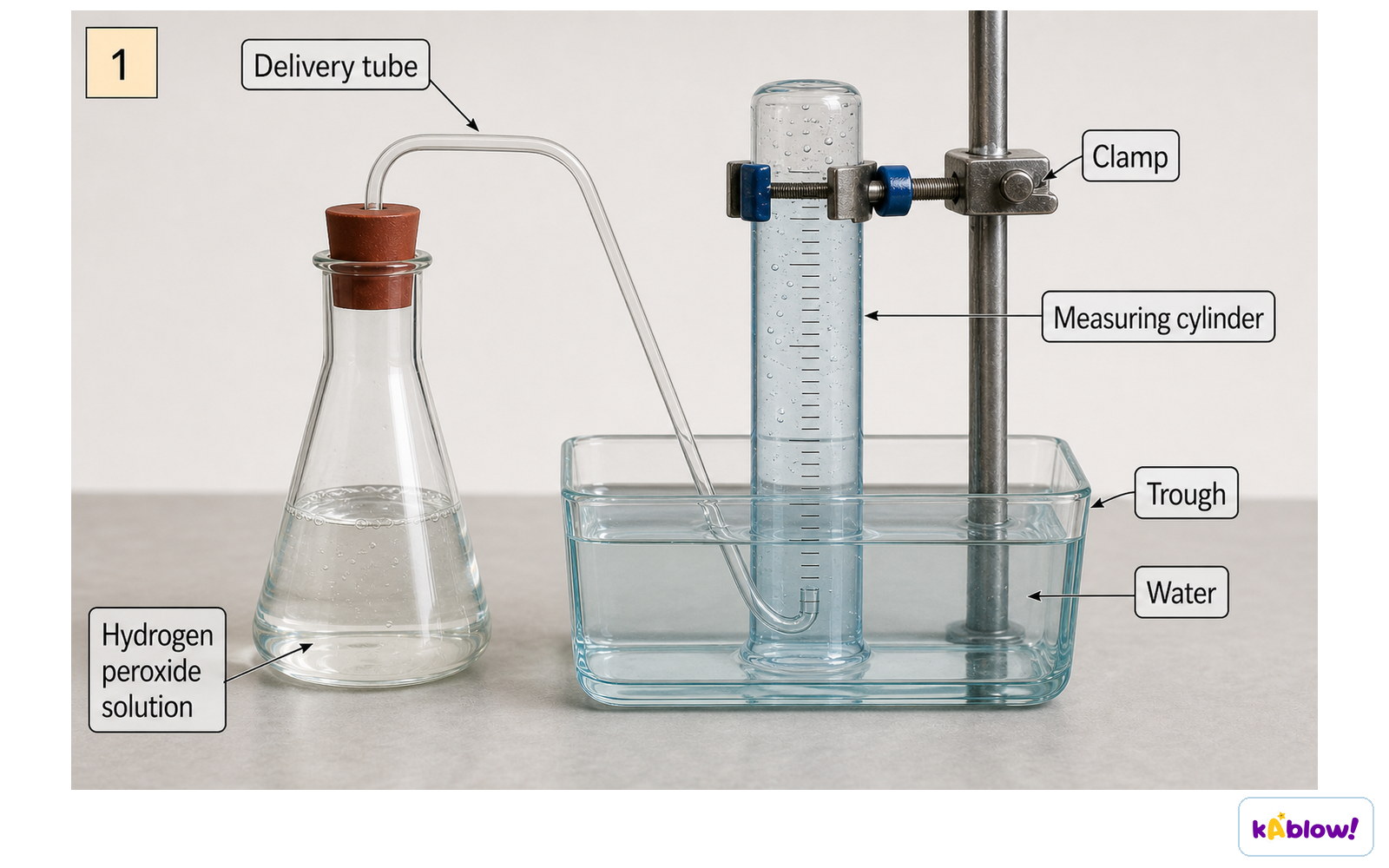
- Measuring gas volume: collect the gas in a gas syringe or an upturned measuring cylinder over water, and record the volume at regular times, such as every 10 seconds. For example calcium carbonate + hydrochloric acid → calcium chloride + water + carbon dioxide, or CaCO₃ + 2HCl → CaCl₂ + H₂O + CO₂.
- Measuring mass loss: stand the flask on a balance with a loose plug of cotton wool. When a gas escapes, the mass falls. This works best with a heavy gas such as carbon dioxide.
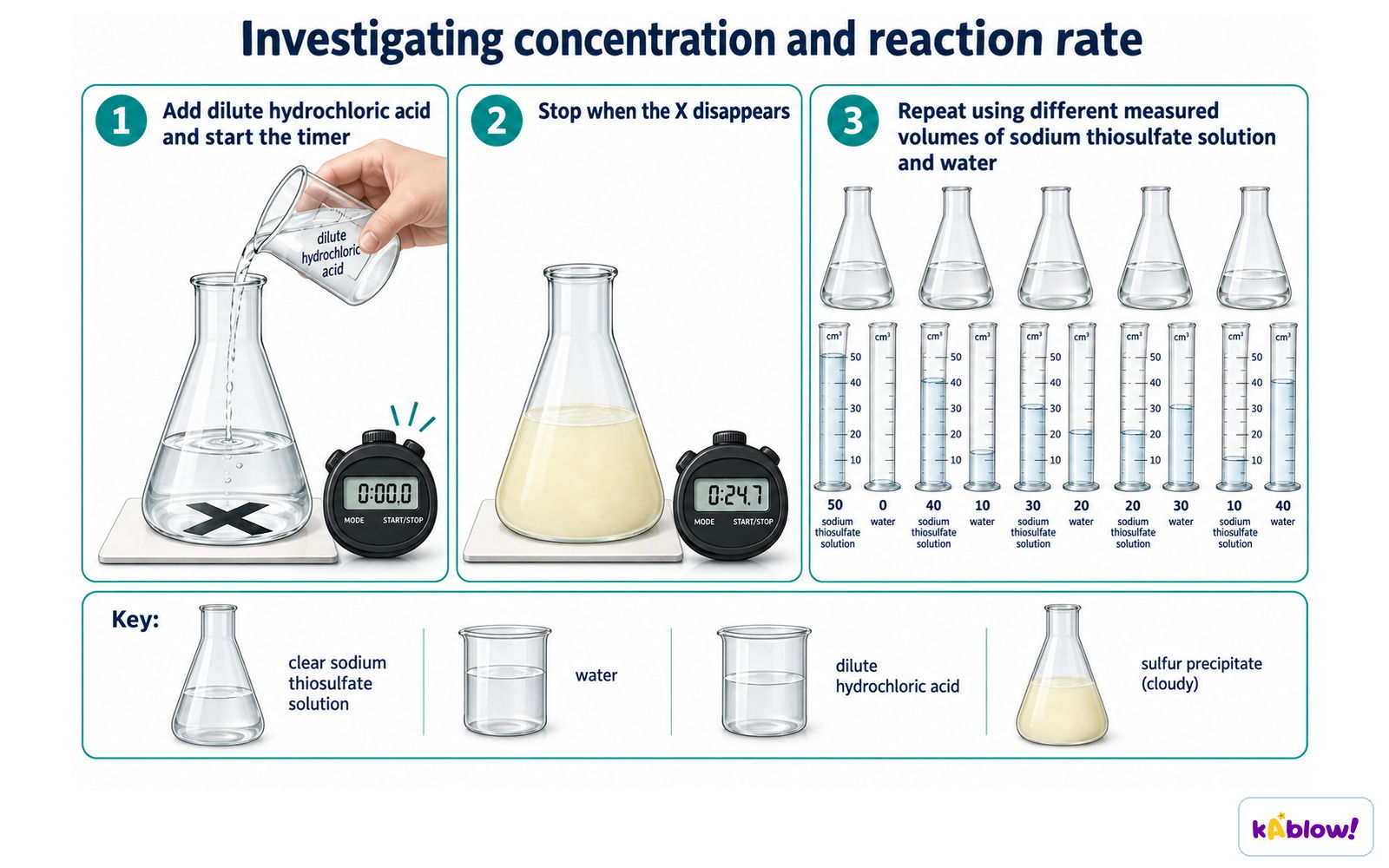
- Timing a change: in the disappearing-cross method, sodium thiosulfate + hydrochloric acid → sodium chloride + sulfur + sulfur dioxide + water. The yellow sulfur makes the mixture cloudy until the cross cannot be seen. A shorter time means a faster rate.
- The cross method gives off sulfur dioxide, which irritates the lungs, especially for people with asthma. A teacher runs it in a well-ventilated room, and everyone wears eye protection.
- Always put the bung in straight away when collecting gas, because gas lost at the start makes the results too low.
- Choose the method that suits the reaction: gas volume or mass loss if a gas forms, and timing a colour or cloudiness change if it does not.
Collecting a gas over water in a measuring cylinder
Reading rate graphs and calculating rates
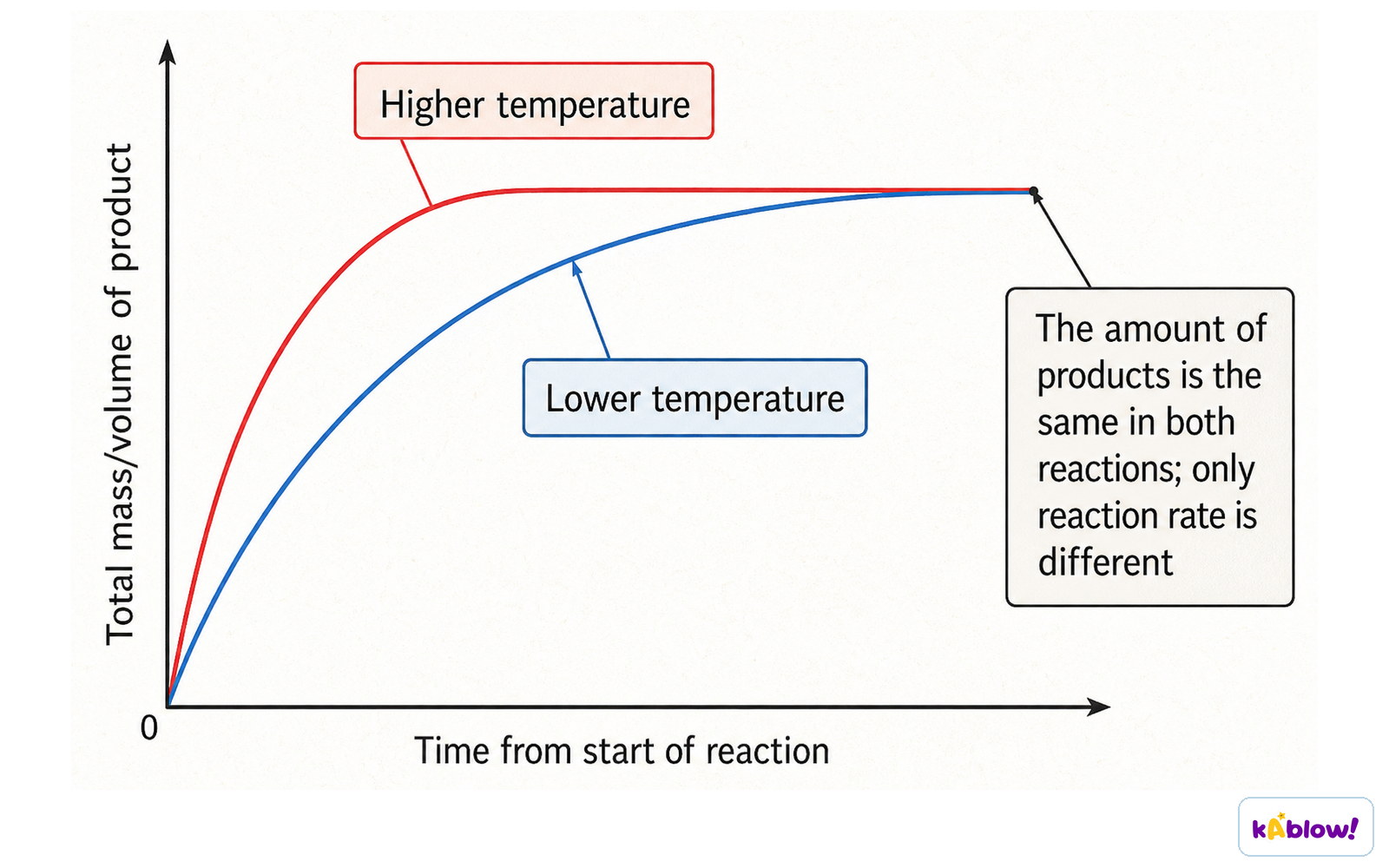
- On a graph of total volume of gas against time, the line is steepest at the start when the reactants are most concentrated. It gets less steep, then becomes horizontal when a reactant has been used up and the reaction has stopped.
- A steeper line means a faster rate. If two lines finish at the same height, the same amount of product formed.
- Mean rate between two times = change in amount ÷ change in time. In one experiment 24 cm³ of gas formed in the first 10 s, a mean rate of 2.4 cm³/s. In the next 10 s only 14 cm³ formed, so the rate fell to 1.4 cm³/s.
- You can rearrange the formula: amount = rate × time, and time = amount ÷ rate. At 1.5 cm³/s, 60 cm³ of gas takes 40 s.
- To find the rate at one moment, draw a tangent to the curve and find its gradient: rise ÷ run. A tangent through (0 s, 4 cm³) and (40 s, 28 cm³) has a gradient of 24 ÷ 40 = 0.6 cm³/s.
- Compare two experiments by comparing the times for the same amount of product. The shorter the time, the faster the reaction.
Rate graph: higher and lower temperature
Think like a scientist: investigating a rate
- A good question to test is: how does the concentration of sodium thiosulfate affect how fast a cross disappears? A teacher runs this in a ventilated room.
- The independent variable is the concentration of sodium thiosulfate, changed by mixing different volumes of the solution with water. The dependent variable is the time for the cross to disappear.
- The control variables are the total volume of solution, the volume and concentration of the acid, the temperature and the same flask and cross each time.
- To make results more reliable, repeat each concentration and use the mean. Look out for an anomaly. Judging when the cross "disappears" is subjective, so the same person should watch each time.
- Safe practice: wear eye protection, work in a ventilated room, never smell the gas and let the teacher handle the acid.
- Your task: plan an investigation into how temperature affects the rate of a reaction. State your variables, how you will control them, what you will record, and how you will use the results to decide how the rate changes. Then say how you would check your conclusion is reliable.
The disappearing-cross method for concentration
Folien
Sign up free to view the lesson slides
Step through every slide for this topic — plus flashcards and revision notes — with a free account.
Übungsfragen
Gratis-Vorschau — 8 von 55 Fragen. Registriere dich, um alle zu sehen.
1.What does the rate of a reaction tell us?
Easy- AHow much energy a reaction gives out
- BHow many different products form
- CHow quickly reactants are used up or products are made
- DWhether the reaction is safe to carry out
2.Which of these changes has the fastest rate of reaction?
Easy- AA firework exploding
- BIron rusting
- CMilk slowly going sour
- DA leaf rotting on the ground
3.For two particles to react, what must happen?
Easy- AThey must change colour first
- BThey must be exactly the same size
- CThey must be far apart from each other
- DThey must collide with enough energy
4.A teacher runs the disappearing-cross experiment, which makes sulfur dioxide gas. Which precaution is sensible?
Easy- ASmell the gas to check it has formed
- BWork in a well-ventilated room and wear eye protection
- CPour the used mixture down the sink while stirring
- DCarry out the reaction in a closed bottle
5.Raising the temperature makes particles move faster.
EasyTrue or false?
6.A catalyst is used up during the reaction.
EasyTrue or false?
7.Complete the sentence.
EasyThe minimum energy needed for a collision to be successful is called the ____ energy.
8.Fill in the missing word.
Easymean rate = amount of product formed ÷ ____
Unlock all 55 questions, flashcards & more
Erstelle ein Gratis-Konto, um alle Fragen, Folien, Karteikarten und Lernnotizen zu diesem Thema zu sehen.