Reactivity series and displacement
Lerne es beim Spielen
Beantworte diese Fragen für Energie, dann angle und erkunde. Kein Konto nötig.
Lektionsnotizen
Big idea: a league table for metals
- Big idea (key concept): Relationships. Where a metal sits in the reactivity series is linked to how it behaves, so we can predict a reaction before we test it.
- Related concept: Patterns. The more reactive a metal is, the more vigorously it reacts and the harder it is to get out of its ore. Spotting these patterns lets us make predictions.
- Global context: Globalization and sustainability. Metal ores are mined and traded around the world. How a metal is extracted, and how quickly it corrodes, depends on its reactivity, so we need to use and recycle metals wisely.
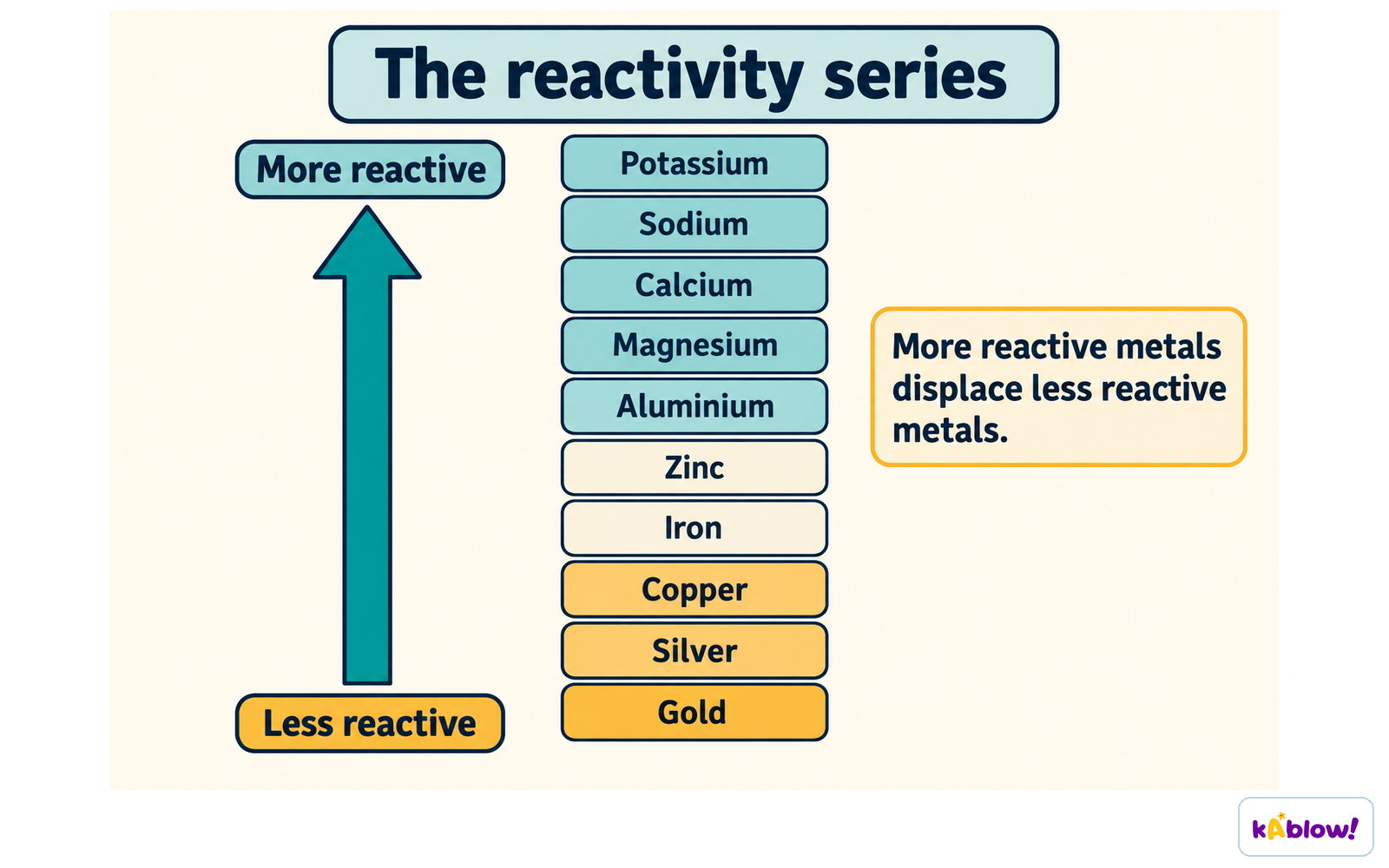
- The reactivity series ranks metals from most to least reactive: potassium, sodium, calcium, magnesium, aluminium, (carbon), zinc, iron, (hydrogen), copper, silver, gold.
- Carbon and hydrogen are not metals. They are in the list because they help us predict: metals above hydrogen react with dilute acids, and carbon can be used to extract metals that are below it.
- To remember the order, make up your own memory sentence from the first letters of the metals.
A reactivity series ladder from potassium to gold
Evidence for the order: water, steam and acid
- Reactivity is how readily a metal takes part in chemical reactions. We build the series by comparing how vigorously metals react with water, steam and dilute acid.
- With cold water: potassium, sodium and calcium react. metal + water → metal hydroxide + hydrogen. For example sodium + water → sodium hydroxide + hydrogen, or 2Na + 2H₂O → 2NaOH + H₂. Sodium and potassium react very fast; calcium fizzes more gently. Only a teacher does this, with a tiny piece behind a safety screen.
- With steam: magnesium hardly reacts with cold water but burns brightly in steam. metal + steam → metal oxide + hydrogen. Magnesium + steam → magnesium oxide + hydrogen, or Mg + H₂O → MgO + H₂. Zinc and iron also react with steam, more slowly. Copper, silver and gold do not react with water or steam. This is a teacher demonstration.
- With dilute acid: metals above hydrogen react. metal + acid → salt + hydrogen. For example magnesium + hydrochloric acid → magnesium chloride + hydrogen, or Mg + 2HCl → MgCl₂ + H₂. Zinc + sulfuric acid → zinc sulfate + hydrogen, or Zn + H₂SO₄ → ZnSO₄ + H₂.
- The speed of bubbling gives the order: magnesium fizzes quickly, zinc steadily, iron slowly, and copper not at all. Hydrogen is tested with a lit splint, which gives a squeaky pop. Potassium and sodium are far too dangerous to put in acid.
- Aluminium is a special case. It is above zinc, but it seems unreactive at first because a thin, tough layer of aluminium oxide covers it. Once that layer is removed, aluminium reacts vigorously.
Displacement reactions
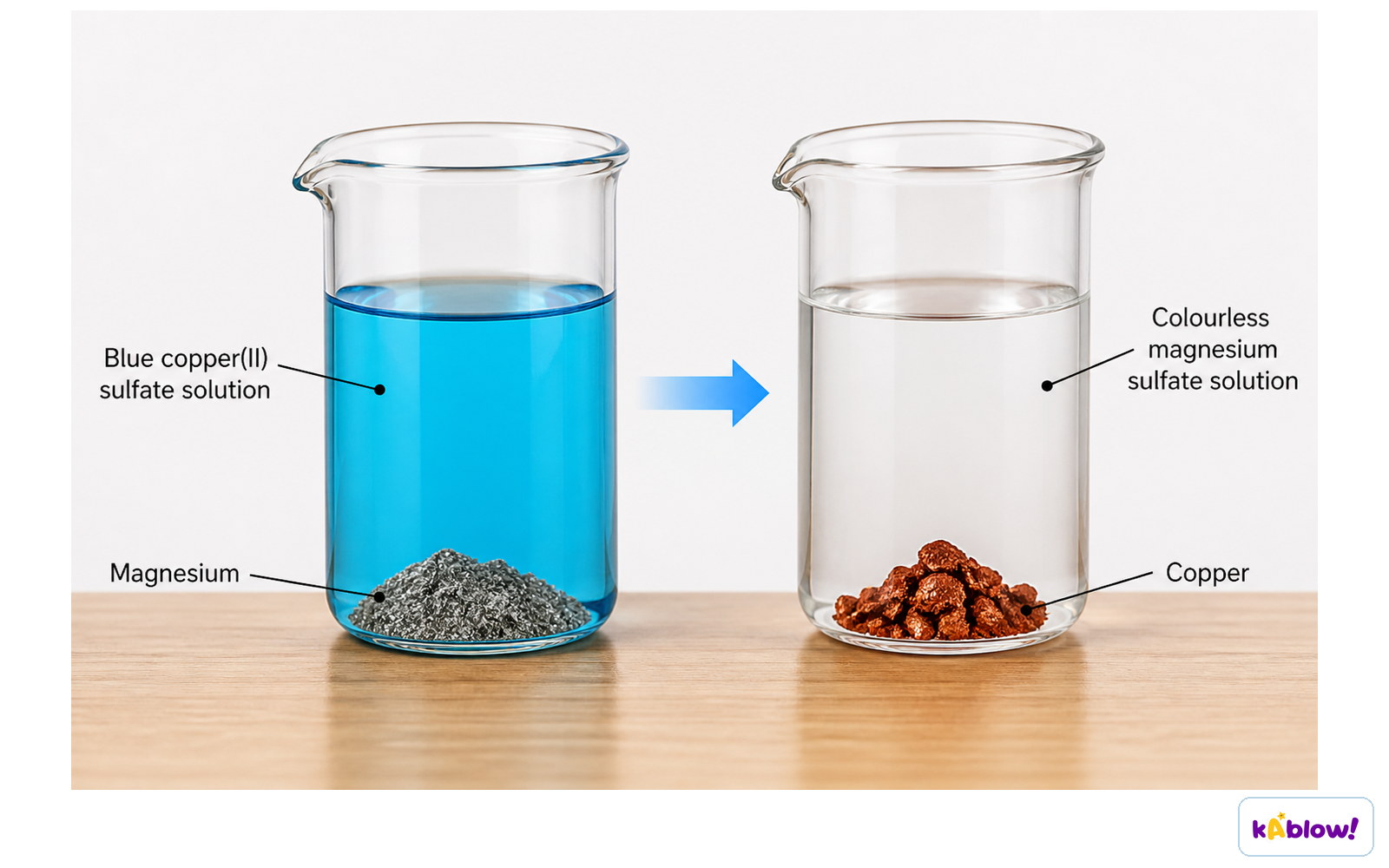
- A displacement reaction happens when a more reactive metal takes the place of a less reactive metal in a compound. The more reactive metal goes into solution as a compound and the less reactive metal is left as a solid.
- magnesium + copper sulfate → magnesium sulfate + copper, or Mg + CuSO₄ → MgSO₄ + Cu. The blue colour fades, a brown-pink solid (copper) forms, and the mixture warms because the reaction gives out energy.
- zinc + copper sulfate → zinc sulfate + copper, or Zn + CuSO₄ → ZnSO₄ + Cu. The blue colour fades to colourless and brown copper forms.
- iron + copper sulfate → iron sulfate + copper, or Fe + CuSO₄ → FeSO₄ + Cu. The nail gets a brown coating and the solution changes from blue to pale green.
- If the single metal is less reactive than the metal in the compound, nothing happens. Copper in zinc sulfate solution gives no reaction, because copper is below zinc.
- Displacement also works with hot metal oxides. For example magnesium + copper oxide → magnesium oxide + copper, or Mg + CuO → MgO + Cu. This is a teacher demonstration.
- Chemists can place unknown metals in order by testing each one against solutions of the others and recording which mixtures react.
Magnesium displacing copper from copper sulfate solution
Predicting reactions and writing equations
- The rule: find both metals in the series. A displacement reaction happens only if the single metal is above the metal in the compound.
- Zinc + copper sulfate: zinc is above copper, so there is a reaction. Copper + zinc sulfate: copper is below zinc, so there is no reaction. Magnesium + iron sulfate: reaction. Silver + copper sulfate: no reaction.
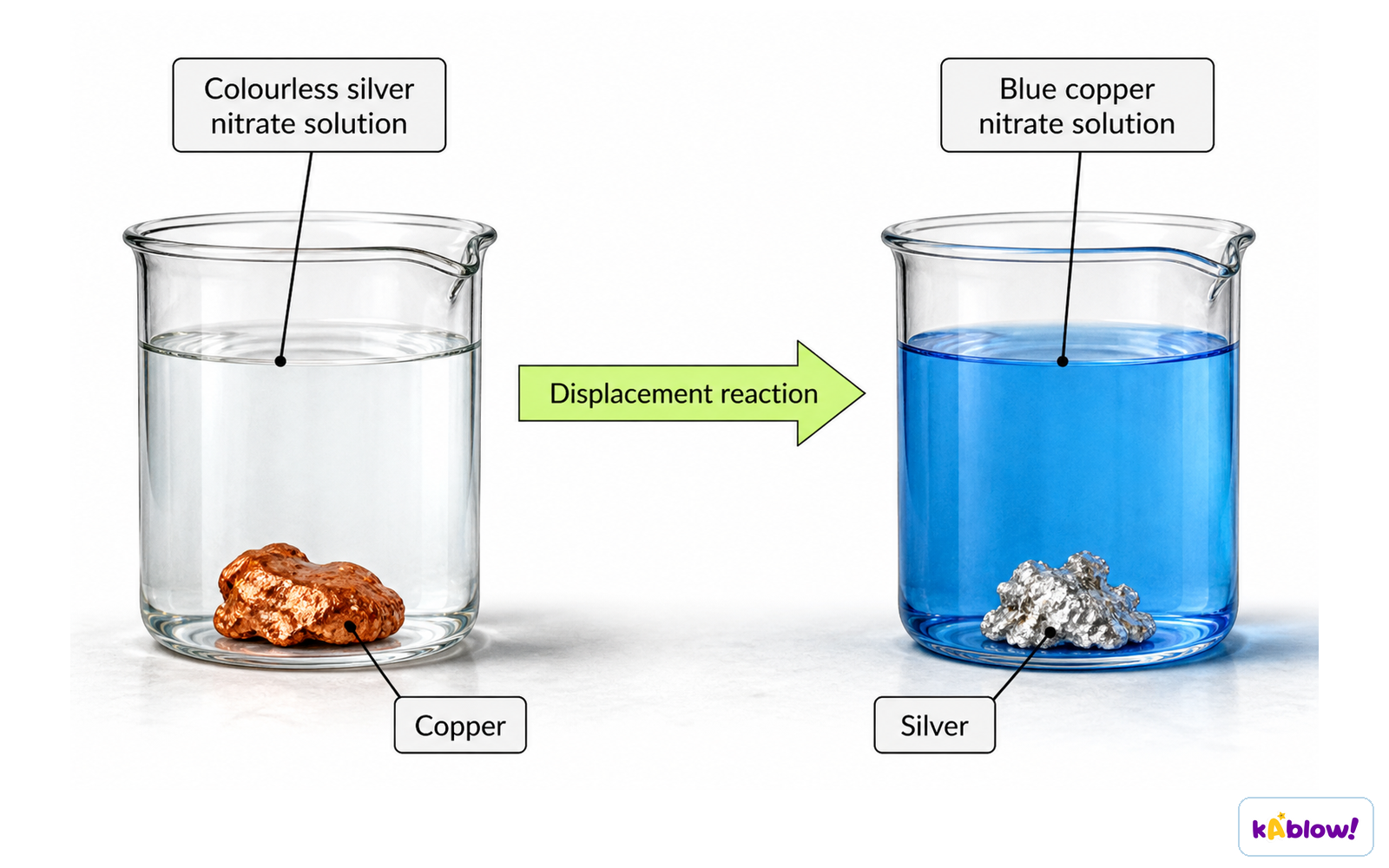
- copper + silver nitrate → copper nitrate + silver, or Cu + 2AgNO₃ → Cu(NO₃)₂ + 2Ag. Silver forms as shiny crystals and the solution turns blue, because copper nitrate is blue.
- A symbol equation must balance: the same number of each type of atom on both sides. In Cu + 2AgNO₃ → Cu(NO₃)₂ + 2Ag there is 1 Cu, 2 Ag, 2 N and 6 O on each side.
- Always write the word equation first, then the symbol equation. When no reaction is predicted, write "no reaction" and give the reason: the single metal is below the one in the compound.
- The further apart two metals are in the series, the more vigorous the displacement usually is.
Copper displacing silver from silver nitrate solution
Extraction, corrosion and using metals wisely
- Most metals are found in the ground as compounds in ores. Gold is so unreactive that it is often found as the metal itself.
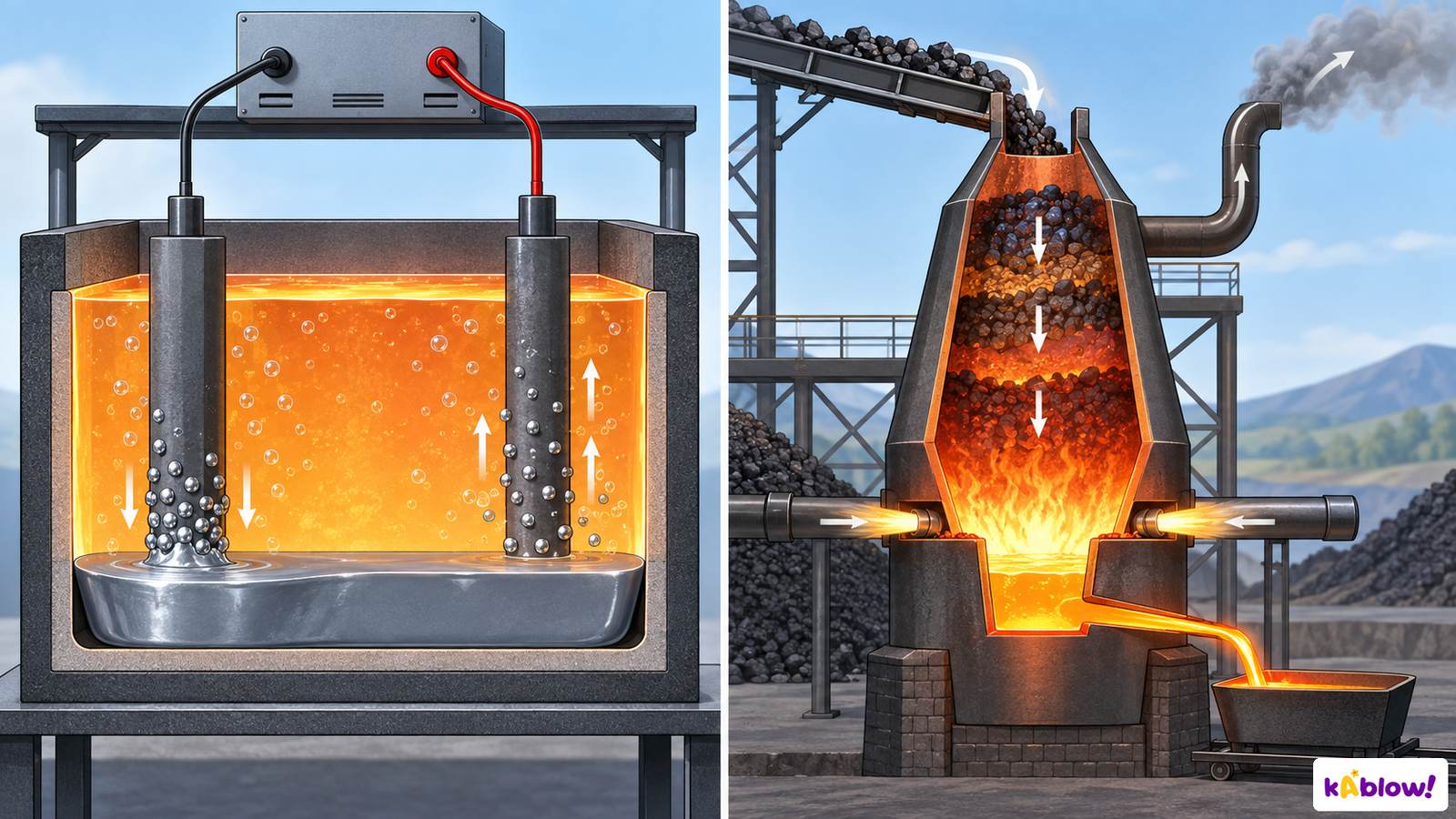
- Reactivity decides how a metal is extracted. Metals below carbon, such as zinc and iron, can be extracted by heating their oxide with carbon, which takes the oxygen away. iron oxide + carbon → iron + carbon dioxide, or 2Fe₂O₃ + 3C → 4Fe + 3CO₂. In a blast furnace the carbon comes from coke.
- Metals above carbon, such as aluminium, hold on to oxygen too strongly for carbon to remove it. Their molten compounds are split by electrolysis, which uses a lot of electricity and is expensive.
- Rusting is the corrosion of iron. Iron needs both oxygen and water, and it forms orange-brown hydrated iron oxide. Barriers such as paint, oil and plastic keep oxygen and water away. Galvanising coats iron with zinc.
- Sacrificial protection uses a more reactive metal such as zinc or magnesium. It corrodes first, so the iron is spared. This is why blocks of zinc are bolted to ship hulls.
- Metal ores are limited, and extracting metals uses energy and changes the land. Recycling saves ore and energy. Recycling aluminium uses only a small fraction of the energy needed to extract it from ore.
Electrolysis cell and blast furnace for extracting metals
Think like a scientist: putting metals in order
- A good question to test is: in what order do magnesium, zinc and iron come in the reactivity series? A teacher can supervise this with dilute acid.
- The independent variable is the type of metal. The dependent variable is what you measure, such as the volume of hydrogen collected in one minute or the time taken for the fizzing to stop.
- The control variables are kept the same: the size of the metal strip, the volume and concentration of the acid, and the temperature. Clean each strip first, because an oxide layer can slow the reaction.
- To make results more reliable, repeat each test and use the mean. Look out for an anomaly, a result that does not fit the pattern.
- Safe practice: wear eye protection, let the teacher handle acids and reactive metals, and keep flames away because hydrogen is flammable.
- Your task: you are given three unknown metals A, B and C and solutions of their sulfates. Plan a displacement investigation. Draw a results table, say which mixtures you expect to react, and explain how the results will give the order of reactivity. Then evaluate your method: what could make your conclusion less reliable?
Folien
Sign up free to view the lesson slides
Step through every slide for this topic — plus flashcards and revision notes — with a free account.
Übungsfragen
Gratis-Vorschau — 8 von 55 Fragen. Registriere dich, um alle zu sehen.
1.Which of these metals is the most reactive?
Easy- AMagnesium
- BZinc
- CPotassium
- DCopper
2.Which of these metals is the least reactive?
Easy- AGold
- BIron
- CSilver
- DCopper
3.What happens in a displacement reaction between a metal and a metal compound?
Easy- AA metal and a non-metal swap places in the periodic table
- BTwo metals join together permanently to make an alloy of both
- CA metal is turned into a gas by heating it strongly
- DA more reactive metal takes the place of a less reactive metal in the compound
4.A teacher drops a tiny piece of sodium into cold water behind a safety screen. What do you see?
Easy- ANothing happens at all
- BIt fizzes and moves around on the surface as hydrogen forms
- CIt turns bright blue
- DIt sinks and slowly dissolves with no bubbles
5.Which safety measure is used when a teacher demonstrates sodium reacting with water?
Easy- ALearners hold the sodium to feel it react
- BA safety screen is used and everyone wears eye protection
- CThe water is heated first to make it safer
- DA large lump of sodium is used so it can be seen clearly
6.Why is recycling metals a good idea?
Easy- AIt makes the metals more reactive
- BIt turns the metals into non-metals
- CIt means the metals never corrode
- DIt saves ores and energy and reduces waste
7.Which two substances must be present for iron to rust?
Easy- AOxygen and water
- BCarbon dioxide and nitrogen
- CSalt and sunlight
- DHydrogen and oxygen
8.Gold is more reactive than silver.
EasyTrue or false?
Unlock all 55 questions, flashcards & more
Erstelle ein Gratis-Konto, um alle Fragen, Folien, Karteikarten und Lernnotizen zu diesem Thema zu sehen.