Reactivity, displacement and corrosion
Lerne es beim Spielen
Beantworte diese Fragen für Energie, dann angle und erkunde. Kein Konto nötig.
Lektionsnotizen
Big idea: reactivity, displacement and corrosion
- Key concept: Change. A more reactive metal can displace a less reactive metal from its compound. Rusting requires both water and oxygen.
- Related concepts: Models and evidence. Use a scientific explanation to make predictions, then test it against observations.
- Global context: Scientific and technical innovation. Coatings and sacrificial protection extend the life of metal structures.
Reactivity Series
- The reactivity series lists metals in order of their reactivity based on reactions with water and acids.
- Non-metals carbon and hydrogen are included for extraction and displacement contexts.
- Order (most to least reactive): K, Na, Ca, Mg, Al, C, Zn, Fe, H, Cu, Ag, Au.
- Mnemonic: “Please send cats, monkeys and cute zebras into hot countries signed Gordon”.
- Metals above hydrogen react with dilute HCl; those below do not.
- More reactive metals react more vigorously with water and acids.
Reactions with Water and Steam
- K, Na, Ca react with cold water: metal + water → metal hydroxide + hydrogen.
- K reacts violently, Na quickly, Ca less strongly.
- Mg reacts very slowly with cold water but vigorously with steam: Mg + H₂O → MgO + H₂.
- Metals below Mg do not react with cold water or steam.
Reactions with Dilute Hydrochloric Acid
- Metals above H in the series react: metal + 2HCl → metal chloride + H₂.
- Mg, Zn, Fe react; Cu, Ag, Au do not.
- Reaction vigour increases with reactivity: Mg > Zn > Fe.
- K and Na react explosively with acids.
Displacement Reactions
- A more reactive metal displaces a less reactive metal from its salt solution.
- More reactive metals lose electrons more easily (better reducing agents).
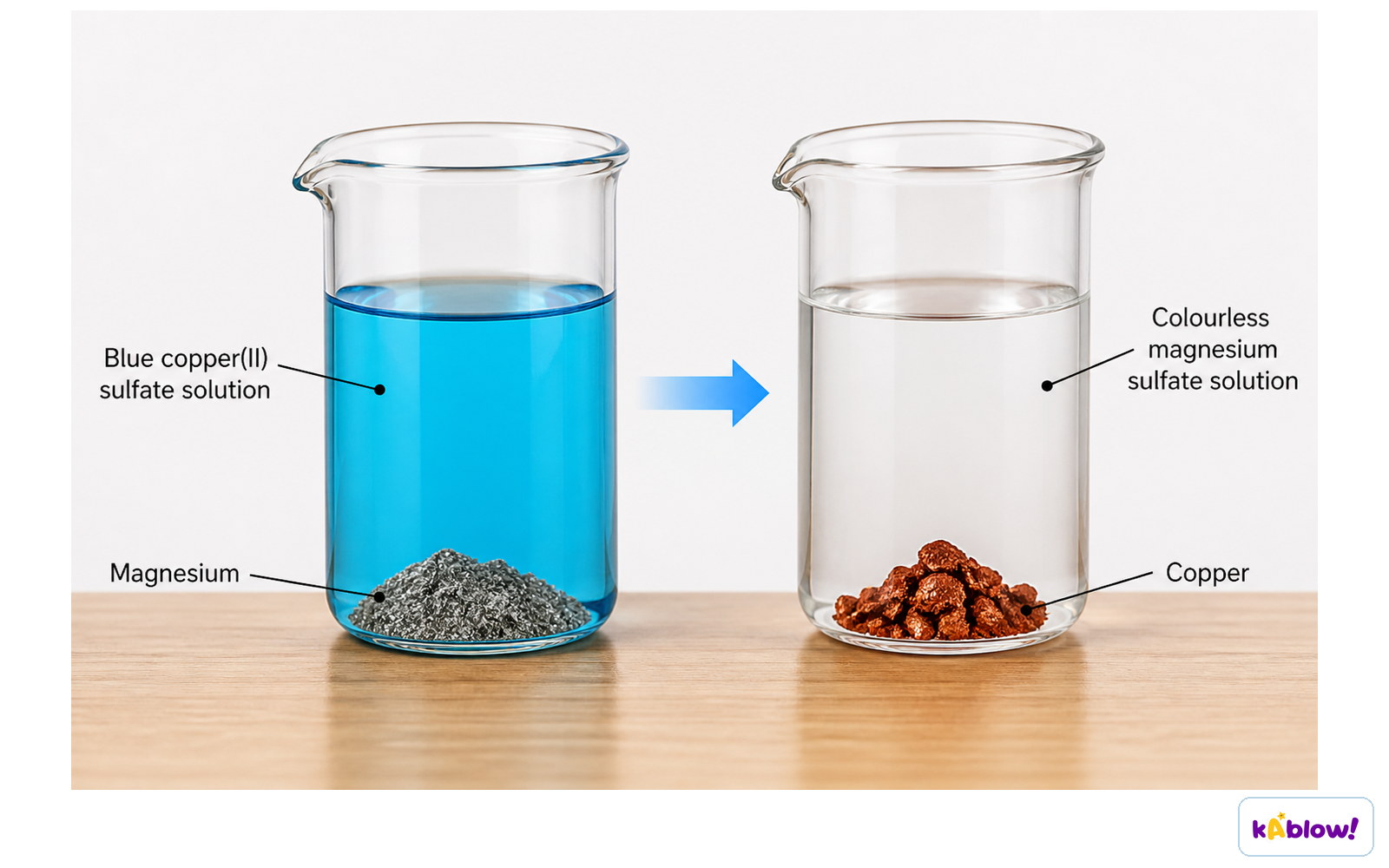
- Example: Mg + CuSO₄ → MgSO₄ + Cu (blue solution fades, copper deposits).
- No reaction occurs if the added metal is less reactive than the metal in the salt.
- Displacement experiments can determine relative reactivity order.
Displacement of copper by magnesium
Explaining Reactivity
- Reactivity depends on the tendency to lose electrons and form positive ions.
- Metals high in the series lose electrons easily; low metals lose electrons with difficulty.
- Aluminium appears less reactive due to a protective oxide layer (Al₂O₃).
Rusting of Iron
- Rusting requires iron, water, and oxygen; product is hydrated iron(III) oxide (reddish-brown).
- Word equation: iron + water + oxygen → hydrated iron(III) oxide.
- Only iron or steel rusts; other metals corrode (not rust).
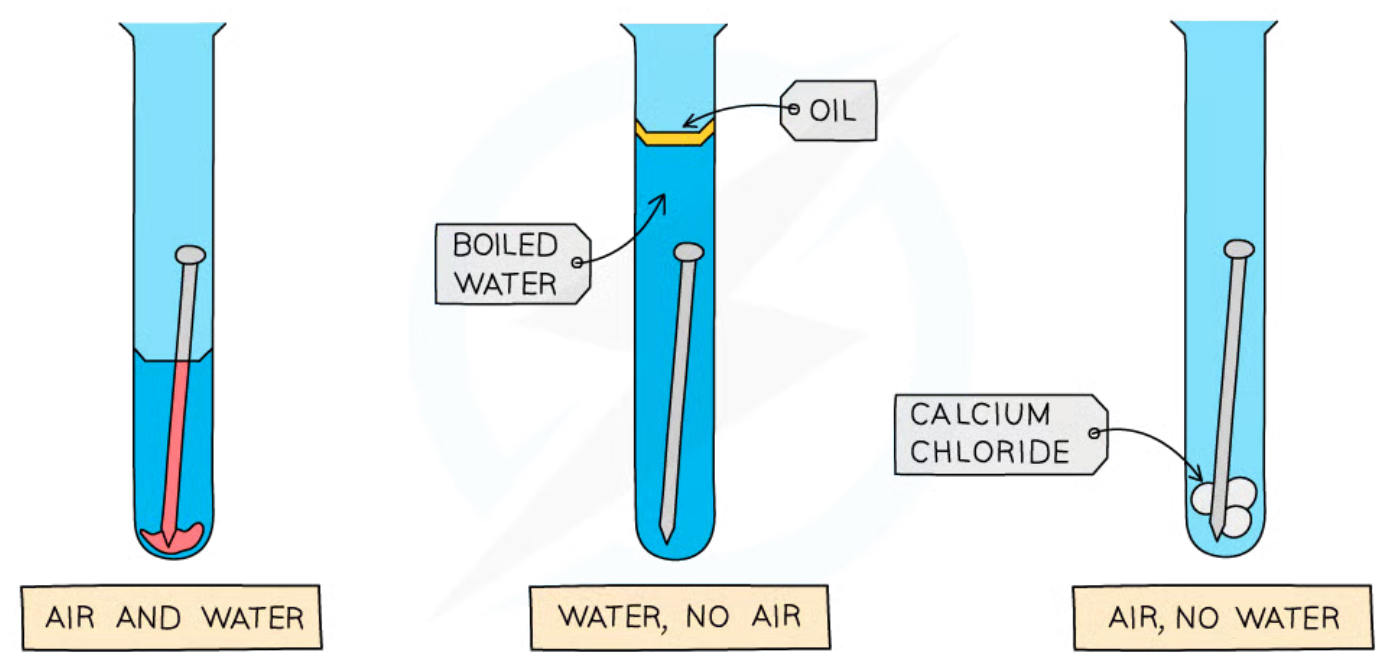
- Investigating rusting: nail in air+water rusts; nail in boiled water+oil (no air) does not; nail with calcium chloride (no water) does not.
Requirements for rusting
Rust Prevention: Barrier Methods
- Barrier methods coat iron/steel to exclude water and oxygen.
- Common barriers: grease, oil, paint, plastic.
- If the coating is scratched, the iron is exposed and will rust.
Galvanising & Sacrificial Protection
- Galvanising coats iron with a layer of zinc (by electroplating or dipping in molten zinc).
- Zinc forms ZnCO₃ barrier; if scratched, zinc provides sacrificial protection.
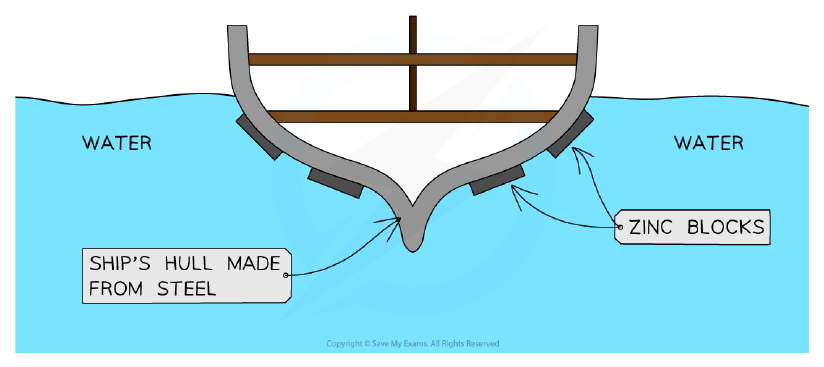
- Sacrificial protection attaches a more reactive metal (e.g., zinc) to iron.
- Zinc oxidises preferentially: Zn → Zn²⁺ + 2e⁻, protecting the iron.
- Zinc blocks on ship hulls must be replaced periodically.
Zinc bars on steel ship hulls
Think like a scientist
- Compare teacher-prepared iron samples stored with different access to water and oxygen.
- Comparison: access to water and oxygen. Outcome: the amount of visible rust after a fixed time.
- Control: use iron samples with the same exposed surface area. Explain why this makes the comparison fairer.
- Evidence: Use a consistent method, repeated observations where appropriate and a table with labelled quantities and units. Keep unexpected results and investigate their cause.
- Safety: Practical activities need teacher supervision and an appropriate risk assessment. Use the provided data or simulation where the investigation specifies it.
- Inquiry task: State a testable question, predict the outcome using the science, then explain how your observations would support or challenge the prediction.
Evaluate the science
- Coatings and sacrificial protection extend the life of metal structures.
- A damaged barrier coating may expose iron, whereas sacrificial protection depends on a more reactive metal remaining electrically connected.
- Evaluation task: Link your conclusion to evidence, identify a limitation and suggest a specific improvement. Distinguish a measured result from an explanation of its cause.
Folien
Sign up free to view the lesson slides
Step through every slide for this topic — plus flashcards and revision notes — with a free account.
Übungsfragen
Gratis-Vorschau — 8 von 52 Fragen. Registriere dich, um alle zu sehen.
1.Which word equation represents the rusting of iron?
Easy- Airon + water + oxygen → hydrated iron(III) oxide
- Biron + water + hydrogen → hydrated iron(III) oxide
- Ciron + water + oxygen → hydrated iron(II) oxide
- Diron + water + hydrogen → hydrated iron(II) oxide
2.Which of the following metals does NOT react with dilute hydrochloric acid?
Easy- AMagnesium
- BZinc
- CCopper
- DIron
3.What is the chemical name for rust?
Easy- AIron(II) oxide
- BIron(III) oxide
- CHydrated iron(III) oxide
- DHydrated iron(II) oxide
4.Which of the following is a correct statement about the reactivity series?
Medium- APotassium reacts more vigorously with cold water than calcium.
- BCopper reacts with steam to form copper oxide and hydrogen.
- CCarbon is more reactive than zinc.
- DGold reacts with dilute hydrochloric acid.
5.In the context of rust prevention, what is galvanising?
Easy- ACoating iron with a layer of zinc.
- BAttaching a more reactive metal to iron.
- CPainting iron with oil.
- DPlating iron with copper.
6.The following section of the reactivity series shows a newly discovered element, Y. The only oxide of Y has the formula YO. Ca Mg Fe Y H Cu Which of the equations shows a reaction which would take place?
Hard- A2Y(s) + Cu²⁺(aq) → 2Y⁺(aq) + Cu(s)
- BY(s) + Fe₂O₃(s) → 2Fe(s) + 3YO(s)
- CY(s) + 2HCl(aq) → YCl₂(aq) + H₂(g)
- DCu(s) + Y²⁺(aq) → Cu²⁺(aq) + Y(s)
7.In an experiment to investigate the composition of air, a student left iron nails in a test tube inverted over water. After one week, the water level inside the test tube rose. Which statement explains why the water level rose?
Medium- ANitrogen monoxide was produced.
- BIron oxide was produced.
- CThe temperature of the water increased.
- DSulfur dioxide was produced.
8.A student adds zinc to copper(II) sulfate solution. Which observations are correct for this reaction?
Medium- ASolution colour stays the same; pale grey crystals forming.
- BSolution turns darker blue; grey residue on the metal.
- CSolution turns orange/brown; blue crystals form on the metal.
- DSolution turns paler blue; orange/brown residue on the metal.
Unlock all 52 questions, flashcards & more
Erstelle ein Gratis-Konto, um alle Fragen, Folien, Karteikarten und Lernnotizen zu diesem Thema zu sehen.