Heating and cooling
Lerne es beim Spielen
Beantworte diese Fragen für Energie, dann angle und erkunde. Kein Konto nötig.
Lektionsnotizen
Big idea: how thermal energy moves and why things cool
- Big idea (key concept): Change. Things heat up and cool down because thermal energy moves. Understanding the change lets us control it.
- Related concept: Energy. Heating and cooling are transfers of energy between thermal stores.
- Global context: Globalization and sustainability. Heating and cooling buildings uses huge amounts of fuel around the world. Good insulation saves energy, money and carbon dioxide.
- Temperature shows how hot something is. It is measured in degrees Celsius (°C) with a thermometer.
- Thermal energy is the total energy of all the moving particles in an object. It is measured in joules (J). A bath of water at 40 °C holds far more thermal energy than a cup of water at 40 °C because it has many more particles.
- Thermal energy always transfers from a hotter object to a colder one. The transfer stops when both reach the same temperature, called thermal equilibrium.
Conduction
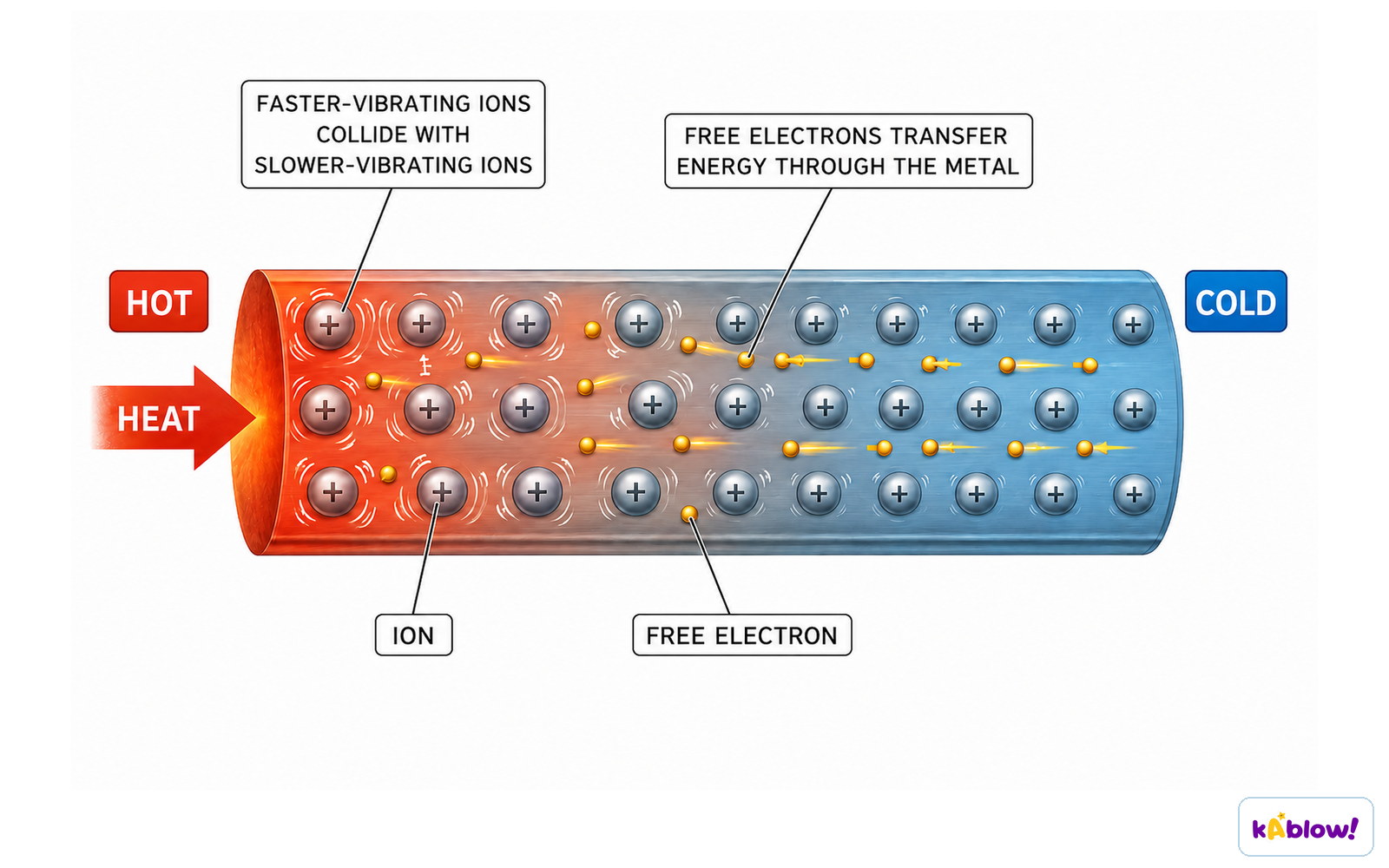
- In conduction, thermal energy passes through a solid. The particles at the hot end vibrate more strongly and bump into their neighbours, passing the energy along. The particles themselves stay in place.
- Metals are the best conductors. They contain free electrons that move through the metal and carry energy quickly.
- Insulators such as wood, plastic and glass conduct badly. Gases such as air are very poor conductors because their particles are far apart.
- A metal spoon feels colder than a wooden one at room temperature because metal takes energy from your hand faster.
Conduction along a heated metal bar
Convection
- Convection happens in liquids and gases (fluids), where particles can flow.
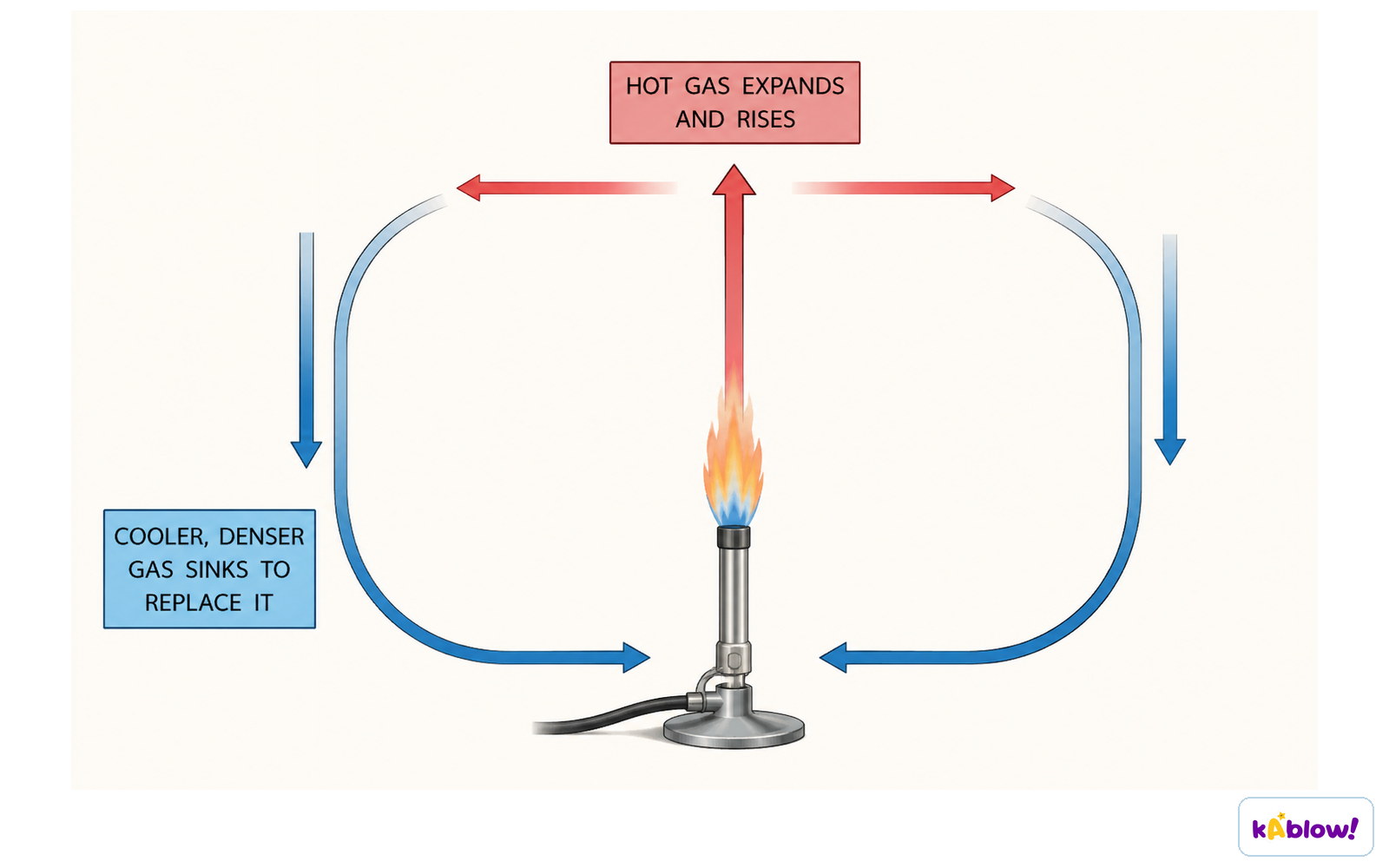
- When part of a fluid is heated, its particles spread out, so the fluid expands and becomes less dense. The warm fluid rises.
- Cooler, denser fluid sinks to take its place. This circulating flow is a convection current.
- Convection warms a room from a radiator and makes water in a kettle heat evenly. It cannot happen in solids or in a vacuum.
A convection current above a heater
Radiation
- Radiation is energy carried by infrared waves. It needs no particles, so it travels through empty space. This is how the Sun's energy reaches Earth.
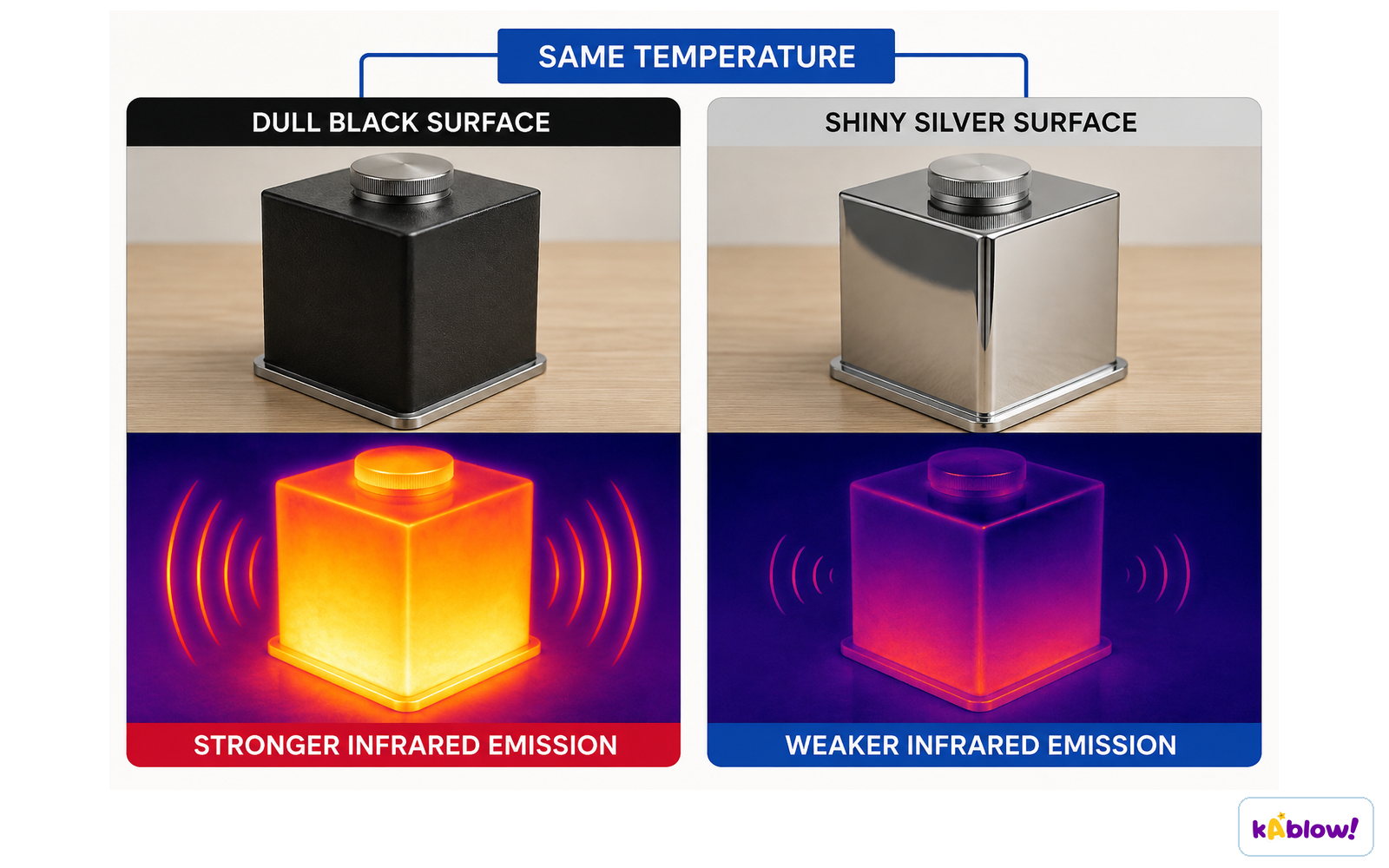
- All objects emit infrared radiation. Hotter objects emit more.
- Dull black surfaces are the best emitters and the best absorbers of radiation. Shiny, light surfaces emit and absorb least and reflect radiation instead.
- That is why solar water heaters use black panels, and why survival blankets and fire-fighters' suits are shiny.
- Safety: never look at the Sun, and use only teacher-approved heat sources.
Dull black and shiny silver containers at the same temperature
Insulation, cooling and saving energy
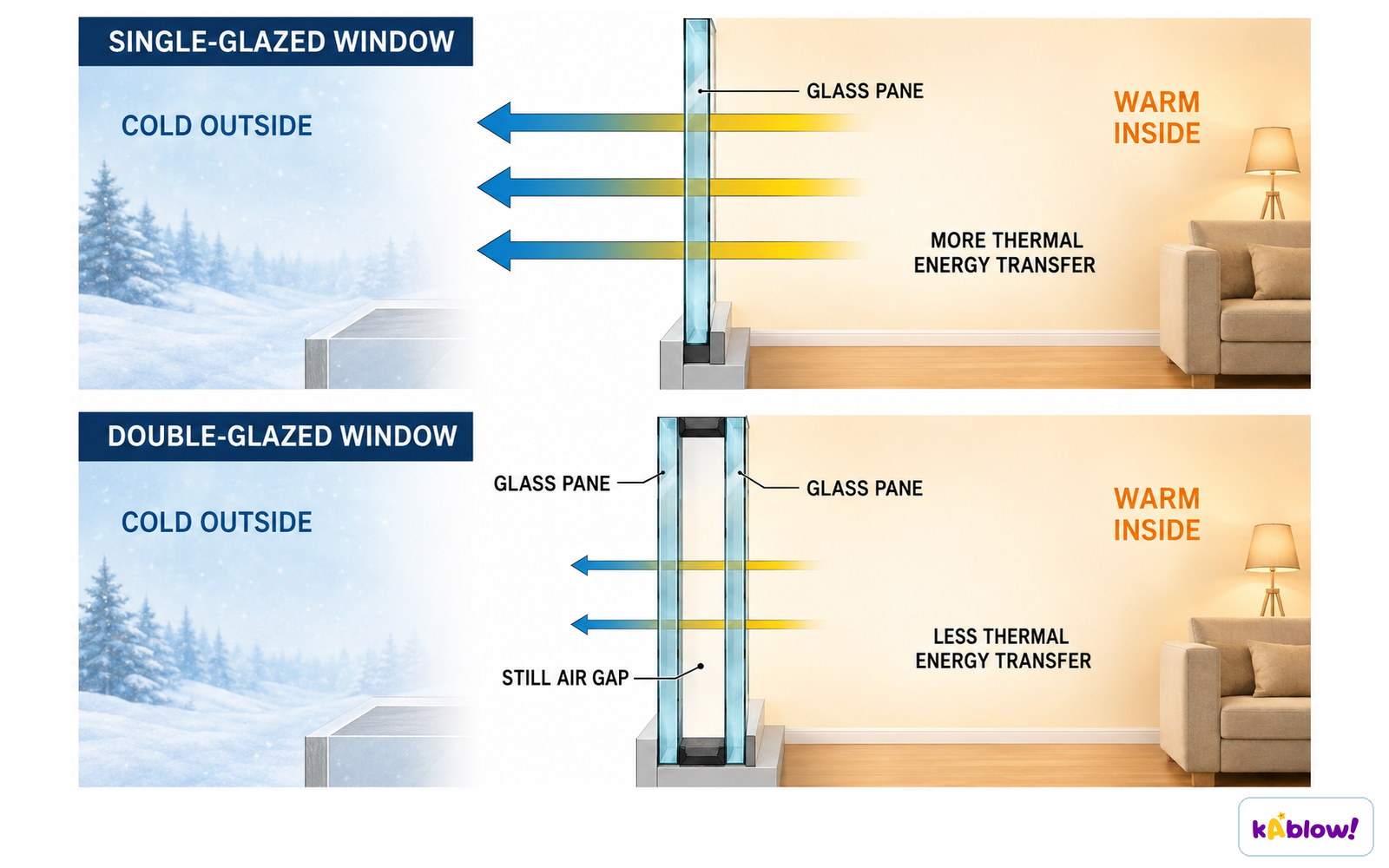
- An insulator slows the transfer of thermal energy. Trapped air is one of the best: it conducts badly and cannot circulate much in tiny pockets. That is why wool, feathers, foam and double glazing work.
- A vacuum flask has a vacuum between two walls (no conduction or convection), silvered walls (reflect radiation) and a stopper (stops warm air escaping).
- A hot object cools fastest at first, when the temperature difference with its surroundings is biggest, then more slowly. It stops cooling at room temperature. A graph of this is a cooling curve.
- In one experiment, a beaker without a lid cooled from 90 °C to 29 °C in 30 minutes. An identical beaker with a lid cooled from 90 °C to 46 °C. The lid reduced the energy loss.
- Houses lose energy through the roof, walls, windows and floor. Loft insulation, double glazing and draught-proofing reduce the loss, so less fuel is burned.
Single and double glazing compared
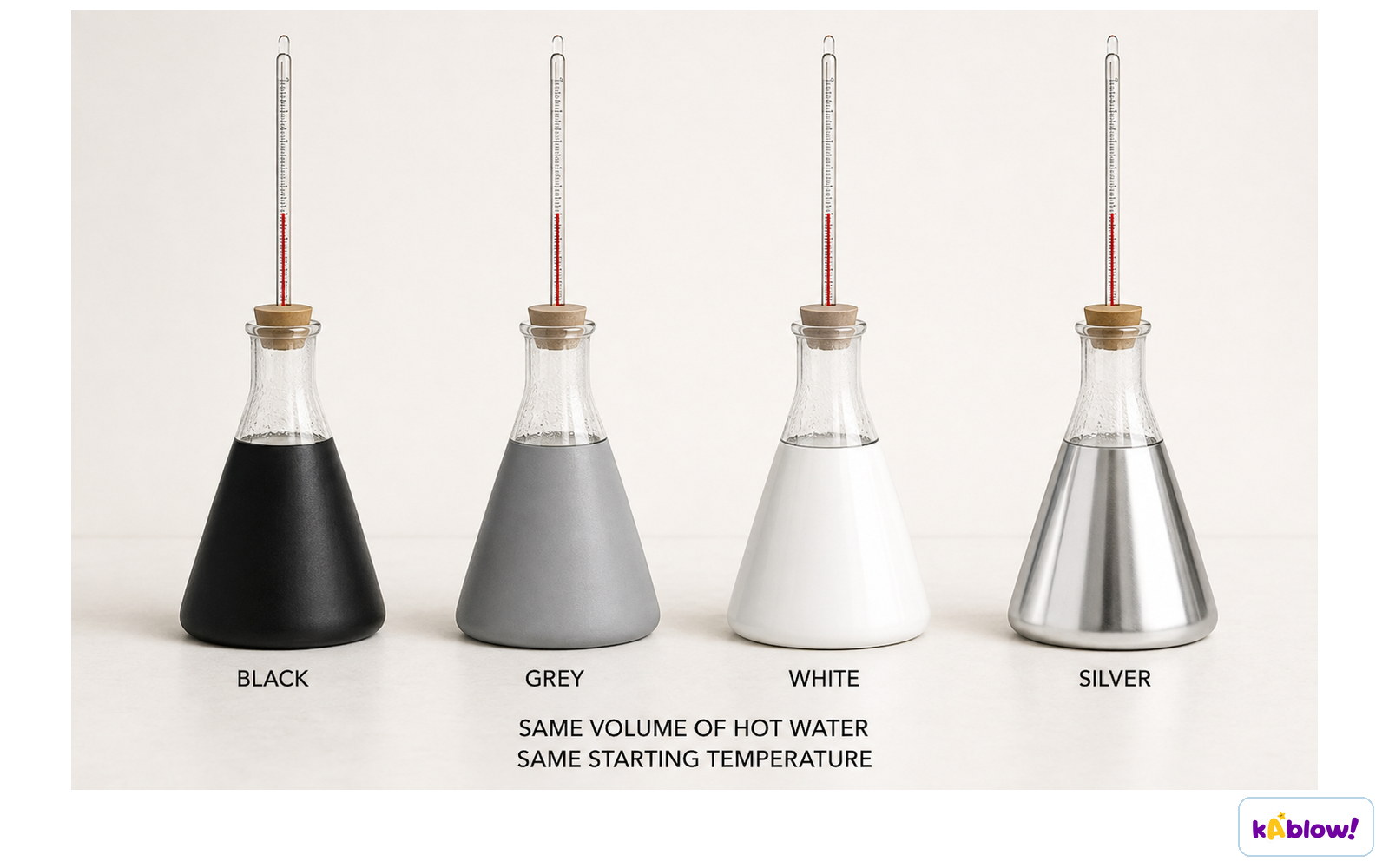
Think like a scientist: which colour of flask keeps water warm for longest?
- Four identical flasks are painted black, grey, white and silver. Each is filled with the same volume of hot water at the same temperature. The temperature is read every 5 minutes.
- The independent variable is the colour of the flask. The dependent variable is the temperature of the water.
- Control variables: the volume of water, the starting temperature, the size and material of the flask, the room and the thermometer.
- To make the data reliable, repeat the experiment three times and calculate a mean for each colour.
- Inquiry task: plot a cooling curve for each colour. Which colour cools slowest? Is the black flask a good emitter or poor emitter of radiation? Suggest one improvement to the method and explain how it would improve your results.
Four flasks painted different colours to test cooling
Folien
Sign up free to view the lesson slides
Step through every slide for this topic — plus flashcards and revision notes — with a free account.
Übungsfragen
Gratis-Vorschau — 8 von 52 Fragen. Registriere dich, um alle zu sehen.
1.What does a thermometer measure?
Easy- AThe total thermal energy in an object
- BThe mass of a liquid
- CTemperature
- DHow fast a liquid flows
2.A hot drink is left in a cool room. In which direction does thermal energy naturally transfer?
Easy- AFrom the drink to the cooler air
- BFrom the cooler air to the drink
- CEqually in both directions for ever
- DIt does not transfer at all
3.Which of these materials is the best conductor of thermal energy?
Easy- AWood
- BPlastic
- CWool
- DCopper
4.Convection can only happen in which type of material?
Easy- ASolids
- BLiquids and gases
- CMetals
- DA vacuum
5.How does energy from the Sun reach the Earth through empty space?
Easy- ABy conduction
- BBy radiation
- CBy convection
- DBy evaporation
6.What is a thermal insulator?
Easy- AA material that makes its own heat
- BA material that transfers thermal energy very quickly
- CA material that cools to 0 °C
- DA material that transfers thermal energy slowly
7.A metal spoon feels colder to touch than a wooden spoon in the same room. What is the best reason?
Easy- AMetal conducts thermal energy away from your hand faster
- BThe metal spoon is at a lower temperature than the wooden one
- CWood makes more thermal energy than metal
- DMetal absorbs cold from the air
8.A metal rod is heated at one end. How does thermal energy move along the rod?
Medium- AHot particles travel along the rod to the cold end
- BThe rod expands and pushes the energy along
- CParticles at the hot end vibrate more and pass energy to their neighbours, helped by free electrons
- DCold particles move towards the hot end to cool it
Unlock all 52 questions, flashcards & more
Erstelle ein Gratis-Konto, um alle Fragen, Folien, Karteikarten und Lernnotizen zu diesem Thema zu sehen.