Carbohydrates & Lipids
Lerne es beim Spielen
Beantworte diese Fragen für Energie, dann angle und erkunde. Kein Konto nötig.
Lektionsnotizen
Properties of Carbon
- Carbon is present in all four major categories of biological molecules: carbohydrates, lipids, proteins and nucleic acids, which is why life is described as carbon-based.
- Carbon has four electrons in its outer shell, so each atom can form four covalent bonds, allowing it to be part of large, stable molecules.
- Carbon forms millions of different covalently-bonded compounds, mainly with hydrogen and oxygen.
- Carbon can bond to other carbon atoms or to hydrogen, nitrogen, oxygen and sulfur, forming long branched chains (e.g. glycogen), straight chains (e.g. cellulose), single rings (e.g. pyrimidines) and multiple rings (e.g. starches and purines).
- Carbon produces a tetrahedral structure, allowing varied 3-D shapes and therefore different biological properties.
- Carbon can form up to four single covalent bonds or a combination of double and single bonds, e.g. carbon dioxide contains two double bonds and methane contains four single bonds.
- Double and triple bonds can form with an adjacent carbon atom, allowing unsaturated compounds to form.
- Carbon forms part of functional groups such as hydroxyl, carboxyl, amino and phosphate groups, which give organic compounds their individual properties.
Macromolecules
- Monomers are the smaller units from which larger molecules are made; polymers are molecules made from a large number of monomers joined together in a chain.
- The process by which monomers join to form polymers is polymerisation.
- Macromolecules are very large molecules containing 1000 or more atoms and so have a high molecular mass.
- Polymers can be macromolecules, but not all macromolecules are polymers; polymers must consist of many repeating subunits.
- Lipids are not polymers, as they do not consist of repeating monomers.
- Key monomer–macromolecule pairs: carbohydrates (polysaccharides) from monosaccharides; lipids from fatty acids, glycerol and phosphate groups; proteins (polypeptides) from amino acids; nucleic acids from nucleotides.
- Macromolecules are formed during condensation reactions, in which molecules combine, forming covalent bonds and removing water.
- Macromolecules are broken down into monomers by hydrolysis, in which covalent bonds are broken when water is added; the -O and -OH from water form the functional groups of the products.
Carbohydrates: Monosaccharides and Disaccharides
- The monomers of carbohydrates are monosaccharides; two monosaccharides join to form a disaccharide and many join to form a polysaccharide.
- Monosaccharides join via condensation reactions, forming a glycosidic bond.
- Monosaccharides have the general formula CnH2nOn, where n is the number of carbon atoms; this formula only applies to monosaccharides.
- Monosaccharide properties include being colourless crystalline molecules and soluble in water.
- Monosaccharides vary by carbon number: triose molecules contain 3 carbons (e.g. glyceraldehyde), pentose molecules contain 5 carbons (e.g. ribose) and hexose molecules contain 6 carbons (e.g. glucose).
- Glucose has the molecular formula C6H12O6 and is the most common monosaccharide, of central importance to most forms of life.
- Glucose is the main substrate used in respiration, releasing energy for the production of ATP, and is produced during photosynthesis.
- Glucose exists as two structural isomers, α (α) glucose and β (β) glucose, and this isomerism has far-reaching consequences on the functions of the polymers.
Polysaccharides: Starch, Glycogen and Cellulose
- Carbohydrates function as essential energy storage molecules and as structural molecules.
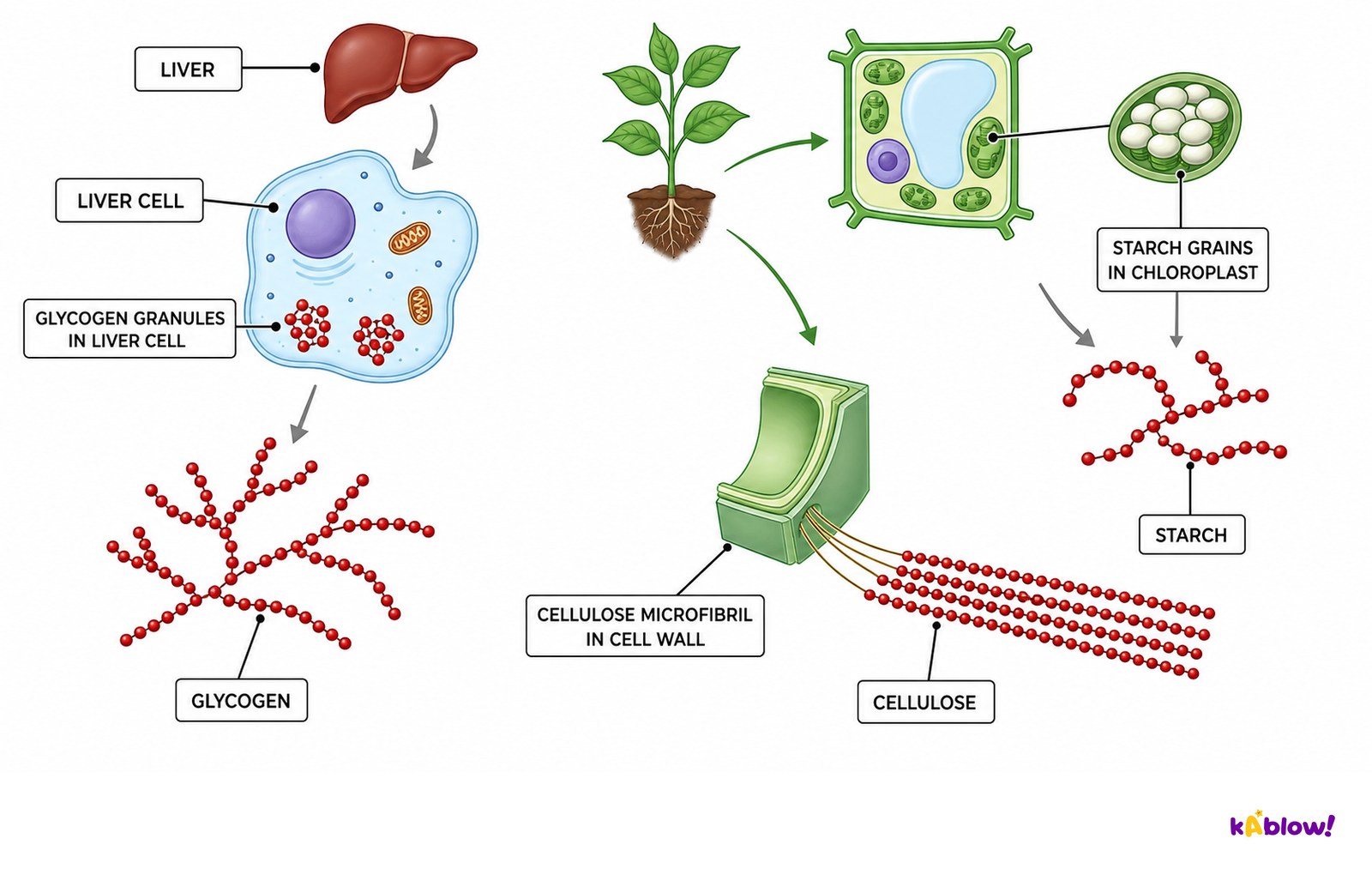
- Starch is the storage polysaccharide of plants, stored as granules in chloroplasts and made of α glucose monomers.
- Starch is constructed from amylose (10–30%), an unbranched helix-shaped chain with 1,4 glycosidic bonds, and amylopectin (70–90%), which has 1,4 and 1,6 glycosidic bonds creating a branched molecule.
- The helix shape of amylose makes it compact and more resistant to digestion; the branches of amylopectin give many terminal glucose molecules that can be easily hydrolysed for respiration or added to for storage.
- Glycogen is the storage polysaccharide of animals and fungi, made of α glucose joined by 1,4 and 1,6 glycosidic bonds; it is more branched than amylopectin, providing more free ends for rapid hydrolysis to supply the higher metabolic needs of animal cells.
- Cellulose is a structural carbohydrate found in the cell walls of plants; it is a straight, unbranched polymer of β-glucose monomers.
- In β-glucose the hydroxyl group on carbon 1 sits above the carbon ring, whereas in α-glucose it sits below; therefore every alternate β-glucose molecule in the chain must invert to form a glycosidic bond.
- The alternating pattern in cellulose allows hydrogen bonding between strands, linking several molecules into microfibrils and giving cellulose its structural strength.
Starch, glycogen and cellulose
Role of Glycoproteins
- Carbohydrates and polypeptides can combine via covalent bonds to make glycoproteins, which are classed as proteins.
- Glycoproteins, along with glycolipids, form part of the structure of cell surface membranes.
- They act as receptor molecules in processes such as cell recognition and identification, receptors for cell signalling molecules such as hormones and neurotransmitters, endocytosis, and cell adhesion and stabilisation.
- Glycoproteins can act as antigens that identify cells as either 'self' or 'non-self'; cells recognised as non-self trigger an immune response.
- A person's blood type is determined by the glycoprotein antigens on the surface of their red blood cells: type A has type A antigens, type B has type B antigens, type AB has both and type O has neither.
- Antibodies in an individual's blood can interact with glycoproteins if blood of the wrong type enters the body, e.g. a person with Type A antigens has antibodies against type B antigens.
- This can cause fatal issues during blood transfusions if the incorrect blood type is given, as antibodies cause the incorrect antigens from the transfused blood to clump together, blocking blood vessels.
Lipids and Triglycerides
- Examples of lipids in living organisms are fats, oils, waxes and steroids; lipid macromolecules contain carbon, hydrogen and oxygen atoms.
- Lipids contain hydrocarbon molecules with many non-polar covalent bonds, making them insoluble in water or other polar solvents; solubility can be improved by combining lipids with other molecules, e.g. glycolipids and lipoproteins.
- Some lipids are triglycerides: three fatty acids join to one glycerol molecule.
- Fatty acids contain hydrocarbon chains that can be saturated (only single carbon-carbon bonds) or unsaturated (one or more double bonds).
- Triglycerides are formed by esterification: an ester bond forms when the hydroxyl (-OH) group of glycerol bonds with the carboxyl group (-COOH) of a fatty acid.
- The formation of an ester bond is a condensation reaction; for each ester bond formed a water molecule is released, so one triglyceride releases three water molecules.
- Lipids are energy-dense compared to carbohydrates due to their high number of C-H bonds, containing about 2× more energy per gram than most carbohydrates.
- Lipids are insoluble so are not transported around the body easily and remain in their storage cells; when respired they produce a lot of metabolic water, which can be used as a dietary water source when drinking water is unavailable.
Fatty Acids
- Both triglycerides and phospholipids contain glycerol with fatty acids attached; these have long hydrocarbon 'tails' containing hydrogen and carbon.
- Fatty acids occur in two forms: saturated and unsaturated; unsaturated fatty acids can be monounsaturated or polyunsaturated.
- In saturated fatty acids the bonds between carbon atoms in the hydrocarbon tail are all single bonds, so the fatty acid is 'saturated' with hydrogen; each carbon atom (except the final one) is bonded to two hydrogen atoms.
- Saturated fatty acids are straight molecules, so lipid molecules containing them pack tightly together, increasing their melting point and making them solid at room temperature; they are often used as storage molecules in animals, e.g. fats in meat and butter.
- In unsaturated fatty acids the bonds in the hydrocarbon tail are not all single bonds; each carbon atom in a carbon-carbon double bond can only bond to one hydrogen atom instead of two.
- Double bonds can cause the hydrocarbon tail to kink, so unsaturated fatty acids cannot pack as tightly together and fats containing them are often liquids at room temperature.
- A fatty acid with one C=C double bond is monounsaturated; lipids containing these have a lower melting point than saturated fatty acids and form liquid oils.
- Polyunsaturated fatty acids contain many carbon-carbon double bonds; lipids containing them also have a low melting point and form oils used for energy storage in plants.
Phospholipids
- Phospholipids are formed from glycerol and fatty acids, but contain only two fatty acids bonded to glycerol, as the third has been replaced by a phosphate ion (PO43-).
- The phosphate is polar, so it is soluble in water, or hydrophilic; the fatty acid 'tails' are non-polar and therefore insoluble in water, or hydrophobic.
- Phospholipids are amphipathic, meaning they have both hydrophobic and hydrophilic regions.
- When placed in water, hydrophilic phosphate heads orient towards the water and hydrophobic hydrocarbon tails orient away from the water, forming a phospholipid monolayer.
- When phospholipids are mixed with water, two-layered structures known as phospholipid bilayers can form; this is the basic structure of the cell membrane.
- The amphipathic nature of phospholipids means the bilayer acts as a barrier to most water-soluble substances; the non-polar fatty acid tails prevent polar molecules or ions from passing between them.
- This means water-soluble molecules such as sugars, amino acids and proteins cannot leak out of the cell and unwanted water-soluble molecules cannot get in.
- Small, nonpolar molecules such as O2 and CO2 are soluble in the lipid bilayer and can diffuse across cell membranes quickly without transport proteins; larger non-polar molecules such as steroid hormones can also cross.
Cholesterol and Steroid Hormones
- Cholesterol is a type of lipid with hydrophobic and hydrophilic regions.
- The hydrocarbon region of cholesterol is non-polar, allowing it to cross lipid bilayers.
- Oestradiol and testosterone are two examples of steroid hormones formed from cholesterol.
- They are produced by gonadal tissues in the reproductive organs.
- Due to their lipid structure they can cross the lipid bilayer and readily travel into and out of cells and nuclei.
- Inside the nucleus these hormones alter and direct the process of transcription.
Folien
Sign up free to view the lesson slides
Step through every slide for this topic — plus flashcards and revision notes — with a free account.
Übungsfragen
Gratis-Vorschau — 8 von 61 Fragen. Registriere dich, um alle zu sehen.
1.Which of the following bonds link two monosaccharides together to form a disaccharide?
Easy- AHydrogen
- BEster
- CGlycosidic
- DPeptide
2.Which of the following features does not explain why lipids are excellent long-term storage compounds?
Easy- AThey can be saturated or unsaturated
- BLess body mass is required to store a given amount of energy
- CThey are insoluble and will not affect the osmolarity of the cell
- DLipids are energy dense molecules
3.Which of the following are involved in the formation of lipids? I. condensation II. amino acids III. hydrolysis IV. fatty acids
Easy- AI and II
- BI and IV
- CII and III
- DII, III and IV
4.Which of the following statements correctly describes a feature of carbohydrates OR lipids?
Medium- AGlycosidic bonds form during hydrolysis reactions, joining monosaccharides together to form disaccharides and polysaccharides.
- BA triglyceride is an example of a polymer as it is formed from many smaller, repeating subunits joined together by covalent bonds.
- CA triglyceride is not an example of a polymer although it is formed from smaller subunits joined together.
- DGlycosidic bonds join disaccharides together to form monosaccharides and polysaccharides.
5.Which of the following occurs when sucrose is formed from monosaccharides?
Medium- ACondensation of glucose and fructose, using water.
- BCondensation of glucose and galactose, using water.
- CCondensation of glucose and fructose, releasing water.
- DCondensation of glucose and galactose, releasing water.
6.Which of the following chemical formulae shows a carbohydrate molecule?
Medium- AC18H34O2
- BC18H32O16
- CC18H32O2
- DC3H8O3
7.Which is the correct reason that cellulose passes through the gut undigested?
Medium- AThere are no enzymes present in the human digestive system capable of cellulose digestion.
- BCellulose is not a required nutrient of the human body.
- CCellulose provides bulk for effective peristalsis which forces the food through the alimentary canal.
- DIt takes too long for the glucose monomers in cellulose to be hydrolysed, so cellulose is egested before it can be digested.
8.Which of the following most accurately describes the formation of a lipid?
Hard- AAn ester bond forms between the -COOH group of three fatty acids and an -OH group on one glycerol molecule, along with the release of three molecules of water
- BAn ester bond forms between the -COOH group of three fatty acids and a -CH group on one glycerol molecule, along with the release of three molecules of water
- CAn ester bond forms between the -COOH group of three fatty acids and an -OH group on one glycerol molecule, along with the absorption of three molecules of water
- DAn ester bond forms between the -COOH group of three fatty acids and a -CH group on one glycerol molecule, along with the absorption of three molecules of water
Unlock all 61 questions & more
Erstelle ein Gratis-Konto, um alle Fragen, Folien, Karteikarten und Lernnotizen zu diesem Thema zu sehen.