Diversity Of Organisms
Lerne es beim Spielen
Beantworte diese Fragen für Energie, dann angle und erkunde. Kein Konto nötig.
Lektionsnotizen
Variation Between Organisms
- Variation refers to the differences that exist between organisms.
- Variation can be seen in visual appearance, behaviour, and biochemistry.
- Variation arises from a combination of genetic and environmental factors.
- Genetic variation is generated by mutation and by the combination of alleles during sexual reproduction.
- The environment can affect gene expression, e.g. temperature, nutrient availability, and oxygen concentration.
- Variation exists both between species and within a species; no two individuals are identical when all characteristics are compared.
- Variation can be discontinuous (distinct categories, e.g. blood type) or continuous (measured on a scale, e.g. height).
Species Classification and the Binomial System
- Classification is the process of putting organisms into groups; the science of classification is taxonomy.
- The smallest taxonomic group is the species.
- Historically, species were classified by morphology (observable characteristics), known as the morphological species concept.
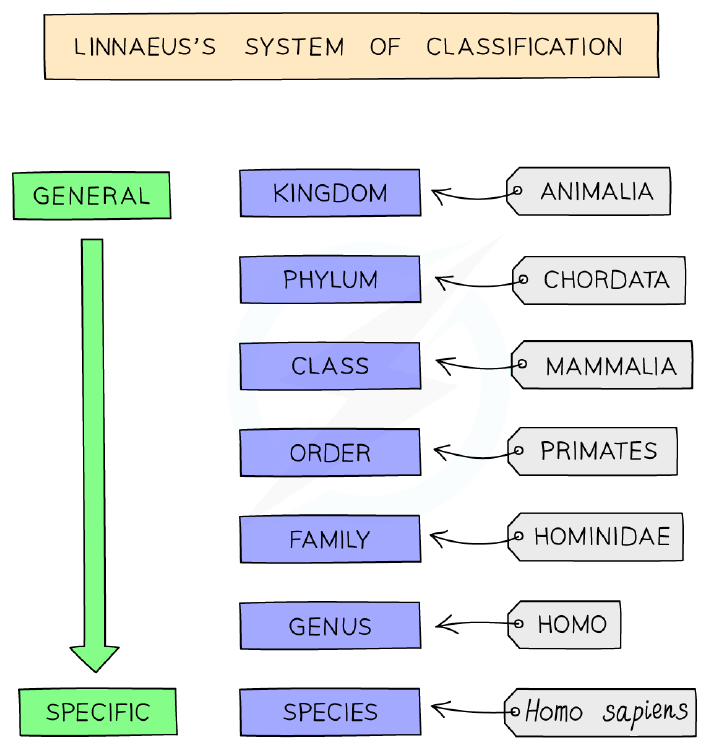
- Carl Linnaeus developed the binomial system of naming species, giving each species a two-part Latin name.
- The first part of the binomial name is the genus (capitalised), and the second is the species name (lower-case), e.g.×Canis lupus×.
- Binomial names are written in italics when typed or underlined when handwritten.
- After first use, the genus name can be abbreviated, e.g.×Triticum aestivum×becomes×T. aestivum×.
- Classification based on morphology alone can be misleading because species with similar appearance are not always closely related.
The taxonomic hierarchy
Biological Species Concept
- The biological species concept defines a species as a group of organisms that can interbreed to produce fertile offspring.
- This concept has limitations: it cannot be applied to organisms that reproduce asexually, such as bacteria.
- It is difficult to apply when fertile hybrids are produced, e.g. the 'wholphin' (a cross between a melon-headed whale and a bottlenose dolphin).
- It cannot be used for extinct species because they cannot be bred to test fertility.
- Other characteristics used to determine species include morphology, DNA sequences, biochemistry, ecology, and evolutionary lineage.
- The characteristics used depend on the organism; e.g. bacteria may be classified by biochemistry or ecology, while extinct species may be classified by evolutionary lineage.
Speciation and Distinguishing Populations from Species
- Speciation is the process by which one species gives rise to two or more new species.
- Speciation can occur when populations become isolated (e.g. geographically), preventing gene flow between them.
- Different environmental conditions can lead to different natural selection pressures, and genetic drift can also contribute to speciation.
- Once speciation has occurred, the two species are reproductively isolated and can no longer interbreed to produce fertile offspring.
- Speciation occurs gradually over long time periods, so it can be difficult to pinpoint when two populations become separate species.
- Assigning separate species status can be subjective; e.g. killer whales show variation between populations and some scientists believe there may be more than one species.
Chromosome Number
- A diploid cell contains two complete sets of chromosomes (2n); haploid cells contain one set (n).
- In animals, haploid cells are gametes (egg and sperm).
- During fertilisation, haploid gametes fuse to form a diploid zygote; both gametes must have the same number of chromosomes for the zygote to be viable.
- Every body cell arising from the zygote has the same chromosome number, except red blood cells which have no nucleus.
- Different species have different chromosome numbers; e.g. humans have 46 (23 pairs) and chimpanzees have 48 (24 pairs).
- The diploid number is always even because it must be divisible by two to produce a whole haploid number.
- Differences in chromosome number can prevent organisms from different species from breeding successfully.
- Chromosome number is not linked to how 'advanced' a species is in evolutionary terms.
Karyograms: Skills
- A karyogram is an image showing all chromosomes in a cell arranged by size, shape, and banding pattern, placed with their homologous pairs.
- A karyotype is the appearance of a complete set of an individual's chromosomes, including number, size, shape, and banding.
- To make a karyogram, cells are stained and viewed under a light microscope; photographs are taken during metaphase of cell division.
- Chromosomes are arranged by size, shape, and banding pattern; this can be done with paper and scissors or on a computer.
- Chromosomes with a central centromere are metacentric; those with a near-terminal centromere are acrocentric.
- Chromosome pair 23 (sex chromosomes) often does not fit the size-order pattern because the X chromosome is very large.
- Karyograms can provide evidence for chromosome fusion; e.g. chimpanzee chromosomes 12 and 13 may have fused to form human chromosome 2.
- Evidence for this fusion includes matching banding patterns, centromere location, and the presence of satellite DNA and telomeric DNA in human chromosome 2.
Genomes and Genome Size
- The genome is all of the genetic information in an organism, including coding and non-coding DNA, mitochondrial DNA, chloroplast DNA, and plasmid DNA (in prokaryotes).
- DNA sequencing determines the base sequence of DNA; genome-wide comparisons can be made between individuals and species.
- There is a high level of genome similarity within and between species; humans share about 99.9% of their DNA with other humans and about 99% with chimpanzees.
- Differences between individuals are due to different alleles; single base changes are called single nucleotide polymorphisms (SNPs).
- Genome size varies widely: viruses and bacteria have small genomes, prokaryotes generally have smaller genomes than eukaryotes, and plant genomes vary greatly.
- Genome size is measured in million base pairs or C-value (haploid nuclear DNA content); 1 pg = 978 Mb.
- Genome size does not always correlate with organism complexity; e.g. humans have 3,100 Mb, hagfish 4,200 Mb, and common wheat 17,000 Mb.
- Factors to consider include non-coding DNA, polyploidy in plants, and that 'complexity' can be defined in different ways.
Uses of Genome Sequencing
- Genome sequencing allows the base sequence of an organism's genome to be identified; methods are becoming faster and cheaper, with next-generation sequencing (NGS) techniques.
- Sequence data can be used to determine evolutionary relationships (phylogenetics), personalised medicine, and more.
- Phylogenetics classifies species based on evolutionary origins and shared common ancestry.
- DNA, mRNA, and amino acid sequences can be compared; the more similar the sequences, the more closely related the species are.
- Species separated for longer have accumulated more mutations, so their sequences differ more.
- Cytochrome c is often used for comparison because it is present in many organisms and shows sufficient variation.
- Sequence data can be used to create phylogenetic trees showing evolutionary relationships.
- Genome sequencing can be used in personalised medicine: identifying disease risks, developing targeted drugs, and selecting treatments based on an individual's genotype.
Folien
Sign up free to view the lesson slides
Step through every slide for this topic — plus flashcards and revision notes — with a free account.
Übungsfragen
Gratis-Vorschau — 8 von 64 Fragen. Registriere dich, um alle zu sehen.
1.Which is the correct definition for a species according to the biological species concept?
Easy- AA group of organisms which can interbreed to produce fertile offspring.
- BA group of organisms which look similar.
- CA group of organisms with similar characteristics.
- DA group of living things.
2.Which of the following statements about genomes is not correct?
Easy- AHumans have the most genes of any organism.
- BHumans have around 20 000 genes.
- CSpecies vary in the number of genes they have.
- DThe number of genes of an organism is not proportional to genome size.
3.The image shows a karyogram. Which of the statements about the karyogram is correct?
Medium- AThe source of DNA for the karyogram was a human cell.
- BThe source of DNA for the karyogram was a haploid cell.
- CAll 23 pairs of chromosomes are arranged in descending order of size.
- DChromosome banding is visible.
4.What is an appropriate unit for comparing the length of genomes?
Medium- AMillion base pairs
- BMicrometers
- CNanometers
- DPicometer
5.What is the most efficient way to compare the genome sizes of different species?
Medium- AExtract information from an online database.
- BRead scientific articles and extract relevant information.
- CCompare the chromosome number of the different species.
- DCompare the proteome size of the different species.
6.Which of the following statements about genome sequencing are correct? (select all that apply)
Medium- AScientists can now look for correlations between changes in a gene and particular human traits.
- BThe genomes of many species have now been sequenced.
- CAdvancing computer technology means that the rate at which a genome can be sequenced continues to increase.
- DScientists now know the location and role of every human gene.
- EGenome sequencing technology is now so advanced that further developments are not expected.
7.The two karyotypes belong to a donkey (Q) and a horse (R). Breeding these two individuals resulted in the production of a sterile mule (S). Why would S be sterile?
Hard- AThe process of meiosis will not be possible in S as homologous pairs cannot form.
- BThe sex of the mule (S) will be undetermined at birth due to the unnatural combination of chromosomes.
- CDifferent combinations of alleles formed as a result of crossbreeding Q and R which leads to disadvantageous characteristics in S.
- DThere are different numbers of chromosomes in the gametes of Q and R so S would not live long enough to breed.
8.What is the smallest taxonomic group?
Easy- ASpecies
- BGenus
- CFamily
- DKingdom
Unlock all 64 questions & more
Erstelle ein Gratis-Konto, um alle Fragen, Folien, Karteikarten und Lernnotizen zu diesem Thema zu sehen.