From Models To Materials
Lerne es beim Spielen
Beantworte diese Fragen für Energie, dann angle und erkunde. Kein Konto nötig.
Lektionsnotizen
Bonding Models
- Bonding models simplify complex systems and allow prediction of substance properties.
- Chemical bonding broadly falls into three types: ionic, covalent, and metallic.
- Real bonding situations are more complex than these three ideal types suggest.
- Example: Aluminium chloride (AlCl₃) contains a metal and non-metal, so it would be expected to be ionic with a high melting point, but it melts at 192 °C due to covalent character; its bonding is polar covalent, not purely ionic.
Bonding as a Continuum
- Bonding is better visualised using a bonding triangle, which places compounds on a spectrum.
- The triangle uses electronegativity difference (Δχ) on the y-axis and average electronegativity (χ̄) on the x-axis.
- Δχ = χA − χB; χ̄ = (χA + χB) / 2.
- Elements have zero Δχ and appear along the x-axis depending on their electronegativity.
- Metals have zero Δχ and appear along the x-axis near the metallic corner (bottom left).
- Ionic compounds have large Δχ and are placed near the apex of the triangle.
- Covalent compounds with low Δχ are near the bottom right; polar covalent compounds lie in between ionic and covalent.
- Bonding character is based on electronegativity trends, not just position in the Periodic Table.
Using the Triangular Bonding Diagram
- The triangular bonding diagram is in Section 17 of the IB Chemistry Data Booklet; electronegativity values are in Section 9.
- The diagram classifies bonds as a continuum between ionic (top), covalent (bottom right), and metallic (bottom left).
- Each compound is plotted using (x, y) = (average electronegativity, electronegativity difference).
- Example: Sodium (Na) has electronegativity 0.9 and Δχ = 0, placing it at the bottom left (100% metallic).
- Example: Chlorine (Cl₂) has electronegativity 3.2 and Δχ = 0, placing it at the bottom right (100% covalent).
- Example: Sodium chloride (NaCl) has χ̄ = (3.2 + 0.9)/2 = 2.05 and Δχ = 3.2 − 0.9 = 2.3, placing it near the apex with around 75% ionic character; this explains its high melting point and ability to conduct electricity when molten.
Percentage of Bonding Type
- The triangular bonding diagram can estimate the percentage of ionic or covalent character in a compound.
- Example: Aluminium chloride (AlCl₃) has χ̄ = (1.6 + 3.2)/2 = 2.4 and Δχ = 3.2 − 1.6 = 1.6, placing it at (2.4, 1.6) with 50% ionic character.
- Example: Aluminium oxide (Al₂O₃) has χ̄ = (1.6 + 3.4)/2 = 2.5 and Δχ = 3.4 − 1.6 = 1.8, placing it at (2.5, 1.8) with 60% ionic character.
- Both AlCl₃ and Al₂O₃ fall near the polar covalent region, indicating significant ionic character and covalent properties.
- Al₂O₃ has a much higher melting point (2072 °C) due to stronger ionic bonding; AlCl₃ melts at just 192 °C due to weaker covalent interactions.
- The diagram allows accurate assessment of real bonding behaviour and prediction of properties like melting point, solubility, and electrical conductivity.
Properties of Alloys
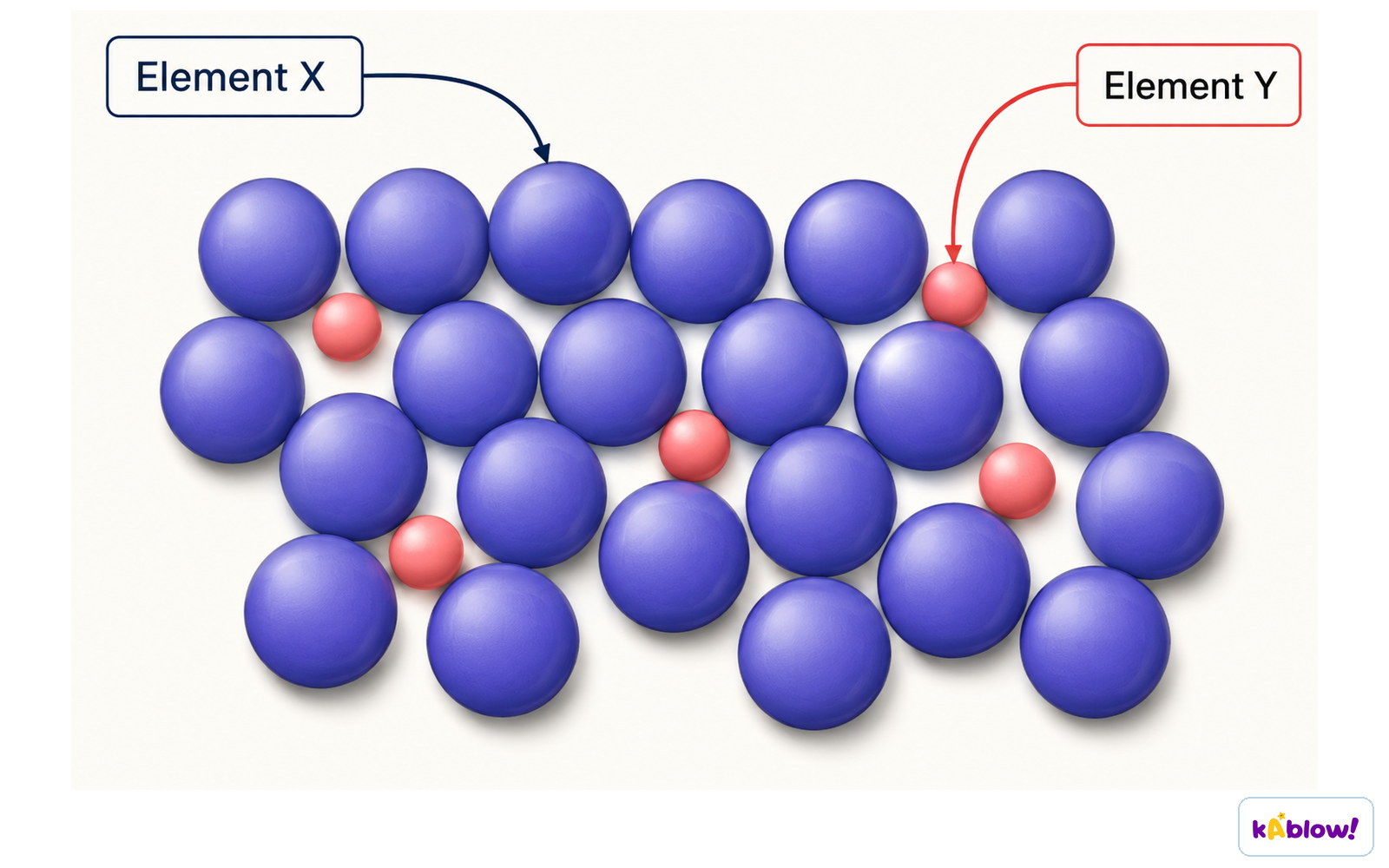
- An alloy is a mixture of metals, or a metal mixed with a non-metal such as carbon; the elements are physically combined but not chemically bonded.
- Atoms of different elements are spread throughout the metallic lattice and are held together by delocalized electrons, as in pure metals.
- Metallic bonds are non-directional, allowing atoms of different sizes to occupy the lattice.
- In a pure metal, cations are arranged in regular layers that slide past one another easily, making the metal malleable.
- In alloys, atoms of different sizes disrupt the regular pattern, making it harder for layers to slide, so alloys are harder and stronger than pure metals.
- Alloys may also be more corrosion resistant or resistant to extreme temperatures.
- Examples: Brass (copper and zinc) is strong and corrosion resistant; Steel (iron with carbon, often chromium, vanadium, molybdenum) is very strong; Stainless steel (iron, chromium, nickel, carbon) is corrosion resistant; Solder (lead and tin) has a low melting point; Bronze (copper and tin) is hard and corrosion resistant.
Structure of an alloy
Polymers
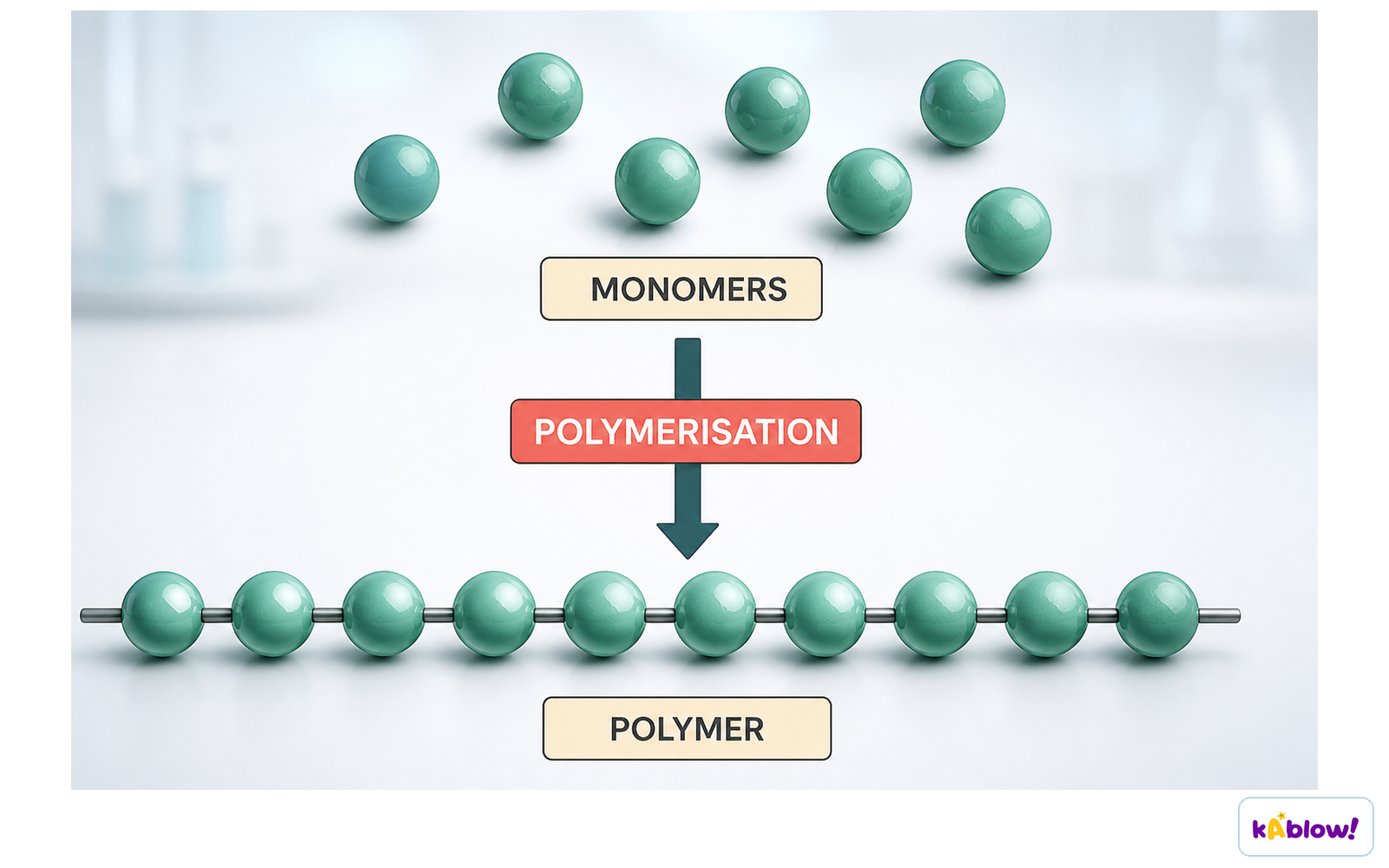
- Polymers are large molecules made by chemically linking many small molecules called monomers.
- A polymer must contain at least 50 repeating units, each joined to the next by strong covalent bonds.
- Polymers are also known as macromolecules due to their large size compared with simple molecules.
- Some polymers contain just one type of monomer unit, e.g. poly(ethene) and poly(chloroethene) (PVC).
- Others contain two or more different types of monomer units and are called copolymers, e.g. nylon and biological proteins.
- Natural polymers include proteins, starch, and DNA; DNA forms a double helix with millions of linked nucleotides.
- Synthetic polymers include plastics like poly(ethene) and nylon; they are man-made and widely used due to durability, low reactivity, and water resistance.
- Synthetic polymers are generally non-biodegradable because of their chemical stability, leading to long-lasting pollution.
Monomers joining to form a polymer
Addition Polymerisation
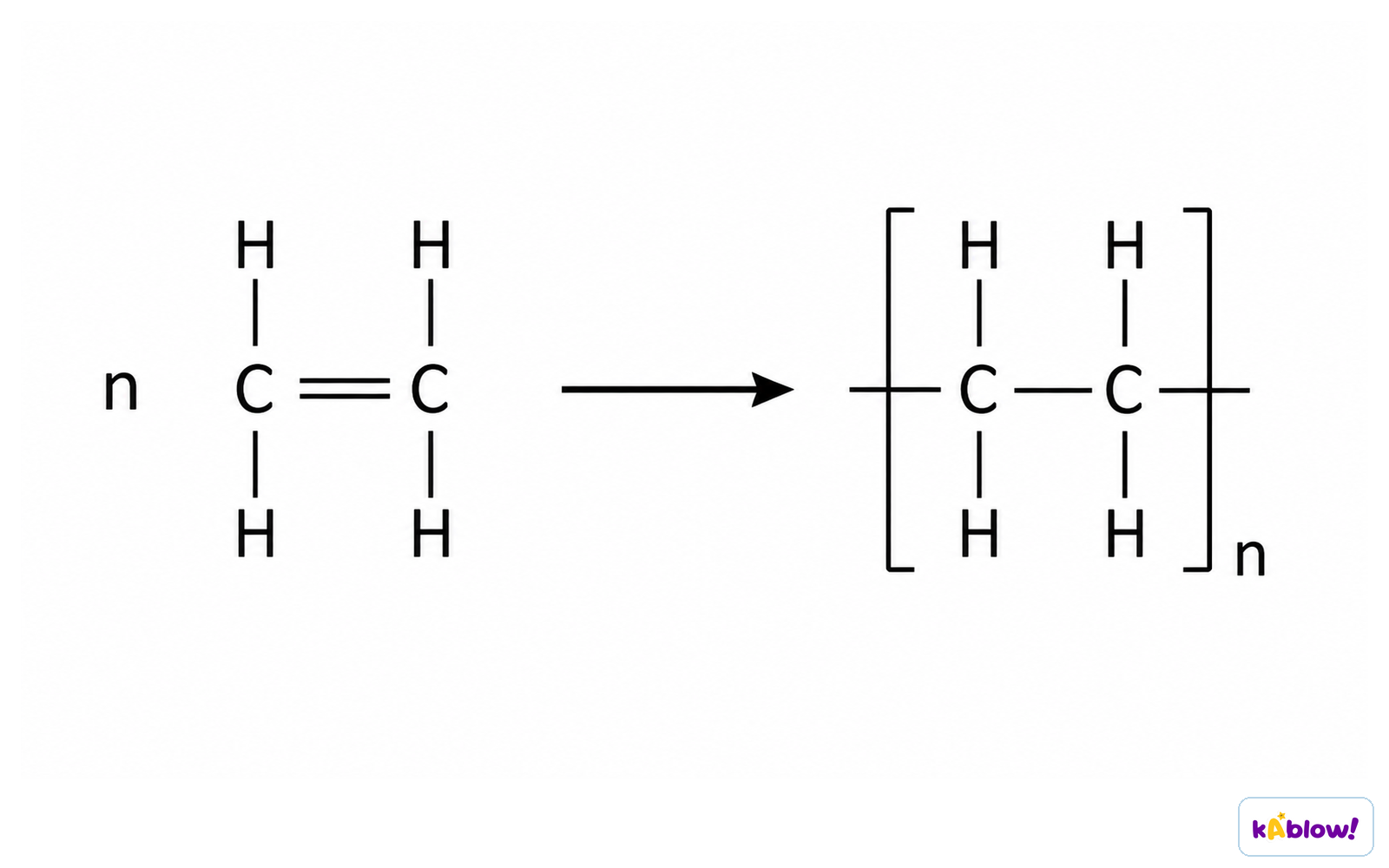
- Addition polymerisation involves monomers containing at least one C=C double bond joining together to form a long-chain polymer.
- The only product is the polymer; no by-products are formed.
- The π-bond in each C=C bond breaks, allowing monomers to link by forming new C–C single bonds.
- Examples: Poly(ethene) from ethene monomers; Poly(chloroethene) (PVC) from chloroethene monomers.
- A repeat unit is the smallest group of atoms that repeats to form the polymer chain; it is shown inside square brackets with an n outside.
- In poly(alkenes), the repeat unit is the same as the monomer except the C=C becomes a C–C bond.
- To deduce the monomer from a polymer, identify the repeat unit (2 carbons in the main chain) and replace the C–C bond with a C=C bond.
Addition polymerisation
Properties of Polymers
- Low density – polymer chains are loosely packed, so plastics are lightweight compared to metals or ceramics.
- Unreactive – most plastics don’t react easily because the polymer chains are chemically stable.
- Water-resistant – plastics repel water and don’t absorb moisture, making them ideal for containers and packaging.
- Strong – polymers are held together by strong covalent bonds, making many plastics tough and durable.
- These properties make polymers useful in everyday materials such as packaging, clothing, construction products, and transportation components.
Folien
Sign up free to view the lesson slides
Step through every slide for this topic — plus flashcards and revision notes — with a free account.
Übungsfragen
Gratis-Vorschau — 8 von 67 Fragen. Registriere dich, um alle zu sehen.
1.Which of the following statements about alloys are correct? I. Alloys contain atoms of all the same sizes II. An alloy is a mixture of a metal with another element III. Alloys are harder than the pure metal they originate from
Easy- AI and II only
- BI and III only
- CII and III only
- DI, II and III
2.A molecule of a polymer contained the sequence shown. Which monomer could produce this polymer by addition polymerisation?
Medium- ACHCl=CHCl
- BCH2=CHCl
- CCH3CCl=CHCl
- DCH3CCl=CH2
3.Which of the following chemicals is not correctly placed within this triangular bonding diagram?
Easy- ALi
- BO2
- CCH4
- DCBr4
4.Which type of bonding can be described as 'the electrostatic attraction between positive nuclei and electrons and occurs by the sharing of electrons'?
Medium- AHydrogen bonding
- BIonic bonding
- CMetallic bonding
- DCovalent bonding
5.A binary compound is plotted on a triangular bonding diagram. The electronegativity values for each element are 1.6 and 3.4. Which estimate for the percentage ionic and percentage covalent character in the compound is correct?
Medium- A10% covalent, 90% ionic
- B40% covalent, 60% ionic
- C55% covalent, 45% ionic
- D100% covalent, 0% ionic
6.The properties of alloys can be explained in terms of metals having I. Non-directional bonding II. Delocalised electrons III. Ions of different size
Medium- AI and II only
- BI and III only
- CII and III only
- DI, II and III
7.Using Sections 9 and 17 of the Data Booklet, which of the following predictions about gallium tribromide are incorrect? I. It is a poor insulator. II. It has a high melting and boiling point. III. It is hard and brittle.
Medium- AI and II only
- BI and III only
- CII and III only
- DI, II and III
8.Match each region of the triangular bonding diagram with the type of bonding found there.
Easy- Apex (top) of the triangle
- Bottom right of the triangle
- Bottom left of the triangle
- Ionic bonding
- Covalent bonding
- Metallic bonding
Unlock all 67 questions & more
Erstelle ein Gratis-Konto, um alle Fragen, Folien, Karteikarten und Lernnotizen zu diesem Thema zu sehen.