Ideal Gases
Lerne es beim Spielen
Beantworte diese Fragen für Energie, dann angle und erkunde. Kein Konto nötig.
Lektionsnotizen
Kinetic Theory of Gases
- Gas molecules are in constant, rapid, random motion.
- The volume of individual gas molecules is negligible compared to the total volume of the gas.
- No intermolecular forces exist between gas particles; they do not attract or repel one another.
- All collisions between gas molecules are perfectly elastic (no kinetic energy is lost).
- The temperature of a gas is directly proportional to the average kinetic energy of its particles.
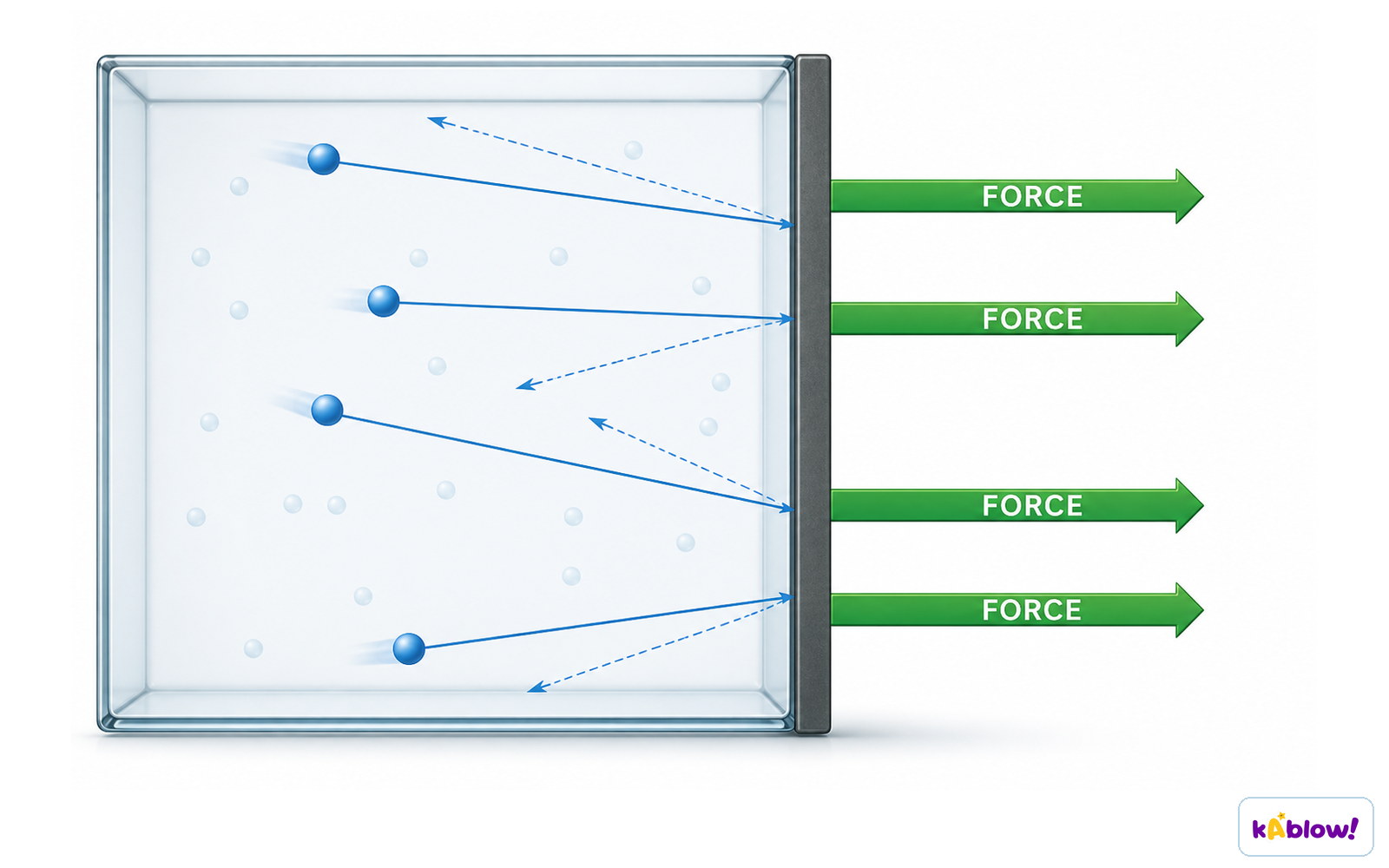
Gas particles and pressure
Ideal vs. Real Gases
- Ideal gases follow all assumptions of the kinetic theory.
- Real gases do not perfectly follow this model, but under low pressure and high temperature, they behave similarly to ideal gases.
- Real gases deviate from ideal behaviour especially at low temperatures and high pressures.
- At low temperatures, intermolecular attractions become significant, reducing collision frequency and force, leading to lower pressure than predicted.
- At high pressures, the volume of gas particles becomes significant, reducing the available space for movement and causing deviation.
Factors Affecting Gas Volume
- The volume a gas occupies depends on pressure (P) and temperature (T).
- Gases exert pressure by constantly colliding with the walls of the container.
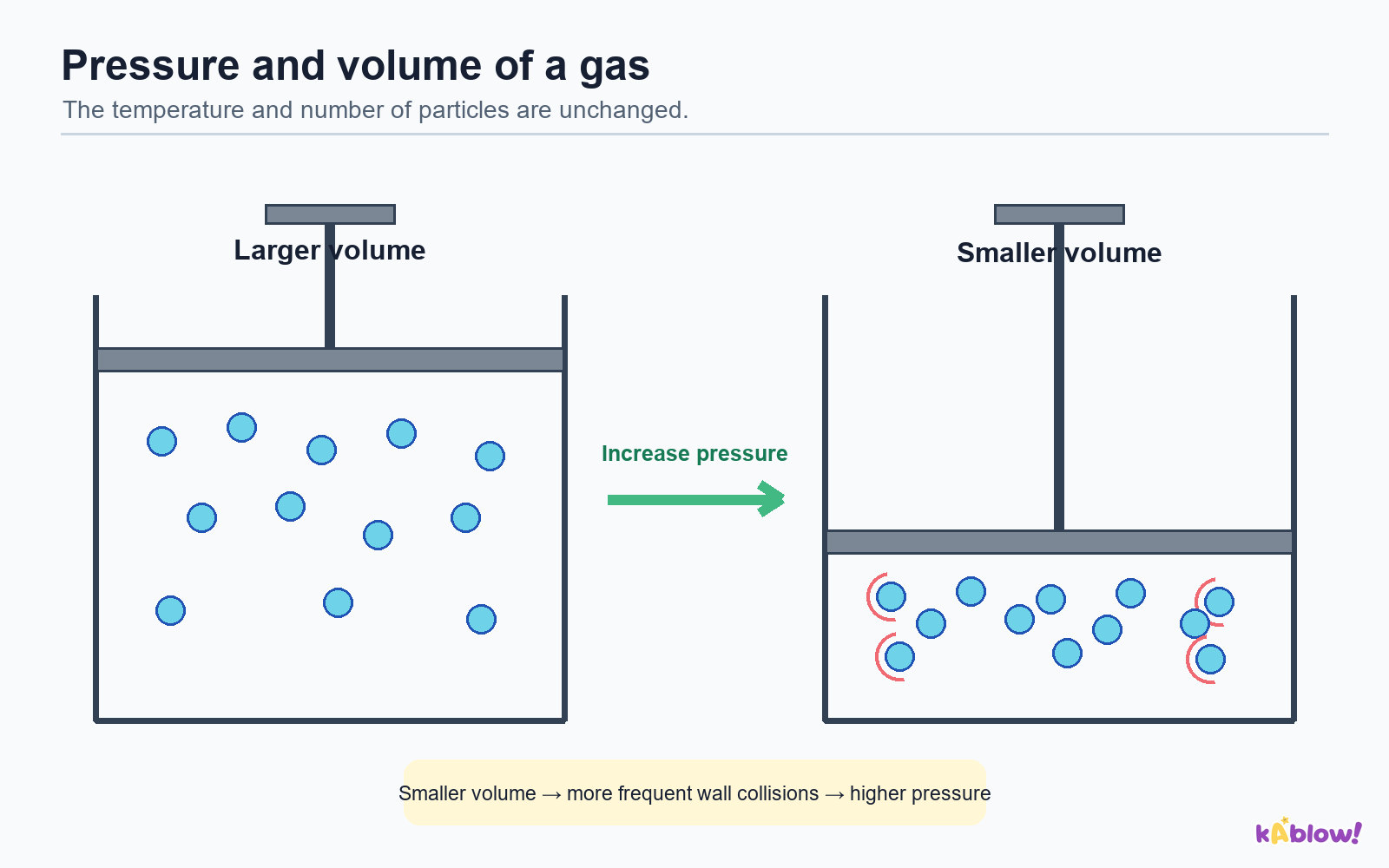
- Decreasing the volume (at constant temperature) causes molecules to be squashed together, resulting in more frequent collisions and increased pressure.
- Increasing the temperature (at constant pressure) gives particles more kinetic energy, leading to more frequent collisions; to keep pressure constant, the gas expands, so volume increases.
- Increasing the temperature (at constant volume) causes particles to move faster and collide more frequently with the container walls, increasing pressure.
Boyle's Law
- Pressure is inversely proportional to volume when temperature is constant: P \propto \frac{1}{V}.
- PV = a constant (Boyle's Law).
- A graph of pressure against 1/volume gives a straight line.
- A graph of pressure against volume gives a curve.
- A graph of PV versus P gives a straight line.
Pressure and volume
Charles's Law
- Volume is directly proportional to temperature in Kelvin at constant pressure: V \propto T.
- V/T = a constant (Charles's Law).
- A graph of volume against temperature in Kelvin gives a straight line.
- When a gas is heated at constant pressure, particles gain kinetic energy, collide more frequently, and the gas expands to keep pressure constant.
Pressure and Temperature Relationship
- Pressure is directly proportional to temperature in Kelvin at constant volume: P \propto T.
- P/T = a constant.
- A graph of temperature in Kelvin against pressure gives a straight line.
- Increasing temperature at constant volume increases collision frequency with the container walls, raising pressure.
Combined Gas Law
- Combining the three relationships gives: \frac{PV}{T} = \text{a constant}.
- For a fixed amount of gas: \frac{P1V1}{T1} = \frac{P2V2}{T2}.
- Temperature must be in Kelvin for all gas law calculations.
- This equation is used when the amount of gas (moles) is constant.
The Ideal Gas Equation
- PV = nRT relates pressure, volume, temperature, and number of moles of an ideal gas.
- P = pressure (Pa), V = volume (m³), n = moles (mol), R = gas constant (8.31 J K⁻¹ mol⁻¹), T = temperature (K).
- The ideal gas equation can also be used to calculate the molar mass (M) of a gas.
- Always convert units: 1 m³ = 1,000,000 cm³ (10⁶ cm³). To convert cm³ to m³, divide by 10⁶; to convert m³ to cm³, multiply by 10⁶.
- To convert °C to K, add 273.
Molar Gas Volume
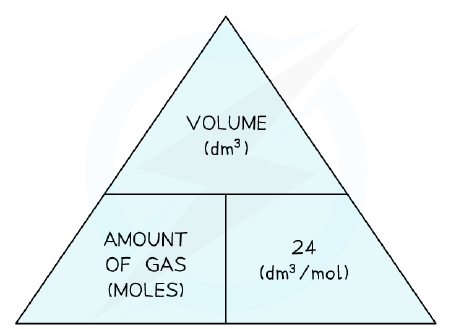
- At standard temperature and pressure (STP), one mole of any gas occupies 22.7 dm³ (or 22,700 cm³).
- Molar gas volume can be used to convert between moles and volume of gas at STP.
- The ideal gas equation can be used to find molar volume under non-standard conditions.
Molar gas volume formula triangle
Folien
Sign up free to view the lesson slides
Step through every slide for this topic — plus flashcards and revision notes — with a free account.
Übungsfragen
Gratis-Vorschau — 8 von 64 Fragen. Registriere dich, um alle zu sehen.
1.Which of the following is NOT an assumption of the kinetic theory of ideal gases?
Easy- AGas molecules are in constant, rapid, random motion
- BThe volume of individual gas molecules is negligible compared to the total volume of the gas
- CIntermolecular forces between gas particles are significant
- DAll collisions between gas molecules are perfectly elastic
2.According to Boyle's Law, for a fixed amount of gas at constant temperature, the pressure of the gas is:
Easy- Adirectly proportional to its volume
- Binversely proportional to its volume
- Cdirectly proportional to the square of its volume
- Dindependent of its volume
3.A graph of pressure of a gas against 1/volume gives a straight line through the origin. This graph represents:
Medium- ACharles' Law
- BBoyle's Law
- Cthe relationship between pressure and temperature at constant volume
- Dthe relationship between volume and temperature at constant pressure
4.Which of the following statements about real gases is correct?
Medium- AReal gases behave most like ideal gases at low temperatures and high pressures.
- BReal gases behave most like ideal gases at high temperatures and low pressures.
- CReal gases never deviate from ideal gas behaviour.
- DReal gases have no intermolecular forces at any temperature.
5.At high pressures, a real gas deviates from ideal gas behaviour mainly because:
Medium- Athe volume of the gas particles becomes significant compared to the total volume
- Bintermolecular forces become negligible
- Cthe collisions between particles are no longer elastic
- Dthe temperature of the gas decreases
6.Which of the following statements are true for an ideal gas? (select all that apply)
Medium- AGas molecules are in constant, rapid, random motion.
- BIntermolecular forces between gas particles are significant.
- CCollisions between gas molecules are perfectly elastic.
- DThe volume of individual gas molecules is negligible compared to the total volume.
- EThe temperature of a gas is directly proportional to the average kinetic energy of its particles.
7.In an elastic collision, kinetic energy is conserved.
EasyTrue or false?
8.According to Charles' Law, the volume of a gas is directly proportional to its temperature in degrees Celsius at constant pressure.
EasyTrue or false?
Unlock all 64 questions & more
Erstelle ein Gratis-Konto, um alle Fragen, Folien, Karteikarten und Lernnotizen zu diesem Thema zu sehen.