Introduction To The Particulate Nature Of Matter
Lerne es beim Spielen
Beantworte diese Fragen für Energie, dann angle und erkunde. Kein Konto nötig.
Lektionsnotizen
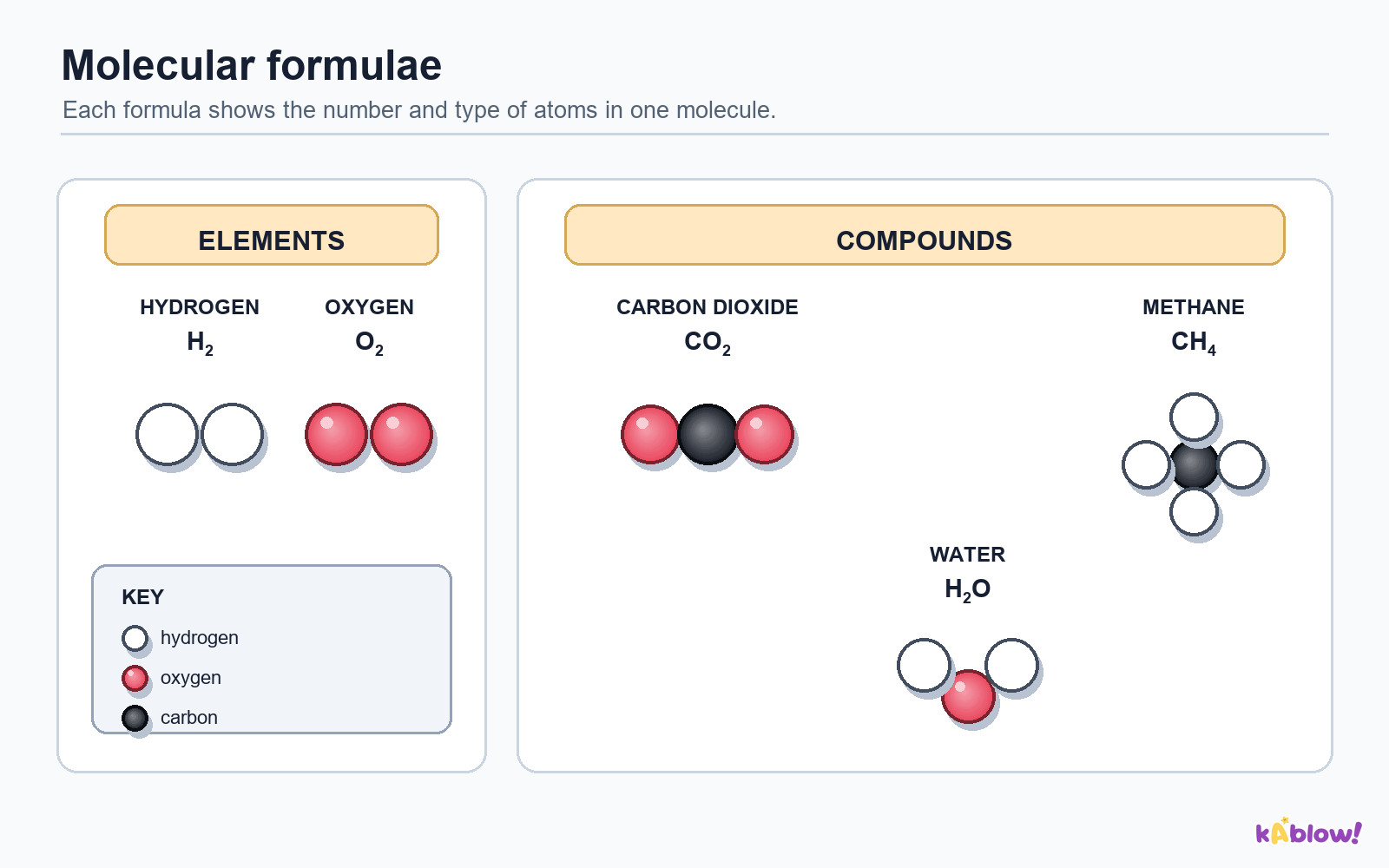
Elements and Compounds
- Elements are substances made from one kind of atom and cannot be chemically broken down into simpler substances.
- Elements take part in chemical reactions in which new substances are made, often involving an energy change.
- In chemical reactions, atoms combine in fixed ratios to give full outer shells of electrons, producing compounds.
- Compounds are made from two or more elements chemically bonded together.
- The properties of a compound can be quite different from the properties of the elements that form it (e.g., sodium chloride vs sodium and chlorine).
Ball-and-stick models of common elements and compounds
Mixtures
- Mixtures contain more than one element or compound in no fixed ratio.
- The components of a mixture are interspersed but not chemically combined.
- The components of a mixture retain their own characteristic properties (e.g., oxygen in air still supports combustion).
- A homogeneous mixture has uniform composition and properties throughout (e.g., air, bronze).
- A heterogeneous mixture has non-uniform composition, so its properties are not the same throughout (e.g., concrete, orange juice with pulp).
- It is often possible to see the separate components in a heterogeneous mixture, but not in a homogeneous mixture.
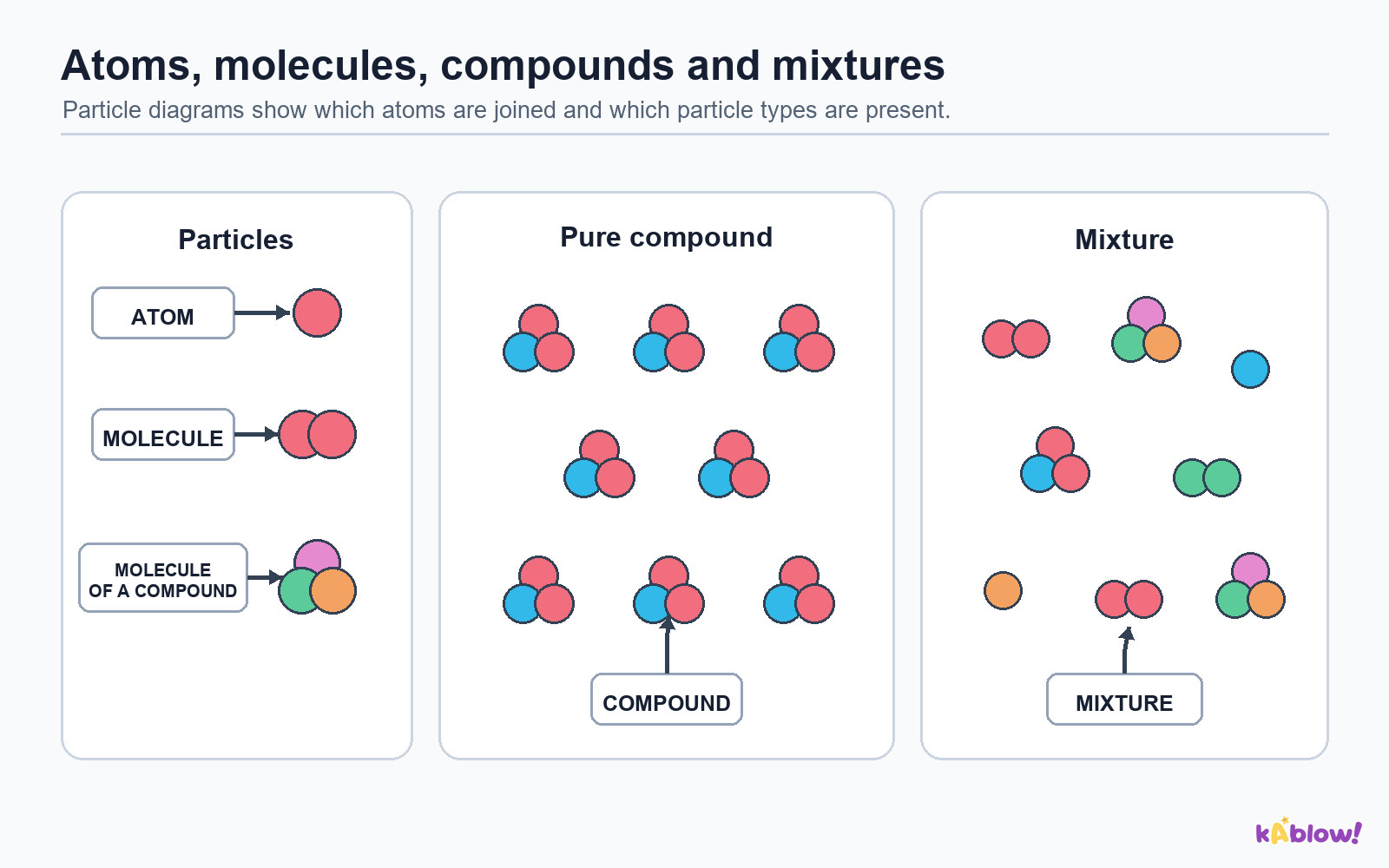
Particle diagram showing elements, compounds and mixtures
Separating Mixtures: Solubility and Filtration
- Separation techniques take advantage of differences in physical properties such as boiling point, solubility, magnetism, or density.
- Solvation is the process where solvent particles surround and attract solute particles; in water it is called hydration.
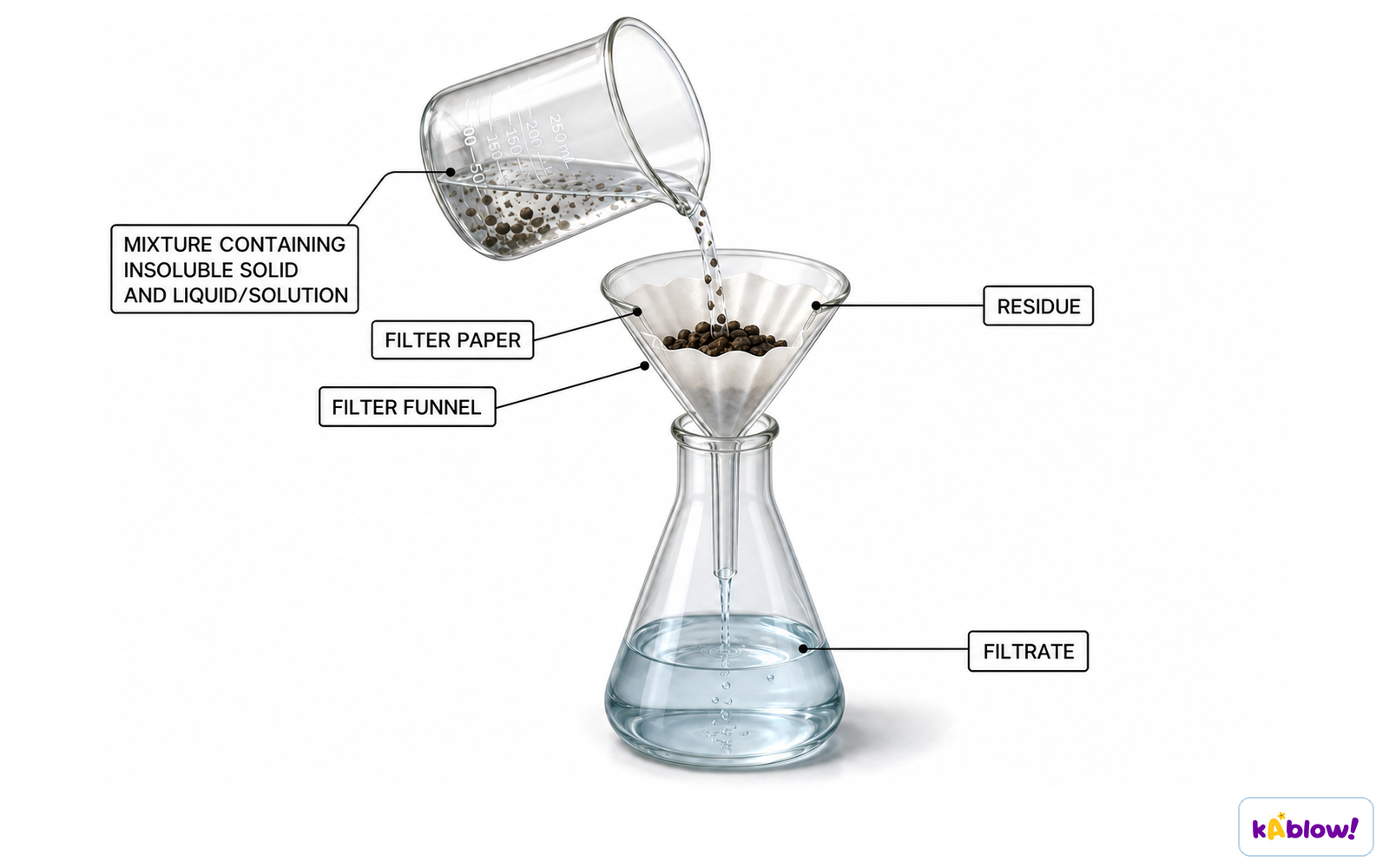
- Filtration separates an undissolved (insoluble) solid from a liquid or solution using filter paper.
- In filtration, the liquid that passes through is the filtrate and the solid left behind is the residue.
- Filtration works because solid particles are too large to pass through the pores in the filter paper.
- Vacuum filtration can be used for very fine solids that clog filter paper under gravity filtration; centrifugation can also separate solid–liquid mixtures.
Filtration apparatus
Separating Mixtures: Crystallisation and Recrystallisation
- Crystallisation separates a dissolved solid from a solution when the solid is more soluble in hot solvent than cold.
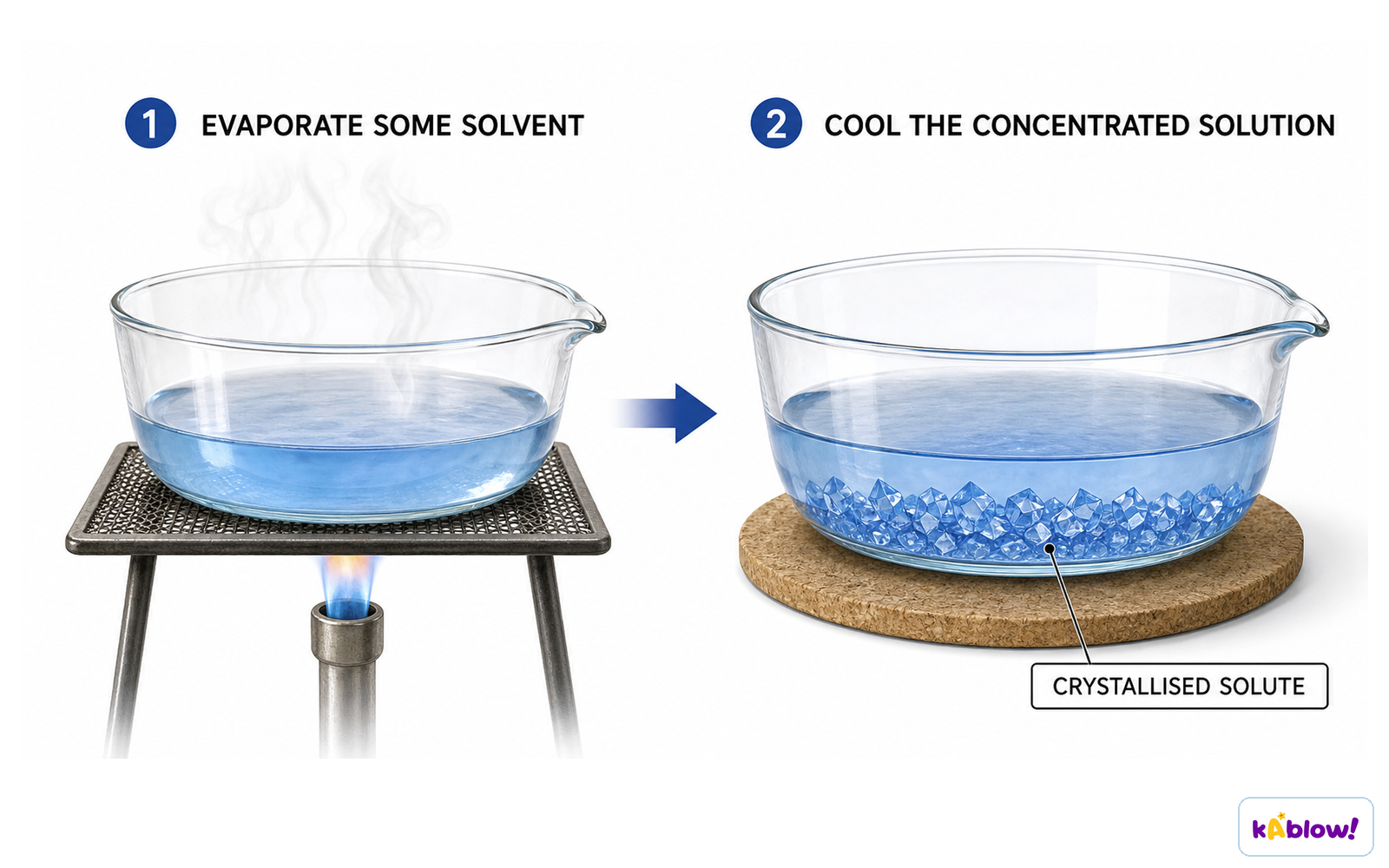
- To crystallise, heat the solution gently to evaporate some solvent, then allow it to cool slowly until crystals form.
- Do not boil to dryness, as this may prevent crystal formation; cool slowly to allow larger crystals to grow.
- Recrystallisation purifies an impure solid by dissolving it in a minimum amount of hot solvent and allowing it to crystallise as the solution cools.
- Impurities remain in the solvent when cooled, while the purified product crystallises.
- Büchner filtration under reduced pressure is faster and more effective than gravity filtration for collecting crystals.
Crystallisation by evaporation and cooling
Separating Mixtures: Distillation and Chromatography
- Simple distillation separates a solvent from a solute or a pure liquid from a mixture, based on differences in boiling point.
- In simple distillation, the liquid with the lowest boiling point evaporates first, then its vapour is condensed and collected as the distillate.
- Fractional distillation separates two or more miscible liquids with similar boiling points using a fractionating column (e.g., ethanol and water, crude oil).
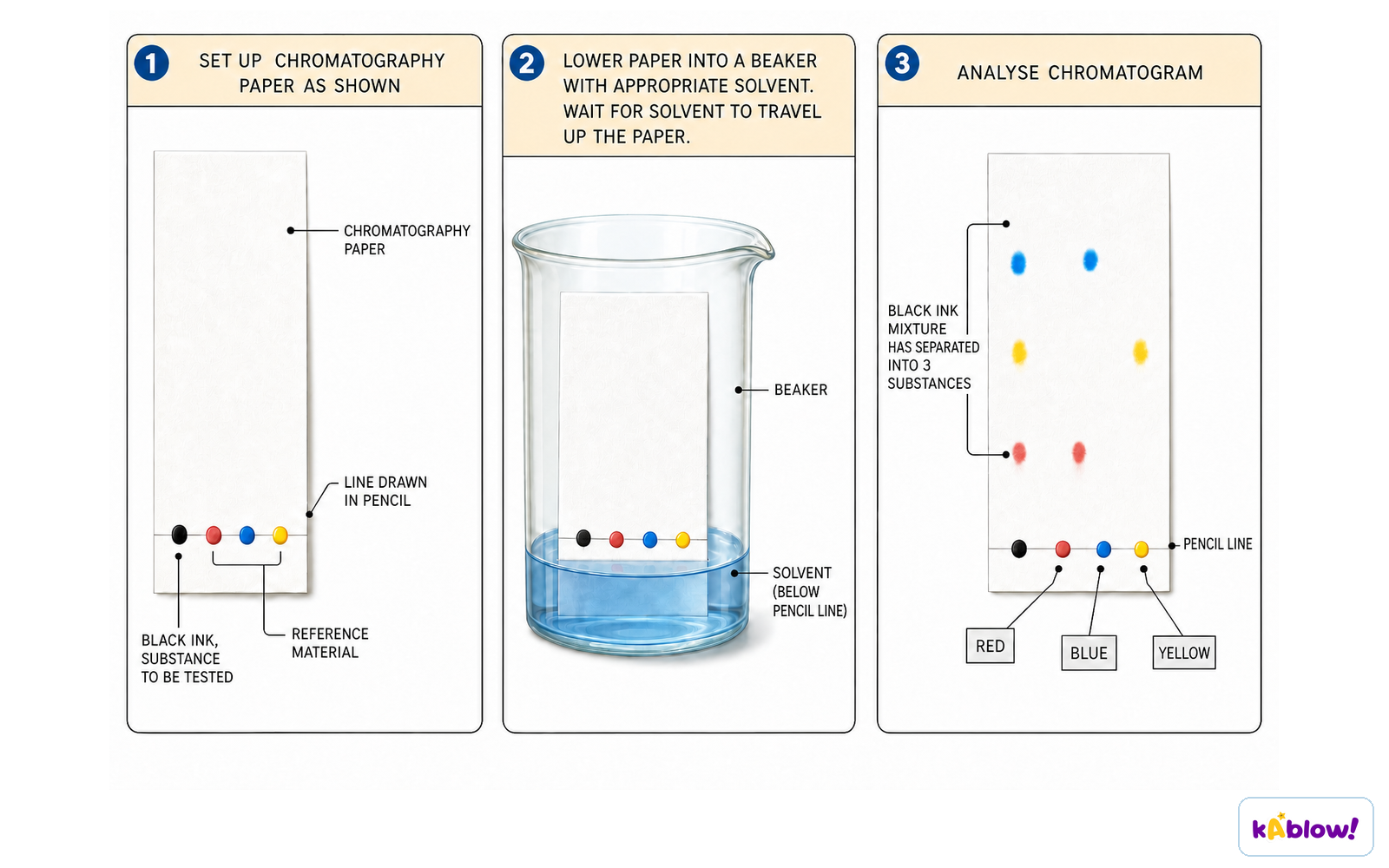
- Paper chromatography separates dissolved substances based on differences in solubility and adsorption to the paper.
- In chromatography, substances more soluble in the solvent travel further; those more strongly adsorbed to the paper move more slowly.
- The pattern of separated spots is called a chromatogram.
- Magnetic separation uses differences in magnetic properties (e.g., removing iron filings from sulfur).
Paper chromatography
The Three States of Matter
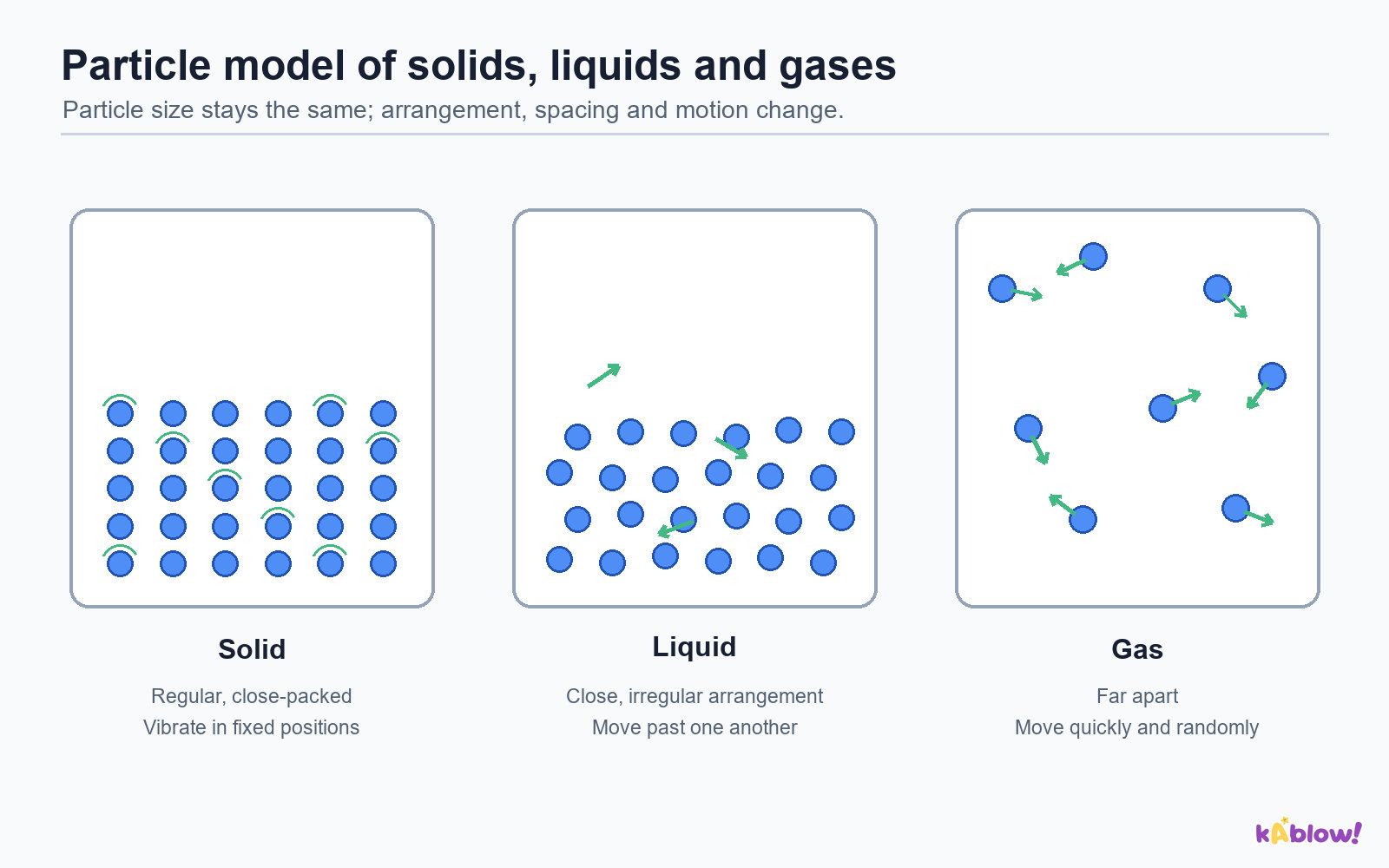
- Solids have a fixed shape and volume; particles are closely packed in a regular, ordered pattern and can only vibrate in place.
- Liquids have a fixed volume but take the shape of their container; particles are close together but randomly arranged and can slide past one another.
- Gases have no fixed shape or volume; particles are widely spaced, randomly arranged, and move quickly in all directions.
- Particle motion in gases causes collisions, which generate pressure.
- Density decreases from solid to liquid to gas due to increasing particle separation.
- Particle energy increases from solid to liquid to gas.
Particle arrangements in solids, liquids and gases
Changes of State
- State changes are physical changes and are reversible; they involve energy transfer but do not alter the chemical identity of the substance.
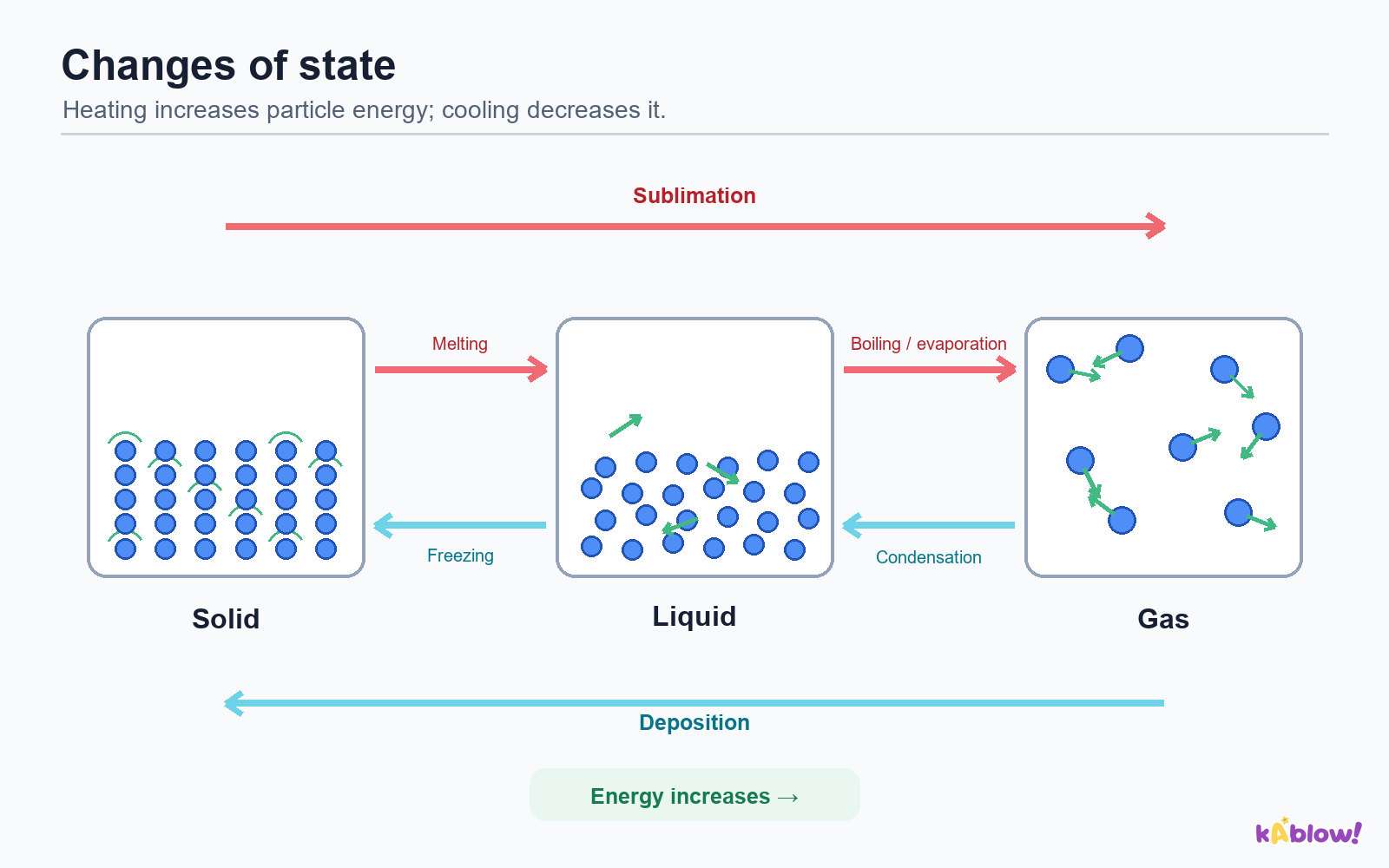
- Melting: solid → liquid; Freezing: liquid → solid.
- Vaporisation: liquid → gas, including boiling (throughout the liquid at a specific temperature) and evaporation (only at the surface, below boiling point).
- Condensation: gas → liquid; Sublimation: solid → gas; Deposition: gas → solid.
- Energy is always required to overcome intermolecular forces, so melting, vaporisation, and sublimation are endothermic.
- Energy is released when particles come closer, so freezing, condensation, and deposition are exothermic.
- State symbols in equations: (s) solid, (l) liquid, (g) gas, (aq) aqueous.
Changes of state
Average Kinetic Energy and Temperature
- Temperature is a measure of the average kinetic energy (Ek) of the particles in a substance.
- The Kelvin (K) is the SI unit of temperature; temperature in Kelvin is directly proportional to average kinetic energy.
- The higher the temperature, the faster the particles move on average.
- At the same temperature, all gases have the same average kinetic energy, but lighter gases move faster and heavier gases move slower.
- Convert Celsius to Kelvin: T(K) = T(°C) + 273.15; Kelvin to Celsius: T(°C) = T(K) − 273.15.
- 0 K (absolute zero) is the temperature at which particles have no kinetic energy.
Interpreting Heating Curves
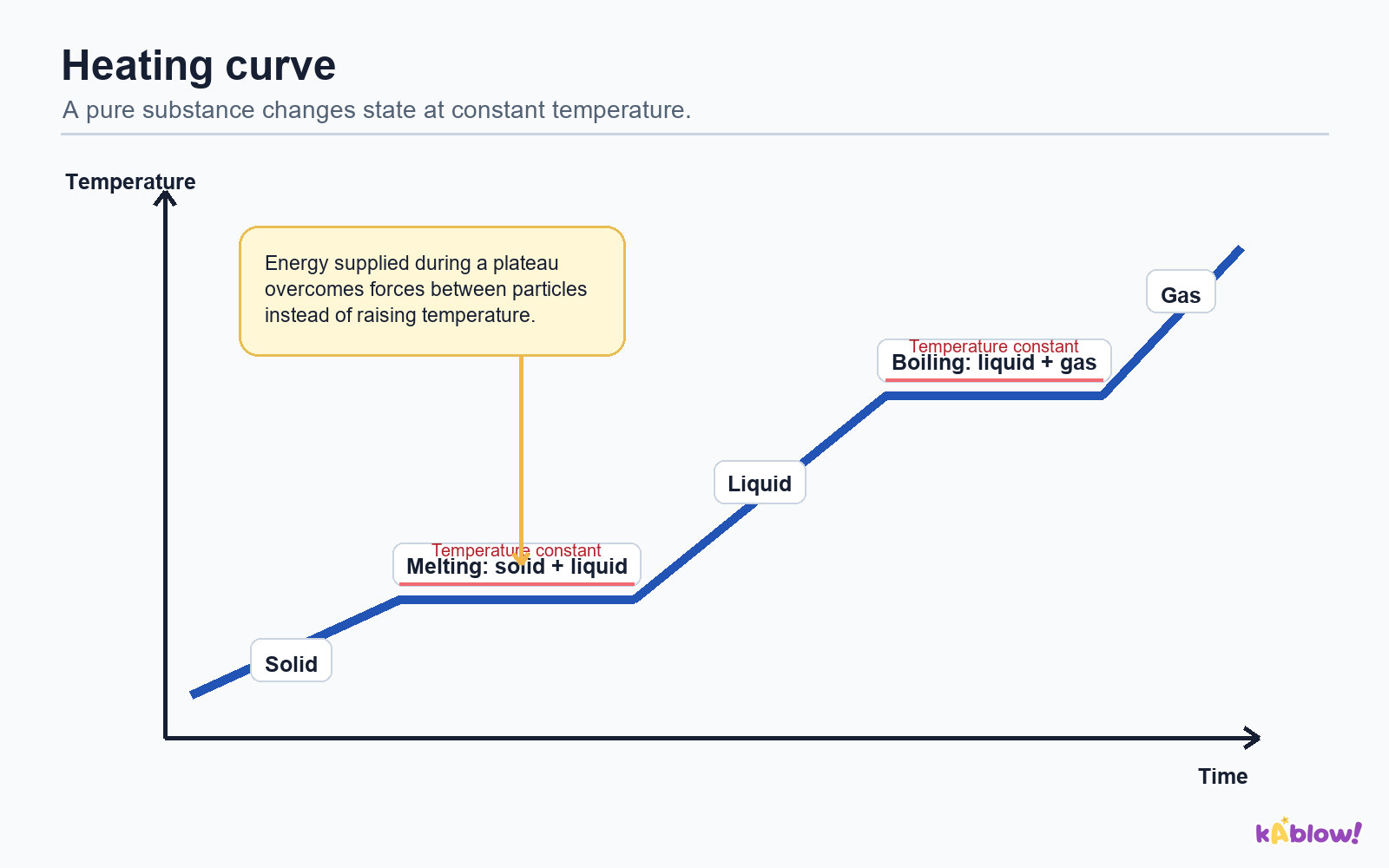
- During heating of a solid, particles vibrate more as they gain kinetic energy, so temperature increases.
- During melting (solid → liquid), energy is used to overcome intermolecular forces, not to increase kinetic energy, so temperature remains constant.
- During heating of a liquid, particles move more freely and gain kinetic energy, so temperature rises again.
- During boiling (liquid → gas), energy goes into overcoming intermolecular forces, so temperature remains constant.
- After boiling, the substance is a gas; particles move rapidly and have the highest average kinetic energy, so temperature increases again.
- Observations: melting loses shape but volume remains constant; boiling forms bubbles throughout; condensation forms droplets on cooler surfaces; freezing regains rigid shape; sublimation solid disappears directly into vapour.
A heating curve
Folien
Sign up free to view the lesson slides
Step through every slide for this topic — plus flashcards and revision notes — with a free account.
Übungsfragen
Gratis-Vorschau — 8 von 61 Fragen. Registriere dich, um alle zu sehen.
1.Which equation represents deposition?
Medium- AI₂(g) → I₂(s)
- BI₂(s) → I₂(g)
- CH₂O(g) → H₂O(l)
- DCO₂(s) → CO₂(g)
2.Which statements about mixtures are correct? (select all that apply)
Medium- AMixtures can contain elements and compounds.
- BThe components of a mixture must be in the same state.
- CThe components of a mixture keep their own properties.
- DMixtures have a fixed ratio of components.
3.Which of the following is a heterogeneous mixture?
Medium- AAn aqueous solution of copper(II) chloride
- BAn alloy of iron, carbon and chromium
- CA mixture of sulfur and potassium chloride
- DA mixture of ammonia, hydrogen sulfide and methane gases
4.The components of a mixture are chemically combined.
EasyTrue or false?
5.Match each change of state with its correct description.
Medium- Melting
- Freezing
- Sublimation
- Deposition
- solid to liquid
- liquid to solid
- solid to gas
- gas to solid
6.Which statement is correct about recrystallisation when purifying a solid?
Medium- AThe solid must be insoluble in the hot solvent
- BThe impurities will remain in the solvent when cooled
- CThe yield of product is the same after recrystallisation
- DThe solvent is in excess during recrystallisation
7.Which of the following mixtures cannot be classified as homogeneous?
Medium- ASalt solution
- BBrass
- COrange juice that has been filtered
- DConcrete
8.Which of the following are examples of homogeneous mixtures? (select all that apply)
Medium- AAir
- BBronze
- CConcrete
- DOrange juice with pulp
- ESalt solution
Unlock all 61 questions & more
Erstelle ein Gratis-Konto, um alle Fragen, Folien, Karteikarten und Lernnotizen zu diesem Thema zu sehen.