The Periodic Table: Classification Of Elements
Lerne es beim Spielen
Beantworte diese Fragen für Energie, dann angle und erkunde. Kein Konto nötig.
Lektionsnotizen
The Periodic Table: Structure and Organisation
- The Periodic Table lists all known elements in order of increasing atomic number (1 to 118).
- Elements are arranged so that atoms with the same number of electron shells are in the same period (row).
- Elements with similar outer-shell electron configurations are placed in the same group (column).
- Period number equals the number of occupied electron shells; group number indicates the number of valence electrons.
- Hydrogen is placed in its own group because its properties do not closely match any single group.
- Helium is in Group 18 because it shares the unreactive nature of noble gases, despite having only 2 electrons.
The Periodic Table
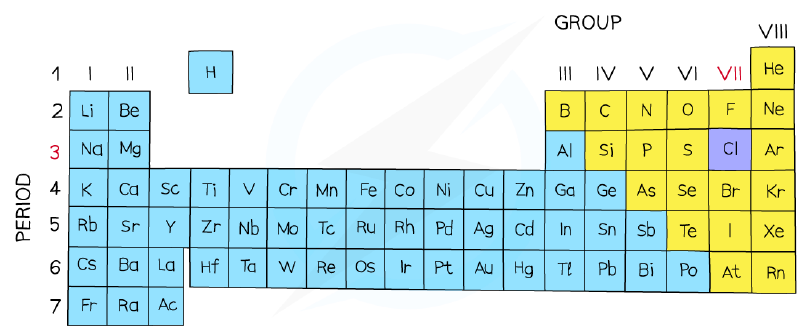
Metals, Non-Metals and Metalloids
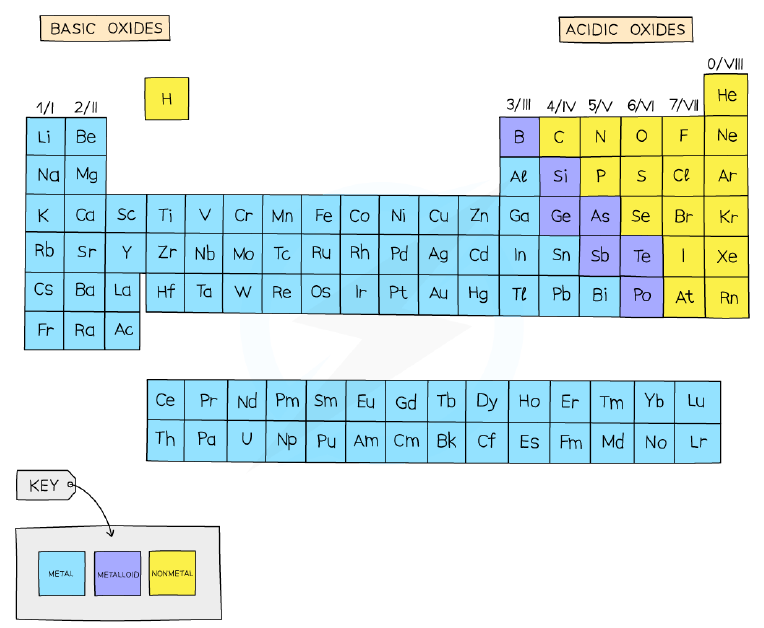
- Metals are found on the left and centre of the table (s- and d-blocks, and part of the p-block). They are good conductors of heat and electricity, and are malleable/ductile.
- Non-metals are on the right-hand side (p-block). They are poor conductors, brittle when solid, and often form acidic oxides.
- Metalloids lie along a diagonal boundary between metals and non-metals and show properties of both.
- Examples of metalloids include boron, silicon, arsenic and antimony.
Metals and non-metals in the Periodic Table
Blocks of the Periodic Table
- Elements are classified into four blocks based on their electron configuration: s, p, d, f.
- s-block: Groups 1 and 2 plus helium; outer electrons are in s orbitals.
- p-block: Groups 13 to 18; outer electrons are in p orbitals.
- d-block: Transition metals (Groups 3 to 12); outer electrons are in d orbitals.
- f-block: Lanthanides and actinides; outer electrons are in f orbitals.
- Block position helps predict reactivity, oxidation states and bonding behaviour.
Electron Configurations and the Periodic Table
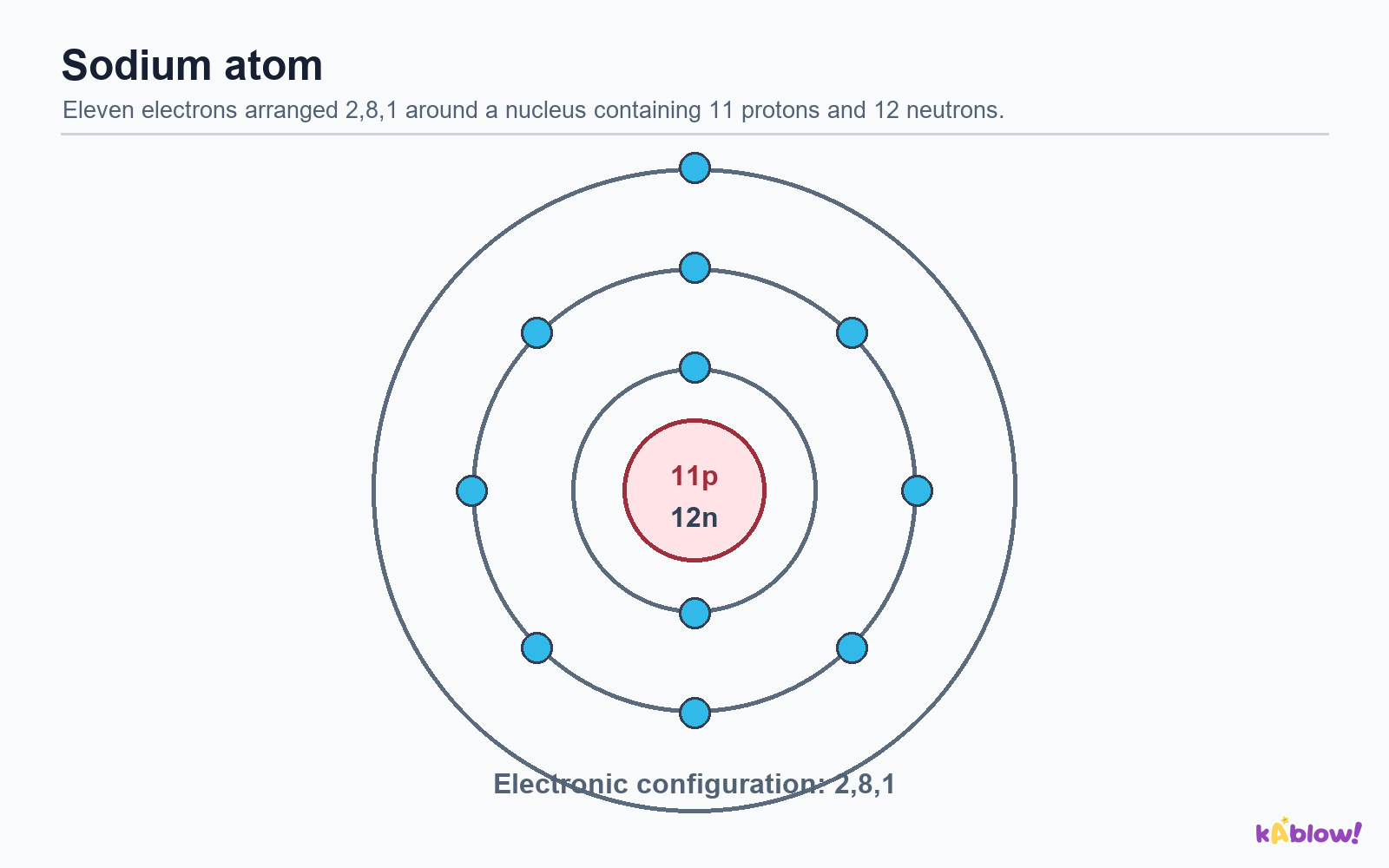
- Electron configuration shows how electrons are arranged in shells, sub-shells and orbitals.
- The period number indicates the highest occupied principal energy level (shell).
- The group number indicates the number of valence electrons.
- The block is determined by the type of orbital (s, p, d, f) occupied by the outermost electrons.
- In the p-block, the element's position from left to right gives the number of electrons in the p subshell.
- The 4s orbital is lower in energy than the 3d subshell, so it is filled first (e.g. potassium: 1s² 2s² 2p⁶ 3s² 3p⁶ 4s¹).
- Shorthand notation uses the nearest preceding noble gas in brackets, e.g. potassium is [Ar] 4s¹.
Electron shells and the Periodic Table
Periodic Trends: Atomic and Ionic Radius
- Atomic radius is the distance from the nucleus to the outermost electron shell.
- Across a period, atomic radius generally decreases because nuclear charge increases while shielding remains roughly constant, pulling electrons closer.
- Down a group, atomic radius generally increases because more principal quantum shells are added, increasing distance and shielding.
- Cations are smaller than their parent atoms due to loss of an outer shell and reduced electron–electron repulsion.
- Anions are larger than their parent atoms because extra electrons increase repulsion, spreading the electron cloud.
- Ionic radius decreases across a period for cations, then increases sharply when anions form, then decreases again.
- Ionic radius increases down a group as more electron shells are added.
Periodic Trends: Ionisation Energy
- First ionisation energy is the energy required to remove one mole of electrons from one mole of gaseous atoms to form one mole of gaseous 1+ ions.
- Ionisation energies are measured under standard conditions (298 K and 100 kPa) and have units kJ mol⁻¹.
- Across a period, ionisation energy generally increases because nuclear charge increases while shielding stays roughly constant, so outer electrons are held more strongly.
- Down a group, ionisation energy generally decreases because outer electrons are further from the nucleus and experience more shielding.
- There is a rapid decrease in ionisation energy between the end of one period and the start of the next due to increased distance and shielding.
- Example: Ca(g) → Ca⁺(g) + e⁻, ΔH = +590 kJ mol⁻¹.
Periodic Trends: Electron Affinity and Electronegativity
- Electron affinity is the energy released when one mole of electrons is gained by one mole of gaseous atoms to form one mole of gaseous ions.
- First electron affinity is usually exothermic for non-metals (e.g. Cl(g) + e⁻ → Cl⁻(g), ΔH = –349 kJ mol⁻¹).
- Some elements (Group 2, Group 12, Group 15) have positive (endothermic) first electron affinities due to stable or half-filled subshells.
- Second electron affinity is endothermic because energy is needed to overcome repulsion between an electron and a negative ion.
- Electron affinity becomes more negative (more exothermic) across a period and less negative down a group.
- Electronegativity is the ability of an atom to attract a pair of electrons towards itself in a covalent bond.
- Electronegativity increases across a period and decreases down a group.
- Electronegativity differs from electron affinity: it applies only to covalent bonding, while electron affinity is a measurable thermodynamic value for forming negative ions.
Group 1 Metals with Water
- Group 1 metals are called alkali metals because they form alkaline solutions with high pH when reacted with water.
- They are soft, shiny when freshly cut, good conductors, with low melting points and low densities.
- They react vigorously with water to form an alkaline metal hydroxide solution and hydrogen gas: 2M(s) + 2H₂O(l) → 2MOH(aq) + H₂(g).
- Lithium floats and reacts slowly; sodium reacts more vigorously, melting into a silvery ball; potassium reacts violently, igniting hydrogen with a lilac flame.
- Reactivity increases down Group 1 because the outer electron is further from the nucleus and more shielded, so it is more easily lost.
- Alkali metals react vigorously with halogens to form alkali metal halides, e.g. 2Na(s) + Cl₂(g) → 2NaCl(s).
Group 17 Elements with Halide Ions
- The halogens are Group 17 non-metals: fluorine, chlorine, bromine, iodine and astatine.
- They are diatomic and have seven electrons in their outer shell, forming halide ions by gaining one electron.
- Colours and states at room temperature: fluorine (yellow gas), chlorine (pale green gas), bromine (orange-brown liquid), iodine (grey-black solid).
- Melting and boiling points increase down the group due to increasing molecular mass and stronger van der Waals forces.
- Reactivity decreases down Group 17 because atomic radius and shielding increase, making it harder to attract an incoming electron.
- A more reactive halogen will displace a less reactive halogen from an aqueous solution of its halide: Cl₂(aq) + 2KBr(aq) → 2KCl(aq) + Br₂(aq).
- Reactivity order: chlorine > bromine > iodine.
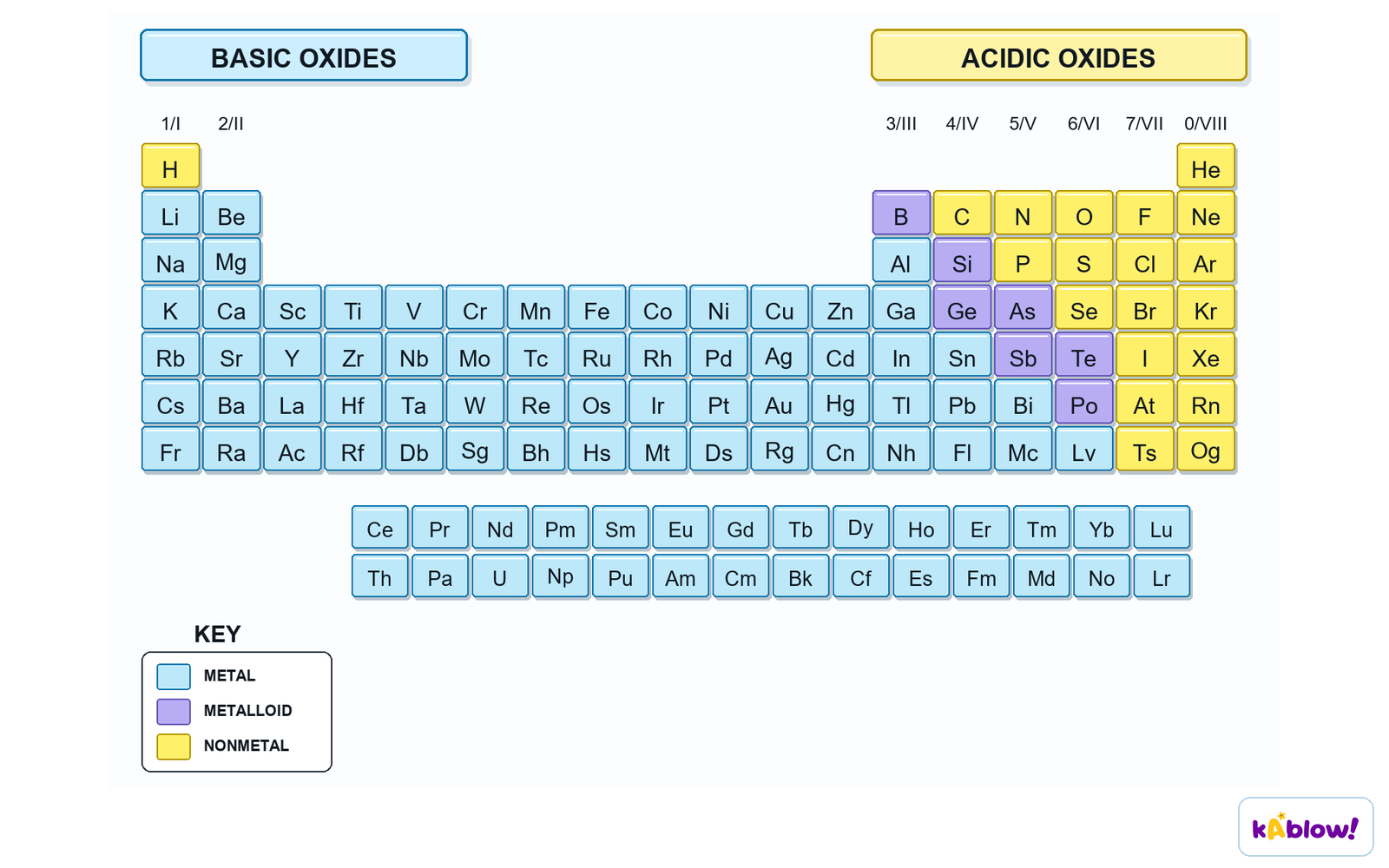
Metallic and Non-Metallic Oxides
- Across a period, oxides change from basic through amphoteric to acidic.
- Basic oxides (e.g. Na₂O, MgO) are ionic solids that form alkaline hydroxides in water: Na₂O(s) + H₂O(l) → 2NaOH(aq).
- Amphoteric oxides (e.g. Al₂O₃) can react with both acids and bases.
- Acidic oxides (e.g. SiO₂, P₄O₁₀, SO₂, SO₃) are covalent and form acids in water: SO₂(g) + H₂O(l) → H₂SO₃(aq).
- The trend from basic to acidic is explained by decreasing electronegativity difference between the element and oxygen across the period.
- Non-metal oxides dissolving in atmospheric water cause acid rain; CO₂ dissolving in seawater causes ocean acidification.
Metals form basic oxides, non-metals form acidic oxides
Oxidation States
- Oxidation can be defined as addition of oxygen, loss of hydrogen, or loss of electrons.
- Reduction can be defined as loss of oxygen, gain of hydrogen, or gain of electrons.
- The oxidation number of an atom is the charge it would have if all bonding were completely ionic.
- Rules: uncombined elements = 0; Group 1 = +1; Group 2 = +2; fluorine = –1; hydrogen = +1 (or –1 in metal hydrides); oxygen = –2 (except peroxides = –1, F₂O = +2).
- The sum of oxidation numbers in a neutral compound is 0; in a polyatomic ion it equals the ion's charge.
- In compounds/ions, the more electronegative element gets the negative oxidation number.
- Oxidation numbers can be fractional when averaged across atoms in different environments (e.g. S in S₄O₆²⁻ is +2.5).
- Stock notation uses Roman numerals for variable oxidation states, e.g. iron(II) oxide (FeO) and iron(III) oxide (Fe₂O₃).
Folien
Sign up free to view the lesson slides
Step through every slide for this topic — plus flashcards and revision notes — with a free account.
Übungsfragen
Gratis-Vorschau — 8 von 63 Fragen. Registriere dich, um alle zu sehen.
1.State the property that determines the order in which elements are arranged in the periodic table.
Medium- AAtomic number
- BAtomic mass
- CNumber of neutrons
- DElectron affinity
2.State the relationship between the electron arrangement of an element and its group and period in the periodic table.
Medium- AGroup number equals the number of occupied electron shells; period number equals the number of valence electrons.
- BGroup number equals the number of valence electrons; period number equals the number of occupied electron shells.
- CGroup number equals the number of protons; period number equals the number of neutrons.
- DGroup number equals the number of valence electrons; period number equals the number of valence electrons.
3.The elements in the periodic table are arranged in order of increasing atomic mass.
EasyTrue or false?
4.Which block of the periodic table contains elements whose outer electrons are in p orbitals?
Medium- As-block
- Bp-block
- Cd-block
- Df-block
5.Which of the following statements about the periodic table are correct? (select all that apply)
Medium- AHydrogen is placed in its own group because its properties do not match any one group closely.
- BHelium is placed in Group 18 because it shares the unreactive nature of the noble gases.
- CMetalloids are found along a diagonal boundary between metals and non-metals.
- DAll non-metals are found in the s-block.
- EGroup 1 elements are known as the halogens.
6.Match each group with its correct name.
Medium- Group 1
- Group 17
- Group 18
- Groups 3–12
- Alkali metals
- Halogens
- Noble gases
- Transition elements
7.An element has the electron configuration 1s² 2s² 2p⁶ 3s² 3p⁵. In which group and period is it found?
Medium- AGroup 17, Period 3
- BGroup 7, Period 3
- CGroup 15, Period 3
- DGroup 17, Period 2
8.Which of the following are properties of metals? (select all that apply)
Medium- AGood conductors of heat and electricity
- BMalleable and ductile
- CBrittle when solid
- DOften form acidic oxides
- EFound on the left and centre of the periodic table
Unlock all 63 questions & more
Erstelle ein Gratis-Konto, um alle Fragen, Folien, Karteikarten und Lernnotizen zu diesem Thema zu sehen.