Work, Energy & Power
Lerne es beim Spielen
Beantworte diese Fragen für Energie, dann angle und erkunde. Kein Konto nötig.
Lektionsnotizen
Principle of Conservation of Energy
- Energy cannot be created or destroyed; it can only be transferred from one form to another.
- The total amount of energy in a closed system remains constant, although the amount in each form may change.
- A system is an object or a group of objects; defining it narrows the focus to what is relevant.
- When a system is in equilibrium, nothing changes and nothing happens; a change means energy is transferred.
- Kinetic energy, gravitational potential energy and elastic potential energy are collectively known as mechanical energy types.
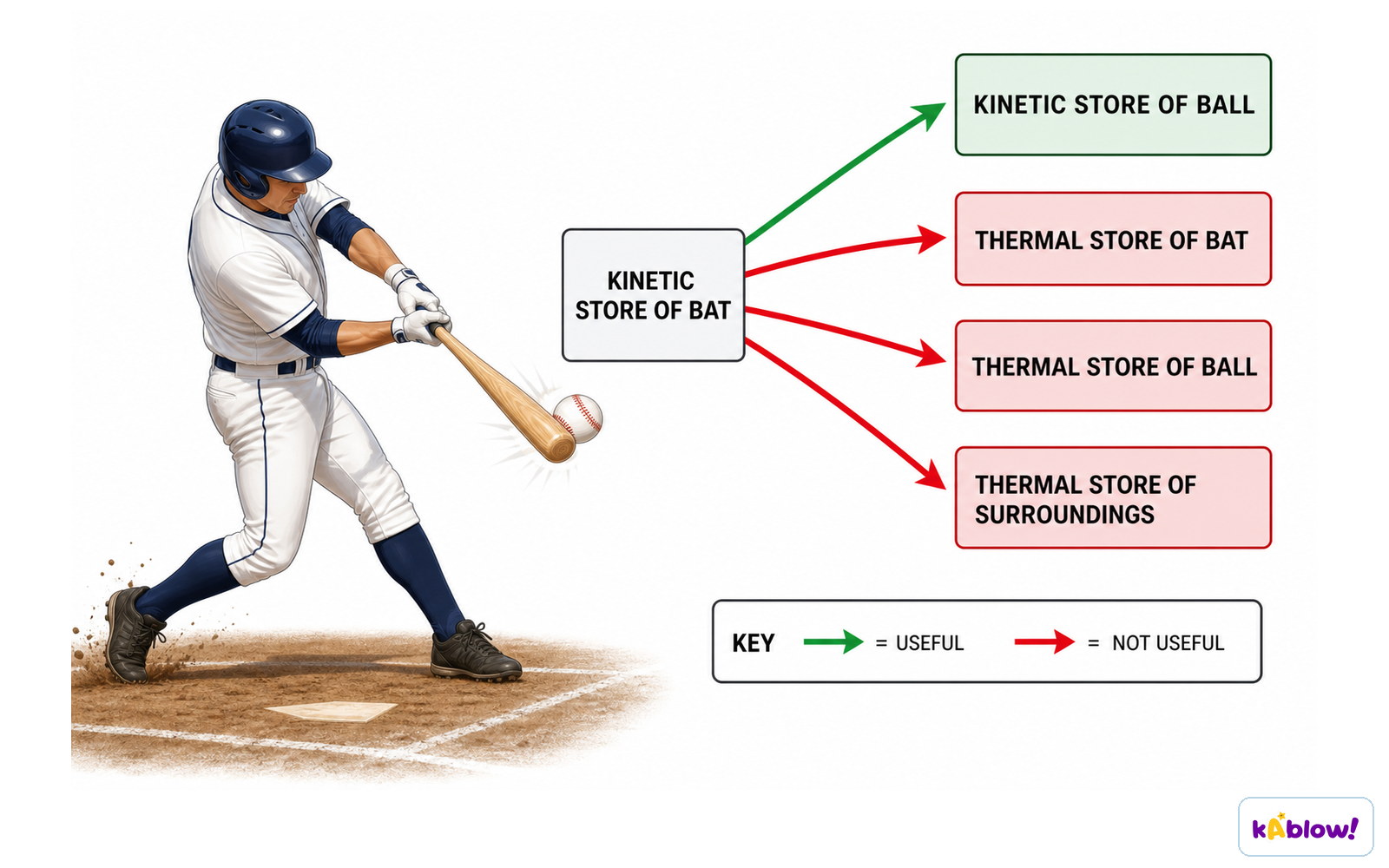
- No energy transfer is 100% efficient — some energy is always dissipated to the surroundings.
- Dissipated energy usually ends up as thermal energy transferred to the surroundings and is regarded as wasted energy.
Energy transfer and conservation
Energy Transfers and Dissipation
- In a kettle, electrical energy is transformed into thermal energy in the heating element, which is transferred to the water.
- Thermal energy transferred to the plastic casing or surrounding air is wasted energy; energy heating the water is useful.
- A falling object in a vacuum transfers gravitational potential energy into kinetic energy with no dissipation.
- A horizontal mass on a spring transfers elastic potential energy into kinetic energy.
- A battery or cell transfers chemical energy into electrical energy; a car transfers chemical energy from fuel into kinetic energy.
- A person bouncing on a trampoline transfers energy from elastic potential to kinetic to gravitational potential.
- If an object travels up a rough inclined surface: loss in kinetic energy = gain in gravitational potential energy + work done against friction.
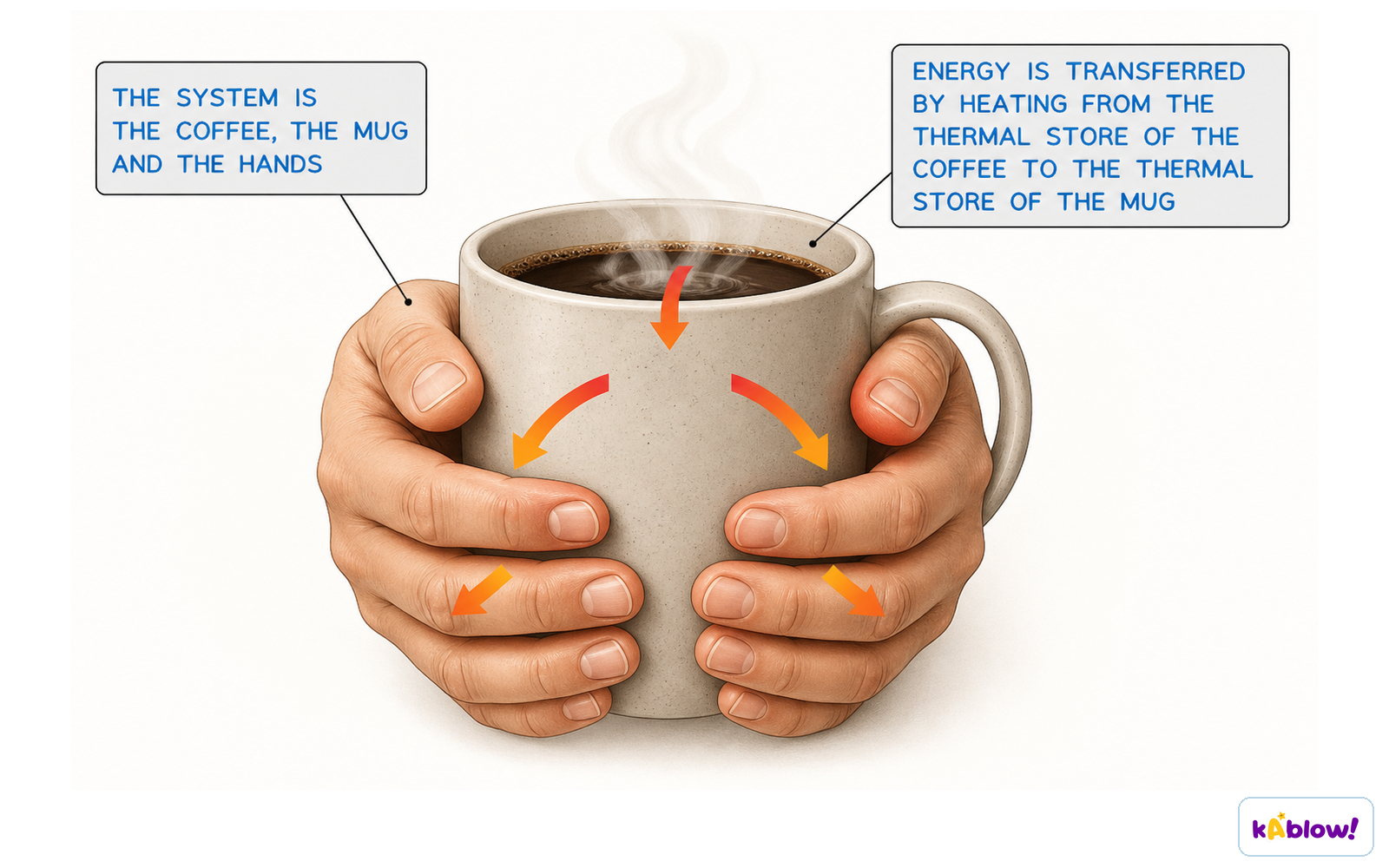
Energy transfer by heating from a hot coffee mug to cold hands
Sankey Diagrams
- Sankey diagrams represent energy transfers using arrows whose width is proportional to the amount of energy going to each store.
- The arrow pointing to the right represents the useful energy output; arrows pointing down represent wasted energy.
- Conservation of energy gives: Total energy in = Useful energy out + Wasted energy.
- A more efficient light bulb has less wasted energy, shown by a smaller downward arrow representing energy transferred by heating.
- The same conservation principle applies to power: Total power in = Useful power out + losses + wasted power.
- When drawing a Sankey diagram, plan the widths of the input, useful output and wasted arrows before drawing, and mark the wasted arrow carefully.
Work Done
- Work done by a force is equivalent to a transfer of energy; its units are newton metres, where 1 N m = 1 J.
- The work done by a resultant force on a system equals the change in energy of that system.
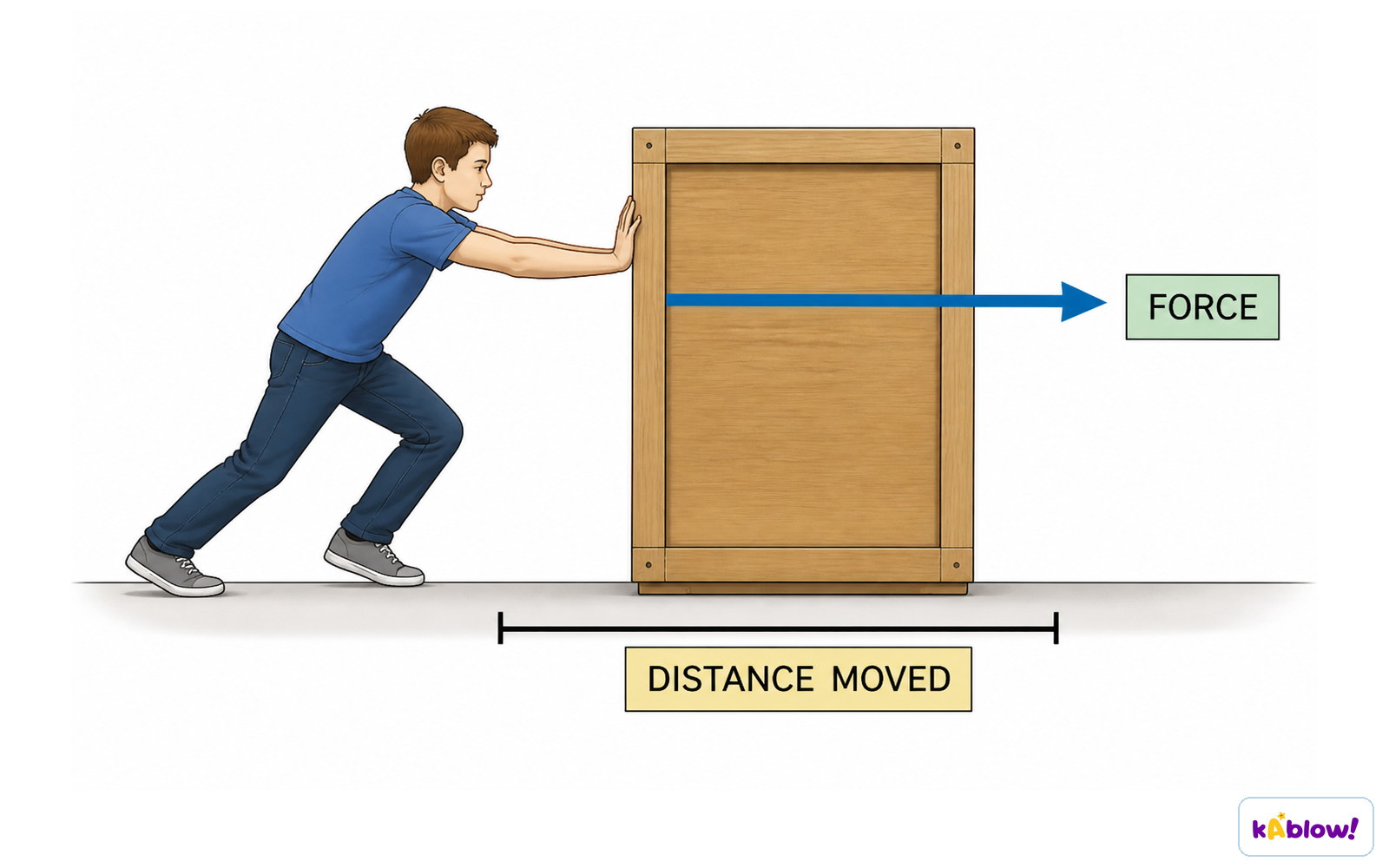
- Mechanical work is the transfer of energy when an external force causes an object to move over a certain distance.
- For a constant force parallel to the displacement: W = Fs, where W is work done (J), F is force (N) and s is displacement (m).
- If the force is at an angle θ to the displacement: W = Fs cos θ, where θ is the angle between the force and the motion.
- When θ = 0, cos θ = 1 and W = Fs; only the component of the force parallel to the displacement does work.
- For horizontal motion use cos θ; for vertical motion use sin θ — always consider the horizontal and vertical components of the force.
- On a graph of average force against displacement, the area under the graph equals the work done.
Work is done when a force is used to move an object over a distance
Kinetic Energy
- Kinetic energy (Ek) is the energy an object has due to its motion; the faster it moves, the greater its kinetic energy.
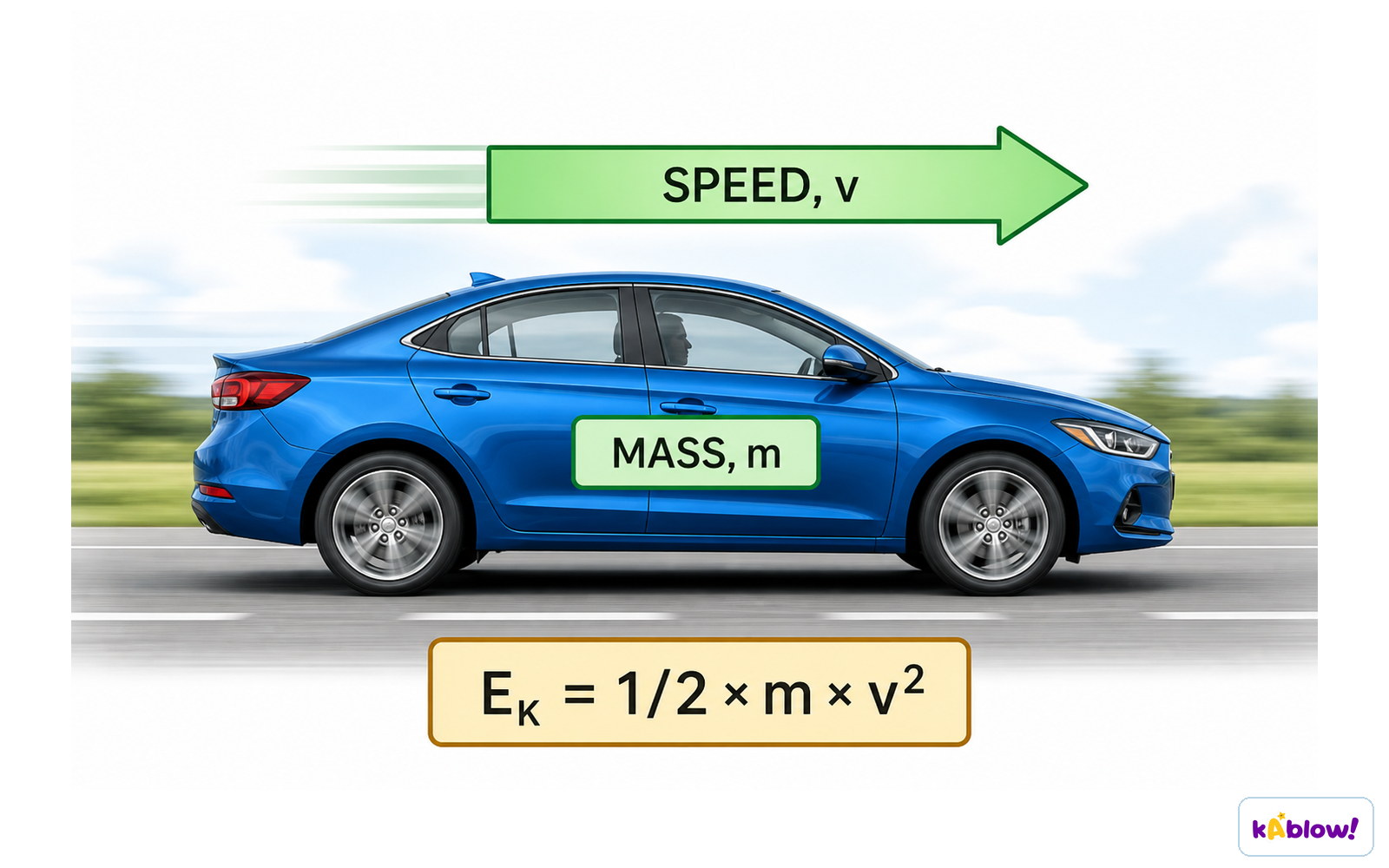
- Kinetic energy is calculated using Ek = ½mv², where m is mass (kg) and v is velocity (m s⁻¹).
- Only the speed is squared, not the mass or the ½.
- When an object falls, it gains kinetic energy transferred from the gravitational potential energy it loses.
- An object maintains its kinetic energy unless its speed or mass changes.
- Kinetic energy can also be written in terms of momentum: Ek = p² / 2m, where p is momentum (kg m s⁻¹).
- The p²/2m form is very useful in particle physics when comparing momentum and kinetic energy.
- Energy is a scalar quantity, so a 'loss of kinetic energy' is stated without a negative sign.
Kinetic energy of a moving car
Gravitational Potential Energy
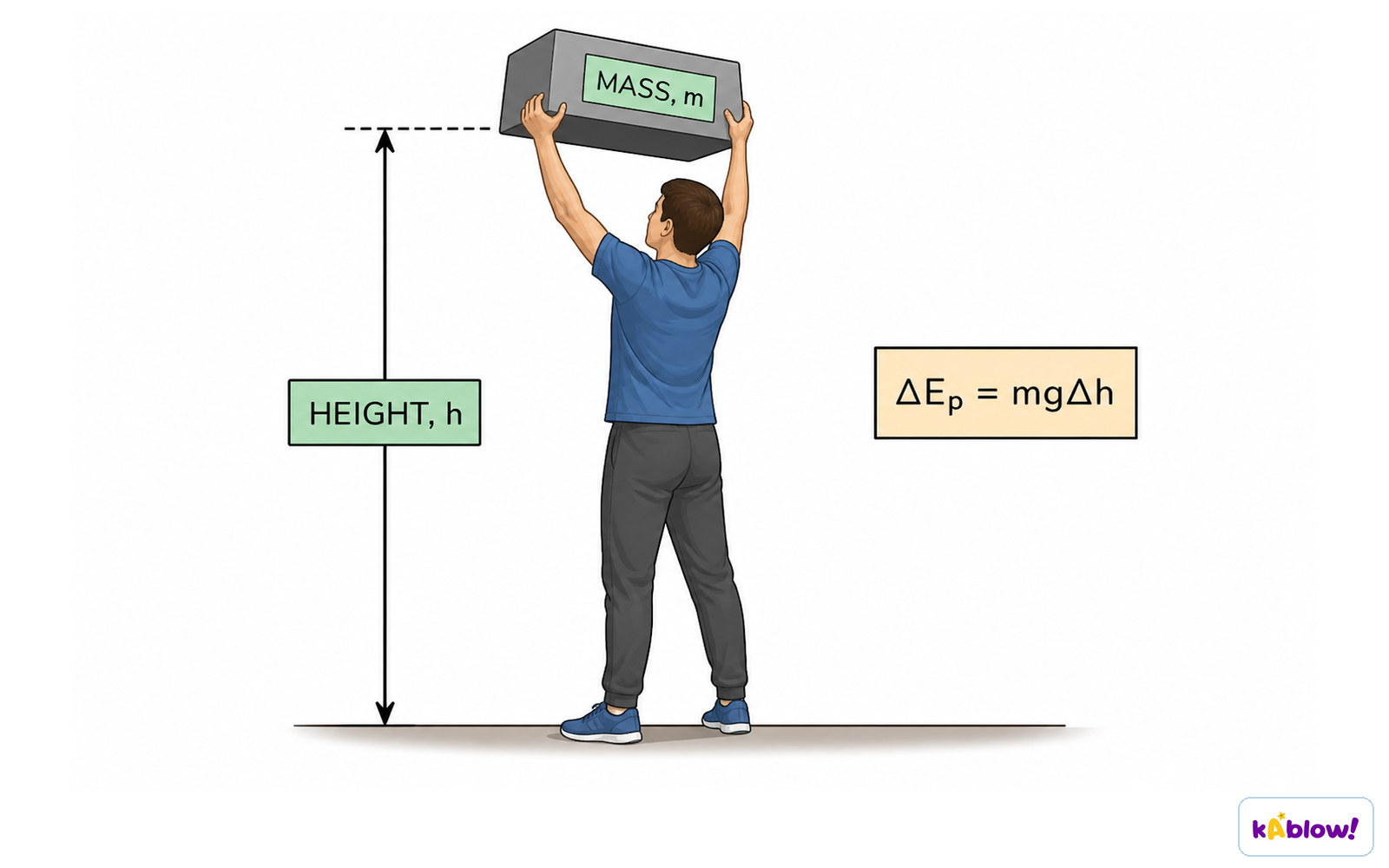
- Gravitational potential energy (GPE) is the energy stored in a mass due to its position in a gravitational field.
- If a mass is lifted up it gains GPE; if it falls it loses GPE.
- Close to the Earth's surface: ΔEp = mgΔh, where g = 9.8 N kg⁻¹ and Δh is the change in height (m).
- The potential energy at ground level is usually taken as zero, but any position can be taken as zero when calculating a change in GPE.
- This equation is only relevant in a uniform gravitational field, such as near the Earth's surface.
- A different potential energy expression is used in the gravitational fields topic because the field is no longer uniform outside the Earth's surface.
- Gravitational potential energy and height have a linear relationship, shown by straight-line graphs of GPE against height or time.
Gravitational potential energy of a lifted mass
Elastic Potential Energy
- Elastic potential energy is the energy stored within a material (e.g. a spring) when it is stretched or compressed.
- For a material obeying Hooke's Law: EH = ½kΔx², where k is the spring constant (N m⁻¹) and Δx is the extension (m).
- It can also be written as EH = ½FΔx, where F is the restoring force given by F = kΔx.
- It is very dangerous if a wire under large stress suddenly breaks because its elastic potential energy is converted into kinetic energy.
- When all elastic potential energy becomes kinetic energy: ½kΔx² = ½mv², so v ∝ Δx.
- The greater the extension Δx, the greater the speed v of the wire when it breaks.
Conservation of Mechanical Energy
- Mechanical energy = Ek + ΔEp + EH — the sum of kinetic, gravitational potential and elastic potential energy.
- The change in total mechanical energy of a system is interpreted in terms of the work done by any non-conservative force, such as friction.
- In the absence of frictional or resistive forces, the total mechanical energy of a system is conserved throughout its motion.
- For a vertical spring oscillating, energy converts between EPE, KE and GPE while the total energy stays constant.
- Vertical spring positions: at maximum height GPE is maximum and KE is zero; at the equilibrium position KE is maximum; at maximum extension EPE is maximum and KE is zero.
- For a horizontal mass on a spring, GPE is constant and the spring only converts between kinetic and elastic potential energy.
- Using conservation of energy with negligible drag: loss in gravitational potential energy = gain in kinetic energy.
- Examples of energy transfer include a swinging pendulum, objects in freefall, and sports involving falling such as skiing and skydiving.
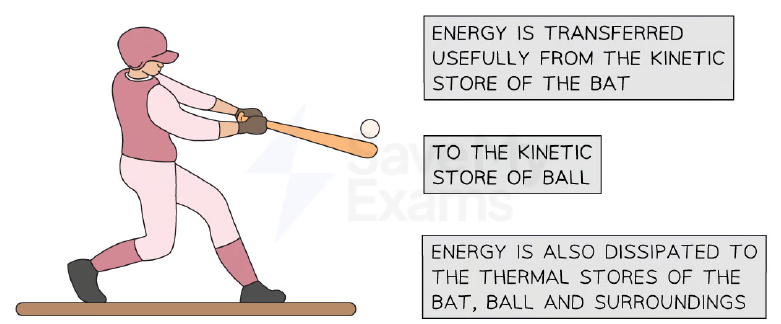
The principle of conservation of energy applied to a bat hitting a ball
Energy & Power
- The power of a mechanical process is the rate at which energy is transferred, i.e. the rate of work done.
- Power is calculated using P = ΔW / Δt = Fv, where F is force (N) and v is velocity (m s⁻¹).
- The Fv form is only relevant where a constant force moves a body at constant velocity, with the force in the same direction as the velocity.
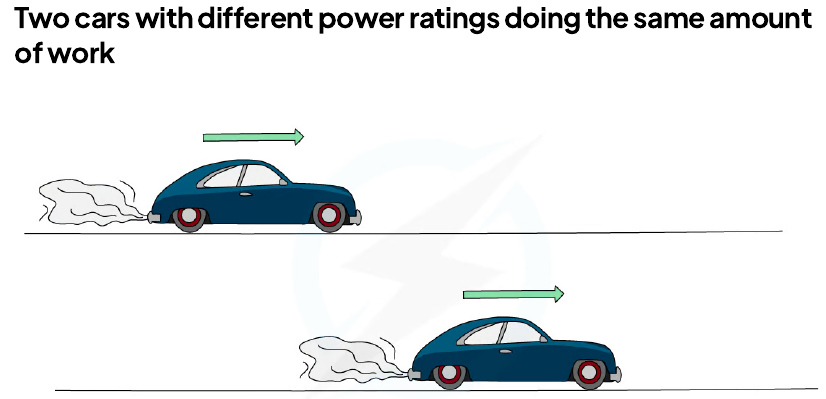
- Two cars may do the same work to accelerate, but the one with more power transfers that energy in a shorter time.
- Of two motors lifting the same weight by the same height, the one that lifts it faster has more power.
- Power is required to produce an acceleration.
- Power is measured in watts (W), where 1 W = 1 J s⁻¹ — a transfer of 1 joule of energy in 1 second.
- Appliances are given a power rating (e.g. 1000 W) indicating the energy transferred per second to the appliance.
Power and rate of energy transfer
Efficiency Formula
- Efficiency is a measure of how successfully energy is transferred in a system.
- It is defined as the ratio of the useful power or energy transfer output to the total power or energy transfer input.
- Efficiency is calculated using η = Eout / Ein = Pout / Pin.
- To express efficiency as a percentage, multiply the ratio by 100%.
- In words: η = useful work out / total work in = useful power out / total power in.
- High efficiency means most of the energy transferred is useful; low efficiency means most is wasted.
- Which energy is useful or wasted depends on the system — for a kettle, heating the water is useful, heating the casing and air is wasted.
- Efficiency has no units because it is a ratio of quantities with the same units; it can be given as a ratio (0 to 1) or a percentage (0% to 100%).
Energy Density
- A fuel is anything that can be burned to produce heat, which can be used for an engine to work.
- Energy density is a measure of the amount of energy per unit volume of a fuel, measured in J m⁻³.
- Different fuels contain different amounts of energy, making them suitable for certain uses, e.g. petrol for running vehicles.
- Example energy densities (MJ L⁻¹): coal 38, diesel 39, biodiesel 33, vegetable oil 30, liquid hydrogen 9, wood 3, methane 0.3.
- 1 litre = 0.001 m³.
- We can get more energy per unit volume of coal than of wood.
- Fuels are chosen for specific uses based on factors including energy density, safety of use and pollutants released in combustion.
Folien
Sign up free to view the lesson slides
Step through every slide for this topic — plus flashcards and revision notes — with a free account.
Übungsfragen
Gratis-Vorschau — 8 von 63 Fragen. Registriere dich, um alle zu sehen.
1.Which statement is the principle of conservation of energy?
Easy- AEnergy cannot be created or destroyed; it can only be transferred from one form to another
- BThe total amount of energy in a system always decreases over time
- CEnergy can be created when a force does work on an object
- DEnergy is always transferred as thermal energy
2.In a Sankey diagram, what does the width of each arrow represent?
Easy- AThe amount of energy going to each store
- BThe temperature of the energy store
- CThe speed at which energy is transferred
- DThe direction of the energy transfer
3.A constant force of 20 N is applied to a box at an angle of 45° to the horizontal, moving it 5 m horizontally. What is the work done on the box?
Medium- A71 J
- B100 J
- C50 J
- D35 J
4.A spring has a spring constant of 92 N m⁻¹ and is extended by 0.3 m. What is the elastic potential energy stored in the spring?
Medium- A4.1 J
- B8.3 J
- C27.6 J
- D13.8 J
5.A car engine exerts a thrust of 200 N while the car travels at a constant speed of 27 m s⁻¹. What is the power of the car?
Medium- A5400 W
- B7.4 W
- C200 W
- D2700 W
6.Which of the following are forms of wasted energy transfer when a petrol car's engine converts chemical energy? (Select all that apply)
Medium- ASound from the engine
- BThermal energy from the engine
- CKinetic energy of the car
- DElectrical energy from the battery
- ELight from the headlights
7.A ball is dropped from a height of 2 m on Jupiter, where the acceleration of free fall is 24.58 m s⁻². Which statements are correct? (Select all that apply)
Hard- AThe gravitational potential energy at the drop point equals the kinetic energy just before impact
- BThe speed just before impact is about 9.9 m s⁻¹
- CThe speed just before impact is about 4.9 m s⁻¹
- DThe relationship between GPE and KE is mgh = ½mv²
- EThe kinetic energy just before impact is greater than the gravitational potential energy at the drop point
8.In a closed system, the total amount of energy remains constant, but the amount of each form of energy may change.
EasyTrue or false?
Unlock all 63 questions & more
Erstelle ein Gratis-Konto, um alle Fragen, Folien, Karteikarten und Lernnotizen zu diesem Thema zu sehen.