Gas Laws
Lerne es beim Spielen
Beantworte diese Fragen für Energie, dann angle und erkunde. Kein Konto nötig.
Lektionsnotizen
Gas Pressure
- Pressure is defined as the force applied per unit area: P = F / A.
- Pressure is measured in pascals (Pa), force in newtons (N) and area in square metres (m²).
- The equation P = F / A is only relevant when gas molecules exert a force perpendicular to the surface.
- A force spread over a large area produces a small pressure; a force spread over a small area produces a large pressure.
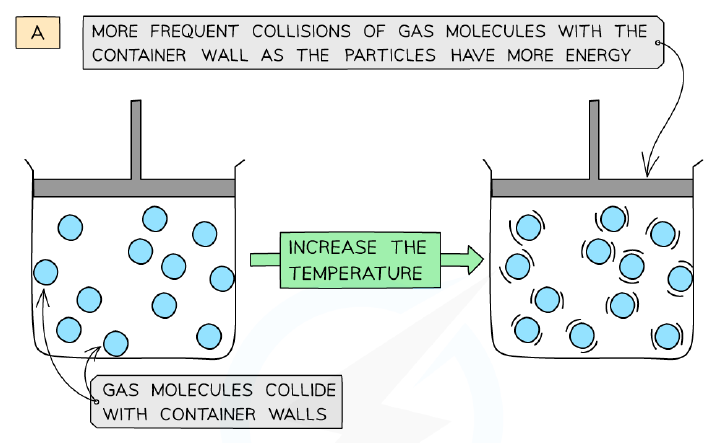
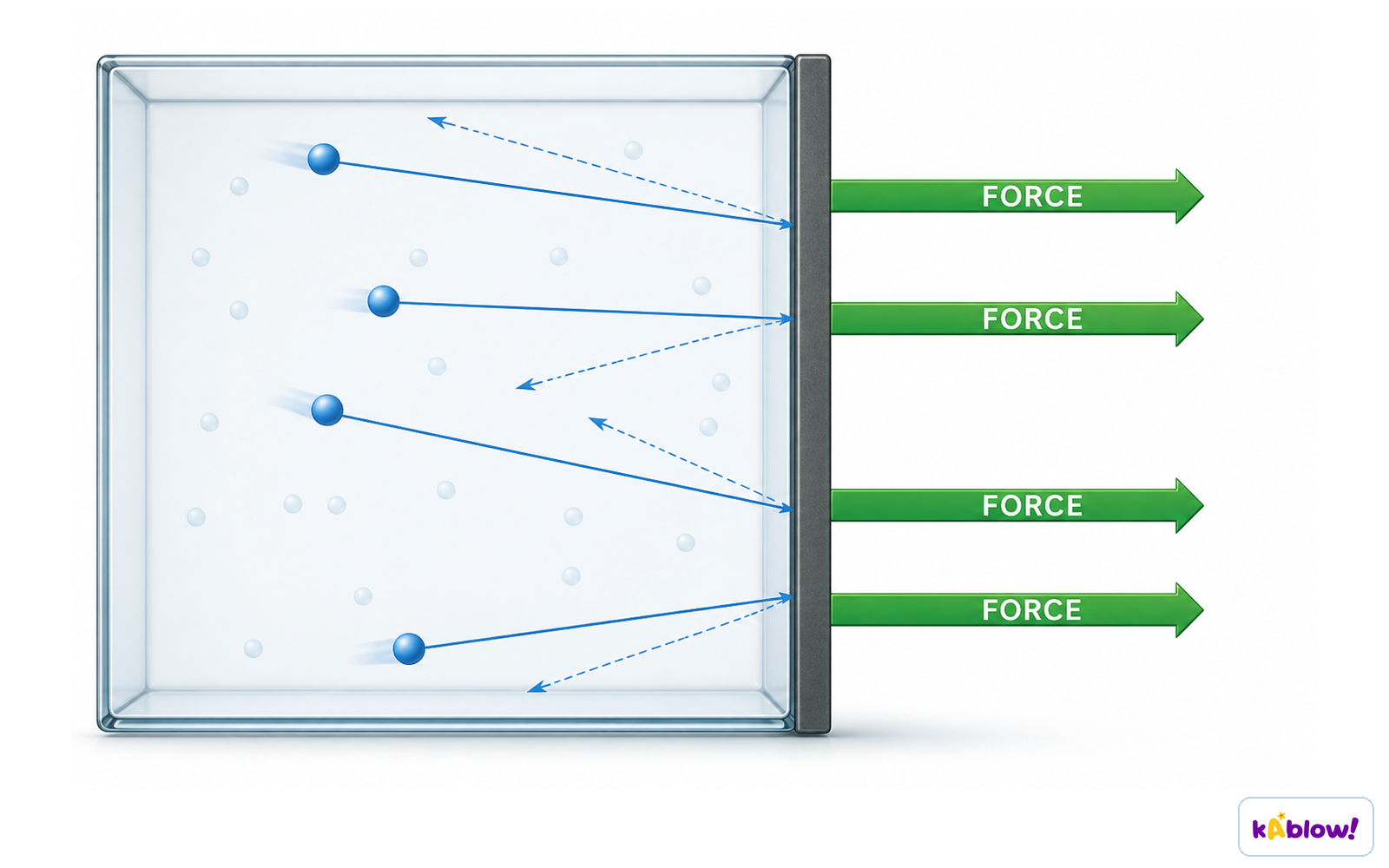
- Gas molecules bouncing off the walls of a container exert a force at right angles to the walls, creating gas pressure.
- When using P = F / A, always use the cross-sectional area of the surface that the force is applied upon.
Diagram showing how increasing the temperature of a gas at constant volume leads to more frequent and energetic collisions with the container walls, thus increasing pressure.
Amount of Substance
- The mole is one of the seven SI base units; it measures the amount of substance, not mass.
- One mole is the amount of substance that contains as many elementary entities as there are atoms in 12 g of carbon-12.
- This number is the Avogadro constant, NA = 6.02 × 10²³ mol⁻¹ (rounded at IB level).
- The number of moles n is calculated using n = N / NA, where N is the number of particles.
- The number of atoms or molecules is found by multiplying the number of moles by NA.
- Molar mass mr is the mass m of a substance divided by the amount in moles: mr = m / n, in g mol⁻¹.
- One mole of any element equals the relative atomic mass of that element in grams; for a compound, add the relative atomic masses.
Gas Laws
- An ideal gas obeys the relation PV ∝ T, which can be written as PV / T = constant.
- The empirical gas laws are Boyle's law (constant temperature), Charles's law (constant pressure) and Gay-Lussac's law (constant volume).
- Boyle's law: at constant temperature, P ∝ 1/V, so P₁V₁ = P₂V₂.
- Charles's law: at constant pressure, V ∝ T, so V₁/T₁ = V₂/T₂.
- Gay-Lussac's (pressure) law: at constant volume, P ∝ T, so P₁/T₁ = P₂/T₂.
- For all gas law experiments, the mass and number of molecules of the gas are assumed constant.
- On a P-V diagram: a horizontal line is constant pressure, a curved isotherm is constant temperature, a vertical line is constant volume.
Gas particles and pressure
Ideal Gas Equation
- An ideal gas is defined as a gas which obeys the ideal gas equation at all pressures, volumes and temperatures.
- The ideal gas equation is PV = nRT, where P is pressure (Pa), V is volume (m³), n is moles (mol), R is the ideal gas constant and T is temperature (K).
- The ideal gas constant R = 8.31 J K⁻¹ mol⁻¹ and is the macroscopic equivalent of the Boltzmann constant kB.
- Another form of the ideal gas equation is PV = NkBT, where N is the number of molecules and kB = 1.38 × 10⁻²³ J K⁻¹.
- The Boltzmann constant is defined as kB = R / NA.
- Always convert temperature to kelvin before substituting into any gas law equation: T(K) = θ(°C) + 273.
- The values of R, NA and kB are given in the data booklet.
Kinetic Theory of Gases
- The kinetic theory models a gas as atoms or molecules moving randomly at high speeds, linking microscopic properties (mass, speed) to macroscopic properties (pressure, volume).
- Assumptions include: gas consists of many identical molecules; volume of molecules is negligible compared to the container; molecules are in continuous random motion.
- Further assumptions: molecules obey Newton's laws; collisions are elastic; there are no intermolecular forces except during collisions; collision time is negligible.
- External forces (e.g. gravity) are ignored, and the number of molecules is very large so average behaviour is considered.
- A real gas approximates an ideal gas when pressure is low, density is low, and temperature is sufficiently higher than the boiling point.
- At very high pressures and densities, molecules are closer together so attractive forces matter and molecular volume is not negligible.
- At low temperatures a gas can change into a liquid, so it no longer behaves like a gas.
Derivation of the Kinetic Theory of Gases Equation
- Gas pressure arises from collisions of gas particles with the walls of the container, exerting a force on the walls.
- For a molecule of mass m and speed v rebounding elastically, the change in momentum is Δp = −2mv, so the force on the wall is F = 2mv / Δt.
- The time between collisions with the same wall is 2l / v, giving a force from one molecule of F = mv² / l.
- For N molecules in a cube of side l, pressure is P = Nmv² / (3V), where V = l³.
- Using density ρ = Nm / V, this becomes P = ⅓ρv², the kinetic theory of gases equation.
- In this equation, P is pressure (Pa), ρ is density (kg m⁻³) and v² is the mean square speed (m² s⁻²).
- The 'mean square' speed means an average speed, assuming all molecules travel at the same speed.
Average Kinetic Energy of a Molecule
- For an ideal gas, molecules collide elastically and have no potential energy, so the internal energy U equals the total kinetic energy.
- The average kinetic energy of one molecule is Ek = ½mv² = (3/2)kBT.
- A greater gas temperature means a greater average kinetic energy of the particles.
- The internal energy of a gas is U = (3/2)NkBT, or equivalently U = (3/2)nRT.
- When heat is transferred to a fixed volume of gas, internal energy increases and so does temperature, since U ∝ T.
- These equations apply only to monatomic gases such as helium, neon and argon.
- A monatomic molecule has only translational energy, while a diatomic molecule has both translational and rotational kinetic energy.
Folien
Sign up free to view the lesson slides
Step through every slide for this topic — plus flashcards and revision notes — with a free account.
Übungsfragen
Gratis-Vorschau — 8 von 64 Fragen. Registriere dich, um alle zu sehen.
1.Which of the following is the correct definition of pressure?
Easy- AThe force applied per unit area
- BThe force applied per unit volume
- CThe energy transferred per unit time
- DThe mass per unit volume
2.What is meant by an ideal gas?
Easy- AA gas that obeys the equation pV ∝ T at all pressures, volumes and temperatures
- BA gas that has no intermolecular forces at all temperatures
- CA gas that can never be liquefied
- DA gas that has zero volume at absolute zero
3.Which of the following are assumptions of the kinetic model of an ideal gas? (Select all that apply)
Medium- AThe molecules are in continuous random motion
- BThe molecules collide elastically with each other and the walls
- CThere are strong intermolecular forces between molecules
- DThe volume of the molecules is negligible compared to the volume of the container
- EThe molecules have a range of different masses
4.Boyle's law states that for a fixed mass of gas at constant temperature, the pressure is inversely proportional to the volume.
EasyTrue or false?
5.Which gas law describes the relationship between pressure and temperature at constant volume?
Medium- ABoyle's law
- BCharles's law
- CGay-Lussac's law (pressure law)
- DAvogadro's law
6.An ideal gas is kept at constant temperature. If its volume is halved, what happens to its pressure?
Medium- AIt is halved
- BIt is doubled
- CIt remains the same
- DIt is quartered
7.A fixed mass of ideal gas has an initial pressure of 410 Pa at 410 K. It is heated at constant volume to 495 K. What is the final pressure?
Hard- A495 Pa
- B410 Pa
- C340 Pa
- D500 Pa
8.Match each gas law with its correct relationship.
Medium- Boyle's law
- Charles's law
- Gay-Lussac's law
- p ∝ 1/V
- V ∝ T
- p ∝ T
Unlock all 64 questions & more
Erstelle ein Gratis-Konto, um alle Fragen, Folien, Karteikarten und Lernnotizen zu diesem Thema zu sehen.